Abdominal aortic aneurysm (AAA) screening - a free test for men aged 65 and over
Updated 9 January 2026
Applies to England

© Crown copyright 2026
This publication is licensed under the terms of the Open Government Licence v3.0 except where otherwise stated. To view this licence, visit nationalarchives.gov.uk/doc/open-government-licence/version/3 or write to the Information Policy Team, The National Archives, Kew, London TW9 4DU, or email: psi@nationalarchives.gov.uk.
Where we have identified any third party copyright information you will need to obtain permission from the copyright holders concerned.
This publication is available at https://www.gov.uk/government/publications/abdominal-aortic-aneurysm-screening-invitation-leaflet/html-version
You can choose if you want to take part in abdominal aortic aneurysm (AAA) screening. This leaflet aims to help you decide.
Why the NHS offers AAA screening
An abdominal aortic aneurysm, or AAA, is a swelling in your aorta. The aorta is the main blood vessel that carries blood from the heart to the abdomen (tummy). Large AAAs can be serious. We offer screening so that we can find aneurysms early and monitor or treat them.
If you have an AAA, you may not notice any symptoms. This means you cannot usually tell if you have one. The easiest way to find out is to have an ultrasound scan of your abdomen.
Who we invite for AAA screening
The NHS invites all men for screening in the year they turn 65. You must be registered with a GP and live in England. Please make sure your GP has the correct details, including your:
- name
- date of birth
- address
- contact number
- email address.
Your invitation may arrive later if you were not registered with a GP in the year you turned 65, or if we did not have up-to-date contact details for you.
Men aged over 65 who have not had screening can contact their local AAA screening service to arrange a test.
Trans and non-binary people
People registered as female with their GP are not invited for AAA screening. Trans and non-binary people assigned male at birth and aged 65 and over can ask for AAA screening. Your GP will be able to arrange this for you.
Abdominal aortic aneurysm (AAA)
The aorta is the main blood vessel that supplies blood to your body. It runs from your heart down through your chest and abdomen.
In some people, as they get older, the wall of the aorta in the abdomen can weaken. It can then start to swell (like a balloon) and form an aneurysm.
The condition is most common in men aged 65 and over.
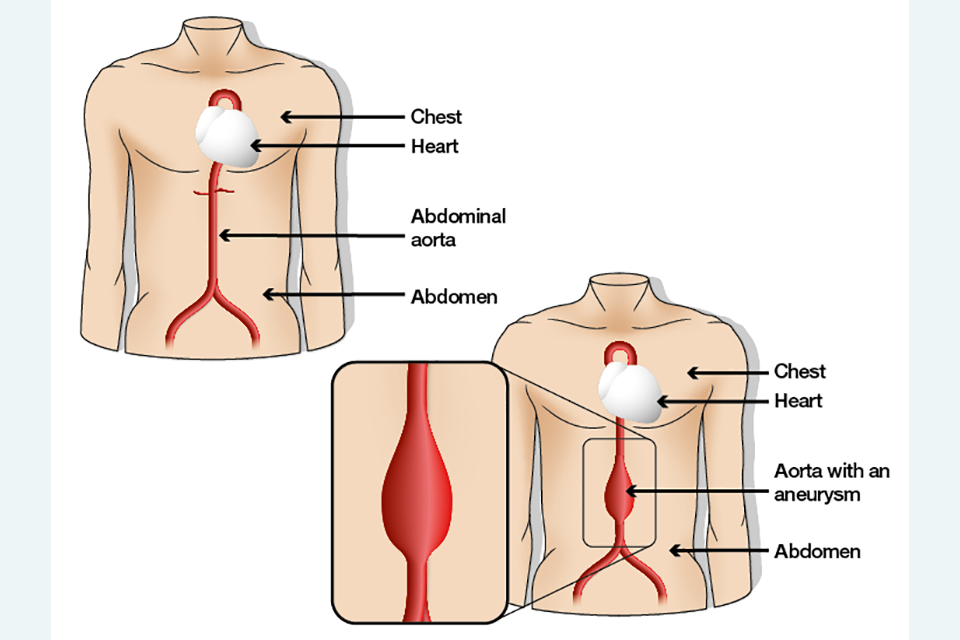
The aorta can swell in the abdomen and form an AAA
Risks from an AAA
Large aneurysms are rare but can be very serious. As the wall of the aorta stretches, it can burst, causing internal bleeding. Around 85 out of every 100 people with a burst aneurysm die as a result.
If we find a small or medium aneurysm, it’s important that we keep checking to see if it’s getting bigger. If you have a small AAA, we will invite you for scans every 12 months. If you have a medium AAA, we will invite you every 3 months.
How AAA screening works
We use a simple ultrasound scan, similar to that offered to pregnant women. This is very quick. The scan usually takes less than 10 minutes.
At the clinic, we will check your personal details and explain the scan. You can ask us any questions.
We will then ask you to lie down. You will need to lift up your top or unbutton your shirt, but you will not need to undress.
We will put a cool gel on your abdomen. We will then slide the scanning probe over your skin. The scan is completely painless. It will show a picture of your aorta on a screen, and we will measure it.
We will be able to tell you your result straight away. We will also send a copy of your results to your GP.
Sometimes the scan is not clear and the aorta cannot be properly checked. This is nothing to worry about. You will be asked to have another scan, usually on a different day.
AAA screening results
There are 4 possible results:
- no AAA
- small AAA
- medium AAA
- large AAA
No AAA found
If your aorta is less than 3cm wide, this means you do not have an AAA. Most men have this result. You do not need treatment or monitoring afterwards. We will not invite you for AAA screening again.
Small AAA
If your aorta is between 3cm and 4.4cm wide, you have a small AAA. Around 1 in 80 men screened has a small AAA. We will invite you back for a scan every 12 months to check if it’s getting bigger.
Medium AAA
If your aorta is between 4.5cm and 5.4cm wide, you have a medium AAA. Around 1 in 500 men screened has a medium AAA. We will invite you back for a scan every 3 months to check if it’s getting bigger.
Large AAA
If your aorta is 5.5cm wide or bigger, you have a large AAA. Around 1 in every 2,500 men screened has a large AAA. We will offer you an appointment with a specialist team. They will do more scans and talk to you about possible treatment options, usually an operation.
Monitoring a small or medium AAA
If you have a small or medium AAA, you will only need treatment if it gets bigger.
It is important to monitor the size of your AAA. This is in case it develops into a large AAA.
Most AAAs get bigger very slowly. Most men with a small or medium AAA may never develop a large AAA and need treatment.
We will arrange an appointment for you to see a vascular nurse specialist who will give you advice on reducing your risk of the AAA getting bigger. Your GP may also give you tablets or review any medicines you may be taking. You may be asked to have your blood pressure checked.
Treating a large AAA
If we find a large AAA, we will refer you to a specialist team. They will carry out more tests and a specialist will discuss treatment options with you. This will usually be an operation within two months of your appointment, if you decide you want it.
Treatment for aneurysms found in screening is usually safe and very effective. There are risks from treatment. The specialist will explain these to you in detail.
Not everyone who has a large AAA will have an operation.
Possible risks of AAA screening
No screening test is completely effective, but the scan used to find AAAs is very reliable. It is rare for a man to develop a large AAA if screening does not find an aneurysm. AAA screening does not entirely remove the risk of an aneurysm bursting, but it is the best way to reduce your risk.
There is no risk from the screening test itself, but there are risks if you need surgery to treat an AAA. Around 30 in every 10,000 men screened have an operation. On average, 1 in 67 men who have surgery will not survive. There is a low chance that their AAA may never have burst if left untreated.
Who is more likely to get an AAA
Men are 4 times more likely to have an AAA than women. This is why women are not offered screening. The chance of having an aneurysm also increases with age.
Your chance of having an AAA can also increase if:
- you are or have ever been a smoker
- you have high blood pressure
- your brother, sister or parent has, or has had, an AAA.
More information and support
For more information on AAA screening, contact your local screening service. Please let them know before your appointment if you need additional support. This could include a carer coming with you, having a longer appointment or going to a different place.
Your invitation will include their contact details. You can also speak to your GP surgery.
Find contact details for your local AAA screening service.
This information is available in alternative formats, including easy read and other languages. To request another format, you can phone 0300 311 22 33 or email england.contactus@nhs.net.
You can also:
- find more information on AAA screening on NHS.UK
- read information for transgender and non-binary people about NHS screening services.
The Circulation Foundation and the British Heart Foundation support people with vascular diseases. This includes people with AAAs.
We use personal information from your NHS records to invite you for screening at the right time. This information helps us improve the screening programmes and deliver quality care. Read more about how we use and protect your information.
Find out how to opt out of screening.