Teenagers back vocational reforms and defy outdated stigma
Majority of young people support more hands-on learning from age 14.
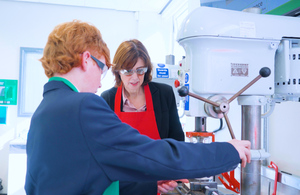
Teenagers have thrown their support behind a shake-up to vocational learning as the government steps up efforts to tackle youth unemployment and challenge outdated attitudes towards technical education.
The majority of young people (84%) overwhelmingly support new options for 14-year-olds that combine practical technical learning (such as coding, construction or manufacturing) with core academic subjects (such as English and Maths) - an ambition announced by the Prime Minister in his first week in office and now being delivered on.
Two weeks ago, the government unveiled plans for Vocational GCSEs - a fundamental change to the education system to put hands-on education on an equal footing with academic from 14.
This shake-up builds on the reforms to introduce rigorous new V Levels which will be available from September 2027 to provide high-quality vocational training for 16 to 19-year-olds. They will sit alongside A Levels and T Levels, and will be equivalent to one A Level, allowing students to mix and match academic and vocational subjects if they are unsure where to specialise.
With nearly a million young people aged 16 to 24 currently out of education, employment or training, the government is determined to ensure the system works for every young person.
Vocational GCSEs will have nationally set standards, unlike the existing Technical Awards, and grading and assessment will be regulated by Ofqual to ensure full parity with traditional GCSEs.
Of those 500 polled, who are due to or have recently made choices about their options at aged 14 and 16:
-
Nearly half (44%) say vocational and technical routes are looked down on by their peers.
-
Over a third (37%) feel pressure from their parents to choose academic options from aged 16.
-
When thinking about their future, their biggest concern was ending up in a job they do not enjoy (69%).
-
Nearly half (46%) are concerned that advances in artificial intelligence could reduce employment opportunities.
-
More than half (52%) said they worry about having the right skills for the jobs of the future.
Education Secretary Lucy Powell said:
The message from young people is clear: they want more choice and more opportunities to develop practical skills that lead to rewarding and prosperous careers.
They’re motivated by the opportunities ahead, yet too many still feel the weight of outdated attitudes towards vocational and technical education, that no longer reflect what they want from life.
If we are serious about building the skilled workforce our country needs and tackling youth unemployment, we must make sure we must make sure young people have strong academic foundations alongside equally valued vocational education.
Vocational GCSEs will sit alongside traditional GCSEs and will eventually replace the current Technical Awards. They are set to be available in some subjects as early as September 2029, as part of broader new technical pathways starting in September 2028. English, Maths and Science will remain a common entitlement. Subject options could include Business Management and Finance, Creative Media Production, Digital Tech, Child Development, and Building and Construction, supporting progression into further study through T Levels and V Levels in these subjects, or through A Levels.
A consultation to shape Vocational GCSEs will be published before the end of the year.
From September 2027, the first V Levels will be available in Education and Early Years, Finance and Accounting, and Digital which could lead into university or an apprenticeship.
For those who need support to pass English and Maths before progressing there will be two new qualifications also available from September 2027:
-
Foundation Certificates will provide a one-year bridging route before progressing to V Levels, T Levels or A Levels, initially in Education and Early Years and Digital.
-
A separate two-year pathway through an Occupational Certificate will be available for those who want to go directly into work or an apprenticeship, with initial subjects in Catering and Hospitality and Education and Early Years.
Pepe Di’Iasio, General Secretary of the Association of School and College Leaders, said:
For too long vocational and technical pathways have played second fiddle to academic qualifications. Schools and colleges will welcome well-supported new qualifications which help to reverse this false divide and the negative perceptions it creates among students and families.
Creating more high-quality technical and vocational routes is vital both to opening up opportunities for young people and for boosting the economic fortunes of the country. We look forward to working with the government on their development.
Ryan Skitt, aged 18 from Wolverhampton, T Level Student of the Year at the 2025 National Apprenticeship and Skills Awards, said:
My T Level gave me something I don’t think I could have gained through classroom learning alone. Real experience of working in the industry and an understanding of how the skills I was learning were actually used. It gave me the confidence to pursue architecture further and eventually start my own business alongside continuing my education. I don’t think technical education should ever be seen as a second choice; for me, it opened doors and helped turn an interest in a career into something I could actually pursue.
There can still be a perception that academic routes are somehow more valuable than technical or vocational ones, but my experience has been completely different. My T Level gave me real industry experience, practical skills and a much clearer understanding of the career I wanted to pursue. It has helped me progress into university and build my own business, and I think young people should feel just as proud choosing a technical route as any other form of education.
Oliver Coombs, aged 20 from Bath, completed a T Level in Engineering and is now completing a Higher Level Apprenticeship in Engineering with BIMTek, a civil engineering consultancy, and Bath College. He won Bronze in Additive Manufacturing at WorldSkills Shanghai 2026. He said:
It’s quite worrying knowing that the jobs we’ll be doing in the future might look completely different from the jobs that exist today and it can be difficult to know whether you’re developing the right skills.
My T Level in engineering, showed me that I wanted to work in industry, while continuing to learn, which is why I chose to take the next step into an apprenticeship. I’m now building the skills I know employers value, which makes me feel much more confident about my future.
Joe Shingler, aged 21 from Shrewsbury, completing a HNC Level 4 in Construction and Built Environment at Shrewsbury College and works for his family construction business, The Shingler Group. He won a Medal for Excellence in Bricklaying at WorldSkills Shanghai 2026. He said:
I would have loved to have the opportunity to learn vocational subjects at school. Making decisions about the career you want to pursue can be daunting, particularly when you have little or no experience of what that career actually involves.
I have really enjoyed my apprenticeship and would encourage all young people to look at all the different routes into employment to see what is the best fit for them.
Elyot Harmston, aged 23 from Biggleswade, Bedfordshire, completed an apprenticeship in aviation and is now an engineer for The Shuttleworth Collection. He recently won Silver in Aircraft Maintenance at WorldSkills Shanghai 2026. He said:
I knew an aviation apprenticeship was right for me as I enjoy practical work and solving problems, but there wasn’t a huge amount of information available to me when I was at school.
It’s fantastic to hear that there will be the opportunity for students to take more practical subjects as this really does build confidence and open more doors for employment.
John Wilkinson, Chief Operating Officer at BAM UK & Ireland:
The UK has an ambitious programme of infrastructure investment ahead of it, but delivering that investment will ultimately depend on having people with the right skills. We need to do a better job of showing young people that technical and vocational education can lead to rewarding, long-term careers in industries like construction.
By bringing education and employers closer together, T Levels, apprenticeships and work placements give young people valuable experience of the workplace, while helping businesses develop the skills we need for the future. Technical routes should be seen as an aspirational choice, not a second choice.