UK Emissions Trading Scheme: Regulating cross-boundary CCS pipelines (accessible webpage)
Published 12 March 2026

© Crown copyright 2026
This publication is licensed under the terms of the Open Government Licence v3.0 except where otherwise stated. To view this licence, visit nationalarchives.gov.uk/doc/open-government-licence/version/3 or write to the Information Policy Team, The National Archives, Kew, London TW9 4DU, or email: psi@nationalarchives.gov.uk.
Where we have identified any third party copyright information you will need to obtain permission from the copyright holders concerned.
This publication is available at https://www.gov.uk/government/consultations/uk-emissions-trading-scheme-regulating-cross-boundary-ccs-pipelines/uk-emissions-trading-scheme-regulating-cross-boundary-ccs-pipelines-accessible-webpage
Introduction
The UK Emissions Trading Scheme (ETS) is jointly run by the UK ETS Authority (hereafter ‘the Authority’) made up of the UK Government, Scottish Government, Welsh Government, and the Department of Agriculture, Environment and Rural Affairs for Northern Ireland (DAERA).
Carbon capture and storage (CCS) will be crucial for the UK to meet its net zero targets, especially for hard to abate sectors such as steel, cement, and chemicals that lack alternatives for deep decarbonisation. Track-1 CCS projects that plan to transport carbon dioxide (CO2) from industrial clusters via pipeline to permanent geological storage have received their final investment decisions (FID) and plan to commence operations towards the end of this decade. Other CCS projects utilising a CO2 pipeline transport network are also planned and working towards the FID milestone.
Pipeline transport of greenhouse gases intended for geological storage is currently regulated by the UK ETS. [footnote 1] However, the Authority has recognised the default permitting framework in the UK ETS could be amended to be less complex and burdensome for operators and regulators of CO2 pipeline transport networks that cross national boundaries in the UK (referred to in this document as ‘cross-boundary CCS pipelines’).
This consultation seeks views on options that could simplify which regulator(s), in respect of the UK ETS, are responsible for permitting, monitoring compliance, and enforcement in respect of:
- the onshore section of a cross-boundary CCS pipeline (i.e. the portion of the pipeline on land), and
- the offshore section of a cross-boundary CCS pipeline (i.e. from when the pipeline enters UK waters).
General information
Why we are consulting
The Authority is seeking feedback on options being considered to streamline the UK ETS regulatory requirements for cross-boundary CCS pipelines.
The purpose of the consultation is to understand views on options to reduce the number of UK ETS permits a CCS pipeline crossing into multiple jurisdictions will require which could simplify the monitoring and enforcement requirements for both operators and regulators.
Consultation details
If you need a version of this document in a more accessible format, please email alt.formats@energysecurity.gov.uk. Please tell us what format you need. It will help us if you say what assistive technology you use.
Issued: 12 March 2026
Respond by: 4 June 2026
Enquiries to:
Emissions Trading
Department for Energy Security and Net Zero
Third Floor
3 Whitehall Place
London
SW1A 2EG
Email: ukets.consultationresponses@energysecurity.gov.uk
Consultation reference: UK Emissions Trading Scheme: Regulating cross-boundary CCS pipelines
Audiences:
- Companies proposing to offer CCS services, including capture installations, pipeline transport network operators, intermediate storage sites, and operators of geological stores.
- UK ETS installations that are considering the use of pipeline CCS.
- Any other potential participants in the CCS value chain.
- Experts, academics, and organisations in the third sector with views on our proposed approach.
- Verifiers and technical experts on monitoring, reporting, and verification (MRV).
- Any other stakeholders with interest in our CCS policy options.
Territorial extent:
This consultation relates to options to develop the UK ETS, which operates across England, Scotland, Wales and Northern Ireland. This is a joint consultation, published by the UK Government, Scottish Government, Welsh Government and the Department of Agriculture, Environment and Rural Affairs for Northern Ireland.
How to respond
Respond online at: UK Emissions Trading Scheme: Regulating cross-boundary CCS pipelines
or
Email to: ukets.consultationresponses@energysecurity.gov.uk
Write to:
Emissions Trading
Department for Energy Security and Net Zero
Third Floor
3 Whitehall Place
London
SW1A 2EG
When responding, please state whether you are responding as an individual or representing the views of an organisation.
Your response will be most useful if it is framed in direct response to the questions posed, though further comments and evidence are also welcome.
Confidentiality and data protection
Information you provide in response to this consultation, including personal information, may be disclosed in accordance with UK legislation (the Freedom of Information Act 2000, the Data Protection Act 2018 and the Environmental Information Regulations 2004).
If you want the information that you provide to be treated as confidential please tell us, but be aware that we cannot guarantee confidentiality in all circumstances. An automatic confidentiality disclaimer generated by your IT system will not be regarded by us as a confidentiality request.
We will process your personal data in accordance with all applicable data protection laws. See our privacy policy.
We will summarise all responses and publish this summary on GOV.UK. The summary will include a list of names or organisations that responded, but not people’s personal names, addresses or other contact details.
Quality assurance
This consultation has been carried out in accordance with the government’s consultation principles.
If you have any complaints about the way this consultation has been conducted, please email: bru@energysecurity.gov.uk.
Regulation of CCS pipelines that cross UK ETS regulatory boundaries
Transport of greenhouse gases by pipelines for geological storage in a storage site is a regulated activity under the UK ETS. Operators of CCS pipelines therefore require UK ETS permits.
CCS pipelines may need to traverse multiple UK ETS regulatory boundaries before reaching permanent geological storage sites offshore. Article 10 of the Greenhouse Gas Emissions Trading Scheme Order 2020 (‘The Order’) [footnote 2] sets out that for CCS pipelines:
- The Environment Agency (EA) is the responsible regulator for UK ETS installations in England,
- Secretary of State, whose regulator functions are delivered by the Offshore Petroleum Regulator for Environment and Decommissioning (OPRED) for UK ETS CCS activities, is responsible for installations in English territorial sea adjacent to England and the UK sector of the continental shelf (starting at 12 nautical miles offshore),
- Natural Resources Wales (NRW) is the responsible regulator for Wales and Welsh territorial sea adjacent to Wales,
- Scottish Environment Protection Agency (SEPA) is the responsible regulator for Scotland and Scottish territorial sea adjacent to Scotland, and
- Northern Ireland Environment Agency (NIEA) is the responsible regulator for Northern Ireland and Northern Irish territorial sea adjacent to Northern Ireland.
Under existing rules, this means responsibility for regulating the pipeline would transfer at each of these regulatory boundaries. Therefore, the operator would require a permit from each relevant regulator, and monitoring infrastructure to determine the amount of CO2 being transferred will be required at each boundary. In the case of a transfer of responsibility from the regulatory body for the relevant territorial sea (up to 12 nautical miles) to the regulatory body for the UK continental shelf (beyond 12 nautical miles), this boundary would be at sea.
For example, a pipeline that ran through the territory of both England and Scotland, before terminating in an offshore geological storage site, would require a permit from the EA, a permit from SEPA, and a permit from OPRED, as well as monitoring infrastructure on the Scottish/English border and at the boundary between the Scottish territorial sea adjacent to Scotland and the UK sector of the continental shelf.
There are also challenging practical issues inherent to any underwater infrastructure for installing and maintaining monitoring infrastructure at the point of transfer in to the UK sector of the continental shelf or between territorial seas. As it stands, these requirements increase both the complexity and the cost of constructing and operating a cross-boundary CCS pipeline.
The Authority recognises that a more straightforward regulatory arrangement would be preferable.
Determining the onshore regulator
To streamline regulatory requirements, the Authority are considering the regulatory requirements where onshore pipelines cross over onshore UK borders, and whether they could only require a single UK ETS permit for the onshore portion of the pipeline. To facilitate this, we would need to identify the responsible UK ETS regulator/s.
The Authority is considering two potential options for assigning regulatory responsibility for the onshore section of cross-boundary CCS pipelines.
Option 1 – Assign a single onshore regulator
Under this option, a single onshore UK ETS regulator would be designated for the entire onshore section of a cross-boundary CCS pipeline. This would entail existing regulator responsibilities being delegated from one regulator to another so they could regulate a cross-boundary CCS pipeline beyond their current jurisdiction.
There are several possible approaches for determining how the onshore regulator could be assigned:
- The regulator may be determined by the location of the pipeline’s central control room, where readings from monitoring equipment are processed and flow calculations are performed. For example, if the control room is located in Wales, NRW would act as the onshore regulator.
- The regulator may be determined by the location of the pipeline operator’s UK-registered office.
- The regulator may be determined by the jurisdiction through which the majority of the pipeline’s length passes.
Whichever approach is taken to assign a single regulator, we propose that in cases of uncertainty, the Authority will be empowered to designate an appropriate onshore regulator for the pipeline.
Option 2 – Jointly confer regulatory functions
Under this option, regulatory responsibility for the onshore section of a cross-boundary CCS pipeline would be jointly conferred on all relevant UK ETS regulators whose jurisdictions the pipeline crosses.
The relevant regulators would then agree on one lead regulator to exercise regulatory functions on behalf of the others. This decision would be based on which regulator is best placed to regulate the pipeline and will likely involve consideration of the above criteria set out for Option 1. Where a consensus is not reached amongst the regulators, the Authority will be empowered to designate an appropriate regulator for the pipeline.
Regulators are involved from the planning stage of pipelines to assess other environmental regulatory requirements, so CCS pipeline projects would be identified early on by the relevant regulators, and deliberation could occur far in advance of when a permit is required. The pipeline operator would be informed by their regulator directly how they would be regulated and how to apply for a permit.
Potential drawbacks of jointly conferring regulatory functions could include introducing legal uncertainty and complexity by requiring regulators to agree on responsibility. This approach may increase administrative efforts. Furthermore, the approach could reduce clarity on regulator enforcement powers and charging arrangements compared to the regulations clearly assigning a single onshore regulator.
We do not anticipate that the regulator responsible for regulating a pipeline will change once initially determined, but if a need to do so arises, regulators would inform the pipeline operator in the year prior to the planned variation to their permit(s).
We are interested in views from stakeholders on the most appropriate approach to determining the onshore regulator for cross-boundary CCS pipelines.
Questions:
1. Do you agree that for onshore cross-boundary CCS pipelines there should be a requirement for only one onshore permit?
2. Do you have a preferred approach between Option 1 (assigning a single onshore regulator) and Option 2 (conferring joint regulatory functions on all relevant regulators)? Please explain your answer and provide evidence for your view where possible.
3. For Option 1, which criterion do you consider most appropriate for determining the onshore regulator? Please explain your answer and provide evidence where possible.
4. Are there any alternative criteria or approaches that should be considered for determining the onshore regulator of a cross-boundary CCS pipeline? If so, please describe the alternative criteria or approach and provide evidence where possible.
Determining the offshore regulator
We have previously presented the Authority view in the May 2019 consultation on the Future of UK Carbon Pricing that for pipelines in England that are partially onshore and partially offshore, OPRED should be the regulator from the last point of measurement onshore before the CO2 is transported to the offshore storage site. In respect of pipelines located in Wales, Scotland and Northern Ireland that are partially onshore and partially offshore, the Authority proposed in the May 2019 consultation that DESNZ Secretary of State could seek consent from the relevant authority in those jurisdictions to direct OPRED as the regulator for CCS pipelines in their respective territories. This was to simplify the monitoring requirements, and mitigate the practical challenges associated with installing and maintaining monitoring infrastructure 12 nautical miles offshore where OPRED would take over regulatory responsibility from devolved regulators.
Since then, the Authority has been considering applying a limit of two regulators for each cross-boundary CCS pipeline and correspondingly a maximum of two permits in total. To streamline the regulatory requirements in that manner, the Authority is considering two options for assigning regulatory responsibility for the offshore section of cross-boundary CCS pipelines.
Option 1 – The onshore regulator remains the regulator for a cross-boundary CCS pipeline until the offshore storage site
Each cross-boundary CCS pipeline, for the onshore and offshore sections, has only one regulator as determined by the onshore regulator options set out above (either EA, SEPA, NRW, or NIEA). This would also result in only one permit for the whole pipeline out to the storage site and, in turn, only require monitoring infrastructure at the start and end points of a CCS pipeline transport network – the end point being at the storage site.
OPRED would remain the UK ETS regulator for the storage site where this site is located in the UK sector of the continental shelf or the territorial sea adjacent to England (i.e. the part of the territorial sea that is not adjacent to Northern Ireland, Scotland or Wales).
Please note that each regulator, in respect of the UK ETS, only has the power to enact duties conferred on it by the Order, which due to the unique structure of the UK ETS is joint legislation made on behalf of the four national authorities that comprise the Authority, and other UK ETS legislation. Therefore, this option does not propose to confer additional powers on a Devolved Government or the UK Government and should not be interpreted as setting a precedent for widening the jurisdiction for other regulatory functions of any of the regulators.
Option 2 – OPRED is the sole regulator for the entire offshore portion of the cross-boundary CCS pipeline including territorial seas and the UK sector of the continental shelf
Each cross-boundary CCS pipeline has only one onshore regulator (either EA, SEPA, NRW, or NIEA), and OPRED is the sole offshore regulator where there will be a requirement for monitoring infrastructure at the onshore-to-offshore transfer point. This would also result in one permit for the offshore portion of the pipeline out to the storage site as well as one permit for the onshore portion. For this onshore-offshore transfer, the Authority considers that regulatory responsibility should pass to OPRED at the last onshore metering point, with OPRED then regulating the entire offshore portion of the pipeline.
As with Option 1, this option does not confer additional powers on a Devolved Government or the UK Government and should not be interpreted as setting a precedent for widening the jurisdiction for other regulatory functions of any of the regulators.
The next section of this document outlines options for monitoring infrastructure in respect of the offshore/onshore boundary in the event that Option 2 is pursued.
Questions:
5. Do you have a preferred approach between Option 1 (the onshore regulator remains the regulator offshore) and Option 2 (OPRED is the sole offshore regulator)? Please explain your answer and provide evidence for your view where possible.
6. For Option 2, do you agree that OPRED’s regulatory responsibility should start from the last metering point at the designated onshore/offshore transfer point? Please explain your answer and provide evidence where possible.
Monitoring infrastructure for the onshore/offshore boundary
For Option 2 (OPRED is sole offshore regulator for CCS pipelines that cross into the UK sector of the continental shelf), monitoring infrastructure (e.g., a CEMS [footnote 3] or AMS [footnote 4]) will be required to monitor CO2 transferred across a regulatory boundary from the onshore regulator to OPRED. This is also currently required at the existing transfer point between the EA and OPRED at an English shore under current rules. The CCS pipeline operator must annually report to their regulator how much CO2 is lost from venting, leakage, and fugitive emissions, as well as the quantity of CO2 that has been transported to the offshore storage site. The boundary provides that end and start point for the onshore and offshore regulator respectively. This ensures the UK ETS robustly accounts for the net amount of greenhouse gas geologically stored. Thus, we are seeking views on the appropriate requirements for pipeline monitoring infrastructure.
It may be possible to use existing onshore monitoring/metering so that it becomes the designated last onshore meter.
Alternatively, the Authority could mandate that additional metering and other monitoring infrastructure be constructed at a suitable onshore point near the pipeline beachhead, which would then be the point of regulatory transfer to OPRED.
For both these eventualities, to ensure that OPRED’s onshore responsibility extends no further than necessary, we recommend that the point of transfer, along with associated infrastructure, be onshore at a maximum of 2 km from the mean high-water springs mark (the average high tide line during spring tides) at the pipeline beachhead.
Questions:
7. Do you agree that dedicated monitoring and metering infrastructure should be required at the point of regulatory transfer between the onshore and offshore regulator? Please explain your answer and provide evidence for your view where possible.
8. What are your views on our proposed approach to monitoring infrastructure requirements for the onshore-offshore transfer? Please explain your answer and provide evidence where possible.
9. Do you agree that the appropriate distance for determining the location of the onshore/offshore transfer point should be no greater than 2 km from the mean high-water springs? Please explain your answer and provide evidence where possible.
Compliance and monitoring infrastructure costs
The Authority is interested in developing its understanding of monitoring infrastructure costs (capital and operational) as well as costs from the administrative effort to Monitor, Report, and Verify (MRV) emissions for each section of the pipeline separately in the event that none of the options in this consultation are taken forward. The Analytical Annex details our current understanding, and we would like to invite stakeholders to provide any relevant data on these costs if available.
Question:
10. If you have cost data you are willing to share either on monitoring infrastructure and/or the expected cost of UK ETS MRV for pipelines transporting CO2 to permanent geological storage, please provide this and accompany with evidence where possible.
Welsh language
Questions:
11. What, in your opinion, would be the likely effects of the options being consulted on have on the Welsh language? We are particularly interested in any likely effects on opportunities to use the Welsh language and on not treating the Welsh language less favourably than English. Do you think that there are opportunities to promote any positive effects? Do you think that there are opportunities to mitigate any adverse effects?
12. In your opinion, could the options being consulted on be formulated or changed so as to have positive effects or more positive effects on using the Welsh language and on not treating the Welsh language less favourably than English; or mitigate any negative effects on using the Welsh language and on not treating the Welsh language less favourably than English?
Consultation questions
1. Do you agree that for onshore cross-boundary CCS pipelines there should be a requirement for only one onshore permit?
2. Do you have a preferred approach between Option 1 (assigning a single onshore regulator) and Option 2 (conferring joint regulatory functions on all relevant regulators)? Please explain your answer and provide evidence for your view where possible.
3. For Option 1, which criterion do you consider most appropriate for determining the onshore regulator? Please explain your answer and provide evidence where possible.
4. Are there any alternative criteria or approaches that should be considered for determining the onshore regulator of a cross-boundary CCS pipeline? If so, please describe the alternative criteria or approach and provide evidence where possible.
5. Do you have a preferred approach between Option 1 (the onshore regulator remains the regulator offshore) and Option 2 (OPRED is the sole offshore regulator)? Please explain your answer and provide evidence for your view where possible.
6. For option 2, do you agree that OPRED’s regulatory responsibility should start from the last metering point at the designated onshore/offshore transfer point? Please explain your answer and provide evidence where possible.
7. Do you agree that dedicated monitoring and metering infrastructure should be required at the point of regulatory transfer between the onshore and offshore regulator? Please explain your answer and provide evidence for your view where possible.
8. What are your views on our proposed approach to monitoring infrastructure requirements for the onshore-offshore transfer? Please explain your answer and provide evidence where possible.
9. Do you agree that the appropriate distance for determining the location of the onshore/offshore transfer point should be no greater than 2 km from the mean high-water springs? Please explain your answer and provide evidence where possible.
10. If you have cost data you are willing to share either on monitoring infrastructure and/or the expected cost of UK ETS MRV for pipelines transporting CO2 to permanent geological storage, please provide this and accompany with evidence where possible.
11. What, in your opinion, would be the likely effects of the options being consulted on have on the Welsh language? We are particularly interested in any likely effects on opportunities to use the Welsh language and on not treating the Welsh language less favourably than English. Do you think that there are opportunities to promote any positive effects? Do you think that there are opportunities to mitigate any adverse effects?
12. In your opinion, could the options being consulted on be formulated or changed so as to have positive effects or more positive effects on using the Welsh language and on not treating the Welsh language less favourably than English; or mitigate any negative effects on using the Welsh language and on not treating the Welsh language less favourably than English?
Next steps
The responses to this consultation will be used to develop final policy decisions for implementation.
The consultation will be open for 12 weeks before closing. The Authority will then work through the responses and aim to publish the Authority Response in due course.
Annex – Analytical summary
UK ETS background
The UK Emissions Trading Scheme (UK ETS) is one of the UK’s flagship decarbonisation policy instruments. UK ETS covers emissions in heavy industry, power generation and aviation. [footnote 5] The scheme will expand to include domestic maritime emissions from July 2026. Consultations have been held on further scope expansion to waste incineration, energy from waste and international maritime emissions.
In 2023, UK territorial emissions totalled approximately 385 million tonnes (Mt) of CO2 of which around 25% (97Mt of CO2) were covered by the UK ETS main scheme. 2024 saw a decrease in emissions covered by the UK ETS of 11Mt of CO2, driven largely by emissions reductions in the power sector and industry. [footnote 6]
UK ETS operators must obtain allowances (purchased in auctions and in the secondary market or freely allocated) and surrender them to cover their emissions liability. This ability of market participants to trade allowances ensures that decarbonisation in the covered sectors in the scheme happens at the least cost as a choice is always made between the purchasing allowances or reducing emissions through deploying a green technology. Under the “cap and trade” principle of the UK ETS, the number of allowances available under the cap each year decreases, ensuring alignment with the proposed emissions reductions required under our long-term net zero goals. The UK ETS is therefore a policy instrument to incentivise decarbonisation through adoption of existing and novel technologies.
CCS summary
One such technology is carbon capture and storage (CCS) where CO2 is prevented from entering the atmosphere by capturing it at production source. Once captured, it is compressed and transported to long-term geological storage.
CCS is viewed as an essential technology for the UK to achieve its 2050 net zero goal, to support economic growth and create high-value, low-carbon jobs in industrial regions. [footnote 7]
This consultation seeks to simplify the permitting arrangements for CCS pipeline operators. By simplifying the regulatory boundaries for cross-boundary permitting in the UK the administrative effort incurred by CCS pipeline operators should be reduced. Making operations more efficient should, in turn, help support the economic viability of CCS. UK ETS operators which utilise pipeline-based CCS to reduce their emissions could benefit from reduced pass-through costs, supporting adoption of the technology.
Analytical summary
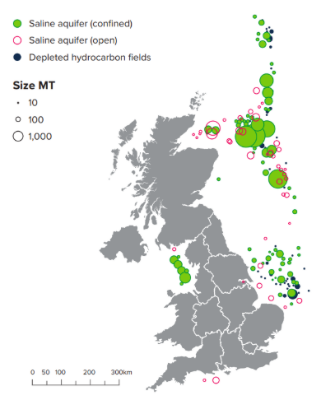
UK ETS installations and operators are geographically dispersed throughout the UK, whilst the majority of the 78 billion tonnes of CO2 storage [footnote 8] in the UK continental shelf is located within the North Sea. Other storage sites are within the Irish Sea and the English Channel.
Figure 1 at A [footnote 9] shows the geographic distribution of ETS installations and operators across the UK and at B [footnote 10] shows the geographic distribution of offshore geological storage.
Figure 1A
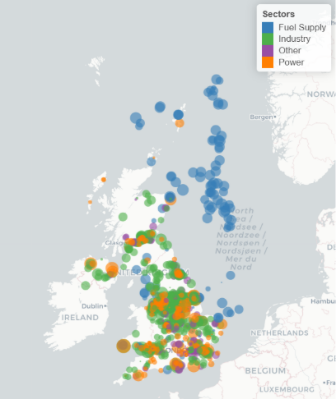
Figure 1B
Each of the four nations of the UK has their own regulator which oversees UK ETS regulated activity. Each regulator has jurisdiction over UK ETS installations on land and devolved regulators have jurisdiction over UK ETS installations in their nation’s territorial sea (within 12 nautical miles of the shore). In addition, there is a regulator, OPRED, for offshore UK ETS installations beyond the 12 nautical mile boundary that also has jurisdiction over the English territorial sea. Under current rules, CCS pipelines which traverse these boundaries will be required to obtain a separate UK ETS permit for each jurisdiction.
From figure 1 above, captured CO2 from UK ETS installations is likely to be transported across regulatory jurisdictional boundaries by pipelines. This highlights the need to ensure the regulatory framework allows CO2 transported by a pipeline to storage across national boundaries (including the transition from land to sea) is robust yet practical to facilitate adoption by operators of UK ETS installations.
Figure 2 – HyNet regulatory status quo and options under consideration.
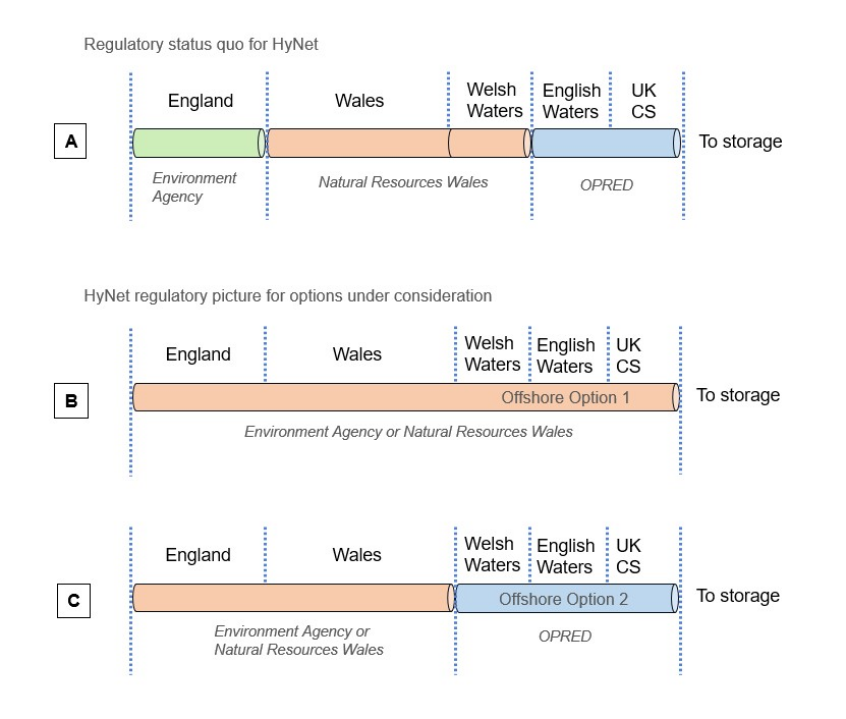
Figure 2A demonstrates the current regulatory framework that the HyNet Transport and Storage Network [footnote 11] will have to adhere to once in operation if none of the options considered in the consultation are implemented. The pipeline starts under the jurisdiction of the Environment Agency (EA; regulator in England). As the pipeline crosses the border into Wales, Natural Resources Wales (NRW; regulator in Wales) has responsibility for the section of pipeline from the England/Wales border and into Welsh territorial sea. At the boundary between the Welsh and English territorial sea, the Offshore Petroleum Regulator for Environment and Decommissioning (OPRED; UK regulator) takes over regulatory responsibility through into the UK sector of the continental shelf (UK CS) until the storage site. Please note, if the UK CS was bordering the territorial sea of a devolved nation, the responsibility would pass from the devolved regulator to OPRED at the boundary between the devolved territorial sea and the UK CS. At each of the boundary points for HyNet, indicated with the longer dashed blue lines, monitoring infrastructure is installed to determine the amount of CO2 being transferred as per each permit’s monitoring plan which are agreed with each regulator.
As an example, two of the options in this consultation are demonstrated in figures 2B and 2C. A criterion or multiple criteria would be used to determine which single regulator (EA or NRW) would be responsible for the onshore section of the HyNet pipeline. In addition, that regulator would either remain the regulator offshore or OPRED would become the sole regulator for the offshore portion. Overall, the HyNet pipeline operator would engage with a maximum of two regulators under the options being considered and the requirement for monitoring infrastructure would be reduced to a maximum of three sites: the start of the pipeline, the land/sea border and the start of the storage site.
Under the existing regulatory framework, pipeline operators are subject to two principal categories of cost:
1. Compliance costs
These costs arise from the requirement to obtain and maintain permits in each jurisdiction the pipeline traverses. Each permit requires operators to pay set-up and annual fees to their regulator. However, the larger cost comes from the complexity of these processes which can be administratively burdensome on operators resulting from engaging with different regulators for different sections of the pipeline to obtain UK ETS permits. Whilst we anticipate the policy to reduce administrative costs, we are unable to estimate them quantitatively. The latest evidence on compliance costs accrued from UK ETS operators dates back to 2016 when UK ETS operators operated under EU ETS rules. However, operators who provided data for this study did not split out the costs associated with permits specifically, so it is not clear what proportion of these costs are derived from the permitting process. In addition, UK ETS operators now operate under UK ETS regulations which have diverged from EU ETS regulations and so this evidence serves as a proxy to understand the impact of this proposed policy on compliance costs under UK ETS regulations. As demonstrated by figure 2A and 2B for HyNet, the consultation options would mean a CCS pipeline operator would engage with a maximum of two regulators (down from three in the case of HyNet). Thus, under the options considered in this consultation, a CCS pipeline operator would save on the fees paid to regulators and administrative costs associated with engaging with less regulators to obtain the necessary permit and report emissions under the monitoring plan.
2. Infrastructure costs
At jurisdictional boundaries, operators are required to install monitoring infrastructure to ensure accurate measurement and reporting for each permit. In cases where the pipeline traverses the boundary of a devolved territorial sea (at 12 nautical miles of the shore) to the UK sector of the continental shelf or from one territorial sea to another, monitoring infrastructure must be installed subsea. As demonstrated in figure 2A and 2B for HyNet, the number of points where monitoring infrastructure will be required due to a boundary would be reduced from three to one or zero; in addition to the monitoring infrastructure required at the start and end points of a CCS pipeline. This would reduce capital expenditure (to purchase and fit the equipment) and operating expenditure (to maintain and operate the equipment). Whilst we anticipate these cost reductions, we are unable to quantify them. The equipment used in large scale projects such as HyNet are largely bespoke to an individual project’s specification, therefore, no ‘off-the-shelf’ cost estimates are available to quote.
Currently, there are no operational CCS pipelines in the UK. In addition to the HyNet Transport and Storage Network, the East Coast Cluster [footnote 12] is also in construction. Both projects target commencing operations in 2028 and together can store 8.5 million tonnes of carbon emissions each year. This would equate to approximately 0.01% of the UK Continental Shelf’s estimated storage capacity each year and around 16% of the 2028 legislated cap [footnote 13].
The government has announced its support for two additional clusters that are in development (Acorn in Northern Scotland [footnote 14] and Viking in Humber [footnote 15]) and is providing the development funding to advance their delivery.
Contracts have been agreed for various projects including those in the power generation and cement production sectors (UK ETS regulated activities) to begin using carbon capture technology and utilise the HyNet network [footnote 16].
Conclusion
Overall, there is clear evidence of the scale of CCS development and the significant potential it offers for UK ETS operators to effectively decarbonise. The geographic distribution of UK ETS industrial sites compared to permanent geological storage indicates that cross boundary transportation of captured carbon dioxide via pipeline is highly likely. The options considered as part of this consultation are expected to simplify the regulatory framework for CCS pipeline operators. This will minimise fees paid to regulators and administrative burden on the pipeline operator, reducing any pass-through operating costs therefore making CCS a more attractive proposition for UK ETS operators seeking to decarbonise.
Going forward, we seek to develop our understanding on infrastructure costs (capital and operational) as well as costs from administrative effort through permitting and reporting to regulators. We would like to invite stakeholders to provide any useful data on these costs if available.
-
Paragraph 3 of Schedule 2, The Greenhouse Gas Emissions Trading Scheme Order 2020 ↩
-
Article 10, The Greenhouse Gas Emissions Trading Scheme Order 2020. ↩
-
Continuous Emissions Monitoring System – measures both the mass and concentration of the gas flowing through the pipeline. ↩
-
Automated Measuring System – measures the mass of the gas flowing through the pipeline (concentration will be calculated via emissions factors). ↩
-
UK Emissions Trading Scheme (UK ETS): a policy overview - GOV.UK. ↩
-
Internal DESNZ analysis of UK ETS data. ↩
-
Carbon capture, usage and storage: a vision to establish a competitive market - GOV.UK (DESNZ, 2023). ↩
-
Internal DESNZ analysis of UK ETS data. ↩
-
Carbon capture, usage and storage: a vision to establish a competitive market - GOV.UK (DESNZ, 2023). ↩
-
The legislated cap in 2028 is 53,498,502 tonnes as set out in Article 22, The Greenhouse Gas Emissions Trading Scheme Order 2020. Note that not all CO2 transported by the HyNet and East Coast Clusters may be from UK ETS regulated activity. It should be noted that these projects are unlikely to operate at full capacity immediately upon commencement. Therefore, the 16% figure is intended to illustrate the relative scale of operations compared to the legislated cap, rather than imply HyNet and the East Coast Cluster will collectively capture 16% of the cap in 2028. ↩
-
Acorn: Growing Our Decarbonised Future - The Acorn Project. ↩
-
Humber CCS: Carbon Capture and Storage - Viking CCS. ↩