Provisional local government finance settlement 2026 to 2027
Updated 9 February 2026
Applies to England

© Crown copyright 2026
This publication is licensed under the terms of the Open Government Licence v3.0 except where otherwise stated. To view this licence, visit nationalarchives.gov.uk/doc/open-government-licence/version/3 or write to the Information Policy Team, The National Archives, Kew, London TW9 4DU, or email: psi@nationalarchives.gov.uk.
Where we have identified any third party copyright information you will need to obtain permission from the copyright holders concerned.
This publication is available at https://www.gov.uk/government/consultations/provisional-local-government-finance-settlement-2026-to-2027/provisional-local-government-finance-settlement-2026-to-2027
Scope of this consultation
The Local Government Finance Settlement (‘the Settlement’) is the annual process through which central government allocates funding to local government for the provision of local services in England. The Settlement consists of allocative grant funding, council tax and locally retained business rates.
The 2026-27 Settlement will be the first multi-year Settlement in a decade, running from 2026-27 to 2028-29. Alongside this consultation, we will be setting out provisional allocations for all 3 years of the multi-year Settlement. We will consult as required on the Settlement in 2026-27 and in each subsequent year. Final allocations for 2027-28 and 2028-29 will be confirmed in their respective years.
This consultation document, together with accompanying documents, including the draft Local Government Finance Report for 2026-27, notifies representatives of local government and members of the public of the government’s proposals for policies across the upcoming Settlement. This includes: the general nature of the basis of Revenue Support Grant (RSG) distribution; the general nature of the basis of the calculation of ‘tariff’ and ‘top up’ payments that form part of the business rates retention system; the determination of the ‘central’ and ‘local share’ of business rates for 2026-27; the general nature of the basis of the distribution of Section 31 grants alongside the Settlement; and council tax referendum principles set through the Settlement process.
Following consultation, the government will determine the final amounts of the RSG, and the Section 31 grants distributed alongside the Settlement, and their allocations to receiving authorities and the specified body, as part of determining the overall allocation of this year’s Settlement made to each local authority in England for 2026-27. At this time, the government will also set out the allocations for 2027-28 and 2028-29, which will be subject to consultation in future years, as required. There will be another Spending Review before the end of the multi-year Settlement, which may impact allocations for 2028-29 and which will determine arrangements for 2029-30 and beyond.
Geographical scope
These proposals relate to England only.
Basic information
Body responsible for the consultation
Local Government Finance Directorate within the Ministry of Housing, Communities and Local Government (the “Department”).
Duration
This consultation will last for 4 weeks from 17 December 2025 to 14 January 2026.
Enquiries
For any enquiries about the consultation please contact: lgfcorrespondence@communities.gov.uk
How to respond
We strongly request you respond through the following online form:
Provisional Local Government Finance Settlement 2026-27 consultation – Citizen Space
If you are unable to use the online form, you can email your response to the questions found in Annex B of this consultation document to: lgfcorrespondence@communities.gov.uk.
All responses to this consultation will be given full consideration.
Responses via correspondence must make clear whether you disagree or agree with each question to ensure the statistics we collect following the consultation accurately reflect respondents’ views. We will categorise responses as ‘do not have a view’ where written responses are unclear. In your response, please indicate whether you are replying as an individual or submitting an official response on behalf of an organisation and include:
- your name
- your position (if applicable)
- the name of your organisation (if applicable)
- an address (including post-code)
- an email address
- a contact telephone number
We encourage all respondents to reply to all questions, regardless of whether you are directly impacted by the proposals, so the government can assess the views of respondents as a whole.
A glossary of technical terms can be found in Annex C.
About this consultation
This consultation document and consultation process have been planned to adhere to the Consultation Principles issued by the Cabinet Office.
Representative groups are asked to give a summary of the people and organisations they represent, and where relevant who else they have consulted in reaching their conclusions when they respond.
Information provided in response to this consultation may be published or disclosed in accordance with the access to information regimes (these are primarily the Freedom of Information Act 2000 (FOIA), the Environmental Information Regulations 2004 and UK data protection legislation). In certain circumstances this may therefore include personal data when required by law. If you want the information that you provide to be treated as confidential, please be aware that, as a public authority, the Department is bound by the information access regimes and may therefore be obliged to disclose all or some of the information you provide. In view of this, it would be helpful if you could explain to us why you regard the information you have provided as confidential. If we receive a request for disclosure of the information, we will take full account of your explanation, but we cannot give an assurance that confidentiality can be maintained in all circumstances. An automatic confidentiality disclaimer generated by your IT system will not, of itself, be regarded as binding on the Department. The Ministry of Housing, Communities and Local Government will at all times process your personal data in accordance with UK data protection legislation and in the majority of circumstances this will mean that your personal data will not be disclosed to third parties. A full privacy notice is included below.
Individual responses will not be acknowledged unless specifically requested.
Your opinions are valuable to us. Thank you for taking the time to read this document and respond.
Are you satisfied that this consultation has followed the consultation principles? If not, or you have any other observations about how we can improve the process, please contact us via the Complaints Procedure.
1. Summary of this consultation
1.1 Introduction
1.1.1 This consultation paper sets out the government’s proposals for the provisional Local Government Finance Settlement (‘the Settlement’) for England for financial year 2026-27. This consultation forms a key part of the provisional Settlement for England for financial year 2026-27.
1.1.2 This chapter provides a summary of this consultation document and the proposals contained within the provisional Settlement for England for financial year 2026-27.
1.1.3 The government will consider views from the public, representatives of local government, and other non-governmental organisations offered in response to this consultation. The government will then publish a response to the consultation in the new year, as part of the final Settlement for England for financial year 2026-27, which will notify local authorities of their final allocations for the financial year 2026-27. As part of this multi-year Settlement, the government will also set allocations for financial years 2027-28 and 2028-29. The provisional Settlement consultation will be undertaken in each respective year, as required. Further detail on this is set out below.
1.2 The 2025 Spending Review
1.2.1 The 2025 Spending Review set local government departmental expenditure limits (DEL) for each financial year from 2026-27 through to 2028-29. The Spending Review announced over £5 billion in additional funding for local government services over this 3-year period. This included £3.4 billion of additional funding allocated through the Settlement for England. The 2025 Spending Review also confirmed our intention to maintain core council tax referendum principles as they were in 2025-26 over the multi-year Settlement.
1.2.2 From within this additional funding, the government will make additional investments in children’s social care and neighbourhood service funding, worth £866 million and £180 million respectively, and will distribute an additional £900 million using the adult social care relative needs formula. The government will hold £50 million as financial contingency per year of the multi-year Settlement period. The government plans to hold this contingency to fund the change to the LG DEL control total in 2028-29, as announced at the Autumn Budget, and to provide a buffer against any new costs or unforeseen events over the multi-year period. We will confirm our approach to contingency at the final Settlement in the new year, and expect to allocate any unused contingency as funding for local services as part of the Settlement. The remaining additional funding will be used to support local authorities in transitioning to their new funding allocations over the multi-year Settlement and in doing so will support the delivery of other core services that local communities rely on.
1.2.3 Under this government, we estimate that local government in England will see a real terms increase in its Core Spending Power (our main measure of the financial resources to local government to fund local services) of up to 9.7% over the period 2024-25 to 2028-29. For financial year 2026-27, the first year of this multi-year Settlement, we expect local government’s Core Spending Power will total up to £77.7 billion, which will be an increase of over £9.2 billion on financial year 2024-25.
1.3 The first multi-year Settlement in a decade
1.3.1 The government made a commitment in its 2024 manifesto to return to multi-year funding settlements to give local authorities stability and certainty over a significant proportion of their yearly budgets. We know from extensive engagement with the sector that more certainty enables councils to effectively plan for the future.
1.3.2 The provisional Settlement for 2026-27 delivers on that commitment. We are giving local authorities certainty over the next 3 years by publishing provisional allocations for financial years 2026-27, 2027-28 and 2028-29.
1.3.3 As required by the relevant legislation (the Local Government Finance Act, 1988), we will consult on the Settlement each subsequent year of the Spending Review period. Local authorities should keep under consideration that funding allocations in future years of the multi-year Settlement will necessarily be responsive, as per the usual process, to changing local government structures, the rate of inflation, future tax changes, or other unforeseen events. However, the government is clear that it is setting out its overall funding methodology for the next 3 years now to give councils certainty and stability over their budgets.
1.4 Implementing Fair Funding Review 2.0 reforms over multiple years
1.4.1 The need for reform has long been understood. The previous government recognised that the system was unfair, and in 2018 consulted on a “review of local authorities’ relative needs and resources”. However, they did not implement the proposals consulted on.
1.4.2 This government has consulted widely with the public, representatives of local government, and other non-government organisations, on proposals to fundamentally update the funding system for the first time in over a decade and to reset the business rates retention system.
1.4.3 We have worked in close partnership with local government, and are grateful for the engagement we’ve had from across the local government sector. From December 2024 to February 2025, we ran the local authority funding reform: objectives and principles consultation, where we agreed principles for local authority funding reform. From April to June 2025, we ran a technical consultation on resetting the business rates retention system. From June to August 2025, we built on these consultations and consulted through the Fair Funding Review 2.0 on introducing a fairer funding system. We also published a policy paper on the approach and methodology to resetting the business rates retention system from 1 April 2026.
1.4.4 On 20 November 2025, we published the government response to the Fair Funding Review 2.0 alongside a policy statement setting out the proposals for the 2026-27 to 2028-29 multi-year Settlement. The policy statement also outlined further detail on the 4, new consolidated grants we are delivering as part of the provisional Settlement that bring together 16 funding streams and are together worth £21.5 billion over the multi-year Settlement, alongside which grants we propose to roll-into the Revenue Support Grant (see paragraph 2.5.1 of this consultation). We are publishing allocations for these 4 new, consolidated grants, and the funding simplification explanatory note provides further detail, including draft grant conditions.
- The Homelessness, Rough Sleeping and Domestic Abuse Grant which consolidates 4 funding streams totalling £2.4 billion and will be in Core Spending Power,
- The Children, Families and Youth Grant which consolidates 5 funding streams totalling £3.1 billion including £2.4 billion of Family First Partnership funding which will be in Core Spending Power. Other funding in this grant will not be in Core Spending Power,
- The Public Health Grant which brings 4 funding streams together with the existing Public Health Grant and totals £13.45 billion. This will not be in Core Spending Power.
- The Crisis and Resilience Fund which consolidates 2 funding streams totalling £2.5 billion. This will not be in Core Spending Power.
1.4.5 Together, these documents gave early notice of proposals for the 2026-27 to 2028-29 multi-year Settlement, including how we plan to transition councils to their new funding allocations over the next 3 years.
1.4.6 This consultation and the accompanying provisional Settlement documents for 2026-27 provide further detail on how the government intends to implement these plans over each year of the upcoming Spending Review period. The consultation will set out: the assumed council tax raising potential for different types of local authority over the next 3 years; how we will phase in new funding allocations through the business rates system and grant funding; the consolidation of grants into the RSG; and allocations of income protection for specific groups of authorities which would otherwise see their income fall as a result of these changes.
1.5 Special Educational Needs and Disabilities (SEND) and the Dedicated Schools Grant (DSG)
1.5.1 We recognise that local authorities are continuing to face significant pressure from Dedicated Schools Grant (DSG) deficits on their accounts. In June this year, we announced a 2-year extension to the DSG Statutory Override to support local authorities to manage these impacts. The government has also confirmed that it will bring forward a full Schools White Paper early in the new year. This will set out substantial plans for reform of special educational needs provision to deliver a sustainable system which – first and foremost – supports children and families effectively, and which is also financially sustainable.
1.5.2 The 2025 Spending Review provides investment for SEND reform. As set out in the Autumn Budget, once the Statutory Override ends at the end of 2027-28, funding will be managed within the overall central government DEL envelope. Local authorities will of course be expected to manage the system effectively and where this is the case we would not expect local authorities to need to fund future special educational needs costs from general funds. We recognise that the size of deficits that some councils may accrue while the Statutory Override is in place may not be manageable with local resources alone, and will bring forward arrangements to assist with them as part of broader SEND reform plans. Whilst we do not expect local authorities to plan on the basis of having to meet deficits in full, any future support will not be unlimited. Councils must continue to work to keep deficits as low as possible. To support local authorities to do this, we are disseminating best practice and case studies from previous programmes focussed on efficient spending, such as Safety Valve and Delivering Better Value, and providing all local authorities with advisers to help consider how these learnings can be applied.
1.5.3 The government will work with local authorities towards a system that enables every child to achieve and thrive; and the financial sustainability of the system will depend on local authorities, along with system partners such as education, health and care services, managing it effectively. Therefore, support provided to local authorities will be linked to assurance that they are taking steps to make that system a reality, in conjunction with government confirming the detail of SEND reform.
1.5.4 Like all areas of spend, we continue to expect local authorities to make sure they are doing all they can locally to manage their system effectively, ensuring the money is being spent in line with best practice. This is a joint effort, with shared responsibility between government, local authorities, health partners, and schools. Education, health and care services should work in partnership with one another, local government, families, teachers, experts and representative bodies to deliver better experiences and outcomes for all our children. We will provide further detail on our plans to support local authorities with historic and accruing deficits and conditions for accessing such support later in the Settlement process.
1.6 Summary of proposals included in the 2026-27 provisional settlement
1.6.1 Chapter 2 – Delivering the Fair Funding Review 2.0 through locally retained business rates and grant funding allocations: This chapter outlines the government’s proposals for resetting the business rates and grant systems and allocating the total Fair Funding Allocation for each council in 2026-27, comprised of RSG, Local Authority Better Care Grant (LABCG), and Baseline Funding Levels (BFLs) in 2026-27, as well as the methodology for phasing in the new fair funding shares over the next 3 financial years.
1.6.2 This chapter also outlines the government’s proposals to provide an additional £150 million funding uplift via the adult social care relative needs formula in 2026-27, as part of RSG, and provide an additional £90 million uplift via the 2028-29 fair funding shares in 2026-27, as part of RSG.
1.6.3 Chapter 3 – Transition, the Recovery Grant and bespoke arrangements: This chapter sets out our plans for transitional arrangements. We are proposing the following levels of income protection in 2026-27 and across the multi-year Settlement:
- 100% income protection. For all local authorities where the difference between their pre-reform and post-reform income is 15% or less of their pre-reform income, we will ensure 100% of their 2025-26 income is protected;
- Real-terms protection. For standalone Fire and Rescue Authorities, we will provide a funding floor which protects their 2025-26 income in real-terms;
- circa 95% income protection. It is the government’s view that local authorities with existing funding furthest above their new allocations will need to accept some losses in income over the multi-year Settlement to ensure funding can be redirected to where it is assessed as being needed most. For upper tier authorities where the difference between their pre-reform and post-reform income is more than 15% of their pre-reform income, and which have council tax levels below the average, we will protect 95% of their 2025-26 income. For all lower tier authorities where the difference between their pre-reform and post-reform income is more than 15% of their pre-reform income, we will protect 95% of their 2025-26 income.
Further detail on the operation of this income protection, including the income baseline that will be protected, is set out in the chapter and the accompanying explanatory note on transition arrangements.
The government will also maintain 2025-26 Recovery Grant allocations in each year of the multi-year Settlement, and will introduce a new Recovery Grant Guarantee, to support the most deprived places which suffered the most from cuts.
1.6.4 Chapter 4 – Council tax: this chapter details the government’s intentions for council tax referendum principles in 2026-27 which apply to the increase in the band D council tax charge set by a local authority.
- Maintain core referendum principles as they were in 2025-26 over the multi-year Settlement.
- A core referendum threshold of up to 3%.
- Local authorities with social care responsibilities will also be able to set an additional adult social care precept of up to 2% per year without a referendum.
- A referendum principle of up to 3% or £5, whichever is higher, for shire district councils;
- A principle of £5 for fire and rescue authorities.
- For police authorities a council tax principle of £15 for 2026-27.
- No council tax referendum principle for Mayoral Strategic Authorities).
- No council tax referendum principle for town and parish councils.
- To increase fairness for taxpayers, provide better value for money, and enable areas to rebalance disparities in their council tax levels should they wish to, the government proposes not setting referendum principles for 6 authorities in 2027-28 and 2028-29 Authorities will not have referendum principles applied if they meet all the following criteria:
- are upper tier local authorities;
- would have 95% of their income protected; and
- have council tax levels lower than average.
It is for individual authorities to determine whether to use the flexibilities set out above, taking into consideration the pressures on households.
1.6.5 Chapter 5 – Social care: this chapter signposts where to find information on adult social care funding. It also sets out the government’s proposals for distributing children’s social care funding:
- £2.4 billion over the multi-year Settlement for the Families First Partnership programme will be distributed via the Children and Young People’s Services (CYPS) relative needs formula and delivered as part of the £3.1 billion Children, Families and Youth Grant.
- A flat cash floor within this distribution will be implemented to prevent any reductions in allocations from 2025-26 levels.
1.6.6 Chapter 6 – Other grant funding: this chapter explains the government’s proposals for the Internal Drainage Boards support grant and seeks views about the grant’s future beyond 2026-27. It also sets out the government’s intention to hold £50 million per year unallocated as financial contingency.
1.6.7 Chapter 7 – Local Government Reorganisation: this chapter sets out the government’s approach to handling local government reorganisation during the multi-year Settlement period.
- For areas undergoing reorganisation, the Settlement will set out multi-year allocations for existing councils. These allocations will set the ‘funding envelope’ for the new local authorities created through reorganisation.
1.6.8 Chapter 8 – Mayoral Strategic Authority funding: this chapter sets out the government’s plan for funding for Mayoral Strategic Authorities through the Settlement; including on the Mayoral Capacity Fund.
- For funding lines where both Mayoral Strategic Authorities and local authorities receive an allocation, these can now be included in both the Settlement and the Integrated Settlement.
1.6.9 Chapter 9 – Equalities impacts of these proposals: this chapter invites views and evidence on the impact that the government’s proposals may have on persons who share a protected characteristic.
1.7 Allocations for proposals
1.7.1 The supporting tables accompanying this consultation show the allocations for the proposals for individual local authorities. Following this consultation, allocations will be finalised and reflected in Core Spending Power figures at the final Settlement. These proposals represent the government’s intentions, and the figures are based on available information.
1.7.2 Data changes, new information or errors identified by either the Department or local authorities between the publication of this consultation paper and the calculation of the final Settlement may lead to changes to individual local authority allocations. The government encourages local authorities to check their individual allocations using the fair funding assessment multi-year calculator. We ask local authorities to contact the Department with any concerns over the accuracy of their individual allocations via lgfcorrespondence@communities.gov.uk.We will set out the final local authority allocations at the final Settlement, following the conclusion of this consultation.
2. Delivering the Fair Funding Review 2.0 reforms through locally retained business rates and grant funding allocations
2.1 Introduction
2.1.1 This chapter outlines the government’s proposals to deliver the Fair Funding Review 2.0 reforms through locally retained business rates and grant funding allocations, over the next 3 years. This will include plans for the total Fair Funding Allocation for each council in 2026-27, comprised of RSG, Local Authority Better Care Grant (LABCG), and Baseline Funding Levels (BFLs), as well as wider changes to the business rates retention system and funding consolidation.
2.2 Resetting the business rates retention system
2.2.1 As set out in the government’s response to the Fair Funding Review 2.0, the government intends to reset the business rates retention system from 2026-27. This is long overdue and will restore the balance between aligning funding with need and rewarding business rates growth.
2.2.2 Before allocating new local authority BFLs, the total amount of business rates to be retained by local government must be estimated as part of the reset. To do this, wherever possible, the government will replicate the methodology used to estimate how much business rates each local authority will collect from 1 April 2026, which was confirmed via the response to the government’s technical consultation on resetting the business rates retention system. The BFL amount will also include an England-wide downward adjustment for the impact that business rates reliefs have in reducing local authority income.
2.2.3 In recognition of the complexity of the business rates system, and the need for it to run uninterrupted to ensure a consistent revenue stream for local areas, we plan to move all local authorities’ BFLs directly to the 2028-29 fair funding shares in 2026-27.
2.2.4 All currently retained business rates will remain with local government across the reset. Business rates will be distributed according to new relative need shares except in bespoke circumstances. A full method has been published alongside this consultation to set out how the BFL amount has been estimated for local government. A full method for calculating individual local authority business rates baselines (BRBs) has also been published following the outcome of the technical consultation that ran from April to June 2025. Together new BFLs and BRBs will set new top-up and tariff figures for all local authorities from 2026-27.
2.3 Updating baseline funding levels and replacing legacy grant funding allocations
2.3.1 The business rates reset in 2026-27 will be accompanied by the phased introduction of new RSG allocations over each year of the multi-year Settlement and the gradual phasing out of legacy grant funding allocations (referred to as the 2025-26 legacy funding share). New terms are summarised in Annex C. The 2025-26 legacy funding share consists of:
-
Allocations through the 2025-26 Settlement (except the Recovery Grant, Domestic Abuse Safe Accommodation Grant and Children’s Social Care Prevention Grant, given this funding is reserved for a specific purposes, which will continue to be distributed in a bespoke way outside of the total Fair Funding Allocation)
-
2025-26 estimates of business rates income, including the vast majority of locally retained growth and Section 31 grant compensation paid in connection with the business rates retention system in 2025-26;[footnote 1]
-
Additional business rates growth retained in enhanced retention areas and an estimate of local authority pooling benefits in 2025-26 will be incorporated; and
-
The 2025-26 allocations of grant consolidated into the RSG and being redistributed within the total Fair Funding Allocation in 2026-27.
2.3.2 The government intends that RSG allocations will largely reflect the net position required to ensure that a council’s total Baseline Funding Level, Local Authority Better Care Grant, and RSG position is sufficient to move away from their 2025-26 legacy funding share and towards their 2028-29 fair funding share in increments of a third. The in-year position will be calculated: in 2026-27, approximately 33% through the 2028-29 fair funding share and approximately 67% through the 2025-26 legacy funding share; in 2027-28, approximately 67% through the 2028-29 fair funding share and approximately 33% through the 2025-26 legacy funding share; and in 2028-29 100% via the 2028-29 fair funding share.
Figure 1: Visualisation of phasing in updated Settlement allocations over 3 years
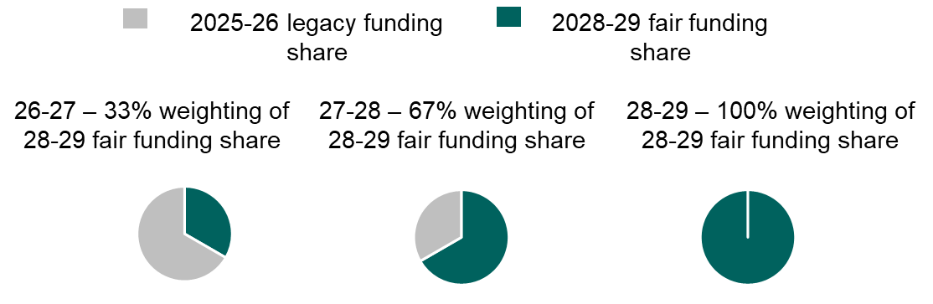
2.3.3 In summary, whilst the business rates retention system will be reset in full in 2026-27, and whilst local authorities will continue to receive a Local Authority Better Care Grant allocation within the total Fair Funding Allocation in 2026-27, RSG will be used to smooth the impact of this and move local authorities towards their new allocations in increments of one third over the multi-year Settlement.
2.3.4 The 2026 reset is happening alongside significant changes to the business rates tax system. Further detail on how the business rates reset will be delivered, including how the government will incorporate recent changes to the business rates tax, is included in the publication ‘Resetting the Business Rates Retention System from 2026-27,’ published on 20 November 2025.
2.3.5 The government is currently estimating future years’ BFLs using the change in OBR Q3 inflation estimates. Future BFL increases will however be updated to use outturn ONS September CPI. Future years’ BFLs will still be subject to consultation at future Settlements, as required.
2.4 Distribution of Revenue Support Grant
2.4.1 The government proposes that RSG will play a key role phasing in the 2028-29 fair funding shares over the course of the multi-year Settlement. As explained above, allocations of RSG will reflect the net amount required to move every local authority towards its 2028-29 fair funding share in yearly increments of a third after factoring in the immediate reset of the business rates retention system in 2026-27 and the continuation of the Local Authority Better Care Grant. As a result, only by 2028-29 will the provisional RSG allocations fully reflect the distribution of the new Fair Funding Assessment through the gradual phasing out of 2025-26 legacy funding allocations.
2.4.2 The government will provide additional funding through the RSG over the multi-year Settlement period. Between 2026-27 and 2028-29, the government proposes that an additional £900 million will be distributed using the Adult Social Care Relative Needs Formula (ASC RNF) allocated as £150 million in 2026-27, £250 million in 2027-28, and £500 million in 2028-29] within RSG. This distribution decision will be reflected in local authorities’ overall RSG allocations. It ensures that a proportion of this grant is directly targeted to the areas where adult social care need is greatest, reflecting the latest available data on adult social care demand across authorities, whilst giving councils flexibility over the use of the funds in their local area.
2.4.3 In addition, the government proposes to allocate an additional £180 million of new funding to local authorities for neighbourhood services over the course of the multi-year Settlement, allocated via the 2028-29 fair funding shares, as part of RSG. This £180 million additional funding will be allocated as £90 million in 2026-27 and £90 million in 2027-28.
2.5 Consolidating funding into Revenue Support Grant
2.5.1 As set out in the government’s response to the Fair Funding Review 2.0, the government intends to consolidate 18 funding streams into RSG. We have restated historic Core Spending Power (CSP) where applicable for rolled in grants to provide a reasonable year on year comparison of CSP since 2024-25, and ensure no local authority’s CSP figures appear artificially inflated. In 2026-27, the value of the 18 funding streams consolidated into RSG will be a total of £11.66 billion. The consolidation of funding streams will be delivered in the following 3 ways, with 2026-27 figures set out below:
-
Consolidating 2 funding streams new to the Settlement keeping the existing distributions. This is the case only where funding was previously distributed in a way that reflects unique pressures not felt in all authorities, and so its purpose cannot reasonably be achieved within the 2028-29 fair funding shares. This funding will therefore not be in scope of phasing in but will be protected in the transitional baseline for funding floors. Local authority allocations for these grants are set out in 2026-27 Key Information Table.
- Social Care in Prisons (£11 million); and
- War Pensions Disregard (£12 million).
-
Consolidating 9 funding streams that are new to the Settlement into the 2025-26 legacy funding shares, which will gradually be phased into the 2028-29 fair funding shares. These funding streams will be included in the income baseline for transitional arrangements. The Fair Funding Allocation Calculator will set out individual local authority 2025-26 allocations for each of these funding streams. For years 2026-27 to 2028-29, these funding streams will be part of RSG in the calculator and will therefore not be visible individually. The Core Spending Power Table will present these 9 grants within ‘Grants rolled in to Revenue Support Grant’ in 2024-25 and 2025-26, which also includes the two grants listed above, and as part of the Fair Funding Allocation from 2026-27.
- Temporary accommodation funding (£323 million), previously part of the Homelessness Prevention Grant. The Fair Funding Assessment includes a temporary accommodation formula to reflect this change;
- Virtual School Head for Children with a Social Worker and Children in Kinship Care (£20.4 million);
- Biodiversity Net Gain Planning Requirement (£9.7 million);
- Deprivation of Liberty Safeguards Funding (£5.2 million);
- Local Government Finance Data Review (<£1 million);
- Enforcement of Location Restriction and Volume New Burdens grant (<£1 million);
- Enforcement of Calorie Labelling Regulations New Burdens grant (<£100,000);
- Awaab’s Law New Burdens grant (<£100,000); and
- Social Housing New Burden grant (<£100,000).
-
Consolidating 7 funding streams that are already within the Settlement into the 2025-26 legacy funding shares, which will also be gradually phased in to the 2028-29 fair funding shares.[footnote 2] These funding streams will be included in the income baseline for transitional arrangements. The Fair Funding Allocation Calculator will set out the same information as the funding streams above. The Core Spending Power Table will present these 7 grants within the ‘Legacy Funding Assessment’ in 2024-25 and 2025-26 and as part of the Fair Funding Allocation from 2026-27.
- Social Care Grant (£5.9 billion);
- Local Authority Better Care Grant (£2.64 billion);
- Historic business rates grant compensation for under-indexation of tax rates; Green Plant and Machinery exemptions; and Small Business Rates Relief lost supplementary income (£3.23 billion);
- Market Sustainability and Improvement Fund (£1.05 billion);
- Employer National Insurance Contributions (£502 million);
- New Homes Bonus (£290.5 million);
- 2025-26 Funding Floor (£121.2 million); and
- Funding from the following grants (treated as one funding stream in our totals) brought together into the Children and Families Grant in 2025-26 (worth £253 million):
- Supported Accommodation Reforms (£94.5 million);
- Staying Put (£33.3 million);
- Virtual School Heads Extension for previously looked after children (£7.6 million);
- Leaving Care Allowance uplift (£13.4 million); and
- Personal Advisors Extended Duty (£12.1 million).
- In addition, we are consolidating the Local Authority Better Care Grant (£2.64 billion) into the 2025-26 legacy funding shares. As set out in paragraph 2.6.2, the LABCG will continue to be paid out as a separate Section 31 grant and will therefore be excluded from our grant consolidation totals. See section 2.6 below for more detail on the approach to the Local Authority Better Care Grant over the multi-year Settlement.
2.6 Local Authority Better Care Grant
2.6.1 The Local Authority Better Care Grant (LABCG), alongside the Social Care Grant and Market Sustainability and Improvement Fund have been included as part of the 2025-26 legacy funding shares. This ensures that this funding is included as part of local authorities’ total Fair Funding Allocations.
2.6.2 For social care authorities, a proportion of the total Fair Funding Allocation for each local authority will be allocated as the LABCG and paid through a standalone, ringfenced, Section 31 grant. This proposal recognises the unique statutory role the LABCG plays in requiring local authorities to pool funding with the NHS under the Better Care Fund (BCF) framework.
2.6.3 The 10 Year Health Plan announced reform to the BCF to focus on integrated services, and the Department for Health and Social Care (DHSC) will shortly set out further detail on our approach to reform. Where this involves any changes to NHS and local authority minimum contributions to pooled funding, we will not introduce those changes before 2027-28. Local authorities’ total funding available for adult social care will not be impacted by any future decisions on the amount of funding that each authority will be required to pool through the LABCG.
2.6.4 The Core Spending Power Table will set out the LABCG allocations for each local authority. Individual local authority LABCG allocations will be the same in 2026-27 as in 2025-26. The Core Spending Power Table does not set out provisional allocations of the LABCG in 2027-28 and 2028-29. In these years, LABCG funding is included within the total Fair Funding Allocation and is notionally presented within the RSG. As a result, adult social care notional allocations will not change.
Question 1
Do you agree or disagree with the government’s proposals for distributing the total Fair Funding Allocation across the multi-year Settlement period from 2026-27? This encompasses the approach to Baseline Funding Levels, Revenue Support Grant, the Adult Social Care Relative Needs Formula distribution, the additional funding for local services, the approach to the Local Authority Better Care Grant, and the method for calculating tariffs and top-ups.
3. Transition, the Recovery Grant and bespoke arrangements
3.1 Proposed transitional arrangements
3.1.1 As set out in the policy statement, the government recognises that transitional arrangements are necessary to enable local authorities to plan for changes. However, the current system is unfair, and there is a balance between providing transitional arrangements and moving decisively towards improved and updated allocations.
3.1.2 Whilst we expect the vast majority of local authorities with social care responsibilities will see their Core Spending Power increase in real terms over the multi-year Settlement, and most other authorities will see their income increase in cash terms, we are proposing the following transitional arrangements:
a. We will move local authorities to their 2028-29 fair funding shares in increments of one third over the multi-year Settlement (as detailed in chapter 2 above); and
b. For local authorities which would see their income fall as a result of changes, we will protect their income through a range of funding floor levels appropriate to specific groups of authorities’ circumstances, set out in further detail below.
Figure 2: Summary of transitional arrangements and the Recovery Grant Guarantee
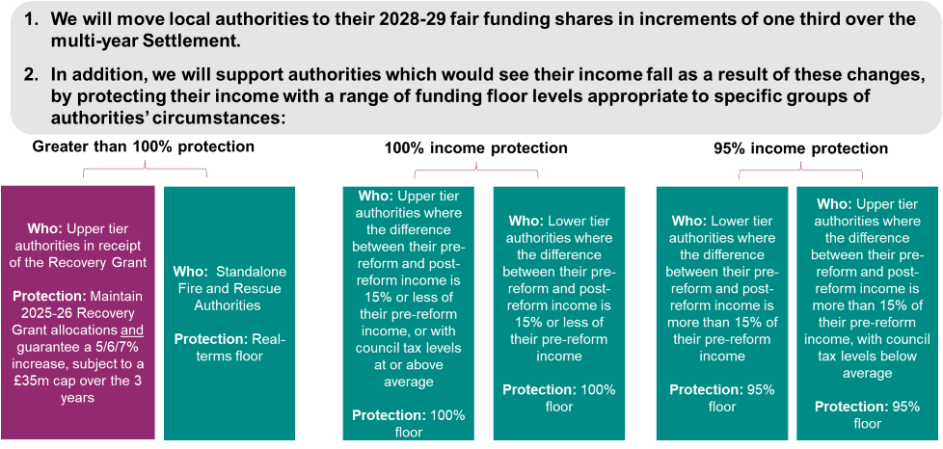
3.1.3 We are proposing the following levels of income protection in 2026-27 and across the multi-year Settlement. Further information on eligibility for and the operation of this income protection is provided in the explanatory note on transition arrangements.
a. 100% income protection. For all local authorities where the difference between their pre-reform and post-reform income is 15% or less of their pre-reform income, we will ensure 100% of their 2025-26 income is protected;
b. Real-terms protection. For standalone Fire and Rescue Authorities, we will provide a funding floor which protects their 2025-26 income in real-terms;
c. 95% income protection. It is the government’s view that local authorities furthest above their new allocations which have benefitted the most from the existing system will need to accept some losses in income over the multi-year Settlement. This is to ensure funding can be redirected to where it is assessed as being needed most. For upper tier authorities where the difference between their pre-reform and post-reform income is more than 15% of their pre-reform income, and which have council tax levels below the average, we will protect 95% of their 2025-26 income. For all lower tier authorities where the difference between their pre-reform and post-reform income is more than 15% of their pre-reform income, we will protect 95% of their 2025-26 income.
3.1.4 To calculate this income protection, we are consulting on a 2025-26 income baseline consisting of:
a. 2025-26 Core Spending Power (except the Domestic Abuse Safe Accommodation Grant and Children’s Social Care Prevention Grant, given this funding is reserved for specific purposes, which will continue to be distributed in a bespoke way outside the scope of the updated Fair Funding Assessment);
b. Current business rates income, including locally retained growth and Section 31 grant compensation paid in connection with the Business Rates Retention System. A business rates retention income calculator was published alongside the Reset delivery publication which provides detail of how individual local authorities’ current business rates income has been calculated. Additional growth retained in enhanced retention areas is incorporated. The government has also made an assumption to incorporate local authority pooling benefits as this is income available to some local authorities in 2025-26. For pooling authorities, the current assumption assumes levy due from the pool is split out in proportion to the pre-pooling levy each local authority would be liable for. Comments on this approach would be welcomed in responses to this part of the consultation. Government does not collect data centrally on how local pooling benefits are shared out, and any method for including pooling benefits for calculating transitional funding arrangements must be implemented in a way that is replicable for all local authorities with pooling arrangements; and
c. The 2025-26 allocations of grant consolidated into RSG.
3.1.5 As a result of our funding floors, some local authorities will remain above their 2028-29 fair funding shares by the end of the multi-year Settlement. We recognise that we will need to provide certainty to these authorities about their future funding arrangements following the end of the multi-year Settlement. Between now and the end of the multi-year Settlement, there will be another Spending Review which will determine arrangements for 2029-30 and beyond. The government will continue to work closely with local government and other government departments to understand specific pressures facing local government ahead of this and other fiscal events.
3.1.6 The government will continue the existing policy that income protection through funding floors assumes local authorities use the full council tax flexibility available to them as set out in chapter 4 below (except where council tax flexibility has been granted following a local request). This assumption strikes a balance between supporting authorities to transition to their new allocations and targeting funding to places we assess as most in need. We will also assume additional income from council tax base growth in line with each local authority’s average annual growth over the last 5 years.
3.1.7 Local authorities will benefit from a wide range of income streams and possible savings in addition to these funding floors which will support the transition to new allocations:
-
Authorities will continue to be rewarded for local growth as part of this government’s number one mission to promote economic growth. As is currently the case, new income from business rates growth in 2026-27 and over the multi-year Settlement will remain outside Core Spending Power, and will be additional to transitional protections.
- This government is driving the biggest transformation of children’s social care in a generation – backed by a historic £2.4 billion investment over the multi-year Settlement. This funding will be allocated in addition to any income protection and enable places to realise savings.
- The Homelessness, Rough Sleeping and Domestic Abuse Grant, also worth over £2.4 billion over the multi-year Settlement, will be allocated in addition to any income protection. This forms part of our National Plan to End Homelessness and will help councils invest in good-quality, better value temporary accommodation, reducing the use of expensive B&Bs and nightly-paid accommodation.
- Councils will continue to benefit from income through the Extended Producer Responsibility (EPR) for packaging scheme, which is expected to be worth £1.2 billion in 2026–27.
- Council tax premia, including the second homes premium which came into effect this year, will not be accounted for in the resource adjustment and any revenue will be additional. These are strong fiscal levers. In areas with a high number of second homes, deciding to use the premium could fully offset - and in some cases exceed - reductions as a result of councils receiving 95% income protection.
- Employer pension contribution rates are currently being set for the 3 years in April 2026. Whilst this won’t be the case in all places, where pension contributions are falling this will offer some support to places as they transition to new allocations.
3.2 Recovery Grant and Recovery Grant Guarantee
3.2.1 Following a large number of representations on the importance of Recovery Grant funding in reversing the effects of austerity, the government will maintain 2025-26 Recovery Grant allocations in each year of the multi-year Settlement. This funding was targeted at the most deprived places which are least able to fund their own services through income raised locally. We will maintain this funding as these places suffered the most from historical funding cuts and we recognise that their recovery is not over.
3.2.2 To continue their recovery, the government will also provide a Recovery Grant Guarantee, ensuring that upper-tier authorities in receipt of Recovery Grant see an increase of at least 5% in 2026-27, 6% in 2027-28 and 7% 2028-29, compared to their 2025-26 income. This will be subject to a cap of £35 million per authority – where an authority hits the cap, they will not receive these increases and instead the funding will be allocated in equal portions of £11.7 million in each year of the multi-year Settlement. The cap will ensure that we are effectively balancing funding local authorities fairly with changes that will enable continued service provision. We will protect the income baseline as set out above, however we will also account for funding allocated through the Children, Families and Youth Grant and Homelessness, Rough Sleeping and Domestic Abuse Grant when calculating an authority’s increase for the purposes of the Recovery Grant Guarantee.
3.3 Bespoke arrangements
3.3.1 The Greater London Authority has unique responsibilities for police, transport and fire services. These include the Metropolitan Police, which has a national role, and Transport for London and London’s fire services, which face unique pressures. Bespoke treatment is essential to maintain these vital, front-line services across London.
3.3.2 The GLA is generally funded by council tax and retained business rates, some of which it receives instead of receiving government grant funding. Given the GLA’s unique responsibilities and funding arrangements, the Fair Funding Assessment does not capture the full range of services which the GLA is responsible for providing. To address this, the measurement of the GLA’s income is adjusted to align it with services in scope of the Fair Funding Assessment. In recognition that the GLA’s retained growth is used to support services outside of the Settlement, such as the Metropolitan Police and Transport for London, and to prevent a reduction in funding to London’s fire and rescue services, the GLA will retain a portion of its locally retained business rates growth past the reset.
3.3.3 For further detail, see the explanatory note on the GLA’s bespoke treatment.
3.3.4 Whilst we recognise the City of London is unique with regards to its high daytime population relative to its resident population, the City is an extreme outlier in its Core Spending Power per person and the extent to which its pre-reform income is assessed as above its post-reform level of need. It is right that government gives careful consideration to whether protection of this level of funding is appropriate and offers value-for-money for taxpayers. Whilst we will protect 95% of the City’s 2025-26 income (including business rates growth) in 2026-27, we will engage the City regarding the design of bespoke arrangements, including through the business rates retention system, from 2027-28. The supporting Core Spending Power tables therefore do not currently reflect the City’s position for 2027-28 and 2028-29. The City will still receive multi-year allocations for consolidated grants, namely: the Homelessness, Rough Sleeping and Domestic Abuse Grant; Children, Families and Youth Grant; Public Health Grant; and Crisis and Resilience Fund.
3.3.5 The West of England Combined Authority have benefitted from the business rates retention system but do not provide services which are assessed as part of the Fair Funding Assessment. We will engage the local authority regarding bespoke transitional arrangements.
Question 2
Do you agree or disagree with the government’s proposed transitional arrangements?
4. Council tax
4.1.1 Whilst the framework for council tax setting is put in place by the government, decisions on council tax levels are a matter for councils. The Secretary of State is able to set referendum principles. Where a referendum principle is in place, councils setting an increase above this threshold must have it approved by voters. Referendum principles are not a cap, nor do they force authorities to set a particular increase. Referendum principles apply to the increase in the Band D council tax charge set by the local authority.
4.2 Council tax referendum principles
4.2.1 Fairness for taxpayers is at the heart of this government’s decision making. Over the multi-year Settlement, the government will maintain core referendum principles as they were in 2025-26 for the vast majority of local authorities. As in previous years, the government proposes a core referendum threshold of up to 3%. Local authorities with social care responsibilities will also be able to set an additional adult social care precept of up to 2% per year without a referendum.
4.2.2 The following flexibilities are also proposed:
- A council tax referendum principle of up to 3% or £5, whichever is higher, for shire
district councils; - A council tax principle of £5 for fire and rescue authorities; and
- A council tax principle of £15 for police authorities.
4.2.3 The government is committed to ensuring the local government funding system is fair for taxpayers across the country. The relative strength of council tax bases has meant that a small number of places can set far lower levels of council tax than others, but still raise as much or even more. Therefore, in some areas of the country, council tax levels are radically lower than others – despite homes being worth more. The reality of this is that the council tax bill for a house worth £10 million in Westminster can be less than an ordinary family home in places like Blackpool and Darlington.
4.2.4 To increase fairness for taxpayers, provide better value for money, and enable areas to rebalance disparities in their council tax levels should they wish to, the government proposes not setting referendum principles for 6 authorities in 2027-28 and 2028-29. Authorities will not have referendum principles applied if they meet all the following criteria:
- Are upper tier local authorities;
- Would have 95% of their income protected; and
- Have council tax levels lower than average.
4.2.5 The authorities that meet these criteria are City of London, Hammersmith and Fulham, Kensington and Chelsea, Wandsworth, Westminster and Windsor and Maidenhead. They have the lowest council tax levels of any upper tier authorities in England. Band D taxpayers in these councils are paying between £450 and £1280 less than the average in England. By choosing not to subsidise very low bills for the 500,000 households in these places, we will improve value for money and provide £250 million more funding for public services in places with higher need.
4.2.6 Decisions on council tax levels are a matter for local authorities. The flexibility is time limited and is provided in recognition of the exceptional circumstances of this very small group of local authorities and having considered overall fairness of the system. A number of these councils reported unringfenced reserves in 2024-25 over 100% of their 2025-26 Core Spending Power; could benefit substantially from the second homes council tax premium which came into effect this year if they chose to use it; and could see reduced employer pension contributions, which are being set for the 3 years in April 2026. The flexibility will give greater choice to these authorities in deciding how to manage their financial position in the way most appropriate for them. These councils all have relatively strong schemes to support households on lower incomes, we expect the councils to continue to support vulnerable taxpayers irrespective of the decisions taken. The GLA, fire and police precepts charged in these areas will continue to be subject to referendum principles each year.
4.3 Local requests for council tax flexibility
4.3.1 We understand that some local authorities may be in a challenging financial position. To strike the right balance between protecting taxpayers and supporting local authorities, the government will consider local requests for council tax flexibility where a local authority is facing significant local financial difficulty and views additional council tax increases as critical to managing financial risk. This is similar to the approach taken by the previous government.
4.3.2 As set out in the policy statement, in considering requests the government will carefully consider a local authority’s specific circumstances and will take account of an authority’s Band D council tax level in relation to the average council tax levels. Unlike the previous government, this government would not agree to requests for additional flexibilities from authorities where council tax payers are already paying more than average. We will also consider the impacts of any proposed council tax increase, including on a local authority’s ability to provide key services and on taxpayers. We expect any authority requesting an additional increase to ensure that appropriate support is put in place for vulnerable households, including reviewing the provision in their council tax reduction scheme and their discretionary discount policy for taxpayers in hardship.
4.3.3 We also recognise the financial pressures facing some Police and Crime Commissioners. Where a police authority views additional increases on the police precept as critical to maintaining their financial sustainability, the government will consider requests for limited flexibility on the police precept referendum principles. Local proposals will be considered on a case-by-case basis and would only be agreed in exceptional circumstances and following careful consideration of the police authority’s specific circumstances.
4.3.4 Local authorities should approach the Department in the first instance as soon as possible if they are considering submitting a request to be considered for additional council tax rises.
4.4 Council tax referendum principles for Mayoral Strategic Authorities
4.4.1 To date, governments have not set referendum principles for these authorities, except where the Mayor exercises Police and Crime Commissioner (PCC) functions. In which case the PCC principle has been applied to the police precept.
4.4.2 The government proposes to continue this approach over the multi-year settlement in the expectation that mayors will charge a level of council tax that is affordable for taxpayers and proportionate to their needs.
4.5 Council tax referendum principles for town and parish councils
4.5.1 To date, no referendum principles have been set for town and parish councils. This approach has been contingent on town and parish councils taking all available steps to mitigate the need for council tax increases. The government proposes to continue with this approach, and reminds these authorities to carefully consider the impact of their precepts on taxpayers.
Question 3
Do you agree or disagree with the proposed package of council tax referendum principles?
5. Social Care
5.1 Adult Social Care
5.1.1 Adult social care remains a key priority for this government. We are progressing towards a National Care Service focused on improving the quality of care and support, greater choice and control, and better joined up health and social care services. This is backed by around £4.6 billion additional funding made available for adult social care in 2028-29 compared to 2025-26, including £500 million for the first-ever Fair Pay Agreement – representing the most significant investment in improving pay and conditions for adult social care staff to date. Further details on the additional funding available are set out in: Additional national funding available for adult social care.
5.1.2 Chapter 2 sets out our approach to adult social care funding as part of the distribution of the total Fair Funding Allocation, on which we invite views as part of Question 1.
5.1.3 To help local authorities plan and deliver adult social care services within this new simplified system, DHSC will shortly set out the government’s adult social care priority outcomes and expectations for local authorities, to help build the foundations for a National Care Service. They will also set out adult social care notional allocations for each local authority for 2026-27 to 2028-29, which are intended as a reference point to support local budget-setting and inform local decisions on adult social care spending. This will aid DHSC’s engagement with local authorities on how they are managing local decisions to embed the government’s priorities for adult social care, within their individual funding context.
5.2 Children’s Social Care
5.2.1 The new £3.1 billion Children, Families and Youth Grant will make available £2.4 billion over the multi-year Settlement for the Families First Partnership programme. Families First Partnership is a national programme transforming children’s social care – embedding preventative services, so that families get the right support at the right time. This investment over and above existing prevention funding is crucial for local government sustainability, by reducing the number of children entering care and increasing the number of children living safely with their families. The Department for Education will be closely engaging local authorities on spend and delivery of the programme to ensure local authorities are moving to a more sustainable children’s social care system.
5.2.2 This £2.4 billion package brings together:
- Children’s Social Care Prevention Grant (£809 million). For 2025-26 this was distributed using an interim version of the CYPS (Children and Young People’s Services) relative needs formula and accounted for the variation in the cost of delivering services and the ability of local authorities to raise resources locally. 2025-26 allocations can be found here
- Families First Partnership programme funding within the Children and Families Grant (£760 million). For 2025-26, this was distributed via the Supporting Families methodology. 2025-26 allocations can be found here
- New funding (£866 million). This includes £319 million from the Transformation Fund announced at the Spending Review and £547 million confirmed in the Policy Statement.
5.2.3 This £2.4 billion will be allocated as £853 million in 2026-27, £853 million in 2027-28 and £729 million in 2028-29 and delivered as part of the Settlement’s new £3.1 billion Children, Families and Youth Grant. This is the only funding in the Children, Families and Youth Grant which is in Core Spending Power.
5.2.4 The government proposes existing and new funding for the Families First Partnership programme is distributed using the final version of the Children and Young People’s Services (CYPS) relative needs formula and an area cost adjustment to account for variation in the cost of delivering services. This is a change in distribution for the existing funding that was available in 2025-26 as set out above, therefore we are inviting views on this new approach. This funding will be allocated in addition to the 95% and 100% income protection in recognition of its vital role driving service transformation. Local authorities’ individual allocations for Families First Partnership programme for 2026-2029 are being published in the Core Spending Power table and an allocations table for consolidated grants.
5.2.5 This formula was consulted on as part of the Fair Funding Review 2.0 and will support the shift towards prevention-focused services by targeting resources at areas with higher predicted need. It uses the latest available data to predict demand for children’s social care services based on child and neighbourhood characteristics known to drive interaction with services—such as deprivation and population size. It does not allocate funding using historic expenditure or past service use, i.e. children-looked after or child in need figures, ensuring funding goes to where children are most likely to need support, regardless of current local authority practice. Further details on the formula’s methodology are set out in Children and Young Persons Formula technical note.
5.2.6 To ensure no local authority receives a cash reduction in children’s social care reform funding, we will implement a flat cash floor within this new distribution.
5.2.7 While this £2.4 billion investment in the Families First Partnership programme marks a significant milestone in transforming the children’s social care system, the children’s social care market is fundamentally broken. Local authorities are being pushed to the brink while some private providers continue to make excessive profits – this cannot continue.
5.2.8 This government’s ambition is to reduce reliance on residential care, reshape the market for care placements, and move towards a system rooted in family environments through fostering. This is better for children, and better for councils.
5.2.9 The Department for Education is bringing forward measures in their Children’s Wellbeing and Schools Bill, including a financial oversight scheme to increase financial transparency across key providers, and enhanced Ofsted powers. Using these powers, the government will explore how we might implement a profit cap in the children’s social care placement market. This would be a crucial step in ensuring public money delivers value and care – not profiteering. We will set out further information on our approach in 2026.
5.2.10 In recognition of the vital role that foster carers play in providing loving homes, the National Minimum Allowance (NMA) for foster carers is routinely uplifted each year, reflecting changes in inflation and earnings forecasts produced by the Office for Budget Responsibility, and what is affordable for local government. For 2026-27, we have uplifted the NMA by 3.35%. Full details will be published on GOV.UK in due course. As set out in the policy statement, the government has committed to a minimum annual uplift of 2.5% for 2027-28 and 2028-29, with final figures confirmed at the Settlement each year.
Question 4
Do you agree or disagree with the government’s proposed approach to distributing funding for the Families First Partnership programme via the final version of the Children and Young People’s Services (CYPS) relative needs formula?
6. Other Grants
6.1 Internal Drainage Boards Support Grant
6.1.1 In recognition of Internal Drainage Board (IDB) cost increases and the impact on local authority special levies, the government announced on 20 November 2025, as part of the policy statement, that it will maintain in total £5 million in funding for the local authorities most impacted by IDB levies. This follows the £5 million grant awarded in 2025-26. Allocations for individual authorities for the 2026-27 IDB levy support grant have not yet been determined. As usual, they will be announced next year once levy data has been received.
6.1.2 The government recognises the need to ensure IDBs are set up for the longer term. In response to rising financial pressures on IDBs, and the farmers and local authorities who fund their work, Defra and MHCLG have commissioned a research project into IDB funding and costs. This is focussed on financial efficiency, value for money, and the broader benefits which IDBs deliver for local communities. It will include examination of whether any changes are needed to their funding model. The research project was launched in early September and will close in summer 2026.
6.1.3 The IDB support grant was introduced in 2023-24 and was intended to be an exceptional one-off grant to those local authorities experiencing the most acute financial pressures from IDB special levies. Pending the outcome of the research project, it is right that we consider whether it is appropriate for the grant to continue beyond 2026-27.
6.2 Contingency
6.2.1 It is normal for the government to hold some funding to one side as contingency until allocations are confirmed at the final Settlement. Holding this money enables the government to fund the change to the LG DEL control total in 2028-29, as per the Autumn Budget, and account for the costs of any unexpected changes that arise in between the provisional and final Settlements, without necessarily needing to revise the proposals it has already set out. We think there continues to be good reasons to hold aside some contingency to cover new costs that might arise over the multi-year Settlement period.
6.2.2 For these reasons, we propose to hold £50 million per year of the multi-year Settlement aside in contingency at the provisional Settlement. This funding may be allocated at the final Settlement early next year, or may be held into future financial years to provide a small budget for future costs and priorities. We will confirm our approach to contingency at the final Settlement early next year.
Question 5
Do you agree or disagree with the government’s proposed approach of continuing the IDB support grant for 26-27 but seeking an alternative solution from 2027-28?
7. Local Government Reorganisation
7.1.1 The government set out the approach to handling local government reorganisation during the multi-year Settlement period in the policy statement. The government also set out the indicative timetable for the reorganisation process on gov.uk on 25 July 2025.
7.1.2 At the Settlement, multi-year grant allocations will be set out based on existing structures.
7.1.3 In recognition that local government reorganisation will change the structure of local authorities from April 2027 in Surrey and from April 2028 for the 20 other areas, we will set a ‘funding envelope’ for the new local authorities created where areas reorganise. This envelope will be set by combining the grant allocations of the relevant local authorities in the year(s) of the multi-year Settlement following reorganisation. To provide certainty, we will not recalculate allocations, including any funding floor payments, based on new unitary geographies in this multi-year Settlement period. Funding floor allocations for existing authorities will therefore be included within the funding envelope for an area.
7.1.4 It will be for areas to agree how to divide the funding where the establishment of new unitary authorities means existing local authorities are split. We will provide guidance to local authorities on how to arrive at local agreements, and will set out a timeline for when these agreements must be reached. We recognise the competing pressures of local areas needing to agree the funding split as soon as possible ahead of vesting day for the new authorities, as well as the need for government to review the agreement and incorporate it through the usual Settlement process. If areas are unable to reach an agreement, the MHCLG Secretary of State will make a determination on the share of Settlement allocations due to new unitaries. The government is clear that the use of a backstop is a last resort. Areas should make every effort to come to local agreements. We will provide further information on this at the earliest opportunity but an indicative timetable is set out below.
Indicative timetable
| Milestone | Surrey | All other areas |
|---|---|---|
| Elections to new authorities | May 2026 | May 2027 |
| Area-led final agreement on division of funding | Summer 2026 | Summer 2027 |
| First incorporation of funding division into provisional LGFS | December 2026 | December 2027 |
| First incorporation of funding into final LGFS | February 2027 | February 2028 |
| New authorities vesting day | April 2027 | April 2028 |
8. Mayoral Strategic Authority Funding
8.1.1 The Fair Funding Review 2.0 and the English Devolution White Paper set out that where a Strategic Authority takes on powers which are currently funded outside of the Settlement or the Integrated Settlements, MHCLG can work with the relevant department or organisation to explore funding these functions through either the Integrated Settlement or the Settlement.
8.1.2 The policy statement set out the government’s position on creating greater alignment between Mayoral Strategic Authority Funding and the Settlement to create a more cohesive local government funding landscape. We set out that for funding lines where both Mayoral Strategic Authorities and local authorities receive an allocation, these can now be included in the Settlement, and the Integrated Settlement where applicable.
8.1.3 The government is now seeking views on the government’s proposal to fund Mayoral Strategic Authorities through the Settlement, and the Integrated Settlement where applicable.
8.1.4 We are publishing allocations for the following grants, with 2026-27 figures set out below:
- £38.1 million for Homelessness and Rough Sleeping through the Homelessness, Rough Sleeping and Domestic Abuse Grant; and
- £33.5 million for Mayoral Capacity Funding.
8.1.5 We are also confirming allocations for Mayoral Strategic Authorities that deliver fire and rescue functions.
8.1.6 As confirmed at the Autumn Budget 2025, region wide enhanced business rates retention arrangements in Cornwall, Liverpool City Region and West of England will continue for a further 3 years, to 2028-29. Region wide enhanced retention arrangements in Greater Manchester, West Midlands and London will also continue for this period.
8.1.7 As set out in the Fair Funding Review 2.0, the government is improving the business rates retention system to more consistently support Mayors in driving growth. Options being considered include allocating Mayoral Strategic Authorities a direct share of business rates to build on Local Growth Plans, allowing more tax to be spent where it is raised and providing Mayors with a share of regional growth. The government will engage with Mayoral Strategic Authorities to co-develop a new offer, including considering how this could work in place of existing grant.
8.1.8 Further details on the arrangements and funding for future years of the multi-year settlement can be found in the Mayoral Strategic Authority Funding Explanatory Note.
Question 6
Do you agree or disagree with the government’s proposal on Mayoral Strategic Authorities in the Local Government Finance Settlement?
9. Equalities impacts of these proposals
9.1 Public Sector Equality Duty
9.1.1 Public bodies have a duty under the Equality Act 2010 to consider the needs of people who share particular protected characteristics. These are: age, disability, sex, gender reassignment, marriage or civil partnership, pregnancy and maternity, race, religion or belief, sexual orientation.
9.1.2 We have considered the equalities impacts of the proposals and decisions in the multi-year provisional Settlement across the period 2026-27 to 2028-29. We have continued to seek views on the equalities impacts on the proposed measures as part of the 3 consultations we have conducted over the last year, the most recent being the Fair Funding Review 2.0. As set out under ‘the scope of this consultation’, the government will consult as required on the Settlement in 2026-27 and in each subsequent year. This will include considering and seeking views on equalities impacts. Final allocations for 2027-28 and 2028-29 will be confirmed in their respective years.
9.1.3 The government intends to include a summary of the equalities impacts of its proposals as part of the response to this consultation. As usual, the government response, which will include the summary of responses and the summary of equalities impacts, will be published alongside the final settlement.
9.1.4 We would be grateful for views on the impact of the proposals contained in this consultation document on the 3 aims under the Public Sector Equality Duty to:
- Eliminate unlawful discrimination, harassment, victimisation and any other conduct prohibited by the Act;
- Advance equality of opportunity between people who share a particular protected characteristic and people who do not share it; and
- Foster good relations between people who share a particular protected characteristic and people who do not share it.
9.2 Foreseeable impacts of proposals on people who share protected characteristics
9.2.1 The government has considered the relative impacts of the funding distribution on persons who share different protected characteristics by assessing the distribution of Core Spending Power between local authorities and the characteristics of the people that live in the local authority areas.
9.2.2 Councils provide various services which people who share a particular protected characteristic will benefit from. Changes in the amount of flexible funding available to local authorities – whether an increase or a reduction – will affect a local authority’s ability to provide these services and therefore impact those persons sharing protected characteristics.
9.2.3 Local authorities understand the needs of their communities best and decide on how their resources are allocated. It is not, therefore, possible to say for certain how changes in funding will affect specific groups of persons sharing a protected characteristic, as this will be dependent on decisions that are made locally. We can, however, make reasonable assumptions about how changes in funding will affect changes in service delivery, in turn affecting service users.
9.3 Proposed mitigations on people who share protected characteristics
9.3.1 As part of the provisional Settlement, the government is proposing an increase in the funding available to local authorities.
9.3.2 The government will better align funding with need across the country, updating for the first time in decades the formulas we use to calculate local authorities’ need for services, relative to one another. The government will ensure the system is kept up to date using projections and regular resets so that changes in local circumstance, such as population, deprivation and income generation are properly accounted for. The government will provide the first multi-year Settlement in a decade, so that local authorities can plan for the next 3 years, partially mitigating against adverse equalities impacts in places that would otherwise see reductions as a result of funding reform.
9.3.3 The government is creating a simpler, less fragmented system by simplifying an unprecedented 36 funding streams, worth over £56 billion over 3 years. Currently, this funding is paid to local authorities through a combination of the existing Settlement (where government will provide new flexibility and simplicity), and outside the Settlement by 6 different government departments (where government will provide new certainty, simplicity, and flexibility).
9.3.4 The government is also distributing £2.4 billion over the multi-year Settlement to children’s social care reform via the new children’s formula with an area cost adjustment. This accounts for differing levels of need among children of different ages and sexes, and ensures children’s social care funding is directed to areas with the greatest need. The government is also distributing £900 million using the adult social care relative needs formula. This will ensure this funding goes to the areas with the greatest adult social care need, helping older people and those with disabilities who rely most on these services.
9.3.5 Transitional measures will partially mitigate any adverse impacts. The government is proposing phasing in allocations and funding floor protection to mitigate funding reductions and adverse equalities impacts. This will help sustain service provision between years and can be used to mitigate any potential impacts on members of protected groups.
9.3.6 The approach will also take account of local authority taxbases and local ability to raise income and more accurately reflect the drivers of local authority need, drawing on more up-to-date evidence. Taken together, this will update the alignment of funding with local authorities’ relative need for the first time since 2014, benefitting areas with a higher level of deprivation.
9.3.7 There is strong link between socio-economic deprivation and individuals with protected characteristics which are highlighted in the Equality Act 2010, including race, disability, sex, age, and religion. The updates the government is proposing will enable deprived places that have historically received relatively less funding than their need would suggest, to reinvest in local government services. This will better enable these local authorities to support their residents, who are likely to have a higher incidence of protected characteristics. Overall, the government believes that implementing a funding system that accurately accounts for relative need and resources advances positive equalities impacts as it will provide additional funding for groups that are disproportionately represented, helping to improve their outcomes across England.
Question 7
Do you have any comments on the impact of the proposals outlined in this consultation document on persons who share a protected characteristic? Please identify which protected characteristic you believe will be impacted by these proposals and provide evidence to support your comments.
Annex A: Personal data
The following is to explain your rights and give you the information you are be entitled to under UK data protection legislation.
Note that this section only refers to personal data (your name, contact details and any other information that relates to you or another identified or identifiable individual personally) not the content otherwise of your response to the consultation.
1. The identity of the data controller and contact details of our Data Protection Officer
The Ministry of Housing, Communities and Local Government (MHCLG) is the data controller. The Data Protection Officer can be contacted at dataprotection@communities.gov.uk or by writing to the following address:
Data Protection Officer
Ministry of Housing, Communities and Local Government
Fry Building
2 Marsham Street
London
SW1P 4DF
2. Why we are collecting your personal data
Your personal data is being collected as an essential part of the consultation process, so that we can contact you regarding your response and for statistical purposes. We may also use it to contact you about related matters.
3. Our legal basis for processing your personal data
The Data Protection Act 2018 states that, as a government department, MHCLG may process personal data as necessary for the effective performance of a task carried out in the public interest i.e. a consultation. This consultation fulfils the mandatory statutory requirements to consult under sections 78(5), 78A(3) and paragraph of Schedule 7B of the Local Government Finance Act 1988.
The collection of your personal data is lawful under article 6(1)(e) of the UK General Data Protection Regulation as it is necessary for the performance by MHCLG of a task in the public interest-in the exercise of official authority vested in the data controller. Section 8(d) of the Data Protection Act 2018 states that this will include processing of personal data that is necessary for the exercise of a function of the Crown, a Minister of the Crown or a government department i.e. in this case a consultation.
4. With whom we will be sharing your personal data
Other government departments including:
- Attorney General’s Office
- Cabinet Office
- Department for Business and Trade
- Department for Culture, Media and Sport
- Department for Education
- Department for Energy Security and Net Zero
- Department for Environment, Food and Rural Affairs
- Department for Science, Innovation and Technology
- Department for Transport
- Department for Work and Pensions
- Department of Health and Social Care
- Foreign, Commonwealth and Development Office
- His Majesty’s Treasury
- Home Office
- Ministry of Defence
- Ministry of Justice
- Northern Ireland Office
- Office of the Advocate General for Scotland
- Office of the Leader of the House of Commons
- Office of the Leader of the House of Lords
- Office of the Secretary of State for Scotland
- Office of the Secretary of State for Wales
- UK Export Finance
MHCLG may appoint a ‘data processor’, acting on behalf of the department and under our instruction, to help analyse the responses to this consultation. Where we do, we will ensure that the processing of your personal data remains in strict accordance with the requirements of the data protection legislation.
5. For how long we will keep your personal data, or criteria used to determine the retention period
Your personal data will be held for 2 years from the closure of the consultation.
6. Your rights, e.g. access, rectification, restriction, objection
The data we are collecting is your personal data, and you have considerable say over what happens to it. You have the right:
a. to see what data we have about you
b. to ask us to stop using your data, but keep it on record
c. to ask to have your data corrected if it is incorrect or incomplete
d. to object to our use of your personal data in certain circumstances
e. to lodge a complaint with the independent Information Commissioner (ICO) if you think we are not handling your data fairly or in accordance with the law. You can contact the ICO at https://ico.org.uk/, or telephone 0303 123 1113.
Please contact us at the following address if you wish to exercise the rights listed above, except the right to lodge a complaint with the ICO: dataprotection@communities.gov.uk or
Knowledge and Information Access Team
Ministry of Housing, Communities and Local Government
Fry Building
2 Marsham Street
London
SW1P 4DF
-
Your personal data will not be sent overseas
-
Your personal data will not be used for any automated decision making
-
Your personal data will be stored in a secure government IT system
We use a third-party system, Citizen Space, to collect consultation responses. In the first instance, your personal data will be stored on their secure UK-based server. Your personal data will be transferred to our secure government IT system as soon as possible, and it will be stored there for 2 years before it is deleted.
Annex B: Address details and list of consultation questions
We strongly request responses through the following online form:
Provisional Local Government Finance Settlement 2026-27 consultation – Citizen Space
If you are unable to use the online survey, responses via correspondence must make clear whether you disagree or agree with each question to ensure the statistics we collect following the consultation accurately reflect the views of respondents. We will categorise responses as ‘do not have a view’ where written responses are unclear.
Written responses may be sent by email or post to: lgfcorrespondence@communities.gov.uk
Or:
Local Government Finance Settlement Team
Ministry of Housing, Communities and Local Government
2nd floor, Fry Building
2 Marsham Street
London
SW1P 4DF
When replying to this consultation please confirm whether you are replying as an individual or submitting an official response on behalf of an organisation and include:
- your name,
- your position (if applicable)
- the name of your organisation (if applicable)
- an address (including post-code)
- an email address
- a contact telephone number
Question 1: Do you agree or disagree with the government’s proposals for distributing the total Fair Funding Allocation across the multi-year Settlement period from 2026-27? This encompasses the approach to Baseline Funding Levels, Revenue Support Grant, the Adult Social Care Relative Needs Formula distribution, the additional funding for local services, the approach to the Local Authority Better Care Grant, and the method for calculating tariffs and top-ups.
Question 2: Do you agree or disagree with the government’s proposed transitional arrangements?
Question 3: Do you agree or disagree with the proposed package of council tax referendum principles?
Question 4: Do you agree or disagree with the government’s proposed approach to distributing funding for the Families First Partnership programme via the final version of the Children and Young People’s Services (CYPS) relative needs formula?
Question 5: Do you agree or disagree with the government’s proposed approach of continuing the IDB support grant for 26-27 but seeking an alternative solution from 2027-28?
Question 6: Do you agree or disagree with the government’s proposal on Mayoral Strategic Authorities in the Local Government Finance Settlement?
Question 7: Do you have any comments on the impact of the proposals outlined in this consultation document on persons who share a protected characteristic? Please identify which protected characteristic you believe will be impacted by these proposals and provide evidence to support your comments.
Annex C: Glossary of technical terms
Baseline funding level
The amount of an individual local authority’s Fair Funding Assessment allocation provided through the local share of retained business rates income.
Business Rates Baseline (BRB)
An authority’s BRB is an estimate of the authority’s business rates income generating ability determined on an individual basis. This has been recalculated as part of the business rates reset. A calculator has been published alongside this consultation to show local authorities how new BRBs have been calculated.
Business Rates Retention (BRR)
Business rates are a tax on non-domestic properties. Billing authorities have a responsibility to issue bills and collect rates in their areas. Since 2013-14, local government has retained, as a whole, 50% of its business rates (excluding areas with increased Business Rates Retention arrangements). This income is subject to redistribution across local government via ‘top-ups’ and ‘tariffs’. From 2026-27 the government is planning on resetting the business rates retention system as part of the Fair Funding Review.
Core Spending Power (CSP)
A measure of the revenue funding available for local authority services. This includes council tax; business rates; Revenue Support Grant; New Homes Bonus; social care grants; and other grants delivered through the Settlement. This includes grant included for under-indexation of the Multipliers. This is an indicative notional number and is not to be seen as a real ‘grant’ – it is dealt with within the BRR system and the number in CSP is for indicative purposes only.
Council tax referendum principles
These mark levels of council tax increases (either in percentage or cash terms) above which a local authority must hold a referendum, which allows residents to approve or veto the increase. The comparison is made between the authority’s average Band D council tax level for the current financial year and the proposed average Band D for the next financial year.
Equalisation of the adult social care precept
We recognise that different places have different abilities to raise local council tax income from the adult social care precept. In response, we make an adjustment to offset these differences so that areas less able to raise council tax income receive a greater share of grant, called equalisation. We have done so since the adult social care precept was introduced. Equalisation is the process through which a proportion of Social Care Grant funding is used to take account of the impact of the distribution of the adult social care council tax precept.
Fair Funding Assessment
A local authority’s share of the local government spending control total comprising its Revenue Support Grant, Local Authority Better Care Grant and Baseline Funding Level for the year in question.
Local Government Departmental Expenditure Limit (LG DEL)
The departmental budget derived from central government resources for the purposes of local government.
New Homes Bonus
The New Homes Bonus was a grant that rewarded a council for net additions to the housing stock above a specific threshold. Most authorities received some form of New Homes Bonus funding from central government. The financial year 2025-26 was the final year of the New Homes Bonus in its current form.
Precept
A council tax charge from local authorities which do not issue bills themselves. These include county councils, police and crime commissioners, fire and rescue authorities, the Greater London Authority, combined authority mayors, and town and parish councils. Billing authorities – usually shire district councils or unitary authorities – collect council tax on behalf of precepting authorities and pass the proceeds to them.
Revenue Support Grant
Revenue Support Grant is paid from central government to authorities as part of their allocation through the Fair Funding Assessment (FFA). It is in addition to their local share of business rates.
Safety net
Mechanism to protect any authority which sees its business rates income drop beyond a set percentage of their baseline funding level. The safety net will be set at 100% of local authorities’ baseline funding level for 2026-27, moving down to the existing level over the multi-year settlement.
Spending Review
The Spending Review sets out the long-term spending limits for government and typically covers the next 3 or 4 years.
Tariffs and top-ups
Calculated by comparing an individual authority’s business rates baseline against its baseline funding level. Tariffs and top-ups Have been recalculated as part of the reset of the business rates retention system.
Tariff Authority
An authority with a higher individual authority business rates baseline than its baseline funding level, and which therefore pays a tariff.
Top-up Authority
An authority with a lower individual authority business rates baseline than its baseline funding level, and which therefore receives a top-up
-
Bespoke arrangements for the Greater London Authority and Greater Manchester and West Midland Combined Authorities will facilitate the retention of some growth that is currently locally retained. ↩
-
The exact value of the funding streams rolled in will reflect the GLA’s bespoke arrangement in recognition of its unique service responsibilities and funding arrangements. ↩