Proposals for heat network zoning 2023: government response (accessible webpage)
Updated 21 January 2026

© Crown copyright 2026
This publication is licensed under the terms of the Open Government Licence v3.0 except where otherwise stated. To view this licence, visit nationalarchives.gov.uk/doc/open-government-licence/version/3 or write to the Information Policy Team, The National Archives, Kew, London TW9 4DU, or email: psi@nationalarchives.gov.uk.
Where we have identified any third party copyright information you will need to obtain permission from the copyright holders concerned.
This publication is available at https://www.gov.uk/government/consultations/proposals-for-heat-network-zoning-2023/outcome/proposals-for-heat-network-zoning-2023-government-response-accessible-webpage
Ministerial foreword
For too long, British families and businesses have paid the price for our dependence on unstable, global fossil fuel markets. This government is determined to take back control of our energy supply with clean, homegrown power that strengthens communities and drives down bills.
Heat networks have an important role to play in this mission. First, they offer the flexibility needed to deliver clean power for the country, using everything from biomass boilers, heat pumps or surplus heat from data centres to provide low-cost, low-carbon heating. They can also generate heat at off-peak times before storing it in large thermal stores, cutting costs and emissions in the process.
It is this flexibility, and in particular their ability to use energy that would otherwise go to waste, which makes heat networks such a powerful tool for boosting our energy resilience. We expect heat networks to provide up to 20% of our heat by 2050. At the same time, the development of heat networks could support tens of thousands of new jobs across the country. This will be crucial as we build the skilled workforce required to deliver our clean energy future.
There are some outstanding examples of heat networks in the UK, from community-led projects like Swaffham Prior in Cambridgeshire to the Mersey Heat Network, which draws heat from the Leeds and Liverpool Canal. However, despite their clear benefits, the development of large-scale heat networks has remained slow, limiting appetite for private investment.
We believe heat network zoning is one of the best ways to speed up development and catalyse growth. By designating zones where heat networks are expected to be the lowest-cost, low-carbon heating option, we can ensure more homes and businesses have access to that greener, cheaper heat.
This consultation response sets out our approach to heat network zoning ahead of the introduction of heat network zoning implementation regulations in England in 2026, with the intention of breaking down barriers to investment and facilitating the growth of this key technology.
We will establish new zoning bodies, which will administer heat network zones in collaboration with local communities, identify the best sites for heat networks across England and appoint developers to build and operate them, with a focus on maintaining sustainable growth.
The proposals, when implemented, will unlock billions of pounds of investment, create good local jobs and accelerate our low carbon heating revolution.
Martin McCluskey MP, Minister for Energy Consumers
Executive Summary
Heat networks are an essential part of our path towards lowering bills, decarbonising heat, enhancing energy security and achieving net zero by 2050. In the Warm Homes Plan we are setting a target to more than double the amount of heat demand met via heat networks in England to 7% (27TWh) by 2035 with them expected to provide a fifth of all heat by 2050.
Heat networks are place-based solutions which can provide the lowest cost, low-carbon heat for consumers in the right settings. By linking densely populated areas to shared sources of heat, they can save significant costs for those in larger buildings, compared to an individual option.
Many buildings such as apartment blocks, hospitals, and university campuses already share heat in this way, and they are a proven scalable technology, capable of supplying whole streets or – as demonstrated in Europe – even entire cities.
However, to date the UK has not maximised heat network potential. The cost of low-carbon heat networks can be prohibitive for buildings using gas for heating, local government does not have the powers to sponsor the large-scale district heat networks that best deliver bill-savings, and heat network developers lack certainty that they will be able to build to scale.
We are committed to supporting heat networks where they are the lowest-cost low carbon option, and to making the overall cost for consumers comparable to a fossil fuel option. The government recognises the need to consider both the upfront costs of installing new low-carbon heat networks and the long-term running costs for buildings connected to them.
As detailed in the Carbon Budget Growth and Delivery Plan, the government will continue to examine how best to support households and businesses with energy costs. We intend to consult on options to reduce costs and make electrification an economically rational choice for a wider range of businesses and organisations.
Reducing the cost of low-carbon heating, together with giving local government more powers to sponsor larger projects through heat network zoning will accelerate the growth of this market in England, providing lower, more stable heating bills and greater energy security.
We consulted on proposals for heat network zoning between 18 December 2023 and 26 February 2024. We received 156 responses from a range of stakeholders. This document sets out how we have considered that feedback in the policy design for heat network zoning.
Zoning bodies
Upcoming secondary legislation will establish the heat network zoning authority. The heat network zoning authority will set national standards for the implementation of heat network zoning, provide strategic direction across zones, and monitor and evaluate the roll-out of zoning across England. The heat network zoning authority will be within the Department for Energy Security and Net Zero (DESNZ) initially and will then be within the Warm Homes Agency once it is established.
The legislation will also enable local government across England to create zone coordination bodies. These bodies will be responsible for a range of activities at the local level including data collection to help identify heat network zones and working with local stakeholders to refine and consult on zone boundaries. Once a heat network zone has been designated, zone coordination bodies will run a competitive process to appoint the zone’s heat network developer or developers, monitor zone development, and promote the zone through local stakeholder engagement.
The heat network zoning authority will provide assistance and advice to zone coordination bodies to design their roles based on local capabilities and resources, but zone coordination bodies will be subject to minimum governance requirements set out in legislation and expanded upon in guidance. In certain circumstances the heat network zoning authority may act as a local zone coordination body. The heat network zoning authority will centrally fund zone coordination bodies. This continues the approach we have already taken in supporting local areas prepare for zoning, with millions of pounds of funding, via the Advanced Zoning Programme. [footnote 1]
Zoning process
Once a zone is designated and a developer appointed, the following types of buildings in heat network zones may be required by the local zone coordination body to connect to the zone’s district heat network within a specified timeframe:
- New buildings which receive planning permission after the designation of a zone,
- Pre-existing (i.e. those built before zone designation) communally heated domestic and non-domestic buildings [footnote 2], and
- Pre-existing non-domestic buildings with an annual average heat demand greater than 100 Megawatt-hours (MWh) and which have a ‘wet’ heating system (e.g. not exclusively heated through electric radiators).
A 100 megawatt-hour building is generally equivalent to a medium to large sized office block.
The local zone coordination body will only require buildings to connect if requested by the zone developer, and if they are confident the developer can connect the building to the network in the proposed timeframe.
When zoning launches buildings will not be required to pay for the cost of connection when required to connect and the zone’s heat network will have to negotiate commercially with the building on the cost of connection they will have to pay. In future, as the sector matures and the cost of low-carbon heating falls, we intend to introduce protections so that future connection costs can be no higher than the building’s alternative heating technology.
Since the consultation we have found that the Energy Act 2023 does not provide powers for heat network developers to charge a connection fee to buildings required to connect, although this was the policy intention. We intend to fix this through primary legislation when parliamentary time allows. Until this is done, the Zone Coordinator will be able to issue connection notices to buildings but will not be able to require that they pay anything for that connection. Consequently we anticipate low levels of connection notices will be issued. Instead, we expect that zone heat network developers will continue to negotiate connection costs and heat supply agreements commercially with buildings as they do currently.
We intend to cap up-front connection charges at zero pounds for domestic buildings with an existing communal heating system where the building owner has been issued with a connection notice, ensuring no costs are put on leaseholders. For new buildings, we propose setting a cap equivalent to the upfront costs of a building-scale heat pump to align with decarbonisation requirements in the proposed Future Homes and Buildings Standard, meaning no additional costs will be imposed. If the new building is not subject to the Future Homes and Building Standard at the point of connection, we anticipate that the cost of connection cap would be set at a gas boiler counterfactual, again ensuring heat network connections are no costlier than the counterfactual. For non-domestic buildings, we will align the cap with an appropriate counterfactual, which we will confirm as we develop the policy and introduction of necessary legislation. We intend to consult on the design of connection costs cap in advance of implementing them, including on the levels of the caps and what types of works are included.
Building owners and new building developers will be able to apply for exemptions to the requirement to connect based on specific criteria. For pre-existing buildings these will include having an existing low-carbon heating system or if there are structural incompatibilities with connecting to a heat network. Exemptions can be long-term ‘conditional’ exemptions, or short-term deferrals called ‘temporary exemptions’. The heat network zoning authority will issue guidance explaining the exemption criteria and ensure fair assessment of exemptions.
Before zone designation, zone coordination bodies will have a role in investigating potential recoverable heat sources for heat networks (for example water treatment centres, data centres and waste incinerators) which can supply heat to heat networks. Zone coordination bodies will publish these reports as part of ‘Zonal Market Prospectuses’ which will be used to attract bidders wishing to become the zone developer. Prospective zone developers will be able to build on the information from the prospectus in their bids for a zone and in their more detailed Zone Development Plans if selected.
Making greater use of this heat from commercial or industrial processes will reduce heating costs for consumers and benefit the country as it will reduce the costs of expanding the electricity grid as we transition to net-zero.
We want to encourage the owners of heat sources and heat networks to negotiate to sell heat that would otherwise be wasted to provide heating for consumers. However, there will also be the backstop under zoning that if no agreement is reached, the zone coordination body will be able to require connection of the heat source to the heat network and for it to provide heat where connection is viable. The heat network zoning authority will support zone coordination bodies with national guidance and advisory support on this negotiation with heat sources. This will ensure that heat network developers and heat sources can strike an acceptable heat price that secures low-cost low-carbon heat for consumers while covering at least the cost of abstracting heat for the heat source.
This requirement will apply to heat sources located within and around zones, provided they can feasibly supply heat to a heat network in a heat network zone.
Zone emissions limits
To ensure that zoning delivers low-carbon heating and that heat networks are built to a consistent national emissions standard we will introduce an emissions limit. From 2030, heat networks with exclusive consent in zones, (i.e. the “zone’s heat network”), will be subject to a maximum annual average carbon emissions limit, expressed in gCO2e/kWh. The limit will be based on a benchmark scenario using a fixed 15% natural gas and 85% air source heat pump (ASHP) mix and will be designed to drive low-carbon design, construction, and operation while not disadvantaging the sector compared to other low carbon technologies. Whilst the benchmark is based on this scenario, heat network developers will be able to use a wide variety of different heat sources as long as the total emissions of the chosen sources are lower than the benchmark.
The emissions limit will be reviewed at least every 5 years from 2030 and allowable emissions will be gradually reduced over time in line with the transition to net zero by 2050. Interim reviews may occur to respond to major changes, ensuring affordability and cost-effectiveness are maintained.
Heat network operators will be required to submit carbon emissions data annually via the Heat Network Technical Assurance Scheme (HNTAS) digital service which is currently in development. It will include an integrated calculation tool for real-time carbon tracking and compliance verification. We will share the draft calculation tool with interested parties early in 2026.
To support long-term planning, compliance with the emissions limit will be assessed using predicted emissions factors - rather than actual year-on-year values. This will ensure that heat network developers can ‘lock-in’ compliance when they make their investments in certain heat sources, ensuring certainty for heat network developers.
Zone identification and designation
The heat network zoning authority will identify zones using a National Zoning Model and periodically publish maps of outlined zones. Local zone coordination bodies will then refine and consult on the outlined zones before formal designation of the zone. The statutory consultation required for zone designation will last at least 6 weeks. The heat network zoning authority will review the methodology for identifying zones regularly to ensure it remains fit for purpose.
The zone coordination body will be responsible for mapping existing heat networks and the planned investment of existing heat networks before zone designation. Existing networks will still be able to connect neighbouring buildings if they comply with zoning implementation regulations and according to a set of proximity rules for existing heat networks in zones. Projects started before the zoning implementation regulations take effect, for example under the Advanced Zoning Programme, may receive zoning rights provided the heat network zoning authority is content that the heat network developer has been competitively appointed and has met other reasonable legal requirements as set out in the forthcoming secondary legislation.
Zone delivery
A competitive process will be used to select zone developers. The competition will not necessarily be for a whole zone. The zone coordination body may divide the zone into smaller heat network zone delivery areas or group more than one zone into a single zone delivery area. If this happens, each zone delivery area will then be subject to a competitive process to identify the best applicant for development. Local authorities will be able to compete against other heat network developers for the rights to develop a zone, either as a wholly local authority owned project or as part of a joint venture. The winning applicant for the zone or the delivery area will receive consent to design the network. If their design is then accepted by the zone coordination body, they will be granted exclusive consent to construct. This consent will come with conditions to ensure the applicant meets commitments such as scale, pace, consistent pricing and providing benefits to local communities. These conditions will also include adherence to regulations and potential obligations regarding adjacent zones and future connections.
Pricing and licensing
From 27th January 2026, all heat networks across Great Britain will be subject to consumer protection regulation by Ofgem. This will include pricing protections for consumers to prevent disproportionate pricing, and, once Ofgem has collected data from the sector, a central transparency register of pricing data, to empower consumers to check their deal against the wider market. In addition, zoning implementation regulations will require developers to issue pricing and service information in a standardised format to potential and existing consumers, to inform them and allow comparison with other heat options. Standardisation will also ensure alignment with any relevant Ofgem protections.
Ofgem will also be required to provide written commentary to the zone coordination body on prices offered by the heat network developer to customers in the zone to allow Ofgem to warn developers and zone coordination bodies whether the proposed schedule of prices will breach Ofgem rules.
The heat network sector is diverse. Prices charged will vary depending on factors including the commercially negotiated contract for input fuel, the efficiency of the network, and can include some level of fair profit not in excess of reasonable compensation for the risks associated with the investment.
As the national regulator for consumers, Ofgem will track heat network prices and profits over time. From January, Ofgem will have the power to take action where prices for consumers appear to be disproportionate and heat networks will have a legal obligations to price fairly and not disproportionately. Ongoing monitoring will involve price benchmarking and reviewing earnings margins for all authorised heat networks. This will help identify trends and provide an initial understanding of variations in profit levels and pricing.
Heat networks that significantly deviate from industry norms will be flagged for further scrutiny. For flagged heat networks, Ofgem will conduct a more detailed profitability assessment, and consider whether further action on behalf of the consumer is required.
We are confident these proposals on pricing regulation will protect consumers and support the heat network industry as a nascent but growing sector. In the medium to long-term as zoning helps the sector expand and we see the development of larger ‘city-scale’ heat networks we will continue to review how prices are regulated. In addition, a number of the leading heat network developers have raised that, in time, moving towards a system more similar to pricing regulation of other utilities (e.g. a Regulated Asset Base) would help lower the costs of investing in the sector. To explore these longer-term options we intend to publish, with Ofgem, a heat network pricing call for evidence by the end of 2026.
We will also introduce secondary legislation in 2026 to underpin the heat networks rights and powers regime. This will enable Ofgem to launch the installation and maintenance licences. This will allow developers and operators of heat networks to apply for a licence, unlocking new statutory rights and powers which will simplify network development and maintenance, lowering end costs for consumers. The legal powers under this regime will mirror those available to other key utilities, including rights related to transport land, rights related to third-party land, and street rights to carry out works in roads.
Zone operation, review and revocation
Once a zone is established, zone coordination bodies will monitor and report on zone performance. They may expand the zone if, for example, significant new building development is proposed adjacent to the current zone. The heat network zoning authority will also have powers to revoke a zone designation in limited circumstances if in future it becomes clear that the zone is no longer viable.
Revocation powers
The zone coordination body will have powers to revoke a consent or approval previously granted to a heat network developer if the conditions in the consent are no longer met. This can happen in whole or in part, and only in the specific circumstances that were set out in the original consent or approval document. The consent or approval will automatically stop being valid if the conditions for revocation are triggered.
Enforcement and appeals
The zone coordination body will be responsible for enforcing compliance with the zoning requirements. If a person, such as a developer, building owner, or heat source owner, fails to meet these requirements, the zone coordination body will be able to: require the person to prove they have complied with a requirement; if they fail to prove compliance, prescribe specific steps the person must take to fix the issue and by when; and if the breach continues or is serious, impose fixed or variable monetary penalties up to £1 million or 10% of annual turnover, whichever is higher.
Parties directly affected by a zone coordination body’s decision will have the right to appeal. For major decisions, the affected party may first request a review by the heat network zoning authority. The heat network zoning authority can uphold, amend, replace, or refer the decision back to the zone coordination body. Following this review, or directly, if no heat network zoning authority review is applicable – the person may appeal to the First Tier Tribunal, which will assess whether the decision was fair, factually accurate, and lawful. This process will ensure a fair and transparent way to challenge decisions made by the zone coordination body.
Next steps
These proposals present a significant step to accelerate the deployment of heat networks. We are drafting two statutory instruments (regulations) that will implement the proposals in this document, one for zoning and one for the rights and powers regime. Subject to parliamentary time, we anticipate that these should be laid in Parliament in spring 2026.
Through our Advanced Zoning Programme we have been supporting, and will continue to support, the development of new zonal-scale heat networks ahead of the zoning implementation regulations, with a view to accelerating their construction as soon as possible after the regulations come into force. This will also help to prepare the market and supply chain for delivering zonal-scale heat networks arising from the national heat network zoning policy.
As part of this we will be supporting at least 10 of the biggest English towns and cities to establish their heat network zones soon after Heat Network Zoning Regulations go live, with further zones to follow.
General Information
This document sets out the government’s response to the second heat network zoning consultation, which was published in December 2023 and closed on 26 February 2024.
We received 156 responses to the consultation. A diverse range of stakeholders provided their views, including responses from 45 local authorities and 5 combined authorities, 12 heat network developers, 11 trade associations, 11 charities and interest groups, 9 heat suppliers, 8 housing associations, 5 supply chain companies and 5 housing developers. The categories for the remaining 44 respondents had less than 5 respondents each, so they are not listed here for brevity.
If you would also like to receive news and updates about heat networks from DESNZ, you can sign up to our newsletter at the following link: Department for Energy Security & Net Zero - Heat Networks - Subscribe to email updates.
Contact details
For questions related to policy decisions or this document please contact: heatnetworks@energysecurity.gov.uk.
Summary of responses and government response
Introduction
This chapter includes:
- Analyses of the submissions to the consultation – “Question analysis”.
- How the government intends to proceed having considered these views – “Government response”.
Each “Question analysis” section includes a numerical summary of the responses received. For questions which asked respondents to select an option, a response table displays the total number of respondents selecting each option (or none), as well as the number of respondents providing comments.
Respondents had the option to submit to the consultation via the online CitizenSpace form or through email. During processing, we uploaded email responses to CitizenSpace to generate the response tables. For questions which asked respondents to select an option, only those email responses that clearly indicated a preferred option for that question were recorded as having selected that option. In cases where the respondent’s preference was ambiguous, we recorded it as “Not Answered” but logged the full answer as a comment.
Therefore, when interpreting the response tables, the percentages represent the percentage of respondents who explicitly selected each option. The written analysis provides a breakdown of all responses, including those which only provided comments.
We evaluated all responses in their entirety and discussed the relevant themes comprehensively in each analysis section.
A note on terminology for zoning bodies
In the consultation, we referred to the two new zoning bodies as the “Central Authority” and “Zone Coordinators”.
After consulting with different user groups, we have concluded that “heat network zoning authority” is a more accurate term than “Central Authority” and will use it throughout the document, except when quoting the original consultation questions.
Likewise, those users also found the term “Zone Coordinator” confusing. This document will use the term “zone coordination body” when discussing the organisation that will deliver the Zone Coordinator responsibilities, except when quoting the original consultation questions.
Zoning bodies
Question analysis – roles and responsibilities (Questions 1 to 3)
Q1. Do you agree with the roles and responsibilities set out for the Central Authority?
Table 1
| Question 1 | Response | Percentage [footnote 3] |
|---|---|---|
| Yes | 68 | 44% |
| No | 20 | 12% |
| Not Answered | 68 | 44% |
| Comments | 76 | - |
In the consultation, we proposed roles and responsibilities for the heat network zoning authority that included: identifying and reviewing zones using the zoning methodology; publishing a national pipeline of projects; developing standardised routes to market; acting as data custodian for zoning data and maintaining the zoning digital service as a register of existing zones; overseeing the appointment and funding of zone coordination bodies; monitoring and reporting on zoning progress and zone coordination body performance; and hearing appeals against exemption decisions or enforcement escalated by the zone coordination body.
There was substantial agreement to the proposed list of roles and responsibilities. Of those who selected a yes or no answer, 77% agreed with the proposal.
Heat network developers were more likely to be in favour of the proposals, with 8 agreeing and 2 disagreeing. Agreement was weaker among local authority respondents, with 20 local authorities agreeing and 10 disagreeing.
Twenty-three respondents suggested that the heat network zoning authority should take on roles additional to those proposed in the consultation. The most raised themes were raising awareness of heat networks projects in zones and nationally (5 respondents), providing tools to the zone coordination body to enable capture of data (5), facilitating agreements between zone coordination bodies, developers and heat sources (4), and monitoring the performance of zones (3).
Five respondents identified the following proposed roles that they disagreed with:
- Two respondents stated that the heat network zoning authority’s role of stepping in to act as zone coordination body should be a “last resort” and the heat network zoning authority should instead focus on aiding the zone coordination body to continue in its role so that such a step does not become necessary.
- One respondent raised concerns that the proposed roles of the heat network zoning authority could conflict or overlap with other regulatory regimes. They specifically mentioned the regulation of water companies regarding the use of heat from sewage treatment plants.
- One respondent stated they disagreed with the roles in general as the focus of the heat network zoning authority should be to drive standardisation and investment.
The views on whether the heat network zoning authority should set a standardised delivery approach across zones were mixed. Twelve respondents supported the heat network zoning authority providing a standardised approach to zoning, for example to ensure investor confidence in the sector. However, 6 respondents thought that the heat network zoning authority should be flexible in its approach to setting zoning delivery requirements, and account for local differences in setting them. In particular, 2 respondents noted that smaller local authorities may not be able to meet the requirements of a standardised approach set by the heat network zoning authority. These concerns focused on the ability to attract and retain sufficient expertise in smaller local authorities, citing that a centralised or regional approach to certain technical skills would be more appropriate, allowing these to be drawn down by smaller local authorities as needed.
Fourteen respondents described concerns about the potential inability of the zone coordination body to resource itself sufficiently to carry out its own roles and responsibilities, and described that the heat network zoning authority should have a responsibility to provide zone coordination bodies with resources and expertise. Two respondents stated this advice should include providing access to legal advice.
Fourteen respondents emphasised the importance of local knowledge in understanding opportunities for local areas, in particular, knowledge of local policy and infrastructure projects. These respondents encouraged a collaborative approach to zoning between the zone coordination body and the heat network zoning authority.
Seven respondents used this question to state that the heat network zoning authority and zone coordination bodies should have regard to Local Area Energy Plans when undertaking zoning activities.
See our proposed approach at Government response – roles and responsibilities (Questions 1 to 3).
Q2. Do you agree with the housing of the Central Authority within the Department for Energy and Net Zero, for the initial period?
Table 2
| Question 2 | Response | Percentage |
|---|---|---|
| Yes | 78 | 50% |
| No | 3 | 2% |
| Not Answered | 75 | 48% |
| Comments | 49 | - |
The ‘initial period’ in this question is not a reference to the ‘initial period’ as defined in regulation 26 of the Heat Network (Market Framework) (Great Britain) Regulations 2025. It is instead a period of several years in the first few years of heat network zoning when the heat network zoning authority will be located within DESNZ, pending further decisions about where best it should be located.
Almost all respondents who selected a “yes” or “no” answer to this question agreed that the heat network zoning authority should be housed within DESNZ for the initial period, with 96% in agreement.
There were some mixed views as to whether and when to rehouse the heat network zoning authority in an independent body. Six respondents stated that, whilst they agreed that the heat network zoning authority could be housed within DESNZ for an initial period, efforts should be made to establish the heat network zoning authority as an independent body as soon as possible. Reasons for this included the view that being an independent body would “give the heat network zoning authority more autonomy and the ability to rapidly scale to help grow zones more quickly”. Housing it within DESNZ caused concerns that “this is likely to limit the headcount available to that team – both as it starts up and as it continues to grow”.
On the other hand, 4 respondents stated that the heat network zoning authority should remain in central government beyond the initial period. Two of these respondents stated that “the rehousing of the heat network zoning authority should only be undertaken if it would result in clear improvements to the functioning of the heat network zoning authority”, with another stating that the role “should be a permanent placing – the role needs to be independent of any private financial interest or other commercial factors”.
Six respondents suggested that the heat network zoning authority be housed in a government department other than DESNZ. These respondents suggested the Ministry for Housing, Communities and Local Government (MHCLG), a “business” department, the National Energy System Operator, a “Net-Zero Delivery Unit” or Ofgem.
Eleven respondents stated that the heat network zoning authority, wherever it is housed, should have strong collaborative links with MHCLG due to zoning policy’s interaction with planning and housing.
Five respondents stated that the heat network zoning authority should also collaborate closely with the Joint Air Quality Unit, the former Department for International Trade (now the Department for Business and Trade), and any other departments responsible for “geospatial planning, transport, housing and communities, and the natural environment” (one response).
Eleven respondents stated that wherever the heat network zoning authority is housed, it must have sufficient resources to be able to carry out its roles and responsibilities.
See our proposed approach at Government response – roles and responsibilities (Questions 1 to 3).
Q3. Do you agree with the roles and responsibilities set out for the Zone Coordinator?
Table 3
| Question 3 | Response | Percentage |
|---|---|---|
| Yes | 66 | 42% |
| No | 23 | 15% |
| Not Answered | 67 | 43% |
| Comments | 92 | - |
In the consultation we proposed roles and responsibilities for zone coordination bodies that included: collecting and using local data to refine heat network opportunity areas; [footnote 4] designating zones by registering them with the heat network zoning authority; implementing the outcome of zone reviews; developing and publishing a Zonal Market Prospectus; running any competition for appointing a developer; finalising agreements with developers; monitoring performance of zone developers against contractual conditions; enforcing zone requirements; and considering appeals against exemption decisions and enforcement actions.
Of those respondents that provided a “yes” or “no” response, 74% agreed with the proposed roles and responsibilities for the zone coordination body.
Forty-five respondents stated that zone coordination bodies would need adequate resources to carry out their roles. Within these, thirty respondents specifically identified funding as a key requirement for the success of zone coordination bodies. Twenty of these respondents were local authorities.
Within the responses that discussed funding and resourcing, 7 respondents noted that when assessing the funding levels to be provided to zone coordination bodies, the Department should take into account not only salary costs for the zone coordination body staff, but also the cost impact on the relevant local authority’s other teams and services such as digital, legal, stakeholder engagement activities, and administrative costs of producing the Zonal Market Prospectus. Nine respondents referred to the cost and time necessary to train and upskill existing staff to take on the role of the zone coordination body. Six respondents suggested peer-to-peer learning to be put in place to allow zone coordination bodies to learn from each other.
Twenty-two respondents suggested further or amended responsibilities for the zone coordination body. The most suggested further responsibilities were:
- A defined responsibility to consider any Local Area Energy Plans or similar that are in place, including liaising with the relevant teams (16 respondents).
- A role related to local stakeholder engagement and assisting with securing local political support for heat networks (16).
- Responsibility to facilitate and support the delivery of heat networks in zones, for example by assisting with building relationships between heat network developers and strategic customers and helping to unblock issues between local authorities and developers (6).
Eight respondents identified specific roles or responsibilities that they disagreed with. The responses expressing disagreement varied, with only one or 2 responses disagreeing with each role. For example, 2 respondents stated that liaison with building developers should be undertaken by the heat network zoning authority, not the zone coordination body, and 2 respondents stated the zone coordination body should not be able to set price conditions in a zone.
Ten respondents stated that local authorities would be best placed to act as zone coordination bodies due to their local knowledge.
See our proposed approach at Government response – roles and responsibilities (Questions 1 to 3).
Government response – roles and responsibilities (Questions 1 to 3)
Heat network zoning authority
Given the broad agreement to the proposals in questions 1 and 2, we confirm that:
- The heat network zoning authority’s roles and responsibilities will be broadly the same as those proposed in the consultation.
- The heat network zoning authority will initially be housed within DESNZ, and will then be within the Warm Homes Agency once it is established.
Roles and responsibilities
The heat network zoning authority will be responsible for carrying out national level tasks and overseeing zoning across England. Appendix 1 sets out their roles and responsibilities, which will be incorporated into the zoning implementation regulations.
While some respondents proposed some additional tasks for the heat network zoning authority, we think that all of the proposals are already covered under the headline functions that we proposed in the consultation. For example, some respondents raised concerns about information sharing and communication between the heat network zoning authority and zone coordination bodies, and concern about the level of support the heat network zoning authority would provide to zone coordination bodies was a common theme.
We consider this covered by the heat network zoning authority’s proposed zone coordination body oversight function, which includes providing advice to zone coordination bodies on the fulfilment of their roles. For the avoidance of doubt, we confirm that the heat network zoning authority will produce guidance for zone coordination bodies on a range of issues and processes, including in relation to:
- Connecting heat sources
- Agreements with heat network developers
- Running consultations and zone developer selection processes
- Expected prices and costs where appropriate
- Appropriate use of zoning powers (for example, requests for information or issuing penalties)
- Working with other parts of local government, other local authorities, and across administrative boundaries (for example planning teams or Net Zero Hubs)
A successful zoning policy will also be built on other parts of the heat network policy landscape. For example, the Heat Network Technical Assurance Scheme (HNTAS) will set mandatory minimum technical standards and metering requirements for applicable heat networks across Great Britain, including those in heat network zones in England. Consumer advocacy was also raised in responses as a potential function of the heat network zoning authority. However, we believe this will be better operated sector-wide and in England and Wales will be provided by Citizens Advice (in Scotland Citizens Advice Scotland).
Some responses proposed additional responsibilities for the heat network zoning authority which we agree are important, but which we believe will be better carried out either by zone coordination bodies or other bodies within the wider regulatory framework. For example, given the ambition for zoning to be locally led, we believe zone coordination bodies will be best placed to engage with and reach agreements with heat network developers. We therefore do not propose introducing a general role for the heat network zoning authority in facilitating these agreements. We also believe zone coordination bodies are best suited to raise awareness of zoning in their communities and will be required to engage with local stakeholders. This is discussed further in the zone coordination body section below.
The heat network zoning authority will have responsibility for publishing the national heat network zoning pipeline. The pipeline will set out which areas the authority expects to be designated as heat network zones in the near future. The pipeline will also include any new or extended networks the authority expects to be built or under construction in these areas during this period. The authority will review this every year. Publishing heat network opportunities in this manner will provide clarity to consumers, the heat network supply chain, and investors on when and where heat network zones are expected to be delivered across England.
Standardisation
Some respondents queried our proposal that the heat network zoning authority would set a standardised delivery approach with requirements that apply across all zones. Given that zoning is intended to be locally led, zone coordination bodies will have some flexibility in their delivery approach and role, as well as the requirements they place on heat network developers. For example, zone coordination bodies may include social value outcomes, additional to those set out in in the Government response – preferred governance model (Question 69), as a condition of zone developer consent.
However, we consider it is important that all zones meet national requirements, to ensure consistency in zones across the country and to provide certainty in the market for investors, developers and consumers. Therefore, whilst the heat network zoning authority and a zone coordination body may agree specific arrangements in relation to the allocation of roles between them – and any necessary adjustments to delivery approach that this entails – all zone coordination bodies will be required to follow the standards and strategic frameworks that the heat network zoning authority will set at a national level.
We confirm that the heat network zoning authority will initially be housed within DESNZ, and will then be within the Warm Homes Agency once it is established. We expect this will help improve the functioning of the heat network zoning authority and further support place-based delivery.
Zone coordination bodies
The proposed roles and responsibilities for the zone coordination body (question 3) were broadly supported by respondents and we will adopt them into legislation. They are listed in Appendix 2 for reference.
Respondents also proposed additional responsibilities for zone coordination bodies which we have considered carefully.
Several respondents proposed an additional responsibility to carry out local stakeholder engagement. We agree and propose that zoning implementation regulations will require zone coordination bodies to have in place effective processes for communicating with representatives of local business and consumer groups. Effective communication with local stakeholders will assist with building local awareness and support for heat network development projects. We will also include a requirement in legislation for zone coordination bodies to communicate effectively with the relevant local authority or authorities.
Respondents also suggested zone coordination bodies should have a specific role in building relationships with heat network developers. We agree and we want zone coordination bodies and heat network developers to take a collaborative approach and work in partnership. We will introduce measures requiring zone coordination bodies to have in place effective processes for communicating with building developers and heat network developers, to ensure smooth and effective communication between them.
In the consultation, we set out clear distinctions in roles between zone coordination bodies and the heat network zoning authority. However, given the need for flexibility highlighted in responses, we recognise that certain responsibilities may be undertaken by the heat network zoning authority for some zone coordination bodies. For example, certain zone coordination bodies may prefer the heat network zoning authority to kickstart the zoning process by taking on the development and publishing of the zonal market prospectus (which will set out the heat network opportunity for an area). Alternatively, the heat network zoning authority may take on administrative support (such as for data collection and publication), or agreeing development contracts with developers, drawing on technical and legal expertise. Other roles that could be taken on by the heat network zoning authority include running the competitive process for appointing zone developers; deciding which standard conditions apply in zones; or setting consent conditions.
The authority will provide assistance and advice to zone coordination bodies to design their roles based on the different local requirements, capabilities, and resources of different local authorities to carry out the zone coordination body role, but zone coordination bodies will be subject to minimum governance requirements set out in legislation and expanded upon in guidance. It would be agreed between the two bodies, factoring in whether there are available resources for the heat network zoning authority and ensuring they focus their resources on the highest priority areas.
Given the introduction of new initiatives since the consultation was published, we are exploring the role of the heat network zoning authority and zone coordination bodies related to local area energy planning and local stakeholder engagement. The department has been undertaking work to consider the role of local energy planning in delivering net zero and in supporting efficient network planning such as the Regional Energy Strategic Plan being developed by the National Energy System Operator (NESO). More broadly, the department recognises the role that local energy will play in the government’s Clean Energy Superpower mission and is working alongside Ofgem and other key stakeholders including Innovate UK, Energy Systems Catapult and the devolved governments to explore solutions to potential barriers to local supply, including the cost of grid connections for community and local energy. We will be supporting at least 10 of the biggest English towns and cities to establish their heat network zones soon after Heat Network Zoning Regulations go live, with further zones to follow.
Respondents to question 3 also emphasised the importance of resourcing and funding to enable zone coordination bodies to carry out their responsibilities effectively. We anticipate that the level of funding given to each zone coordination body will depend on various factors including:
- the size of the zone; A larger zone with larger-scale infrastructure development would normally receive more funding than a smaller one with a lower resource requirement.
- the degree to which the zone coordination body is centralised; A zone coordination body that carries out all zone coordination tasks itself will require more funding than a zone coordination body that has allocated some of its roles to the heat network zoning authority.
Please see the response to question 7 for details about funding mechanisms for zone coordination bodies.
Question analysis – designation, governance, and funding (Questions 4 to 7)
Q4. Do you agree with the suggested approach for designating Zone Coordinators?
Table 4
| Question 4 | Response | Percentage |
|---|---|---|
| Yes | 60 | 38% |
| No | 16 | 10% |
| Not Answered | 80 | 51% |
| Comments | 72 | - |
Most respondents who selected a “yes” or “no” response (79%) agreed with the suggested approach for designating zone coordination bodies.
However, 27 respondents sought further clarity on the proposals. Respondents raised queries on the following areas:
- the process for selecting a zone coordination body if none step forward, or if a zone crosses the geographic boundaries of multiple local authorities and those authorities cannot agree upon who should become the zone coordination body.
- the level of funding that will be available for zone coordination bodies, and at which point during the process it will be made available.
- how incumbent local authorities managing existing heat networks would be managed; and
- how to decide upon appointing a lead authority.
Twenty-seven responses expressed concern regarding local authorities not having the necessary resources to take on the role of zone coordination body and emphasised that sufficient funding and resourcing is essential for the success of the role. Amongst these responses there was consensus that central government should provide the funding and resourcing, rather than requiring local authorities to draw on their existing budgets.
Three of the responses identified a “critical dependency” between the heat network zoning authority and zone coordination bodies, in that the heat network zoning authority would provide funding and resourcing for zone coordination bodies to carry out their role, but that one of the suggested ‘fitness to operate’ criteria would be adequate resourcing. One respondent suggested “it seems more appropriate that the heat network zoning authority tells the zone coordination body what resources will be available”.
Five respondents to this question stated that more clarity is required over the tasks that must be accomplished during the zone coordination body appointment process, to assess whether the 12 months proposed in the consultation is appropriate. Two respondents stated 12 months was “too long”.
See our proposed approach at Government response – designation, governance, and funding (Questions 4 to 7).
Q5. Do you agree with the proposed list of Fitness to Operate Assessment criteria set out in Table 1?
Table 5
| Question 5 | Response | Percentage |
|---|---|---|
| Yes | 60 | 38% |
| No | 8 | 5% |
| Not Answered | 88 | 56% |
| Comments | 57 | - |
Of those respondents that selected a “yes” or “no” answer, a clear majority of respondents agreed with the proposed list of assessment criteria for zone coordination bodies (separate from assessment for developers and operators) with 88% in agreement.
Of the respondents identifying themselves as local authorities, 25 local authorities provided a “yes” response and 4 provided a “no” response. Sixteen local authorities did not provide a yes or no response.
The most prevalent theme in this response was funding and resources, with 22 respondents raising this topic. They stated that the ability of local authorities to meet the criteria set out in the assessment was dependent on sufficient resources and funding being provided to them. These responses tended to indicate that central government should provide funding and resourcing.
The second most common theme was expertise. Seventeen respondents stated the importance of the zone coordination body having sufficient expertise to be able to carry out its role, with 11 respondents stating that the assessment should also incorporate a specific ‘expertise’ requirement.
Sixteen respondents suggested additional criteria to those that the consultation proposed. The majority of these referred to technical competency (11 respondents), but individual respondents also proposed criteria around assurance, risk management procedures, governance, community engagement, conflicts of interest, and accountability.
Eleven responses requested further detail on the criteria prior to its final publication.
See our proposed approach at Government response – designation, governance, and funding (Questions 4 to 7).
Q6. Do you agree with the Zone Coordinator governance requirements set out above?
Table 6
| Question | Response | Percentage |
|---|---|---|
| Yes | 44 | 28% |
| No | 26 | 17% |
| Not Answered | 86 | 55% |
| Comments | 74 | - |
Respondents were more divided on this than other questions in this section. Whilst most respondents who selected a ‘yes or no’ answer did agree with the proposals (63% “yes” respondents), this was a smaller majority than for other questions in this section.
A key concern of 33 respondents was conflicts of interest. Of these, 22 specifically raised the risk of a conflict where a developer forms part of a zone coordination body, including situations in which the local authority is the developer but also designated as the zone coordination body.
Twenty responses requested further clarity on elements of the governance proposals. The most frequent requests (from 6 respondents) were for more clarity on the extent of the involvement of stakeholder representatives in the zone coordination body decision-making process. Four respondents also raised queries on what level of expertise would be required of the technical expertise representatives that we propose zone coordination bodies must incorporate into their structures or source from the heat network zoning authority, as part of their governance obligations.
Twenty-three responses addressed the social responsibility and community engagement proposals. Of these, 17 respondents agreed that we should include requirements on social responsibility and community engagement to ensure that, as one response put it, “consumers and businesses are fully engaged and feel positive and confident about the benefits of being part of a heat network zone.” However, 5 respondents raised concerns that the involvement of such representatives in decision-making could cause delay. Of those that expressed concern, the responses suggested including an alternative form of community engagement such as a duty to consult in legislation, or stakeholders forming advisory panels.
Twelve responses expressed concern that the zone coordination body would not receive sufficient funding to be able to meet the requirements.
Ten respondents addressed the Optional Structure. This structure involves a local authority opting to establish the zone coordination body as a separate legal entity controlled by government. We proposed to introduce this structure to allow current heat network companies who use joint venture companies or similar, to continue using their existing governance structures. It may also be preferred where multiple local authorities jointly act as the zone coordination body and prefer to establish the zone coordination body as a separate body. Of these respondents, only 2 clearly agreed that the Optional Structure was important to acknowledge existing heat network governance structures. Six respondents disagreed with zone coordination bodies being able to choose this structure, due to not perceiving a reason to establish the structure externally to the local authority.
See our proposed approach at Government response – designation, governance, and funding (Questions 4 to 7).
Q7. Do you agree that, longer-term, heat network developers should pay a greater proportion of the costs of Zone Coordinators related to zones they are formally engaged with?
Table 7
| Question 7 | Response | Percentage |
|---|---|---|
| Yes | 52 | 33% |
| No | 26 | 17% |
| Not Answered | 78 | 50% |
| Comments | 88 | - |
Twice as many respondents (67%) agreed with the principle set out in the question than those that disagreed. However, 26 respondents withheld support pending further details either on the implementation of said charges or the zone coordination body role itself. Respondents were concerned about issues that included:
- Fairness given increases on consumer bills, especially for vulnerable consumers (33 respondents)
- Impact on investor confidence and economic viability of networks (25)
- Mismatch in timing between need for funding (for example at design and build stage) and revenue from charges (networks operational) (25)
- Risk of conflicts of interest, undesirable incentives, different charging levels between zones, all arising from small scale of sector and perceived direct relationship between zone coordination body and developer at zone level (24)
- Regulatory costs could cancel out any capital support from HMG (4)
On the general principles of the policy and its implementation, there was support for several key points. Twenty respondents provided clear support for the idea of sustainable, clear funding for local authorities and zone coordination bodies. Twenty-nine respondents indicated that Central Government should provide or secure funding in some form in the near term. Twenty respondents were of the view that the heat network sector should pay more as it matures. Twenty-two respondents supported the principle of raising funding from the wider energy sector via a levy on gas and electricity bills, given the benefits of heat networks for the entire system. Some of these respondents also mentioned higher levies for more polluting heat networks or other activities. Seven respondents supported the principle that larger companies should pay a larger proportion of costs.
See our proposed approach at Government response – designation, governance, and funding (Questions 4 to 7).
Government response – designation, governance, and funding (Questions 4 to 7)
Establishment of the zone coordination body
Process for establishing of the zone coordination body
There was broad agreement to our proposed approach for designating and establishing zone coordination bodies. The heat network zoning authority will take a flexible approach in overseeing the establishment of zone coordination bodies at the most appropriate level of local government.
Due to the potential complexity of the process, the heat network zoning authority will begin early engagement with local government bodies once an area is included in their national pipeline of heat network opportunities. This will start the co-design process of the zone coordination body.
During the co-design process, the heat network zoning authority will work with the relevant local and/or strategic authorities to:
1. Determine the geographical area which a certain zone coordination body will cover.
2. Where a zone coordination body could be formed from multiple parties working collaboratively, determining which functions will be carried out by which party.
Geographic coverage and roles of different local authorities
The geographic distribution of heat network zones will not be bound by existing local government boundaries. This means that a single zone coordination body responsible for certain zones might need to span multiple local authorities: this could be several authorities at the same level of local government, at different levels of local government, or a combination.
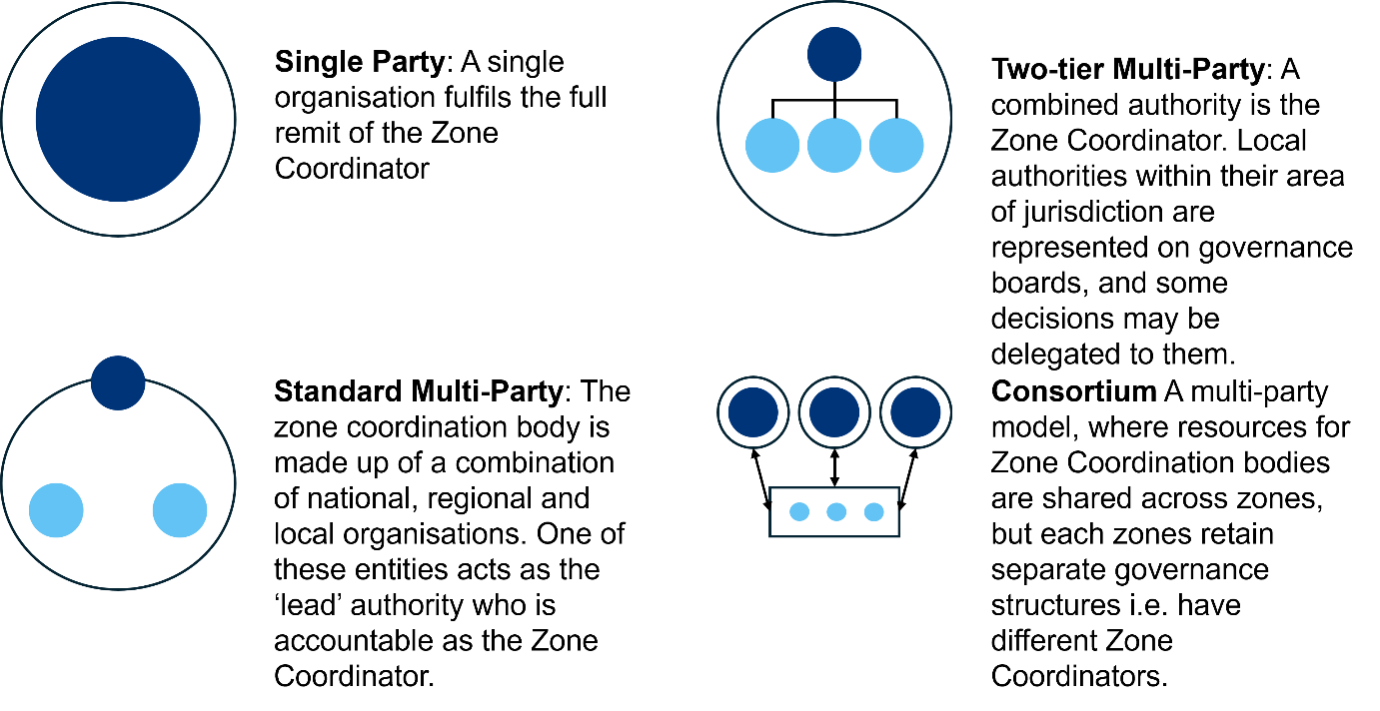
During the zone coordination body co-design process, the relevant local authorities and the heat network zoning authority will decide which of the following models for the zone coordination body best suits the government structure and geographic distribution of heat network zones in that area (also shown in Figure 1).
- Single party: A single organisation fulfils the full remit of the Zone Coordinator. For example, a single combined authority.
- Two-tier multi-party: A combined authority fulfils the remit of the Zone Coordinator but local authorities within their area of jurisdiction are represented on governance boards, and some decisions may be delegated to the local authorities.
- Standard multi-party: The zone coordination body is made up of a combination of national, regional and local organisations. One of these entities acts as the ‘lead’ authority who is accountable as the Zone Coordinator.
- Consortium: A multi-party model, where resources for zone coordination bodies are shared across zones, but each zone retains separate governance structures i.e. have different zone coordination bodies.
We consider the two-tier multi-party model the optimal approach where a zone is within the jurisdiction of a strategic authority.
Figure 1: Possible zone coordination body organisational models.
Division of responsibilities
The zone coordination body requires careful design to ensure that tasks are carried out by officials in the right local government unit, and at an appropriate level of local government.
The duties of a zone coordination body will be split between governance and operational delivery.
For example, under a two-tier multi-party structure, a combined authority may take on operational, convening and coordination responsibilities for the entire, wider geographical area. Each local council or borough in the combined authority area would be formal members of governance boards. Local councils or boroughs in the combined authority area may have some decisions delegated to them, and may also lead on other operational responsibilities, such as stakeholder engagement, within their own geographical areas.
Official invitation to form the zone coordination body
In advance of zone designation and after initial co-design has taken place, the heat network zoning authority will send a formal invitation to the relevant local authorities, asking them to form a zone coordination body. The zone coordination body jurisdiction and division of responsibilities between different levels of local government will be formalised during this process. The proposed zone coordination body will be assessed for suitability and conflicts of interest by the relevant local authorities or the heat network zoning authority.
Several respondents asked about the process for establishing a zone coordination body if the affected local authorities cannot agree on a governance structure or if no local authority steps forward. If the relevant parties cannot reach an agreement within 28 days of receiving the formal invitation, the heat network zoning authority will have the option to designate itself as the zone coordination body for that zone.
In relation to the fitness to operate assessment (question 5), respondents were supportive of our proposals. We intend to take the proposed requirements forward and they will be included in the zoning implementation regulations. Instead of the heat network zoning authority, the prospective zone coordination body will have to ensure they meet the criteria themselves. As noted above, several respondents suggested additional criteria, most prominently in relation to technical competency. We agree and will include a requirement for zone coordination bodies to ensure that they have access to sufficient expertise to enable them to carry out the duties of the Zone Coordinator. Furthermore, in response to the request for a criterion on risk management, we will include a requirement for zone coordination bodies to ensure they have effective arrangements to manage risk.
Zone coordination body governance
Respondents requested further detail on zone coordination body governance. In Question 6 of the consultation, we outlined 6 categories of requirements on which the governance policy will be based: independence, local democratic accountability, input from relevant stakeholder groups, conflicts of interest, transparency, and risk management. We will publish detailed guidance on zone coordination body governance when the heat network zoning implementation regulations take effect.
Many respondents raised concerns regarding conflicts of interest between local government and the zone coordination body. We will ensure that the final governance requirements contain strong anti-conflict measures to minimise the risk of conflicts arising. The regulations will also ensure that, if conflicts ever do occur, there are robust, legally binding mechanisms for dealing with them. There will be clear publicly available guidance on this. Additionally, please see the government response on the preferred governance model for zone delivery for more details about local authorities acting as zone developers.
We note the positive responses to our proposals to place social responsibility and community engagement requirements on the zone coordination body, which included encouraging zone coordination bodies to engage regularly with local residents by undertaking activities such as holding public events or distributing information about the heat network zone. We intend to implement these proposals while ensuring they do not cause unnecessary delay or disruption to heat network development.
Legal status of zone coordination bodies within local authorities
Once local authorities and the heat network zoning authority formally agree the structure of the zone coordination body and the relationship between the parties within it, the legal relationship between the “parent” organisation (either a local authority or the heat network zoning authority) and the zone coordination body will need to be defined. The main options are:
- Option 1 (the “principal” structure): the zone coordination body is a team directly within the relevant local authority, strategic authority or group of authorities, with appropriate separation of governance and operational duties and conflict of interest management approaches in place. This structure is similar to (but not the same as) how local planning authorities carry out their duties independently from other council departments.
- Option 2 (the “optional” structure): The zone coordination body is a separate legal entity controlled by the relevant local authority or group of authorities.
Several respondents indicated that the flexibility offered by option 2 would be welcome, especially where several local authorities are involved.
Where no agreement has been reached on who will carry out the Zone Coordinator role, and the heat network zoning authority has intervened but decided not to designate one of the relevant local authorities as Zone Coordinator (in which case Option 1 would apply), the following structure will be used:
- Option 3 (the “additional” structure): The Zone Coordinator role is carried out by the heat network zoning authority, or as a separate legal entity which is accountable to the heat network zoning authority, in place of local government control (though local authority representatives may still form part of the governance structure).
All structures would be appropriate for any of the organisational models described in Figure 1.
As we want zoning to be locally led, we envisage that option 3 will be used rarely and only when the relevant local government bodies cannot agree on an approach but the zone opportunity is important to progress. The heat network zoning authority will ensure the relevant local government bodies have been consulted before deciding to use this option. This will still allow an area to benefit from zoning where local government bodies are unable to or have decided not to take a leading role. It also allows the merging of Zone Coordinator functions for a wide area in one body, enabling the pooling of resources and knowledge between multiple local authorities.
Whichever of the 3 structures is used, the same governance requirements will apply, specifically the obligation on zone coordination bodies to regularly report to local councillors and to engage with local stakeholders. This will ensure local issues and considerations will continue to underpin the development of zones. Each model has different advantages and legal implications, which will be set out in guidance to local authorities by the heat network zoning authority in due course.
Zone coordination body funding
Respondents sought clarification as to the level of funding that will be available to zone coordination bodies, and at which point it will become available. We can confirm that funding will be provided through central government budgets for the first years of the policy. Zone coordination bodies will be allocated funding through the heat network zoning authority once the zone coordination body has been selected. This continues the approach we have already taken in supporting local areas prepare for zoning, with millions of pounds of funding, via the Advanced Zoning Programme. We are continuing to finalise funding arrangements for the longer term and will set out, in due course, how funding may be accessed.
Longer-term, as the sector matures, respondents supported the principle that zone developers should pay a greater proportion of zone coordination body costs for the zone they are formally engaged in question 7.
The heat network zoning authority will consider what funding is available when determining the published pipeline of zone opportunities and which zones are designated.
Zoning process: buildings
Question analysis - buildings in scope (Questions 8 to 26)
Q8. Please suggest the features a building must have to be considered “heat network ready”, meaning the characteristics required to enable a future connection to a district heat network.
This question received 92 responses.
In the consultation we proposed that new buildings to which the heat network could not connect during construction of the building would need to be made “heat network ready” to facilitate future connection. Key points raised by respondents included the following:
- 34 respondents noted the importance of sufficient space within the building for heat network-related plant and operating equipment, for example heat exchangers, heat interface units and meters.
- 33 respondents made suggestions relating to pipework, for example in terms of space for installing pipework and risers, access to connection points and safeguarding routes for pipes.
- 32 respondents commented on the need for appropriate flow and return temperatures to enable the efficient operation of the heat network; lower temperatures would be preferable.
- 17 respondents noted the need for adequate building fabric efficiency, and 15 respondents flagged the need for appropriately sized radiators or emitters, to ensure that heat from the heat network is used efficiently.
- 15 respondents flagged the need for a centralised heating and hot water system rather than individual boilers, and 13 respondents stressed the need for a ‘wet’ heating system.
- 11 respondents noted that the exact requirements would depend on both the nature of the building and the design of the heat network that is being connected to.
See our proposed approach at Government response – buildings in scope (Questions 8 to 26).
Q9. Do you agree that new buildings within a zone should be required to be “heat network ready” if they cannot connect immediately on completion of construction?
Table 8
| Question 9 | Response | Percentage |
|---|---|---|
| Yes | 81 | 52% |
| No | 17 | 11% |
| Not Answered | 58 | 37% |
| Comments | 90 | - |
This question received 98 responses. Of those who selected a “yes” or “no” answer, 83% agreed with the proposal.
- 11 respondents – of whom 2 agreed with the proposal and 6 disagreed – noted that the proposal could increase costs for building developers.
- 8 respondents – of whom 6 agreed and one disagreed – considered that this should be subject to exemptions, for example on cost or carbon grounds.
- 8 respondents, of whom 7 agreed with the proposal and 1 did not state whether they agreed or not – commented on the need for clarity regarding the application of planning permission, for example in respect of phased developments.
- 7 respondents – of whom 5 agreed and one disagreed – noted the need for zoning policy to align with other relevant policies, including the Future Homes and Buildings Standard and Local Plans.
- 6 respondents – of whom 5 agreed and one did not state whether they agreed or not – noted that this would mean new buildings are designed to be more efficient and would help minimise later disruption.
- 5 respondents, all of whom agreed with the proposal, noted that temporary plants would be needed where a heat network connection is not available on completion of the building; this could be the responsibility of the heat network developer/operator or zone coordination body.
See our proposed approach at Government response – buildings in scope (Questions 8 to 26).
Q10. Do you agree that all existing buildings with communal heating systems should be within the scope of the requirement to connect?
Table 9
| Question 10 | Response | Percentage |
|---|---|---|
| Yes | 81 | 52% |
| No | 18 | 12% |
| Not Answered | 57 | 37% |
| Comments | 97 | - |
Of those who selected a “yes” or “no” answer, 82% agreed with the proposal. This question had the highest engagement of all questions, with 99 different respondents providing a response.
Twenty-six respondents – 17 of which agreed with the proposal and 5 of which did not – emphasised the need to consider the wider progress on decarbonisation. Respondents wanted communally heated buildings with existing low carbon heating to be considered as distinct from fossil-fuel powered communal networks. The most common suggestion was to remove these buildings from the requirement completely or until the end of the low carbon technology’s life.
Twenty-two respondents, most of whom disagreed, described potential barriers to connecting communally heated buildings which could make the requirement to connect more difficult to implement. The reasons included: prohibitive costs placed on residents and businesses, difficulties in connecting poorly designed legacy systems, adapting historical buildings, complex pre-existing contractual arrangements, and significant disruption within the building.
Additionally, 20 respondents highlighted the role of technical and economic feasibility in the decision to require a building to connect. Five of these disagreed with the proposal, stating that old, poorly designed, or small communal systems may not be feasible to connect for economic or technical reasons. Access to an exemption process for communally heated buildings appeared as a common theme among 14 respondents. See questions 27 to 33 for an analysis of the views about exemptions.
Seven respondents raised the importance of consulting with building residents and wider communities. Primarily, this was to ensure that all those affected by the connection had clear information about what connecting would entail. Seven respondents highlighted that connecting a communally heated building would risk exacerbating fuel poverty among residents.
Five respondents wanted to expand the requirement to connect. Suggestions included buildings in single ownership without communal systems, all residential buildings, some individually heated buildings if other decarbonisation technologies are unaffordable, “campus” networks, and small district heat networks.
Finally, 4 of the respondents who disagreed believed that communally heated buildings should not be included in the requirement if it can be proven that retaining the communal system is better value or more cost-effective. Three respondents specifically indicated that connecting a poorly performing communal heat network to a district system could be unaffordable or undesirable for the district network.
See our proposed approach at Government response – buildings in scope (Questions 8 to 26).
Q11. What impacts, if any, may this have on building owners, tenants, residents and other communally heated building users? Please provide any mitigations.
This question received 96 responses.
The most common suggested impacts of the requirement to connect, from 68 respondents, were about the costs: the cost of connecting to the heat network, retrofitting the building, or the cost of the disruption to the lives of tenants and residents. Respondents indicated that building owners would likely pass the upfront costs of connecting down to tenants and residents. Most mitigations suggested described financial support, such as grants, loans or tax relief, which would decrease the costs of connecting, as well as flexibility to minimise disruption.
Twenty-six respondents described the technical or contractual challenges of the requirement to connect. This included how the requirement to connect interacted with, for example, existing heat supply agreements or complex ownership models. The technical impacts included the complexity of having to adapt buildings to take heat from the heat network, mainly focussing on retrofit measures. Respondents highlighted the costs of resourcing or legal fees to manage these complexities. The main mitigations suggested included good quality engagement, communication, and flexibility – especially around exemptions – to ensure buildings can connect at an appropriate pace.
Twenty-two respondents indicated an impact on heating costs or consumer protection, stating that some may pay more for heat than they do with their existing infrastructure. Some respondents thought that there could be a positive impact, with costs being lower through larger strategic heat networks.
Thirteen respondents specifically mentioned that consultation and engagement between the zone developer, the zone coordination body and the building owner will be important to minimise any negative impacts on the building or its occupants. Three respondents also mentioned that better alignment with other decarbonisation policies, such as grant funding schemes like the Public Sector Decarbonisation Scheme (PSDS) [footnote 5] and the Warm Homes: Social Housing Fund (WH:SHF) [footnote 6] would help to minimise impacts on building residents.
See our proposed approach at Government response – buildings in scope (Questions 8 to 26).
Q12. Please describe any implications for local authorities from the requirement to connect existing publicly owned, communally heated buildings to district heat networks.
This question received 79 responses.
Thirty-six respondents described funding, budget and resource implications for local authorities if publicly owned building were required to connect. Respondents indicated that local authorities may face costs related to connecting as well as refurbishing or otherwise preparing buildings for connection. Some also described the additional human resources required by local authorities, such as staff for project management, commercial, and negotiation.
Twenty-four respondents described impacts on local authorities related to refurbishment of pre-existing public sector buildings to make them suitable for connecting to a heat network. This included not only cost (around 10 respondents) but also the logistical challenges of upgrading potentially large estates in time for the connection date.
Eleven respondents indicated that local authorities may come up against procurement and contractual issues when their buildings are required to connect. Respondents specifically highlighted potential conflicts with the Procurement Act 2023.
Seven respondents emphasised that local authorities would need to carry out significant stakeholder engagement to manage expectations around preparation for connection to the heat network, with implications on resourcing.
Respondents described several other implications including but not limited to the need to carry out surveys, managing complex work on heritage buildings, the lack of skills or knowledge about heat networks within the local authority, and balancing connection with existing plant which has not yet reached the end of its life.
See our proposed approach at Government response – buildings in scope (Questions 8 to 26).
Q13. Which multi-unit residential buildings should be “heat network ready” following significant refurbishment? Please describe any impacts of this on owners or other users of these buildings and any appropriate mitigations.
This question received 70 responses.
Twenty respondents said all multi-unit residential buildings should be heat network ready following significant refurbishment. Twelve respondents considered that any requirement should be applied more flexibly, for example only where it is cost-effective.
Twenty respondents proposed specific building types, including assisted living facilities or nursing homes (5 respondents), student accommodation (5 respondents), blocks of flats (4 respondents), mixed-use buildings or those converting from non-residential to residential (4 respondents), and new developments and children’s homes (1 response each).
Six respondents felt any requirement should be determined based on the building’s heat demand or number of dwellings.
Five respondents noted the importance of consistency with wider requirements relating to buildings safety, while 5 respondents felt the proposal required a clear definition of ‘significant refurbishment’.
See our proposed approach at Government response – buildings in scope (Questions 8 to 26).
Q14. Please suggest how to assess the cost-effectiveness of making buildings “heat network ready” during significant refurbishment, including which costs should be considered.
This question received 75 responses.
Thirty-six respondents indicated that a wide scope should be taken when assessing the cost effectiveness of making buildings heat network ready. This includes considering the whole life costs of both the heat network and the alternative low carbon technology, considering the capital cost, operating costs and the costs of any other physical changes within the building required to make it heat network ready.
Twelve respondents indicated that the financial viability of the connection would need to be assessed – primarily referring to how long the repayment period is, and how affordable the changes are. Eleven respondents stated that environmental and social impacts would need to be considered, such as the carbon intensity of the heat network and the impacts on fuel poverty.
Eight respondents stated that any assessment of cost effectiveness would be building-specific, and another 8 indicated that some in-person building assessments might need to be carried out to assess the viability of making them heat network ready.
Four respondents highlighted the importance of assessing buildings using standard assumptions or a methodology, with 2 indicating that sufficient guidance should be available.
See our proposed approach at Government response – buildings in scope (Questions 8 to 26).
Q15. Please suggest a suitable definition of “significant refurbishment”. If possible, the definition should be unambiguous, enforceable and definitive.
This question received 66 responses.
The most common suggestion, made by 22 respondents, was to link significant refurbishment to the replacement or update of the building’s existing heating system, such as replacement of a defined proportion of the heating system, works to the heating system, which affect the majority of residents of a building, or works to extend the heating services. Five respondents specifically stated that vacation of premises should be used as a metric for judging if a refurbishment is “significant” enough. Three suggested that applying for WH:SHF or PSDS funding could indicate a building will undergo significant refurbishment.
Thirteen respondents suggested aligning the definition of significant refurbishment with existing statutory definitions. Most of these respondents suggested the definition included in building regulations and their approved documents i.e. changes to 25% of the building envelope. Others suggest the definition in Heat Network Metering and Billing regulations or planning definitions around change of use or permitted development rights.
Twelve respondents linked the definition to structural changes to the building, including changes to the internal layout, changes to the building envelope or extensions. Twelve others suggested including energy performance improvements, such as the installation of insulation. Eleven respondents suggested that a change of use should be considered significant refurbishment.
Five respondents suggested that significant refurbishment should be linked to a cost metric i.e. a percentage of the value of the property.
See our proposed approach at Government response – buildings in scope (Questions 8 to 26).
Q16. Among the metrics listed in Table 2, which, if any, do you think should determine whether a non-communally heated, non-domestic building is within scope of a requirement to connect? Please provide alternative metrics if you disagree with those listed.
Table 10
| Question 16 | Response | Percentage |
|---|---|---|
| Reported annual average heat demand (MWh per year) | 32 | 21% |
| Total installed heat capacity (kW) | 7 | 4% |
| Gross/net internal floor area (m2) | 7 | 4% |
| A combination of floor area and use-type (commercial m2, warehouse m2) | 11 | 7% |
| Annual heat demand based on standard use-type energy density benchmark (MWh/m2/yr*m2) | 23 | 15% |
| None of the above | 3 | 2% |
| Not Answered | 108 | 69% |
| Comments | 61 | - |
Reported annual average heat demand (MWh per year) and annual heat demand based on use-type energy density benchmarks were the most preferred options – around 70% of respondents who selected at least one option chose one of these. Respondents supported the former as it most closely aligns to a building’s real heating demand, providing more certainty about the potential revenues from that building. Respondents supported the latter as energy benchmarks can be based on empirical data, noting that it is easy to understand and has a standardised calculation structure.
Respondents who disagreed with using gross/net internal floor area suggested this would be too simplistic and select buildings with low heat density unsuitable for connecting. Those opposed to installed heat capacity indicated that buildings often have oversized boilers, thus making it an inappropriate metric for accurately designing a connection.
Respondents provided suggestions for a range of alternative metrics or other factors which should be considered, including peak load utilisation and demand seasonality, among others.
See our proposed approach at Government response – buildings in scope (Questions 8 to 26).
Q17. For any additional metrics you have suggested, please describe how they are, or could be: (i) independently verifiable; (ii) made easy / simple to understand; (iii) effective in selecting relevant buildings.
This question received 41 responses. Due to the range of different suggested metrics, the responses are summarised in Appendix 5.
See our proposed approach at Government response – buildings in scope (Questions 8 to 26).
Q18. For each of the metrics you have proposed in the previous questions, please describe a suitable threshold.
This question received 35 responses. Due to the range of suggested metrics, the responses are summarised in Appendix 5.
See our proposed approach at Government response – buildings in scope (Questions 8 to 26).
Q19. Do you agree with the proposed mechanism for activating the requirement to connect?
Table 11
| Question 19 | Response | Percentage |
|---|---|---|
| Yes | 52 | 33% |
| No | 14 | 9% |
| Not Answered | 90 | 58% |
| Comments | 70 | - |
Of those who selected “yes” or “no”, 79% agreed with the proposals and 21% disagreed.
The most common concern, raised by 16 respondents, was the lack of a requirement on buildings to use heat from the connection to the network. Respondents highlighted that a failure to require the use of heat would undermine the business case for heat networks.
Thirteen respondents stated a need for early engagement and awareness raising in advance of the process beginning. Suggestions as to how this could be achieved included: publishing development plans for the network as soon as possible, allowing building owners to express an interest in connecting before or soon after the zone is designated, and establishing trusted intermediaries to raise awareness of the heat network and low carbon heating in general.
Eleven respondents were clear about the importance of having a flexible approach due to the diversity of buildings. Additionally, 7 respondents raised the need for incentives or financial support to encourage connections and use of heat from the network.
See our proposed approach at Government response – buildings in scope (Questions 8 to 26).
Q20. What, if any, unintended consequences for building developers, owners, and residents, would result from requiring existing buildings to connect at a time determined by heat network developers? Describe any mitigations.
This question received 83 responses.
Thirty-seven expressed concerns around increasing costs to building owners & tenants. Respondents identified a variety of sources including the cost of connection, interference with existing infrastructure development plans and having to exit long term energy contracts. This was of particular concern to housing associations or building owners that could have multiple buildings within a heat network zone.
Thirty-two expressed issues relating to the age of existing heating infrastructure, and the long-term planning process that goes into replacement plans. Concerns related to this included increased life cycle carbon emissions from early replacement of infrastructure, short-connection times that may not be in line with the pre-existing buildings owners / operators.
Twenty raised the issue of disruption to end users of the connection process, such as upgrading heating systems in flats, and how to mitigate for distress replacements needed shortly before connection date. There were also concerns around what structures would be in place to ensure continuity of heating or hot water throughout the connection process.
Fifteen respondents suggested strong consultation processes would be needed with a variety of stakeholders, particularly local authorities, building owners and tenants, throughout the zoning process.
Twelve raised concerns that zoning may interact negatively with existing contract or legal obligations. This includes energy supply contracts that are held for multiple years to provide price stability, statutory and contractual obligations that landlords have with tenants, and difficulty in identifying building owners and responsibilities during the zoning process.
Eleven respondents highlighted concerns that the heat network regulations, standards and consumer rights were either lacking or needed to be strengthened to ensure that building owners and/or tenants are reasonably protected.
Ten respondents raised concerns that the powers proposed for heat network operators – specifically the requirement to set connection and activation “windows” and act as sole suppliers – could limit the ability of building owners to avoid high or potentially unaffordable costs.
Ten respondents raised concerns that the zoning policy could create market distortions including:
- Building owners avoiding connection by installing low carbon heating systems, or hiring consultants to exaggerate claims of exemptions, via overestimating the cost of heat networks relative to a counterfactual technology.
- Building owners deferring investment in low carbon heating upgrades because of uncertainty of if they will be required to connect in the future.
- Market distortions in property prices where buildings have a requirement to connect or uncertainty on if there will be a requirement to connect.
Eleven respondents suggested increased financial support for buildings required to connect to heat networks under zoning and 6 respondents suggested creating schemes associated with zoning similar to other capital grant schemes, such as grants equivalent to the Boiler Upgrade Scheme (BUS) to support additional voluntary connections, or support similar to Green Heat Network Fund (GHNF) to support building owners with the cost of connection and retrofit costs.
See our proposed approach at Government response – buildings in scope (Questions 8 to 26).
Q21. What types of incentives could encourage connections to heat networks? For each suggestion, describe how the incentive will encourage connection, for instance by specifying which barrier to connecting.
This question received 82 responses. Respondents suggested a wide range of potential incentives. Due to the range of responses, we have summarised them in Appendix 5.
See our proposed approach at Government response – buildings in scope (Questions 8 to 26).
Q22. Do you agree with the following timings for connecting existing buildings?
Table 12
| Question 22 | Response | Percentage |
|---|---|---|
| 1 year for the connection window | 33 | 21% |
| 6 months for the agreement period | 28 | 18% |
| 2 months for the buffer period | 30 | 19% |
| Disagree with all the above | 14 | 9% |
| Not Answered | 109 | 70% |
| Comments | 70 | - |
Please note that percentages for this question do not sum to 100 as respondents could select multiple answers.
For reference, the consultation proposed the following timeline for the connection of pre-existing buildings:
- The zone coordination body issues the building a connection notice which specifies a minimum 1-year “connection window”.
- The zone coordination body will determine the maximum duration of the connection window in line with any growth conditions imposed on the zone developer as part of the award of zoning rights.
- The building owner then has a minimum of 6 months to agree an exact connection date with the zone developer – the “agreement period”. The exact connection date must fall within the connection window.
- The maximum length of the agreement window is determined by the timing of both the requirement to connect and the associated connection window.
- The building owner can also apply for an exemption during the agreement period.
- The agreement period would be followed by a 2 month “buffer period” so the zone coordination body can finalise any exemption applications or internal reviews.
Many respondents stated their preferences in comments rather than selecting an option on the online form. When preferences expressed in comments are included and non-responses excluded, the percentage breakdown is adjusted as follows:
- 51% of respondents agreed with a 1-year connection window.
- 42% of respondents agreed with a 6-month agreement period.
- 44% of respondents agreed with a 2-month buffer period.
- 23% disagreed with all the proposed timings.
Disagreement with all the options was highest amongst heat network developers.
Fifteen respondents suggested longer periods than those proposed:
- 5 wanted a longer agreement period (up to a year)
- 4 wanted a longer buffer period (up to 3 months)
- 2 wanted a longer connection window (up to 5 years)
- The remainder requested longer in general or for all the proposed periods.
Only 4 respondents, who were all heat network developers, wanted shorter periods than those proposed in the consultation.
Seven respondents suggested that a maximum period for each phase should be defined to minimise variation between zones.
Several respondents raised various views on how flexible these windows should be. Five stated that the zone coordination body should have the ability to extend each period for certain circumstances. Four expressed a preference for general flexibility to suit individual building circumstances.
See our proposed approach at Government response – buildings in scope (Questions 8 to 26).
Q23. Please describe any administrative burdens or other impacts on any entity which could be caused by the use of agreement and buffer periods and describe any mitigations.
Fifty-eight respondents commented on impacts and mitigations related to the use of agreement and buffer periods.
Seven respondents highlighted the potential for backlogs and burdens due to administrative overload. Causes included: a large number of applications near the beginning and end of the agreement and buffer periods, the need for zone coordination bodies to hold records in line with the agreement and buffer periods of multiple entities, and, where they serve as the zone coordination body – other responsibilities local authorities need to undertake. Two respondents commented on integration with other processes, including proposed Future Homes heat allocation and the wider planning process.
Four respondents indicated that low understanding of the end-to-end process could be burdensome. Further, 5 respondents emphasised that undertaking due diligence as part of the process would require both legal costs and time. Five respondents highlighted a need for a standard contract or agreement template to simplify and shorten the agreement process. Similarly, 3 respondents wanted standardised commercial terms and 2 emphasised the need for further guidance on buffer and agreement period processes.
Respondents also mentioned timeline-related constraints that may emerge during the given periods. Three respondents raised concerns about the availability of contractors, with one specifically referring to heat suppliers. Additionally, 7 respondents noted that securing consents, planning application approvals, permits, and similar processes may be lengthy and not align with proposed timelines. Five respondents noted the requirement for the zone coordination body to coordinate activities between multiple sites – each with its own agreements and buffer periods- could result in administrative burdens. One respondent suggested the introduction of a centralised application tracking system to help manage these complexities.
Four respondents emphasised the need to ensure adherence to deadlines by all parties involved, with 4 respondents separately identifying building owners as key stakeholders who must be actively engaged to support compliance.
Two respondents found the agreement period to be short. Additionally, 2 respondents found the proposed buffer periods to be insufficient. Conversely, one respondent described that shorter agreement and buffer periods could lead to lower ‘administrative overhead’.
Several respondents indicated a need for funding as a mitigation for burdens faced by various entities.
See our proposed approach at Government response – buildings in scope (Questions 8 to 26).
Q24. Please indicate when you believe the following stages in the connection process should begin and end for new buildings. Please be specific by, for example, naming the stage in the development process, such as Gateway 1 or Gateway 2.
Part A – the agreement period
There were 52 responses to this part of the question.
Respondents held a range of views about when the agreement phase for new buildings should start.
Thirteen respondents indicated that the agreement phase needs to begin before a planning application is made by a building developer, with some respondents indicating the planning pre-application as an appropriate milestone for the process to begin.
Eleven respondents indicated that the agreement phase should begin when a building application is made. However, several respondents indicated this was conditional on either the building developer and heat network developers communicating beforehand, or the building developer being aware of the requirement to connect before making an application. Two respondents mentioned the submission of outline planning permission as the specific milestone.
Nine respondents indicated that the agreement phase should end before the final design of the building is approved. Of these, 2 respondents indicated that, if the connection to a heat network has not been resolved prior to planning permission, a reserved matters application or a section 106 agreement could be used to ensure an agreement is reached. Only 2 respondents indicated that the agreement phase should end as late as the installation of the heating system for the buildings.
Five respondents made general points about how planning policies must be in place to facilitate the agreement phase. Respondents suggested that National Development Management Policies could bring the process for requiring buildings to connect into the planning process, and that “heat hierarchies” could provide more direction as to what heating technology should be adopted by new buildings.
Part B – the buffer period
There were 35 responses to this part of the question.
Compared to Part A, respondents were less consistent in their recommendations for the timing of the buffer period.
Suggestions included:
- Begin following discharge of planning conditions.
- End before planning application made.
- End before planning permissions is granted.
- End when connection is made.
- End before RIBA 3 planning stage.
- End before RIBA 4 planning stage.
- End by Gateway 2 (from Building Safety Act)
- The buffer should be 6-12 months long.
- The length and duration of the buffer period should be determined on a case-by-case basis.
See our proposed approach at Government response – buildings in scope (Questions 8 to 26).
Q25. Do you foresee the process for connecting new buildings introducing any burden or delays on the building development process? Please suggest any mitigations.
Table 13
| Question 25 | Response | Percentage |
|---|---|---|
| Yes | 34 | 22% |
| No | 14 | 9% |
| Not Answered | 108 | 69% |
| Comments | 70 | - |
Of those who selected a “yes” or “no” answer, 71% of respondents foresaw delays or burdens on the building development process from the proposed method for connecting new buildings.
Seventeen respondents emphasised the potential of delays without early engagement and extensive communication with heat network and building development stakeholders. Thirteen respondents indicated the need for availability of regulatory information prior to the building development process and 3 respondents suggested that standardised commercial terms should be available to facilitate connection.
Fourteen respondents raised concern about burdens caused by independent deadlines between heat network delivery and new development planning and delivery processes, with few outlining a need for guaranteed deadlines on heat networks to prevent such concerns. A further 7 respondents expressed that heat networks should either be guaranteed or exist prior to new build development to prevent commercial risks.
Ten respondents expressed planning related concerns that may emerge despite flexibility in connection timing. These include incompatible planning process and heat network connection timelines, delays in obtaining planning permissions, clashes with other large public infrastructural development (e.g. highways or drainage systems), and the need to revise plans or planning applications during development from changes to connection requirements or policy. Six respondents mentioned additional notice or longer agreement and buffer periods in the process to connect.
Four respondents foresaw delays in the beginning of the connection process due to the general newness of implementation. Similarly, 3 respondents mentioned general administrative backlogs and 4 mentioned construction related delays. Additionally, 5 respondents highlighted that the involvement of multiple entities in the building development process creates the need for extensive coordination and collaboration across parties.
To mitigate some of the above possible burdens, respondents suggested measures to reduce delays and costs for stakeholders. Of these, 3 respondents highlighted a need for financial support for new buildings required to connect while 2 respondents wanted funding to be available for heat sources. Another 2 respondents suggested funding for developers, which may be fulfilled by the existing GHNF and BUS.
See our proposed approach at Government response – buildings in scope (Questions 8 to 26).
Q26. Do you foresee any of the proposals in this consultation placing disproportionate burdens on the following (a) and (b)? If so, indicate what the impact could be on housing supply:
a) Housing developers in general
b) SME housing developers
Table 14
| Question 26 | Response | Percentage |
|---|---|---|
| Yes – housing developers in general | 4 | 3% |
| Yes – on SME housing developers | 1 | <1% |
| Yes – on both house developers in general and SME housing developers | 17 | 11% |
| No disproportionate burden foreseen | 24 | 15% |
| Not Answered | 110 | 70% |
| Comments | 61 | - |
Fourteen respondents said they did not foresee the proposals placing disproportionate burdens on the given groups.
Sixteen respondents referenced cost in their responses. Responses covered topics such as cost certainty, cost effectiveness, cost implications being more significant for smaller developers, or cost to connect.
Eleven respondents discussed delays due to infrastructure and bottlenecks in the supply chain. Five respondents commented on the impact on new housing developments, particularly highlighting concerns around delays to delivery. One respondent mentioned that “the volume and scope of heat network zoning arrangements could deter new housing developments within designated zones particularly during the early roll out of the arrangements”. Another mentioned that “disproportionate burden could in turn create issues with the supply of new housing.”
Eight respondents highlighted the importance of engagement and/or training. This included the need to educate and support SME housing developers while they adapt to new heating technologies, ensuring that clear guidance and technical support are readily available, and investing in workforce upskilling to enable the deployment of heat networks at pace and scale.
Seven respondents mentioned the need for flexibility with regards to timing, the potential for slower or reduced delivery on supply, and the timing of connection.
Six respondents referred to the supply chain. This included numerous comments on skills (e.g. low carbon technology skills, designers and installers, builders).
Four respondents mentioned exemptions and/or avoidance of connection. Two respondents noted the potential for developers to “submit applications on the basis that they won’t have to connect” which will “prolong the planning process and undermine the viability of heat zones”.
Four respondents referred to development viability, including that of pre-existing buildings. This included one reference to brownfield sites “which generally already face viability and deliverability issues”.
Five respondents mentioned the potential of a disproportionate impact on small developers or SMEs. One response included the risk that SMEs “might find it more challenging to secure financing for projects that include the additional complexity and cost of connecting to heat networks, especially if lenders perceive these projects as higher risk.”
See our proposed approach at Government response – buildings in scope (Questions 8 to 26).
Government Response – buildings in scope (Questions 8 to 26)
Zoning process: buildings
We expect heat network developers to engage proactively with building owners to encourage connections to the heat network. However, to build investment certainty and to ensure coordination of the development of a local heat network, local government-sponsored zone coordination bodies will be able in some instances to require some buildings (categories confirmed below) in zones to connect to the zone’s heat network. This connection will have to be completed within a defined timeframe after the issuance of a connection notice. When zoning launches, buildings will not have to pay for the cost of connection when required to connect and the zone’s heat network will have to negotiate commercially with the building on the cost of connection they will have to pay. In future, as the sector matures and the cost of low-carbon heating falls, we intend to introduce protections so that future connection costs can be no higher than the building’s alternative heating technology.
The zone developer for the area will be able to trigger this process by asking the zone coordination body to issue a notice to specific buildings – the zone coordination body will not send notices without this request. This will allow the zone developer to secure the connection of a building to the heat network at a specific point in time. In addition, while buildings may be required to connect and maintain the connection to the heat network, they will not be required to buy heat from the heat network. They will still be able to keep their previous heating systems in place even after connection if they are not yet ready to buy their heat exclusively from the heat network. Over time, after the building has been connected, and with the cost of low-carbon heating becoming the rational choice through industry and government interventions, we expect many buildings will opt to buy heat from their zone’s heat networks.
Ultimately if building owners and zone developers can mutually agree the terms of connection to the satisfaction of both parties, the requirement to connect will not be needed.
Owners of buildings which are required to connect will have to allow for the installation of a functional heat network connection. This includes the installation of external pipework from the heat main to the building, the installation of a heat interface unit and any associated equipment, and any changes to the internal heating system or structure of the building needed to make the connection functional. This will not include equipment or works necessary to improve the efficiency of the building’s heating system. We are separately consulting on minimum technical standards for heat networks in the Heat Networks Technical Standards Consultation, published in January 2026.
Zoning legislation does not apply to bodies with Crown Status, meaning that buildings or heat sources owned by the Crown (including the Crown Estate, central Government departments and some of their associated agencies, and the Duchies of Cornwall and Lancaster) cannot be required to connect to a heat network in a zone. We are engaging with the relevant bodies with Crown Status to make them aware of the benefits and opportunities of heat networks and how they can support the implementation of Heat Network Zoning. We are also exploring legislative amendments that would enable us to apply appropriate parts of the heat network zoning framework to the Crown.
As detailed in the Carbon Budget Growth and Delivery Plan, the government will continue to examine how best to support households and businesses with energy costs. We intend to consult on options to reduce costs and make electrification an economically rational choice for a wider range of businesses and organisations.
Categories of building in scope
New buildings
We confirm that new buildings will be in scope of the requirement to connect, where a “new building” is any building that receives planning permission after the designation of the zone. This means that buildings which have already received planning permission prior to the designation of the zone, but which have not yet started construction, will not be required to change their heating systems post-designation.
We note the support for the proposal that new buildings within a zone should be required to be ‘heat network ready’ if they cannot connect to a heat network by completion of construction (question 9), as the building would likely in future be within range of an upcoming heat network. We intend to introduce this requirement and will work with colleagues at the MHCLG to do so through relevant building standards. Responses to question 8 have informed guidance on heat network ‘compatibility’ which was published as part of the launch of phase 4 of the Public Sector Decarbonisation Scheme, in October 2024.
Pre-Existing communally heated buildings
We confirm that all pre-existing communally heated buildings will be in scope of the requirement to connect (question 10). We do not expect there to be significant commercial interest in requiring small (<10 premises) communally heated buildings to connect, but we are including them within the scope so as not to exclude buildings which may support the successful delivery of heat networks in zones.
The proposals for exemptions from the requirement to connect and connection cost caps (see our proposed approach at Government response – emissions limit (Questions 43 to 46) should mean that these requirements will not impose costs or technical difficulties on these buildings.
Buildings undergoing significant refurbishment
We will not take forward the proposal that other non-communally heated multi-unit residential buildings should be made heat network ready following significant refurbishment (questions 13-15). We have concluded that the complexity of defining relevant “significant refurbishment” for these types of buildings and enforcing the requirement would make this requirement unworkable in practice.
Large non-domestic buildings
Having considered responses received to questions 16-18 we confirm that non-domestic buildings will also be in scope of the requirement to connect if their measured annual average heat demand is greater than 100 MWh and if they already have a ‘wet’ heating system. If measured data is not available, consumption will be estimated using use-type energy density benchmarks.
Campus networks
Following feedback from respondents we intend to extend the requirement to connect to buildings if they contain an energy centre which supplies heat to a “campus network”. We agree with respondents who argued that the same logic of applying a requirement to connect to buildings with communal heat networks should apply to campus networks. The detailed definition of a campus network is found in the Government response – incumbent networks and investment (Question 67).
Public sector procurement and the requirement to connect
Under the requirement to connect, building owners will have to agree a connection date and potentially carry out additional works to enable the connection to take place. Building owners may also decide to agree to an optional heat supply contract with the heat network. The contracts for connection, additional works or heat supply may be considered “covered procurement” under the Procurement Act 2023 if the building owner is a public authority. Public authorities will need to seek their own legal advice on whether a competitive procurement is required or whether these contracts may be awarded directly. While it is not for the Department to advise public authorities or issue legal advice on this matter, we aim to publish light-touch guidance to help building owners navigate the process for connecting under their procurement obligations. We are also exploring viable ways to mitigate the procurement burden on public authorities.
Activation of building connections
We will proceed with the proposed mechanism for activating the requirement to connect outlined in the consultation, with some minor changes. We believe the approach to requiring buildings to connect within specified time windows will provide a good balance between the need to provide assurance to heat network developers but also provide building owners with sufficient time to consider their options fully.
The zone developer will ask the zone coordination body to issue a connection notice to the relevant building, which the zone coordination body will be required to do within 2 weeks of receiving such a request. Receipt of the connection notice will initiate the connection process. Within the first 6 months after receiving the notice (the ‘agreement phase’), either:
1. The building owner and the zone developer agree to an exact connection date within the connection window, or;
2. The building owner applies for a temporary exemption.
The connection window, which much be at least 12 months long, and the agreement period can run simultaneously, but the connection window must not start any later than the end of the agreement period.
The main change to the proposed process set out in the consultation is that a zone developer may only activate the requirement once they receive consent, from the zone coordination body, to develop a heat network in the zone. Additionally, building owners may only apply for a temporary exemption once they receive a connection notice, as described in the following response section.
Therefore, the earliest a zone coordination body can send a connection notice is once a developer receives consent to develop a heat network. The zone developer will be bound by growth requirements they committed to as part of the Zone Development Plan and we expect this combination of measures will ensure the orderly connection of buildings at an appropriate time in the development of the heat network. For more information on the phased consents process, please see the Government response – preferred governance model (Question 69). If the heat network developer and the building fail to agree a connection date within the agreement period, zone developers can ask the zone coordination body to set the final connection date.
We recognise the views shared by stakeholders on potential impacts resulting from the use of agreement periods and the connection window. We will monitor this impact when the policy is implemented but will proceed with the proposed minimum periods of 6 and 12 months, respectively.
For new buildings, the consultation proposed that local planning authorities would notify zone coordination bodies of new planning applications. Instead, we have agreed to work with MHCLG to implement an informal notification processes between the planning authority and the zone coordination body for an area. The requirement to connect process will be administered separately from the relevant local authority’s wider planning function. The zone developer will be able to request a connection notice when they are informed of a planning application for a new building development, but before planning permission has been granted. The connection must be established prior to the completion of the building. Building developers will also be able to apply for exemptions to the requirement to connect before they complete construction. Zone coordination bodies and zone developers will have engaged with building developers as early as possible in the process of developing plans and designs for new buildings. We will expect but not require that local planning authorities will inform new build housing developers of zoning requirements through pre-application advice to applicants.
Question analysis – exemptions (Questions 27 to 35)
Q27. Do you agree that the agreement phase is an appropriate time for buildings owners to apply for exemptions?
Table 15
| Question 27 | Response | Percentage |
|---|---|---|
| Yes | 45 | 29% |
| No | 19 | 12% |
| Not Answered | 92 | 59% |
| Comments | 54 | - |
Of those respondents selecting “yes” or “no”, 70% agreed with the proposal that the agreement phase is an appropriate time to apply for exemptions.
Thirteen respondents suggested that building owners should be able to apply for exemptions earlier in the requirement to connect process. One local authority suggested that engagement prior to the agreement phase would provide clarity to investors and building owners about a future exemption application. Of those who disagreed with the proposal, most raised concerns about the risk that heat networks and buildings might have to take on without clarity about the buildings which would be exempt, therefore arguing for an earlier exemption application process.
Relatedly, 5 respondents who disagreed with the proposal indicated that, for new buildings, exemptions must be settled before the developer submits a planning application, or even before they purchase land. Respondents commonly referred to how a required heat network connection would affect the design of the building. Five respondents explicitly indicated that a shorter period should also be used – namely one where all exemptions are resolved in less than 3 months after the receipt of an activation notice.
Eight respondents, 4 of which agreed and the remainder neither agreeing nor disagreeing with the proposal outright, emphasised the need for the zone coordination body to be flexible. Some reasons given for this position included the need to facilitate a smooth transition to a heat network from existing assets and to allow for flexibility in case of unforeseen circumstances.
Five respondents also emphasised that the zone coordination body should carry out extensive early engagement with the relevant buildings. This would give buildings enough time and information to gather evidence for an exemption application and would also indicate to the zone coordination body which buildings may apply during the application window.
Four respondents stated that the clarity and efficiency of the exemptions process would determine if the agreement period would be practical for exemptions applications. Four respondents indicated that leaving exemptions to the agreement period may increase the risk of the building installing an alternative heating technology before a heat network can connect them.
See our proposed approach at Government response – exemptions (Questions 27 to 35).
Q28. Do you agree with the proposal that exemptions should be either temporary or conditional?
Table 16
| Question 28 | Response | Percentage |
|---|---|---|
| Yes | 57 | 37% |
| No | 10 | 6% |
| Not Answered | 89 | 57% |
| Comments | 53 | - |
Of those responding yes or no, 85% agreed with the proposal.
Across the responses, a broad theme was a request for further clarity on the definitions of exemption types. Respondents made comments on the wide range of circumstances that might lead to a building requesting an exemption and the implications that could have for the number of exemptions and the subsequent effect on the feasibility of heat networks in zones.
Nine respondents raised the issue of permanent exemptions, only one of whom agreed with the overall proposal. Two of these respondents raised concerns that the exemption structure could inadvertently lead to functionally permanent exemptions, but the remainder suggested that permanent exemptions should be a distinct, additional type of exemption. Four respondents specifically stated that new buildings should be granted permanent exemptions if the heat network cannot connect them during building construction.
Seven respondents discussed the role of existing heating systems when assessing exemptions. Around half of these proposed that buildings with existing low carbon heating systems should be exempt or that buildings should be exempt until the end of life of their existing system. Conversely, the remainder stated that granting exemptions based on a recent investment in a new heating system should not be allowed, or proposed that exemptions for existing low carbon heating technologies should use standard assumptions about the lifespan of that technology.
In addition to the 3 respondents supporting exemptions for existing low carbon systems, one further respondent explicitly supported allowing building developers to apply for exemptions during construction on the basis that they can provide a lower cost low carbon alternative to a heat network.
There were also some minor themes, some of which were also raised in response to other questions. These included:
- Supporting the inclusion of fuel poverty in assessing exemptions.
- Noting the potential administrative burden of complex exemption assessments.
- Supporting the exclusion of a gas-based counterfactual and ensuring that direct electric heating is not considered an alternative.
See our proposed approach at Government response – exemptions (Questions 27 to 35).
Q29. Should leaseholders be provided with a route for requesting an exemption?
Table 17
| Question 29 | Response | Percentage |
|---|---|---|
| Yes | 36 | 23% |
| No | 19 | 12% |
| Not Answered | 101 | 65% |
| Comments | 61 | - |
Of those who selected “yes” or “no”, 65% agreed with the provision of a route for leaseholders to request an exemption. There was a clear split in the themes in the responses between the respondents who agreed or disagreed with the question.
Eleven respondents, most of whom said “no”, stated that the existing consultation process required by the Landlord and Tenant Act 1985 should be the main avenue for leaseholders to express their views on exemptions to their landlords. Eight respondents who also mainly disagreed with the proposal said that adding in an exemptions route for leaseholders would add unnecessary complexity to the process.
Conversely, 10 respondents who mostly agreed with the proposal said that leaseholders should be able to apply for an exemption if they are responsible for the building’s heating systems. Additionally, 7 stated that they should be able to apply if connecting would increase their heating costs and have a disproportionate impact on their finances. Finally, 6 respondents said that non-domestic leaseholders in possession of a long lease should have the ability to apply for an exemption.
See our proposed approach at Government response – exemptions (Questions 27 to 35).
Q30. How frequently should buildings holding a conditional exemption have to reapply? Please suggest a single number of years and any mitigations to reduce the burden of reapplying on building owners.
Figure 2 Summary of responses to question 30
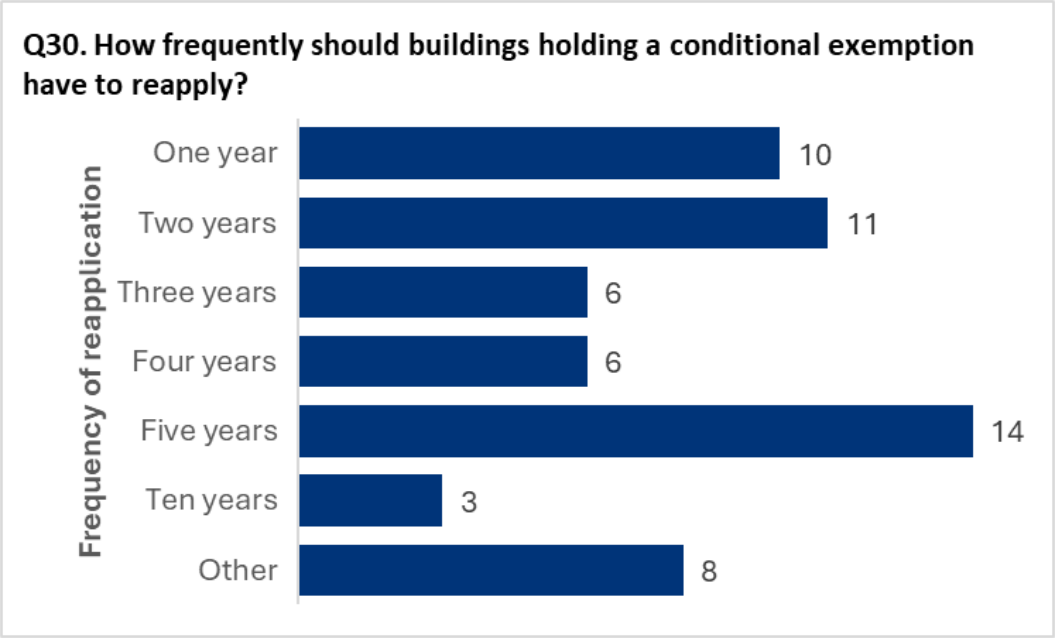
As indicated in Figure 2, 14 respondents (24%) preferred a five-year reapplication window, followed by 11 (19%) and 10 (17%) preferring two- and one-year windows, respectively. Overall, 33 respondents preferred a window of less than 5 years, and 17 preferred 5 years or more.
Eleven respondents indicated that reapplication should be streamlined, allowing for buildings to submit “no change” reapplications to ease administrative burdens. Three respondents indicated that reapplications should only happen if the building undergoes a material change of use, or when the condition of the exemption is broken.
See our proposed approach at Government response – exemptions (Questions 27 to 35).
Q31. Do you agree that building owners or developers should be able to apply for exemptions on grounds of either a) cost or b) timing?
Table 18
| Question 31 | Response | Percentage |
|---|---|---|
| Yes – cost | 5 | 3% |
| Yes – timing | 6 | 4% |
| Yes – cost and timing | 61 | 39% |
| No | 4 | 3% |
| Not Answered | 80 | 51% |
| Comments | 57 | - |
94% of respondents who selected a “yes” or “no” option agreed with at least one of the exemption criteria, and 80% agreed with both.
The most common view, expressed by 13 respondents, was that exemptions based on cost need to be assessed using a standard methodology with a consistent counterfactual. This included suggestions of independent assessors or transparent and open assessment procedures to allow for scrutiny of any exemption application. Five of these respondents wanted more clarity about the counterfactual used when assessing exemptions.
Some respondents provided suggestions for additional criteria. Five respondents, most of whom agreed with at least one of the criteria, indicated that exemptions could also be awarded if the applicant can prove that an alternative technology would provide more carbon savings than the heat network. This theme is present in the responses to many of the questions in this section.
Four respondents, all of whom agreed with both criteria, also indicated that some buildings may need an exemption based on wider technical factors such as an absence of an appropriate connection point or wayleave rights.
Three respondents suggested that temporary exemptions on time grounds need to have a limit on the length of the exemption, so that they cannot be extended indefinitely.
See our proposed approach at Government response – exemptions (Questions 27 to 35).
Q32. What costs should the Zone Coordinator consider when assessing a cost-based exemption, and what is a suitable counterfactual?
This question received 86 responses.
Respondents provided several comments about the principles of the process for assessing exemptions. Eleven respondents said that, regardless of the costs considered, the assessment must be standardised with clear and unambiguous criteria. Some of these respondents suggested that the counterfactual could be a standard national benchmark. Three respondents suggested that exemptions should be assessed by an independent party while 2 respondents raised concerns that the potential complexity of assessing cost exemptions might overburden the zone coordination body.
Respondents also provided suggestions about what the counterfactual technology should be.
- Eighteen respondents agreed that a heat pump is the most suitable option for the counterfactual, with 9 of them specifying an individual air source heat pump. Six respondents indicated that heat pumps should be the default counterfactual, but other low carbon alternatives should not be ruled out if the building can make the case that they are cheaper.
- Eighteen respondents said that the counterfactual should be allowed to include other suitable low carbon alternatives, including the 6 respondents above who preferred a heat pump default.
- Three respondents indicated that the counterfactual should be the lowest cost option, regardless of carbon content.
When it came to the question of which costs to consider, 9 respondents stated that the whole life costs of both the heat network and the counterfactual needed to be considered in any calculations.
Respondents listed the following costs as those which should be assessed by the zone coordination body:
- 23 respondents described operational, replacement and maintenance costs, of which 15 explicitly mentioned the cost of heat – either as heat supplied by the heat network or electricity used by a heat pump. Three additional respondents mentioned the cost of heat without specifying other operating costs.
- 22 respondents described the upfront capital costs of connection such as cost of works to physically connect the building, and costs of plant or equipment and their installation, including ancillary equipment.
- 19 respondents described the costs of changes to the internal infrastructure of buildings, such as changes to existing heating systems or building structures or layouts. This may vary between different buildings. Sixteen respondents described the costs of fabric improvements to the building, including measures to reduce flow temperatures within the building’s heating systems.
- 10 respondents highlighted the importance of including the costs of grid connection or upgrade when assessing counterfactual costs.
- 7 respondents - primarily local authorities and housing associations - indicated that affordability needs to be considered in a cost-based exemption. These drew particular attention to the effect on fuel poverty.
- Finally, 5 respondents stated that carbon savings should be considered in the cost calculation, and 3 respondents each said that cooling and costs of disruption need to be included in the assessment.
Six respondents agreed that the zone coordination body should consider the availability of grants or other financial support before awarding a cost-based exemption.
See our proposed approach at Government response – exemptions (Questions 27 to 35).
Q33. Do you agree that an exemption extension may be granted if connecting to the heat network will increase the carbon intensity of a building’s heating systems? Note, this will only apply to exemptions based on having an existing low-carbon heating system.
Table 19
| Question 33 | Response | Percentage |
|---|---|---|
| Yes | 79 | 51% |
| No | 5 | 3% |
| Not Answered | 72 | 46% |
| Comments | 57 | - |
There was a high level of agreement with this proposal, with 93% of those who selected yes or no agreeing with it. Of note, many respondents indicated support for exemptions for buildings with existing low carbon heating outright, rather than the proposal in the question which specified extensions to existing exemptions.
Fifteen respondents fully supported the proposal with no further caveats. Some of these respondents proposed even stronger positions – such as low carbon exemptions being permanent or automatic. Most of the remaining respondents agreed with the proposal but with some conditions.
Among these, the most common was the suggestion that the impacts on the electricity system of the relevant low-carbon systems should be considered. This was raised by 11 respondents and was the most common view expressed by the small number who disagreed with the proposal. Respondents indicated that this type of exemption should not be granted if connecting the relevant building to a heat network would lead to greater carbon savings at an electricity system level, even if it led to an increase in that building’s nominal emissions. Others thought consideration should be given to the impact of the exemption on the ability of the heat network to grow, and a few proposed that there should be a tolerance where a marginal increase in emissions should be ignored.
Seven respondents stated that the exemption extension should not be granted if the higher emissions were expected to be temporary – for example, if the heat network had a clear plan to decarbonise within a few years. Six respondents thought the exemptions should last until the end of the life of the existing low carbon heating unit.
With respect to the process for assessing a low carbon exemption, 8 respondents stated that it needs to be standardised with a clear definition of what counts as “low carbon”. Finally, 4 respondents emphasised that the assessment of an existing low carbon technology should use operational data rather than factory assumptions.
See our proposed approach at Government response – exemptions (Questions 27 to 35).
Q34. Do you agree that corrections of misclassified buildings should occur during the agreement period?
Table 20
| Question 34 | Response | Percentage |
|---|---|---|
| Yes | 46 | 29% |
| No | 7 | 4% |
| Not Answered | 103 | 66% |
| Comments | 33 | - |
Of those respondents who selected an option, 88% chose “yes” and 12% chose “no” indicating a high level of agreement.
Eight respondents stated that misclassifications should be resolved earlier in the zoning process.
See our proposed approach at Government response – exemptions (Questions 27 to 35).
Q35. Do you think there are any other points in the requirement to connect process where a notification should be issued to a building owner?
Table 21
| Question 35 | Response | Percentage |
|---|---|---|
| Yes | 20 | 13% |
| No | 16 | 10% |
| Not Answered | 120 | 77% |
| Comments | 40 | - |
Of those respondents selecting “yes” or “no”, 7 respondents indicated an earlier notification, such as when the zone has been designated. This notification, as suggested by respondents, would be informative and would outline the broad process for the requirement to connect. Four respondents said that the connection notice should include information about the building owner’s duty under the Landlord and Tenant Act 1985, and 3 said it should include indicative information about the cost of connection.
See our proposed approach at Government response – exemptions (Questions 27 to 35).
Government response – exemptions (Questions 27 to 35)
Exemptions to connection for buildings
We confirm that building owners will be able to apply for either a temporary or a longer term ‘conditional’ exemption from the requirement to connect.
- Conditional exemptions will be for buildings where a long standing or permanent feature of the building makes connecting to a heat network impossible, or less appropriate than another form of low carbon heating.
- Temporary exemptions will be deferrals to the final connection date for shorter, time limited connection blockers, such as contracts or other works.
Building developers will also be able to apply for exemptions for their new buildings within zones.
Exemption application timelines
We have considered the views raised by respondents and have made some changes to the consultation proposals in relation to the timeline for building owners applying for exemptions.
Owners of pre-existing buildings will now apply for conditional exemptions after zone designation but before the granting of the consent to develop a heat network in a zone. The zone coordination body will notify relevant buildings when this window opens. While the exact timing of this window will be determined by the zone coordination body based on guidance from the heat network zoning authority, the intention is that building owners have a reasonable amount of time to apply. The objective is for all conditional exemptions for pre-existing buildings to be settled prior to the start of the detailed design of the relevant development phase. Ensuring this process is settled before the development consent is granted will improve planning certainty for the heat network developer of the zone.
New buildings will be able to apply for exemptions after they receive a connection notice but must apply before completion of construction of the building itself. They should allow enough time to apply for an exemption and negotiate a connection date if that were to fail. Building developers will be responsible for complying with this duty.
Building owners will have to reapply for conditional exemptions – the reapplication date will be set by the zone coordination body depending on the underlying reason for the exemption. The minimum time for reapplication will be 2 years. We will ensure that, where reasonable, building owners can simply reconfirm the data they submitted in their previous application if it is still relevant. This will allow zone coordination bodies to monitor when a conditional exemption has expired without burdening building owners unnecessarily.
Building owners will only be able to apply for temporary exemptions during the agreement phase i.e. in the 6 months following the receipt of the connection notice. Additionally, temporary exemptions will now only last a maximum of 2 years from the end of the proposed connection window – in this sense, temporary exemptions may better be considered as “deferrals” of the end of the connection window.
Exemption criteria
We have decided to specify the exemption criteria based on the suggestions provided in responses.
Building owners may apply for conditional exemptions in the following circumstances:
1. Where their building has an existing low carbon heating system with an expected lifespan greater than 2 years.
2. Where they are bound by legal or contractual requirements that could be breached by connecting to a heat network e.g. restrictive covenants which prevent the use of land in certain ways, lease terms incompatible with connection.
3. Where fire-safety cladding remediation (or other building safety remediation work) on the building is needed, has started or where a date has been agreed by the person with the repairing obligation in respect of the building. This exemption only applies if remediation works would likely be negatively impacted or delayed by work to connect to a heat network. Where there are permanent physical features of the building or the land surrounding the building which make a connection impossible e.g. the structure of the building, or geological conditions of the site.
4. Where there is an enduring technical incompatibility between the building’s existing heating system and the heat network which prevents connection without incurring significant costs e.g. where a building has a direct electric heating system.
5. Where the building is subject to building conservation requirements, such as listed status, which either make a connection impossible due to the nature of the requirement, or where the cost of connecting and complying with the requirement would be disproportionate.
For criteria 1, guidance will set out the expected lifetimes for different heat technologies with buildings needing to declare and evidence a date of installation when applying.
For exemption criteria 5 and 6, where cost is considered, the zone coordination body will determine if an exemption is warranted by comparing the costs for the heat network connection paid by the building owner – including the costs of necessary internal works to make the connection possible and functional – and the equivalent costs for the installation of an alternative low-carbon heating system with equivalent performance (for example a building scale heat pump system). This will include estimates of a connection charge.
The heat network zoning authority will issue sufficient guidance to ensure that exemptions are assessed fairly within and between different zones, including the use of standard assumptions and methodologies.
Building owners can apply for temporary exemptions for the following reasons:
1. Where their building has an existing low carbon heating system with an expected end of life within 2 years after the connection window ends.
2. Where they are bound by legal or contractual requirements lasting less than 2 years after the connection window ends that could be breached by connecting to a heat network (including the terms of the lease or any other covenants)
3. Where there will be construction or maintenance work to the building or its surroundings which would prevent connection during the connection window.
Temporary exemptions will have an expiry date, and the building owners must connect to the heat network as soon as reasonably practicable after the expiry of the exemption.
Finally, following responses to question 29 in the consultation we have decided not to introduce a separate application route for leaseholders to apply for exemptions. However, building owners may apply for exemptions on lease-related issues, under the legal/contractual, structural or technical incompatibility criteria.
Table 22 provides a summary of the differences between temporary and conditional exemptions.
Misclassifications and automatic exemptions
Corrections of misclassifications of buildings will occur during the application window for conditional exemptions. Building owners may apply to the zone coordination body if they believe their building has been incorrectly classified as “required to connect” based on incorrect data or assumptions.
The heat network zoning authority and zone coordination body will be able to automatically exempt certain buildings for national security or defence reasons. This will be a power held by the heat network zoning authority and we expect this will apply to a small number of buildings nationwide. The heat network zoning authority will determine any automatic exemptions as early as possible in the zoning process to avoid limiting zone opportunities. Where possible, buildings expected to be automatically exempt will be excluded prior to or during the zone refinement process.
Table 22 Comparison of conditional and temporary exemptions.
| Conditional exemptions | Temporary exemptions |
|---|---|
| Building owners can apply from the zone designation stage onwards, when notified by the zone coordination body. | Building owners can only apply once they receive a connection notice. |
| Criteria for exemption reflect long-term or permanent building features. | Criteria for exemption reflect short term blockers to connection. Maximum deferral of 2 years. |
| Building owners can reapply when conditional exemption expires. | No reapplication. |
| Building owners do not have to connect when exemption expires but zone coordination bodies can issue them a connection notice. | Building owners must connect as soon as reasonably practicable after the exemption expires. |
Zoning process: voluntary connections
Question analysis (Question 36)
Q36. Please provide any comments on the following potential interventions which could increase voluntary connections in zones: a) a duty to provide a simple application process and provide quotes when asked, b) a duty to offer connections to buildings, c) a duty to connect buildings who request it if they pass a fair cost test, d) any other intervention.
This question received 52 responses.
Of these, 29 responses related to the proposed duty for heat network developers to provide a simple application process and provide quotes on request with 21 respondents agreeing outright. As noted in the consultation document, ‘quote’ here describes any form of bespoke assessment of the costs and benefits of connecting a specific building.
Five respondents agreed with the proposal and provided comments, including:
- That providing quotes to all buildings should be best practice rather than a requirement, as it may be difficult to give an accurate quote based on a building’s level of energy demand or stage in development.
- That where a similar approach is taken with gas and electricity network connections that there are fees to deter speculative applications.
- That quotes could be indicative to reduce burdens on heat network developers.
One respondent disagreed and considered the proposal was not feasible, as detailed information would be required to provide quotes and this differs from building to building. They suggested an alternative proposal which would require heat network developers to provide a route for building owners to request a quote but leave it to the heat network developers whether to follow up with estimates, full quotes or connection offers.
Two respondents did not indicate whether they agreed or disagreed with the proposal but called for the process to be low cost and easy to understand for building owners.
Thirty-six responses related to the proposed duty for heat network developers to make a connection offer to all appropriate buildings in a relevant area, with 16 of these agreeing outright.
Seven respondents agreed to the proposed duty and provided comments, including:
- Seeking clarification of how ‘appropriate buildings’ would be defined.
- Noting that applying the requirement to buildings with minimal heat demand could be an undue administrative burden.
- That the process should be transparent and supported by heat network zoning authority guidance to ensure consistency.
- That building owners who are given a connection offer should not feel compelled to connect.
Two respondents disagreed with the proposal, as they said that it does not account for circumstances where connection is not feasible (for example, due to a building’s location) and would require heat network developers to size networks to enable connection to all buildings.
Eleven respondents did not indicate whether they agreed or disagreed but provided comments, including:
- Asking for the definition of ‘appropriate building’ to be clarified.
- That there is no leeway in the proposal for omitting buildings where connection does not make financial or environmental sense.
- That the proposal needs to be timed to account for the growth of the network into a particular area of the zone,
- It may lead to heat network developers installing ‘excess’ capacity to connect buildings that may never do so.
- The proposal may not be viable without prior engagement with building owners.
- High linear heat density could be used as the basis for making offers.
Thirty-six responses related to the proposed duty for heat network developers to connect all buildings who request a connection if they pass a ‘fair-cost’ test, with 13 respondents agreeing outright.
Twelve respondents agreed and provided comments, including:
- The proposals were unclear on how a ‘fair cost test’ would be undertaken.
- The fair cost test would need to account for all capital costs, including those relating to ensuring a building is ‘heat network-ready’.
- The fair cost test will need a clear methodology and should be developed with industry. It should also consider commercial, legal or technical perspectives.
- The timescales for the fair cost test would need to be carefully considered.
- The proposal needs to allow flexibility to ensure connection timings align with network growth plans.
- Applicants should pay heat network developers a fee to prepare the offer.
- Further support is needed to provide trusted independent advice and stakeholder engagement.
One respondent disagreed with the proposal as they said it would require heat network developers to size networks to enable connection to all buildings.
Ten respondents did not indicate whether they agreed or disagreed with the proposal but provided comments, including:
- Further clarity is needed on the definition of the ‘fair cost test’ and how it will operate, including whether the test is assessed from the perspective of the heat network developer or the building owner.
- The fair cost test should include both capital and operational costs and take account of grant or other funding which assist with connection costs.
Thirteen respondents suggested other interventions which could increase voluntary connections in zones, including:
- Financial support for connection costs, building upgrade or retrofit costs.
- Subsidies, incentives or discounts for connection fees or heat tariffs.
- Measures relating to information provision and consumer engagement.
See our proposed approach at Government response (Question 36).
Government response (Question 36)
Zoning process: voluntary connections
We are grateful for the views expressed by respondents and confirm the following decisions against each of the options proposed in the consultation.
A duty to provide a simple application process and provide quotes when asked
We will encourage zone developers to provide a simple application process and provide quotes to consumers when asked; however, at this stage we will not make this a requirement. Instead, we will keep the situation under review and may introduce requirements in future if developers do not take steps to deliver this service.
The zoning digital platform (which will support zoning across England) will provide zone developers’ contact details so that building owners in a zone who are interested in a connection can request the above. We also intend for the Zone Development Plan to set out which buildings will be connected and when (see the response to the zone delivery questions).
A duty to make a connection offer to all appropriate buildings in a relevant area
We note the points made by respondents that this could provide benefits but also significant costs to the sector. At this stage we therefore do not propose introducing this requirement.
A duty to connect all buildings who request a connection if they pass a fair cost test
We acknowledge the range of issues raised by respondents in relation to how a ‘fair cost test’ would be defined and the potential issues that may arise in applying it in practice. As noted above, we will encourage zone developers to consider requests and provide quotes when asked, but, as above, at this stage we do not propose introducing a requirement to connect buildings on request because of the cost burden it would place on a nascent sector.
Zoning process: heat sources
Question analysis (Questions 37 to 41)
Q37. Do you agree that the Zone Coordinator should be responsible for heat source investigation and preparation of a heat source report?
Table 23
| Question 37 | Response | Percentage |
|---|---|---|
| Yes | 77 | 49% |
| No | 7 | 4% |
| Not Answered | 72 | 46% |
| Comments | 80 | - |
There was strong agreement across all types of respondents that the zone coordination body should be responsible for heat source investigation and the preparation of a heat source report.
Of the 84 respondents who answered the yes/no part of the question, 92% agreed. Only 7 respondents disagreed, of which 4 were local authorities. Each of these local authorities cited different reasons; for example, that it would require significant technical competency and capacity to prepare the report which local authorities do not have, or that the report should be produced by heat network developers to avoid duplication of work, because they will have to produce their own report as part of their due diligence.
Twenty-five respondents said the person responsible for the investigation must have sufficient funding and analytical support. Eighteen of these respondents also agreed this person should be the zone coordination body.
Eight respondents expressed a desire for standardisation. Of these, 5 wanted a standardised heat source report template and 3 wanted standardised terms for heat sources so that heat price negotiations could progress quickly.
Six respondents emphasised that the heat source report must be reliable and accurate. Of these, one noted that a reliable report would ensure that prospective bids from heat network developers were based on realistic and fair assumptions. Another noted that a reliable report would demonstrate the long-term viability of the zone to heat network developers. Similarly, 3 respondents wanted the heat source report to be peer-reviewed or refined by third party experts to ensure the report’s accuracy.
Six respondents said that Local Area Energy Plans can assist the zone coordination bodies in their heat source investigations. Another 6 said heat network developers should be proactive and engage with heat sources during this stage (heat source investigation).
Six respondents expressed concern that the zone coordination body and heat network developers may undertake separate investigations simultaneously, potentially leading to duplication of effort. Some respondents thought heat sources could be inundated by questions from the zone coordination body and heat network developers. Another respondent thought the approach to heat source investigation could create unnecessary work. Similarly, another respondent suggested that data from previous work - such as existing feasibility studies funded by the Heat Network Delivery Unit – could be used to inform the development of the heat source report.
Five respondents said heat network developers should play a greater role in developing the heat source report. Of these, 4 wanted only heat network developers to develop the report because they have more knowledge and experience. One thought the zone Coordination Body should develop a high-level report and that this should form the basis for heat network developers to carry out further research for the heat report.
Five respondents said local authorities should not be responsible for heat source investigations because they do not have the experience or expertise.
Four respondents discussed the importance of transparency in the heat source report. For example, it was suggested that the zone coordination body should remain neutral and have no affiliations with any commercial organisation.
Three respondents stated that the proposals do not account for all potential heat sources and their nuances. Of these, one suggested that the zone coordination body should investigate all heat sources and speak to local energy generators to understand the possible collaborative opportunities. One suggested that the zone coordination body should investigate community energy organisations providing heat. One suggested several data points that should be included in the report, for example, the volume of the surplus heat.
Three respondents highlighted that mobile heat (i.e. where heat is transported and not delivered through a pipe) has been neglected and it should be accounted for in the development of the heat source report.
Two respondents commented that potential heat source suppliers should be engaged during the heat source investigation and supply relevant information.
Additionally, individual suggestions were as follows:
- The zone coordination body should collaborate with district authorities as they will have local knowledge.
- It is important for the zone coordination body to be aware of other regulations and requirements that could impact the heat source, e.g., the Air Quality Focus Area.
- The heat source investigation should respect existing commercial agreements for heat sources. In some circumstances it may be helpful for commercially sensitive data to be shared.
- There was concern about who would pay for the heat source investigations carried out by heat network developers.
- The zone coordination body should engage directly with large heat sources to secure detailed information but for smaller heat sources they could use benchmark data.
- The heat source investigation should not be in the refinement stage. On this point, respondents suggested that the successful heat network developer should carry out the heat source investigation because they have the relevant knowledge and experience.
See our proposed approach at Government response (Questions 37 to 41).
Q38. Do you agree that heat network developers should be required to include heat source plans in their Zone Development Plans?
Table 24
| Question 38 | Response | Percentage |
|---|---|---|
| Yes | 86 | 55% |
| No | 0 | 0% |
| Not Answered | 70 | 45% |
| Comments | 58 | - |
All respondents who answered the yes/no part of the question agreed that heat network developers should be required to include heat source plans in their Zone Development Plans.
Seven respondents stated that an evaluation of the Zone Development Plan is important. Of these, 6 said the Zone Development Plans must be robust, affordable and deliverable. One said that heat network developers should note where they are anticipating alternative heat sources.
Twelve respondents outlined the following specific information that Zone Development Plans should include:
- Longevity of the heat source, security and mitigation plans (3 respondents)
- Carbon intensity (2)
- Approach to cooling (2)
- Community and sustainability benefits (1)
- Use of heat sources outside of zones (1)
- An approximate timeline when heat network developers are moving to zero carbon energy (1)
- Prioritisation of heat source connections (1)
- Environmental implications and associated permits (1)
Six respondents said the relevant authority should outline what should be included in the Zone Development Plans and that it must be the same outline across all zones to ensure consistency and fairness.
Four respondents said that Zone Development Plans must consider that heat sources may have existing commercial plans which means they cannot supply heat. One respondent noted heat sources outside of zones should have commercial freedom to use their heat for other purposes. One expressed concern that heat sources could be burdened by investigations by multiple heat network developers.
Three respondents said Zone Development Plans are important for transparency and knowledge sharing across zoning.
Two respondents said heat network developers should engage with heat sources early on to ensure their Zone Development Plans are viable. One said that some heat network developers may own heat sources. This could give them an unfair advantage over other heat network developers during the bidding process.
Two respondents said Local Area Energy Plans could assist the zone coordination bodies.
Two respondents stated that plans should not be too detailed because they can be affected by external factors. One respondent suggested that detail should be added once a zone has been awarded. One respondent said plans could prevent speculative bidding from heat network developers.
See our proposed approach at Government response (Questions 37 to 41).
Q39. Should owners of heat sources be able to appeal a decision requiring them to connect to a heat network or give access to a heat source?
Table 25
| Question 39 | Response | Percentage |
|---|---|---|
| Yes | 78 | 50% |
| No | 6 | 4% |
| Not Answered | 72 | 46% |
| Comments | 67 | - |
Of those who responded to the yes/no part of the question, 93% agreed that owners of heat sources should be able to appeal a decision requiring them to connect to a heat network or provide access.
Nine respondents called for a clear process on the right to appeal. This includes clarity on the grounds upon which a successful appeal can be made. It was stated that the appeals framework should be robust to minimise the disruption it could create for the heat network’s development.
Nine respondents stated that the impact on business operations should be considered. Various reasons were given such as impacting revenue generation as part of their core business, business continuity, availability of heat, investment decisions (including making their sites more energy efficient), and any regulated duties the business undertakes.
Local authorities shared a concern that any appeal process may place significant burden on the zone coordination body, who may not have available resources to defend against appeals.
See our proposed approach at Government response (Questions 37 to 41).
Q40. Do you agree that a) the requirement to connect should prioritise high temperature heat sources, and b) the requirement to give access should apply to low temperature infrastructure heat sources and the location specific ambient heat sources?
Table 26
| Question 40 | Response | Percentage |
|---|---|---|
| Yes | 46 | 29% |
| No | 40 | 26% |
| Not Answered | 70 | 45% |
| Comments | 84 | - |
Eighty-six respondents answered the yes/no part of this question, of whom 54% agreed that the requirement to connect should prioritise high temperature heat sources, and the requirement to give access should apply to low temperature infrastructure heat sources and the location specific ambient heat sources.
Analysis of these replies by type of respondent shows that local authorities were the most likely to agree, with two thirds of local authority respondents agreeing. Heat network developers were most likely to disagree (7 out of 8 respondents in this category).
Twenty-two respondents wanted all heat sources, not just high temperature sources, to be required to connect. Respondents cited several reasons for requiring all heat sources to connect, including that zones are likely to have a limited supply of high temperature heat sources compared to low temperature heat sources. Some of these respondents also noted that the Government should provide clear and explicit definitions for high and low temperature heat sources.
Fifteen respondents suggested that the availability of heat sources is more important than the temperature.
Ten respondents noted that the context of the zone is important i.e. the demand and supply characteristics of each zone will inform the requirement to connect. Flexibility will be needed.
Seven respondents noted that the requirement to connect should consider the financial viability of the heat source. They questioned whether waste heat owners should be compensated only at cost or should it be made financially attractive for them to connect.
See our proposed approach at Government response (Questions 37 to 41).
Q41. Do you agree that this is the right general approach for the Zone Coordinator to take in assessing whether a heat source should be required to connect?
Table 27
| Question 41 | Response | Percentage |
|---|---|---|
| Yes | 40 | 26% |
| No | 27 | 17% |
| Not Answered | 89 | 57% |
| Comments | 65 | - |
Of the 67 respondents who selected “yes” or “no”, 60% agreed with the approach that heat sources could be in scope of the requirement to connect if there is a positive difference between the marginal heat price and the substitution price. Heat network developers were most likely to agree to this approach (75% of developers) followed by local authorities (68%).
Thirty respondents indicated that the calculation for heat prices is not appropriate for various reasons. These include:
- If the heat price is not accurate, it could compromise the zone and affordable heat (12 respondents)
- It lacks nuance e.g. it should calculate the additional heat the heat source can provide; the price should be subject to local conditions; the cost of heat is not static (8)
- There is a high risk of overcompensating heat sources (6)
- Differences between marginal and substitution price are not a reliable indicator that a heat source could financially gain from the sale of heat and there are additional risks that can outweigh the monetary benefits. (3)
- Available data is limited and simplistic (2)
- Marginal pricing is preferred to the substitution price. The marginal price is more appropriate valuation of the financial return to the heat source (2)
- Marginal costs depend on other costs such as energy, production and equipment costs (1)
Twenty-two respondents suggested that the zone coordination body should consider other factors besides the marginal and substitution heat price as follows:
- Commercial viability (10 respondents).
- Environment, social and governance benefits (4).
- Longevity and reliability of heat sources (3).
- Specific heat sources may require further consideration before they are required to connect e.g., water treatment plants are regulated and therefore would need to work with the heat network zoning authority and Ofwat before a decision is made (2).
- Profit (1)
- Heat sources should not be financially disadvantaged (1)
Additionally, one respondent said the zone coordination body should be able to require low temperature heat sources to connect at their discretion.
Six respondents noted that certain zones may have specific characteristics that must be considered. Five respondents said that heat sources will vary across zones, and this should be considered in the zone coordination body’s approach to connection and access. One said local requirements will impact the heat price.
Eleven respondents commented on the role of key local authorities. Six respondents wanted support from the relevant local authority. Four were concerned about authorities impacting business decisions. One said that the government should provide a detailed price benchmark methodology.
Additional comments included:
- All heat sources should be required to connect/give access (3)
- Heat networks should provide capital for connection and maintenance costs but not for the purchase of heat (2)
- Some heat sources could deliberately avoid improving their energy efficiency to benefit financially from selling their heat (1).
- Heat source recovery should be zero cost where it would otherwise be wasted (1).
- The price of heat should be low to encourage heat network development (1)
- The scheme design needs improvement (1)
One respondent expressed that the heat network zoning authority should train zone coordination bodies to be able to implement rules and regulations.
See our proposed approach at Government response (Questions 37 to 41).
Government response (Questions 37 to 41)
Heat source investigations and preparation of a heat source report
There was broad agreement that the zone coordination body should be responsible for the heat source investigation and preparation of the heat source report (question 37). We understand there are concerns that this could lead to duplication of effort with the zone developer, who will consider heat sources in preparing Zone Development Plans. We also note the concerns that the zone coordination body may not have the capabilities and capacity to thoroughly investigate potential heat sources for heat networks in the zone.
After careful consideration, we have decided that the Zonal Market Prospectus will contain only key details of potential heat sources as a guide for prospective zone developers (question 38). This will reduce the burden on the zone coordination body and their statutory duties as well as ensure that the zone coordination body and prospective zone developers do not duplicate work. The Zonal Market Prospectus will contain the following details on heat sources:
- the location of each heat source,
- the nature of the heat source,
- the owner of the heat source,
- whether any negotiations have taken place with the owner of the heat source and,
- any planning or regulatory requirement that would need to be addressed before the heat source could supply heat to the heat network
We will ensure the zone coordination body is sufficiently supported with clear guidance for the delivery of the heat source section of the Zonal Market Prospectus.
As has always been our position, developers will not be limited by the heat sources in the Zonal Market Prospectus; plans to use other heat sources or approaches will be assessed equally if they are justified in providing the best outcomes for consumers.
Requirement to connect and give access
Responses to Question 40 and 41 have caused us to reconsider our approach. Question 40 sought views on the requirement to connect applying to high temperature heat sources and a requirement to give access to low temperature and ambient heat sources.
We acknowledge that distinguishing between high-temperature and low-temperature heat sources would be difficult when imposing a requirement to connect. We also recognise this could be unnecessarily restrictive, as there are other factors that are of importance and should be considered, such as heat source availability, the context of the zone, and financial considerations (e.g. impact on scheme viability). Therefore, the requirement to connect and give access will be extended to all heat sources. We will provide further guidance on the use of this power. This will ensure that it does not disproportionately impact heat sources and will take into account their unique characteristics when deciding if the requirement to connect powers should be used.
We anticipate that zone heat network developers and heat sources will seek to agree to connect and provide heat to a network, with a view to ensuring that heat sources which provide the best cost and carbon benefit for heat network customers are utilised, thus providing greater energy security and price certainty
If no agreement is reached, the zone coordination body will be able to require heat sources to connect to a heat network once the zone coordination body has awarded the zone rights. The zone coordination body may initiate a heat source connection, either independently or at the request of the network developer, provided it is feasible.
How the zone coordination body will assess the requirement to connect heat sources
There was a mixed response to question 41, which sought views on the zone coordination body assessing whether a heat source should be required to connect. There was a wide range of concerns from both the heat source and heat network operator perspective. We intend to continue using the measurement of price and marginal cost as part of an initial assessment for determining if there is merit in using a requirement to connect. However, the heat source will be able to appeal this decision based on a range of different factors, including broader considerations of commercial viability, which will be stipulated in subsequent guidance.
We acknowledge that the subsequent pricing of heat offtake should not be based on the marginal and substitution price methodology alone, as there is a risk of detrimentally impacting both heat network operators and heat source owners. It risks artificially overcompensating heat sources for the price of heat, while also risking undercompensating heat sources as the differences between marginal and substitution prices is not a reliable indicator that a heat source could financially gain from the sale of heat and could fail to appropriately price for any additional risks or commercial impact to their business operations. If a requirement to connect notice is issued, the zone coordination body should work with both the heat source and zone developer to ensure any agreement is proportionate for both parties. Government remains committed to issuing guidance on this matter.
Appealing the requirement to connect
Most respondents agreed with our proposal (question 39) that the owner of a heat source should be able to appeal against a requirement for them to connect to a heat network or give access for connection via the specialised zoning appeals process. The zoning appeals process will ensure faster processing times compared to a judiciary review process, as well as disputes being reviewed by specialised First Tier Tribunal judges, saving time and resource for both the person or persons impacted by the decision and the zone coordination body. For more details, please see the “Enforcement and Appeals” section. We acknowledge some stakeholder concerns about the clarity of the criteria for the requirement to connect, exemptions and how rules would be implemented across different zones. We believe that providing a specialised appeals process would ensure that the rules would be implemented fairly and consistently across the country.
Conditions in zones: heat networks
Question analysis – pricing transparency, templates and conditions (Question 42)
Q42. Do you agree with the following proposals?
(1) All consumers will be guaranteed transparency on the prices charged by heat networks.
Table 28
| Question 42 (1) | Response | Percentage |
|---|---|---|
| Agree | 80 | 51% |
| Disagree | 1 | 1% |
| Not Answered | 75 | 48% |
(2) Standardised templates will set out how pricing should be presented to heat network customers within zones.
Table 29
| Question 42 (2) | Response | Percentage |
|---|---|---|
| Agree | 80 | 51% |
| Disagree | 0 | 0% |
| Not Answered | 76 | 49% |
(3) Zone Coordinators will be permitted, but not required, to set pricing conditions on the award of a zone to a developer.
Table 30
| Question 42 (3) | Response | Percentage |
|---|---|---|
| Agree | 53 | 34% |
| Disagree | 25 | 16% |
| Not Answered | 78 | 50% |
In parts 1 and 2, there was near total agreement with the proposals. Many respondents expressed an interest in seeing and even working on the pricing-related templates and approaches to transparency that would be used. Many agreed that transparency would be a useful tool to identify instances where consumers were being offered a poor deal, and that this can be achieved without relying on commercially sensitive data.
On part 3, the main themes were:
- Guidance, methodology or controls on pricing should be set centrally by Ofgem (18 respondents)
- Risk of ‘too many cooks’ intervening on pricing (9)
- Need to protect investors, the profitability and speed of delivery in the sector (8)
- Need to protect consumers and small businesses due to monopoly risk (7)
There were some further themes, including:
- That a competitive process can drive prices down better than economic or techno-engineering modelling of the zone (4 respondents)
- How prices are broken down into connection and standing charges is important in terms of existing contractual and legal obligations building owners have towards tenants (4)
- That pricing policy impacts heat source utilisation and behaviour (4)
One or two respondents each also commented:
- If different consumer groups are given different deals, conflicts of interest may arise, for example if the local council wants to give domestic consumers a better deal at the expense of non-domestic, or when the local council is also a consumer (via social tenants, in its business holdings or via public buildings) (2)
- In favour of the proposal saying that since networks are defined by local factors the local zone coordination body should set the price (2)
- That there is a risk of prices being set at wrong level (1)
- Need to focus on quality of offer (reliability, temperature) as well as price (1)
See our proposed approach at Government Response – pricing transparency, templates and conditions (Question 42).
Government Response – pricing transparency, templates and conditions (Question 42)
Pricing, transparency, templates and conditions
Within a zone some building owners will be required to enable connection of buildings, with significant protections so the cost of doing so is no higher than the relevant counterfactual. Buildings will not be required to purchase heat from the zone heat network. This will ensure the zone heat network must sell heat at a competitive price to potential customers and will keep prices low. This section details how prices and offers for the sale of heat will operate in a zone. These will be enforced via the zoning consents. Ofgem’s role within pricing is also covered.
Templates for offers to buildings by developers
A zone developer’s offer to building owners will need to be made in a clear and consistent manner (structure noted below). This will ensure building owners can understand the financial cost to them and how this is calculated. Building owners will then be able to communicate this offer to any tenants. Ongoing billing will also reflect this principle.
Offers will be required to detail all charges transparently, and we expect them to follow the structure of:
- Connection charge, £ per unit of capacity, one-off charge
- Standing charge, £ per unit of capacity, annual or monthly charge
- Unit charge, £ per unit of heat consumed
- Others, such as a charge or discount based on the efficiency of a consumer’s heating system in taking heat and returning cooler water
Uniform prices per deal; one set of deals per zone
A developer’s pricing schedule [footnote 7] will be prevented from offering different heating prices for new customers compared to pre-existing customers, but it will be allowed to differ for different building types e.g. for domestic or business.
This will not prevent a heat network developer from offering a range of deals, where there is clear reasoning for different prices and conditions. Examples could include, but are not limited to the following:
- A social tariff, with lower prices for vulnerable consumers. There will be no obligation to introduce this. Developers may offer this in the competitive process and zone coordination bodies may state a preference for such deals.
- A zero-carbon tariff, for consumers who want to make an agreement with the heat network developer to only buy heat that meets a particular threshold of carbon emissions.
- Consumption driven tariffs, for consumers who consume very high quantities of heat, the per unit price may fall. Bulk buying at a lower price is common in a range of markets. Alternatively, a consumer may commit to consuming in ‘off-peak’ periods, at a lower per unit price (a ‘time of use’ or Economy 7 style tariff).
- Options to spread the connection charge over ongoing standing charges to lower upfront costs. Or, the opposite, for consumers who wish to lower ongoing liabilities.
In short, the developer will be permitted to offer pricing deals where it can provide rationale to the zone coordination body as to why a different pricing structure is needed.
The importance of uniform deals
Offering uniform deals across a single zone will ensure fair and efficient network growth:
- Households and businesses will understand the available heat prices in their area.
- Connections will be agreed more efficiently. Potential customers will know that the heat network cannot deviate from the pricing schedule and this will avoid costly negotiations between the developer and each new building.
- The zone coordination body will be able to publish and potentially endorse pricing deals to raise interest in the network. This may raise confidence for some potential customers.
This approach will not prevent a developer from cutting prices to reflect falling costs, or to attract new consumers, but it will require that existing consumers must also benefit from any new, lower prices:
- Ongoing charges (standing, unit, others) – there will a requirement that reductions must apply to existing consumers’ consumption from that date. There would be no refund on previous usage.
- Connection charge – there will not be a requirement for refunds to earlier connection charges, if such charges are cut for new connections. This will align with the approach for ongoing charges, that only future charges are impacted. Developers could voluntarily guarantee to buildings that any later cuts in connection charges will lead to refunds for existing connections, but this would be a commercial decision for that developer.
Pricing deals and the developer selection process
The sections above cover how pricing deals will be governed once a developer is already making offers to buildings. To reach this stage, the developer will have been selected via a competitive process, run by the zone coordination body. The stages of the proposed process are detailed below with explanation of how heat prices will be evaluated at each stage:
- Stage one: several developers will be required to evidence their ability to develop the zone (for example financial backing, expertise etc) and may make commitments on a range of areas (for example speed of delivery, cost of heat production etc).
- The zone coordination body will select a single developer to move to stage two.
- Stage two: the developer will ‘commercialise’ the zone in detail. At this stage the developer will finalise the initial pricing schedule for the zone. The developer will be required to submit its detailed plans, including the pricing schedule, to the zone coordination body for final approval.
- The zone coordination body will then either accept or reject the developer’s detailed plan. If accepting, the zone coordination body will grant the developer consent to begin construction. If rejected, the zone is revoked or the process is re-run (with potential modifications to the zone or related conditions).
See the Government response – zone delivery competition (Question 61) for full details of this process.
As noted above, at this final approval stage the developer will be required to provide a commitment on the deals it will offer to building owners.
The zone coordination body will test these prices against guidance issued by the heat network zoning authority on counterfactuals and other pricing data to ensure it represents a fair and reasonable deal. Such data could be drawn from already operating zones.
Ofgem will also be required to comment on the proposed pricing deals in relation to its pricing rules and any future benchmarks. This will make the process clearer for zone coordination bodies, developers and Ofgem, without risking double regulation. There is more on Ofgem’s role in pricing below.
These checks will ensure a level playing field approach to pricing across England, whilst empowering local authorities to take on the zone coordination body role where appropriate.
Ofgem’s role and how it avoids double regulation
The sections above have discussed the relationship between a zone developer and buildings within a zone, in England only. Ofgem’s national consumer standards including pricing regulation will apply across Great Britain, within and outside of zones, and will be phased in over time.
Where building owners sell heat on to domestic users, Ofgem consumer standards will apply. An example of this could be for a block of flats, where the building owner will often buy heat from the zone developer and then resell it to residents. In future Ofgem’s regulation will ensure consumers will benefit from fair, non-disproportionate and transparent prices via clear billing and other measures. This will mean consumers will understand what charges in their bill relate to, how these charges sum to the bill total, and how their bill compares to the wider market. Ofgem and DESNZ have also consulted on how these standards could extend to some non-domestic consumers. These could apply where the building owner is the end consumer (no re-sale to tenants) or where a building has non-domestic tenants, for example a café on the ground floor of a block of flats.
Where prices are transparent across a market, with suitable benchmarking, consumers can check how the prices they are being charged compare with those being paid by others. Ofgem has committed to further develop 3 options in this area:
1. A segmented approach where aggregate prices would be published by segments such as network age or technology.
2. A counterfactual comparison approach where prices are published for the whole market and compared to gas and low-carbon counterfactual technologies
3. A RAG rating approach to indicate how suppliers are performing relative to a benchmark without revealing granular data.
Pricing transparency and data will support Ofgem in identifying potential instances of disproportionate pricing, where the regulator has powers to investigate and act. See page 57 of the government response to the market framework consultation for further details on pricing transparency and see this consultation for further details on wider consumer protections (such as clear billing requirements).
Question analysis – emissions limit (Question 43 to 46)
Q43. Which, if any, of the three proposed emissions limits should be set as the initial limit in 2030?
Table 31
| Question 43 | Response | Percentage |
|---|---|---|
| Option 1 – 44 gCO2e/kWh | 29 | 19% |
| Option 2 – 147 gCO2e/kWh | 5 | 3% |
| Option 3 – 83 gCO2e/kWh | 8 | 5% |
| None | 24 | 15% |
| Not Answered | 90 | 58% |
Forty-two respondents selected an option - 69% of them supported option 1, 12% supported option 2 and 19% supported option 3.
Analysis by type of respondent shows that local authorities were more likely to choose option 1 than any other type of respondent. They noted that option 1 aligned with their local targets. With some exemptions, the majority of heat network developers in England that responded to the consultation supported option 3, expressing concern that pushing the limit down too far could unduly increase the cost of heat. They also flagged the increased risk of negative interactions with requirements from the Future Homes and Building Standards. Additionally:
- Although carbon factors were published in the consultation, respondents wanted further clarification on the treatment of carbon from various low carbon heat sources.
- Respondents expressed a desire for a clear and consistent methodology for calculating carbon emissions across different schemes (for example, the Green Heat Networks Fund and Green Gas Support Scheme).
- Respondents wanted a ‘just transition’ for customers which balanced the rate of decarbonisation with the cost of heat.
- Respondents noted that the emissions limit should be linked to other targets, for example, national carbon budgets.
Some respondents were concerned that option 1 would hinder heat network deployment. They noted that the aim of zoning is to encourage connections between heat sources and heat networks, and they believed setting a very low emissions limit would stop this.
Respondents suggested that the emissions limit should be set in a phased approach and that it would not be appropriate for all heat networks to have the same limit.
See our proposed approach at Government response – emissions limit (Questions 43 to 46).
Q44. Do you agree that introducing the emissions limit from 2030 will give adequate time for heat networks to adapt?
Table 32
| Question 44 | Response | Percentage |
|---|---|---|
| Yes | 35 | 22% |
| No | 23 | 15% |
| Not Answered | 98 | 63% |
| Comments | 61 | - |
Of the 58 respondents who answered the yes/no part of this question, 60% agreed that introducing the limit in 2030 would give sufficient time for heat networks to adapt. Local authorities were more likely to agree that 2030 is sufficient time while heat network developers were more likely to disagree.
Twenty-four respondents said that 2030 is achievable only under certain conditions including:
- That it will depend on which emissions limit is implemented and the methodology used to assess it (10 respondents)
- That there is sufficient provision of funding/incentives (5)
- Supportive government regulation (5)
- That government ‘rebalances’ the relative prices of gas and electricity (3)
- Allowing fossil fuels connections initially while infrastructure is being developed (1)
According to 12 respondents, 2030 is not appropriate for all heat networks. Reasons included:
- More difficult for existing heat networks to achieve (6 respondents)
- More difficult to achieve for new heat networks (1)
- Dependent on size of heat network (2)
- Dependent on type of heat network (2)
- May be impacted by existing commercial contracts (1)
Eight respondents stated that there is potential to hinder deployment of heat networks due to:
- Risk of heat networks closing due to costs associated with deadline (1)
- Penalties for non-compliance may lead to temporary/permanent closure (1)
- Cost pressures and supply chain/skill shortages (6)
Several respondents suggested alternative dates. Five respondents suggested 2025 as the deadline though most noted that this could only be for new heat networks and that 2030 was appropriate for existing heat networks. Six respondents suggested 2035 or beyond for the deadline. One respondent suggested that there should be an additional target in place for 2050. One respondent highlighted the importance of certainty on dates.
See our proposed approach at Government response – emissions limit (Questions 43 to 46).
Q45. What would be appropriate intervals for reviewing the national zoning emissions limit?
Of the 70 respondents who answered this question, 51 specified a time-period in their response. 65% of these thought 5 years was the most appropriate interval for review, 29% thought it could be shorter than 5 years while 6% thought it should be longer. The table below provides a detailed summary of responses.
Table 33 Summary of responses to Question 45
| Question 45 | Response | Notes |
|---|---|---|
| 1 year | 6 | Includes 2 respondents who suggested carbon limit is set for 5 years but reviewed annually within this |
| 2 years | 2 | - |
| 3 years | 3 | Includes one respondent who wanted no longer than 3 years and consultation prior to any changes to the national zoning emissions limit |
| 4 years | 4 | Includes one respondent who suggested 3-5 years |
| 5 years | 33 | Includes: Eight respondents who suggested aligning the 5-year periods with those of the national carbon budgets One respondent who suggested a review before zone designation and thereafter every 5 years |
| 7 years | 1 | - |
| 10 years | 2 | - |
Thirteen of the above respondents expressed a desire for the review period to align with various intergovernmental targets and regulations, such as carbon budgets or the Future Homes and Buildings Standards. One respondent thought the time period should be in line with local targets if available.
Several respondents wanted a relatively long period for review to enable operators to forward plan with certainty. One respondent suggested grandfathering should be applied to existing heat networks.
See our proposed approach at Government response – emissions limit (Questions 43 to 46).
Q46. As a heat network company operating heat networks:
a) Do you currently measure greenhouse gas emissions of your heat networks? If so, how is this done?
b) Is this linked to any formal monitoring requirements, for example the UK Emissions Trading Scheme (ETS), Display Energy Certificates?
Table 34
| Question 46(a) | Response | Percentage |
|---|---|---|
| Yes, we currently measure greenhouse gas emissions of our heat networks | 9 | 40% |
| No, we do not currently measure greenhouse gas emissions of our networks | 2 | 9% |
| (If monitoring greenhouse emissions currently) Yes, this is linked to formal monitoring requirements | 3 | 14% |
| (If monitoring greenhouse emissions currently) No, this is not linked to formal monitoring requirements | 2 | 9% |
| Not Answered | 10 | 45% |
The majority of heat network operators that responded to the consultation stated that they measure their carbon performance, although this is not always driven by formal reporting requirements. Three heat network operators stated that they are reporting against formal requirements, pointing to UK ETS or funding which contains measuring carbon as a condition. Two respondents stated that they do not currently measure carbon and do not have appropriate reporting facilities. Overall, respondents agreed that understanding and measuring the carbon intensity of their heat networks is important - for reasons including consumer transparency, compliance with funding conditions or meeting external formal requirements.
See our proposed approach at Government response – emissions limit (Questions 43 to 46).
Government response – emissions limit (Questions 43 to 46)
Carbon Emissions Limit for Heat Networks in Zones
To ensure that zoning promotes low-carbon heat networks that will help meet our net-zero targets, the 2023 consultation proposed the introduction of a carbon emissions limit from 2030, based on grams of carbon dioxide-equivalent per kilowatt-hour of heat (gCO2e/kWh).
A majority of respondents supported the most ambitious option 1 - 44gCO₂e/kWh. In 2030 electricity grid emissions terms this is equivalent to the current Green Heat Network Fund low-carbon threshold which applicants need to meet to qualify for funding consideration. Local authorities particularly favoured this threshold as it aligned with their local climate targets. In contrast, most heat network developers preferred higher limits of Option 2 (147 gCO₂e/kWh – predominantly gas-heat networks) and Option 3 (83 gCO₂e/kWh, a mid-range option using less gas and more renewables or waste heat), citing concerns about increased heat costs and potential conflicts with other regulatory frameworks, such as the proposed Future Homes and Building Standard (FHBS).
Our analysis showed that the most stringent option (44gCO2e/kWh) would prevent almost all gas generation but would lower the overall deployment of heat networks and carbon savings delivered by zoning. We estimated that the lifetime costs of heat networks compliant with the most ambitious target would be 4% greater than the same lifetime cost of heating for heat networks compliant with the 83gCO2e/kWh option. These is a significant increase, particularly when the market is nascent.
The 83gCO2e/kWh limit would permit some fossil fuel generation for zone heat networks that will need to be phased out in order to reach net zero by 2050. We believe it will be better to phase out this remaining gas capacity later in the transition when it will be easier to secure the additional investment in making all heat generation low carbon. This is better than adding these costs now when most low-carbon heat networks still require government capital investment and there is a need to lower running costs.
As announced in the Carbon Budget Growth and Delivery Plan we intend to consult on options to reduce costs and make electrification an economically rational choice for a wider range of businesses and organisations.
Having considered responses to the consultation and the evidence above we will introduce an emission limit aligned with the 83gCO₂e/kWh option in the consultation. The limit will be set as a formula, rather than a fixed value, which will provide a value in grams of CO₂ equivalent per kilowatt-hour (gCO₂e/kWh) of heat generated. The formula will reference published coefficients (e.g. fuel emissions factors and technology efficiencies) that will be updated periodically by the department. This approach will avoid the costs of changing the limit in legislation whilst also providing transparency and longer-term certainty for heat network developers and investors.
The equation in Figure 3 shows the emissions limit formula. The limit is equal to 15% of a gas emissions factor divided by gas boiler thermal efficiency, plus 85% of an electricity emissions factor divided by air source heat pump thermal efficiency.
Figure 3: Equation for the zoning emissions limit (text version)
Zoning Emissions Limit = 15% * (Gas Emissions Factor / Gas Boiler Thermal Efficiency) + 85% * (Electricity Emissions Factor / ASHP Thermal Efficiency)
This technology mix (85% ASHP - 15% gas boiler) will set the maximum emissions threshold but it will not prescribe specific technologies. Heat networks seeking to comply with the limit will be able to use a range of sources – including waste heat, geothermal, biomass, and other renewables – provided their overall annual average emissions remain below the benchmark scenario.
Contrary to the suggestion in the government consultation we now intend to set the limit excluding primary heat losses (the heat losses incurred transporting heat from the energy centre to a building), as these would be regulated through the Heat Networks Technical Assurance Standard (HNTAS). This will mean that emissions would be measured at the point of generation in the energy centre.
Table 35 - Examples of emissions limits from 2030 to 2035 based on current Green Book factors
| Year | 2030 | 2031 | 2032 | 2033 | 2034 | 2035 |
|---|---|---|---|---|---|---|
| Limit (gCO₂e/kWh) | 66 | 59 | 54 | 49 | 46 | 43 |
Table 35 shows some examples of the emissions limits using current published emissions factors. For compliance reasons the government will publish predicted annual emissions factors - see “assessing compliance” section below.
The limit will be set as a requirement in the zoning implementation regulations. Failure to meet the limit will trigger zoning enforcement measures, such as the issuing of compliance notices, penalties, or delivery failure notices.
Implementation date
There was broad agreement that a 2030 implementation date would provide sufficient time for adaptation, contingent on several enabling conditions: clearer guidance on how carbon emissions will be calculated; adequate funding / incentives; supportive regulation; allowing fossil fuel-based connections while infrastructure is developed. We will require enforcement of the emissions limit from 2030.
Emissions limit scope
The emissions limit will apply from 2030 to new heat networks in zones or existing networks that make new connections to buildings after a zone has been designated. It will not apply to networks and buildings that were already connected before the zone was designated.
There will be some exemptions. The limit will not apply to communal heat networks in zones and to shared ground loop systems.
Assessing compliance against “locked in” emissions limits and factors for existing projects
To support long-term planning, each heat network will be assessed against its calculated emissions factors. The emissions limit calculation will be “locked in” at the time of design consent approval. These locked-in values will apply for the network’s lifetime unless more than 50% of generation equipment or the largest generation unit is replaced. The “lock-in” mechanism will ensure that:
- Compliance is assessed against the limit calculated using factors applicable at the point of consent.
- Future updates to emissions factors will not apply retrospectively to projects that have already received consent.
- New projects will use updated formula and coefficients, ensuring alignment with decarbonisation trends.
- Existing projects will retain certainty and avoid risk of non-compliance after investment.
Table 36 Example emissions limit compliance process
| Step | Action |
|---|---|
| 2028 | HN applies for design consent |
| Application | Submits predicted 2030 carbon intensity using 2028-projected factors for 2030 |
| Consent | ZC approves if compliant with 2030 limit (calculated using 2028-projected factors for 2030) |
| 2030 | Reports actual emissions using the same 2028-projected 2030 factors |
| Ongoing | These factors remain fixed for lifetime compliance checks |
Online carbon calculator and defined carbon calculation methodology
To support consistent and user-friendly compliance, an online carbon calculator will be made available through the Heat Network Technical Assurance Scheme (HNTAS) digital platform, which is currently in development – see “Reporting and compliance” section below. This tool will be underpinned by a carbon calculation methodology. It will allow network operators to input their data and verify compliance with the applicable emissions limit and relevant fuel and electricity factors for specific years. We intend to release the carbon calculator to interested parties early in 2026.
Reviewing the fossil fuel percentage
The limit will be reviewed periodically and gradually phased out to ensure continued alignment with the broader heat decarbonisation strategy and phased approach to Net Zero. Most respondents supported a five-year review cycle. Reflecting this feedback, we will adopt a standard review period of every five years. However, to remain responsive to the evolving decarbonisation landscape or unexpected significant developments - such as major shifts in energy markets or price volatility - we may initiate interim reviews as needed. This flexible approach ensures that any adjustments to the methodology are timely. Any proposed changes will be communicated well in advance allowing heat network operators sufficient time to prepare and implement necessary adaptations.
Alignment with the Future Homes and Building Standard (FHBS)
Ensuring access to the lowest-cost, low-carbon heat for new developments is essential. In most cases within zones, this will be delivered via heat networks. Connecting new buildings to these networks is therefore a strategic priority.
In collaboration with the Ministry of Housing, Communities and Local Government, we are exploring mechanisms to enable such connections while ensuring alignment between the zoning emissions requirements and the proposed Future Homes and Buildings Standard (FHBS). Further details will be provided in the Government response to the FHBS consultation, which will be published in the next few months.
Reporting and Compliance
Under the proposed Heat Network Technical Assurance Scheme (HNTAS) – subject to separate consultation – it is expected that each heat network developer will need to appoint a “Responsible Party” who holds ultimate accountability for ensuring the network meets all HNTAS requirements. It is expected that this designation will be made prior to the design and construction phase and may change throughout the lifecycle of a heat network project from design to construction to operation. Once authorised, it is anticipated that the entity registered as the Responsible Party under HNTAS will typically be the same organisation later authorised by Ofgem as the network operator.
Heat network Responsible Parties will be required to report carbon emissions data through the HNTAS digital service, which will serve as the single platform for carbon reporting for the Heat Network Zoning policy, HNTAS and other building decarbonisation requirements.
Responsible Parties, within the scope of HNTAS, must submit emissions data at key stages: design, construction, and operation. Predicted emissions are submitted during planning stages, with actual emissions reported once the network becomes operational. After full certification, expected within 2 years of supplying heat in new build networks, annual reporting will be required to ensure continued compliance.
The HNTAS platform will include a standardised carbon calculation tool that automatically processes submitted data to assess compliance for Responsible Parties subject to carbon emissions limits. This tool will support up-to-date tracking and ensure consistent, transparent reporting across both zoning and other building decarbonisation requirements. A published methodology will underpin the tool to ensure clarity and comparability.
The submitted carbon data may be reviewed and verified by HNTAS assessors in cases where Responsible Parties hold a legal obligation to meet carbon emissions limits. This will apply to new heat networks in zones, existing heat networks in zones that make new connections to buildings after the zone has been designated, or heat networks outside of zones looking to connect to new buildings. Non-compliance will be referred to the relevant emissions regulator. Assessors may also be re-engaged to review and verify data during major audits or when significant changes occur - such as major network extensions or system upgrades. It is expected that the costs associated with this quality assurance process will be borne by heat network operators. The process described here is shown in Figure 4 below.
Figure 4: Heat Network Emissions Reporting and Compliance Process Diagram (text only)
1. Data submission
2. Carbon Calculation Tool
3. Zoning Data Validation and Verification by HNTAS assessors
4. Compliance and Enforcement Undertaken by the Relevant Emissions Regulator
Question analysis – affordable heat in zones (Question 47)
Q47. Please provide comments, if you have any, on the above initiatives to make heat provided by heat networks affordable and any further suggestions if you have them.
This question received 74 responses.
Forty-one respondents referenced costs. Of these, 22 noted that the cost of heat should be affordable, 16 discussed low connection costs, 9 referenced price regulations (with some mentioning a price cap), 5 suggested the need for low management and admin costs and 4 mentioned low operating costs. Four respondents cited the need for affordable repayment plans. Three respondents mentioned affordable construction costs.
Thirty respondents mentioned financial support. Of these, 24 noted that financial support was needed, with some citing the National Wealth Fund [footnote 8] or grant funding from the Department (GHNF, BUS, WH:SHF or Heat Network Efficiency Scheme). Seven respondents referenced financial incentives or tax breaks.
Twenty-three respondents referenced protecting customers. Of these, 19 discussed the need to protect against fuel poverty and/or provide financial support for vulnerable customers, and 12 discussed customer support.
Nineteen respondents referenced heat sources. This included 12 respondents who discussed waste heat. Of these, some suggested a requirement for waste heat sources to connect, and one noted the need for mitigations if an industrial source closes at short notice.
Fourteen respondents referenced the need for price rebalancing to reduce the cost of low-carbon heat.
Thirteen respondents referenced network or building inefficiencies. This included 4 respondents who noted the need for certainty of operation or security of heat supply, 2 respondents who noted the need for building upgrades, and one respondent who noted that buildings needed to be connection ready.
Eight respondents referenced energy efficiency. Three respondents suggested energy efficiency funding e.g. for home improvements. Three respondents noted that energy advice would allow residents to better understand how they could increase their energy efficiency.
Six respondents mentioned regulations. One respondent highlighted that they have to meet regulatory requirements before they can make heat available for heat networks. One respondent was cautious about overly relying on regulation to drive affordable heat.
Five respondents made suggestions about the facilitation of connections. Two respondents referenced non-payment, with one suggesting the need to be proactive in dealing with non-payment, including establishing affordable repayment plans.
Three respondents referenced the supply chain, with one respondent noting that local employment should be ensured and one respondent suggesting the establishment of training programmes for professionals involved in the design, construction and maintenance of heat networks.
Three respondents highlighted regional or national considerations. One respondent noted that there is a need to ensure that constraints on development do not impede the growth of heat networks in locations which have been identified as target areas. One respondent requested more clarification on regional deployment. One respondent noted the difference between the UK and Scandinavia, where they stated that the majority of consumers are existing properties with high heat demands, while in the UK the majority of consumers are new-build low-heat demand properties.
Three respondents referenced the appointment of zone developers. Two respondents suggested that the financial and time cost of appointing zone developers should be as low as possible.
Finally, 3 respondents suggested that cost of heat should be benchmarked.
See our proposed approach at Government response – affordable heat in zones (Question 47).
Government response – affordable heat in zones (Question 47)
Affordable heat in zones and connection costs
Heat network zoning aims to enable local government to deliver local low-carbon heat networks that will reduce energy bills and reduce our reliance on volatile fossil fuel markets for heating. Heat network zones will be designated where the national zoning model suggests that low-carbon heat networks will be the cheapest low-carbon heating system for business and households in the zone.
Within zones some categories of buildings will be required to connect but they will not be required to purchase heat, and the heat network will need to offer an attractive price for heat to ensure they sign up customers. The heat network industry is focused on driving down costs and as detailed in the Carbon Budget Growth and Delivery Plan, the government will continue to examine how best to support households and businesses with energy costs. We intend to consult on options to reduce costs and make electrification an economically rational choice for a wider range of businesses and organisations.
However, we know that currently some households on heat networks are facing high prices for their heat now. As set out below, from January 2026, new and existing heat network customers will start to receive more protections under the new heat network regulatory framework, with Ofgem as the regulator. Our ambition is that, over time, heat network consumers will receive similar protections to gas and electricity consumers, as well as access to free impartial advice from Citizen’s Advice and redress through the Energy Ombudsman.
Reducing costs
- On connection costs, when parliamentary time allows and as the sector matures and the cost of low-carbon heating falls we intend to introduce legislation so that buildings can be required to pay for connection (see Government response – buildings in scope (Questions 8 to 26) section), we will introduce a cap on these upfront connection charges for buildings required to connect so that future connection costs can be no higher than the building’s alternative heating technology.
- The cap for new buildings will be limited to the equivalent costs of the appropriate counterfactual technology under the proposed Future Homes and Building Standards. If the new building is not subject to any decarbonisation requirements at the point of connection, we anticipate that the cost of connection cap would be set at a gas boiler counterfactual. This will ensure no additional costs on building developers.
- We intend to cap connection costs for non-domestic buildings between the cost of a gas boiler and an air-source heat pump, depending on any future decarbonisation requirements introduced for non-domestic buildings. We will confirm the exact cap in due course. The cap will ensure that a heat network is no more expensive than the counterfactual technology to install.
- The connection cost for domestic buildings will be capped at zero to minimise the costs imposed on domestic leaseholders.
Connection cost caps will cover most necessary works to make a connection. However, building owners may need to cover some costs, such as ensuring there is suitable space for the connection infrastructure. We will confirm what works are included within and excluded from the cap in due course.
We will consult fully on any proposed connection cost caps in advance of their implementation. This will include consulting on the levels of the caps, what types of works should be included in them and the timing of the introduction of the caps. When consulting we will ensure we capture a wide range of stakeholders to ensure the caps are set at a sensible level. This will include heat network developers, building developers, residential and commercial leaseholders or tenants organisations and public sector organisations among others.
As outlined in the Government response to Questions 37 to 41, zone developers will be encouraged to use heat sources which provide the best cost and carbon benefit for heat network customers, thus providing greater energy security and price certainty.
The Government continues to support the rollout of heat networks via capital investment schemes such as the Green Heat Network Fund. As of December 2025, 49 Green Heat Network Fund awards totalling nearly £575 million have been announced to projects across England.
Wider regulation
Many of the consumer protection issues raised in consultation responses in relation to the cost of heat will be addressed through the sector wide market framework regulation, which will cover heat networks inside and outside of zones across Great Britain. This regulatory framework will be overseen by Ofgem which will begin a phased introduction from January 2026. This will provide consumer protections on a range of issues including the protection of vulnerable consumers and standards of conduct which will drive improvements in quality of service and reliability. See further details in the recent government response the market framework consultation. Additionally, forthcoming minimum technical standards on heat networks will improve the efficiency of heat networks and lower heating costs for many consumers.
Zone identification and refinement
Question analysis (Question 48 to 55)
Q48. Should the zone refinement stage allow more general refinements?
Table 37
| Question 48 | Response | Percentage |
|---|---|---|
| Yes | 55 | 35% |
| No | 3 | 2% |
| Not Answered | 98 | 63% |
| Comments | 63 | - |
The main theme, raised by 24 respondents (of whom 18 agreed and 6 did not indicate whether they agreed or disagreed), was that refinement should consider an area’s Local Plans or local area energy plans.
Five respondents, of whom 4 agreed and one did not indicate whether they agreed or disagreed, noted the importance of community engagement during the refinement stage to ensure successful outcomes.
Five respondents, of whom 4 agreed and one did not indicate whether they agreed or disagreed, felt that the National Zoning Model should include consideration of future development of heat demand and heat sources.
Four respondents, of whom 2 agreed and 2 did not indicate whether they agreed or disagreed, expressed concern that large, multi-zonal strategic heat sources were at risk of being overlooked in favour of smaller-scale heat sources within zones. This could hinder the development of more efficient heat network infrastructure on a broader scale.
See our proposed approach at Government response (Questions 48 to 55).
Q49. Do you agree that we should not introduce any requirements around the minimum or maximum size of a potential heat network zone?
Table 38
| Question 49 | Response | Percentage |
|---|---|---|
| Yes | 60 | 38% |
| No | 6 | 4% |
| Not Answered | 90 | 58% |
| Comments | 49 | - |
This question received 80 responses. Of the 60 respondents who agreed with the proposal:
- 11 respondents considered that the size of a heat network zone should be determined on a case-by-case basis, reflective of local circumstances (including availability of heat sources and heat demand) and not be defined with reference to a predetermined minimum or maximum size. This view was also expressed by 4 respondents who didn’t state whether they agreed or disagreed with the proposal.
- 4 respondents stated that not setting a minimum or maximum zone size would enable the delivery of zones that may be supported locally, even if they are not part of the strategic national pipeline. This view was also expressed by one respondent who indicated that they didn’t agree with the proposal.
Two respondents agreed with not setting a maximum zone size, provided that large zones could be divided for practical delivery, and suggested offering large zones in tranches to prevent delays in deploying more viable, smaller zones.
One respondent proposed setting minimum zone sizes based on build cost or heat demand, with suggestions ranging from 1 GWh to 100 GWh. Another respondent argued that zones below certain thresholds would be uneconomic unless very low-cost heat sources are available, while one supported amalgamating smaller zones if they are adjacent.
Two respondents who did not indicate whether they agreed or disagreed with the proposal felt that the issue should be kept under review.
See our proposed approach at Government response (Questions 48 to 55).
Q50. Do you have views on whether and how to introduce rules regarding the aggregation of smaller indicative heat network zones? [footnote 9]
This question received 44 responses.
Fourteen respondents indicated that they supported the concept of smaller heat network zones being aggregated to form more commercially viable opportunities. Eleven respondents felt that any zone aggregation should be determined locally and carried out on a case-by-case basis.
Six respondents considered that the impact on existing heat networks operating within the zone would need to be considered before deciding whether to aggregate zones. A further 3 respondents flagged that aggregation should be subject to the consent of the heat network developer.
Four respondents agreed with zone aggregation in principle, provided it did not lead to certain technologies being excluded from consideration (2 respondents specifically referred to low-temperature heat networks in this context).
See our proposed approach at Government response (Questions 48 to 55).
Q51. Please suggest any additional information which should be included in the formal notice to request information from an organisation.
This question received 40 responses.
Fourteen respondents suggested that information regarding the current heating system, including its installation and expected replacement date, should fall within the scope of the requirement to provide information.
Eleven respondents considered that various forms of technical information should be included; for example, gas and electricity demand, flow and return temperatures, peak demand and variations across days or seasons.
Eight respondents provided suggestions for how data should be requested, including guidance and advice to organisations providing the data, the need to minimise burdens on small businesses and individuals, and ways to mitigate concerns around sharing commercially sensitive or personal data.
Six respondents considered that information about the building itself (e.g. relating to its use or floor area) should be in scope.
See our proposed approach at Government response (Questions 48 to 55).
Q52. Please provide any views on types of data which could be difficult or costly to provide. Specify the type of data and which organisation would supply it.
This question received 41 responses.
Five respondents considered that the data likely to be needed should be readily available and not be too costly to obtain. By contrast, 4 respondents suggested that it should be assumed that there could be difficulties in sourcing any relevant data.
Nine respondents considered that heat source data would be difficult to obtain. This included information about the temperature of waste heat and issues accessing data on ‘innovative’ heat sources.
Seven respondents noted that commercial confidentiality or broader privacy concerns may be relevant to certain data, which may therefore only be available where non-disclosure agreements are in place.
While 3 respondents flagged the need for standardised approaches to calculating data (of whom 2 referred specifically to calculating carbon emissions and one referred to energy consumption data), 4 respondents emphasised the importance of maintaining flexibility, for example to account for regional variations or gaps in available data.
See our proposed approach at Government response (Questions 48 to 55).
Q53. Do you agree that the heat network zoning authority should review the zoning methodology every five years?
Table 39
| Question 53 | Response | Percentage |
|---|---|---|
| Yes | 62 | 40% |
| No | 9 | 6% |
| Not Answered | 85 | 54% |
| Comments | 45 | - |
Sixteen respondents – of whom 7 agreed with the proposal, 6 disagreed and 3 did not state whether they agreed or not – considered that a more frequent review period would be necessary in the initial years of zoning.
Respondents who disagreed with the proposal suggested a range, from annual reviews to reviews every 3 years.
Six respondents, of whom 4 agreed and 2 did not state whether they agreed or not, felt that reviews should not apply retroactively to existing zones.
Four respondents – of whom 2 agreed with the proposal, one disagreed and one did not indicate whether they agreed or not – considered that parties should be consulted on proposed changes to the methodology following a review.
Three respondents, all of whom agreed with the proposal, requested further clarity regarding the review process.
See our proposed approach at Government response (Questions 48 to 55).
Q54. What factors should the Central Authority consider when reviewing the zoning methodology?
This question received 56 responses.
Nineteen respondents suggested that the review should consider whether the policy is delivering against its objectives, including whether it is supporting the delivery of net zero, number of buildings connecting to heat networks, and heat networks’ environmental and economic performance (including regarding cost of heat).
Fifteen respondents felt that the review would be an opportunity to reassess the technological and economic assumptions underpinning the zoning methodology, including in relation to heat pumps as the counterfactual technology and the potential role of ambient and low-temperature heat networks.
Fifteen respondents considered that in undertaking the review the heat network zoning authority should engage with – and seek feedback from – relevant stakeholders, including zone coordination bodies, heat network developers, heat suppliers, local communities and consumer groups.
Five respondents felt that the review should consider changes in availability of low carbon heat sources and 5 respondents felt that consideration of new developments would be important.
Two respondents considered that the review of the zoning methodology should be undertaken by an independent organisation.
See our proposed approach at Government response (Questions 48 to 55).
Q55. Do you agree that changes to the zoning methodology following a review should not apply retroactively to existing zones?
Table 40
| Question 55 | Response | Percentage |
|---|---|---|
| Yes | 46 | 29% |
| No | 9 | 6% |
| Not Answered | 101 | 65% |
| Comments | 47 | - |
Twenty respondents – of whom 10 agreed with the proposal, 6 disagreed and 4 did not state whether they agreed or disagreed – felt that retroactive changes should not be definitively ruled out, as there may be circumstances where they are necessary or beneficial - for example, where they improve efficiency or deliver greater carbon savings. Six of these respondents felt that any consideration of retroactive changes should be subject to a defined process. Two respondents suggested there may be a case for minor changes to be made retroactively whereas more significant amendments should only apply prospectively.
Eleven respondents, of whom 9 agreed with the proposal and 2 did not state whether they agreed or not, considered that retroactive changes should not be allowed as they would undermine investor and regulatory certainty.
Further points made by respondents included that stakeholders should be engaged before any potential changes take effect (3 respondents); and that the review process should be clarified (2 respondents).
See our proposed approach at Government response (Questions 48 to 55).
Government response (Questions 48 to 55)
Zone identification and refinement
The National Zoning Model will be used to identify heat network opportunity areas and these will be subject to a refinement process led by zone coordination bodies. This will involve engagement with local stakeholders to review the accuracy of the National Zoning Model outputs, with missing or revised data being submitted where necessary.
We note the support among respondents to question 48, for zone coordination bodies to be able to make more general refinements to heat network opportunity areas. These are intended to be refinements which do not relate to specific errors or omissions in the National Zoning Model but will be refinements to the outline of the zones which will ensure it aligns with local priorities or strategies. As noted in the consultation document, however, if these changes are taken too far it may undermine the economic case for the heat network zone.
We therefore propose to allow more general refinements to zones to be undertaken during the refinement stage where they are supported by evidence. This evidence must demonstrate that the proposed refinements have a sound technical basis (for example, relating to proposals for new buildings that weren’t confirmed at the point the National Zoning Model was run). In these instances, we propose that zone coordination bodies would need to submit the proposed change and supporting evidence to the heat network zoning authority for consideration and approval.
Approach to minimum or maximum zone sizes
We confirm that we do not propose introducing constraints on the minimum or maximum size of heat network opportunity areas that are identified by the National Zoning Model (question 49). However, as noted in the response to question 64, larger zones may be split into smaller ‘heat network zone delivery areas’, to facilitate effective delivery. We note the views provided on whether and how to enable the aggregation of smaller heat network opportunity areas (question 50). We also propose that more than one heat network zone may be amalgamated into a single zone delivery area. Each zone delivery area will be subject to a competitive process for appointing a heat network developer. Zone coordination bodies will also be able to run a single competitive process for multiple zones or zone delivery areas simultaneously, and/or to appoint a single zone developer for multiple zones or zone delivery areas. This will allow more streamlined and cost-effective delivery.
Information requests
The consultation asked about what types of data may need to be in scope of formal requests for information (question 51). We propose that the items set out in the consultation will be in scope (heat demand of buildings, information about heat sources, information about waste heat, carbon emissions associated with heat sources, planning data). In terms of the types of data which could be difficult or costly to provide (question 52), we note the points made regarding the potential issues in sourcing certain data – including from a commercial confidentiality or personal privacy perspective – and the need to ensure that requests are not overly burdensome. However, obtaining accurate data will be key to ensuring proposed heat network zones are delineated appropriately. To balance these perspectives, we will develop guidance and adopt practices to ensure sensitive commercial or personal data is handled appropriately and in accordance with UK data protection law.
Once a zone’s boundaries are refined, the zone coordination body will continue its work, preparing information to demonstrate the opportunity to develop a heat network within the zone. See the Government response – bringing zones to market (Question 62) for further details.
Reviewing the zoning methodology
As stated in the consultation, reviewing and amending the zoning methodology will ensure it remains fit-for-purpose over time. Having considered responses received to question 53, we remain of the view that a 5-year review period is appropriate. We confirm that any reviews of the methodology will not be applied retroactively to areas which have already been designated as heat network zones (question 55). This will provide clarity to the market as to the process by which a heat network zone has been identified, refined and designated while ensuring any necessary amendments to the process can be delivered in a relatively timely manner. We note the suggestions made by consultees regarding the factors that the heat network zoning authority should consider when reviewing the zoning methodology (question 54).
Zone designation
Question analysis (Questions 56 to 60)
Q56. Do you agree that a consultation period of 21 days is sufficient for the formal consultation part of heat network zone designation?
Table 41
| Question 56 | Response | Percentage |
|---|---|---|
| Yes | 21 | 13% |
| No | 49 | 31% |
| Not Answered | 86 | 55% |
| Comments | 72 | - |
The 49 respondents who disagreed with the proposal – or 70% of those who selected a yes or no response - felt that the consultation period should be longer due to:
- the need to identify and engage with a range of stakeholders;
- the need for sufficient time for consultees to consider proposals and provide their views; and
- the significant ramifications that zoning could have for consumers and businesses.
A range of alternative consultation periods were proposed, ranging from 25 working days to 3 months. The most popular alternative suggestions were 28 days (8 respondents), 6 weeks (7 respondents), 3 months (4 respondents), and 12 weeks (3 respondents). Two respondents suggested that the length of the consultation period should be determined by the specific context and needs of the zone.
Eight respondents – of whom 4 agreed with the proposal, 3 disagreed and one did not state whether they agreed or not – felt that zone coordination bodies should have the flexibility to extend the consultation period in extenuating circumstances.
Twenty-one respondents – of whom 3 agreed with the proposal, 10 disagreed and 8 did not stage whether they agreed or not – flagged the importance of meaningful stakeholder engagement ahead of and during the consultation stage.
See our proposed approach at Government response (Questions 56 to 60).
Q57. Which of the following platforms should host the formal consultation: a) the zoning digital service, b) local authority or zone coordination body websites, c) other (please specify).
Table 42
| Question 57 | Responses | Percentage |
|---|---|---|
| - The zoning digital service | 25 | 16% |
| - Local authority or zone coordination body websites | 30 | 19% |
| - Other | 12 | 8% |
| No answered | 110 | 71% |
| Comments | 55 | - |
This question allowed respondents to select several options, and some respondents also indicated their preference in comments only. Further analysis showed that:
- 14 respondents selected option A only.
- 15 selected option B only.
- 6 selected option C only.
- 17 chose A and B, one chose B and C, and 6 chose A, B and C.
Fourteen respondents stated that the consultation needed to be communicated as widely as possible, regardless of the platform.
Twelve respondents indicated that the consultation should not be hosted directly on the local authority or zone coordination body website. Eleven respondents expressed a preference for it to be hosted on the zoning digital service.
Five respondents who preferred option B specified that the consultation should be hosted only on the zone coordination body’s website, while 2 specified that it should be hosted on the local authority’s website.
Five respondents indicated that a wider set of engagement activities should accompany the consultation. Finally, 4 respondents said that the consultation method should be uniform across all zones regardless of the platform used.
See our proposed approach at Government response (Questions 56 to 60).
Q58. What other information do you consider should be published prior to or during the zone designation stage?
This question received 49 responses. Respondents suggested the following information:
- Information about the rationale for heat network zoning and its benefits (24 respondents).
- Details for where stakeholders can find further information and relevant contact details (11).
- Information around timelines, including in relation to zone delivery (9).
- Information regarding heat sources (6).
- General cost information (5).
- The criteria that were used to identify the potential zone (5).
See our proposed approach at Government response (Questions 56 to 60).
Q59. Do you agree with the proposed two-tier approach to classify statutory consultees?
Table 43
| Question 59 | Response | Percentage |
|---|---|---|
| Yes | 54 | 35% |
| No | 8 | 5% |
| Not Answered | 94 | 60% |
| Comments | 35 | - |
Of the 54 respondents who agreed with the proposal, 69% agreed with no further comments.
Six respondents considered that the process would benefit from wider consumer and community representation. Three respondents suggested relevant groups should be included in Tier 2, and 2 suggested their inclusion in Tier 1.
Four respondents, of whom 3 agreed with the proposals and one did not state whether they agreed or not, felt that there should be wider public consultation ahead of zone designation.
Seven respondents made suggestions for additional consultees with the most common suggestions being anchor loads (3 respondents) and heat sources (4 respondents).
Five respondents who disagreed with the proposals felt they were over-complicated and that a single tier of consultees would be sufficient.
See our proposed approach at Government response (Questions 56 to 60).
Q60. Do you agree with the proposed Tier 1 and Tier 2 consultees set out in Appendix 5?
Table 44
| Question 60 | Response | Percentage |
|---|---|---|
| Yes | 32 | 21% |
| No | 31 | 20% |
| Not Answered | 93 | 60% |
| Comments | 56 | - |
Of the 32 respondents who agreed with the proposal, 21 (66%) agreed outright.
Thirty-three respondents put forward additional parties which they suggested should be included in the list. These included:
- Other utility providers (10 respondents, of whom 8 specifically mentioned water companies).
- Consumer and community representatives (9 respondents).
- Combined Authorities (3 respondents) and other local authority functions e.g. local highways or waste disposal authorities (3 respondents).
Thirteen respondents proposed changes to the classification of parties. Of these, 10 respondents proposed moving certain Tier 2 parties to Tier 1, and one respondent proposed moving certain Tier 1 parties to Tier 2. For the former, the most popular suggestions were to move anchor loads and/or heat sources to Tier 1 (6 respondents) and the inclusion of consumer and community groups in Tier 1 (3 respondents).
Four respondents proposed removing certain parties from the list of consultees; 3 respondents flagged the risk of conflicts of interest among consultees; and 2 respondents stressed the need for wider public consultation ahead of zone designation.
See our proposed approach at Government response (Questions 56 to 60).
Government response (Questions 56 to 60)
Zone designation
The proposed 21-day period for the formal consultation stage ahead of zone designation (question 56) was based on time limits used in the planning system. [footnote 10] However, we acknowledge that most consultees considered 21 days was too short, and that the local context and circumstances may determine the optimum time. As a result, we confirm that the formal consultation period ahead of zone designation will be required to last a minimum of 6 weeks while allowing zone coordination bodies to extend the consultation period where this is considered necessary.
We confirm our intention to develop a ‘zoning digital service’ - an online tool that will provide general information about zoning, as well as details on specific zones, including interactive maps (question 57). In developing the zoning digital service, we are considering views expressed by respondents to the consultation regarding the type of information that should be published prior to or during the zone designation stage.
The zoning digital service is currently in private beta development, with the development team undertaking detailed user research to explore users’ information needs. A public beta is planned for release prior to the zoning implementation regulations coming into force. The aim is to test the zoning digital service with the wider public to ensure it provides the right information.
We acknowledge respondents’ views that the consultation ahead of zone designation should be communicated as widely as possible. We envisage that the zoning implementation regulations will include a general requirement to enable broad participation with guidance clarifying the respective roles of the heat network zoning authority, zone coordination bodies and local government in ensuring this outcome. We will also consider views provided on the other information that should be published prior to or during the zone designation stage (question 58).
Statutory consultees
We confirm that we will implement the proposed two-tier approach for statutory consultees set out in the consultation (question 59). As noted there, this will provide zone coordination bodies with the flexibility to determine which bodies are most relevant to the consultation, while ensuring important stakeholders can provide their views. For the avoidance of doubt, the consultation will also be open to the wider public and responses are not restricted to statutory consultees.
We have considered respondents’ feedback and the full list of proposed tier one and tier two consultees is included in Appendix 3: Proposed statutory consultees.
Zone delivery
Question analysis – zone delivery competition (Question 61)
Q61. Do you agree with the proposal to use a competed process to confer special and potentially exclusive rights to zone developers?
Table 45
| Question 61 | Response | Percentage |
|---|---|---|
| Yes | 42 | 27% |
| No | 8 | 5% |
| Not Answered | 106 | 68% |
| Comments | 50 | - |
Table 45 summarises the direct responses to the question. Of those who responded to the yes/no part of the question, 42 (84%) were in favour of a form of competed process to confer special and/or exclusive rights to a heat network developer and 8 (16%) were not.
Where specific responses were provided as to why such a model may not be appropriate, key concerns raised were with regards to the accountability of the zone developer (5 respondents), with some highlighting the proposal for a low level of engineering design work prior to the competed process as an issue.
Fourteen respondents felt that greater clarification on the nature of the competition itself is required, particularly with regard to what the evaluation criteria should be. Five respondents suggested that the heat network zoning authority should standardise this process.
Three respondents advocated for local authorities to have the right to develop the network without a competed process. One of these respondents was an organisation that represented several local authorities.
Three respondents highlighted the risk that shared ground loops/ambient loops may be omitted due to separate proposals for inter-operability requirements, as well as their acknowledged exclusion from the National Zoning Model. While forming only a small percentage of responses, 2 of the respondents were trade associations representing several organisations, including those with an interest in shared ground/ambient loops.
See our proposed approach at Government response – zone delivery competition (Question 61).
Government response – zone delivery competition (Question 61)
Competitive process
There was consensus from respondents to this question that a competitive process should be adopted for selecting who should develop heat networks in zones. We believe that this is important for 2 key reasons:
1. Competition – special and exclusive rights to develop potential monopolies should be awarded through a competitive process, ensuring that commitments made as part of the competition form the conditions of the developer’s right to develop the network.
2. Procurement law – by undertaking a formal competition, our aim is to design this competition such that, by virtue of section 6(4)(b) of the Procurement Act 2023, a wholly owned private sector developer would not then be covered by the Procurement Act 2023 for their work in the zone. This is intended to enable developers and the supply chain to form vertically integrated partnerships, if they want to, when applying to be the zone developer. Given the scale of development needed, this is designed to enable a single competition without complex subsequent procurements for contractors such as design and build contractors. This will reduce bidder fatigue. Note that there are separate considerations for the interaction between buildings required to connect and the Procurement Act 2023 outlined at Government response – buildings in scope (Questions 8 to 26).
Respondents sought clarity on the design of the evaluation criteria for awarding exclusive zone rights. The same was said for the checks and balances that would be put in place to ensure the developer delivers on promises made as part of the competed process.
To answer this, we anticipate that the heat network zoning authority will maintain a list of heat network developers (the “developers list”). All developers wishing to bid will need to be included on the list. The heat network zoning authority may base inclusion on the list on criteria such as economic and financial standing, a review of insurances in place, or an assessment of the company’s track record of developing heat network projects or projects with a comparable complexity of a heat network development. The selection questionnaire may be as simple as confirming:
- that the developer, or a consortium member, is included on the developers list.
- agreement to the zone objectives, set by the zone coordination body, including: when the Zone Development Plan will need to be completed by, the size of the zone area that is being competed for (expressed in GWh/year), and the expected pace of delivery.
Invitation to compete element
The competition, run by the zone coordination body, will require evidence from bidders. The zone coordination body will use this evidence in objectively evaluating which developer is best placed to deliver the strategic outcomes of the competed zone delivery area. The questions asked may cover the following areas, in addition to others:
- What is the proposed team of people and companies that will commercialise the project?
- How will the developer approach producing the Zone Development Plan for the competed zone delivery area?
- How will the developer mobilise to construct the project, should the project be successfully commercialised?
- What is the developer’s approach to subcontracting and supply chain?
- How will the developer operate the network?
- What is the developer’s investment hurdle rate?
- How will the developer fund the project?
- What will their approach be to setting a tariff and explaining how it will lead to a deliverable project while demonstrating value for money to customers?
- Evaluation of the resources of the developer accounting for the developer’s commitments to other heat network zone developments.
- Social value questions focused on job creation, creating training opportunities, supporting local environmental protection, improving health & wellbeing and supporting strong, integrated communities.
- The estimated cost to commercialise the project with a detailed programme and clear milestones. Bidders will be required to set out the extent that they envisage central government financial support will be necessary. The lower the required contribution the higher the score.
We anticipate that prospective bidders will have an opportunity, following their bid submission, to present their bids to the zone coordination body and answer questions as part of the assessment. It is possible that this feature will only be used where bids are sufficiently close together that further differentiation is required and therefore will be at the discretion of the zone coordination body, rather than a required feature of the competition.
The majority of the proposed evaluation criteria have been tested as part of the South Westminster Area Network (SWAN) procurement and wider Advanced Zoning Programme projects. This has allowed the Department to understand the efficacy of this model prior to the zoning implementation regulations taking effect. We intend for this model to award exclusive zoning rights to a heat network developer within 6 months of the competition’s start.
This initial competed process will conclude with the zone coordination body awarding exclusive rights to develop (design and construct) a district heat network in the Heat Network Zone. The zone developer will then typically have a period of 12-18 months to produce a Zone Development Plan which will set out how the heat network zone delivery area will be built in phases, the timing of those phases and the proposed tariff structure with annual escalation formula. Where construction is planned over multiple phases, the timing of subsequent phases will be committed to at that point, and the governance structure (see response to Question 69) will be designed to monitor these outcomes. Where the outcomes are not met there would be implications such as revocation of rights. However, it will be possible to amend targets by mutual agreement where adjustment can be legitimately justified and is compliant with wider regulations.
Existing Heat Networks and Pre-Zone Heat Networks
In many heat network zones, there will be pre-existing heat networks. The competed area will exclude such networks, and the buildings connected to them, from the competition. This proposed approach is set out in in more detail in the response to Question 67.
See our proposed approach at Government response – emissions limit (Questions 43 to 46) for the approach to emissions limits for pre-existing heat networks.
Question analysis – bringing zones to market (Question 62)
Q62. What stage of project development, as shown by Options 1 to 4 in Table 6, do you think that the Zone Coordinator should achieve prior to marketing the opportunity?
Table 46
| Question 62 | Response | Percentage |
|---|---|---|
| Option 1 – Post Model output | 4 | 3% |
| Option 2 – Post techno-economic modelling | 18 | 12% |
| Option 3 – Post engagement within zone | 45 | 29% |
| Option 4 – Post detailed financial design | 3 | 2% |
| Other (see comments) | 15 | 10% |
| Not Answered | 71 | 46% |
| Comments | 64 | - |
Eighty respondents selected at least one of the options, including “Other”. A further 5 provided a response via a comment but did not select an option.
Forty-five respondents supported option 3. This was presented as the preferred option in the consultation.
Eleven respondents suggested they would be content with either option 2 or 3. Those who supported just option 2 and just option 3 together constituted 63 of the 85 substantive responses or, 74%.
Fifteen respondents who did not choose one of the numbered options highlighted alternative models falling under 2 approaches:
- a two-stage approach with early engagement to determine levels of interest and then a more detailed approach if sufficient interest was available e.g. option 1 followed by option 3. (4 respondents).
- different models will be needed for different zones depending on a range of factors such as size, availability of heat sources, building types etc. (5)
Respondents that were opposed to option 3 focused on:
- the expense and resource intensiveness of engagement by the zone coordination body with buildings, heat sources, incumbent heat networks etc.
- the risk of taking significant amounts of time to get to a point where option 3 can be fulfilled prior to the competed process being launched.
- A few respondents raised concerns regarding the accuracy of cash flow modelling led by a zone coordination body, its relevance to the zone developer given the likelihood that they will not adopt it, and the potential for an expectation gap between zone coordination body and zone developer.
Our proposed approach is outlined here.
Government response – bringing zones to market (Question 62)
When will a zone opportunity be taken to market? With what preparatory work?
For the reasons set out below, it will be important for the zone coordination body to understand the potential scale of a heat network within a proposed zone and to publicise this in the Zonal Market Prospectus. It will also be important for the zone coordination body to proactively engage with building owners within the zone ahead of the competed process for appointing a zone developer.
- To ensure the information about the zone is attracting bids from developers who are capable of developing a heat network of the required size.
- To ensure the zone coordination body can objectively assess bids: they must have sufficient information on the potential opportunity of the zone.
- To increase the likelihood that a project will be developed: projects should only be taken to market where there is a high level of confidence that rights to develop a heat network in the zone will be successfully awarded and a heat network constructed. Prior engagement by the zone coordination body with consumers (building owners) and heat sources will be crucial to give this confidence.
- To support in ensuring that any wholly owned private sector developer that is selected will not be covered by the Procurement Act 2023 in relation to its activities connected with the competition, by virtue of section 6(4)(b) of the Procurement Act 2023.
Despite reservations from a minority of responses, we still believe that a limited level of techno-economic modelling will be required by the zone coordination body before the competed process is undertaken. To make this an efficient process it is proposed that heat network zoning authority guidance will set out a standardised economic appraisal of a heat network opportunity area based on outputs from the National Zoning Model.
Additionally, the zone coordination body will have a statutory responsibility to carry out a consultation before designating an area as a heat network zone (see Government response (Questions 56 to 60)). This will better ensure that all buildings and heat sources that are impacted by the proposal to designate a heat network zone in their area can provide feedback. This consultation may allow the zone coordination body to informally identify buildings likely to be in scope of a conditional exemption. The zone coordination body will not negotiate or discuss the potential commercial terms of any heat network connections to buildings or heat sources at this stage.
The zone coordination body will then carry out or commission a desktop technical review of the outputs of the National Zoning Model and produce a standardised economic summary appraisal. We anticipate techno-economic appraisal would be limited to:
- parcelling of the zone into heat network zone delivery areas where appropriate (relevant criteria would be set out in heat network zoning authority guidance); and,
- identification of potential energy centre locations based on local authority owned land (this will not limit the developer to select these locations).
Heat network zoning authority guidance will develop a standardised specification of work for technical consultants engaged to undertake this work. This consistent framework will reduce costs, timelines and provide consistent outputs for zones across England.
Question analysis – delivery model (Question 63)
Q63. Do you agree with these principles for evaluating commercial delivery models?
Table 47
| Question 63 | Response | Percentage |
|---|---|---|
| Yes | 46 | 29% |
| No | 9 | 6% |
| Not Answered | 101 | 65% |
| Comments | 48 | - |
Sixty-eight respondents, including those who responded yes, no, or clarified they neither agree nor disagree directly responded to this question. Further analysis of the comments provided the insight that 46 respondents agreed with the proposed overriding principles, 9 disagreed with the proposed principles, and 13 respondents neither agreed nor disagreed.
Of the 22 respondents who disagreed or neither agreed nor disagreed, all but 2 said that they agreed in principle but suggested adding further principles. These included:
- wider social values such as employment opportunities, encouraging inclusion of SME organisations within supply chain etc (8 respondents).
- good customer service as part of “good customer outcomes” (5).
- encouraging innovation whether it be in system design, keeping running costs low, or some other area (4).
Six respondents questioned who would be responsible for establishing and monitoring whether developers had breached the principles. Four respondents suggested that prioritisation would be required to manage potential conflicts between principles. For example, full coverage of the area may push against a desire to provide very low-cost heat.
Our proposed approach is outlined here.
Government response – delivery model (Question 63)
Evaluating Commercial Delivery Models
The purpose of the principles set out in the consultation was to help the Department in its design of the governance structure for heat network zoning and how to transfer the special rights provided to Heat Network zone developers under the forthcoming heat network zoning implementation regulations. For a full list of the principles see page 66 of the consultation document.
We agree with the many respondents to the consultation who agreed that social value should form part of the evaluation of a successful zone developer and have included this in our proposals set out above, in the Invitation to compete element of the Government response section for Question 61. Please also refer to our response to Question 69, where Community Benefit outcomes are set out in more detail.
In designing the governance structure and mechanism for awarding zoning rights to zone developers we have decided, in light of the consultation responses, to prioritise the following principles:
- Fair and transparent award of rights within a zone
- Good customer outcomes
- Minimise delay
- Respect pre-existing investment decisions
These principles are mutually exclusive and independently achievable – achieving one should not require compromising another – and should always hold in the design of the routes to market. The remaining principles set out in the consultation document - to promote ambition, avoid ‘sterilisation’ (pockets of delayed or no heat network coverage), have a single competitive process, develop and improve delivery confidence over time and increase supply chain and investment levels into the sector - while still considered, might be potentially compromised to preserve these key principles.
Question analysis – heat network zone delivery areas (Question 64)
Q64. Do you agree that larger heat network zones could be divided into multiple smaller “heat network zone delivery areas”?
Table 48
| Question 64 | Response | Percentage |
|---|---|---|
| Yes | 63 | 40% |
| No | 5 | 3% |
| Not Answered | 88 | 56% |
| Comments | 56 | - |
Eighty-two respondents directly responded to this question, including those who did not provide a “yes” or “no” answer but commented.
Sixty-four respondents were in favour of allowing zone coordination bodies to split heat network zone areas into smaller delivery areas where it is appropriate to do so. Compared to this, 7 respondents were opposed and 11 were neither for nor against the proposal.
The main concerns raised were:
- potential loss of economies of scale (10 respondents).
- increased duties, and associated costs of splitting an area into multiple areas for the zone coordination body (4).
- the need to introduce technical requirements to ensure that networks developed in individual delivery areas could be interconnected in future (8).
Other respondents sought clarity on factors a zone coordination body would consider when deciding whether:
-
to split a zone into individual zone delivery areas (6 respondents)
-
to revoke rights to develop an area with the potential risk of impairing investor confidence.
Our proposed approach is outlined here.
Government response – heat network zone delivery areas (Question 64)
Dividing zones into “heat network zone delivery areas”
In the consultation, we proposed that within large heat network zones there would be multiple smaller “heat network zone delivery areas”. A different company could be granted rights to each zone delivery area (meaning each area would be developed by a different company). By managing large zones as several smaller areas, the intention is to accelerate overall delivery and enable smaller companies and new entrants into the market. Developers will be able to bid for multiple adjacent areas but will need to provide evidence that they are sufficiently resourced to deliver on the commitments for each new zone delivery area, as well as any commitments for zone delivery areas they have already won.
A significant majority of respondents agreed with the main proposal which will be implemented. As noted above, in light of responses received to question 50 we also propose that more than one heat network zone may be amalgamated as a single zone delivery area.
For the avoidance of doubt, we are intending that a zone coordination body will follow clear guidance issued by the heat network zoning authority when deciding zone delivery areas’ sizes and boundaries. This will ensure zones are only divided into smaller zone delivery areas where appropriate, using a consistent approach across the country.
Some areas identified for zoning will be so large (several terawatt hours of annual heat demand) that we believe no single developer would currently be able to complete construction at the pace required. By ensuring opportunities are of a manageable size, more parties will be successful in winning zoning rights, meaning different zone delivery areas could be developed by distinct developers or consortia. Enabling this diversity in the sector will improve standards, including speed of deployment and the national supply chain.
The criteria for splitting larger zones into smaller zone delivery areas (or amalgamating more than one zone into a single zone delivery area) will be set out in heat network zoning authority guidance (not regulations) and will consider the following factors:
- size: the smallest zone delivery area should not be so small as to create high administrative burden relative to the desired social gains (such as air quality, CO2e abatement etc.) and should be attractive for investment.
- heat sources: if there are zone specific heat source considerations then these should be considered.
- inter-operability: when adopted, obligations for future inter-connection with other networks and ensuring that systems are inter-operable.
Some respondents raised concerns regarding shared ground loops and ambient loop systems. They felt that the proposed zoning design would limit the ability of these kinds of systems to compete for customers. We believe that such systems could be compatible with many Heat Network Zones but would need to satisfy specific technical requirements, listed below.
If:
- the zone developer is not planning to connect certain buildings to the Zone Network at any stage i.e. the Zone Development Plan does not include them as a proposed connection, or
- the zone developer did plan to connect the buildings to the Zone Network but has materially failed to comply with relevant aspects of the Zone Development Plan, or
- the zone developer is itself unwilling to design, construct and operate a commercially viable shared ground loop having been requested to do so by one or more building owners,
then we propose that the zone coordination body will be able to award a shared ground loop consent. This would permit another developer to build the proposed shared ground loop, connecting only those buildings specified in the consent awarded.
We envisage setting size limits on the size of such networks which we will specify ahead of the zoning implementation regulations being introduced to parliament. This will ensure they do not undermine the wider economic viability of the Zone Development Area.
Question analysis – zoning pipeline (Questions 65 – 66)
Q65. Do you agree with the option of establishing a framework for conferring zone rights for national pipeline projects as set out above?
Table 49
| Question 65 | Response | Percentage |
|---|---|---|
| Yes | 50 | 32% |
| No | 6 | 4% |
| Not Answered | 100 | 64% |
| Comments | 47 | - |
Sixty-eight respondents responded to this question, including those who did not provide a “yes” or “no” answer but commented instead. Further analysis of the comments illustrates that 49 respondents were in favour of adopting a national framework for conferring zone rights, 6 were opposed, and 13 were neither for nor against.
Key themes raised by respondents included:
- the need for a nationally consistent and transparent framework that helps reduce bid costs (18 respondents).
- a desire for more information to determine whether a framework would be appropriate (10).
- the need to ensure that new suppliers could participate, expressing concern that a framework could restrict this under procurement rules (7).
See our proposed approach at Government response – zoning pipeline (Questions 65 – 66).
Q66. Do you agree with the option of establishing a separate framework for conferring zone rights for smaller scale projects?
Table 50
| Question 66 (a) | Response | Percentage |
|---|---|---|
| Yes | 47 | 30% |
| No | 11 | 7% |
| Not Answered | 96 | 63% |
| Comments | 45 | - |
Sixty-seven respondents directly responded to this question, including those who did not provide a “yes” or “no” answer but commented instead. Further analysis of the comments provided the insight that 46 respondents were in favour of a separate framework for projects not included in the proposed national pipeline of heat network zones, 9 were opposed to this approach, and 12 were neither in favour nor against the approach.
Of those supporting a separate framework, 12 respondents stated that such a model would be more likely to encourage participation from Small and Medium Enterprises (SMEs) and greater flexibility for smaller projects. Of those opposed to this model, 11 respondents highlighted that having 2 frameworks would increase, not reduce, the administrative burden of applying to be a zone developer.
Our proposed approach is outlined here.
Government response – zoning pipeline (Questions 65 – 66)
Establishing a National Framework for Pipeline projects
In the consultation, we proposed setting up procurement frameworks to quickly award projects in a legally compliant way. We proposed that requiring developers and their assessors to undergo a suitability assessment prior to submitting bids would help ‘front-load’ the administrative burden. We also thought that establishing a framework for this process would also support compliance with wider legislative requirements, including the Procurement Act 2023 (PA23). We also thought that such a framework would enable selection processes to focus primarily on the prices submitted in bids.
We have since concluded that the framework option is not appropriate. This is because in response to the governance model (question 69) we have determined that the Authorisation and Consent (proactive) model should be taken forward for zone governance. Under this model we believe there is no procurement undertaken by the zone coordination body. Our assessment is that the competed process to award heat network zoning rights will not be governed by the Procurement Act 2023 (PA23) and therefore a formal PA23-compliant framework to award zone rights is not necessary or appropriate. However, the standardised competition process, questions, and evaluation process used by zone coordination bodies will be designed to adhere to the exemption provided in section 6(4)(b)(i) and (ii) of the PA23 where the bidder is a wholly privately owned company.
Zone coordination bodies will have the ability to deviate from elements of this process for project specific reasons on a case-by-case basis and with heat network zoning authority approval. The developers list (see section Government response – zone delivery competition (Question 61)) will be a more effective way than a procurement framework to “front-load” the effort of assessing a developer’s ability to be a zone developer.
While we are not proposing to set up a procurement framework or frameworks for the conferral of zone rights, we are considering whether establishing a national procurement framework for the award of heat connection and supply agreements to the successful zone developer, may be helpful. Such a framework (or equivalent), if taken forward, would be designed to address the below challenge:
- Where a public sector body intends to procure a contract for the supply of goods, services or works (e.g. the supply of heat), it is required to do so in accordance with the PA23 unless the contract is an exempted contract or has a value which is less than the threshold amount for the relevant contract. If a PA23 compliant framework were established, this might allow public bodies to place heat supply (and works) contracts with parties to the framework without conducting a separate procurement process in accordance with the PA23.
We are planning to undertake a detailed legal assessment of this option in 2026 that will consider whether such a model could meet the outcomes set out above and if it could, which organisation would be most appropriate to establish and maintain the framework.
Question analysis – incumbent networks and investment (Question 67)
Q67. Do you agree with the proposed approach to incumbent networks and investment, to be used following zone designation, as set out above?
Table 51
| Question 67 | Response | Percentage |
|---|---|---|
| Yes | 46 | 29% |
| No | 11 | 7% |
| Not Answered | 99 | 63% |
| Comments | 61 | - |
A total of 76 respondents responded to this question, including those who did not provide a “yes” or “no” answer but submitted comments. Of these, 16 respondents neither agreed nor disagreed with the proposals, citing a need for greater clarity, particularly regarding the definition of “substantively commercialised”, within the regulations.
Eleven respondents disagreed with the proposals, predominantly due to concerns about the lack of a sufficient definition for “substantively commercialised” (as noted above), the need for clarity over apparent conflicts of interest where the local authority may act as the incumbent and potentially the zone coordination body, and the absence of a clear distinction between “campus” and “incumbent “ heat networks.
Three respondents, including one representing a wider group of organisations, highlighted that where incumbents had spare capacity or pre-existing plans to develop an area and could demonstrate value for money to customers via expansion, incumbency rights should be extended to include such connections.
Two respondents highlighted the complexities of public procurement law and the risk of legal challenge arising from the declaration of incumbent networks without a competitive process.
Our proposed approach is outlined here.
Government response – incumbent networks and investment (Question 67)
Incumbent networks and investment
In the 2023 consultation we proposed that zone coordination bodies would work with national government and Ofgem to map existing heat networks within the proposed heat network zone prior to the designation of the zone. We proposed this to provide incumbent network operators, and developers with heat networks in development within the zone, an opportunity to share information about their existing heat networks and planned investments or expansion plans.
We proposed that the zone coordination body would then assess the submitted investment and expansion plans, to determine if it would be appropriate to directly award limited zoning rights to those developers. This assessment would identify where existing or planned heat network infrastructure, such as energy centres and pipework, could supply sufficient heat to nearby buildings, indicating that further development by another developer in the same area may not be necessary. This approach would need to be balanced against the requirement to ensure fair and open competition for zoning rights, particularly where other companies may be capable of developing a heat network in the zone.
Consultation responses were supportive of our position that past investment rights should be respected. The zoning implementation regulations will factor this in for incumbent networks. Furthermore, respecting existing investments in this way will help to maintain market confidence and support continued investment ahead of the regulations taking effect and heat network zones being formally designated.
We note the common requests for more detailed definitions, in relation to this process, which we provide below.
Definition of a pre-zone heat network
A “pre-zone heat network” is intended to recognise heat networks that were developed (or in development) prior to the zoning implementation regulations but where the local authority ran a competition for a developer to deliver a network serving a wide area. The Advanced Zoning Programme (AZP) is an example of this, where standardised procurement documents were developed for the procurement of heat network development partners.
The definition of a pre-zone heat network in the zoning implementation regulations is proposed to be one where:
- the Secretary of State for Energy Security and Net Zero or any local authority (a “network sponsor”) has, before the regulations came into force, undertaken any relevant activity in relation to a heat network opportunity area or a potential zone delivery area, or commenced but not completed that relevant activity;
- the network sponsor intended the heat network in the heat network zone or zone delivery area to serve a number of buildings having different owners in a single geographical area; and
- the opportunity to be granted the right was publicised widely enough to avoid an artificial narrowing of competition, and the grant of the right was based on criteria that did not favour or disadvantage certain persons.
Definition of an incumbent/existing heat network
An “existing heat network” will be defined as a heat network that pre-dates the heat network zoning implementation regulations and which is not a “pre-zone heat network”. As special and exclusive rights will be conferred to an incumbent/existing heat network then, unless a suitable competition has previously been undertaken, it would be expected that any procurements undertaken by developers of such networks would be governed by the Procurement Act 2023 as regulated utilities. This is a key distinction between such a network and a pre-zone competed network.
The definition of an incumbent/existing heat network in the regulations is proposed to be a heat network which is wholly or partly within a heat network zone which:
- satisfies the definition of a district heat network in section 216 of the Energy Act 2023,
or where all the following are satisfied:
- the network is being sponsored by an organisation included on a list maintained by the heat network zoning authority (these organisations will have worked on projects funded by schemes such as the Green Heat Network Fund, the Heat Network Investment Project, or the European Regional Development Fund.)
- the network has reached a stage of development equivalent to the end of the concept design stage (stage 2) described in the Royal Institute of British Architects (“RIBA”) Plan of Work Overview, published by RIBA in 2020,
- the developer can demonstrate that the network will provide greater value for money for consumers than the installation of an alternative low-carbon heating system, such as an air source heat pump capable of heating the buildings to be connected, and
- the developer has funding in place which will enable the heat network to be completed.
Definition of a campus heat network
A “campus network” will be a district heat network where the person who owns the district heat network is:
- the building owner of buildings to which at least 80% of the heat is supplied by the district heat network, or
- a related undertaking of the building owner, or
- a network that would meet the definition of an existing heat network but has not had that status confirmed by the zone coordination body.
The significance of a campus network, compared to an existing heat network, is that the energy centre of a campus network will be treated as a class of building, with respect to the requirement to connect. They will therefore have the same legal obligations as other buildings that are in scope of the requirement to connect – see Government response – buildings in scope (Questions 8 to 26).
The campus networks described above will already exist when a heat network zone is designated. However, when building developers start new build developments in existing heat network zones, it may be more appropriate for the building developer to build its own “on-plot” heat network during construction of the site. Zone coordination bodies will be able to permit the development of such networks. They will be treated as campus heat networks, and they may be required to connect to the wider heat network when the zone coordination body issues them a connection notice (at the request of the zone developer). New build developers would be able to choose whether they want the zone developer or an alternative contractor to develop their on-plot heat network. In the latter case, the campus network will be required to meet specification requirements set by the zone developer to ensure it will be inter-operable with the wider district heat network in future.
Shared ground loops / ambient loops
It is likely that shared ground loops, as well as ambient loop networks, will meet the definition of a district heat network in section 216 of the Energy Act 2023. It is envisaged that under the zoning implementation regulations, all district heat networks will need to have a consent to operate in a designated heat network zone (see the Government response – preferred governance model (Question 69)). If the operators of a shared ground loop or ambient loop did not secure zone developer rights, these networks would not be permitted to be developed or operate within future zones. However, this approach may limit access to cost-effective solutions for decarbonising certain buildings that are not in scope of the requirement to connect.
To mitigate this risk, we are proposing that a shared ground loop/ambient loop provider without zone developer rights could obtain permission from both the zone coordination body and zone developer to install such systems for buildings specified in their application (see specific provisions from page 115). As a standard condition of their consent, the zone developer would be required to review these applications in a timely manner. In doing so, they will have to consider whether the Zone Development Plan includes connecting the specified buildings, and whether the zone developer is likely to do so. The zone coordination body would be able to grant consent to the provider of the shared ground loop/ambient loop network to construct and operate it and to connect specified buildings if the zone developer:
- has not proposed connecting these buildings (or has proposed to connect them but has failed to do so) and,
- there is no justifiable concern that connecting these buildings to the shared ground loop/ambient loop would undermine the economic viability of the heat network zone or zone delivery area.
Proximity rules for incumbent heat networks (planned and existing)
Where there is an existing heat network, buildings in close proximity to it may be better served by connecting to the existing heat network rather than waiting for a new heat network to be developed.
Some existing heat networks will have been constructed with pipework capable of supplying low carbon heat to buildings in ‘close proximity’ to their existing infrastructure in addition to the existing connections. We consider that buildings in “close proximity” to such networks should be able to connect to them, if they wish, where the existing heat network operator has both the capacity and willingness to facilitate the connection. To enable this, the existing heat network operator may apply to the zone coordination body to establish a “competition area” around their network. In this context, ‘competition’ refers to the ‘direct competition’ between the existing heat network operator and the zone developer for building connections within that area, rather than a formally competed process.
In determining the size of the “competition area” for an existing heat network, the zone coordination body will need to take account of:
- the number of existing heat networks which are to be granted a competition area, and
- the need to ensure that the area in which the zone developer receives exclusive rights is viable.
Where a competition area is established, the existing heat network operator will only be permitted to make connection offers to buildings in the competition area following the approval and publication of the zone developer’s Zone Development Plan. They will have a time limited period to make such offers which we anticipate will be limited to 5 years from that point.
Obligations of an Existing Heat Network
As with a zone developer, there will be standard conditions attached to the ‘right to operate’ as an existing heat network, a pre-zone network, a campus heat network, or a shared ground/ambient loop network within a designated zone. However, we anticipate additional requirements to ensure the longer-term integration of the existing heat network and pre-zone heat network with the wider zone heat network infrastructure, including:
- an obligation to inter-connect to the wider network at the point when it is assessed by both the existing heat network/pre-zone network operator and the zone coordination body to be viable to do so.
- all heat supplied to new connections made by an existing heat network or a pre-zone heat network must meet the same emission requirements imposed upon the zone developer. See page 86 for further information about emissions limits.
Failure to meet these requirements may result in planned connection phases being made available to the zone developer who has zone rights to develop a heat network in the wider zone.
As noted above, the energy centre of a campus heat network is expected be treated as if it were a building within scope of the requirement to connect under the zoning implementation regulations. Additionally, we envisage that shared ground loops would be unlikely to ever be inter-operable with the wider zone heat network, which is one reason why size is likely to be a limiting factor set by the zone coordination body of independent shared ground loops within designated heat network zones.
Expansion of existing heat networks
We note that 3 respondents requested that incumbents should be allowed to expand their network, and some went as far as to suggest that they should be allowed to do this even if they did not have a “planned heat network” as defined above.
We strongly believe that a balance needs to be struck between leveraging existing networks to enable expedient, cost-effective heat decarbonisation, and the need to allow efficient competition in areas that remain undeveloped. We believe that competition is vital to attract investment and drive the market forward.
As such, if a zone developer has not established a clear plan for subsequent connection phases (see section above), endorsed by a recognised organisation or funding scheme (e.g. GHNF, HNIP, ERDF etc.), then a competition for the wider heat network opportunity area, including those potential future phases, will be the default beyond the “competition area” described.
Past procurements of heat network developers by local authorities
We are aware of several heat network developers that were procured by a local authority under a concession agreement, or equivalent process, prior to the Advanced Zoning Programme (AZP). Our intent is to recognise these as “pre-zone heat networks” (see above) where the procurement of the concession clearly defined a geographic area within which the concession would operate as a heat network developer, subject to meeting the necessary requirements that will be set out in the upcoming zoning implementation regulations.
Question analysis – continuation of pre-existing rights (Question 68)
Table 52
Q68. Do you agree with the proposed approaches to zoning rights awarded prior to zone designation, as outlined above?
| Question 68 | Response | Percentage |
|---|---|---|
| Yes | 41 | 26% |
| No | 6 | 4% |
| Not Answered | 109 | 70% |
| Comments | 45 | - |
As a reminder, the proposed approaches to zoning rights awarded prior to designation were:
- Advanced Zoning Programme (AZP) – DESNZ is working with a small number of local councils to kickstart large network development when zoning goes live. These opportunities will be broadly and transparently marketed. Although these areas cannot be designated as heat network zones until the zoning implementation regulations are in effect, we expect that any heat mains constructed, or invested in, will benefit from the regulatory powers once they are in place. This means they will have the right to connect neighbouring buildings, even if the larger zone (where investment and construction has not taken place) is awarded via a competed process.
- Other pre-zoning projects – for councils who wish to push ahead with selecting a zone developer, but fall outside of the AZP, DESNZ will provide support to ensure any such selection is in-line with future regulations. This will give developers the same level of assurance seen under the AZP.
- Existing award of rights – Some councils have already selected a development partner and awarded them rights. Once zoning is live, the zone coordination body will assess if said selection was made using a competition which was widely publicised and which used objective evaluation criteria, as well as the extent of the existing investments. They will then assess areas without committed investment, to identify any potential zone delivery areas which other heat network companies could feasibly develop. These “remaining” areas will then be subject to the competitive process to award rights under the zoning implementation regulations. For the areas around the incumbent’s existing network, or areas where they have committed investment to expand into, the incumbency rules set out in “Proposed approach to incumbent networks and investment” will apply.
86% of those providing a response agreed with this proposal. In the written comments, there were 3 main themes:
- Requests for further information, detail and/or consultation (11 respondents). Of these, 2 respondents requested a definition of ‘fair and open’ competition.
- A need to not undermine existing investments or agreements (7).
- A need to prevent developers gaining an unfair advantage (equivalent to land banking) from securing agreements in the pre-regulation environment (4).
Our proposed approach is outlined here.
Government response – continuation of pre-existing rights (Question 68)
Zoning rights awarded prior to regulations coming into force
In the 2023 consultation we identified 3 scenarios where we believed it may be appropriate for zone rights to be awarded to companies without going through a competed process. This would be where an equivalent competitive process had been undertaken before zoning legislation comes into force. The categories we suggested were:
- Bidders for Advanced Zoning Programme (AZP) projects would be given confidence that heat mains constructed, or invested in, ahead of zone designation and appointment will then have rights to connect neighbouring buildings, even if the larger zone is awarded via a competed process.
- Once the zoning legislation takes effect, zone coordination bodies will assess whether any existing rights have been awarded using a competition which was widely publicised and used objective evaluation criteria, and any claims developers make to existing or planned networks, as outlined in the incumbent/existing heat network investment section as noted in our response to Q67.
- Zone rights can then be formalised in line with the zoning implementation regulations, with remaining areas developed through the open and fair competition process outlined in response to Question 61.
We will proceed with this approach, as set out in the consultation. The heat network zoning authority will have the power to deem decisions taken by a local authority (or DESNZ) before the zoning implementation regulations take effect as having the same outcomes as if taken by a zone coordination body following the implementation of the regulations – where correct procedures have been followed (for example, open and fair competition). An example would be where a developer has been selected, and a zone agreed under the AZP.
We are confident that this will provide the right balance between ensuring the market can proceed with development before regulations are in force, whilst preventing any developers from gaining an unfair advantage through uncompetitive means. On the issue raised by respondents regarding the process for running an open and competitive process to award rights, the general principles and proposed approach are set out in response to Question 61. We envisage that the heat network zoning authority will provide further details and guidance on the issue to zone coordination bodies.
Question analysis – preferred governance model (Question 69)
Q69. Do you agree with the proposed shortlist of models: Authorisation and Consent (Proactive), Local Authority Joint Venture and both concession models (‘Time limited’ and ‘Evergreen’)?
Table 53
| Question 69 | Response | Percentage | |
|---|---|---|---|
| Authorisation and consent (proactive) | Agree | 15 | 10% |
| Disagree | 1 | 1% | |
| Not Answered | 140 | 90% | |
| Local authority Joint Venture | Agree | 9 | 6% |
| Disagree | 6 | 4% | |
| Not Answered | 141 | 90% | |
| ‘Time limited’ concession | Agree | 5 | 3% |
| Disagree | 10 | 6% | |
| Not Answered | 141 | 90% | |
| ‘Evergreen’ concession | Agree | 13 | 8% |
| Disagree | 3 | 2% | |
| Not Answered | 140 | 90% | |
| I agree with all the shortlisted models | Agree | 27 | 17% |
| Disagree | 2 | 1% | |
| Not Answered | 127 | 81% | |
| I disagree with all of the shortlisted models | Agree | 3 | 2% |
| Disagree | 2 | 1% | |
| Not Answered | 151 | 97% | |
| Comments | - | 60 | - |
Respondents were allowed to select multiple governance models, including “All”, meaning percentages in Table 53 will not sum to 100.
Seventy-five respondents directly responded to this question. Forty-four respondents agreed with the authorisation and consent (proactive) model, thirty-seven agreed with the local authority Joint Venture model, Thirty-one agreed with the ‘time limited’ concession model, and forty-one agreed with the ‘evergreen’ concession model.
Eighteen respondents specifically highlighted the need to allow local authority-led heat networks as a permitted model.
Eight respondents suggested that, were the local authority to either be in a Joint Venture or directly lead the heat network, there would need to be careful management of conflict of interest in their potential role as zone coordination body.
Regarding the time limited concession, 8 respondents stressed the risk that such contracts present an increasing disincentive to invest in the network as the expiry date of the concession gets closer and therefore incentives for strategic expansion can be diminished or removed entirely.
Six respondents stressed the need for flexibility of models, and that zone coordination bodies should be empowered to consider what options fit best depending on factors such as scale of network, interested parties etc.
Box 1: Windfall profits and social benefits consultation
Heat networks currently require government subsidy to make them economically viable for their investors. In the future, heat networks may become economically viable without any form of subsidy. This could lead to windfall profits for heat network developers i.e. profits in excess of the rate of return forecast to enable investment into the project. Additionally, heat network zoning implementation regulations will establish a form of monopoly as certain buildings will be required to connect to a heat network and zone developers will receive exclusive rights to develop heat networks within a designated Heat Network Zone.
After the heat network zoning consultation closed in 2024, we considered whether to include any standard conditions in the consent awarded to a zone developer to:
- Monitor the social value outcomes committed to by the successful zone developer as part of the competed process, or as submitted to the zone coordination body on application for the right to be an Existing Heat Network; and
- Monitor the extent to which windfall profits are being made by a developer.
We organised 4 consultation engagement sessions on these proposals: one with members of the Heat Network Industry Council (HNIC), one with the 2 heat network trade associations and their members, a webinar which was accessible to all subscribers to the heat networks policy newsletter (around 5,000 subscribers) and a session with local authorities.
We also presented 2 options for how windfall profits made by heat networks could be shared with communities: sharing of a portion of unanticipated profits and sharing of profits at point of sale of a network due to differences in cost of capital.
We received twenty-two responses to the proposals. Fifty percent of responses were from Local Government, 36% from Energy and Utilities sectors, 5% from Standards and Regulations, 5% from Property and Development and 5% from the Third Sector including consumer representatives.
We asked: “How far do you support the five proposed social value outcomes?”. Of the twenty-one responses that answered this question, 77% agreed, with 29% strongly supporting the proposals. 10% did not support the proposals and 14% were neutral.
We asked: “Do any of the profit-sharing proposals raise concerns for investment and if so, how might they be rectified?” Of the twenty-one responses that answered this question, 71% of respondents said yes, 5% said no, and 24% were unsure. Of those with concerns, the most common reasons given were the effects on investment risk (7 respondents) and unclear definitions of what constitutes a “windfall”.
Our proposed approach is outlined here, alongside our response to Question 69.
Government response – preferred governance model (Question 69)
Preferred governance model: Zone Consent with Authorisation from the Regulator
In the consultation we set out 7 potential commercial delivery models, as well as our preferred options: option 3, Authorisation and Consent (Proactive); option 5, local authority Joint Venture; and options 6 and 7, concession models (both ‘Time Limited’ and ‘Evergreen’). See page 72 of the original consultation for a full list and description of all models.
We will take forward option 3 as the preferred governance model.
Following the conclusion of the competitive process for appointing a zone developer (as described in the response to question 61 above), the zone coordination body will issue a consent that provides the successful zone developer exclusivity to develop heat networks within their respective zone delivery area within a designated zone. The consent will be forward looking, aiming to ensure that the network being designed and built will meet the strategic outcomes set out by the zone coordination body within the competed process.
Importantly, the consenting model is believed to be compatible with any existing heat network governance structure with the aim of minimising change in law risk for existing heat networks.
Consent awarded via competed process
Where the consent is awarded following the competed process, as set out in response to Question 61, the zone developer would be awarded an exclusive right to develop the network within the heat network zone delivery area. Conditions would be attached to the consent that the zone developer would be obliged to meet (see Standard Conditions of the Consent section below).
As per the response to Question 62, we anticipate that the zone coordination body will undertake certain preparatory steps to be confident there is a viable heat network to develop. However, this will not sufficiently de-risk the opportunity enough for the successful zone developer to make an investment decision at the point of competition. Instead, the first task, as a condition of the consent, will be for the zone developer to produce a Zone Development Plan – see response to Question 61. We anticipate this taking 12-18 months. We anticipate that the zone coordination body will set the time required to produce the Zone Development Plan following heat network zoning authority guidance.
On presentation of the Zone Development Plan to the zone coordination body, the zone coordination body will assess whether the Zone Development Plan sufficiently meets the outcomes set out during the competed process. If it does, the zone coordination body would formally approve the plan which would then be attached to the consent and made a public document.
The timing and extent of each phase of delivery of the heat network would then be set. Buildings within the area would be able to factor this into their own plans for their future heating and hot water provision.
The timing and extent of a given phase will undoubtedly change for a variety of legitimate reasons. The consents will require the zone developer to make a formal request to the zone coordination body when such changes are identified. The Zone Development Plan will be republished if the proposed changes are approved by the zone coordination body.
Consent awarded via direct award
It will be necessary to have specific consents awarded to the following types of district heat network (see response to Question 67 for more detail of these networks):
- Existing heat networks that have successfully applied to the zone coordination body for the right to be recognised as an existing heat network.
- Pre-zone networks that have been subject of a direction from the heat network zoning authority that assigns them the right to be recognised as a pre-zone competed network.
- A heat network that meets the definition of a district heat network in section 216 of the Energy Act 2023 will, on application, receive a temporary consent to operate their network. This is to ensure that any district heat network supplying heat to customers prior to the zone being designated may continue to do so once the zone is designated (they also would need an Authorisation from Ofgem).
- The zone developer and the zone coordination body may permit smaller networked systems such as shared ground loops and ambient loops to be built within a designated zone e.g. a street of terraced houses. See the response to question 67 for more detail
- Where new housing developments are required to connect to the heat network it may be appropriate / necessary for an on-plot network to be developed prior to connecting to the wider zone heat network. We are exploring the possibility of allowing housing developers to choose an appropriate contractor, which may not be the zone developer, to install the on-plot heat network designed to meet the zone developer’s specification. We will establish a mechanism in the zoning implementation regulations to allow such networks and would treat these as campus heat networks for the purposes of the regulations.
Standard Conditions of the Consent
We have further developed our thinking on how best to regulate the long-term outcomes in heat network zones whilst working with the wider technical standards and consumer protection regulations, to avoid double regulation within zones. Consents awarded to the zone developer, pre-zone heat networks, existing heat networks and campus heat networks will have 2 tiers of conditions. These will be standard conditions that are managed by the heat network zoning authority to ensure consistency across heat network zones:
Tier 1 Standard Conditions of the Consent
If a zone developer breaches and does not rectify a Tier 1 condition, it could lead to revocation of the zone coordination body consent in extreme circumstances. The Tier 2 penalties (see below) would also be available to the zone coordination body in the event of an unremedied breach. We believe it will be important to strike a balance between making heat network zones an attractive investment opportunity – entailing awarding exclusivity and establishing a monopoly position – and requiring the developer to deliver positive local outcomes beyond decarbonising heat and improving air quality. If a zone developer substantively fails to deliver on its promises relating to community outcomes, we think it will be important that a new developer is found. To this end we have set out 2 core conditions that would constitute Tier 1 conditions:
- Community benefit outcomes (see below for more detail): This condition will require developers to commit to community benefit outcomes when bidding for the exclusive rights to develop heat networks in zones. In addition, they will need to update and develop their community benefit outcome plans to the satisfaction of the zone coordination body, following heat network zoning authority guidance, on a set frequency which we anticipate being every 5 years.
- Information sharing: It will be essential that the communities that are affected by heat network zoning are well informed and have access to information about how they will be affected. While some of that responsibility will reside with the zone coordination body, the zone developer will also need to proactively participate in this.
We also intend to introduce several technical Tier 1 standard conditions. These will focus on:
- Ensuring that zone developers seek formal approval from the zone coordination body to progress through each stage of development (development > construction > operation) for a given phase of development.
- Persistent unremedied breaches of emission limits will also potentially be treated as a Tier 1 standard condition of the consent.
- Identification of corrupt practice, failure to declare a conflict of interest or submitting incomplete/inaccurate information as part of their bid to be the zone developer.
Tier 2 Standard Conditions of the Consent
Tier 2 standard conditions of the consent will be all other standard conditions. Unremedied breaches of the Tier 2 standard conditions of the consent will still have strict penalties but they alone could never result in the revocation of the zone coordination body consent. These penalties will be limited to:
- Financial penalties,
- Removal of phase areas (the Zone Development Plan will require the zone developer to set out the phased delivery of the network with each phase of delivery referred to as “phase areas”) that are still in development stage from the scope of the zone coordination body consent,
- Request to the heat network zoning authority to reflect the zone developer’s breach of condition(s) in the developers list maintained by them. This would have the effect of barring them from bidding for other zones until the cause of the breach has been remedied.
Community Benefit Outcomes
Heat Networks are expected to bring significant value to the communities that they serve.
Based on the outcomes of the consultation described in Box 1, we can confirm that those bidding for the rights to be a zone developer will be asked to submit commitments on how they will deliver the 5 social value outcomes listed below. The zone coordination body will assess these commitments as part of their evaluation of bids. These commitments will be adopted as a condition of the consent awarded by the zone coordination body, with outcomes monitored. We anticipate the following core areas that bidders will need to complete, but we will consider further whether it is appropriate for Local Authorities, in their capacity as zone coordination body, to have a degree of flexibility over questions relating to social value. The base position is expected to require bid responses relating to:
- Creating more integrated communities
- Local job creation
- Protecting and improving the local environment
- Supporting local health and wellbeing
- Educational opportunities such as training and access to qualifications
These are a minimum set of conditions. Zone coordination bodies may choose to include additional social value outcomes as conditions of the consent. The heat network zoning authority will approve any additions.
In addition, a condition of the consent will require the zone developer to review their community benefit commitments and update these on a 5 yearly basis. This will ensure that they remain relevant and in line with heat network zoning authority guidance on community benefit outcomes.
Windfall Profits
Based on the outcomes of the consultation exercise described in Box 1, we will not implement any zone-specific profit-sharing proposals.
Local authorities as zone developers
In the 2023 consultation, we outlined our concerns with the local authority delivery model, given the financial and policy constraints of local government. We noted that a Joint Venture would allow the local authority to invest in the network and attract private sector expertise and capital. The concession model, either time-limited or evergreen, was also identified as a potential option.
The consultation responses and our internal work have identified the following issues related to local authorities acting as a zone developer:
- While a significant proportion of respondents, notably from local authorities, highlighted the need for local authorities to take a leading role in developing heat networks within zones, other stakeholders raised concerns about the potential for conflicts of interest arising from a local authority acting as both zone coordination body and the developer.
- In both the original consultation and in this response, we have highlighted the importance of a competitive process to identify the best organisations to develop each zone and then award them zone rights. Directly awarding rights to the local authority is not in keeping with this approach, except where the local authority’s heat network development prior to the zoning implementation regulations taking effect meets the definition of an Existing Heat Network.
- Further to this, our work with local authorities through the Heat Network Delivery Unit (HNDU), the Heat Network Investment Project (HNIP) and Green Heat Network Fund (GHNF) has shown that local government often view heat network investments in terms of market returns as a private developer would. In other words, they do not always invest expecting a social rate of return and instead expect to see a return closer to commercial levels.
- However, we acknowledge that there certainly have been some excellent examples of publicly led large scale strategic heat networks that may not have been achieved had the public sector not taken on a leading role.
- Additionally, we have considered relevant competition law, and the proposed exclusivity rights to be provided under the zoning implementation regulations. These could give rise to legitimate legal challenge were a local authority to have a first right of refusal to rights that result in a monopoly position capable of providing economic benefit without having won those rights through a fair and open competition.
We therefore propose that public sector developers may compete for zones alongside private developers in the process outlined in response to Question 61. If a local authority is best placed to deliver the network, then they will be able to demonstrate this through the competition.
Should a local authority win the consent to develop the network, they could introduce a more traditional contractual structure if they wish to enter a form of public-private partnership. This approach allows dovetailing with existing agreements promoted, for example, through the Advanced Zoning Programme (AZP). We propose that only the competitive process and consenting mechanism will be included in the zoning implementation regulations, allowing decisions on contractual models to be taken on a case-by-case basis where the local authority has won the right to develop the heat network within a heat network zone. The heat network zoning authority will issue guidance to local authorities on this.
The local authority would need to have done work in anticipation of the competed process to be in a position where it is able to bid for the zone developer rights (and having the necessary internal approvals in place). The heat network zoning authority will provide guidance on this and give early sight of planned areas for zoning via a published pipeline. This means local authorities will be able to prepare, alongside private sector bidders. If a local authority wins the exclusive rights to develop the network, then they would be able to establish a governance structure below the consent that meets their specific needs.
Conflicts of interest
Some respondents highlighted potential conflicts of interest where local government is both the developer (incumbent or prospective) and the zone coordination body. Please see the response to Questions 1 to 3 for the proposals for zone coordination body governance.
Why other governance models have not been taken forward
Following a more detailed legal review of each of the alternative governance models, they all have an important feature in common which the Authorisation and Consent options do not: they require a legal contract. A consent can sit above any contractual structure (e.g. a Joint Venture, a Joint Development Agreement, a concession agreement etc.) without necessarily interfering with or terminating existing agreements.
A further consideration is the objective to establish a more efficient and streamlined approach to granting consent permissions and resolving related legal disputes. The proposed consent is a unilateral permission to a developer from the zone coordination body, with a dedicated dispute resolution process managed through the proposed zoning implementation regulations. This approach is intended to avoid the need for parties to pursue legal challenges through the broader court system (this would be the case in a commercial contract scenario) which can be costly and time-consuming for all parties. We believe this approach will enable faster, more cost-effective, and efficient governance and resolution of disputes model for both local authorities, in their role as zone coordination bodies, and heat network developers. It is designed to support local authorities in carrying out their responsibilities without the added complexity of contractual litigation. To the extent that an appeal is made these will be managed through the Zoning appeals process (where relevant – see response to Questions 77 to 80 below). If there is not an applicable review process for a given process (see Appendix 4: Decisions in scope of the zoning appeals process), appeal would be through judicial review: neither of these routes for remedy involve significant additional costs nor resource requirements to the zone coordination body as they would be managed by the First Tier/Upper Tribunal or the Department in the event of a judicial review. This is intended to help local authorities, fulfilling their functions as zone coordination bodies, to continue to do so and not become unduly involved in dispute resolution.
Zone operation
Question analysis (Questions 70 to 72)
Q70. Please provide suggestions for minimising the burden on organisations of data collection throughout the zoning lifecycle.
This question received 56 responses.
The most common theme, expressed by 28 respondents, was standardisation. This included the standardisation of the data/methodology approach, standardisation of the forms used to collect data, and the benefits of alignment with existing data sources such as the National Underground Asset Register (NAUR) or Ofgem (e.g. using the Ofgem portal).
Twelve respondents said that there should be no duplication of data requests. Some noted that integration with other data capture exercises (e.g. those by Ofgem) or coordination with other regulatory bodies could help with this. Nine respondents suggested implementing a data sharing framework, including data sharing agreements and the ability to cross reference data (e.g. by providing unique reference numbers). Six respondents highlighted the importance of government collaborating with external stakeholders and other government bodies (e.g. with Ofgem).
Eleven respondents suggested that data collection should be automated, such as obtaining the data from energy meters.
Eleven respondents noted that the data should not be onerous to provide, including suggestions like phased data collection. Ten respondents said that data requests should be proportionate, with 2 respondents requesting that as little information as necessary is collected.
Ten respondents noted that data should be collected or provided centrally where possible. Suggestions included a centralised national platform for submission, or a central repository accessible to all.
Eight respondents mentioned data sensitivities. This included flagging that some data collected would be commercially sensitive by revealing operational information, requests for certain data not to be made public, data to be anonymised, or reasonable objections being allowed for commercially sensitive information.
Six respondents suggested that the data collection process should be reviewed and refined. Some respondents noted this would keep the data requirements relevant, or that the data collection could be adjusted based on technology advancements. Three of these respondents noted that AI or machine learning could be used for data analysis or management.
Four respondents said that there should be dedicated support services to assist organisations in supplying the data.
Three organisations noted that there should be penalties if data is not provided in a timely way, though 2 respondents noted that penalties should only be used as a last resort.
See our proposed approach at Government response (Questions 70 to 72).
Q71. Do you agree with the intended outcomes for the monitoring and reporting regime in Table 7?
Table 54
| Question 71 | Response | Percentage |
|---|---|---|
| Yes | 39 | 25% |
| No | 9 | 6% |
| Not Answered | 108 | 69% |
| Comments | 42 | - |
Ten respondents noted that the metrics for measuring the intended outcomes should be developed further in collaboration with the sector.
Six respondents suggested monitoring the impact of zoning on CO2 emissions.
Four respondents suggested that exemptions should be captured by the monitoring regime, such as the type of exemption awarded by building type or how long the exemption will be in place.
Three respondents noted that there should be a metric measuring the pace of awarding zones to developers. Two respondents suggested a target of 6 months or less.
Three respondents suggested that the number of consumer complaints should be a metric to measure satisfaction with zoning and performance of the zoning bodies.
Two respondents suggested that system efficiency should be monitored but did not suggest any specific metrics.
See our proposed approach at Government response (Questions 70 to 72).
Q72. Do you agree that Zone Coordinators should be able to decide whether they want a heat network developer to hold a licence before applying for the right to develop in a zone?
Table 55
| Question 72 | Response | Percentage |
|---|---|---|
| Yes | 41 | 26% |
| No | 16 | 10% |
| Not Answered | 99 | 63% |
| Comments | 45 | - |
Fifty-seven respondents selected a “yes” or “no” response.
Ten respondents said that a license should be mandatory. A further, 10 respondents suggested that someone other than the zone coordination body should be responsible for whether a heat network developer holds a license before bidding for the right to develop a zone. Five respondents said this should be Ofgem’s responsibility. Other responses include that whether a heat network developer should hold a license before applying should be a decision for the heat network zoning authority, that the process for licensing should be kept separate from the zoning process, and from one respondent, that they support local authorities having powers equivalent and beyond those provided by the proposed licences, to promote joint ventures and allow smaller developers to develop heat networks, which we understand to mean that local authorities’ range of powers should be equal to or greater than those available to heat networks licence holders.
Three respondents suggested that the terms of the licencing regime should align with other licencing schemes within the wider regulated energy and utility sector. Two respondents noted that licensing should conform to and consider existing planning and building regulations.
Six respondents noted that more information was needed. Six respondents said there should be a standardised process, which should be applied equally to all zones. Three respondents noted that this proposal could cause barriers to entry for developers just starting out. One respondent suggested the criteria for licensing should be made publicly available to allow developers to self-assess their eligibility, and another suggested that sub-contractors will also need to be licensed, as they believe it is unlikely that developers will be undertaking the whole range of activities involved in installation, operation and maintenance of the system.
Our proposed approach is outlined here.
Government response – Questions 70 to 72
Zone operation
On the monitoring and reporting regime (for both developers and zone coordination body performance), we are content that responses support the principles set out in the consultation document. We will continue to work with Ofgem and other stakeholders to ensure a standardised, efficient approach, using smart and technological solutions where this is cost efficient. Security and legal compliance around data is key. Some elements flagged in responses will be covered by the heat network consumer protection regulation and HNTAS.
Licencing to access Rights and Powers (or Installation and Maintenance Licences)
We welcome the responses on the timing of licences. We note that most respondents supported either Ofgem, zone coordination bodies, or the heat network zoning authority deciding whether an installation and maintenance licence [footnote 11] would be required to apply for the rights to develop a zone. We are continuing to work on the legal and practical interactions between the zoning and licensing systems and will release further information in due course as we aim to introduce the necessary regulations for installation and maintenance licences in 2026.
We confirm that the licence regime will be distinct from zoning. The rights conferred by the licence may be used inside or outside zones. Heat network entities will be able to apply to Ofgem for a licence, regardless of whether they intend to apply for zone development rights. Ofgem may grant the licence if they are satisfied the applicant is an appropriate person to hold it. A licence holder’s subcontractors will be able to benefit from its licence too, when carrying out work on its behalf. As mentioned in the Pricing and licensing section, we will also introduce secondary legislation in 2026 to underpin the rights and powers regime.
However, once the licensing regime is live, we would expect that zone coordination bodies will either require a developer to already have a licence when they apply for zone development rights or require them to be in the process of applying for one.
Zone review
Question analysis (Questions 73 to 76)
Q73. Do you agree with the process for zone review described in this section, including the list of relevant changes and the role of the zoning bodies?
Table 56
| Question 73 | Response | Percentage |
|---|---|---|
| Yes | 51 | 33% |
| No | 3 | 2% |
| Not Answered | 102 | 65% |
| Comments | 31 | - |
94% of respondents who selected “yes” or “no” agreed with the proposals.
Five respondents stated that technological developments or advancements should be considered a relevant change, and 5 suggested that zone reviews should consider broader systemic factors, such as changes in the market or economic factors. Three respondents indicated that the construction or planning of heat mains should constitute a relevant change and should enable zone expansion. However, one respondent warned that zone reviews carried out on this basis should be wary of the risk of “zone creep” i.e. the gradual expansion of a zone over time.
Five respondents also requested clarity on how existing zone rights would be affected by a zone review.
See our proposed approach at Government response (Questions 73 to 76).
Q74. Do you agree that the zone coordination body and/or the Central Authority should have the power to revoke a zone?
Table 57
| Question 73 | Response | Percentage |
|---|---|---|
| Yes | 62 | 40% |
| No | 4 | 3% |
| Not Answered | 90 | 58% |
| Comments | 33 | - |
93% of respondents who selected “yes” or “no” agreed with the proposals.
Seven respondents stated that the heat network zoning authority should have the sole or final say in revoking a zone. In contrast, 5 respondents said that both the zone coordination body and the heat network zoning authority must agree for a zone revocation to proceed.
See our proposed approach at Government response (Questions 73 to 76).
Q75. Do you agree with the process for revoking zones? Please provide suggestions for any further checks and balances on the zone revocation process.
Table 58
| Question 75 | Response | Percentage |
|---|---|---|
| Yes | 41 | 26% |
| No | 8 | 5% |
| Not Answered | 107 | 69% |
| Comments | 44 | - |
84% of respondents who selected “yes” or “no” agreed with the proposals.
Seven respondents expressed concern about the risk that zone revocation would pose to existing investment. Respondents indicated that the zone revocation process, as outlined, may deter investors.
Six respondents stated that protection of consumers would need to be considered during zone revocation, such as ensuring that all reasonable measures have been taken to reduce prices to a reasonable level or to provide compensation to those who have suffered a detriment. Three respondents indicated that a failure to decarbonise should be a reason for zone revocation.
Three respondents stated that an independent body should oversee zone revocation to prevent unfair or biased outcomes.
See our proposed approach at Government response (Questions 73 to 76).
Q76. Please provide suggestions as to how the zoning bodies should respond to wider changes which may affect all heat network zones simultaneously.
This question received 43 responses.
This question asked respondents about how zoning bodies should respond to wider changes that could affect all zones at once. This could include factors such as revisions to the zoning methodology, changes in the market which affect the economics of heat networks (such as significant changes in the relative price of a heat pump), or technological advancements.
Six respondents indicated that the heat network zoning authority should decide what happens in these cases, with 3 of them suggesting that local zone coordination bodies could be consulted on to determine a way forward. Six respondents emphasised that any response to wider changes should not undermine investor confidence. Two said that any approach should prioritise the stability of zones.
Our proposed approach is outlined here.
Government response - Questions 73 to 76
Zone review
Having considered responses to question 73, we confirm that we will proceed with the process for zone review outlined in the consultation. Only major new building developments near or adjacent to a zone (within 1km of the zone boundary), and the discovery or connection of a major new heat source will be able to trigger a zone review. Changes in technology and market conditions will not be relevant changes and therefore will not trigger a zone review but may affect future zone designations. Zone coordination bodies will assess the impact of the relevant changes on the zone boundary, by collecting local data to assess the impact of changes on the designated zone and re-running the national zoning model. They will then choose whether to proceed with redesignation. Zone reviews will only lead to an expansion in heat network zones.
We note the points raised about the awarding of zoning rights in newly zoned areas following a zone review. These rights will be awarded according to the zone delivery and incumbency processes outlined in the previous sections. Whether a competition happens will depend on whether it is technically feasible for a new heat network developer to develop a new heat network in the expanded area of the zone.
Zone revocation
In response to questions 74 and 75, we will also proceed with zone revocation as a tool for removing zone designations. The zoning bodies will only be able to revoke a zone when there is a clear case for doing so – namely, where a critical number of buildings can no longer expect heat networks to provide the lowest cost low carbon heat, or where no heat network developer can be found to develop the zone following the competitive process. This will follow a rigorous investigation of the zone by the zone coordination body and engagement with the zone developer if there is one.
The consultation originally proposed holding a statutory consultation akin to the zone designation consultation before the zone is revoked. However, given the extensive engagement the zone coordination bodies will carry out prior to the revocation process, this consultation will now be a 6-week “standstill” period before the revocation takes effect, which will allow the zone coordination body to consider any further evidence that may be presented to them by the public. The heat network zoning authority will need to approve zone revocations.
Some respondents expressed concern that this approach may deter investors. We consider that the delivery of heat networks in zones using zone delivery areas and a phased approach to consents will reduce the time between investment and construction, minimising the risk that a zone is revoked in the meantime. Additionally, heat network zones or zone delivery areas which are inherently not economically attractive may not attract any “bidders” during the zone delivery phase, which provides an additional check to reduce investment risk.
Effect of economy-wide or systemic changes
In response to question 76, we can confirm that any economy-wide or systemic changes which could affect all zones simultaneously will be considered on a zone-by-zone basis.
Enforcement, penalties and appeals
Question analysis (Questions 77 to 80)
Q77. Do you agree with the suggested penalty brackets?
Table 59
| Question 46 | Response | Percentage |
|---|---|---|
| Yes | 14 | 10% |
| No | 22 | 14% |
| Not Answered | 120 | 77% |
| Comments | 52 | - |
Of those who selected “yes” or “no”, 66% disagreed with the suggested penalty brackets. Only one heat network developer agreed while 6 disagreed. Similarly, only one heat supplier agreed but 4 disagreed. Local authorities were more evenly split, with 6 agreeing and 7 disagreeing.
Respondents provided the following views:
- The suggested penalty brackets are too low to ensure compliance (13 respondents).
- Government should provide more information and clarification on the overall enforcement process (11).
- The zone coordination body should be mindful of the cause for non-compliance before applying the penalty (6).
- The zone coordination body should be mindful of who they are penalising and should use their discretion when setting the charges (5).
- Other charges (i.e. connection charges) should be applied in addition to penalties (3).
- Price rebalancing should be addressed to encourage building owners to connect (2).
Additional themes from respondents included: there should be additional penalties for poor performance; that penalties should apply to individual heat networks, heat sources and/or buildings not whole organisations; that the suggested brackets could disproportionately impact SMEs compared to larger businesses; that there should be increasing penalties if there is failure to pay and/or comply; that there should be another consultation on the enforcement process; that certain buildings should be automatically exempt from penalties, and that building owners/landlords should not be able to recover costs from tenants.
See our proposed approach at Government response (Questions 77 to 80).
Q78. Should penalties apply to individuals and organisations below £2 million turnover?
Table 60
| Question 78 | Response | Percentage |
|---|---|---|
| Yes | 22 | 14% |
| No | 15 | 10% |
| Not Answered | 119 | 76% |
| Comments | 45 | - |
Of those who selected “yes” or “no” to this question, 59% agreed that penalties should apply to individuals and organisations below £2 million turnover.
The main themes provided by respondents were:
- zone coordination bodies should use their discretion when penalising small businesses/individuals (5 respondents).
- Penalties should be commensurate with the company’s turnover (5)
- Penalties could threaten the financial stability of smaller businesses/individuals (4).
- Penalties should not apply to small businesses or individuals, but it should be kept under review (4).
- Zoning will be carried out by SMEs and so they should be included in the enforcement process (3).
- Penalties should be based on other metrics (e.g., capacity of connection or energy use) in addition to turnover (2)
- No penalty for smaller businesses and individuals could cause disparity in implementation. It should be a consistent process (2).
- Penalties could discourage smaller scale projects (2).
- There was concern that the penalty threshold was too low (2).
See our proposed approach at Government response (Questions 77 to 80).
Q79. Do you agree with the proposed methods for calculating penalties?
Table 61
| Question 79 | Response | Percentage |
|---|---|---|
| Yes | 11 | 7% |
| No | 19 | 12% |
| Not Answered | 126 | 81% |
| Comments | 44 | - |
Of those selecting “yes” or “no”, 63%, disagreed with the proposed methods for calculating penalties.
Seven respondents stated that the suggested penalties are not sufficient to ensure compliance.
Six respondents described that the calculation of penalties should include additional factors such as energy use, emissions, the type of building or type of heat source.
Six respondents wanted further detail about the process. Separately, 3 respondents mentioned a desire for transparency throughout the process.
Four respondents raised concern that penalties resulting from our proposed calculation methods could be too high, resulting in the project becoming unfeasible for businesses.
See our proposed approach at Government response (Questions 77 to 80).
Q80. Do you agree with the proposed internal review and appeals process?
Table 62
| Question 80 | Response | Percentage |
|---|---|---|
| Yes | 33 | 21% |
| No | 2 | 1% |
| Not Answered | 121 | 78% |
| Comments | 38 | - |
Of the 35 respondents who selected “yes” or “no”, 94% agreed with the proposed internal review and appeals process penalties.
Four respondents were concerned that the proposed internal review and appeals process could be time-consuming, particularly in the early stages of zoning, and cause a bottleneck of appeals.
Three respondents stated that the zone coordination body should have all the necessary resources to carry out the enforcement process. There was a concern that if the zone coordination body is not fully resourced, they may use all their time focusing on appeals and enforcement rather than implementing zoning and decarbonisation.
Three respondents expressed that those who may need to appeal a decision will need to be supported to navigate the appeals and enforcement process. Two respondents specifically highlighted that the process may be too complex for stakeholders to understand.
Two respondents said that the zone coordination body should consult with the heat network zoning authority before final decisions.
Two respondents expressed a desire for more detail on the time limits for each stage. One respondent expressed that the proposed appeals process should be a transitional process.
One respondent suggested that the heat network zoning authority should oversee appeals if the zone coordination body is part of the local authority.
Our proposed approach is outlined here.
Government response – Questions 77 to 80
Enforcement
The zone coordination body will be responsible for enforcing compliance with zoning requirements. If an individual or an entity (e.g. a developer, building owner, or heat source owner) fails to meet these requirements, the zone coordination body will be able to take the following enforcement actions:
- Initial Compliance Notice - if the zone coordination body suspects non-compliance, they may issue a notice requesting the person to demonstrate they have met the requirements.
- Formal Compliance Notice - if the person fails to demonstrate compliance, the zone coordination body may issue a formal compliance notice, prescribing specific steps they must take to fix the issue and by when.
- Penalties - In cases of continued or serious non-compliance, the zone coordination body may impose fixed or variable monetary penalties. The variable penalty can be up to £1 million or 10% of annual turnover, whichever is higher. Penalty amounts will be determined based on factors such as the severity of the breach, its impact on the zoning delivery plan, and any financial gains resulting from non-compliance.
Appeals process
The consultation proposed a five-stage review and appeals process. This included the zone coordination body issuing a decision notice, followed by a self-review by the same body, a review by the heat network zoning authority, and subsequent appeals to the First Tier and Upper Tribunals, respectively.
While most respondents agreed with the proposed internal review and appeals process at First Tier Tribunal, concerns were raised about its overall complexity. In response, the process has been streamlined by reducing the number of stages and limiting the heat network zoning authority’s review to a defined set of high-impact decisions.
Under the revised process, a person that is directly affected by a decision made by the zone coordination body - such as a building which has been issued a connection notice being denied an exemption from the requirement, or receiving a compliance notice or a financial penalty - has the right to challenge the zone coordination body decision through a formal appeals process.
If the decision is considered high impact, (e.g. affecting the zone delivery area), the person may request a review by the heat network zoning authority. The authority may uphold the original decision, change it, replace it with a new one, or send it back to the zone coordination body to reconsider.
After this review, or directly if the decision is not eligible for heat network zoning authority review, the affected person may appeal to the First Tier Tribunal. An appeal may be brought if the decision was based on a factual error, wrong in law, is unreasonable for any reason, or if a penalty imposed is unreasonably high. Appeals will need to be submitted within 28 days of receiving the decision or the outcome of the heat network zoning authority’s review.
While the appeal is ongoing, most decisions will remain in effect, but any financial penalties will be paused until the appeal is resolved. The tribunal will have the power to cancel, change, or confirm the decision, and will also be able to send it back to the zone coordination body for further consideration.
This revised process will ensure a clear, fair, and transparent mechanism for challenging zoning decisions. A visual overview is provided in Figure 5 and the list of decisions eligible for a heat network zoning authority review is included in Appendix 4:Decisions in scope of the zoning appeals process.
As was originally proposed, we confirm that the heat network zoning authority will review decisions made by the zone coordination body. Where the heat network zoning authority acts as the zone coordination body, reviews will be conducted by a separate team within the Department for Energy Security and Net Zero, to ensure independence and impartiality.
Penalties
The majority of respondents did not agree with the proposals for penalties in the consultation. We acknowledge the concern that penalties would be too low to ensure compliance and that the zone coordination body should be mindful of the cause of non-compliance before applying the penalty. We also note that respondents would like penalties to apply to individuals and organisations with a turnover below £2 million (which was the lower limit proposed in the consultation).
Having considered responses, we will raise the maximum penalty to £1 million or 10% of the business’ turnover. Penalties would also apply to individuals and organisations with a turnover below £2 million. We will also include criteria for calculating penalty amounts in forthcoming zoning regulations and will issue further guidance to support zone coordination bodies in the calculation of penalties. The criteria will include, for example, business size and the severity of the breach. If non-compliance continues (i.e. the person has failed to take remedial steps to become compliant following the initial penalty), the zone coordination body will be able to apply the penalty again as this will be in effect a new contravention. There will be a 5-year time limit from the date of the contravention for applying the penalty.
Figure 5: Illustration of new appeals process (text only)
Zone Coordination Body decision notice
[leads to either:]
- Decision not subject to a Heat Network Zoning Authority review
[Outcome:]
- Affected party may lodge an appeal at First Tier Tribunal in 28 days
[or:]
- Decision subject to Heat Network Zoning Authority review
- Heat Network Zoning Authority can confirm, amend; remit the decision back to the Zone Coordination Body or substitute own decision
[Outcome:]
- Affected party can lodge and appeal against the new decision at First Tier Tribunal in 28 days
Next steps
As stated in the Warm Homes Plan we are setting a target to more than double the amount of heat demand met via heat networks in England to 7% (27TWh) by 2035, with them expected to provide a fifth of all heat by 2050. The proposals set out in this document represent a significant step in accelerating the deployment of heat networks in England. We recognise there are still significant hurdles to overcome, such as reducing the cost of low carbon heat, and we will continue to engage with our stakeholders on these issues.
We are drafting the statutory instrument (regulations) that will implement the proposals in this document. Before coming into force, the statutory instrument will be subject to parliamentary scrutiny. Subject to parliamentary time, the zoning implementation regulations are expected to be laid in Parliament in spring 2026. We also intend to provide an opportunity for stakeholders to review and comment on the draft zoning implementation regulations before they are laid in Parliament.
Work will continue to prepare for the implementation of zoning once the relevant legislation is in place, including the development of guidance for various stakeholders. We will continue to work with the Advanced Zoning Programme towns and cities to support the construction of new zonal scale heat networks as quickly as possible following the launch of heat network zoning. As part of this we will be supporting at least 10 of the biggest English towns and cities to establish their heat network zones soon after Heat Network Zoning Regulations go live, with further zones to follow.
A public beta of the zoning digital service is also planned for release before the zoning implementation regulations come into force.
Further details about the process for commenting on the draft regulations will be made available via the newsletter in due course. If you would like to be involved in this process, or to receive news and updates about heat networks from DESNZ, please sign up to the newsletter at the following link: Department for Energy Security & Net Zero - Heat Networks - Subscribe to email updates.
Appendix 1: Proposed roles and responsibilities of the heat network zoning authority
(a) The identification of the areas in England which may be designated as heat network zones;
(b) publishing a list of the heat network opportunity areas with a map of England showing all the areas identified;
(c) publishing and annually reviewing a list of the areas expected to be designated as heat network zones, and where new or extended heat networks are expected, within the next five years;
(d) preparing and publishing of a list of standard conditions for consents granted by zone coordination bodies to heat network developers;
(e) developing and publishing a heat network zone implementation strategy for England;
(f) coordinating the designation of zone coordination bodies;
(g) identifying buildings in England that may not be required to connect to a heat network for reasons of national security or national defence;
(h) preparing and maintaining the “heat network developers list”.
Appendix 2: Proposed roles and responsibilities of zone coordination bodies
- (a) Working with local stakeholders to undertake the refinement of a heat network opportunity area;
- (b) Undertaking the public consultation on the proposed zone boundaries, prior to the designation of the heat network zone;
- (c) Coordinating the delivery of the heat network zone, including -
- (i) developing and publishing a Zonal Market Prospectus in relation to each zone delivery area;
- (ii) where necessary, holding a competitive process to appoint a zone developer for each zone delivery area;
- (iii) identifying the standard conditions which apply in a heat network zone or zone delivery area;
- (iv) setting the conditions for the grant of consent to the zone developer for each zone delivery area;
- (v) monitoring the performance of the zone developer against those conditions;
- (vi) enforcing any requirements imposed on heat network developers or other persons;
- (d) co-ordinating the operation of the zone, including -
- (i) monitoring the performance of heat network developers against their consent conditions;
- (ii) enforcing any requirements imposed on heat network developers or other persons;
- (iii) appeal and penalties processes;
- (e) promoting the supply of heat using heat networks to consumers in order to achieve the objectives of the heat network zone.
Appendix 3: Proposed statutory consultees
Tier 1 consultees
Parties who the zone coordination body must consult before a zone is designated:
- Electricity distribution network operators within the heat network opportunity area
- Gas distribution network operators within the heat network opportunity area
- Local authorities within or adjoining a heat network opportunity area
- Local planning authorities, covering areas within or adjoining a heat network opportunity area
- Transport for London, passenger transport executives and sub-national transport bodies
- Representatives of local business and consumer groups
- Building developers who operate within the heat network opportunity area
- Heat network developers who operate within the heat network opportunity area
- The operators of existing heat networks within the heat network opportunity area
- Any utilities providers operating within the heat network opportunity area
Tier 2 consultees
Parties who the zone coordination body may consult before a zone is designated, as far as they are likely to have an interest in the proposals:
- Canal and River Trust
- Citizens Advice
- English Heritage
- Environment Agency
- Forestry Commission
- Gardens Trust
- Heat Trust
- Historic England
- Homes England
- Marine Management Organisation
- Mining Remediation Authority
- National Highways
- Natural England
- Network Rail
Appendix 4: Decisions in scope of the zoning appeals process
| Who can appeal | What can be appealed | Subject to heat network zoning authority review |
|---|---|---|
| Building owner | Requirement to connect to a heat network | No |
| Building owner | Refusal to grant an exemption from a requirement to connect (including the reasons for the refusal and length of the exemption) | Conditional exemption – yes Temporary exemption – no |
| Building owner | Penalty for failing to agree a connection date within the period provided in the notice | No |
| Building owner | Penalty for failing to connect on the agreed date | No |
| Building owner | Penalty for failing to remain connected. This also includes penalties for damaging or otherwise making the connection inoperable | No |
| Heat source | Requirement to install equipment which is required to enable a heat source to be connected to the heat network | No |
| Heat source | The terms of the heat offtake agreement imposed on the heat source | Yes |
| Heat source | Requirement to connect to a heat network | Yes |
| Heat source | Requirement to allow a heat network developer access to operate and maintain equipment | No |
| Heat network developer [footnote 12] | Revocation of consent or phase consent | Yes |
| Heat network developer | Issuing a compliance notice that specifies steps | No |
| Heat network developer | Penalty for contravening a requirement in a compliance order (requesting a person to demonstrate compliance or to take steps) | No |
| Heat network developer | Penalty for starting construction without a consent | No |
| Heat network developer | Penalty for failing to comply with the requirement to connect notice to a heat source or building | No |
| Heat network developer | Penalty for failing to connect to a building on the agreed date | No |
| Heat network developer | Penalty for failing to remain connected to a building required to connect (this also includes penalties for not maintaining or damaging or otherwise making the connection inoperable.) | No |
| Heat network developer | Imposing a non-standard condition on consent or on approval of phase consent | No |
| Heat network developer | Non-compliance with conditions in the Zone development plan | No |
| Heat network developer | Variation of consent to operate | No |
| Heat Network Developer | Penalty for failing to request the zone coordination body to set a connection date | No |
| Existing heat network | Decision of the zone coordination body to not grant network consent to develop and operate a heat network as a pre-zone heat network | No |
| Existing heat network or campus heat network | Size of the exclusive area and the additional ‘competition’ area determined by the zone coordination body | Yes |
| Campus heat network | Requirement to connect to a district heat network | Yes |
| Campus heat network | Classification of campus heat network | Yes |
| All | Penalty for not complying with an enforcement notice | No |
| All | Penalty for any other non-compliance | No |
| All | Penalty for providing false or misleading information in response to an information notice | No |
| All | Penalty for failing to provide information (includes failing to provide information on time, in the requested format and to ensure the information is correct) | No |
Please note this table is subject to change while the zoning implementation regulations are finalised.
Appendix 5: Detailed response tables
Table 63: Summary of suggested metrics for determining which non-domestic buildings should be required to connect, and suggested thresholds
| Metric | Thresholds suggested (where applicable) |
|---|---|
| Annual average heat demand | > 75 MWh/year > 100 MWh/year > 500 MWh/year |
| Floor area | 1000 sqm |
| Energy use benchmark | Further research needed > 150 kWh/m2/year for commercial. > 50 kWh/m2/year for warehouse spaces. |
| Building area density | > 100 households per km2 |
| Building performance | Flow temperature < 75º C Delta T > 30º C |
| Peak heat load | Further research needed |
| Peak heat demand/heat profile | N/A |
| Building lifespan | > 5 years |
| Lease term | > 2 years |
| Proximity to heat source | < 1 km |
| Grey heat demand days | > 16 kW for >183 days a year |
| Gas annual quantity | Top 20% in an area |
| Energy density per year | N/A |
| Carbon intensity | Heat network carbon intensity < 1.1 times that of existing system |
| Age of heating system | > 5 years old than average lifespan of technology |
| EPC rating | < C, potential improvement by 2 bands. |
Table 64: Detailed summary of responses for Q21. What types of incentives could encourage connections to heat networks?
| Type of incentive | Count |
|---|---|
| Theme: Funding to support connection | # 38 |
| Financial support for the cost of connection, including directing subsidies at non-profits and waiving of connection | 24 |
| Financial support for energy efficiency improvements, including direct subsidies for retrofit equipment. | 18 |
| Cap on connection charges | 2 |
| Heat network developer initiatives, such as covering the difference between the heat network and a counterfactual technology and packaging up retrofit works. | 2 |
| Reimbursement of grid reinforcement costs for buildings with existing low carbon heating. | 1 |
| Grants for legal support. | 1 |
| Theme: Heat price guarantees. | # 21 |
| Parity with building’s existing system. | 10 |
| Cheaper than gas | 4 |
| Cheaper than an unspecified alternative. | 4 |
| Cheaper than most relevant legal requirement. | 1 |
| Theme: Fiscal measures | # 18 |
| Discounts or relief on business rates. | 10 |
| Discounts or relief on VAT for heat or products and services related to retrofit. | 7 |
| Discounts or relief on other levies, such as stamp duty, ETS or the climate change levy. | 4 |
| Increases in capital allowances for those who connect. | 2 |
| Tax credits or rebates for those who connect. | 1 |
| Theme: Free or complimentary information and advice services. | # 17 |
| Theme: Access to financing options to spread the cost of connecting over a longer period. | # 14 |
| Low or zero interest loans | 5 |
| Theme: Discounts on the cost of heat for an initial period. | # 10 |
| Theme: Focussing on reliable and resilient service. | # 6 |
| Theme: Provision of temporary plant by heat network developers. | # 3 |
Appendix 6: Glossary
Table 62: Glossary table
| Term / Acronym | Explanation |
|---|---|
| Additional structure | A model of zone coordination body governance where the Zone Coordinator role is carried out by the heat network zoning authority, or as a separate legal entity which is accountable to the heat network zoning authority, in place of local government control. See also: Optional structure, Principal structure |
| Advanced Zoning Programme (AZP) | An existing initiative aimed to support rapid construction of zonal heat networks with a small number of local councils, where zoning rights are awarded prior to national designation. |
| Ambient loop | An ambient loop heating system is a low-temperature, closed-loop network that distributes heat using a central circulating pump to move a heat-exchange fluid (e.g. water, water-glycol) around a group of buildings. Each building has its own individual heat pump to elevate the ambient temperature of the loop to target temperature. Such systems can utilise multiple heat sources such as aquifer, river, ground etc. See also: shared ground loop |
| Anchor load | Buildings with such significant and consistent heat demands that they are among the first to be connected to heat networks projects. |
| Automatic exemption | A permanent exemption granted by the heat network zoning authority to a building that would otherwise be required to connect, for reasons of national security or defence. |
| Campus heat network | A district heat network where the person who owns the district heat network is the building owner (or a related undertaking of the building owner) of buildings to which at least 80% of the network’s heat is supplied, or where a heat network that would meet the definition of an existing heat network has not had that status confirmed by the zone coordination body. |
| Carbon intensity | A measure of how “clean” heat produced by a heat source is, based on how many grams of carbon dioxide equivalent (CO2e) are released to produce a kilowatt-hour (kWh) of heat. |
| Carbon factors | The amount of carbon dioxide equivalents (CO2e) emitted per unit of heat delivered. |
| Communal heat network | A type of heat network in which heating, cooling or hot water is supplied only to a single building divided into separate premises or persons in those premises. |
| Conditional exemption | A type of exemption where a building that would otherwise be required to connect to a heat network may be granted an exemption by the zone coordination body where a long standing or permanent feature of the building makes connecting to a heat network impossible, or less appropriate than another form of low carbon heating. |
| Connection window | A period of time during which a building subject to the requirement to connect must connect to the relevant heat network. |
| District heat network | A type of heat network in which heating, cooling or hot water is supplied to two or more buildings or persons in those buildings. |
| Energy Act 2023 | Primary legislation that provides powers for the Secretary of State to introduce heat network zoning in England via regulations. |
| Exemption (from the requirement to connect) | Zone coordination bodies will issue exemptions to buildings (following successful application from a building owner) which temporarily or conditionally exempt that building from the requirement to connect to a heat network, excusing it from any duties under that requirement. |
| Exemption agreement | The document issued by the zone coordination body to the relevant heat network developer and building owner which formalises the exemption status of that building. |
| Fitness to operate assessment (for zone coordination bodies) | The process whereby relevant local authorities will assess prospective zone coordination bodies against a minimum standard before designating them. |
| Green Heat Network Fund (GHNF) | A capital grant fund that supports new and existing heat networks in England to adopt low-carbon technologies such as heat pumps, geothermal, recovered heat and energy from waste. See: Green Heat Network Fund (GHNF) |
| Heat main | The flow and return pipes which distribute the heated medium past all buildings which might connect to a heat network. |
| Heat network | A network that, by distributing a liquid or a gas, enables the transfer of thermal energy for the purpose of supplying heating, cooling or hot water to a building or persons in that building (and includes any appliance the main purpose of which is to heat or cool the liquid or gas). See also: communal heat network, district heat network, campus heat network |
| Heat network investment project (HNIP) | A £320 million government funding programme that is now closed for applications. It aims to increase the number of heat networks being built, deliver carbon savings and help create the conditions necessary for a sustainable heat network market to develop. See: Evaluation of the Heat Networks Investment Project (HNIP) scheme |
| Heat network operator | An organisation that is responsible for the day-to-day operation and maintenance of a heat network and its infrastructure. |
| Heat network opportunity area | The geographical areas identified by the National Zoning Model where heat networks are expected to be the lowest cost low-carbon heating solution. |
| Heat network zone | Also referred to as a “zone”, this is an area in England that is designated as such under zoning implementation regulations by virtue of being appropriate for the construction and operation of one or more district heat networks. |
| Heat network zone delivery area | Smaller areas within a zone where zoning rights can be granted exclusively to different companies. |
| Heat network zoning authority | A new national body that will perform zoning tasks requiring a standardised approach across England, for example the national mapping exercise. The heat network zoning authority will also support zone coordination bodies in undertaking their functions. |
| Heat networks delivery unit (HNDU) | Team within DESNZ which provides support to local authorities and others in England and Wales through the early stages of heat network development, including heat mapping, energy master planning, techno-economic feasibility and detailed project development. |
| Heat source report | Produced following a heat source investigation by the zone coordination body. It will be included in the Zonal Market Prospectus. |
| Incumbent network | A heat network that is already operating or developing in a Zone, prior to the introduction of Heat Network Zoning implementation regulations and is not a “pre-zone heat network”. |
| Local Area Energy Planning (LAEP) | A new, technical evidence-based process designed to deliver effective local action to contribute to the UK’s net zero 2050 emissions target. |
| Local Area Energy Planning (LAEP) Local Plans | A new, technical evidence-based process designed to deliver effective local action to contribute to the UK’s net zero 2050 emissions target. Local Plans, prepared by a local planning authority in consultation with its community, set out a vision and a framework for the future development of an area. |
| National Zoning Model (NZM) | A data-led spatial energy model developed by DESNZ to identify heat network opportunity areas across England. |
| Ofgem | Office of Gas and Electricity Markets. Independent energy regulator governed by the Gas and Electricity Markets Authority (GEMA). [footnote 13] |
| Optional Structure | A model of zone coordination body governance whereby the zone coordination body exists as a separate legal entity to local government, controlled by the zone’s relevant local authority or several local authorities. See also: Additional structure, Principal structure |
| Pre-zone heat network | A heat network that was developed (or is in development) prior to the zoning implementation regulations taking effect where the local authority ran a competition for a developer to deliver a network serving a wide area. Projects under the Advanced Zoning Programme (AZP) are examples of this. |
| Principal Structure | A model of zone coordination body governance whereby the zone coordination body of a zone sits within the relevant local authority, strategic authority or group of authorities whilst operating independently and with conflict of interest management approaches in place. See also: Additional structure, Optional structure |
| Relevant change | Zone reviews may only occur following a pre-defined ‘relevant change’ in local conditions, namely major new building developments near or adjacent to a zone (within 1km of the zone boundary), and the discovery or connection of a major new heat source will be able to trigger a zone review. |
| Requirement to connect buildings | The zoning implementation regulations will include a power to require certain buildings in zones to connect to a heat network subject to certain criteria. |
| RIBA stage | A phase in the Royal Institute of British Architects (RIBA) Plan of Work, which is a framework used to manage and deliver building projects in the UK. |
| Shared ground loop | A system where a ground loop provides heat energy through a hydraulic connection to two or more ground source heat pumps installed in separate or the same premises, provided that not more than one ground source heat pump is installed in a single domestic premises. See also: ambient loop |
| Statutory consultee | Individuals or entities that the zone coordination body must consult during the consultation part of the zone designation process. |
| Techno-economic modelling | The process of estimating the technical and economic performance of a proposed or envisioned project. |
| Temporary exemption | A type of exemption where the zone coordination body may grant a building a short-term deferral from the connection date if that building cannot viably connect to the heat network within the specified connection window. |
| Voluntary connection | Any connection of a building to a heat network within a zone that occurs outside of the requirement to connect. |
| Zonal market prospectus | A report prepared by the zone coordination body of a zone which outlines the development opportunities available and provides information about that zone coordination body’s preferred delivery model. |
| Zone coordination body | New bodies established to lead on local implementation of zoning policy within a zone. They will perform functions such as zone refinement, consultation with buildings and organisations within a zone, and managing the competitive process for appointing zone developers. |
| Zone delivery | The process for deciding what heat networks will be built in a designated heat network zone, where and by whom. |
| Zone delivery area | See: Heat network zone delivery area |
| Zone designation | The process, conducted by the Zoning Bodies, of consulting on and officially confirming the boundaries of a Heat Network Zone. |
| Zone developer | A heat network operator that is awarded the rights to develop a specific zone delivery area by the zone coordination body. |
| Zone development plan | The plan prepared by the successful zone developer setting out how they intend to develop a Heat Network Zone. |
| Zone heat network | A heat network that is subject to the exclusive right to develop in a heat network zone or zone delivery area. |
| Zone identification | The process by which the Zoning Bodies will identify Heat Network Zones using the National Zoning Model. |
| Zone operation | The stage in the zoning lifecycle following zone delivery. During this phase, zone developers will construct new infrastructure, make new connections, and maintain and operate the heat networks on an ongoing basis. |
| Zone refinement | A process to refine the borders of a heat network opportunity area produced by the National Zoning Model. Zone refinement produces a refined heat network zone, which may then proceed to public consultation prior to Zone designation. |
| Zone review | The process, conducted by a zone coordination body, of reassessing the boundary of an existing zone in the event of changes in local circumstances. |
| Zone revocation | The decision by the heat network zoning authority, followed by an investigation involving both Zoning Bodies, to remove the designation of a zone or part of a zone. |
| Zone rights | A zone coordination body’s consent to design, construct, operate and/or maintain heat networks within a heat network zone as required by the Energy Act 2023. |
| Zoning Bodies | The heat network zoning authority and the zone coordination bodies. |
| Zoning digital service | An online portal for information about zoning, both in general, and for information about specific zones. |
| Zoning methodology | The standardised national methodology for identifying areas which may be designated as heat network zones. |
| Zoning pipeline | An ordered list of areas the heat network zoning authority expects to be designated as heat network zones and in construction in the near future. This will be published, on the zoning digital service, and reviewed yearly. |
| Zoning implementation regulations | Secondary legislation that provides the legal basis for the heat network zoning policy framework. Before coming into force, the regulations will be scrutinised by Parliament. Subject to parliamentary time, the regulations are expected to be laid in Parliament in spring 2026. |
-
DESNZ is working with a range of councils across England to prepare for the launch of zoning via the Advanced Zoning Programme; see more information on GOV.UK: Heat Networks Zoning Pilot and Six towns and cities to pilot clean heating innovation. ↩
-
Communally heated buildings are those where a centralised heating system provides heat and hot water to the individual dwellings or units within the building. ↩
-
Percentages included within tables throughout this document have been rounded to the nearest integer for clarity. This means they will not always total to 100%. ↩
-
The consultation described these as “indicative heat network zones”. ↩
-
The Public Sector Decarbonisation Scheme is now closed to new applicants, following the spending review in June 2025, which confirmed there would be no further funding for the Scheme. ↩
-
Formerly the Social Housing Decarbonisation Fund (SHDF). ↩
-
The schedule is the complete list of the contract types a developer will offer in a zone, including the charges for each contract type. ↩
-
Formerly the UK Infrastructure Bank (UKIB). ↩
-
This consultation response refers to these as “heat network opportunity areas”. ↩
-
See GOV.UK: Consultation and pre-decision matters. ↩
-
As provided by Part 5 of Schedule 18 of the Energy Act 2023. ↩
-
Heat network developer” means a developer of a district heat network, including developers of an existing heat network or a pre-zone heat network, and zone developers. ↩
-
Under section 217 of the Energy Act 2023, the heat networks regulator in England, Wales and Scotland (“the Regulator”) is the Gas and Electricity Markets Authority. ↩