Moving to commonhold: banning leasehold for new flats
Updated 10 February 2026
Applies to England and Wales

© Crown copyright 2026
This publication is licensed under the terms of the Open Government Licence v3.0 except where otherwise stated. To view this licence, visit nationalarchives.gov.uk/doc/open-government-licence/version/3 or write to the Information Policy Team, The National Archives, Kew, London TW9 4DU, or email: psi@nationalarchives.gov.uk.
Where we have identified any third party copyright information you will need to obtain permission from the copyright holders concerned.
This publication is available at https://www.gov.uk/government/consultations/moving-to-commonhold-banning-leasehold-for-new-flats/moving-to-commonhold-banning-leasehold-for-new-flats
This consultation sets out the government’s proposed approach to introducing a ban on the use of leasehold for new flats so that the reformed commonhold model can be the default tenure for new flats.
It seeks views from industry and consumers on questions relating to scope, exemptions, timings, transitional arrangements, and the wider commonhold legal framework.
Geographical scope
These proposals relate to England and Wales.
Impact assessment
An impact assessment will be published to accompany the Draft Commonhold and Leasehold Reform Bill. Legislation brought forward as a result of this consultation will be subject to appropriate assessment.
The UK government is mindful of its responsibilities, including those under the Public Sector Equality Duty to have due regard to the potential impact of their proposals on people with protected characteristics, and their responsibilities to consider environmental principles in any proposals, including, in relation to England, as set out in the Environment Act 2021. We welcome evidence and views on the impacts of this policy as part of this consultation.
Bodies responsible for the consultation
The Ministry of Housing, Communities and Local Government.
Duration
This consultation will run from 27 January 2026 to 24 April 2026.
Enquiries
For any enquiries about the consultation contact: commonhold@communities.gov.uk
How to respond
You may respond by completing an online survey on Citizen Space.
Alternatively, you can email your response to the questions in this consultation to commonhold@communities.gov.uk
When you reply, please confirm whether you are replying as an individual or submitting an official response on behalf of an organisation, and if so, include the name of the organisation and your position.
Ministerial Foreword
This government is determined to provide leaseholders with greater rights, powers and protections over their homes by implementing the various provisions of the Leasehold and Freehold Reform Act 2024.
While we have taken the time necessary to ensure that reforms are watertight, we have made good progress to that end over the past 18 months. We have now implemented provisions in the Act relating to building safety, rent charge arrears, the work of professional insolvency practitioners, the removal of the 2-year qualifying rule in relation to enfranchisement and lease extensions, and the right to manage.
On 4 July 2025, we published a consultation on Strengthening Leaseholder Protections over charges and services seeking views on how we best implement the Act’s provisions relating to the transparency of service charges and building insurance policies, and unjustified litigation costs. In the near future, we will publish a consultation to help us determine the prescribed rates that will be used to calculate enfranchisement premiums under the new method the Act introduces.
As we have continued to steadily progress the implementation of those reforms to the leasehold system already in statute, we have not lost sight of the wider set of reforms that are necessary to honour the commitments made in our manifesto to bring the feudal leasehold system to an end in this parliament.
Reinvigorating commonhold is integral to achieving that objective. Commonhold is a modern homeownership structure, equivalents of which are used widely around the world. It is not merely an alternative to leasehold ownership, but a radical improvement on it. At the heart of the commonhold model is a simple principle: the people who should own buildings, and who should exercise control over their management, shared facilities and related costs, are not third-party landlords, but the people who live within them and have a direct stake in their upkeep.
The ambitious Draft Commonhold and Leasehold Reform Bill published today provides for a comprehensive new commonhold legal framework based on the vast majority of the recommendations made by the Law Commission in their 2020 report. This consultation on banning leasehold for new flats supplements that proposed framework with a view to making commonhold the default tenure.
We want to ensure that as many people as possible benefit from these reforms. That is why we are proposing that the ban covers a wide range of flatted properties, including new build flats, conversions of buildings to flats, and repurposed buildings. We also recognise there may be limited circumstances where leasehold ownership structures remain necessary and desirable or where legal or practical barriers make the use of commonhold unworkable. We are therefore inviting views on where such exemptions may be justified.
I invite you to share your views on our proposals. We are particularly keen to receive feedback about the practical implications of this ban, and how we can facilitate a smooth and effective transition away from leasehold. Among other matters, we are seeking views on how long the market will need to prepare and what transitional arrangements may be necessary to safeguard the delivery of much-needed homes. We are also seeking views on what further refinements may be needed to the new commonhold legal framework to support the adoption of this homeownership structure across the market.
I know my ministerial colleagues in Wales share our desire to deliver these bold reforms and we will therefore continue to work with the Welsh Government to ensure they apply across England and Wales.
Matthew Pennycook MP
Minister of State for Housing and Planning
Introduction
Commonhold offers full freehold ownership for flats and other interdependent properties. Each homeowner owns their home outright with no time limit on ownership, and all owners have a say over how the building is managed, including the costs and responsibilities that come with it. Commonhold is specifically designed for managing shared blocks without a third-party landlord. It provides opportunity for democratic decision-making among owners, and the flexibility to meet the changing needs of residents and the building itself.
Commonhold-type models are widely used around the world. They are the default tenure for owning flats in most comparable countries. Where long residential leases do exist internationally, they tend to be the exception and used for specific purposes rather than as a standard form of homeownership.
In contrast, in England and Wales leasehold has long been used as the main form of flat ownership, despite its well-documented flaws and growing dissatisfaction with the tenure. Under leasehold, homeowners do not own their homes outright. Ownership is time limited (for example, a 99-year lease) and over time reverts to the freehold owner (that is, the landlord). Leaseholders are bound by the terms of their lease, which are difficult to change. Control over the building and its management are restricted by the landlord, leaving leaseholders with little say over the management of the building, associated charges or decisions affecting their homes.
A ‘share of freehold’, where owners are both leaseholders of their flat and collectively hold the freehold of the wider building, can bring homeowners the security and control that they want. However, it lacks both a structure for democratic decision-making and the flexibility of commonhold, as it remains reliant on its underpinning leasehold legal framework. For many people, leasehold or a share of freehold can feel like an adequate and workable form of tenure, but when issues arise they can often highlight the limitations to the control and influence homeowners have.
The UK government’s long-term vision is for a housing market that works for people and communities. One that expands and improves the experience of homeownership and supports the creation of thriving neighbourhoods. We believe homeowners should have genuine control over their homes and the buildings they live in, and are best placed to decide how they are looked after, and this is what commonhold offers.
Commonhold was first introduced in England and Wales through the Commonhold and Leasehold Reform Act 2002, with supporting regulations in 2004. It failed to gain traction for a variety of reasons, such as competition with the entrenched leasehold system and legal limitations that restricted its use, for example, in mixed use buildings.
That landscape is now set to change. Our draft legislation will update and strengthen the commonhold legal framework and build on recent reforms which has levelled the playing field for commonhold. The Leasehold Reform (Ground Rent) Act 2022 prohibited ground rents in most new leasehold properties, and now more flats are being built and sold without a third-party landlord as a share of freehold. Commonhold builds on this by offering a tenure specifically designed for homeowner-led ownership and management of buildings. Following recommendations from the Law Commission, and as set out in our Commonhold White Paper published in March 2025, the UK government has now brought forward a comprehensive new legal framework so commonhold can work across all types of development.
The Draft Commonhold and Leasehold Reform Bill was published for pre-legislative scrutiny on 27 January 2026. The Housing, Communities and Local Government Select Committee will now examine the detail of the bill in depth before it is introduced to parliament. This will help to get the detail right for the new reformed commonhold model. As part of responding to this consultation, it will also be important to understand what the new commonhold model will look like. Many people responding to this consultation may also wish to contribute or provide evidence to support the Committee’s consideration of the draft Bill.
The UK government wants as many homeowners as possible to benefit as quickly as possible from commonhold ownership. Reforming the law alone will not be sufficient. Once a reformed commonhold model is available, we can see no good reason, other than in exceptional circumstances, why new flats should continue to be provided as leasehold. That is why the UK government will take decisive action to deliver its manifesto commitment to ban the use of leasehold for new flats, to ensure that commonhold becomes the default tenure.
The ban on the use of leasehold will apply to flats in new-build developments, as well as newly created flats for sale in certain existing buildings. Those building homes exclusively for rent, such as in Build to Rent blocks or social rent blocks, will not be captured by the ban.
The ban on the use of leasehold will not apply to existing leasehold flats. However, existing leaseholders will not be left behind. The UK government is committed to tackling unfair practices and improving leasehold as far as possible, as well as helping existing leaseholders to take greater control of their buildings and to move away from leasehold. We are implementing the Leasehold and Freehold Reform Act 2024 in full, delivering greater transparency of fees and charges, rebalancing litigation costs and enhancing rights to redress. Further reforms will tackle unregulated and unaffordable ground rents, remove the disproportionate threat of forfeiture, protect leaseholders from abuse and poor service at the hands of unscrupulous managing agents, and enact remaining Law Commission recommendations on enfranchisement and the Right to Manage.
We will also make it easier for existing leaseholders to voluntarily convert their buildings to commonhold. Through the Draft bill we are bringing forward reforms to make converting existing leasehold buildings to commonhold much more accessible, by reducing the leaseholder consent threshold from the current 100% requirement to 50%. We are making further changes so that should a block convert to commonhold and retain a mix of commonhold unit owners and leaseholders, it can be managed effectively, enjoy the full benefits of commonhold and provide a fair balance of rights and protections for all homeowners as well as providing a clear pathway to ensure that the block becomes fully commonhold over time.
Parts of the proposed legal ban are set out in the draft Bill and though this consultation, we welcome your views on both these specific clauses as well as further detail we wish to explore in this consultation. These include key definitions, necessary to ensure clarity as well as to minimise the risk of error or evasion. In particular we are seeking your views, and where possible any supporting evidence, on the case for any exemptions to the ban where leasehold may still be justified, as well as with regards to transitional arrangements to enable industry to prepare for a smooth transition to use of commonhold and help as many homeowners and prospective homeowners benefit from commonhold ownership as quickly as possible.
Structure and scope of the consultation
This is a UK government consultation covering England and Wales. The UK government intend the reforms to commonhold and the ban on new leasehold flats to apply to England and Wales.
This document sets out the UK government’s high-level objectives for introducing a ban on new leasehold flats. Our aim is to ensure a successful and sustainable transition to commonhold as the default tenure for new flats, while minimising disruption to housing supply. Industry and consumer feedback to this consultation will be instrumental in shaping the final legislation. We are therefore seeking views from industry and consumers on the following key areas for the ban:
- Scope: what should be captured by a ban on new leasehold flats?
- Exemptions: what is the case for exemptions from the ban?
- Method: how should a ban on new leasehold flats operate as part of our approach to moving to the reformed commonhold model?
- Timing: when to commence a ban on leasehold for new flats, and what transitional arrangements might be necessary?
- Costs and benefits: what will the costs and/or savings be to you or your organisation be, in moving to commonhold and complying with the ban?
We also invite feedback on the commonhold framework itself. The Commonhold White Paper outlined how the reformed model will operate in England and Wales based on recommendations from the Law Commission. Given the intended broad application of the ban on new leasehold flats, it is essential that the commonhold system can accommodate a wide variety of building types and homeownership arrangements.
Our reforms are designed so that commonhold can be used in a much wider variety of settings. In considering where the new commonhold model may not be appropriate and an exemption to the ban may be necessary, we are also interested in whether any further changes to the commonhold model are needed so it can be made to work in as many settings as possible. We are therefore seeking views on any relevant considerations for the new commonhold legal framework or additional considerations which may be needed to help the tenure to thrive and extend the benefits to as many homeowners as possible.
Views are also sought on how the ban can work effectively alongside the ban on leasehold houses provided for in the Leasehold and Freehold Reform Act 2024.
To help respondents consider the implications of the proposed ban, it is important to understand the reformed commonhold model. Details of the reformed commonhold model are set out in the Draft Commonhold and Leasehold Reform Bill and accompanying guidance.
About you questions
Question 1
If you’re responding on behalf of an organisation, please provide the organisation’s name and the contact details of a nominated contact.
[Free text box]
Question 2
In what capacity are you responding?
-
homeowner, including leaseholder or prospective buyer
-
private intermediate landlord (head lessee)
-
private landlord (that owns the freehold of a leasehold property)
-
local authority or relevant representative group
-
housing association or relevant representative group
-
developer, home builder, or relevant representative group
-
managing agent, property agent, or relevant representative group
-
lender, valuer, insurer, or relevant representative group
-
legal professional, conveyancer, or relevant representative group
-
other, please specify
[Free text box]
Question 3
If you are responding as an individual, in which region(s) do you live? If you are responding on behalf of an organisation, in which region(s) do you primarily operate?
-
North East
-
North West
-
Yorkshire and the Humber
-
East Midlands
-
West Midlands
-
East of England
-
South West
-
South East
-
London
-
Wales
-
national organisation
-
other, please specify
[Free text box]
Question 4
For developers/landlords/manging agents: How many flats (individual units) do you currently own or manage?
- 0 to 25
- 26 to 50
- 51 to 100 - 250
- 251 to 500
- 501 to 1000
- 1001+
Question 5
For developers: Approximately how many new flats (individual units) do you expect to deliver in the next 5 years?
- 0 to 50
- 51 to 100
- 101 to 200
- 201 to 300
- 301 to 400
- 401 to 500
- 501 to 1000
- 1001+
Scope of the ban
With a reformed commonhold model in place, the UK government sees no compelling reason why new flats should continue to be sold on a long lease[footnote 1], other than in exceptional circumstances. Instead, commonhold will become the default tenure for new flats, enabling more homeowners to benefit from commonhold homeownership.
To deliver this objective, we propose a broad scope for the ban on the use of leasehold for new flats. This means that the vast majority of new flats intended for homeownership will be sold as commonhold instead of leasehold. To ensure comprehensive coverage, we are proposing the following:
A broad definition of a ‘flat’
The ban should apply not only to conventional flats, but also to more unusual forms of flatted development.
A broad definition of ‘new’
The definition will include:
- newly built flats
- newly created flats in existing buildings such as conversions of houses to flats
- flats resulting from changes of use such as from office to residential
- flats in certain buildings which did not contain leasehold flats prior to the ban
The ban should apply to both small and large blocks
Any new block where at least one is a flat for sale, will be prohibited from selling the flat(s) with a new long lease.
Few exemptions
While in limited cases the use of long residential leases may be necessary for certain flats within commonhold blocks, or for whole developments, these exemptions should be strictly limited.
Definition of a flat
To provide clarity and certainty for consumers and the housing market, the new legislation will define what constitutes a ‘flat’ for the purposes of the ban. Our aim is to ensure the definition is robust, minimising ambiguity and opportunity for error or potential evasion.
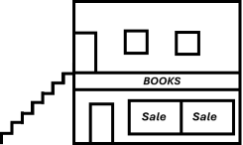
Flats are horizontally divided, self-contained, individual units for residential use, within a building with some degree of shared infrastructure or fabric (see examples at Figure 1). Where these are new to the market after the ban has commenced, they will no longer be permitted to be sold with long leases under the proposed ban.
Figure 1: examples of flats for the purposes of the ban
Figure 1a: flats in a converted house

Figure 1b: purpose built block of flats

Figure 1c: flat over commercial unit
The UK government believes that where a property intended for homeownership can be provided on a freehold basis, it should be. That is why we will implement measures in the Leasehold and Freehold Reform Act 2024 so that other than in exceptional circumstances, new houses must be provided on a freehold basis. The same principle applies to new flats, which should enjoy the benefits of freehold ownership through commonhold.
To provide as comprehensive coverage as possible for the leasehold flat ban, we are also looking to incorporate more unconventional types of permanent dwellings that might outwardly appear to be houses but have certain characteristics associated with flats, so that they do not fall between the definitions of houses and flats provided in the respective bans. We want to ensure that the bans on new leasehold houses and flats are robust and work effectively together.[footnote 2]
Certain permanent dwellings that may outwardly appear to be houses are not a ‘house’ under the legal definition of a house in the LFRA. Figure 2 shows 2 examples of these, where a dwelling is built over land, or another dwelling, not belonging solely to that property.
Figure 2: examples of interdependent properties or structures
Figure 2a: Row of properties with shared underground parking
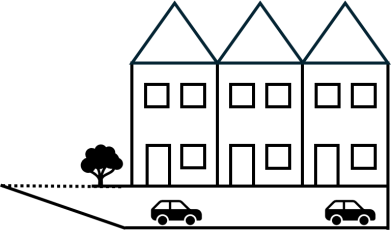
Figure 2b: property overhanging or underhanging its boundary with a neighbouring property

In the examples provided, because each dwelling either over-hangs or under-hangs property belonging to another dwelling, owners of these homes will have mutual obligations to one another, such as insuring and maintaining shared structures. To avoid the legal complexity of ‘flying freeholds’ (where each property is owned freehold but enforcing mutual obligations of building owners can be challenging), such properties are typically sold with a lease to manage these arrangements.
The UK government is now reforming the commonhold framework so that it suitable for operation in a much wider range of settings and can be an appropriate replacement for leasehold for a much wider variety of new housing. Once the reformed commonhold model is in place, we are proposing such properties (like the examples above at Figure 2), which are newly constructed or converted should also be required to use commonhold in future.
To ensure the ban captures both conventional and more unconventional types of flats, including those that may outwardly appear to be houses but that are not covered by the house ban in the LFRA, we are proposing the following legal definition in the draft Bill for consultees to comment, copied here:
Flats
A “flat” is a separate set of premises (on one or more floors) —
- which forms part of a building
- which is constructed or adapted for use for the purposes of a dwelling, and
- the whole or a material part of which lies above or below some other part of the building
Consultation question
Question 6
Do you agree with the proposed definition of a “flat” for the purpose of the ban. Yes/No, if No, please explain why [Free text box].
If you have any other comments on the proposed definition of a ‘flat’, please provide them here [Free text box].
Application of the ban
Where new flats can be commonhold, they should be. The ban on leasehold will apply to new flats for sale in newly completed residential and mixed-use developments, as well as to flats that are newly for sale in certain existing buildings.
Broadly speaking, the approach we are proposing in the draft Bill is that if there are no long residential leases in a building once the ban has commenced, the freeholder must sell any new flats as commonhold. Conversely, if there are long residential leasehold units in the building, the freeholder will be permitted to sell flats with new leases.
Following our reforms, many existing leaseholders may wish to choose to collectively convert their buildings to commonhold, but we do not intend to require them to. Permitting new leases in such cases avoids forcing existing leaseholders to convert to commonhold, which would risk being legally complex and disruptive. It would also place a financial burden upon them as they would be required to compensate the landlord as part of acquiring the building’s freehold and converting to commonhold.
Newly completed developments
In most cases, where a developer would previously have sold a new flat with a long residential lease, they will be prohibited from doing so once the ban comes into effect[footnote 3]. This means that any newly completed residential or mixed-use developments, where at least one unit is intended for sale as a residential unit, must be provided on a commonhold basis. Selling these flats on long leases will no longer be permitted. The sale of new long leases of flats will only be allowed if the lease qualifies for a permitted exemption.
The ban will not apply to newly completed developments built exclusively for rent such as Build to Rent or social rent blocks, while they remain used solely for that purpose. These buildings do not involve the grant of long residential leases of individual flats. Instead, all flats are rented out on assured tenancies or equivalent arrangements (such as an occupational contract in Wales, or other forms of tenancy or licence) and so fall outside the scope of the ban.
There are other good reasons to leave purpose-built rented blocks outside of the ban. Requiring the use of commonhold would offer no advantages to the sole landlord of the building, and nor would it benefit the tenants, because the voting rights of commonhold are tied to the owners of the homes and spaces.
It could be argued that commonhold, which apportions decision-making in accordance with the share of units owned in a block, would be beneficial where the purpose-built rented block is shared between 2 different landlords, for instance a Build to Rent provider letting market rent properties and a Registered Provider owning a headlease of multiple flats built for social or affordable rent. Nevertheless, as no long leases of individual flats are being sold in the building, the ban will not force such arrangements to use commonhold.
Flats newly for sale in existing buildings
New flats for sale do not only arise from the construction of entirely new developments. A significant number of new flats for sale are created through the redevelopment or conversion of existing self-contained buildings. For example, converting commercial or industrial premises into residential use,[footnote 4] or sub-dividing houses into multiple flats.[footnote 5] New leasehold flats also arise where developments originally built solely for rent later have some or all of the units sold for homeownership.[footnote 6]
In most circumstances, converting or redeveloping an existing building will require the land to be in single ownership, and the repurposing of the building may involve substantial redevelopment, meaning the building is essentially ‘reset’. This creates a clear opportunity, provided there are no registered long leases in the building, to use commonhold rather than leasehold. An example would be where a developer purchases a freehold three-storey Victorian house and wishes to convert the house into three flats for sale. Because the developer owns the freehold and there are no registered long leases in the building, there are no obstacles to the building being registered and flats within it being sold as commonhold. Once the ban is in force, the developer will need to register the building as commonhold in order to sell the flats to individual prospective homeowners, and they will have to be sold as commonhold rather than leasehold units.
In addition to the use of buildings changing over time, such as from commercial to residential uses, or from houses into flats, the tenure of flats can change too. For instance, a developer may have built a block of flats as a build-to-rent development but later decides to sell some units on the open market for homeownership. In such cases, planning conditions may restrict the sale of flats originally intended for rent, and developers may be required to apply to the local planning authority to vary those conditions. If planning approval was granted to change the tenure, the building would no longer be a wholly rented development. It would instead become a mixed tenure block, a scenario where commonhold would have been required had the tenure mix been planned as such from the outset. We therefore consider that any purpose-built rented block which is subsequently changed to include units for sale should be caught by the ban. The block would therefore need to be registered as commonhold before those units could be sold.
Summary of ban scope
In summary, once the ban has commenced, we are proposing that it will apply to the sale of flats in the following types of multi-unit building:
A. Purpose-built new developments
That include flats for sale (and which may or may not include other uses, such as commercial units and light industrial space, or homes for rent).
B. A house newly converted into flats
Where at least one flat is for sale on a long lease.
C. Commercial buildings newly redeveloped to contain flats
Where at least one flat is for sale. For example, office space or a shopping centre with flats on upper floors.
D. Purpose-built rental blocks whose owners have later opted to sell flats for homeownership
For example, a block entirely made up of Build to Rent flats where one or all flats are subsequently marketed for sale to prospective homeowners.
E. Other residential buildings where there are no existing registered long residential leases
For example, an existing block of flats in vacant possession, that is refurbished so the flats can be resold.
Consultation question
Question 7
Do you agree with the proposed scope of the ban (categories in A-E above)? [Please provide ‘Agree/Disagree’ against each category in A-E] and provide justification for cases where you disagree [Free text box per category].
Commercial leases in existing buildings
Commonhold is primarily intended for residential ownership, but it also provides a broad legal framework for ownership and management that could also be used for commercial buildings. Changes to the commonhold framework in the draft Bill mean that commonhold will be better suited for use in mixed blocks of residential and commercial developments, for example, by introducing “sections” to allow for delegated decision-making and new ways to apportion costs. The use of buildings may of course change over time, and we want to consider the best approach for the consumer, landlord and commercial arrangements should a portion of floor space in an existing commercial building be converted to residential use for homeownership.
We want to test a further element of scope with consultees: circumstances where the owner of a commercial leasehold building, with no long residential leases, wishes to change the building’s use by offering a flat within that building for residential homeownership. Our starting point is that any new flat intended for homeownership should be sold as commonhold, unless there are good reasons not to. We want to understand if there are any practical obstacles to providing new homes as commonhold in such circumstances.
There are a number of reasons why the reformed commonhold model may be appropriate for use in such situations, including:
- it has been designed to provide maximum flexibility for buildings or developments containing both commercial and residential properties
- allowing the presence of a commercial lease in an existing building as a reason to permit the grant of long residential leases would create a significant loophole in the ban
When we draft the final bill, it is also our intention to ensure that a change of the building from leasehold to commonhold would see the commercial lease continue, and the leaseholder’s landlord would remain the same, but as a unit owner of the commercial space.
We would welcome views from stakeholders on the application of commonhold where existing commercial buildings are partially converted into residential units for sale.
Finally, we are not proposing to ban commercial leases, or change how or when they can be granted in this legislation. Entirely commercial buildings will not be expected to use commonhold in the future, though they could adopt commonhold if they wish.
Consultation question
Question 8
Should an owner of a building with a sitting commercial tenant and no residential long leases be required to change the building to commonhold if they wish to sell a new flat in the building? [Yes/No] [Please explain your answer].
Application of the ban to existing leasehold flats
We are not banning the sale of existing leasehold flats. Existing residential leaseholders will continue to be able to sell their leasehold flats as they would be able to do today. Measures in the Draft Commonhold and Leasehold Reform Bill seek to make it easier for leaseholders who wish to, to convert their existing buildings to commonhold.
We do not intend to ban the grant of new or replacement leases for leasehold flats that existed before the ban comes into effect. Leaseholders may need to enter into new leases for various reasons, such as extending an existing lease, or making substantial variations that require a regrant. These arrangements are entered into voluntarily by existing leaseholders and their landlords. Prohibiting this would significantly curtail the rights of leaseholders at a time when we are working to enhance their protections. Furthermore, conversion to commonhold can only take place on a whole-building basis. This means it cannot provide a viable alternative where a new or replacement lease is needed on an existing individual leasehold flat within a block, without unfairly imposing costs on other leasehold owners in the block, who would also need to compensate the landlord if a single flat triggered a conversion to commonhold.
Similarly, we do not intend to ban landlords from granting new leases on existing leasehold flats where a previous lease has expired, been voluntarily surrendered, or terminated due to a breach of lease terms. In such scenarios, other residential leaseholders in the building may be unable or unwilling to convert the building to commonhold. Expecting the landlord to bear the full cost of converting the building to commonhold in order to sell the flat again would be unreasonable, particularly where the circumstances were beyond their control.
In some cases, the grant of a new lease may be necessary, even for flats that were not previously leasehold - for example, when a social renter exercises their Right to Buy, or Right to Acquire, or when someone wishes to purchase an existing flat on shared ownership terms through ‘Home ownership for people with a long-term disability’ (HOLD), Social Homebuy or after using Rent to Buy, or London Living Rent or equivalent schemes in Wales. Requiring landlords to convert the building to commonhold in these instances would again place an inappropriate burden on them for circumstances beyond their control.
We will develop the detail of how to allow leases to be granted in such situations after the consultation window and pre-legislative scrutiny process have ended.
Considering the case for exemptions
Countries across the world have commonhold-type models by default. For example, France uses a model called copropriété, in Germany, Wohnungseigentumsgesetz. The USA and Canada’s version of commonhold is called condominium, and in Australia and New Zealand, strata title.
Many of these same countries do however, continue to use leases in certain narrow circumstances to cater for specific homeownership products, land ownership arrangements, or to accommodate wider public policy goals. For example, in 2014 the French government promoted a long leasehold model as a means to encouraging private investment into redeveloping existing homes into affordable housing. Australia has an advanced legal framework for freehold flat ownership under the Strata system, but in Australia’s Capital Territory (ACT) to control how land is used and developed, the government retains the freehold and homes within the ACT are only sold on a leasehold basis (typically 99 years).[footnote 7]
While our ambition is to make commonhold the default tenure for new flats, we recognise that there may be certain circumstances where a lease may be appropriate or even preferable for the benefit of particular consumers or to support certain policy objectives. This could be either a lease of a commonhold unit, or a leasehold structure instead of commonhold.
Through this consultation we wish to seek views on the case for exemptions in three key ways:
-
first, beyond those identified in the Commonhold White Paper (shared ownership leases, home purchase plans including Islamic finance products, and certain equity release products that require a lease), whether any additional long residential leases within commonhold developments should be permitted
-
second, existing commonhold legislation already prohibits certain categories of buildings and land from registering as commonhold, such as flying freeholds and land subject to compulsory purchase. We are minded to continue to prevent these arrangements from registering as commonhold, and therefore also exempt from the ban. We are inviting views on whether the current list (see Box 1 below) should therefore remain as it is
-
third, we turn to whether any other types of building, land or homeownership products should be permitted to continue to use leasehold on a block or site-wide basis
Across all three aspects, we are keen to get your views, as well as evidence, of why an exemption may be needed. This could include why the reformed commonhold model would not work, or could not be made to work, or why use of leasehold may still be justified. For any proposed exemptions, we also would like to understand the scale of developments or units involved (i.e. approximate volumes of such new leases of flats per year).
Permitted leases within a commonhold
Under existing legislation, long residential leases cannot be granted within commonhold. In the Draft Commonhold and Leasehold Reform Bill, we are changing this to broaden the scope for commonhold’s use. This will allow certain types of long residential leases within commonhold, specifically, shared ownership leases (including specialist variants of shared ownership, such as Older Persons Shared Ownership, and Home Ownership for people with a long-term disability), home purchase plans (including Islamic finance products), and certain equity release products that require a lease.
Permitting these lease-based arrangements within commonhold will give consumers greater flexibility in how they finance their homes, such as helping them get onto the property ladder or releasing equity from their current home. For example, shared ownership uses a lease to enable homebuyers to purchase a “share” of the equity of a property, helping make homeownership more affordable. The lease governs the relationship between the buyer and the provider and enables the buyer to acquire additional “shares” over time.
While these owners will technically be leaseholders within a commonhold setting, the draft Bill makes provision for them to have the same core rights as commonhold unit owners. This includes the right to participate in the governance of the commonhold association, such as electing directors and voting on the annual budget. And owners will also benefit from commonhold consumer protections in place of leasehold rights, such as to challenge the reasonableness of service charges.
For these permitted leases, the provider of the shared ownership lease (typically a housing association, local authority, or other provider), or provider of the home purchase plan, will be the owner of the commonhold unit. These providers will also enjoy certain rights to participate in the decision-making of the commonhold for certain significant decisions (such as where they may be liable for certain costs or over the termination of the commonhold). Where the leaseholder’s equity is paid back to the provider in full, the provider will transfer the unit to the homebuyer.
There may be other circumstances where the use of specific types of long residential leases within a commonhold may be necessary. We would like to hear from consultees on any such examples, and how commonly they might be expected to be used in practice.
Consultation question
Question 9
Besides shared ownership (including specialist variants of shared ownership), home purchase plans, and equity release products, are there any other types of residential long leases that will be necessary within a commonhold?
[Free text box] [Note: Please provide your reasoning for why the arrangement is being suggested. Please also include any data available on:
- the prevalence of flats currently using such an arrangement; and/or
- where possible, please provide the expected number of new units per year using this arrangement.]
Land that cannot currently be registered as commonhold
The current commonhold legislation already details certain categories of land that are not permitted to be registered as commonhold.[footnote 8] These are flying freeholds, agricultural land and contingent titles (see Box 1 below).
Box 1: Land not registrable as commonhold
Flying Freeholds
A) To avoid the creation of flying freeholds, the creation of commonhold land at first floor level or above is prohibited unless all the land below it and down to the ground is part of the same commonhold.
Agricultural land
B) Certain sites used for agriculture, such as those with a farm business tenancy, or a tenancy of an agricultural holding, cannot be registered as commonhold.
Contingent title
Land also cannot be registered as commonhold land if it is held contingent on external events, including:
C) Land subject to a compulsory purchase order cannot be registered as commonhold.
D) Certain sites for institutions or places of worship, including land reserved for educational institutions (for example, museums or libraries), and sites used for worship (for example, a church or temple).
E) Certain sites that have been used for schools, for example land which is held subject to a grant under the Schools Sites Act 1841 reverts to the grantor when the land in question ceases to be used for a school.
We foresee that most of these categories will continue to be relevant and therefore subject to an exemption from the ban on new leasehold flats, otherwise neither new leasehold nor commonhold flats could be provided on such sites. However, we welcome views on whether there is a case for any of the above exclusions to be removed from this list.[footnote 9]
Consultation question
Question 10
Which, if any, of the above types of land that cannot be registered as commonhold should continue to be excluded and therefore exempt from the ban?
[For A-E boxes please indicate whether you think the restriction should continue or be lifted and leave blank if you do not have a view]
[Please provide a justification for why and any data available on the prevalence of the given category of land]
Developments where future use of leasehold may be justified
The reformed commonhold model is designed to accommodate all types of residential and mixed-use development. In addition to your feedback on the list of sites currently prohibited from registering as commonhold (above), we welcome views and evidence on where continued use of leasehold may be justified.
There may be circumstances where long leases remain the best means of managing a specific relationship between 2 parties and are consequently an appropriate tenure for the consumer. For example, housing products may include or rely upon a level of services or facilities best provided by a third-party because of the complexity involved. An example of this is the live debate in the retirement housing sector about which parts of it could shift to providing retirement housing as commonhold in future, and which parts, due to the complexity of provider services and financing, may wish to make the case to continue using leasehold.
There may also be justifiable reasons to protect certain tracts of land from being sold on a freehold basis. In the UK, this is commonly termed ‘inalienable’ land, but preventing the transfer of freehold title is a feature of many countries where commonhold-type models are the default tenure. For instance, New Zealand, Canada, and Australia all have systems to protect the sale of certain categories of land on a freehold basis, whether to prevent land speculation, to protect wildlife and habitats, or to preserve land so that it can be enjoyed for wider public benefit in perpetuity.
Consultation question
Question 11
We welcome your views on whether any land ownership arrangements, or types of development, should be exempt from a ban on new leasehold flats.
[Free text box] [Note: Please provide justification for why the arrangement is being suggested, and any data available on the volumes of flats (or number of sites and buildings) using this arrangement that could be anticipated per year].
Structure of the ban on new leasehold flats
We will deliver our manifesto commitment to make commonhold the default tenure by bringing the ban on new leasehold flats into law. Key components of the ban are set out in the Draft Commonhold and Leasehold Reform Bill published for pre-legislative scrutiny. A legally-binding ban will ensure it will apply consistently across the market, creating a level playing field for new housing supply and maximising the number and speed at which consumers will benefit from commonhold homeownership. This approach provides clarity, certainty and enforceability, helping to drive the transition away from leasehold.
How the ban will operate
We propose that the ban on new leasehold flats should take a similar approach to Part 1 of the Leasehold and Freehold Reform Act 2024, which prohibits the use of leasehold for new houses, other than in defined exceptional circumstances.
This approach puts the onus on developers and vendors to demonstrate compliance with the ban before a prospective buyer has handed over any money. Consumers should not only have better upfront information when buying a home, a key focus of our wider reforms to the system of home buying and selling, but they should also be assured that the legally correct tenure is being marketed in the first place. Aligning the approach to banning use of leasehold for flats and houses will make compliance simpler for industry and provide clarity for consumers, particularly where it may be unclear whether a new property for sale is a flat or house.
There are multiple checkpoints built into the proposed ban to protect the consumer from being wrongly mis-sold a leasehold flat at the marketing, sale, and registration stages of a purchase. These stages are set out below, and are needed because there are potential situations where legitimate new leases may be created after the property has been marketed for sale. For example, buying a new commonhold unit where the consumer wished to use a home purchase plan (a permitted lease) to finance the purchase, which relied on a lease. A lease of the commonhold unit is legitimately created by the provider of the home purchase plan to enable the buyer to complete the sale. Checks after the marketing stage are therefore designed to reassure buyers that what they are purchasing is compliant with the ban.
If it transpires that these checkpoints have been evaded by a vendor, consumers will have a backstop redress right, enabling them to acquire what they should have been sold in the first place. Further details on redress are set out below.
Collectively, this system of up-front checks underpinned by financial penalties, and the backstop redress right will provide a clear and robust framework to ensure compliance and disincentivises to those looking to get around the ban.
Detailed drafting on the approach is provided in the draft Bill. The general structure of the proposed ban is set out here for comment:
Marketing
Advertising for sale a new leasehold flat will be banned, unless the flat qualifies for an exemption. Where an exemption applies, marketing materials must show the basis for exemption.
Sale
Granting a new lease of a flat will be banned, unless the flat qualifies for an exemption. For exempt leases of flats, the landlord will be required to issue a prescribed ‘Warning Notice’ to the prospective buyer and their solicitor. This must be issued at least 7 days before exchange of contracts, detailing the exemption and where necessary providing further evidence of compliance. The 7-day period will provide the prospective buyer with the opportunity to ask questions and seek further evidence if required.
Registration
Assurance for first and subsequent buyers will be provided through the land registration system. All new long leases of flats registered with His Majesty’s Land Registry (HMLR), will have to include a new ‘Prescribed Statement’ confirming their compliance with the ban. Failure to comply will trigger a temporary restriction on title, preventing the flat from being resold until the property’s status is resolved.
Redress
Buyers will have rights to redress if mis-sold a leasehold flat in breach of the ban. Remedies will vary depending on the nature of the breach:
- if a consumer was unlawfully granted a lease in a commonhold building, they will have the right to obtain the commonhold unit, at no cost to them
- if one or multiple flat owners were unlawfully sold a leasehold flat in a relevant building, they will have the right to require the building be converted to commonhold and to acquire their flat as a commonhold unit, at no cost to them
- if a consumer acquired a leasehold flat that qualified for a legitimate exemption, but the required evidence was not provided, they will have the right to have this corrected in the lease at the landlord’s expense
If the landlord contests the redress right, or is otherwise missing or non-responsive, the consumer will have the right to apply to the appropriate tribunal to determine the appropriate outcome.
Enforcement of the ban will occur through financial penalties, scaled according to the level of consumer harm. For example, wrongly advertising a new leasehold flat would incur a lower penalty than completing a prohibited sale. The enforcement of the ban will be led by a lead enforcement authority appointed by the Secretary of State.
Consultation question
Question 12
Please provide any views or suggestions on the proposed structure of the ban [Free text box].
Timetable for moving to commonhold
The UK government is committed to making commonhold the default tenure for new leasehold flats, and we want to see consumers enjoying the benefits of commonhold in new buildings as soon as possible.
We were also clear in our White Paper published last year that this consultation on moving away from leasehold to commonhold would consider carefully how to minimise disruption to housing supply. The UK government remains committed to its ambitions for delivering 1.5 million new homes in England over the parliament, and we want to see the supply of new flats playing a vital part in that effort.
The goals of increasing housing supply and a better homeownership offer are not in conflict. They can and should reinforce one another. The leasehold system has long been associated with complexity, unfair practices, and market friction, issues that have deterred buyers, lenders, and developers. By promoting a fairer and more transparent tenure in the form of commonhold, we have the opportunity to restore confidence in the flat buying market, and over the longer-term unlock greater demand for, and investment in, new flats.
Commonhold-type arrangements will be familiar for many of the major housebuilders who operate in Scotland, in parts of Europe or further afield alongside their operations in England and Wales.[footnote 10] For those that do not, they will nevertheless likely have experience selling blocks of flats on a share of freehold basis, where resident management companies are established and in charge of decision-making from the outset.
Developers and supporting parts of the sector will, however, be less familiar with the more technical aspects of the new England and Wales commonhold regime, and understandably will need time to familiarise themselves with the reformed commonhold model and adjust accordingly.
There will also be some developers who have either started selling leaseholds on a site when the ban is commenced or own a plot of leased land. Changing such sites immediately to commonhold could be straight forwards depending on the nature of the development, or may be more difficult. For these reasons, as well as carefully listening to industry on the timetable for moving to commonhold, we also want to hear from industry about the treatment of sites where development is underway when the ban is commenced, so we can put in place transitional arrangements that balance encouraging the market to move quickly to commonhold, without interrupting the construction and sale of much needed new homes.
Staging posts in the transition to commonhold by default
To support a smooth transition across the housing market, the UK government intends to proceed with care and in a logical sequence towards making commonhold the default tenure for flats. This direction of travel has been clear and consistent, signalled through our manifesto commitments, the publication of our Written Ministerial Statement on leasehold and commonhold reform in November 2024, and followed by the Commonhold White Paper in March 2025. These documents set out our ambition for commonhold to become the default model for new flats.
In parallel to this consultation, we are publishing our proposed commonhold reforms in the Draft Commonhold and Leasehold Reform Bill. This will allow consumers and industry stakeholders to understand how commonhold with operate in practice, and to begin preparing for its adoption. Publishing the draft Bill for pre-legislative scrutiny will also enable parliament, consumers and industry to consider the detail of the reforms and where necessary suggest refinements, helping to ensure commonhold can work across a wide range of developments.
Following this period of scrutiny, we will formally introduce the commonhold legislation in Parliament. The UK government will implement the ban on new leasehold flats only after the new commonhold framework – including any necessary regulations – has been brought into force. This consultation forms part of the process to determine the appropriate timing for switching on the ban.
The timing of a ban on new leasehold flats
To support a successful transition to commonhold as the default tenure for flats, the UK government is keen to understand how long different parts of the housing sector may need to adapt, and the reasons behind these timelines.
The time needed to adjust is likely to vary across the market and is made all the more significant by the decision to mandate commonhold for most new supply, rather than leaving it as an optional alternative. For example, developers building smaller, simpler blocks, and particularly those that might currently be sold as share of freehold, may be able to transition relatively quickly, given the modest impact on the changes on their business models, whereas other types of developers may need longer
Other parts of industry such as property agents may need longer to adapt their operational practices to the new commonhold framework. Different considerations may apply for example, to conveyancers who may require updated training and systems as the legal processes and documentation associated with commonhold which differ from leasehold.
Lenders are also a key part of a functioning market. Despite the very small numbers of existing commonholds a number of major lenders will already offer mortgages for commonhold flats and we anticipate that as demand grows more providers and products will become available.[footnote 11]
These sector-specific differences mean that readiness may be uneven, and so it is vital we hear back from all parties involved in the development, home buying and selling, financing and valuation, insuring and management of new flats so we can account for these nuances.
Government is also working across key delivery partners including HMLR, HMCTS and Companies House to ensure that the supporting infrastructure necessary for greater use of commonhold is available on day one of the new model being available for use. This also includes consideration of the information, guidance and support that consumers will require.
We are seeking views from consultees on how long your profession or sector would need to prepare for commonhold becoming the default tenure for new flats. In addition to a time estimate, we are particularly interested to understand the drivers behind your response.
Consultation questions
Question 13
Do you anticipate that you, your organisation or your sector will begin using, or supporting the use of, commonhold once the new commonhold model is introduced, or only once the ban is in place for new flats? [Once the new commonhold model is introduced/ Only when the ban comes into force/ Other. Please set out your reasoning.] [Free text box].
Question 14
What actions or activities would you, your organisation or your sector need to undertake to prepare for the widespread use of commonhold? And how long would these take? [Free text]
Question 15
From the point at which the revised commonhold law comes into force, how long would you, your organisation or your sector need to prepare for using commonhold as the default tenure in new blocks? [No time/1 years /2 years/5 years, other] [Free text to justify answer given].
Phased implementation for different types of development
The complexity of transitioning to commonhold may differ across types of development. For example, it has been suggested that the ban could start with smaller blocks that are generally simpler to manage and move to larger more complex blocks once familiarity with commonhold has increased.
Others suggest that it may be better to have a single point from which commonhold is required to support implementation and avoid confusion for consumers and industry. A single implementation date for the ban would offer clarity and simplicity for consumers, industry and enforcement bodies. However, we are open to considering a phased approach, for instance starting with smaller, simpler developments and gradually expanding to more complex sites. This could help build momentum while allowing additional time for parts of the market that face greater challenges to make this transition.
Separately, we are proposing two specific transitional arrangements for flats on phased-sites, and flats on leased land. These are addressed below, but beyond those two mechanisms, we would welcome views as to whether the market should move in unison away from selling new leasehold flats, or whether commencement should be staggered with reference to specific products, sub-sectors, or types of building.
Consultation question
Question 16
Should the UK government introduce the ban on new leasehold flats with a single implementation date for everyone, or should it be staggered, allowing certain types of new building or developments more time to adopt commonhold?
[A. The ban should commence at a single point
B. The ban should be staggered]
[If you think the ban should be staggered, which development or building types should be granted more time to prepare for a ban on the sale of new leasehold flats? Please set out your reasons for any answer given, and the estimated volumes of these products delivered each year.]
Sites under development when the ban is commenced
Development of a single site can take years from start to completion, whether the site is a single block or occurs in phases. The UK government acknowledges that when the ban is introduced, there will be blocks already under development, some of which the developer may have begun selling as leasehold.
At the point of commencing the ban, where a block stands alone and no units have yet been sold off, we believe a developer should be able to pivot to sell these as commonhold once development is complete. However, where a block is not yet complete, but leases have already been granted or sold, we recognise shifting to commonhold may be challenging. We are therefore proposing a transitional arrangement that would allow self-contained blocks in which new leasehold flats have already been sold at the point the ban is commenced to continue to do so following commencement of the ban.
This proposal will prevent the interruption of immediate sales, while requiring developers to move to commonhold on future phases of the site. The result could therefore, be a site of both leasehold and commonhold blocks. While a mixed development of leasehold and commonhold would add some complexity to managing the site, the UK government is not minded to allow large volumes of new leasehold flats to be sold into the distant future.
Consultation questions
Question 17
Do you agree that self-contained blocks that have already sold new leasehold flats at the time the ban is commenced should be able to continue to do so?
[Yes/No] ] [Please explain your answer]
Question 18
If you answered yes to the previous question, how long should developers have to complete the self-contained block?
[No time limit / 1 years / 2 years / 5 years / 10 years / other] [Please explain your answer]
Question 19
Are there any alternative approaches to dealing with phased sites? [Free text]
Flats built on historical leasehold land
Commonhold, that is freehold developments, can only be built on freehold land. We know most developers acquire land on a freehold basis. Owning the land on a lease restricts developers’ ability to construct and sell the homes on the site with the flexibility they would enjoy if they owned it on a freehold basis.
We note that in more limited cases, development sites may be acquired on a leasehold basis, and that there are circumstances where the freehold cannot be acquired, such as where the freeholder cannot be identified, or will not release the land on a freehold basis.
Therefore, we consider that where a developer currently owns land on a leasehold basis and has firm plans for the development of leasehold flats upon it, that they should not be captured by the ban so that they can deliver those homes.
We do not, however, want to encourage the stockpiling of leased land. The ban on new leasehold houses includes an exemption for land leased by 21 December 2017 (the day before the policy intent was announced in the response to the house ban consultation). This will allow owners of sites meeting that condition to continue to sell leasehold houses after the ban comes into force.
For the flat ban, we are minded to make a similar provision, and supplement it by requiring that any leasehold land exempted from the ban must have been both leased and acquired prior to a specified date before the ban commences.
This approach disincentivises the stockpiling of leased land from a particular date (for example, by those looking to get round the ban), but it is open ended, and so consumers could be sold new leasehold houses on these sites at any point in future. We think this should not be an open-ended exemption, and so are seeking views on whether there should be a cut-off date by which legacy leasehold sites are used to provide leasehold flats.
If we proceed with an approach that requires that leased land must be both leased and acquired prior to the ban commencing, and also proceed with a cut-off date for flats to be built on leased land, we will likely adopt the same for the ban on new leasehold houses.
Consultation questions
Question 20
Where land is owned on a leasehold basis at the point the ban comes into force, what further conditions, if any, should enable the site to qualify for an exemption?
Please tick which, if any, of the following should apply:
- the leased land was acquired before the ban is commenced
- the site has planning permission at the point the ban is commenced
- the site is under construction at the point the ban is commenced
-
the first sale of a leasehold flat occurs within a fixed period of time after the ban is commenced:
- none of the above
- other (please specify)
Question 21
If you selected ‘the first sale of a leasehold flat occurs within a fixed period of time after ban has commenced’, please specify the time period.
- within 1 year
- within 2 years
- within 5 years
- no time requirement
Question 22
Where a site is owned on a leasehold basis, should the developer have a fixed amount of time to finish selling leasehold flats on the site once the ban has commenced?
[Yes / No]
[If no, please set out your reasoning]
Question 23
If Yes, how long should the developer have to sell the remaining leasehold flats on the site once the ban has commenced?
- 1 year
- 2 years
- 5 years
- Other [please specify and justify]
Question 24 - For developers/landowners only
Do you own any land intended for residential or mixed-use development on a leasehold basis?
[Yes/No] [If yes, please provide the number of sites and their capacity, and what costs you anticipate incurring acquiring the land on a freehold basis instead of leasehold?]
Question 25
Are there any alternative approaches for dealing with historical leased land? [Free text]
Further refinements to support market-wide adoption of commonhold
The Law Commission’s commonhold proposals for reinvigorating commonhold were developed following extensive consultation with industry and stakeholders. These proposals, which we are now taking forward, lay the groundwork for commonhold to be adopted much more widely across the housing market.
The publication of the Draft Commonhold and Leasehold Reform Bill provides stakeholders with a detailed view of how the reformed commonhold framework will operate. The bill introduces new flexibilities designed to support adoption across a broad range of development types and ownership products. However, the Law Commission’s work was undertaken in the context that commonhold would remain optional. The UK government recognises that mandating commonhold as the default tenure for new flats represents a significant shift in policy. In light of this change, we are open to considering whether further technical refinements to the draft legislation may be needed to ensure commonhold works effectively.
The UK government proposes to limit the number of exemptions to the ban so as to maximise the number of consumers who would stand to benefit from commonhold. We therefore consider that making adjustments to the commonhold laws to provide further flexibility will reduce the need for exemptions in certain circumstances, and support broader, more inclusive adoption. We turn first to a question of whether there are any technical changes sought by the those involved in the delivery of private sector-led developments, and would welcome input for both market-wide, and sector-specific, changes to the commonhold provisions set out in Part 1 of the Draft bill that would support the delivery and management of new commonhold blocks.
Consultation question
Question 26
Are there any technical or minor changes to part 1 of the published Draft Commonhold and Leasehold Reform Bill that would better support specific private sector-led development models or forms of homeownership? [Free text]
Supporting adoption in the affordable housing sector
The UK government is committed to extending the benefits of commonhold ownership as widely as possible, including within the affordable housing sector.
Commonhold is being redesigned to accommodate mixed-tenure buildings, and many stakeholders in the affordable housing sector have engaged with previous consultations by both the Law Commission and the previous government on commonhold reforms. The draft Bill proposes integrating shared ownership into the commonhold framework for the first time, and features such as the ability to establish “sections”, allocate separate heads of costs, set local rules and apply minority protections are intended to support providers in meeting their obligations.
We recognise, however, that affordable housing providers have additional responsibilities, including to comply with the standards set by the Regulator of Social Housing, such as the Safety and Quality Standard and the Neighbourhood and Community Standard.
With the draft legislation now available, we welcome views from those working in the affordable housing sector on whether further changes to the commonhold framework would help in in meeting their obligations to their tenants and to the Regulator.
Consultation question
Question 27
Are there any technical changes to the published Draft Commonhold and Leasehold Reform Bill that would further enable the affordable housing sector to use commonhold? [Free text]
Professional management in commonhold developments
Managing agents play a key role in the maintenance of multi-occupancy buildings. Their importance will only increase as commonhold becomes the default tenure for new flats and more leaseholders exercise their Right to Manage, collectively enfranchise, or convert to commonhold.
The UK government is taking steps to improve standards in the sector, including consulting on mandatory qualifications for managing agents last year.[footnote 12] We anticipate that developers of most new commonhold developments, particularly larger or more complex ones, will have managing agents put in place from the outset (though of course, the commonhold unit owners may choose to replace a managing agent or make their own appointment at a later point), as is common practice in share of freehold arrangements.
While self-management by lay directors may be suitable for small or simple buildings, stakeholders have suggested that more complex sites may require professional directors or agents to ensure effective governance and compliance. For high-risk buildings in England (above 18m or at least 7 storeys high), we might reasonably expect commonhold associations to engage specialist managing agents with fire safety expertise.
International approaches vary. For example, in Victoria, Australia, managing agents are required for certain larger strata buildings, while in Western Australia their use is at the discretion of the building owners.
Tall buildings, particularly those taller than 11 metres, are subject to specific legal obligations under the Building Safety Act 2022 in England (additional requirements are also proposed for Wales in the Building Safety (Wales) Bill). In such cases, professional management is likely to be essential.
Consultation question
Question 28
Are there any types of commonhold building or development (for example those over a certain number of units) which should be required to appoint professional directors and/or managing agents? [Yes/No] [If yes, please specify which types of commonhold development and provide your reasoning. [Free text]
Beyond professional management, there may be additional obligations (beyond those that already apply) that consultees think we should apply to particularly large or complex commonhold buildings. We welcome views on what additional requirements may be appropriate to ensure safe and effective operation.
Consultation question
Question 29
Apart from professional management, are there any additional requirements that should apply to owners of particularly large or complex commonhold buildings? Please outline the nature of the building and any additional obligations you think should apply. [Free text]
Micro-commonholds
Small buildings are typically simpler to manage, as they will involve fewer shared areas and infrastructure. This will be true of small commonholds, and so we are also open to reflections on whether to apply commonhold laws in exactly the same way for all sizes of buildings.
Other jurisdictions which use commonhold-like models do not apply a one-size-fits-all approach, and we are conscious that some of the requirements of the general commonhold legal framework may be unduly onerous for very small, simple buildings – for example, those involving 4 or fewer units, perhaps where the only shared areas are a hallway and parking. For the purposes of this consultation, we have termed these ‘micro-commonholds’.
We are interested in views on whether any obligations of the commonhold association should be disapplied or made voluntary for micro-commonholds so that they can consciously opt-out.
For example, under the articles of association that apply for all commonhold associations, a commonhold association is required to have a minimum of two directors. Additionally, one third of directors are required to retire at each Annual General Meeting. If no-one steps forward to take on responsibility it is possible for the retiring director to be reappointed. Whilst very small commonholds could appoint an external director to replace a retiring director, it might be more pragmatic to allow micro-commonholds to opt out of this retirement process altogether to allow micro-commonholds to opt to be run with a single director (as is the case with other companies).
Consultation question
Question 30
Do you agree with our proposed definition of ‘micro-commonholds’ as those which contain 4 residential units or fewer? [Yes/No]
Question 31
If no, where do you think that threshold should be set?
- 2 units
- 6 units
- other [please specify] [please provide your reasoning]
Question 32
Should any legal obligations on commonhold associations be removed or made optional for very small, simple commonholds?
[Yes/No] [If yes, please specify which obligations you believe should be removed or made optional, and explain your reasoning] [Free text]
Understanding costs and benefits
The UK government is also interested in understanding the potential costs and efficiencies that might arise from moving from leasehold to commonhold in new developments, and whether there are any sector-specific costs or efficiencies we should be aware of.
We are aware that industry will need to familiarise itself with how commonhold works, and some may need to update various aspects of their processes, policies, training and guidance both to accommodate the new commonhold tenure, and in order to comply with the requirements of the ban on new leasehold flats. We are also know that parts of the housing market will already be familiar with commonhold-like models – for example, where they operate in non-domestic markets, or will be familiar with resident-led buildings through working on share of freehold buildings.
Consultation questions
Question 33
For those involved in the development, marketing, sale and conveyancing of new blocks of flats, in the past 3 years, what percentage of these typically have the following features?
Please provide an approximate percentage for each:
- 990-year leases (or longer) as standard [None, 0 to 25%, 26 to 50%, 51 to 75%, 76 to 100%, don’t know]
- sold as share of freehold [None, 0 to 25%, 26 to 50%, 51 to 75%, 76 to 100%, don’t know]
- a resident management company (regardless of whether it owns the freehold) [None, 0 to 25%, 26 to 50%, 51 to 75%, 76 to 100%, don’t know]
- a resident management company that owns the freehold of the building/s [None, 0 to 25%, 26 to 50%, 51 to 75%, 76 to 100%, don’t know]
- professional managing agents responsible for the upkeep of the building [None, 0 to 25%, 26 to 50%, 51 to 75%, 76 to 100%, don’t know]
- a reserve fund in place from the outset [None, 0 to 25%, 26 to 50%, 51 to 75%, 76 to 100%, don’t know]
Question 34
Will you or your organisation need to implement new, or update existing, systems to adapt to the use of commonhold? (Yes/No) [If yes, please provide a brief description of these changes and their associated costs]
Question 35
Will your organisation need to train/upskill staff to adapt to the use of commonhold? (Yes/No) [If yes, please provide a brief description of the training required and its associated costs]
Question 36
Will you or your organisation need to consult external professionals to adapt to the use of commonhold? (E.g. legal professionals, consultants etc.). (Yes/No) [If yes, please provide a brief description of the external advice needed and its anticipated costs.]
Question 37
Do you expect any costs to arise from complying specifically with the ban (e.g. adapting marketing materials, issuing warning notices, including prescribed clauses in exempt leases)? (Yes/No) [if yes, please outline why, and your expected cost per development, purchase / sale, or contract to change]
Question 38
Do you anticipate any efficiencies to arise from the adoption of commonhold in the form of cost savings for you or your organisation? (Yes/No) [If yes, please outline where you might expect these efficiencies to materialise, and by how much associated costs may fall.]
Next steps
The UK government will carefully consider the responses to the consultation, and feedback received as part of the pre-legislative scrutiny process. This will be used to inform our approach to final legislation and necessary regulations. We will continue to work with industry and consumer groups to ensure that developers, lenders and property professionals are continuing to prepare for commonhold to become the standard tenure for new supply.
As set out in the Commonhold White Paper, we would also encourage property professionals to start thinking now about how they will support consumers through the process of buying a new commonhold property. In particular, which processes need to be changed and how they will ensure people in consumer-facing roles have sufficient knowledge and training. In light of the draft Bill being published alongside this consultation, now is the right time to start preparing for commonhold by default.
About this consultation
This consultation document and consultation process have been planned to adhere to the Consultation Principles issued by the Cabinet Office.
Representative groups are asked to give a summary of the people and organisations they represent, and where relevant who else they have consulted in reaching their conclusions when they respond.
Information provided in response to this consultation may be published or disclosed in accordance with the access to information regimes (these are primarily the Freedom of Information Act 2000 (FOIA), the Environmental Information Regulations 2004 and UK data protection legislation. In certain circumstances this may therefore include personal data when required by law.
If you want the information that you provide to be treated as confidential, please be aware that, as a public authority, the Department is bound by the information access regimes and may therefore be obliged to disclose all or some of the information you provide. In view of this it would be helpful if you could explain to us why you regard the information you have provided as confidential. If we receive a request for disclosure of the information we will take full account of your explanation, but we cannot give an assurance that confidentiality can be maintained in all circumstances. An automatic confidentiality disclaimer generated by your IT system will not, of itself, be regarded as binding on the Department.
The Ministry of Housing, Communities and Local Government will at all times process your personal data in accordance with UK data protection legislation and in the majority of circumstances this will mean that your personal data will not be disclosed to third parties. A full privacy notice is included below.
Individual responses will not be acknowledged unless specifically requested.
Your opinions are valuable to us. Thank you for taking the time to read this document and respond.
Are you satisfied that this consultation has followed the Consultation Principles? If not or you have any other observations about how we can improve the process please contact us via the complaints procedure.
Personal data
The following is to explain your rights and give you the information you are entitled to under UK data protection legislation.
Note that this section only refers to personal data (your name, contact details and any other information that relates to you or another identified or identifiable individual personally) not the content otherwise of your response to the consultation.
1. The identity of the data controller and contact details of our Data Protection Officer
MHCLG is the data controller. The Data Protection Officer can be contacted at dataprotection@communities.gov.uk or by writing to the following address:
Data Protection Officer,
Ministry of Housing, Communities and Local Government,
Fry Building,
2 Marsham Street,
London,
SW1P 4DF
2. Why we are collecting your personal data
Your personal data is being collected as an essential part of the consultation process, so that we can contact you regarding your response and for statistical purposes. We may also use it to contact you about related matters.
We will collect your IP address if you complete a consultation online. We may use this to ensure that each person only completes a survey once. We will not use this data for any other purpose.
Sensitive types of personal data
Please do not share special category personal data or criminal offence data if we have not asked for this unless absolutely necessary for the purposes of your consultation response. By ‘special category personal data’, we mean information about a living individual’s:
- race
- ethnic origin
- political opinions
- religious or philosophical beliefs
- trade union membership
- genetics
- biometrics
- health (including disability-related information)
- sex life
- sexual orientation
By ‘criminal offence data’, we mean information relating to a living individual’s criminal convictions or offences or related security measures.
3. Our legal basis for processing your personal data
The collection of your personal data is lawful under article 6(1)(e) of the UK General Data Protection Regulation as it is necessary for the performance by MHCLG of a task in the public interest/in the exercise of official authority vested in the data controller. Section 8(d) of the Data Protection Act 2018 states that this will include processing of personal data that is necessary for the exercise of a function of the Crown, a Minister of the Crown or a government department i.e. in this case a consultation.
Where necessary for the purposes of this consultation, our lawful basis for the processing of any special category personal data or ‘criminal offence’ data (terms explained under ‘Sensitive Types of Data’) which you submit in response to this consultation is as follows. The relevant lawful basis for the processing of special category personal data is Article 9(2)(g) UK GDPR (‘substantial public interest’), and Schedule 1 paragraph 6 of the Data Protection Act 2018 (‘statutory etc and government purposes’). The relevant lawful basis in relation to personal data relating to criminal convictions and offences data is likewise provided by Schedule 1 paragraph 6 of the Data Protection Act 2018.
4. With whom we will be sharing your personal data
MHCLG may appoint a ‘data processor’, acting on behalf of the Department and under our instruction, to help analyse the responses to this consultation. Where we do we will ensure that the processing of your personal data remains in strict accordance with the requirements of the data protection legislation.
We may use artificial intelligence (AI) tools to analyse the responses to consultations more efficiently. These tools assist in identifying and mapping themes in consultation responses, but do not make decisions and all outputs are reviewed by staff for accuracy and reliability. Data used in AI tools is not used for training the AI models.
5. For how long we will keep your personal data, or criteria used to determine the retention period
Your personal data will be held for 2 years from the closure of the consultation, unless we identify that its continued retention is unnecessary before that point.
6. Your rights, e.g. access, rectification, restriction, objection
The data we are collecting is your personal data, and you have considerable say over what happens to it. You have the right:
a. to see what data we have about you
b. to ask us to stop using your data, but keep it on record
c. to ask to have your data corrected if it is incorrect or incomplete
d. to object to our use of your personal data in certain circumstances
e. to lodge a complaint with the independent Information Commissioner (ICO) if you think we are not handling your data fairly or in accordance with the law. You can contact the ICO at https://ico.org.uk/, or telephone 0303 123 1113.
Please contact us at the following address if you wish to exercise the rights listed above, except the right to lodge a complaint with the ICO. Email dataprotection@communities.gov.uk or write to:
Knowledge and Information Access Team,
Ministry of Housing, Communities and Local Government,
Fry Building,
2 Marsham Street,
London,
SW1P 4DF
7. Your personal data will not be sent overseas
8. Your personal data will not be used for any automated decision making
9. Your personal data will be stored in a secure government IT system
We use a third-party system, Citizen Space, to collect consultation responses. In the first instance your personal data will be stored on their secure UK-based server. Your personal data will be transferred to our secure government IT system as soon as possible, and it will be stored there for 2 years before it is deleted.
-
‘Long lease’ means a lease granted for over 21 years. This is the standard approach to defining leases in legislation, including the ban on new leasehold houses in the LFRA 2024, and we propose to adopt it for the ban on new leasehold flats. It does not mean rental products such as assured tenancies in England or occupational contracts in Wales. ↩
-
We are aware that there will be calls for the UK Government to implement a single ban covering all new leasehold ‘dwellings’. For now, we are considering these bans as separate entities, which each may warrant different speeds of implementation, and may also need different approaches to certain aspects of their design to cater for the differences between houses and flats, such as different exemptions and different redress regimes. ↩
-
This will include leases of flats sold ‘off plan’. ↩
-
In England in 2023/24 there were 21,590 additional dwellings from change of use between non-domestic and residential. See Housing supply: net additional dwellings, England: 2023 to 2024 - GOV.UK. ↩
-
In England in 2023/24 there were 4,360 from conversions between houses and flats. See Housing supply: net additional dwellings, England: 2023 to 2024 - GOV.UK. ↩
-
We note that this specific scenario may create an issue for landlords when a social tenant exercises their Right to Buy or Right to Acquire, through no action taken by the landlord. See paragraphs under Application of the ban to existing leasehold flats. ↩
-
See Solidarity real lease -How to buy affordable housing near you? Service Public, and Crown leases - City and Environment Directorate - Planning. ↩
-
Schedule 2 of the Commonhold and Leasehold Reform Act 2002. ↩
-
Note, the exclusion of ‘flying freeholds’ is a distinct issue from whether multiple new overhanging units should be required to use commonhold, as set out in Chapter 2. ↩
-
The top 5 major housebuilders all have operations or subsidiaries in Scotland, which does not utilise long residential leasehold for new flats. ↩
-
A number of major lenders currently offer mortgage products for commonholds in England and Wales, including Nationwide, HSBC, Barclays. ↩
-
See MHCLG (2025) Strengthening leaseholder protections over fees, charges and services: consultation: Strengthening leaseholder protections over charges and services: consultation - GOV.UK. ↩