Feed-In Tariffs (FiT) scheme: Final consultation analytical annex - impact of indexation options (accessible webpage)
Updated 31 March 2026

© Crown copyright 2026
This publication is licensed under the terms of the Open Government Licence v3.0 except where otherwise stated. To view this licence, visit nationalarchives.gov.uk/doc/open-government-licence/version/3 or write to the Information Policy Team, The National Archives, Kew, London TW9 4DU, or email: psi@nationalarchives.gov.uk.
Where we have identified any third party copyright information you will need to obtain permission from the copyright holders concerned.
This publication is available at https://www.gov.uk/government/consultations/feed-in-tariffs-fit-scheme-indexation-changes/outcome/feed-in-tariffs-fit-scheme-final-consultation-analytical-annex-impact-of-indexation-options-accessible-webpage
The outputs in this annex will differ from the Analytical Annex in the consultation on changes to inflation indexation in the Feed-In Tariffs (FIT) [footnote 1], due to updated forecasts published by the Office for Budget Responsibility on 26th November 2025 and updated FIT for financial year 2024/25 [footnote 2].
Background on Indexation
An inflation measure quantifies the rate at which the general price level of goods and services rises in an economy. It serves to track the cost of living, gauge economic stability, and inform monetary and fiscal policy decisions by central banks and governments. It helps individuals, businesses, and governments understand how their purchasing power is changing and allows for appropriate adjustments to wages, contracts, and interest rates to maintain price stability and economic well-being.
There is often debate about which methodology is most appropriate with the three most common measures used in the UK being the Retail Prices Index (RPI), Consumer Prices Index (CPI), and Consumer Prices Index with Housing (CPIH). [footnote 3] significant concerns about RPI. The methods used to produce it are not consistent with internationally-recognised best practice, a shortcoming that led to it losing National Statistics status in 2013.
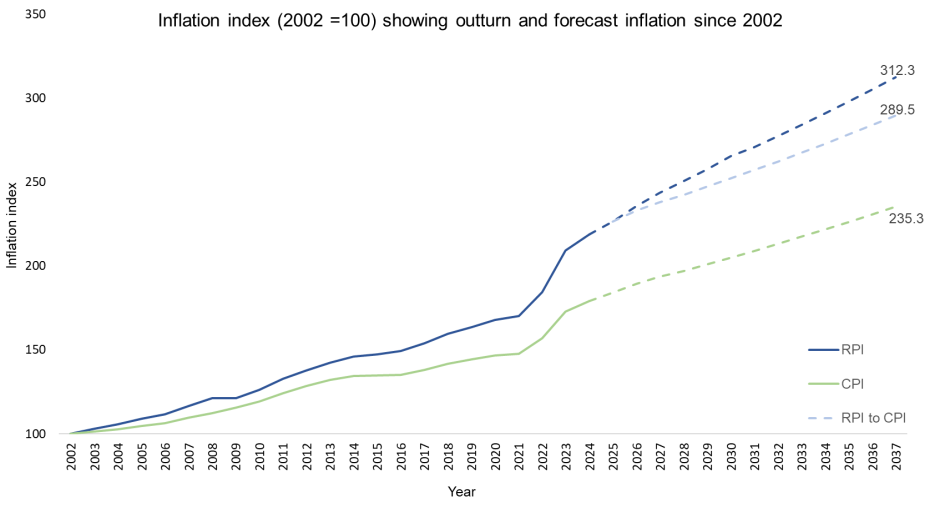
The Office for Budget Responsibility (OBR) produce regular Economic and Fiscal Outlooks that provide projections for RPI, CPI, and CPIH (Figure 1) up to Q1 2030. In general, RPI has consistently tracked higher than both CPI and CPIH and is expected to remain higher in the future. Beyond Q1 2030, it is assumed that CPI increases at 2.0% with CPIH and RPI increasing at 2.4% based on OBR long-term forecasts from the publication “The long-run difference between RPI and CPI inflation” [footnote 4].
Figure 1. OBR projections for RPI, CPI and CPIH. The plot also shows the rate of change for RPI if the CPI methodology was used (which is expected to occur in the future).
Operation of the Feed-in Tariffs Scheme
The FIT scheme was introduced in 2010 to incentivise small-scale renewable electricity generation. Although closed to new applicants, accredited generators continue to receive payments under the scheme for the duration of their contracts – typically 20 to 25 years.
Under the FIT scheme, accredited generators are registered with FIT licensees (electricity suppliers) who are responsible for administering payments. These payments consist of two components:
- A generation tariff: A payment for each kilowatt-hour (kWh) of electricity generated, regardless of whether it is consumed on-site or exported.
- An export tariff: A payment for electricity exported to the grid, either metered or deemed.
Tariff rates were set by the Department for Energy Security and Net Zero (DESNZ) and its predecessors and are adjusted annually by Ofgem, in line with RPI.
As tariffs are defined explicitly and indexed, any change in the indexation methodology would directly affect both the total value of payments made to generators, and the overall cost of the scheme, which is ultimately passed on to consumers.
Impact of the Change of Indexation
The FIT scheme cost forecast is based on the most recent outturn data published by Ofgem for the 2024/25 financial year. As the FIT scheme is closed to new entrants, the modelling assumes that total scheme costs remain flat in real terms up to 2029. From 2030 onwards, costs are assumed to decline gradually each year, falling to zero in the early 2040s, consistent with the expected expiry profile of existing generator contracts.
This projection is derived from high-level, aggregate modelling and is therefore subject to a number of material uncertainties. In particular, it does not explicitly model heterogeneity in generation output across FIT accredited installations, which can vary significantly over time due to technology type, ageing effects, weather variability, and operational performance. In addition, there is uncertainty around the timing and profile of scheme exits, as the analysis applies stylised assumptions on generator retention rather than forecasting individual exit behaviour. No generator level modelling has been undertaken to estimate scheme exit dates or changes in participation status, and as a result the long-term costs projections are sensitive to unobserved variation in participant behaviour, introducing uncertainty into the estimated trajectory of scheme costs over time.
The options as set out in the consultation [footnote 5] to replace indexation using RPI are:
Option 1 Immediate switch to CPI indexation
Option 2 Temporary freeze and gradual realignment with CPI (Indexation using CPI with transactional protection of the current price).
Changing FIT indexation from RPI to CPI is estimated to reduce total scheme expenditure by around £20m (24/25 prices) in 26/27 rising to approximately to £80m (24/25 prices) in 30/31. Gross generators’ income is expected to decrease by similar amounts.
Temporarily freezing the FIT indexation and gradually aligning with CPI is estimated to reduce total scheme expenditure by around £70m (24/25 prices) in 26/27 increasing to approximately £210m (24/25 prices) in 30/31. Gross generators’ income is expected to decrease by similar amounts.
Table 1. Impact of changing the indexation of the FIT scheme
| 25/26 | 26/27 | 27/28 | 28/29 | 29/30 | 30/31 | 31/32 | 32/33 | 33/34 | 34/35 | 35/36 | 36/37 | |
|---|---|---|---|---|---|---|---|---|---|---|---|---|
| Cost (£bn, nominal) | ||||||||||||
| RPI | £1.9 | £2.0 | £2.1 | £2.1 | £2.2 | £2.1 | £1.9 | £1.8 | £1.7 | £1.5 | £1.4 | £1.2 |
| Option 1 CPI | £1.9 | £2.0 | £2.0 | £2.0 | £2.1 | £2.0 | £1.8 | £1.7 | £1.6 | £1.4 | £1.3 | £1.1 |
| Option 2 Temporary Freeze | £1.9 | £1.9 | £1.9 | £1.9 | £1.9 | £1.8 | £1.7 | £1.6 | £1.4 | £1.3 | £1.2 | £1.0 |
| Cost (£bm, 24/25 prices) | ||||||||||||
| RPI | £1.9 | £1.9 | £1.9 | £1.9 | £1.9 | £1.8 | £1.6 | £1.5 | £1.3 | £1.2 | £1.0 | £0.9 |
| Option 1 CPI | £1.9 | £1.9 | £1.9 | £1.9 | £1.8 | £1.7 | £1.5 | £1.4 | £1.3 | £1.1 | £1.0 | £0.8 |
| Option 2 Temporary Freeze | £1.9 | £1.9 | £1.8 | £1.7 | £1.7 | £1.6 | £1.4 | £1.3 | £1.2 | £1.0 | £0.9 | £0.8 |
| Savings (£m, 24/25 prices) [footnote 6] | ||||||||||||
| RPI | £0 | £0 | £0 | £0 | £0 | £0 | £0 | £0 | £0 | £0 | £0 | £0 |
| Option 1 CPI | £0 | £20 | £40 | £60 | £80 | £80 | £80 | £80 | £70 | £70 | £60 | £60 |
| Option 2 Temporary Freeze | £0 | £70 | £130 | £170 | £220 | £210 | £200 | £190 | £170 | £160 | £140 | £130 |
Impact on generators
The reduction in total income for generators is equivalent to the savings.
The annual percentage reduction in FIT revenue arising from the indexation change increases over time, reflecting the cumulative nature of these impacts (see Table 2). Cumulative impacts are expressed on an undiscounted basis assuming no change in generation. For example, a generator remaining in the scheme until 2036/37 is estimated to experience a cumulative reduction of around 4.2% in total FIT revenue relative to the unchanged indexation counterfactual. Earlier exits would result in smaller cumulative impacts.
Table 2. Percentage reduction on FIT revenue to generators of changing the indexation of the FIT scheme
| 26/27 | 27/28 | 28/29 | 29/30 | 30/31 | 31/32 | 32/33 | 33/34 | 34/35 | 35/36 | 36/37 | |
|---|---|---|---|---|---|---|---|---|---|---|---|
| Annual change in revenue | |||||||||||
| Option 1 CPI | 1.2% | 2.3% | 3.2% | 4.0% | 4.3% | 4.7% | 5.1% | 5.5% | 5.8% | 6.2% | 6.6% |
| Option 2 Temporary Freeze | 3.7% | 6.6% | 9.1% | 11.7% | 12.1% | 12.4% | 12.8% | 13.1% | 13.5% | 13.8% | 14.1% |
| Cumulative change in revenue | |||||||||||
| Option 1 CPI | 1.2% | 1.7% | 2.2% | 2.7% | 3.0% | 3.3% | 3.5% | 3.7% | 3.9% | 4.1% | 4.2% |
| Option 2 Temporary Freeze | 3.7% | 5.2% | 6.5% | 7.9% | 8.7% | 9.3% | 9.7% | 10.1% | 10.4% | 10.6% | 10.8% |
Moving FIT indexation to CPI implies that payments will be maintained in real terms as measured against the Government’s target inflation metric, such that the purchasing power of FIT revenues is preserved over time, assuming no changes in generation output or scheme participation.
Overall, the analysis provides an indicative, system‑level assessment of impacts and are subject to uncertainty arising from data gaps, averaging effects, and unmodelled behavioural responses.
The available data allows for assessment of aggregate impacts but does not support analysis at the level of individual businesses, households, or community energy projects. The assessment focuses on average impacts under existing scheme arrangements and does not model potential behavioural or scheme-level responses, such as early exists, opting out of export payments or switching to the Smart Export Guarantee rate due to data limitations and uncertainty around participant behaviour.
Impact on Household Bills
The analysis below presents the estimated impacts of the two policy options on an average dual fuel household in Great Britain and is based on high level aggregate modelling.
FIT costs are currently estimated to add around £20 to average dual fuel household electricity bills, based on the Q1 2026 Default Tariff Cap. [footnote 7]
Assuming all other factors remain constant (including housing stock and electricity consumption patterns), changes in total FIT scheme costs are assumed to be passed through proportionately to household bills. On this basis, the estimated average savings per dual fuel household are shown in Table 3 [footnote 8]:
Table 3. Savings per average dual fuel GB household (£2024/25) [footnote 9]
| 26/27 | 27/28 | 28/29 | 29/30 | 30/31 | 31/32 | 32/33 | 33/34 | 34/35 | 35/36 | 36/37 | |
|---|---|---|---|---|---|---|---|---|---|---|---|
| Option 1 CPI | <£0.5 | <£0.5 | £1 | £1 | £1 | £1 | £1 | £1 | £1 | £1 | <£0.5 |
| Option 2 Temporary Freeze | £1 | £1 | £2 | £2 | £2 | £2 | £2 | £2 | £1 | £1 | £1 |
These estimates should be interpreted as indicative. The analysis does not model household level variation in electricity usage, tariff type and therefore does not capture differences in impacts across households. The analysis also does not consider distributional effects across income groups or vulnerability characteristics.
Impact on Non-Domestic Bills
The typical usage for non-domestic consumers will vary depending on the sector and size of the business. As such impacts for non-domestic consumers are expressed in £/MWh.
FIT costs are currently estimated to add around £7/MWh to non-domestic electricity prices for those businesses who are not exempted.
Assuming other assumptions remain constant (distribution of electricity usage) the costs for non-domestic users would change proportionately in line with the total costs of the FIT scheme. The estimated £/MWh is forecast in Table 4.
Table 4: Non-Domestic Electricity Price Savings per £/MWh, £2024
| 26/27 | 27/28 | 28/29 | 29/30 | 30/31 | 31/32 | 32/33 | 33/34 | 34/35 | 35/36 | 36/37 | ||
|---|---|---|---|---|---|---|---|---|---|---|---|---|
| £/MWh (2024/25 prices) [footnote 10] | ||||||||||||
| RPI | £7 | £7 | £7 | £6 | £6 | £5 | £4 | £4 | £3 | £3 | £2 | |
| Option 1 CPI | £7 | £7 | £6 | £6 | £5 | £5 | £4 | £4 | £3 | £3 | £2 | |
| Option 2 Temporary Freeze | £7 | £6 | £6 | £6 | £5 | £4 | £4 | £3 | £3 | £2 | £2 | |
| Savings (£,2024/25 prices) [footnote 11] | ||||||||||||
| RPI | £0 | £0 | £0 | £0 | £0 | £0 | £0 | £0 | £0 | £0 | £0 | |
| Option 1 CPI | <£0.5 | <£0.5 | <£0.5 | <£0.5 | <£0.5 | <£0.5 | <£0.5 | <£0.5 | <£0.5 | <£0.5 | <£0.5 | |
| Option 2 Temporary Freeze | <£0.5 | <£0.5 | £1 | £1 | £1 | £1 | £1 | £1 | <£0.5 | <£0.5 | <£0.5 |
-
Ofgem: Feed-in Tariffs Annual Report: Scheme Year 15 April 2024 to March 2025. ↩
-
ONS: Measuring changing prices and costs for consumers and households: December 2023. ↩
-
The long-run difference between RPI and CPI inflation - Office for Budget Responsibility. ↩
-
Figures are rounded to the nearest £10m. ↩
-
FIT cost (£/MWh) is calculated as total annual FIT expenditure divided by forecast electricity demand (EEP - Annex F (TWh) - Final Energy Demand (TWh)). The average household contribution is derived by multiplying this cost by the 2024 average household consumption (Energy prices: Domestic prices - table 225). Note: Some non-domestic users are exempt from FIT charges; the cost of these exemptions for other users is excluded from this analysis. ↩
-
Figures are rounded to the nearest £. ↩
-
Figures are rounded to the nearest £. ↩
-
Figures are rounded to the nearest £. ↩