Establishing a Development Corporation in Greater Cambridge
Updated 3 June 2026
Applies to England

© Crown copyright 2026
This publication is licensed under the terms of the Open Government Licence v3.0 except where otherwise stated. To view this licence, visit nationalarchives.gov.uk/doc/open-government-licence/version/3 or write to the Information Policy Team, The National Archives, Kew, London TW9 4DU, or email: psi@nationalarchives.gov.uk.
Where we have identified any third party copyright information you will need to obtain permission from the copyright holders concerned.
This publication is available at https://www.gov.uk/government/consultations/establishing-a-development-corporation-in-greater-cambridge/establishing-a-development-corporation-in-greater-cambridge
This consultation is published by the Ministry of Housing, Communities and Local Government and seeks views on establishing a new development corporation in Greater Cambridge, to be known as the Greater Cambridge Development Corporation (“the Development Corporation”).
Scope of this consultation
This is a statutory consultation under Part 16 of the Local Government, Planning and Land Act 1980 (“the 1980 Act”), as amended. The Ministry of Housing, Communities and Local Government is seeking views on the government’s proposal to establish a centrally-led urban development corporation in Greater Cambridge.
This includes the:
-
case for establishing a centrally-led urban development corporation in Greater Cambridge
-
proposed objectives and activities of the Development Corporation
-
proposed geographical area that the Development Corporation would operate in
-
proposed approach to planning powers (plan making and development management) the Development Corporation would be granted
-
role of local partners and routes to continued local democratic involvement
Geographical scope
These proposals relate to England only.
Strategic Environmental Assessment (SEA) and Habitat Regulation Assessment (HRA)
In accordance with the consultation requirements in Environmental Assessment of Plans and Programmes Regulations 2004, an SEA screening has been commissioned in respect of the proposed establishment of a development corporation and the proposed boundary outlined in this document.
A full SEA and potentially HRA is likely to be needed in the future – for example, if the Development Corporation engages in plan-making activity and consultees will have the opportunity to comment further at that point.
Body responsible for the consultation
Ministry of Housing, Communities and Local Government (MHCLG).
Duration
This consultation opened on 4 February 2026. Responses should be submitted no later than 11:59pm on 1 April 2026.
How to respond
Respond to the consultation using the online survey.
Citizen Space is the Department’s online consultation portal and our preferred route for receiving consultation responses:
We strongly encourage responses to be made via Citizen Space, particularly from organisations with access to online facilities. Consultations receive a high-level of interest and use of the online survey greatly assists our analysis of responses, enabling more efficient and effective consideration of issues raised.
Respondents do not need to answer every question.
Respondents should not cite previous questions or remark ‘see above’. Due to the way the consultation responses are processed we cannot guarantee your comments will be captured if replying in this this way. Any points you wish to raise in response to a question should be set out in full as part of that question’s response.
If you cannot respond via Citizen Space, or you have supporting evidence to accompany your response, you many send these by email to: GCDCconsultation@communities.gov.uk
Respondents are encouraged to submit any relevant evidence they wish the government to consider as part of their response, by email by the closing date.
Written responses should be sent to:
Cambridge Strategy Unit,
3rd Floor
Fry Building
2 Marsham Street
London
SW1P 4DF
When you reply, we would welcome confirmation of whether you are replying as an individual or submitting an official response on behalf of an organisation, and if so, include the name of the organisation and your position within it.
For any enquiries about the consultation please contact: GCDCconsultation@communities.gov.uk.
Next steps
Following this public consultation, the government will prepare and publish a summary of responses alongside a formal government response outlining next steps.
Before any development corporation could be established, the government would need to bring forward secondary legislation via a statutory instrument, which would be subject to Parliamentary scrutiny.
Ministerial foreword
Sustained economic growth is the only route to improving the prosperity of our country and the living standards of working people. That is why it is this government’s number one mission.
The economic growth of Cambridge has been a phenomenal success and the city and its environs are now home to the most intensive science and technological cluster in the world. As part of the wider Oxford-Cambridge Growth Corridor, we know that Greater Cambridge has the potential to make an even greater contribution to the UK economy and the government is determined to make this happen.
While local partners in Greater Cambridge share the government’s ambitions, there remain significant barriers to further growth. If we are to realise the full potential of Greater Cambridge, to the benefit of its existing communities and the country as a whole, we must tackle a range of challenges including infrastructure deficiencies, commercial accessibility and housing affordability.
This consultation sets out our proposal to establish a Greater Cambridge Development Corporation, aligning national capabilities with local expertise and insight to tackle these challenges at the scale and pace required.
Central to our approach will be a step-change in how we deliver infrastructure alongside new housing. A Development Corporation would have the necessary powers and capacity to provide for an enhanced approach to infrastructure provision, ensuring new transport, utilities, social and physical infrastructure, green spaces and amenities are brought forward at the appropriate point in the development process.
Our aim is to facilitate high-quality sustainable growth in Cambridge and its environs. We want to deliver new homes and neighbourhoods that are attractive, well-connected, and nature-rich. We also want to build places that last and that set the standard for how our cities, towns, and villages can adapt to the future.
This consultation marks the first step in unleashing nationally significant growth in Greater Cambridge. We are inviting views from residents, communities and businesses on key decisions including the principle of whether to establish a centrally-led Urban Development Corporation and what its proposed objectives, operational area and powers should be.
The government is determined to sustain the constructive relationship we have established with local leaders and key partners. I remain firmly of the view that local knowledge will be key to the successful delivery of the government’s ambitions. The consultation therefore outlines how we believe democratically elected local leaders can shape the work of the proposed Development Corporation.
I encourage all those with an interest in the future of Greater Cambridge to respond to this consultation and share their insights and knowledge. Your representations will help guide us as we work toward delivering high-quality sustainable growth in Greater Cambridge to the benefit of new and existing communities alike.
Matthew Pennycook MP
Minister of State for Housing and Planning
Executive summary
Greater Cambridge is one of Britain’s most important engines of growth, home to the University of Cambridge, other world-class research institutions, and innovation-led ecosystems in technology, advanced manufacturing, and the life sciences.
However, despite its global significance, Greater Cambridge faces critical constraints that are preventing it from realising its full potential as a place to live and work. These include housing affordability, congested transport and wider infrastructure capacity that are limiting growth and threatening Cambridge’s position as a global centre of innovation. These challenges are not new, and local institutions have worked hard to address them over many years.
In response to these challenges, the government is proposing to establish a Greater Cambridge Development Corporation, a centrally-led urban development corporation with the legislative powers, focus and resources to unlock the area’s potential.
The proposed Development Corporation would have a clear remit to deliver lasting benefits for both existing and future communities. It would do so by accelerating economic growth; coordinating enabling infrastructure; leveraging public and private investment; delivering environmentally sustainable outcomes; and reducing inequality through affordable housing and skills development. Building upon the exceptional quality of place seen across much of Greater Cambridge, the objective of the Development Corporation would be to deliver exemplary development in the form of high-quality, well-designed, attractive, and sustainable homes and neighbourhoods.
A centrally-led approach would provide the stability, capability and capacity needed to coordinate complex infrastructure delivery across multiple councils, landowners, delivery partners and agencies, and secure the major public and private investment required to unlock growth at this scale. It is proposed that the board of the Development Corporation would include leaders from local councils and the Mayor of Cambridgeshire and Peterborough, ensuring local democratic input and accountability on its approach.
This consultation invites views on the proposal to create a Greater Cambridge Development Corporation, focusing specifically on:
- The case for establishing a centrally-led urban development corporation.
- The proposed objectives and activities of the Development Corporation.
- The proposed geographical boundary in which the Development Corporation would operate.
- The proposed approach to a spectrum of powers that the Development Corporation would be granted.
- The proposed approach to integrating local democratic representation in the Development Corporation’s activities.
This is not a consultation on the specific details of development that will come forward. It would be for the Development Corporation, once established, to work with local communities and partners on how to take forward development of the area, building upon the emerging Greater Cambridge Local Plan.
This consultation will run for 8 weeks from 4 February to 1 April 2026.
Following the consultation, the government will prepare and publish a summary of responses alongside a formal government response outlining next steps.
1. Why a Greater Cambridge Development Corporation is needed
National and global significance
The government’s number one mission is to boost economic growth and raise living standards, by creating strong foundations today to secure Britain’s long-term future. As part of the government’s mission of national renewal, it is making decisive, place-based interventions where opportunities of national significance exist.
Greater Cambridge, encompassing the historic city of Cambridge and the surrounding district of South Cambridgeshire, is one of the UK’s most important engines of growth. The University of Cambridge and other research institutions underpin world-class, innovation-led ecosystems for technology, advanced manufacturing, and the life sciences.
Cambridge is:
A major contributor to the UK economy
It contributes an estimated £30 billion annually to UK Gross Value Added (GVA).[footnote 1]
In 2022, it exported £8.9 billion worth of services, making it one of the largest UK exporters.[footnote 2]
A world leader in innovation, research and development
It has been ranked as the most intensive science and technological cluster in the world, relative to its population density in recent years.[footnote 3]
A critical hub for skilled employment for the UK
It has the highest share of graduates of all cities in the UK. Over 5,300 knowledge-intensive firms employ 86,000 people, generating £18 billion in turnover. [footnote 4] [footnote 5]
A global centre of influence for the UK in global tech
It was valued to be in the world’s top 20 most valuable technology cities in 2024. [footnote 6]
Greater Cambridge’s remarkable economic success is inseparable from its exceptional quality of place. It is special because of its world-renowned history, heritage in the built environment, the quality of green spaces and natural landscapes, its communities and cultural assets. The city is an internationally renowned and attractive place to live, work, and study because of these strong foundations.
In an era of global competition, bolstering Britain’s leadership in high-growth and high-skill sectors is vital to our national prosperity.
Greater Cambridge has a vital role to play and that role comes with responsibility: to grow in a way that protects that which makes the area special. Getting this right matters. It is also central to achieving the government’s ambitions for the Oxford to Cambridge Growth Corridor and delivering on the Cambridgeshire and Peterborough Local Growth Plan.
Current and future constraints
Greater Cambridge remains a highly attractive destination to live, work and study, but sustaining its level of success requires coordinated action. The challenge is to deliver good growth sustainably, while safeguarding Greater Cambridge’s qualities for both existing and future communities alike.
Local institutions, including councils, universities and businesses have adapted positively and worked hard to support Greater Cambridge’s rapid growth over many years. The Greater Cambridge Shared Planning Service and local councils have a strong track record in facilitating high-quality housing delivery, with 22,422 homes built between 2011 and 2024. New transport infrastructure has been delivered, including Cambridge North station, with Cambridge South currently under construction. Improved transport corridors have boosted mobility and supported economic expansion.
Despite strong local efforts, a number of constraints are still limiting the region’s ability to fully realise the government’s national ambition for sustainable growth.
These constraints include:
Affordability
Cambridge consistently ranks as one of the more unaffordable areas in the country, with a median house price to earnings ratio of 10.9 in 2024,[footnote 7] and median rents consuming 35.5% of household income, versus an East of England average of 28.5%.[footnote 8]
This is particularly impactful on early career households and key workers. Unaffordability of housing has exacerbated broader inequalities, resulting in the city becoming one of the UK’s most unequal cities. [footnote 9]
Transport networks
Severe congestion remains present on road networks, with commute times rising 15% since 2024. The imbalance between job locations and housing delivery has pushed workers to live further from workplaces, adding pressure to transport networks. New transport solutions are needed to improve connectivity.
Strategic infrastructure projects such as East West Rail are essential, but not yet fully realised. Responsibility for transport initiatives lies across multiple local councils, each with their own priorities. There is a need for a coordinated ambition to deliver long-term solutions at scale.
Water supply
Cambridge is classified as being seriously water-stressed [footnote 10], with government successfully intervening in the short-term to create additional headroom for growth, unlocking over 9,000 homes and over 500,000 square metres of commercial space.
Water companies are responsible for ensuring a sustainable supply of water, and are delivering the Grafham Water Transfer Scheme (by 2032) and the Fens Reservoir (by 2036) to support growth in the medium-term. Growth ambitions beyond 2040 require coordination to ensure supply keeps pace with development.
Wastewater treatment
The existing treatment plant is operating near capacity, and is a constraint on growth. In 2025, Anglian Water raised concerns about planning applications in the Cambridge area as a result.
Water companies are responsible for delivering wastewater infrastructure, but ensuring capacity aligns with growth ambitions will require coordination of long-term plans.
High voltage grid capacity
Electricity demand could triple by 2050,[footnote 11] even before taking into account potential demand beyond the scope of current and draft local plans.
Not having longer-term development planned means that provision is constrained by a regulatory framework that prevents investment in infrastructure ahead of confirmed demand.[footnote 12]
Commercial and laboratory space
There have been periodic shortages of high quality laboratory and commercial space for start-ups and scale-ups, especially in the urban centre of Cambridge. 91% of new office and lab space was taken up by knowledge-intensive businesses in 2024 and these businesses continue to dominate the market.[footnote 13]
A consistent supply is needed in the right places to prevent shortages, allowing companies to grow and benefit from agglomeration effects through clustering.
Social infrastructure
Rapid growth has stretched existing facilities in some areas, including schools, health and open spaces.
Consultation responses to the Greater Cambridge Shared Planning Service have highlighted concerns that social infrastructure is not keeping pace with new housing, primarily due to funding challenges. [footnote 14] [footnote 15]
This makes new developments less attractive to potential residents and can generate objections from existing communities.
Natural environment
The region’s natural environment, including waterways, greenspaces and ecological assets, faces increasing pressure. Local water bodies show signs of pollution, and sensitive areas like chalk streams and wetlands require protection.
The case for action
These constraints are affecting the quality of life for existing residents, and are beginning to affect Greater Cambridge’s international competitiveness. Analysis by Cambridge’s Centre for Business Research shows that the number of new businesses launched in Cambridge has more than halved in the 6 years leading up to 2023-24.[footnote 16]
Separate polling of major employers by Cambridge Ahead highlights that one-third have considered international relocation, with the top 3 concerns cited as transport, housing affordability and non-housing costs. [footnote 17]
Without intervention, there is a risk these trends intensify. However, the scale of the opportunity remains substantial if these constraints are addressed. Government-commissioned analysis shows that if barriers to housing and infrastructure provision were relieved: [footnote 18]
- Greater Cambridge’s Gross Value Added (GVA) could grow up to 4.0% per year to 2050, with the potential to double the size of its existing workforce
- growth of this magnitude would make the local economy up to 3 times larger than it is currently, equivalent to a £16 billion increase in Greater Cambridge’s GVA by 2050
- this is projected to result in broader employment opportunities, including for foundational economy workers, so the benefits of growth would be shared widely
Systemic challenges preventing growth
The Greater Cambridge Shared Planning Service is the joint planning service between Cambridge City Council and South Cambridgeshire District Council. It is an effective and proactive planning authority, recognised as the Royal Town Planning Institute Planning Authority of the Year 2025.
However, the scale and complexity of growth that Greater Cambridge has experienced has surpassed the capacity and powers of existing institutions. In addition to the constraints already outlined, analysis shows that between 2011 and 2019, employment grew by 41,000 jobs, creating a 6:1 imbalance between job creation and housing supply.[footnote 19] [footnote 20]
There have been, and remain, challenges in delivering great places at major sites across the region, with an opportunity to go further on delivering high-quality infrastructure and connectivity, for example:
Northstowe
A new town of up to 10,000 homes faced delays due to strategic highway (A14) funding lags which restricted housing delivery, with market interest and absorption challenges prior to completing supporting social infrastructure.
Waterbeach East
Plans for 4,500 homes was delayed for nearly 4 years due to water scarcity concerns and an undeliverable consent for major transport infrastructure. Public sector intervention, with the Greater Cambridge Partnership and Homes England funding the station relocation, was required to unlock the development.
Bourn Airfield
A new village planned for 3,500 homes unlocked via a Homes England backed joint venture. Future delivery is dependent on the Cambourne to Cambridge busway, which requires coordination between the Greater Cambridge Partnership, the County Council and the Combined Authority.
Delivering the infrastructure and housing needed to sustain economic growth across Greater Cambridge requires coordination across multiple institutions. These include several local councils, landowners, delivery partners and agencies, each with their own priorities, statutory responsibilities, deadlines and budgets. The scale of the challenge locally, combined with delivery fragmentation, has led to infrastructure delivery failing to keep pace with development, creating delays and undermining investor confidence. Many of these challenges also have a national dimension, as utility providers and regulators operate at a national level. Stronger alignment between local planning and national actors is needed to unlock growth.
To address issues in the short-term, the government has already intervened and is working with local councils and the Greater Cambridge Shared Planning Service. Work led by the Ministry of Housing, Communities and Local Government to tackle immediate water scarcity issues has helped unlock over 9,000 homes, 500,000 square feet of commercial space and a new cancer research hospital, all previously stalled in the planning system.
The Ministry of Housing, Communities and Local Government established the Cambridge Growth Company (a subsidiary of Homes England) to accelerate existing developments and help address infrastructure constraints in collaboration with local councils. However, without more comprehensive statutory powers and the capability, capacity and stability to coordinate large-scale infrastructure delivery over a long-time period, current delivery arrangements cannot meet the long-term challenge in Greater Cambridge. That is why the government is proposing to establish the Development Corporation.
A Development Corporation for Greater Cambridge
Development corporations offer an approach that goes beyond ‘business-as-usual’ delivery through local councils. A development corporation is a statutory body, created by Statutory Instrument laid in Parliament to deliver development. Subject to the approach taken, they can have funding and borrowing powers, alongside powers to deliver infrastructure, assemble land, prepare plans and grant planning permission.
Several models of development corporations exist. Urban Development Corporations (UDCs) and New Town Development Corporations (NTDCs) can be either centrally-led by the UK government or locally-led by councils. Mayoral Development Corporations can be established by a combined authority mayor, where applicable.
Why a centrally-led Urban Development Corporation?
The government considers that establishing a development corporation in Greater Cambridge is in the national interest. Given the national significance of the region’s economy and the complexity of challenges to delivering infrastructure and sustainable growth, the government is proposing to deliver a centrally-led urban development corporation.
The proposed Greater Cambridge Development Corporation could enable a transformational, long-term approach to delivering sustainable growth in the region.
It would have a single focus on unlocking Greater Cambridge’s potential, with the capacity and statutory powers to enable the delivery of large strategic infrastructure and sites.
In its initial phase, the proposed Development Corporation would build on the work of the Cambridge Growth Company, and work in close partnership with local councils to increase both the pace and amount of development at sites identified in the draft Greater Cambridge local plan. In the medium to long term, the Development Corporation would prepare a long-term spatial plan for Greater Cambridge, with a focus on providing major new strategic sites for growth.
This would represent a step-change from current arrangements by aligning statutory powers, and the funding and coordination capacity needed to tackle the constraints to great placemaking. The government has already announced up to £400 million of initial funding in October 2025, to back these ambitions in Greater Cambridge.
The history of Milton Keynes and London Docklands demonstrates the largest and most ambitious initiatives benefit from a development corporation led by central government. A centrally-led UDC provides specific advantages over both NTDC and locally-led approaches:
Local context
NTDCs are designed to deliver entirely or largely new standalone communities. Greater Cambridge’s challenges are different. Growth must be integrated with the existing historic city and its surroundings, with benefits also delivered to existing communities. A UDC is the right vehicle for Greater Cambridge, where growth challenges span the existing historic city and its surroundings.
Delivering infrastructure
A centrally-led UDC has the national authority and Ministerial backing to coordinate infrastructure delivery at scale. It can act as a convenor between infrastructure providers, utility companies and central government departments, providing the leverage needed to align investment with development. Where coordination alone is not sufficient, UDCs also have powers to deliver infrastructure directly – planning, funding and providing utilities, schools, health facilities and public spaces.
Leveraging investment
UDCs have the ability to leverage the major public-private investment needed to unlock the infrastructure-first approach. With the backing of central government, a UDC can coordinate public funding, capture land value and crowd in private capital. This can enable a UDC to fund and build nationally significant infrastructure. For example, for every £1 of central government funding put into the London Docklands Development Corporation, £4 was attracted from the private sector. [footnote 21]
A UDC can also borrow against its assets, with repayment supported by land value uplift and development contributions. A centrally-led approach provides the capability and balance sheet to do this at scale.
Long-term continuity
A centrally-led UDC would ensure that development is responsive to both national and local interests. Statutory spatial plans and planning decisions can be responsive to the national need, as well as local needs of Greater Cambridge. This can increase investor confidence and support better long-term place-based outcomes.
Taken together, this demonstrates that a centrally-led UDC can unlock the strongest approach to delivering high-quality placemaking for new and existing communities alike. For existing residents, this can mean growth is properly supported by new infrastructure, reducing pressure on services. For new communities, it can result in well-planned places with social infrastructure delivered alongside housing. For workers, it can mean better access to high-quality jobs and more affordable housing options closer to where those jobs are. For businesses, it can mean securing the commercial space, connectivity and access needed to grow and invest with confidence.
Local partnership and democratic accountability
The government believes the proposed centrally-led urban development corporation is needed to deliver the intended scale of sustainable growth in Greater Cambridge. It also believes its success would depend on strong alignment with local priorities and democratic accountability to the communities it serves. Local councils and communities have the best insight into the character of their places, and the needs and priorities of existing residents, which should shape how growth is delivered. The strength of a joint national and local model is combining the influence of national capacity with local knowledge and accountability.
To ensure local democratic voices are embedded in strategic decision-making, the government intends to invite leaders from Cambridge City Council, South Cambridgeshire District Council, Cambridgeshire County Council and the Mayor of Cambridgeshire and Peterborough to be members of the Development Corporation’s Board. Local democratic representation would be maintained in the event of any future local government reform. The Development Corporation would be based in Greater Cambridge, maintaining the Cambridge Growth Company’s approach to employing staff who are long-term residents with knowledge and experience of the local area.
The combination of a centrally-led UDC’s advantages, with an approach to ensuring local accountability, means that the government considers this model as the most appropriate for the Greater Cambridge context, and is therefore the focus of this consultation.
Full detail on the proposed Development Corporation is available below:
- it’s objectives, activities, and phased approach in Chapter 2
- it’s proposed operational boundary in Chapter 3
- proposed legislative powers and functions in Chapter 4
Full details on the proposed approach to local democratic input, and engagement between the Development Corporation with local communities, residents and businesses are set out in Chapter 5.
Consultation questions
Question 1
What do you think about the current delivery of infrastructure and homes in Greater Cambridge?
Question 2
What do you think about the proposal to create a centrally-led Urban Development Corporation in Greater Cambridge?
2. The Greater Cambridge Development Corporation
Objectives of the Greater Cambridge Development Corporation
If taken forward, the government would establish the Greater Cambridge Development Corporation, a centrally-led urban development corporation, to focus on delivering strategic development in Greater Cambridge.
It would be guided by a commitment to sustainable growth, delivering high quality placemaking that protects and enhances Greater Cambridge’s distinctive character, heritage and natural environment, and creating beautiful, well-designed places where people want to live, work, study and visit. To do so, it would look to have the following overarching objectives:
1. Transformational economic growth
Drive a step change in the sustainable and inclusive economic development of Cambridge, commensurate with its status as a critical national growth area. Deliver a significant increase in high quality jobs and homes, cement Greater Cambridge’s status as a global centre for science, technology, and innovation.
2. Infrastructure-led development
Coordinate and advance the delivery of a radical upgrade to infrastructure in Cambridge, removing systemic barriers to growth and setting new benchmarks for connectivity and sustainability. Building on ongoing work to identify Mass Rapid Transit solutions for the region, introduce transformative transport solutions that minimise journey times, reduce congestion, and enable seamless movement across Greater Cambridge.
3. Innovative investment
Establish Greater Cambridge as the UK’s flagship for integrated investment into infrastructure and housing, unlocking significant public and private capital. Front-load infrastructure funding to accelerate delivery of well-planned, sustainable communities that go beyond current and draft local plan ambitions. Drawing on the government’s track record for attracting private investment at 5 times the level of public funding, this investment would support delivery at major strategic locations.
4. Environment and climate
Deliver environmentally sustainable and climate resilient outcomes through creating and maintaining large, connected, high-quality green and blue spaces, and long-term stewardship of natural assets.
5. Inclusion and opportunity
Reduce inequality between people and places in Greater Cambridge, maintaining a high rate of affordable housing delivery. Establishing a progressive skills and talent agenda that links local communities to the growing opportunities across the innovation ecosystem, and so reduces unemployment in all age categories.
Key activities and projects
The Greater Cambridge Development Corporation would support the draft Greater Cambridge local plan through to adoption, given the advanced stage that the draft local plan has already reached in the planning process. This offers the fastest route to progress on the sites identified as priorities for development in the draft local plan. The Development Corporation would make the case at every stage for an ambitious, growth-oriented approach, accelerating and bringing forward strategic new development wherever possible, to unlock a significant amount of new homes and jobs.
It is proposed that the Greater Cambridge Development Corporation would exercise plan-making powers to deliver growth once the local plan has been adopted in 2028. This would only occur sooner if the existing or draft local plans would not deliver development at the scale and pace necessary. It will also look to support development outside the local plan, where this is supported by national policy changes and other material considerations.
Phase 1 (2026 to 2029): Unlocking delivery and supporting strategic sites
The Greater Cambridge Shared Planning Service has made significant progress in progressing their draft local plan, which has recently completed its Regulation 18 consultation. The plan aims for Regulation 19 consultation in autumn 2026, submission for examination in December 2026 and adoption in 2028, with a plan period running to 2045.
In its initial phase, it is proposed that the Development Corporation will work in close partnership with local councils and stakeholders to ensure an ambitious growth-oriented approach to addressing the barriers currently delaying the delivery of key developments, which could include major sites identified in the draft local plan, such as North East Cambridge[footnote 22], Cambourne North, Cambridge East, Grange Farm, North West Cambridge and Cambridge Biomedical Campus.
It is proposed that the Development Corporation would accelerate development through land assembly, investment to support infrastructure, investment into delayed and stalled sites, and would employ development management powers to accelerate key sites identified in the draft local plan. It would also look to deliver development outside the draft local plan, using tools such as potential national policy changes and other material considerations.
Phase 2 (2029 and beyond): Shaping a long-term spatial vision
Following the adoption of the draft local plan, it is proposed that the Development Corporation would begin preparing a successor plan for the long-term future of Greater Cambridge, looking to the 2050s and beyond.
This long-term spatial plan would identify ambitious new locations for growth, set out transformative infrastructure requirements, and establish strong environmental priorities to ensure development delivers lasting benefits for existing and future communities.
The plan would be subject to the same consultation requirements as any local plan, and would be developed through extensive engagement with local communities, stakeholders and partners, to ensure it reflects both local priorities and national growth ambitions.
Ongoing partnership and engagement
Throughout, the Development Corporation would act as a collaborative delivery partner, maintaining strong relationships with local councils, delivery partners and local residents and businesses. Transparent governance, inclusive engagement and a commitment to long-term public value would be central to its approach, and is outlined in Chapter 5 on Governance.
Supporting wider national and local initiatives
The Development Corporation would be a major delivery body in the region, and therefore contribute to other local and national programmes and objectives:
Mayoral Local Growth Plan and Spatial Development Strategy
The government remains committed to its ambition for devolution. The Cambridge and Peterborough Local Growth Plan has set out an ambition for the region to be the UK’s fastest-growing regional economy outside London, with ambitions to deliver the ‘Global Cambridge Opportunity Area’.
The government welcomes the Mayor’s approach to delivering national ambition locally. The Development Corporation will be a key delivery partner for the Cambridgeshire and Peterborough Local Growth Plan, and a future Spatial Development Strategy to be brought forward by the Mayor.
National policy priorities
The Development Corporation will also contribute to wider national policy objectives. These include the UK becoming a science and technology superpower, supercharging growth in the Oxford to Cambridge Growth Corridor, and contributing towards building 1.5 million homes within this Parliament.
Lifespan
The proposed Development Corporation is envisaged to operate for at least 25 years, providing the sustained focus needed to plan and deliver the intended transformational change. At the end of this period, it is expected assets and powers would transfer back to locally-accountable institutions.
To ensure ongoing effectiveness and value for money, the Development Corporation will be subject to a review 5 years after its establishment, with regular monitoring throughout its lifespan.
Consultation questions
Question 3
What matters most to you about the future of Greater Cambridge?
Consultation question 4
Do you have any views on the objectives of the Greater Cambridge Development Corporation, as set out in the consultation document?
3. Proposed boundary of the Development Corporation
The boundary of the Greater Cambridge Development Corporation defines the area in which it would focus its activities and exercise its powers. The Development Corporation would work collaboratively with local councils and partner organisations to coordinate planning, transport, economic development and infrastructure delivery within this boundary.
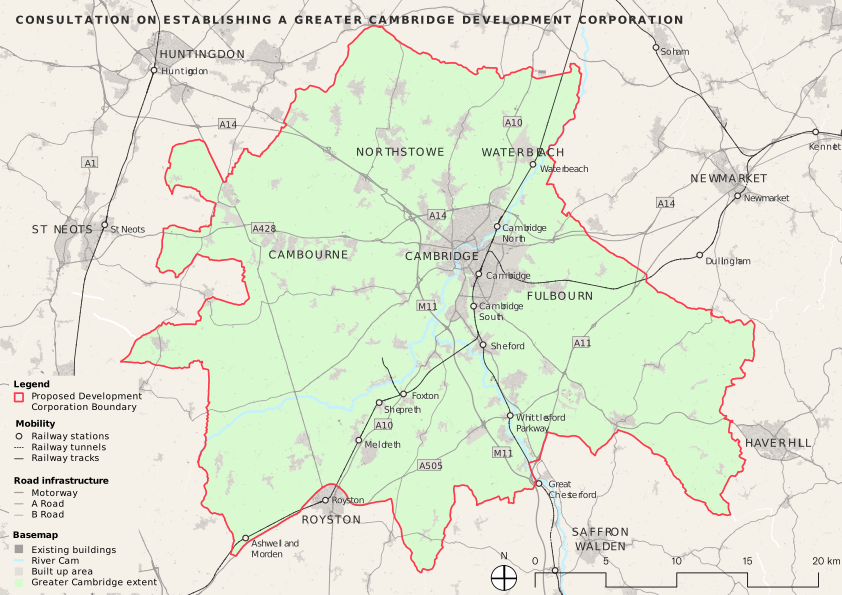
The proposed boundary of the Development Corporation aligns with the current, combined administrative areas of Cambridge City Council and South Cambridgeshire District Council, as outlined in Annex B.
Rationale for the proposed boundary
A broad development area is essential to achieving the proposed Development Corporation’s objectives and making effective use of the powers available to it.
The proposed approach provides several key advantages:
Delivering and funding strategic infrastructure
The proposed boundary encompasses land needed for strategic infrastructure. A broad geography enhances a development corporation’s ability to maximise funding and enable land value captured to be deployed, increasing the viability of major projects, including social and environmental projects.
Alignment with existing governance
Aligning the boundary with the 2 local councils (Cambridge City Council and South Cambridgeshire District Council) simplifies governance arrangements and delivery. It would enable a development corporation to support the draft local plan, working to accelerate its delivery once adopted.
Coherent spatial planning
The boundary would allow for integrated, long-term spatial planning across Greater Cambridge as a whole, rather than a fragmented approach to individual sites.
Flexibility and adaptability
The boundary would maintain the flexibility required to respond to emerging constraints and opportunities for economic growth over the Development Corporation’s lifetime. This ensures development can be planned in the right places for the right reasons, rather than being constrained by artificial limits.
Consultation question
Question 5
What do you think about the proposed boundary of the Greater Cambridge Development Corporation, as set out in Annex B?
4. Powers and functions
The Secretary of State will confer a range of statutory powers and functions on the proposed Development Corporation to enable delivery of its objectives, drawn from the 1980 Act and subsequent legislation.
Proposed powers
A development corporation would have access to the following powers to support delivery:
Land acquisition and disposal powers
UDCs can be given powers to acquire land by agreement or compulsory purchase orders, vest land from public bodies, assemble fragmented sites, remediate contaminated areas, and dispose of land to facilitate development, often at uplifted values.
The proposed Development Corporation would have these powers from the outset and would apply these to unlock stalled or underutilised sites, enabling efficient assembly for urban extensions and infrastructure-led growth, while prioritising community benefits.
Infrastructure powers
UDCs can help coordinate infrastructure provision with providers. They can also be given powers to directly plan, fund, and deliver essential infrastructure to support regeneration, including utilities such as water, electricity, gas, and public realm improvements like schools and green spaces.
The proposed Development Corporation would have these powers from the outset. It would take a lead in ensuring there is adequate capacity of utilities to enable development to come forward, and use its powers to enable the delivery of social infrastructure upfront in support of high quality placemaking.
Transport powers
UDCs can help coordinate, and in some circumstances deliver transport schemes if they facilitate development within their operational area.
It is intended that the proposed Development Corporation would work closely with existing transport authorities to deliver ambitious transport solutions, building on the Cambridge Growth Company’s work with the Combined Authority and other local partners to explore options for mass rapid transit.
Where local transport authorities fail in their duty to have regard to or cooperate in the development or implementation of plans proposed by a development corporation, the Development Corporation can apply to the Secretary of State to direct the transport authorities to cooperate. As a backstop, transport powers can be transferred to the Development Corporation, where deemed necessary.
Financial powers and functions
UDCs can access central government grants and borrowing, providing financial flexibility to deliver at scale. The government has already announced up to £400 million of initial government funding in October 2025, to back these ambitions in Greater Cambridge. UDCs can co-invest with private and institutional partners to de-risk development and attract capital, and they have powers to acquire land to assemble sites for infrastructure and housing, which is essential for unlocking delivery at pace.
They can also develop assets, generating income to reinvest in growth. We will explore opportunities to further expand the pool of funding and borrowing that a UDC in Greater Cambridge could access, working in collaboration with local partners and other public financial institutions.
Other operational powers
UDCs hold additional tools for effective regeneration, including surveying land for acquisitions, exercising public health functions (e.g., addressing nuisances), and managing dissolution or function transfers upon completion.
These powers would be given to the proposed Development Corporation from the outset.
Planning powers
In addition to these enabling powers, the 1980 Act as to be amended by the Levelling up and Regeneration Act 2023 empowers the Secretary of State to designate a development corporation as the local planning authority for all or part of its area.
This encompasses 2 main functions, preparing a local plan for an area and determining planning applications. It is proposed the Greater Cambridge Development Corporation once established, is granted both of these powers in a focused, phased and collaborative manner, working closely with local stakeholders to build upon the positive work of the Greater Cambridge Shared Planning Service.
Plan making powers
It is proposed the Greater Cambridge Development Corporation would be granted plan making powers under Parts 2 and 3 of the Planning and Compulsory Purchase Act 2004. These would allow it to create a long-term spatial plan for the area within its boundary, ensuring coordinated and ambitious growth for Cambridge over the long term.
Any Development Corporation local plan would be subject to the same requirements as any local plan and would be underpinned by a robust programme of engagement and consultation with local communities, stakeholders and partners. This would ensure the plan reflected both national and local priorities.
Development of the plan would involve close liaison with other local bodies, such as those responsible for public health, transport and the environment to ensure that there was a balanced and considered approach.
The Development Corporation would contribute to the development of the Cambridgeshire and Peterborough Combined Authority’s Spatial Development Strategy and any development plan produced by a development corporation would have to be in general conformity to the Spatial Development Strategy, ensuring strategic alignment across the wider area.
Phased approach to plan making
As set out in Chapter 2, given the significant progress already made on the draft Greater Cambridge local plan, it is proposed that the Development Corporation not exercise plan making powers until Phase 2 of its approach. A driver for this approach is to avoid creating an impediment to the draft local plan. To ensure the fastest route to delivering growth in the short to medium term, the Development Corporation would support the draft local plan so that there is a policy framework for development in place.
To give effect to this phased approach, it is proposed that the Secretary of State uses a direction to restrict the use of plan making powers by the Development Corporation when it is established. The direction will be lifted when the Secretary of State decides it is appropriate, expected to be once the draft local plan has been adopted, although this could change depending on the circumstances and progress of the local plan.
Development management powers
Development management powers are essential for the Greater Cambridge Development Corporation to deliver its objectives of accelerating strategic growth in an integrated way. The Development Corporation would therefore take these powers from the outset.
In line with the Development Corporation’s intended focus on sites of strategic importance, it would have the ability to use these development management powers in two ways.
First, to determine applications on any site of strategic importance that met specified size thresholds. As part of this consultation, we are seeking views on what the minimum threshold should be. Table 1 below sets out the proposed minimum threshold for different application types, above which a planning application would be determined by the Development Corporation. Responsibility for determination of applications which fall below minimum thresholds would remain with the relevant local authority.
Second, to determine applications, regardless of their size, on any site necessary to ensure the delivery of a site of strategic importance. The use of development management powers in such instances would only be used where development of a site would compromise or negatively impact on the delivery of a site of strategic importance and would have to be appropriately justified.
Table 1: Proposed development corporation determination thresholds
| Development Type | Proposed threshold minimum |
|---|---|
| C3 (Residential dwellinghouses) | A minimum set at 250, 500 or 1,000 dwellings or equivalent floorspace |
| C1 (hotels) and C2 (hospital/care homes) | A minimum set at 100 or 250 rooms or equivalent floorspace |
| C2a (Secure Residential Institutions) | A minimum set at 1,000sqm or 2,500 sqm |
| Class E (commercial, business and service) | A minimum set at 1,000sqm or 2,500 sqm |
| Class B (general industrial B2 and storage distribution B8) | A minimum set at 1,000sqm or 2,500 sqm |
| Class F (learning, non-residential institutions recreation and community uses) | A minimum set at 1,000sqm or 2,500 sqm |
The decision-making process for planning applications
The Development Corporation will be required to follow the same legal requirements and consider the same issues as a local planning authority and would hold no additional powers or exemptions to other such authorities. The Development Corporation will not give undue weight to any one particular land use and all applications will be determined in line with local policy within the adopted local plan, and national planning policy.
It will have to consult with local residents, businesses and a range of statutory consultees on all planning applications and will be required to consider all representations received when determining applications.
It is anticipated that a planning committee of the Development Corporation would comprise technical experts in planning, urban design and infrastructure delivery, as well as local representation.
Appeals against decisions by the Development Corporation
If the Development Corporation refuses planning permission or fails to determine a planning application within the timescale allowed, the applicant would appeal to the Secretary of State in the same way as with local authority decisions. Appeals would be handled by the Planning Inspectorate, with the Development Corporation required to defend its position. If an appeal is lodged by the applicant, it will be dealt with in the normal way by the Planning Inspectorate.
Only applicants have the right to appeal. There is no third party right of appeal against decisions, which is consistent with the position for local planning authorities. This means that those making representations against development proposals determined by the Development Corporation would not have any greater rights of appeal than they currently have.
Enforcement and rights to enter land powers
Although the 1980 Act allows the Secretary of State to grant enforcement and land entry powers to the Development Corporation, we propose these remain with the existing local councils. The Development Corporation would work closely with local councils to ensure that any appropriate enforcement action is taken across all development.
Joint national and local approach
In addition to these arrangements, the Development Corporation would be expected to establish a Memorandum of Understanding with local councils and the Greater Cambridge Shared Planning Service. The purpose of this agreement will be to establish the correct process for all the bodies involved to work together, covering areas such as: handling applications submitted to the wrong body; collaborative working on enforcement cases; information sharing; and coordination and transition arrangements.
Consultation questions
Plan making
Question 6
What do you think about the phased approach we have proposed in regard to plan making powers?
Question 7
What do you think about the proposals to give the Development Corporation plan making powers as set out in the consultation document?
Determining planning applications
Question 8
What do you think about the proposals to give the Development Corporation powers to determine planning applications as set out in the consultation document?
Question 9
Do you agree with using thresholds for the Development Corporation taking decision making powers?
Which minimum thresholds for determining planning applications do you think are appropriate?
( Yes / No / Don’t know). Please add any comments you wish to make.
Other
Question 10
Do you have any other views on the proposed approach to the Development Corporation’s powers and functions?
5. Governance
The Greater Cambridge Development Corporation would be responsible for delivering its objectives in the Greater Cambridge area, and would operate under a robust governance framework.
The Board
The Development Corporation’s Board will be responsible for ensuring that it discharges its functions effectively and efficiently; it fulfils the overall aims, objectives and priorities set out in its corporate plan; and it complies with all statutory or administrative requirements relating to the use of public funds.
The 1980 Act and the Levelling Up and Regeneration Act 2023 provides that a development corporation must have a board appointed by Secretary of State that consists of a Chair, a Deputy Chair and a minimum of 5 other members; and have regard to the desirability of securing the services of members who have special knowledge of the locality in which a development corporation would operate.
The Board will drive a challenging and complex agenda. Given the government’s approach to establish the Development Corporation as a centrally-led body, but as a joint national-local endeavour, the government intends to ensure local democratic input and that its activities represent the needs of existing communities across Greater Cambridge.
The democratically elected local leaders from Cambridge City Council, South Cambridgeshire District Council, Cambridgeshire County Council, and the Mayor of Cambridgeshire and Peterborough will be invited to join the Board. Their insight into the character of their places and the priorities of existing residents should shape how any growth is delivered. The strength of a joint national and local model lies in combining national capacity with local knowledge and accountability. This approach has already been established through local leaders’ representation on the Cambridge Growth Company’s Advisory Council, alongside a select number of local and technical experts.
The Board is also expected to invite members with a range of skills and experience in development, design and master planning, environment, finance, and infrastructure delivery. Expertise will be essential to ensure the Board can effectively oversee the complex, long-term programme of work required to deliver sustainable growth in Greater Cambridge. Further details on the final Board membership of the Development Corporation would be made in due course.
Transparency and openness
As it enters delivery, the Development Corporation will hold its planning committee meetings in public, following the same practice as local councils. In doing so, the government expects it to adopt the principles set out in the Openness of Local Government Bodies Regulations 2014, enabling members of the public to report on meetings of their council using digital and social media. It is also anticipated that the Development Corporation would regularly hold Board meetings that are open to the public.
Transparency and openness are essential to ensuring that the Development Corporation will be accountable to local residents and to the wider public. As an arm’s length body of the Ministry of Housing, Communities and Local Government, the Development Corporation will be subject to the same transparency requirements that apply to all of the Ministry’s arm’s length bodies, including monthly publication of expenditure over £250 and the disclosure of certain salary information. As a public body, the Development Corporation will also be subject to the Freedom of Information Act as well as the Environmental Information Regulations 2004.
Whilst the Development Corporation will not be a local authority, and therefore not directly covered by the Local Government Transparency Code, it is the government’s intention that the Development Corporation should generally (to the extent relevant) follow the same transparency provisions expected of local councils.
Consultation questions
Question 11
What do you think about proposed local representation on the Development Corporation Board, as set out in the consultation document?
Question 12
What do you think about the board having expertise in areas such as planning, property development, design, environment, finance, and infrastructure delivery?
Public sector equality duty
We would like to hear about any differential impact of any of the above proposals on persons with a relevant protected characteristic as defined by the Equality Act 2010 compared to persons without that protected characteristic, together with any appropriate mitigation measures, which may assist in deciding final policy approaches in due course.
Consultation questions
Question 13
Do you have any views on the impacts of the above proposals for anyone with a relevant protected characteristic?
a) If so, please explain who, which groups, including those with protected characteristics, may be impacted and how.
b) Is there anything that could be done to maximise benefits or address any concerns you have identified?
Annex A: Consultation questions
-
What do you think about the current delivery of infrastructure and homes in Greater Cambridge?
-
What do you think about the proposal to create a centrally-led urban development corporation (UDC) in Greater Cambridge?
-
What matters most to you about the future of Greater Cambridge?
-
Do you have any views on the objectives of the Greater Cambridge Development Corporation, as set out in the consultation document?
-
What do you think about the proposed boundary of the Greater Cambridge Development Corporation, as set out in Annex B?
-
What do you think about the phased approach we have proposed in regard to plan making powers?
-
What do you think about the proposals to give the Development Corporation plan making powers as set out in the consultation document?
-
What do you think about the proposals to give the Development Corporation powers to determine planning applications as set out in the consultation document?
-
Do you agree with using thresholds for the Development Corporation taking decision making powers? Which minimum thresholds for determining planning applications do you think are appropriate?
-
Do you have any other views on the proposed approach to the Development Corporation’s powers and functions?
-
What do you think about proposed local representation on the Development Corporation Board, as set out in the consultation document?
-
What do you think about the board having expertise in areas such as planning, property development, design, environment, finance, and infrastructure delivery?
-
Do you have any views on the impacts of the above proposals for anyone with a relevant protected characteristic?
a) If so, please explain who, which groups, including those with protected characteristics, may be impacted and how.
b) Is there anything that could be done to maximise benefits or address any concerns you have identified?
About you (optional)
14. Do you live or work in the Greater Cambridge area? (defined as the proposed boundary of the Development Corporation)
[Yes / No / Don’t know]
15. Are you responding as an individual or on behalf of an organisation?
[Individual / Organisation / not applicable]
16. If you’re responding on behalf of an organisation, please provide the organisation’s name and the contact details of a nominated contact.
17. What type of organisation are you representing? (if applicable)
- local authority
- neighbourhood planning body, parish or town council
- developer
- business
- other private sector organisation
- professional body
- interest group or voluntary organisation
Annex B: Proposed operational boundary
Annex B is a map showing the boundary of the proposed Greater Cambridge Development Corporation, which aligns with the combined administrative areas of Cambridge City Council and South Cambridgeshire District Council.
Annex C: Frequently asked questions
Purpose of the proposed Greater Cambridge Development Corporation
Greater Cambridge faces critical constraints that are preventing it from realising its full potential as a place to live and work. These include housing affordability, congested transport and wider infrastructure capacity that are limiting growth and threatening Cambridge’s position as a global centre of innovation.
In response to these challenges, the government is proposing to establish a Greater Cambridge Development Corporation, a centrally-led urban development corporation with the legislative powers, focus and resources to unlock the area’s potential.
Building upon the exceptional quality of place seen across much of Greater Cambridge, the objective of the Development Corporation would be to deliver exemplary development in the form of high-quality, well-designed, attractive, and sustainable homes and neighbourhoods.
How long the Development Corporation will exist
We expect the proposed Development Corporation to operate for at least 25 years, proving the sustained focus needed to plan and deliver the intended transformational change. At the end of this period, it is expected assets and powers would transfer back to locally accountable institutions.
To ensure ongoing effectiveness and value for money, the Development Corporation would be subject to a review five years after its establishment, with regular monitoring throughout its lifespan.
The powers of the Development Corporation
The proposed Development Corporation will have access to a suite of powers to enable delivery of its objectives. These include powers related to planning, land acquisition and disposal, financing, infrastructure, and operations.
These would be drawn from the Local Government, Planning and Land Act 1980, the Planning and Compulsory Purchase Act 2004, the Levelling up and Regeneration Act 2023, and the Planning and Infrastructure Act 2025.
Further information on powers can be found in Chapter 4 of this document.
Funding for the Development Corporation and building infrastructure
Last October, government confirmed that up to £400 million of initial government funding will be made available to kickstart development in Cambridge with affordable homes, infrastructure and business expansion.
Infrastructure for more homes
Infrastructure delivery in Greater Cambridge has not kept pace with the provision of new homes. One of the key objectives of the Development Corporation will be to plan, coordinate and advance the delivery of enabling infrastructure that responds to critical issues, removes barriers to growth and investment, and benefits local communities.
What the Development Corporation is not responsible for
Other than the transfer of certain planning functions, the local councils will remain responsible for the provision of the usual council services in the Development Corporation’s area. Local councils will therefore continue to deliver services including:
- refuse collection
- recycling
- neighbourhood services
- council tax and benefits
- housing and property services
- parking services
- licensing issues, including environmental health
- building control
- facilities and maintenance, including parks and open spaces, and leisure centres
- education
- highways and transport
- public safety and public health
- social care
- libraries
- waste management
- trading Standards
- police, fire and rescue services
- health services
Who to send my planning application to
Who you send your planning application to depends on the proposed development. The Development Corporation will only determine applications over a certain threshold. These thresholds are set out in Table 1 in this document. If the proposed development does not meet these thresholds, it will be determined by the local planning authority.
If the proposed Greater Cambridge Development Corporation is established, we will provide further information in due course on how and who to submit a planning application to.
Objecting to a planning application
You can still object to a planning application being considered by the development corporation.
The Development Corporation will have to consult with local residents, businesses and a range of statutory consultees on planning applications submitted to them in the same way that a local authority does, and it will be required to consider the representations it receives in coming to a decision on any application it considers.
Planning applications in progress when the Development Corporation’s planning functions commence
Any undetermined planning applications on the day that the Development Corporation is granted on planning powers will be transferred to the Development Corporation, if said planning application meets the thresholds set out in Table 1. The Development Corporation will be given the full statutory period in which to determine these.
Council tax
Your council tax will continue to be set by your local authority.
Having a say in proposals for Greater Cambridge if you live outside the boundary
People outside of the boundary of the Development Corporation will have the opportunity to comment on the proposals.
About this consultation
This consultation document and consultation process adhere to the Consultation Principles issued by the Cabinet Office.
Representative groups are asked to give a summary of the people and organisations they represent, and where relevant who else they have consulted in reaching their conclusions when they respond.
Information provided in response to this consultation may be published or disclosed in accordance with the access to information regimes (these are primarily the Freedom of Information Act 2000 (FOIA), the Environmental Information Regulations 2004 and UK data protection legislation). In certain circumstances this may therefore include personal data when required by law.
If you want the information that you provide to be treated as confidential, please be aware that, as a public authority, the Department is bound by the information access regimes and may therefore be obliged to disclose all or some of the information you provide. In view of this it would be helpful if you could explain to us why you regard the information you have provided as confidential. If we receive a request for disclosure of the information we will take full account of your explanation, but we cannot give an assurance that confidentiality can be maintained in all circumstances. An automatic confidentiality disclaimer generated by your IT system will not, of itself, be regarded as binding on the Department.
The Ministry of Housing, Communities and Local Government will at all times process your personal data in accordance with UK data protection legislation and in the majority of circumstances this will mean that your personal data will not be disclosed to third parties. A full privacy notice is included below.
Individual responses will not be acknowledged unless specifically requested.
Your opinions are valuable to us. Thank you for taking the time to read this document and respond.
Are you satisfied that this consultation has followed the Consultation Principles? If not or you have any other observations about how we can improve the process please contact us via the complaints procedure.
Personal data
The following is to explain your rights and give you the information you are entitled to under UK data protection legislation.
Note that this section only refers to personal data (your name, contact details and any other information that relates to you or another identified or identifiable individual personally) not the content otherwise of your response to the consultation.
1. The identity of the data controller and contact details of our Data Protection Officer
The Ministry of Housing, Communities and Local Government (MHCLG) is the data controller. The Data Protection Officer can be contacted at dataprotection@communities.gov.uk or by writing to the following address:
Data Protection Officer,
Ministry of Housing, Communities and Local Government,
Fry Building,
2 Marsham Street,
London,
SW1P 4DF
2. Why we are collecting your personal data
Your personal data is being collected as an essential part of the consultation process, so that we can contact you regarding your response and for statistical purposes. We may also use it to contact you about related matters.
We will collect your IP address if you complete a consultation online. We may use this to ensure that each person only completes a survey once. We will not use this data for any other purpose. Respondents should refrain from sharing personal or special category data outside of the administrative questions at the end of the Citizen Space questionnaire.
Sensitive types of personal data
Please do not share special category personal data or criminal offence data if we have not asked for this unless absolutely necessary for the purposes of your consultation response. By ‘special category personal data’, we mean information about a living individual’s:
- race
- ethnic origin -political opinions
- religious or philosophical beliefs
- trade union membership
- genetics
- biometrics
- health (including disability-related information)
- sex life
- sexual orientation
By ‘criminal offence data’, we mean information relating to a living individual’s criminal convictions or offences or related security measures.
3. Our legal basis for processing your personal data
The collection of your personal data is lawful under article 6(1)(e) of the UK General Data Protection Regulation as it is necessary for the performance by MHCLG of a task in the public interest/in the exercise of official authority vested in the data controller. Section 8(d) of the Data Protection Act 2018 states that this will include processing of personal data that is necessary for the exercise of a function of the Crown, a Minister of the Crown or a government department i.e. in this case a consultation.
Where necessary for the purposes of this consultation, our lawful basis for the processing of any special category personal data or ‘criminal offence’ data (terms explained under ‘Sensitive Types of Data’) which you submit in response to this consultation is as follows. The relevant lawful basis for the processing of special category personal data is Article 9(2)(g) UK GDPR (‘substantial public interest’), and Schedule 1 paragraph 6 of the Data Protection Act 2018 (‘statutory etc and government purposes’). The relevant lawful basis in relation to personal data relating to criminal convictions and offences data is likewise provided by Schedule 1 paragraph 6 of the Data Protection Act 2018.
4. With whom we will be sharing your personal data
MHCLG may appoint a ‘data processor’, acting on behalf of the Department and under our instruction, to help analyse the responses to this consultation. Where we do we will ensure that the processing of your personal data remains in strict accordance with the requirements of the data protection legislation.
Your responses may be processed by Artificial Intelligence to analyse the responses to the consultation more efficiently. These tools assist in identifying and mapping themes in consultation responses, but do not make decisions and all outputs are reviewed by staff for accuracy and reliability. Where data is processed by Artificial intelligence, MHCLG will take reasonable and proportionate steps to remove personal data from the consultation responses before using an Artificial Intelligence, tool but this cannot be guaranteed. Respondents should refrain from sharing personal or special category data outside of the administrative questions at the front of the Citizen Space questionnaire. The AI tool processes data securely and does not copy or share 8 data. The data will only be accessed and used by those authorised to do so. Data used in AI tools is not used for training the AI model.
MHCLG will take steps to check AI outputs for accuracy and identify and reduce bias.
5. For how long we will keep your personal data, or criteria used to determine the retention period
Your personal data will be held for 2 years from the closure of the consultation, unless we identify that its continued retention is unnecessary before that point.
6. Your rights, e.g. access, rectification, restriction, objection
The data we are collecting is your personal data, and you have considerable say over what happens to it. You have the right:
a) to see what data we have about you
b) to ask us to stop using your data, but keep it on record
c) to ask to have your data corrected if it is incorrect or incomplete
d) to object to our use of your personal data in certain circumstances
e) to lodge a complaint with the independent Information Commissioner (ICO) if you think we are not handling your data fairly or in accordance with the law.
You can contact the ICO at https://ico.org.uk/, or telephone 0303 123 1113.
Please contact us at the following address if you wish to exercise the rights listed above, except the right to lodge a complaint with the ICO: dataprotection@communities.gov.uk or
Knowledge and Information Access Team,
Ministry of Housing, Communities and Local Government,
Fry Building,
2 Marsham Street,
London,
SW1P 4DF
7. Your personal data will not be sent overseas
8. Your personal data will not be used for any automated decision making
9. Your personal data will be stored in a secure government IT system
We use a third-party system, Citizen Space, to collect consultation responses. In the first instance your personal data will be stored on their secure UK-based server. Your personal data will be transferred to our secure government IT system as soon as possible, and it will be stored there for 2 years before it is deleted.
-
Cosh, A. & Caselli, G. (2025). Business Growth & Clusters: Cambridge City Region 2015–2024. Centre for Business Research, University of Cambridge. ↩
-
Oxford Economics (2025). Greater Cambridge: Growth Scenarios: A Report for the Ministry of Housing, Communities, and Local Government. ↩
-
World Intellectual Property Organisation, Global Innovation Index Rankings. (2022), (2023), (2024). ↩
-
Cosh, A. & Caselli, G. (2025). Business Growth & Clusters: Cambridge City Region 2015–2024. Centre for Business Research, University of Cambridge. ↩
-
Cambridge City Council (2024). Productivity Plan. ↩
-
Oxford Economics (2025). Greater Cambridge: Growth Scenarios: A Report for the Ministry of Housing, Communities, and Local Government. ↩
-
Office for National Statistics (2024). Housing affordability in England and Wales. ↩
-
Office for National Statistics (2024). Private rental affordability in England, Wales and Northern Ireland. ↩
-
Cambridge City Council (2023). State of the City ↩
-
Environment Agency (2021). Water stressed areas - final classification. ↩
-
Cambridgeshire County Council (2025). Local Area Energy Planning. ↩
-
Cambridge Ahead & Anglia Ruskin University (2025). The Infrastructure Gap – The future of sustainable energy in Greater Cambridge. ↩
-
Bidwells (February 2025). Cambridge Databook: Offices and Labs (February 2025). ↩
-
Greater Cambridge Shared Planning (2025). Greater Cambridge Planning Obligations Supplementary Planning Document Statement of Consultation – post consultation stage. ↩
-
South Cambridgeshire District Council (2023). Northstowe Community Facilities Update – report for scrutiny. ↩
-
Cambridge Judge Business School (2025). Growth In the Cambridge economy 2018-24. ↩
-
Cambridge Ahead (2024). Pulse Survey - Capturing the views of Major Cambridge Employers ↩
-
Oxford Economics (2025). Greater Cambridge: Growth Scenarios: A Report for the Ministry of Housing, Communities, and Local Government. ↩
-
Cambridgeshire and Peterborough Independent Economic Review (CPIER) (2018). Final Report. ↩
-
Iceni Projects (2020). Greater Cambridge Housing & Employment Relationships Report (HERR). In: Greater Cambridge Planning, Employment and Housing Evidence Update. ↩
-
House of Commons (1998). Supplementary Memorandum from the Department of the Environment, Transport and the Regions (EST 98D). ↩
-
Noting the government’s decision not to make additional funding available through the Housing Infrastructure Fund for the waste water treatment plant relocation at North East Cambridge, following significantly increased costs of the project. ↩