Draft Annual Plan 2026 to 2027
Updated 23 March 2026

© Crown copyright 2026
This publication is licensed under the terms of the Open Government Licence v3.0 except where otherwise stated. To view this licence, visit nationalarchives.gov.uk/doc/open-government-licence/version/3 or write to the Information Policy Team, The National Archives, Kew, London TW9 4DU, or email: psi@nationalarchives.gov.uk.
Where we have identified any third party copyright information you will need to obtain permission from the copyright holders concerned.
This publication is available at https://www.gov.uk/government/consultations/cma-draft-annual-plan-2026-to-2027/draft-annual-plan-2026-to-2027
Chair’s and Chief Executive’s foreword
This Annual Plan is the first detailed implementation plan under our new 2026 to 2029 Strategy. Our Strategy centres on promoting competition and protecting consumers with a clear end goal in mind: to drive economic growth and improve household prosperity. This is in keeping with the government’s Strategic Steer to the CMA, which provides important transparency over the policy priorities we can help advance whilst explicitly acknowledging our statutory independence.
The 5 core objectives in our Strategy reflect a combination of continuity and change for the CMA:
-
We will remain a strong advocate for, and independent enforcer of, effective competition across the UK economy. We know this drives greater innovation, productivity and security of supply, as well as lower prices, more choice and improved quality. But effective competition does not preclude business collaboration. So, we are also stepping up action to enable legitimate, pro-growth collaboration.
-
Championing consumers will continue to be at the heart of everything we do. Specifically, we will work to put money back in people’s pockets, protect them from harm and help businesses do the right thing by their customers. These activities contribute directly to household prosperity, as well as strengthening consumer confidence which supports the conditions for economic growth. We will continue our deliberately strategic approach to implementing the enhanced consumer protection regime under the Digital Markets, Competition and Consumers Act (DMCCA), which marks a fundamental shift in how we uphold consumer rights in the UK. That means supporting businesses to comply with the law, alongside tough enforcement where it really matters to people. We remain clear that this the recipe to maximise the value of the new regime for consumers and fair dealing businesses.
-
We are dialling up our role as an enabler of competition through advice and recommendations to government. This activity will be powered by the unique combination of the CMA’s markets, microeconomics and public policy expertise. We believe the impact of this shift could be significant, particularly in support of the government’s Industrial Strategy and the resilience of public finances. Our focus includes removing anti-competitive regulation standing in the way of companies scaling, applying a pro-competition lens to public procurement and unlocking cross-economy barriers to growth (like more interoperability and access to data).
-
In a world of mobile capital and talent, the UK must work hard to attract the investment needed to power growth. For the CMA, that means doubling down on our contribution to a UK regulatory landscape which instils business confidence and acts as a magnet for investment. This does not mean less robust decision making, nor that we will always see eye-to-eye with parties in individual cases. However, delivering on our Strategy requires a foundational level of business and investor confidence in our regimes. This is what our comprehensive 4Ps framework is designed to address. Transformative change across the organisation will continue throughout 2026 to 2027 under the 4Ps.
-
Across all of our work, we will focus relentlessly on delivering tangible benefits for the UK. We will consciously prioritise markets and issues that deliver the greatest positive impact for the UK’s economy, citizens, and businesses, setting the UK on a path to a more stable and prosperous future. And we will leverage the unique design of the UK’s competition, consumer protection and digital markets regimes to deliver outcomes that make a real difference for the country, and to foster a global reputation for a purposeful and pragmatic British approach.
These 5 objectives underpin the priorities for the next year and key elements of our ongoing transformation programme that are laid out in this Annual Plan.
Through execution of our Annual Plan, we will build on a strong track record of change delivery last year. This included:
-
an overhaul of the way we work through the implementation of our 4Ps programme
-
a step change in stakeholder engagement including through the establishment of the CMA’s Growth & Investment Council
-
Implementation of 2 major new DMCCA regimes, leading to the completion of 3 SMS designations and the launch of a substantial first wave of consumer protection investigations
Alongside this, we continued to deliver impactful outcomes through our existing casework, for example:
-
imposing around £200 million in financial penalties through competition enforcement
-
taking important consumer protection action, including to change the way Ticketmaster operates
-
helping to ease the cost of living with a focus on bringing down prices and improving choice in markets from infant formula, to vets and road fuel
So that the CMA is accountable for how we execute our Strategy, we will report against delivery of the priorities in this Annual Plan in our 2026 to 2027 Annual Report and Accounts (ARA). Alongside accountability sits openness to feedback. Stakeholders have an opportunity to feed into the development of our annual priorities through the public consultation on this draft Annual Plan. As ever, we are grateful to those who take the time to share their views with us.
-
do you agree with the CMA’s proposed priorities for the year ahead?
-
how can the CMA engage with our stakeholders effectively in the year ahead?
-
do you have any other comments on the CMA’s draft Annual Plan?
Our 2026 to 2029 strategy
Our purpose: We will promote competition and protect consumers with a clear end goal - to drive economic growth and improve household prosperity.
We will focus on 5 strategic objectives:
1. Promoting effective competition
We will remain a strong advocate for, and independent enforcer of, effective competition across the UK economy - removing blockers to competition whilst also stepping up action to enable legitimate, pro-growth business collaboration.
2. Championing consumers
We will protect people from harm and help businesses do the right thing by their customers.
3. Helping government deploy tailored pro-competition interventions to support growth, innovation and investment-related policies
We will step up our role as an enabler of competition, providing expert advice and recommendations to government with a particular focus on public procurement and regulatory barriers.
4. Fostering a UK regulatory landscape that attracts investment and instils business confidence
We will continue to implement our 4Ps approach (Pace, Predictability, Proportionality and Process), ensuring the competition and consumer protection regimes contribute to the UK’s reputation as a great place to do business and invest.
5. Prioritising UK interests
Across all of our work, we will focus relentlessly on delivering tangible benefits for the UK’s economy, its citizens and businesses.
These will contribute to a set of mutually reinforcing outcomes:
-
dynamic, competitive markets drive investment, innovation and growth
-
strategically important markets and scaling businesses can flourish
-
lower prices and fairer outcomes, particularly in essential markets, ease the burdens on household budgets
-
consumers can engage confidently in markets, without fear of exploitation
-
fair-dealing businesses can compete on a level playing field
-
our expert advice and recommendations to government shape pro-competitive policies that drive growth, support consumers, and secure value for money in public services
To deliver these objectives, we are making fundamental changes to how we work:
-
embedding the 4Ps framework across all areas of the CMA
-
evolving how we operate to maximise agility and productivity
-
delivering a step-change in how we measure performance and impact
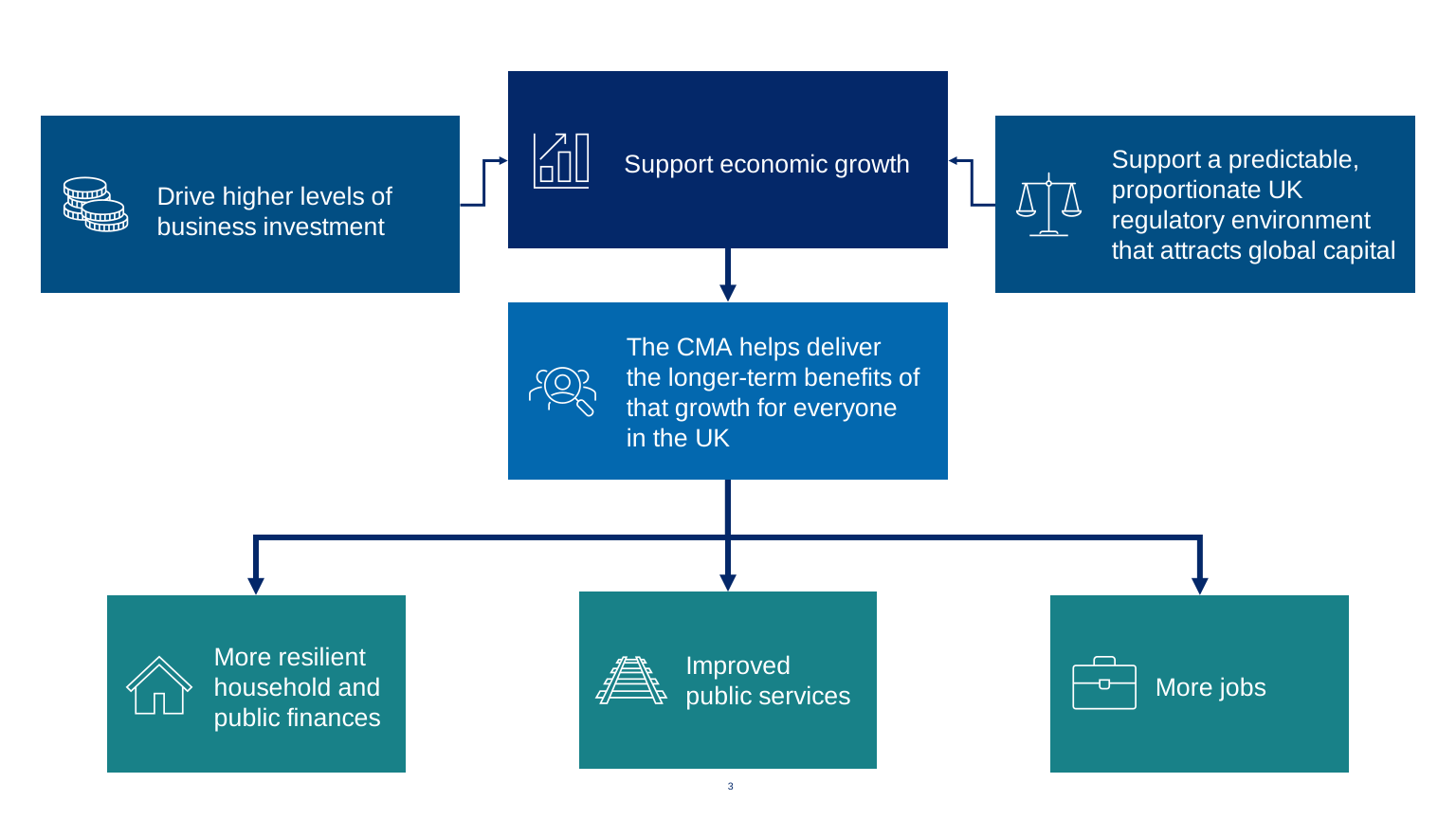
How the CMA helps drive growth
-
by promoting competition, we help spur innovation, investment and productivity - opening up access to markets and ensuring a level playing field for businesses of all shapes and sizes to innovate and grow
-
effective consumer protection boosts consumer confidence and the financial resilience of households, creating the best conditions for economic growth
-
by contributing to a proportionate and predictable regulatory environment, we help ensure the UK is a great place to do business and invest
How the CMA helps improve household prosperity
-
by promoting competition, we help keep prices low and quality high, delivering the best possible value for stretched household budgets
-
protecting consumers in their day-to-day transactions puts money back in people’s pockets and helps businesses do the right thing by their customers
-
by promoting competition, we help drive efficiency and value for money in the provision of public services
By working directly to…
Implementation plan
This implementation plan is intended to provide the clarity and predictability that we know our stakeholders value. We set out below annual priorities and changes we are making to the way we work. These reflect the 5 core objectives in our 2026 to 2029 Strategy, and the outcomes we will contribute to for the UK’s economy, citizens and businesses.
The priorities highlighted in this Plan offer a degree of flexibility should circumstances change. We will continue to make prioritisation decisions throughout the year, in line with our published Prioritisation Principles, our Strategy and the government’s Strategic Steer. This section starts by looking at those areas where we have greater choice over where we focus in the coming year.
CMA prioritisation principles
We apply published prioritisation principles to direct our focus and resource:
-
strategic significance: does action in this area fit with the CMA’s objectives and Strategy
-
impact: how substantial is the likely positive impact of CMA action
-
is the CMA best placed to act: is there an appropriate alternative to CMA action
-
resources: does the CMA have the right capacity in place to act effectively
-
risk: what types of risks are associated with CMA action, and how significant are they
Separate prioritisation principles inform decisions made in relation to some work undertaken by the OIM and SAU. These are set out in specific guidance on the CMA’s approach to these functions.
How we work
We know that how we go about our work is just as important as what areas we prioritise and the CMA is upgrading how we operate to reflect this. This plan in turn reflects how we continue to embed our 4Ps programme, which is a core part of our contribution to a UK regulatory landscape that instils business confidence and incentivises investment. The genesis of the programme was direct feedback on how the CMA could make improvements in areas that are most important to these stakeholders:
-
pace: making good decisions as quickly as possible
-
predictability: providing clarity on our approach and expected outcomes
-
proportionality: ensuring our actions are balanced and targeted
-
process: transforming our engagement with key stakeholders across our functions
Government reforms
We welcome the government’s latest legislative proposals, which complement the CMA’s operational transformation and further embed the 4Ps programme. The government’s consultation proposes important refinements to how decisions are made in merger and market investigations, enhancing the accountability of the CMA Board in these areas. It also proposes a new single-stage ‘market review’ process for examining markets, with the potential to deliver significant benefits to consumers and businesses more quickly. The government’s commitment to provide greater certainty on which transactions will be subject to UK merger control, and how market remedies should be reviewed, will also be part of the consultation.
These plans build on the CMA’s own programme of transformation to drive greater pace, predictability, proportionality and improved engagement through our processes and will enhance the accountability of our decision making. We look forward to continuing to engage positively with government in relation to its consultation, and in the development of any associated legislative instrument.
We also look forward to supporting government in relation to its consideration of possible legislative change regarding the opt-out private damages regime, and regulatory appeals (which we continue to carry out in line with our existing statutory duties and as efficiently as possible).
Consumer protection
The CMA’s ambition for consumer protection is to promote trust and confidence, so people can participate actively in the economy and businesses can compete on a level playing field. Our activities support improved household prosperity and economic growth, while deterring poor corporate practices. We focus on protecting people from harm and helping businesses do the right thing by their customers. We target conduct that is especially harmful to consumers, taking particular care to prevent harm in areas of essential spend and at moments of vulnerability.
The CMA has a refreshed mandate for consumer protection. In April 2025 we set out our approach to implementing an enhanced consumer protection regime under the Digital Markets, Competition and Consumers Act 2024 (DMCCA). This approach continues to drive our priorities for 2026 to 2027.
Annual priorities for consumer protection include:
Maintaining our strategic approach to implementing the new regime, helping businesses comply with new rules (through guidance and pro-active engagement), while taking direct enforcement action through a number of investigations in priority areas.
Continuing to prioritise areas of essential spend to help people struggling with pressure on household budgets.
Focussing our action on more egregious practices where the law is clear. These include areas where we are already taking enforcement action as well as those where we have sent advisory letters (for example, in relation to fake reviews), as well as the behaviours identified in our consumer approach document:
-
aggressive sales practices that prey on consumers in vulnerable positions
-
providing information to consumers that is objectively false
-
banned practices including the new banned practice relating to fake reviews
-
fees that are hidden until late in the purchase process
-
contract terms that are clearly imbalanced and unfair, including those that impose unfair exit charges on consumers
As part of this, progressing our first investigations under the new regime, which focus on price transparency and misleading online choice architecture in a range of sectors – from secondary ticketing, to homeware, and personal fitness.
Driving behavioural change in businesses and sectors using advisory letters to alert companies to areas where they may be at risk of enforcement. We have already seen significant behavioural change in response to advisory letters – they are an effective means of delivering better outcomes for consumers without needing to deploy resource to full enforcement work.
Actions under the 4Ps we expect to progress this year:
Embedding the 4Ps within our first investigations under the new consumer protection regime. Actively streamlining cases to focus on the most important potential concerns, standing down lines of inquiry as quickly as possible where appropriate. Publishing regular information about our progress on each investigation, as well as timings and next steps. Using our information gathering powers proportionately and in a targeted way, focusing on specific, relevant information to minimise burdens for business. (Pace, Predictability, Proportionality, Process)
Developing further accessible materials to help businesses comply with the law and taking cases that will promote legal certainty. We recognise there is limited case law in some areas of consumer law and that the consequences for infringements are now greater under the new consumer regime. (Predictability)
Continuing to offer direct engagement with businesses, including to better understand the issues they experience in practice – and where further guidance might best support compliance. We know this is particularly important for SMEs. Being an active part of the wider consumer landscape is integral to delivering good outcomes for people, so we will continue to engage closely with consumer groups to understand where they think businesses are unclear on the law. (Process)
Markets
The CMA’s markets function allows us to look at entire markets to identify where there are opportunities for them to deliver better outcomes for the UK. These outcomes might include greater choice, lower prices and fairer outcomes for consumers. Our markets work can also drive greater productivity and innovation, as well as bring down barriers to entry or scaling for challengers and small businesses. In this way, it can be a powerful tool both to drive economic growth and to support household prosperity.
In July 2025 we published an overview of our strategic approach to markets work. This set out our ambition for the regime: to carry out our work in a way that maximises overall benefits, while minimising any potential costs and uncertainty for businesses, investors and other stakeholders. This approach document continues to guide our markets work in 2026 to 2027.
Annual priorities for markets include:
Acting in consumer facing markets. We expect this to include work on private dentistry, as well as implementation of remedies that result from veterinary services market investigation. We will continue to identify markets where there is a need to improve consumer trust and confidence – particularly in key areas of consumer need and spend, and in areas of consumer vulnerability.
Supporting implementation of the government’s Industrial Strategy – helping to unlock cross-economy barriers to growth, like more interoperability and access to data.
Supporting government’s role as a market shaper through public procurement and wider policy interventions. This includes completing our civil engineering market study, through which we expect to make clear, focused recommendations to government to improve how projects are scoped, planned, procured and regulated to better support UK growth.
Actions under the 4Ps we expect to progress this year:
Carefully selecting the appropriate markets tool at the outset, adopting the lightest-touch, faster tool that we think can effectively address the particular issues leading us to look at a market (in other words, a market review over a market study, a market study over a market investigation). (Pace)
Continuing to embed the 4Ps in future casework, building on the approach taken in our civil engineering market study. For example, in relation to pace we will draw in sector expertise from an early stage so we can assess and address concerns more promptly. We will publish project roadmaps to support predictability. Where we make recommendations or impose orders on firms, we will ensure proportionality through more comprehensive assessment of remedy costs. Our casework will be underpinned by more active engagement with businesses to better understand likely impacts on them at key decision points. (Pace, Predictability, Proportionality, Process)
Ensuring an effective and proportionate monitoring and enforcement regime. Where the CMA puts in place remedies to address our concerns following a market investigation, we are responsible for monitoring and enforcing compliance with those remedies. The CMA works closely with businesses subject to our remedies to ensure that our approach to monitoring and enforcement is effective in addressing non-compliance but proportionate to any concerns we have. We also keep these remedies under review and consider whether they need to be removed or varied. We will be stepping up our activity in this area over the coming year. (Proportionality)
Government reforms. As above, government has now announced its intention to consult on reforms to the markets regime. We will work closely with them to ensure that any policy and legislative change enhances CMA accountability and strengthens our ability to deliver on the 4Ps. (Pace, Predictability, Proportionality)
Advocacy
The CMA has a statutory role providing expert advice and recommendations to government and public authorities across the UK nations and regions. This advocacy work – often underpinned by research and analysis – helps ensure that competition and consumer protection are properly considered in wider policy-making. Increasingly, we leverage multiple capabilities and tools together to achieve impactful outcomes in this way – in particular, the CMA’s unique combination of advocacy, public policy, microeconomic and markets expertise.
We have a strong track record of advocacy work to tackle the cost of living and will continue our efforts to improve household prosperity this year. We have also been clear that the CMA should be as much an enabler of competition as an enforcer. This ambition is reflected in our third strategic objective: to help government deploy tailored pro-competition interventions to support growth, innovation and investment-related policies. Advocacy, in combination with our wider toolkit, will be key to delivering this.
Annual priorities for advocacy include:
Maximising the impact of the CMA’s markets and consumer casework by ensuring high uptake of our recommendations to government.
Identifying opportunities to remove anti-competitive regulation which acts as a barrier to growth, investment and innovation. We are keen to work with government to examine how reform of the wider regulatory environment can promote competition and unlock opportunities for investment and growth – particularly in the Industrial Strategy priority sectors, such as defence and life sciences.
Advising on how policy can help UK firms grow from challengers into world-leaders. We have active public policy and microeconomics work ongoing in this area, as well as ongoing stakeholder engagement across the UK nations and regions. We expect to deliver relevant policy and research insights throughout the year.
Helping government realise the full potential of public procurement to achieve critical policy objectives – including creating opportunities for high-potential firms to scale, building supply chain resilience, and boosting UK competitiveness. Our engagement with startups, scale-ups and investors consistently highlights that systemic incumbency advantages in public procurement processes can create significant barriers to their growth. Reforming these processes could become one of the most powerful tools for enabling UK startup success. We will step up our work with government in this area over the coming year. This includes continuing to assist the Ministry of Defence in their review of defence contracting (focussed on increasing participation from SMEs, innovators and non-traditional suppliers); as well as our work in the civil engineering market (see above). To further strengthen public finances, we will also continue to work with government to tackle illegal bid-rigging.
Delivering new insights from our Microeconomics Unit – we will continue to undertake research and analysis relevant to enabling growth, investment and innovation.
Competition enforcement
Our competition enforcement work deters anti-competitive conduct that stands in the way of fair outcomes for consumers and taxpayers, reduces market dynamism and impedes innovation. We achieve this through robust enforcement outcomes – including fines or director disqualification – and also through outreach that helps fair-dealing businesses understand how to comply with the law.
Competition enforcement remains core to what we do, especially in strategically important parts of the economy. But effective competition does not preclude legitimate business collaboration, which can support investment, innovation and growth. We are stepping up action to enable this activity, in line with our Strategy.
Annual priorities for competition enforcement include:
Tackling anti-competitive conduct including in key growth sectors and areas that can help improve household prosperity. As part of our broad pipeline of proactive work, we will actively target anti-competitive activity that prevents innovative firms from entering and scaling – particularly in strategically important markets.
Enabling legitimate business collaboration. We are stepping up action to facilitate pro-growth collaboration – particularly in the 8 Industrial Strategy priority sectors and in relation to environmental sustainability agreements. We are interested in hearing from sectors where there is concrete evidence that competition law concerns are chilling beneficial collaborations, and where we might be able to help.
Achieving effective outcomes to our investigations. This means seeing through investigations where we believe there is significant harm to address or deterrent impact to achieve, vigorously defending any legal challenges we may face. As with all our work, the CMA will act with pace. But we are clear that this must not come at the expense of effective outcomes, and we will not shy away from taking the time needed to deliver these.
Prioritising action on public procurement. Anti-competitive bid-rigging can inflate prices by 20% or more. We will continue efforts to tackle these practices, making use of AI and other data science tools to scan bidding data and identify illegal activity at scale. Working with government, we can help deliver substantial public savings and safeguard the level playing-field for fair-dealing businesses. We expect the deterrent effect of enforcement action to increase with cartelists now facing inclusion in a central debarment register, and exclusion from future public tenders for up to 5 years, as a result of the debarment regime now in place under the Procurement Act 2023.
Ensuring new technologies support, and do not impede, effective competition – with a particular focus on deterring algorithmic collusion. We will continue to help businesses understand how to stay on the right side of the law when using or offering algorithmic pricing services. At the same time, we will keep a watchful eye on business practices, making use of our dedicated in-house capability in technology, data and AI to actively scan the market for signs of unlawful activity, ready to take enforcement action where we see evidence of collusion.
Actions under the 4Ps we expect to progress this year:
Achieving the right suite of interventions across the regime. We have a range of tools at our disposal to bring about behaviour change, both by parties to investigations and by businesses that may be at risk of breaching competition law. This can include a significant fine imposed following a full administrative procedure. In other cases – provided it can be done without sacrificing the overall deterrent impact of the regime – impactful outcomes can be achieved faster and more efficiently through use of tools such as warning and advisory letters, or by consensual agreement (settlement or commitments). (Proportionality)
Improving key elements of processes that help us detect and tackle illegal activity. We are making further investments in our detection tools, such as use of data analytics, including AI, tools to identify suspicious activity. With new guidance in place, we are implementing more streamlined procedures to make it easier for firms involved in a cartel to apply for leniency. We are also encouraging complaints from businesses affected by potential anti-competitive behaviour. (Process)
Digital Markets Competition Regime
As new technology permeates every aspect of our lives, effective competition in digital markets is key. The CMA is implementing the new digital markets competition regime to deliver tangible benefits for the UK economy, as well as for UK consumers. We will prioritise opportunities to unlock innovation and investment, supporting greater choice for people and businesses and enabling growth across the economy.
In April 2025, we clarified our approach to implementing the 4Ps in the new digital markets competition regime under the DMCCA, which will continue to guide our work in 2026 to 2027. This approach leverages the unique design of the UK regime – flexible, participative and forward-looking – to support an environment where all companies, large and small, can flourish. We believe it can deliver outcomes that make a real difference for the country, as well as fostering a global reputation for a purposeful and pragmatic British approach in digital markets.
Annual priorities for digital markets include:
Progressing our work on Search and Mobile platforms. We have completed the first ‘Strategic Market Status’ designations in respect of search (Google) and mobile platforms (Apple and Google). We are now moving to design proportionate, targeted interventions to ensure effective competition and fair treatment for businesses and consumers in the UK. These interventions will be tailored to maximise impact, whilst minimising burdens on the businesses concerned. We have laid out a phased approach to actions we are taking in both areas, focussing on the early priorities which we would expect to deliver some of the quickest benefits for UK businesses and consumers.
In Search, focussing on greater choice and control, including through:
-
choice screens: ensuring people can easily choose and switch between search services (potentially including AI Assistants), by making default choice screens a legal requirement
-
fair ranking principles: ensuring Google’s ranking and presentation of search results is fair and non-discriminatory, with an effective process for raising and investigating issues
-
publisher controls: ensuring transparency, attribution and choice for publishers in how their content, collected for Search, is used in Google’s AI services (including AI Overviews and Gemini AI Assistant)
-
data portability: helping innovative new businesses to bring products and services to market by ensuring people can transfer their data (such as search history)
In Mobile platforms, focussing on:
-
Apple’s and Google’s important role in app distribution. A key early priority is promoting greater competition, certainty and confidence for app developers:
-
app certainty: ensuring a fair and transparent app review process (including fair use of data collected), as well as fair and transparent app store rankings
-
promoting greater competition in relation to alternative app distribution, alternative in-app payments and steering: ensuring developers and consumers have choice around where to distribute and access apps and make payments for in-app transactions, removing restrictions to enable developers to steer users to complete transactions outside of an app
-
-
interoperability for Apple to ensure app developers have access to the functionality they need to innovate and compete:
-
interoperability request process: ensuring requests for interoperability from app developers are considered fairly and objectively
-
digital wallets and connected devices: enabling third party providers, including UK FinTechs and digital identity providers, to bring innovative digital wallets to market, as well as to enable connected devices such as smartwatches, gaming headsets or health-tech tools to seamlessly connect with Apple smartphones
-
browsers: enabling third party browsers to use alternative browser engines to Apple’s WebKit
-
-
Keeping under review possible options for further SMS designation investigations – which we anticipate will be considered by the CMA Board in early 2026. We continue to build our understanding of how digital markets are changing, undertaking monitoring work across a range of sectors to inform future prioritisation decisions
Actions under the 4Ps we expect to progress this year:
Delivering the next stages of Search and Mobile work in a way that exemplifies the 4Ps, and our purposeful and pragmatic British approach in digital markets. Proportionality is embedded in the regime (we can only impose interventions on firms when it is proportionate to do so), and we have already provided predictability around our priorities for potential interventions. This year, we will focus on keeping up our pace and working in a participative way. (Pace, Predictability, Proportionality, Process).
Driving forward our ‘go to you’ approach where we proactively make available a wide range of quick, straightforward opportunities for businesses to connect with us, alongside statutory processes. (Process).
Structuring any further SMS investigation launches to allow all stakeholders the time required to engage sufficiently. (Proportionality).
Keeping our focus on whether the CMA is best placed to act. We will consider the interplay of digital markets issues with the actions of other regulators and government bodies, domestically and internationally. When dealing with issues also addressed by international counterparts, we will only act where interventions in other jurisdictions do not adequately and effectively address UK harms. (Proportionality).
Merger control
Merger control safeguards consumer interests and ensures UK markets remain dynamic and competitive, spurring innovation and growth. Most mergers do not raise competition concerns, but those that do can negatively impact on consumers (for example, through higher prices) and businesses (for example, by reducing incentives for investment). The CMA is clear that every deal capable of being cleared unconditionally, or with effective remedies, should be.
As in other areas, the way we operate the regime is crucial to business and investor confidence in the UK. Continuing to embed the 4Ps is therefore a key part of the planned activity for merger control this year.
Annual priorities for merger control include:
Continuing to apply our merger control function in a highly targeted way in line with our strategic objectives, remaining a strong advocate for effective competition across the UK economy. The voluntary nature of the UK merger control regime means that we only investigate mergers that have the potential to raise competition concerns. Where a merger is being investigated by another competition authority, we will also consider whether we can ‘wait and see’ whether those proceedings resolve any UK concerns before opening our own investigation.
Where we do investigate, we will always make robust and independent decisions, based on objective scrutiny of the evidence. This enables us to support innovation, productivity and growth in UK markets, and to secure positive outcomes for UK consumers and businesses.
We will continue to be guided by our Mergers Charter. The Charter sets out clear principles and overarching expectations for how the Competition and Markets Authority (CMA) will engage with businesses and their advisors during merger reviews, and what we expect from businesses in return. Constructive and direct engagement with businesses is vital to ensuring that we are able to take well-informed, evidence-based, and timely decisions.
Actions under the 4Ps we expect to progress this year:
Merger remedies
We will implement the changes introduced in our revised remedies guidance published at the end of last year. The new guidance widens the scope for behavioural remedies and provides merging businesses more clarity on when remedies can secure rivalry enhancing efficiencies (gains from a merger that strengthen competition between the merging businesses and other firms, as was the case in our recent Vodafone/Three investigation) and how we assess relevant customer benefits when considering potential remedy options. The new guidance also makes changes to our processes to facilitate earlier engagement with merger parties on remedies. (Proportionality)
Government reforms
When we set out our merger control 4Ps commitments, we said it was open to government to consider going further through legislative change. As above, government has now announced its intention to consult on a more streamlined approach to Phase 2 decision-making, as part of wider reforms. We will work closely with them so that any policy and legislative change enhances CMA accountability and our ability to deliver on the 4Ps. (Pace, Predictability, Proportionality)
Office for the Internal Market (OIM) and Subsidy Advice Unit (SAU)
The SAU and OIM are important advisory functions that make a significant contribution to economic growth and prosperity across the UK. The OIM provides economic advice and analysis supporting intra-UK trade. The SAU delivers clear, actionable advice to public authorities to enable well-targeted government interventions in a range of policy areas. Both functions report on the operation of the relevant policy frameworks.
Annual priorities for OIM and SAU include:
-
continuing to advise with pace and rigour on subsidies – mostly on a mandatory basis (SAU). This will support delivery of policy objectives including the Industrial Strategy and clean energy transition
-
publishing our first statutory review of the UK subsidy control regime, assessing whether the regime is meeting its aims and drawing on extensive stakeholder engagement and analysis (SAU)
-
working with the 4 governments in support of the Common Frameworks that help manage regulatory divergence across the UK (OIM). This follows from the UK Government’s 2025 review of the UK Internal Markets Act
Actions under the 4Ps we expect to progress this year:
Delivering rigorous work at pace, applying proportionate levels of scrutiny to reflect differential risk and complexity. We will continue to challenge ourselves to ensure that timescales for scrutinising less complex subsidies reflect our internal efficiencies (SAU). We will also deliver proportionate and timely advice to governments to help them avoid unnecessary burdens on businesses caused by regulatory divergence, building on the success of our first short-form review (OIM). (Pace, Proportionality)
Continuing to set clear, predictable expectations through our guidance and extensive stakeholder engagement. We will move from general awareness raising to providing practical advice on the issues that public authorities tell us they find most challenging (SAU). We will continue to engage actively with businesses potentially affected by regulatory differences and increase our involvement in intergovernmental-working groups through the Common Frameworks programme (OIM). (Predictability, Process)
Working with our stakeholders
The CMA will continue to engage and work closely with a range of domestic and international stakeholders, in a variety of contexts.
Stakeholder engagement
The CMA has ramped up engagement considerably in recent years, as well as diversifying the ways in which we tailor it to meet the needs of our many stakeholders. The insights we gain from this activity are invaluable – from the business and investor feedback that formed the genesis of the 4Ps, to uncovering intelligence or data that supports our casework and research.
2026 to 2027 will be another year of intensive engagement, particularly as we continue to embed the 4Ps commitments relating to Process. This includes targeted outreach programmes and more direct dialogue with businesses, investors and consumer groups (within and outside of cases), as well as clearer, more accessible web content and guidance.
Last year, we launched our Growth and Investment Council (GIC), bringing together the leaders of 11 major UK business and investor groups. The GIC has delivered rich discussion, new insights and constructive challenge – we look forward to continuing our regular meetings throughout 2026 to 2027.
Close engagement across the consumer protection landscape is essential to our understanding of where consumers are experiencing harm. It also ensures that our action is coherent with that of other enforcers. Our new CMA Consumer Forum brings together key organisations representing the voices of UK consumers. We know the Forum will help keep these perspectives at the heart of our work.
Because impactful economic research and public policy development advice relies on a broad range of data and insights from multiple perspectives, we will also continue to build and leverage relationships with academia, civil society and the policy community in the year ahead.
Working with other regulators
As a cross-economy regulator, the CMA works proactively and collaboratively with other bodies across the UK regulatory landscape to support alignment and coherence. An important aspect of work with sector regulators is coordinating use of our shared competition powers, as part of the competition concurrency arrangements. This includes bilateral cooperation on specific cases, as well as sharing expertise through the UK Competition Network (UKCN). The UK’s consumer protection regime also involves shared responsibility across different bodies, with whom we work directly and through forums such as the Consumer Protection Partnership and the Consumer Concurrency Group.
In relation to digital regulation, the CMA works closely with partners (the Financial Conduct Authority, Information Commissioner’s Office and Ofcom) through the Digital Regulation Cooperation Forum (DRCF). The DRCF supports the regulatory clarity and coherence which we know is important to business confidence, innovation and growth in the UK tech sector. The CMA will continue to champion the DRCF’s mission objectives in the year ahead, and work with other members to facilitate knowledge-exchange on new technologies, including AI. Future DRCF workstreams will be published in its forthcoming 2026 to 2027 workplan.
International cooperation
The CMA’s primary responsibility is the UK. Our Strategy makes clear that we will consciously prioritise markets and issues that deliver the greatest positive impact for the UK’s economy, consumers and businesses. However, we do not operate in isolation from the global context – especially as trade policy, competition policy and industrial strategy have become increasingly interconnected.
Particularly in relation to merger control and digital markets, the CMA will continue to consider where action on global issues being taken by international counterparts may address our concerns. We will avoid unnecessary duplication where possible. When we do decide to take action, impact for UK consumers and businesses will in many cases be enhanced by effective international cooperation where markets have cross-country or global dynamics; or where anti-competitive conduct or unfair treatment extends across borders. For businesses navigating complex international frameworks, this cooperation can support greater certainty, clarity, and expediency of process.
The CMA will seek to maximise opportunities presented by participation in major international networks this year, including the Organisation for Economic Co-operation and Development (OECD), the International Consumer Protection and Enforcement Network (ICPEN), the G7 and the United Nations Conference on Trade and Development (UNCTAD). The CMA’s Chief Executive, Sarah Cardell, will act as Vice Chair of the International Competition Network (ICN) this year, and the CMA will chair the ICN Technologist Group. These networks continue to be a highly valuable source of shared knowledge, expertise and perspectives.
We will also continue to support government in the negotiation of cooperation and trade agreements, as relevant to competition and consumer policy. We expect the UK-EU Competition Cooperation Agreement to come into force in 2026, which should lead to more effective enforcement of competition law.
Evolving how we operate
The CMA’s ambition is to maximise the value we deliver with the finite resources available to us. With continued pressure on public finances, and the opportunity to boost our productivity through greater use of technology, we must upgrade how we operate, with a clear focus on agility and productivity in all that we do.
Our resource envelope for 2026 to 2027
HM Treasury has allocated the CMA a funding settlement for 2026 to 2027 which includes a Resource Departmental Expenditure Limit budget (excluding depreciation) of £130.4 million and a Capital Departmental Expenditure Limit budget of £8.5 million. This resource will be allocated by the CMA to ensure that we can deliver on the priorities set out in this Annual Plan, whilst also undertaking the considerable amount of non-discretionary work (for example, mergers) that we expect in the year ahead.
Agility and productivity
We must be agile in the way that we work, making maximum use of the full range of possible actions available to us to achieve impactful outcomes as quickly and proportionately as possible. We have a number of potential routes, including: formal investigations and informal reviews; settlement resolution and litigation; business and consumer advice and guidance; advocacy, policy advice and recommendations to government. In the year ahead, we will make conscious and agile choices about the best route to deliver greatest impact – both at the outset and during the course of a particular project.
To better address our evolving portfolio and strategic objectives, we are committed to increasing flexibility in the way we allocate and manage our people. By enabling colleagues to contribute across a range of CMA activities, we can respond more effectively to shifting priorities and emerging opportunities within our organisation. This approach, which we will drive forward over the medium-term, will improve our agility, as well as offer our people the opportunity to grow their careers and deliver meaningful impact on a range of projects.
Our positive impact, now and in the future, depends on continuing to attract and retain talented and committed people. Working in an organisation that plays a significant role in the UK economy continues to inspire many skilled professionals to join and remain at the CMA. In a highly competitive labour market, we must continue to invest in the skills we need to deliver our Strategy, alongside career development for our colleagues, and must provide the best tech-enabled tools to enhance their productivity and support their development.
We are committed to ensuring that everything – from our office space to our use of data and AI – is pulling in the same direction, empowering our people to deliver real benefits across the UK economy. Foundational steps are already well-progressed, including our 4Ps framework, our digital transformation programme, and our continuing laser focus on productivity to drive pace of our delivery and to ensure that we allocate our resources in a way that helps us deliver the greatest impact.
Digital transformation
In line with our Strategy, the CMA is delivering an ambitious programme of digital transformation to boost productivity, agility, and impact across the organisation.
This programme will continue to shape how the CMA operates, helping to deliver a significant operational upgrade and support roll-out of the 4Ps across all frontline activities. Consolidation of teams with diverse yet complimentary expertise (from strategic business analysis to digital forensics, data science and AI) into one directorate – Data, Technology and Insight – has proven highly beneficial in accelerating progress.
We invested early in secure private and public cloud enterprise architectures, alongside a modern end-user computing strategy. We are now harnessing advanced technical capability to drive insight, efficiency, and effectiveness.
We are evaluating opportunities for further automation, process re-engineering, and targeted reinvention of core operational activities to fully exploit emerging technologies. At the same time, we continue to invest in the strong analytical and technical capabilities to deliver these benefits.
In relation to horizon scanning and case identification, we are developing and deploying technology to strengthen our identification of nascent risks and potential areas of casework, including:
-
tailored mergers intelligence tool. Since the UK has no legal requirement for companies to notify mergers to the CMA, our automated system gathers and analyses intelligence from a wide range of external sources to identify, filter, and prioritise potential mergers for closer scrutiny
-
advanced data-driven and AI-enabled capability to detect bid-rigging in public procurement, presenting a significant opportunity for public sector savings
-
customised agentic AI to detect consumer harms at scale, alongside our Internet Lab, which simulates consumer journeys in priority areas and captures evidence to forensic standards to support live enforcement activity
-
broad, AI-enabled scanning of emerging technologies and market developments, helping inform CMA work and thinking – for example, as reflected in our published Technology Horizon Scans and deep dive reports on thematic areas
Cases and investigations often now involve very large volumes of data and digital evidence. We have invested substantially in modern investigative capability in casework, including:
-
a new digital case management system, already deployed in some frontline areas and being extended to other areas of our work. This digitises and streamlines complex case workflows, supporting a significantly more efficient ‘digital-first’ operating model
-
cutting-edge digital forensics and internet investigations capability, enabling efficient, effective review of large volumes of digital documentation and intelligence, supporting merger, competition enforcement, and consumer enforcement functions
-
the ability to ingest particularly large-scale and/or novel data sources and to triage, interrogate and analyse these at scale and pace, including via pilots of frontier technologies
-
expertise and tooling to interrogate algorithmic systems where needed, including detailed review of source code, evaluation of inputs, outcomes and the ability to inform technical remedy design
Delivering impact and measuring performance
Accountability for delivering against this Annual Plan
Our priorities in this Annual Plan have been set in line with the objectives and outcomes in our Strategy. It is important to have clear visibility of the CMA’s progress in delivering on them. We will report on this in our 2026 to 2027 Annual Report and Accounts (ARA). The outcomes include broad, cross-economy conditions in which the CMA can play an important, but not exclusive, role. Evaluating our particular contribution can be challenging. We will use best efforts to anchor our reporting to specific, relevant projects – evaluating both the impact our work has had and any relevant stakeholder experiences.
Measuring our impact
Measuring our impact effectively is a key part of our accountability. The CMA has an established and internationally well-regarded approach to evaluating the ‘direct financial benefit’ to consumers of our work. We report annually on this in our Impact Assessment (IA), against a government target of at least £10 benefit for every £1 of taxpayer’s money spent on us. We consistently deliver in excess of this target – our last IA identified a direct benefit to cost ratio of 24.5:1 as an average of the last 3 years.
However, our IA does not capture the full range of our work and does not address the indirect benefit of our activity (including the deterrent effect), which can be significant. It is also heavily weighted towards the impact of enforcement action. This means it does not reflect the growing importance of our role in enabling competition, supporting compliance and advising government.
We are updating our IA methodology to better reflect the full breadth and impact of our evolving portfolio of work. In the next IA, to be published alongside our 2025 to 2026 ARA, we plan to expand our core assessment of ‘direct impact’ to reflect more of our activity. We will also provide a clearer picture of likely indirect effects of our activities, including deterrence of illegal or harmful practices.
Tracking our performance
Our Strategy sets out to deliver a step-change in how we perform as an organisation and we are determined to be accountable for the progress we make. We want to be transparent about how we are doing, open to feedback on how we can improve, and proactive in identifying opportunities to do things better.
In its Strategic Steer to the CMA, and the wider Regulation Action Plan, the government has set clear expectations regarding performance. These include regular reporting against key indicators of performance, reducing the burden we place on businesses, and listening to feedback from our stakeholders.
The CMA will use a new suite of key performance indicators (KPIs) to track progress and strengthen accountability:
-
the impact we deliver is a critical measure of our overall performance. Our new KPIs will include metrics drawn from our improved IA, addressing both our direct and indirect impact
-
we will include metrics relating to the speed and efficiency of our work, including average durations for cases across many of our functions and new KPIs for merger prenotifications and straightforward phase 1 cases. Plus how our 4Ps programme is reducing the regulatory burden on businesses
-
we will track and report on the experience and perceptions of our stakeholders, including business and consumer groups, as well as parties which have directly engaged with us. We are conducting a number of new, regular stakeholder surveys for this purpose
We will launch these KPIs and report on the results of our surveys in our 2025 to 2026 ARA, using initial results to baseline our performance.