Changing the way government allocates Disabled Facilities Grant funding to local authorities in England: Consultation response
Updated 17 February 2026

© Crown copyright 2026
This publication is licensed under the terms of the Open Government Licence v3.0 except where otherwise stated. To view this licence, visit nationalarchives.gov.uk/doc/open-government-licence/version/3 or write to the Information Policy Team, The National Archives, Kew, London TW9 4DU, or email: psi@nationalarchives.gov.uk.
Where we have identified any third party copyright information you will need to obtain permission from the copyright holders concerned.
This publication is available at https://www.gov.uk/government/consultations/changing-the-way-government-allocates-disabled-facilities-grant-funding-to-local-authorities-in-england/outcome/changing-the-way-government-allocates-disabled-facilities-grant-funding-to-local-authorities-in-england-consultation-response
Introduction
This government recognises how crucial home adaptations – changes to the fabric and fixtures of a home – are in enabling older and disabled people to live as safely and independently as possible in a suitable environment. The Disabled Facilities Grant (DFG) is a capital grant, administered by local authorities in England, that can help meet the cost of home adaptations for eligible people of all ages and tenures, subject to a needs assessment and a means test.
The Department of Health and Social Care (DHSC) and Ministry of Housing, Communities and Local Government (MHCLG) hold joint policy responsibility for the DFG. DHSC are responsible for the overall DFG budget, and MHCLG allocates and distributes DFG funding to local authorities in England to help enable them to meet their statutory duty to provide home adaptations for eligible people.
The current allocations methodology has not been updated since 2011, and a 2018 independent review of the DFG recommended it should be brought up to date to ensure more adaptations reach those who need them most. This recommendation was repeated by the 2024 Levelling Up, Housing and Communities Select Committee Inquiry Report into disabled people in the housing sector.
As a result, government committed to review the allocations methodology, consult on a new approach during 2025, and implement a new methodology as soon as possible after consultation. MHCLG consulted on proposed changes to the way government allocates DFG funding to local authorities in England in summer 2025.
This government wishes to bring the way DFG funding is allocated more into line with local need, consistent with this government’s move to a fairer, more evidence-based approach to local authority funding overall, as set out in the government response to the Fair Funding Review. Ensuring that funding reaches more of the people who need adaptations the most will support this government’s health mission aims to move from sickness to prevention, enabling more people to live independently in their local community for longer.
The total amount for the DFG in 2025-26 is £761 million. This includes an in-year uplift of £50 million, which was announced in January 2026 and paid in February 2026.
We can confirm £723 million funding for the DFG for 2026-27.
Government is grateful for the time and effort respondents took to respond to the consultation and provide informative views on proposals. This response sets out the government’s intended approach and next steps. In finalising its policies, as set out in this response, the government has had regard to its responsibilities under the Equality Act 2010 and the Environment Act 2021.
Overview of responses
The consultation was published on GOV.UK and was open for 8 weeks from 22 July to 16 September 2025. Government invited responses from local authorities across the country, including those responsible for housing and social care services, as well as from others who have an interest in the way DFG funding is allocated to local authorities in England.
Responses were accepted through an online survey, by email and by written correspondence.
There were 227 responses to the consultation in total. This included 188 responses from local authorities in England in addition to responses from individuals and representative organisations for both local authorities and disabled people.
Of those who answered the relevant questions:
- 88.3% agreed with the principles of the proposed new allocations approach
- 74.4% said they would change an element of the proposed formula
- 89.2% agreed with the proposal to phase in new allocations to enable local authorities sufficient time to adjust
- 83.8% agreed that we should have a funding floor in phasing in new allocations
- 80.7% thought the funding floor should be based on retaining a percentage of the previous year’s allocation each year
While there was strong support for moving to a new allocations approach, the vast majority of respondents called for this to happen in a phased way, with a funding floor based on retaining a percentage of the previous year’s allocation, to allow time for local authorities to adjust their plans and local policies.
Implementation of a new allocations approach
Government recognises the clear need to bring the DFG allocations methodology up to date, and acknowledges the strong support for moving to a new approach. In order to ensure authorities can meet the needs of disabled people in their communities that require adaptations and still deliver adaptations sustainably, government intends to implement a new allocations approach to commence in 2026-27 with transitional protections in place.
With thorough consideration of all consultation responses, we appreciate that there were also a number of suggestions and concerns with our proposals. The following sections set out in more detail the views raised in consultation responses and how, in considering these views, government has finalised the allocations formula and transitional arrangements for implementation of the new approach in the next financial year.
Allocation of resources
The consultation stated government’s view that the underlying principles of the current allocation methodology remain important to calculate local demand for the DFG, including separate estimates of the number of older and disabled people, a measure of income deprivation to account for means tested grants for adults, and the proportion of local authority owned housing stock. However, the consultation was clear that the current allocations approach is out of date given that it is based on indicators and datasets from 2011 and set out proposals to bring these indicators and datasets up to date.
The consultation also proposed that the new allocations formula should bring in new indicators to capture the prevalence of disabled children separately to disabled adults. This is because disabled children’s applications are not means tested and are often more expensive. It also proposed to account for variations in building costs between regions.
Question 1: Do you agree with the principles of the proposed new allocations approach?
There were 214 responses to this question.
| Option | Total |
|---|---|
| Yes | 189 |
| No | 25 |
Of those that answered the question, 88.3% of respondents agreed with the principles of the proposed new allocations approach set out in the consultation.
Question 2a: Would you change anything about the proposed allocation formula?
There were 215 responses to this part of the question.
| Option | Total |
|---|---|
| Yes | 160 |
| No | 55 |
Of those that answered the question, 74.4% said they would change an element of the proposed formula.
Question 2b: If yes, what would you change and why?
- Formula variable?
- Datasets used?
- Calculation of the disabled adult, older people and disabled children terms in the formula?
- Maximum grant amount adjustment?
- Other?
There were 159 responses to this part of the question.
Many respondents had multiple areas they suggested needed to change with:
- 47 responses suggesting a change to a formula variable
- 74 responses suggesting a change to the proposed datasets
- 46 responses suggesting a change to the calculation of the disabled adult, older people and disabled children terms in the formula
- 47 responses suggesting a change to the maximum grant adjustment
- 81 responses suggesting other changes
A summary of suggestions under each area and the government response is below.
Government response: A new allocations formula
Formula variables
Responses called for consideration of several additional variables in the formula.
Some respondents called for the formula to account for differences in the cost of adapting different types of homes situated in different types of landscapes or environments, including indicators of:
- rurality
- topography
- the condition of local housing stock (e.g. age, accessibility, or adaptability)
After careful consideration, rurality, topography and the condition of local housing stock are not separately included as indicators within government’s new formula. The Building Cost Information Service (BCIS) data on tender prices should already account for variations in building costs for any reason including rurality and topography.
However, following calls from respondents, the government agrees it would be preferable to include local rather than regional building cost differences. The new formula has been updated and now reflects local variations in costs (including labour and materials transport costs), rather than regional averages. However, the BCIS dataset does not include an index value for Blaby and the Isles of Scilly. For Blaby, we used the East Midlands region’s index value and, for the Isles of Scilly, we used BCIS’s ‘islands’ index value, reflecting the higher labour and materials transportation costs associated with islands surrounding mainland Great Britain.
Responses called for the formula to include indicators for property tenure, given relatively high demand in housing associated with Private Registered Providers and relatively low demand in private rented properties. However, the formula is based on an estimate of the local population eligible for a DFG, rather than accounting for demand by housing tenures. The government is also taking action to strengthen protections for tenants in the private rented sector, through, for example, the abolition of no fault evictions, which should mean that disabled tenants can request adaptations without fear of eviction. As such, after thorough consideration, weightings to reflect housing association or private rented stock within the formula have not been included.
Councils with a Housing Revenue Account should self-fund adaptations for council tenants through this account. Excluding local authority owned properties from the formula takes this into account.
Other responses called for consideration of ethnicity within the formula, given hereditable illness within certain communities and that minoritised groups may be less likely to be accounted for in disability benefits and other data. However, there is a lack of available data and evidence to draw upon to understand the impact of different ethnicities on the need for adaptations locally.
Datasets
Many respondents stated the need for datasets to be regularly updated, and asked for clarity on how often datasets will be updated. Government’s intention is to use robust, readily available, national data sources, which are likely to continue into the future, so that data can be updated regularly, balancing the need for stability to enable local authorities to plan against the need for funding to stay aligned with local need. How often datasets will be updated will be kept in consideration and will be subject to Ministerial decision.
Following consideration of the responses, the new formula has been updated to include the latest available datasets, including the updated Indices of Multiple Deprivation (IMD) income deprivation data, published on 30 October 2025, which now takes account of housing costs.
Some respondents were concerned that using Department for Work and Pensions (DWP) benefits data may not fully reflect need, as not all disabled people claim all the benefits they are entitled to. Suggestions were made to look at use of local health and social care datasets, or the Health Deprivation Index within the IMD, for better accuracy.
We considered these options but found that the Health Deprivation Index does not differentiate between disabled adults and disabled children. Given that most respondents welcomed the proposal to consider disabled children separately within the formula, we do not think this is a good option. Other health and social care datasets (such as Special Educational Needs data) focus on sub-sets of disability or do not provide sufficiently robust data, consistently available at local authority level.
After consideration, we intend to continue to use DWP data, which is robust and has precedence in government formulae to estimate numbers of disabled people in local areas. The new formula combines local level DWP data with self-reported survey data from the Family Resources Survey (FRS) at regional level to capture those who do not claim benefits.
Calculations
Some concerns were raised about the calculation of the proportion of disabled children. Respondents considered this should be calculated at a more local level than the consultation proposal, which used regional FRS data for the proportion of disabled children. Respondents suggested using local NHS, Education, Health, and Care Plan (EHCP), Special Educational Needs and Disabilities (SEND), or Disability Living Allowance (DLA) claimant data.
Following consideration, government agrees that the rates of child disability are not likely to be uniform across local areas in each region. Having looked at the different datasets suggested, we have amended the approach to estimating child disability prevalence from a regional to a local approach. We have now incorporated child (under 16) DLA data into the calculation of child disability prevalence. This provides an indication of local variation in child disability, and brings this calculation more closely in line with the way adult disability prevalence is estimated within the new allocations formula.
Some respondents called for the formula to include a weighting to reflect the higher cost of children’s adaptations. Government has some evidence that children’s adaptations are more expensive. Data collected from local authorities in 2023-24 suggests that children aged up to 17 receive 7% of overall DFG grants, but 43% of all high-value adaptations over £30,000, indicating that children are more likely to require complex and costly adaptations. Available data also shows that the average high value adaptation for a child costs 25% more than an adult high value adaptation. Therefore, we have decided to multiply the estimated number of disabled children in each local authority by 1.25 to reflect the typically higher costs of adaptations for this group.
It was also suggested an additional weighting should also be applied to the share of population aged 80+ who may be frail and require more, or more expensive, adaptations. However, government has no data to tell us to what extent adaptations are more frequent or expensive for people aged 80+. While we know that frailty and co-morbidities increase with age, we also know that this varies around the country with people experiencing greater health impacts at younger ages in more deprived places.
A weighting based on a single age band such as 80+ would benefit those areas where people live longer, without necessarily reflecting how costs increase. In addition, much older age groups may also be more likely to enter a care or residential setting where adaptations would no longer be required, so potentially offsetting any increase in adaptations for those who remain in their own homes. After consideration of these difficulties of building this into the formula, we have decided not to incorporate a frail elderly weighting.
Maximum grant amount adjustment
Most respondents did not comment on the proposed adjustment within the allocations formula, which will ensure that two of the very smallest authorities (Isles of Scilly and City of London) receive at least the maximum grant level (currently £30,000). However, the need to raise the DFG grant upper limit was a key message throughout responses from authorities, practitioners, and representative organisations.
The government has undertaken a review of the upper limit, and is currently considering the right approach for the future. Although this was not a consultation on the level of the upper limit, the strength of feeling on this issue from respondents has been noted.
The new DFG allocations formula
Through carefully analysing all suggestions and views made in the consultation, government has updated proposals to finalise a new allocations formula. A technical note setting out the details of the new formula calculation is provided at Annex B.
Transitioning to a new approach
The consultation made clear that updating the DFG allocation methodology means that the share of the total fund amount that an individual local authority will receive will change. Some local authorities will receive a greater proportion of the funding than they currently receive, and other local authorities will receive less. This change is intended to more accurately reflect local need and demand for the DFG.
Government understands that while there are huge pressures on local demand for the DFG in some areas, many local authorities have put more generous local housing assistance policies in place based on their current levels of funding. The consultation proposed that any transition to a new allocations approach should allow authorities sufficient time to adjust to their new allocation level. This will help ensure that local authorities can still meet their statutory duty and local demand for the DFG.
The consultation invited views on whether to phase in new allocations over time and if there should be a funding floor which would protect a proportion or amount of previously allocated funding amounts for local authorities that would receive less funding with a new allocations methodology. However, this would involve a direct trade-off with funding amounts for local authorities that would gain funding with a new allocations methodology. The consultation noted that transitioning to a new allocations approach is likely to take longer if local authorities are protected from losses with a funding floor.
Question 3 (a): Do you agree with the proposal to phase in new allocations to enable local authorities sufficient time to adjust?
There were 214 responses to this question.
| Option | Total | Percentage |
|---|---|---|
| Yes | 191 | 89.25% |
| No | 23 | 10.75% |
The great majority (89.25%) of respondents agreed with phasing in new allocations to enable authorities sufficient time to adjust to their new allocations and to support strategic and financial planning and avoid disruption to services. Respondents who disagreed argued that if the new allocations formula distributes funds more fairly then it should be applied without delay.
Question 3 (b): Please state how many years you would consider sufficient time to move to new funding allocations with an updated funding formula.
There were 199 responses to this question.
Most respondents considered 3-5 years a sufficient time for local authorities to adjust to new allocations. Shorter periods of 1-2 years were favoured should changes to allocations be modest or if there were funding increases, while longer periods of 4-5 years were recommended where there were likely to be significant changes to allocations.
Question 4 (a): Do you agree or disagree that we should have a funding floor in phasing in new allocations?
There were 204 responses to this question.
| Option | Total |
|---|---|
| Agree | 171 |
| Disagree | 33 |
Most respondents agreed that there should be a funding floor in phasing in new allocations. Reasons given for this included the need for gradual change to help ensure financial stability and service continuity, and to allow time for strategic planning including the revision of housing assistance policies, medium to long term financial planning, and for operational adjustments including staffing changes. The need for sufficient time for implementing changes to allocations was stressed to avoid disruption to statutory services for vulnerable residents and to limit disruption to delivery of adaptations that can span multiple financial years for larger projects.
Respondents who disagreed with having a funding floor to phase in new allocations suggested that a funding floor would slow the implementation of a fairer formula, prolonging existing disparities and undermining efforts to direct money to areas with greatest need. A few respondents argued that if the new formula accurately reflects actual need, it should be implemented without delay, making a funding floor unnecessary and counterproductive.
Question 4 (b): If you agree, do you think the funding floor should be based on retaining a percentage of the previous year’s allocation each year, or set a cash limit on losses each year?
There were 171 responses to this question.
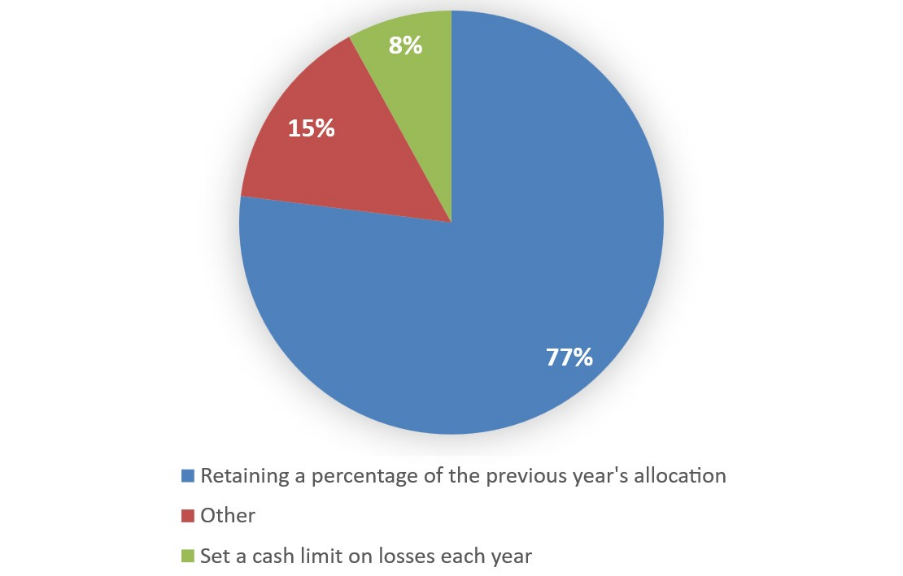
A percentage-based approach to transition to a new approach was largely seen as fairer than a fixed cash limit, as this would scale with the size of the authority and its previous allocation, and avoid disproportionately protecting larger councils, ensuring equitable treatment across regions. Only 7.82% considered that new allocations should be phased in by setting a cash limit on losses each year and 15% suggested ‘other’ as detailed in the response to question 4e below.
Question 4 (c): What percentage do you think a funding floor should be to move to new allocations with an updated DFG funding formula?
There were 125 responses to this question.
As presented in the graph below, respondents favoured stronger protections with 90% or more of allocations protected. Around 36.4% requested protections of 95-100% (i.e. a funding floor of 5% or lower), while 36.4% requested protections of 90-95% (i.e. a funding floor of between 5 and 10%).
Breakdown of funding floor % responses in 5% increments
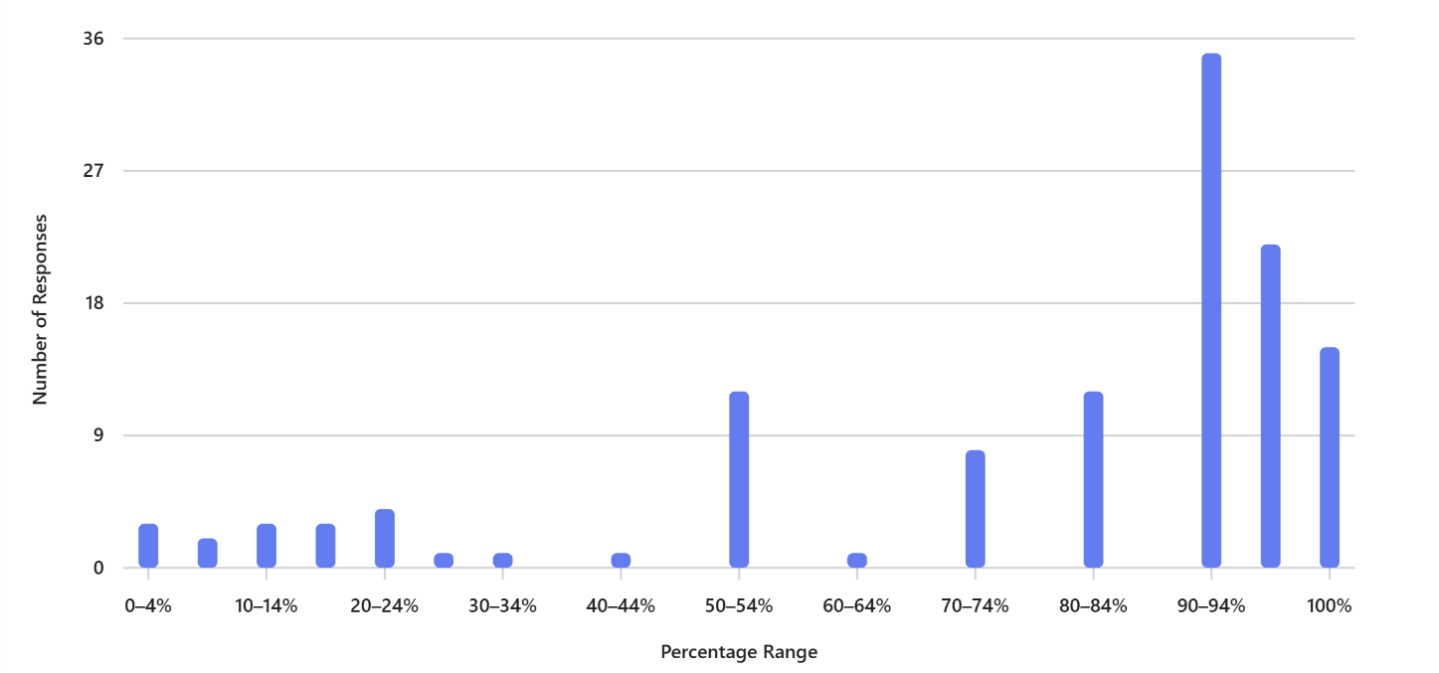
The highest counts are:
- 90–94%: 35 responses
- 95–99%: 22 responses
- 100%: 15 responses
- 50–54% and 80–84%: 12 responses each
Question 4 (d): What do you think a cash limit on losses each year should be to move to new allocations with an updated DFG funding formula?
There were 33 responses to this question.
Whilst only 14 respondents favoured setting a cash limit on losses, 33 respondents suggested how much they considered a cash limit should be. These suggestions did not provide a consensus, ranging from £5,000 from the current level of funding to £2 million or no cash loss at all.
Question 4 (e): What other method should be adopted to smooth the transition to the new approach?
There were 92 responses to this question.
Respondents raised other options for transition, including shadow allocations in conjunction with transitional top-up grants for local authorities that would lose significant funding. There were a small number of calls for no losses or a freeze in funding for a set period when the new approach was first implemented.
Government response: Transitioning to the new formula
Government has carefully considered all suggestions and views presented in consultation responses on how best to transition to a new allocations approach. Government agrees that a new allocations approach should be phased in gradually to give local authorities time to adjust. In line with the majority view, this will be based on a percentage based funding floor.
Government notes respondents’ calls for advance notice of any change to the formula to enable authorities to have time to plan for new allocated funding levels. Given this, when the new formula is implemented in 2026-27, transitional protections will ensure that no local authority receives less funding than it received in June 2025. Government intends to continue to phase in new funding arrangements gradually, with percentage based transitional protections in place until at least 2028-29.
Government also notes that the majority of respondents favoured protection of at least 90% of previous funding levels, and commits that in 2027-28 all local authorities will receive at least 97.5% of the amount they received in June 2025, and in 2028-29 all local authorities will continue to receive at least 95% of the funding level they received in June 2025.
The majority of authorities will receive more than their June 2025 allocation in 2026-27, but the minimum DFG income guarantee set out above should provide all local authorities with the certainty they require to plan their policies, while enabling progress towards the new fairer allocations levels for those authorities who have been receiving less than their fair share for many years. Moving nearer to the fair allocations should enable more older and disabled people on the lowest incomes to receive the adaptations they need.
Depending on the overall funding amount confirmed for DFG each year, it is likely that a minority of councils will still not have reached their fair funding allocation by 2028-29, and it is likely that transitional protections will continue to be needed beyond that date, but decisions on funding for 2029-30 onwards will be a matter for the next spending review.
Further considerations
Question 5: Please provide any additional information, including the impact an updated funding formula could have on local authorities’ financial sustainability.
There were 181 responses to this question.
Responses indicated significant anxiety at the prospect of reduced allocations with a new approach, expressing concerns regarding planning and the impact on workforce and service delivery. Some advised that any reduction in funding could impact the discretionary grants offered through their Housing Assistance Policies which may need to be reduced or withdrawn.
There was a strong call for local authority level data to be made available to understand the impact of a new formula and some requests for a further round of consultation.
There were also calls for government to monitor and evaluate the effectiveness of the new formula to ensure local authorities can adhere to grant conditions.
Many responses called for further DFG reform to increase the upper limit and review the means test.
Some responses called on government to consider any changes to allocations alongside other policy dependencies including any possible future increase to the DFG upper limit, the Fair Funding Review and Local Government reorganisation.
Government response
Government has noted respondents’ concern in moving to a new allocations approach, including around the prospect of reduced allocations, balanced with the strong support for this change. We have set out our plans above to implement the new allocation formula in 2025-26 with transitional protections in place. To enable authorities sufficient time to adjust to their new allocations, to support strategic and financial planning and to avoid disruption to services, government intends to phase in new allocations over time with a percentage based funding floor of at least 95% to gradually move local authorities to their updated funding amounts. No local authority will receive less funding in 2026-27 than it received in June 2025-26.
Government does not intend to consult further on these changes, and will continue to use the existing annual Delta data collection to monitor local DFG delivery.
Requests to see how the allocation approach will work in practice
Many respondents requested to see more of the underlying data inputs and outputs of the new allocation formula. To address this, a calculator has been developed which shows the calculations for each local authority and their relative share of funding with the final formula, before any transitional protections are applied.
Fair Funding Review
Government recognises the financial pressures which local authorities have been facing, and is committed to fixing the foundations of local government including funding. The government response to the Fair Funding Review 2.0 sets out how the government will move towards a fairer, evidence-based funding system for local authority revenue funding, where funding goes where it is needed most. The provisional local government finance settlement published on 17 December 2025 consults on allocations, with the majority of upper-tier authorities seeing an increase in Core Spending Power over the multi-year settlement, and income protection being put in place for local authorities which would see their income fall as a result of changes , appropriate to their circumstances.
The government recognises that local authorities will be managing these changes in revenue funding at the same time as changes to DFG funding allocation arrangements. That is why transitional arrangements will also be put in place with income protection for DFG funding. However, the current system of allocating DFG funding is unfair, with some local authorities running out of money for this statutory duty part way through the year, meaning disabled people can face long waits for the vital adaptations they need. So it is important that we start to move towards improved and updated allocations for the DFG as soon as possible, rather than delay further.
Local government reorganisation
In regard to local government reorganisation, the government’s ambition is to simplify local government, by ending the two-tier system and establishing new single-tier unitary councils. This is a once-in-a-lifetime reform to help reform local services – bringing services like housing, public health and social care under one roof means that one council can see the full picture and spot problems early.
On 5 February 2025, the government invited two-tier authorities and their neighbouring small unitaries to develop proposals for unitary local government. The invitation provided statutory guidance to support councils on issues such as size, sensible geographies efficiencies and financial sustainability, public service delivery, community engagement and devolution. All 21 have now submitted final proposals which government will consider and decide on after a formal consultation period. Our ambition is for all new unitaries go-live from 1 April 2028, with the exception of Surrey who are on a fast-track programme, and will go live on 1 April 2027.
We understand that the areas concerned may have questions or concerns about managing their DFG delivery through this process. To support councils with continued DFG delivery in these areas, Foundations, the government funded national body for DFG and Home Improvement Agencies provides practical tools, expert advice, and training to support local authorities around efficient, effective, and timely DFG delivery.
To provide some certainty and help affected local authorities to plan through this period, we can confirm that where new unitary authorities are made up of one or more existing districts and/ or unitaries and follow pre-existing boundaries, the new DFG formula funding allocation will be the sum of the constituent councils’ allocations, and transitional protections will be applied as required, based on the sum of the constituent districts’ previous allocations. If a new unitary council follows completely new boundaries, we will need to consider the best way to share the allocation of ‘split’ district(s). This would likely based on share of population in each new area.
Reform of the DFG
Government continues to keep all aspects of the DFG, including the means test, under consideration.
As mentioned previously, government has undertaken a review of the upper limit, and is currently considering the right approach for the future.
Local authorities have a significant degree of flexibility in how they deliver home adaptations funding. For example, they can publish a housing assistance policy to increase the upper limit of the grant or remove means testing for grants costing under a certain amount.
Conclusion
In light of the strong support for the proposed new approach, the government intends to start to transition to a new approach from 2026-27.
Allocations for 2026-27 will be based on the new formula, amended as set out above, but in light of the strong desire for time to adjust, transitional protections will ensure that no local authority receives less funding than it received in June 2025.
The new formula seeks to reflect varying local demand for the DFG by estimating the population of potential DFG applicants. The formula adds up best estimates of the number of income-deprived disabled working age adults, the number of additional income-deprived people over 65, and the number of disabled children locally. Adjustments are then made to reflect variations in local building costs, and that adaptations to council-owned stock are paid for separately from the HRA. The result is used to produce a fair share percentage, which is applied to the total DFG funding to produce each local authority’s allocation.
In light of responses to the consultation proposal, adjustments have been made to ensure that the formula captures local rather than regional variation in building costs and in child disability prevalence. A weighting has also been applied to reflect the higher costs of children’s adaptations. In addition, the formula has been updated to include the most recent datasets such as the IMD 2025.
The full set of allocations for 2026-27, based on a total of £723 million funding to be provided by DHSC, are set out in Annex A.
A technical note setting out the details of the new formula calculation is provided at Annex B.
In addition, a calculator has been provided to enable local authorities to see how the formula calculations apply to them.
Next steps
£723 million in DFG funding for 2026-27 will be paid to local authorities as soon as possible in the next financial year, as per the allocations set out in Annex A.
Government intends to provide details of future years allocations with as much notice as possible ahead of each new financial year, dependent on decisions on the overall funding being confirmed.
Annex A: List of local authority DFG allocations 2026-27
£723 million Disabled Facilities Grant funding 2026-27
| Tier 1 Authorities | DFG 2026-27 allocations |
|---|---|
| Cambridgeshire | £6,381,355 |
| Cambridge | £1,051,549 |
| East Cambridgeshire | £856,275 |
| Fenland | £1,561,449 |
| Huntingdonshire | £1,851,457 |
| South Cambridgeshire | £1,060,624 |
| Derbyshire | £10,057,521 |
| Amber Valley | £1,808,989 |
| Bolsover | £1,450,660 |
| Chesterfield | £1,763,217 |
| Derbyshire Dales | £746,657 |
| Erewash | £1,365,385 |
| High Peak | £713,347 |
| North East Derbyshire | £1,053,617 |
| South Derbyshire | £1,155,648 |
| Devon | £10,452,656 |
| East Devon | £1,900,020 |
| Exeter | £1,252,122 |
| Mid Devon | £1,038,519 |
| North Devon | £1,428,225 |
| South Hams | £1,091,402 |
| Teignbridge | £1,937,993 |
| Torridge | £1,089,402 |
| West Devon | £714,973 |
| East Sussex | £10,117,668 |
| Eastbourne | £2,177,949 |
| Hastings | £2,551,975 |
| Lewes | £1,521,125 |
| Rother | £2,289,105 |
| Wealden | £1,577,514 |
| Essex | £15,277,318 |
| Basildon | £1,849,226 |
| Braintree | £1,357,928 |
| Brentwood | £540,042 |
| Castle Point | £1,068,674 |
| Chelmsford | £1,415,993 |
| Colchester | £1,866,507 |
| Epping Forest | £1,248,378 |
| Harlow | £1,164,075 |
| Maldon | £786,822 |
| Rochford | £694,181 |
| Tendring | £2,982,688 |
| Uttlesford | £302,804 |
| Gloucestershire | £8,571,130 |
| Cheltenham | £1,271,268 |
| Cotswold | £1,647,677 |
| Forest of Dean | £1,238,625 |
| Gloucester | £1,641,330 |
| Stroud | £1,048,518 |
| Tewkesbury | £1,723,713 |
| Hampshire | £17,732,070 |
| Basingstoke & Deane | £1,938,929 |
| East Hampshire | £2,097,539 |
| Eastleigh | £1,637,608 |
| Fareham | £1,065,847 |
| Gosport | £1,160,190 |
| Hart | £1,039,954 |
| Havant | £2,473,197 |
| New Forest | £1,591,407 |
| Rushmoor | £1,493,114 |
| Test Valley | £1,706,769 |
| Winchester | £1,527,515 |
| Hertfordshire | £10,609,894 |
| Broxbourne | £1,084,755 |
| Dacorum | £1,269,322 |
| East Hertfordshire | £993,024 |
| Hertsmere | £1,008,249 |
| North Hertfordshire | £1,225,218 |
| St Albans | £996,179 |
| Stevenage | £1,088,800 |
| Three Rivers | £842,773 |
| Watford | £985,714 |
| Welwyn Hatfield | £1,115,860 |
| Kent | £24,038,579 |
| Ashford | £1,326,653 |
| Canterbury | £1,733,229 |
| Dartford | £878,636 |
| Dover | £1,893,818 |
| Gravesham | £1,461,296 |
| Maidstone | £1,937,102 |
| Sevenoaks | £1,616,972 |
| Folkestone & Hythe District Council | £1,867,983 |
| Swale | £3,619,650 |
| Thanet | £4,246,147 |
| Tonbridge & Malling | £1,667,979 |
| Tunbridge Wells | £1,789,114 |
| Lancashire | £20,986,972 |
| Burnley | £3,378,236 |
| Chorley | £1,129,834 |
| Fylde | £1,535,198 |
| Hyndburn | £1,408,723 |
| Lancaster | £2,660,701 |
| Pendle | £1,420,109 |
| Preston | £2,160,029 |
| Ribble Valley | £487,659 |
| Rossendale | £1,439,437 |
| South Ribble | £995,066 |
| West Lancashire | £1,791,082 |
| Wyre | £2,580,898 |
| Leicestershire | £5,716,380 |
| Blaby | £853,241 |
| Charnwood | £1,448,118 |
| Harborough | £658,584 |
| Hinckley & Bosworth | £744,152 |
| Melton | £443,083 |
| North West Leicestershire | £977,627 |
| Oadby & Wigston | £591,574 |
| Lincolnshire | £8,967,438 |
| Boston | £813,279 |
| East Lindsey | £2,621,563 |
| Lincoln | £1,095,131 |
| North Kesteven | £1,170,386 |
| South Holland | £992,805 |
| South Kesteven | £1,253,629 |
| West Lindsey | £1,020,645 |
| Norfolk | £11,710,896 |
| Breckland | £1,709,098 |
| Broadland | £1,302,996 |
| Great Yarmouth | £1,732,752 |
| King’s Lynn & West Norfolk | £2,291,585 |
| North Norfolk | £1,680,858 |
| Norwich | £1,662,693 |
| South Norfolk | £1,330,915 |
| Nottinghamshire | £9,984,692 |
| Ashfield | £1,345,850 |
| Bassetlaw | £1,680,618 |
| Broxtowe | £1,220,946 |
| Gedling | £1,475,616 |
| Mansfield | £1,832,424 |
| Newark & Sherwood | £1,490,103 |
| Rushcliffe | £939,135 |
| Oxfordshire | £8,262,172 |
| Cherwell | £1,538,565 |
| Oxford | £1,763,767 |
| South Oxfordshire | £1,923,855 |
| Vale of White Horse | £2,033,699 |
| West Oxfordshire | £1,002,286 |
| Staffordshire | £12,439,394 |
| Cannock Chase | £1,304,398 |
| East Staffordshire | £1,439,858 |
| Lichfield | £1,376,330 |
| Newcastle-under-Lyme | £2,128,178 |
| South Staffordshire | £1,398,005 |
| Stafford | £1,888,596 |
| Staffordshire Moorlands | £2,201,067 |
| Tamworth | £702,962 |
| Suffolk | £8,926,805 |
| Babergh | £943,348 |
| Ipswich | £1,757,576 |
| Mid Suffolk | £897,150 |
| West Suffolk | £1,830,711 |
| East Suffolk | £3,498,020 |
| Surrey | £12,624,753 |
| Elmbridge | £1,212,294 |
| Epsom & Ewell | £974,408 |
| Guildford | £999,993 |
| Mole Valley | £1,100,399 |
| Reigate & Banstead | £1,596,577 |
| Runnymede | £1,084,747 |
| Spelthorne | £1,170,409 |
| Surrey Heath | £1,096,927 |
| Tandridge | £671,182 |
| Waverley | £1,057,945 |
| Woking | £1,659,872 |
| Warwickshire | £6,392,570 |
| North Warwickshire | £985,920 |
| Nuneaton & Bedworth | £2,050,012 |
| Rugby | £921,921 |
| Stratford-on-Avon | £1,194,592 |
| Warwick | £1,240,126 |
| West Sussex | £11,682,451 |
| Adur | £918,497 |
| Arun | £2,355,526 |
| Chichester | £2,135,764 |
| Crawley | £1,305,939 |
| Horsham | £1,741,888 |
| Mid Sussex | £1,443,251 |
| Worthing | £1,781,586 |
| Worcestershire | £7,693,188 |
| Bromsgrove | £1,285,847 |
| Malvern Hills | £857,774 |
| Redditch | £1,181,745 |
| Worcester | £1,002,880 |
| Wychavon | £1,553,446 |
| Wyre Forest | £1,811,496 |
| Unitary Authorities and London Boroughs | DFG funding 2026-27 |
|---|---|
| Barking & Dagenham | £2,386,824 |
| Barnet | £3,707,715 |
| Barnsley | £4,190,366 |
| Bath & North East Somerset | £1,853,396 |
| Bedford | £1,813,334 |
| Bexley | £3,679,055 |
| Birmingham | £16,636,797 |
| Blackburn with Darwen | £2,737,531 |
| Blackpool | £3,361,198 |
| Bolton | £4,598,950 |
| Bournemouth Christchurch & Poole | £4,522,369 |
| Bracknell Forest | £1,201,617 |
| Bradford | £6,603,171 |
| Brent | £6,597,406 |
| Brighton & Hove | £2,972,999 |
| Bristol, City Of | £4,535,271 |
| Bromley | £3,131,874 |
| Buckinghamshire | £5,045,198 |
| Bury | £2,669,235 |
| Calderdale | £3,763,476 |
| Camden | £1,345,453 |
| Central Bedfordshire | £2,476,580 |
| Cheshire East | £3,010,671 |
| Cheshire West & Chester | £4,576,583 |
| City of London | £46,024 |
| Cornwall | £9,366,480 |
| County Durham | £8,671,146 |
| Coventry | £5,188,794 |
| Croydon | £3,846,731 |
| Cumberland | £5,390,647 |
| Darlington | £1,319,439 |
| Derby | £2,986,329 |
| Doncaster | £3,576,105 |
| Dorset Council | £5,152,517 |
| Dudley | £7,996,217 |
| Ealing | £4,750,409 |
| East Riding of Yorkshire | £3,829,488 |
| Enfield | £4,802,086 |
| Gateshead | £2,619,593 |
| Greenwich | £3,544,877 |
| Hackney | £2,224,589 |
| Halton | £2,563,952 |
| Hammersmith & Fulham | £1,855,793 |
| Haringey | £3,443,342 |
| Harrow | £2,212,851 |
| Hartlepool | £1,570,574 |
| Havering | £2,643,774 |
| Herefordshire | £2,815,031 |
| Hillingdon | £6,341,993 |
| Hounslow | £3,721,992 |
| Isle of Wight | £2,819,232 |
| Isles of Scilly | £36,412 |
| Islington | £2,493,349 |
| Kensington & Chelsea | £1,233,739 |
| Kingston Upon Hull, City of | £3,694,532 |
| Kingston Upon Thames | £1,886,213 |
| Kirklees | £4,658,211 |
| Knowsley | £3,530,487 |
| Lambeth | £2,157,395 |
| Leeds | £10,281,651 |
| Leicester | £3,488,527 |
| Lewisham | £1,952,454 |
| Liverpool | £10,944,132 |
| Luton | £2,067,448 |
| Manchester | £10,525,724 |
| Medway | £3,175,756 |
| Merton | £1,866,660 |
| Middlesbrough | £2,814,373 |
| Milton Keynes | £1,629,585 |
| Newcastle Upon Tyne | £3,378,154 |
| Newham | £3,660,851 |
| North East Lincolnshire | £3,996,530 |
| North Lincolnshire | £3,210,130 |
| North Northamptonshire | £3,292,834 |
| North Somerset | £2,930,217 |
| North Tyneside | £2,319,155 |
| Northumberland | £4,130,676 |
| North Yorkshire | £6,346,790 |
| Nottingham | £3,558,511 |
| Oldham | £3,012,015 |
| Peterborough | £2,874,604 |
| Plymouth | £3,616,778 |
| Portsmouth | £2,555,739 |
| Reading | £1,535,942 |
| Redbridge | £3,122,440 |
| Redcar & Cleveland | £2,221,389 |
| Richmond Upon Thames | £2,389,529 |
| Rochdale | £3,839,931 |
| Rotherham | £3,938,064 |
| Rutland | £335,343 |
| Salford | £4,498,818 |
| Sandwell | £5,867,565 |
| Sefton | £5,985,019 |
| Sheffield | £6,566,135 |
| Shropshire | £4,518,428 |
| Slough | £1,466,207 |
| Solihull | £3,083,300 |
| Somerset | £6,366,284 |
| South Gloucestershire | £2,932,346 |
| South Tyneside | £2,380,494 |
| Southampton | £3,118,615 |
| Southend-on-Sea | £2,212,223 |
| Southwark | £2,167,336 |
| St Helens | £3,905,852 |
| Stockport | £3,580,879 |
| Stockton-on-Tees | £2,319,668 |
| Stoke-on-Trent | £4,272,944 |
| Sunderland | £5,032,092 |
| Sutton | £2,243,168 |
| Swindon | £1,679,216 |
| Tameside | £3,662,459 |
| Telford & Wrekin | £2,875,688 |
| Thurrock | £1,694,805 |
| Torbay | £2,736,176 |
| Tower Hamlets | £2,982,974 |
| Trafford | £3,064,844 |
| Wakefield | £5,386,116 |
| Walsall | £5,402,160 |
| Waltham Forest | £3,036,464 |
| Wandsworth | £2,262,288 |
| Warrington | £2,757,571 |
| West Berkshire | £2,562,585 |
| West Northamptonshire | £3,289,209 |
| Westminster | £2,222,680 |
| Westmorland & Furness | £3,457,171 |
| Wigan | £5,651,238 |
| Wiltshire | £4,773,728 |
| Windsor & Maidenhead | £1,280,708 |
| Wirral | £6,071,658 |
| Wokingham | £1,334,715 |
| Wolverhampton | £4,431,405 |
| York | £1,821,521 |
Annex B: Technical annex
New Disabled Facilities Grant (DFG) funding allocations formula
1. The design of the new allocation formula is underpinned by three principles:
i. Fairness – the formula should generate allocations that reflect relative demand for the DFG;
ii. Accuracy – the formula should be calibrated using reliable data, ensuring that its parameters reflect the relevant populations and their characteristics; and
iii. Stability – the formula should rely on enduring and readily available datasets to maintain funding stability over time.
2. A local authority’s fair share of DFG funding is calculated using the formula:

Where ‘i’ denotes the local authority. As there are 296 authorities with housing responsibility, we define i = 1, …,N, where N = 296. The parameters of the formula are set out below.
di – disabled adult population in the local authority
ei – non-disabled older adult population in the local authority
yi – income deprivation score in the local authority
ci – disabled children population in the local authority
ω – weighting assigned to disabled children
hi – proportion of non-LA housing stock in the local authority
bi – input price adjustment at the local authority level
3. The formula allocates funding to each local authority based on its share of the estimated eligible population. It combines estimates of low-income disabled adults (di) and non-disabled older adults (ei) with estimates of disabled children (ci). These are then adjusted for the proportion of non-council housing stock (hi) and local input prices (bi). Each authority’s allocation is calculated as its share of the total after these adjustments.
4. In general, we expect authorities with larger DFG-eligible populations to receive larger volumes of DFG applications. As such, we consider that a local authority with a larger DFG-eligible population should be given a larger share of DFG funding than a local authority with a smaller eligible population. Using objective indicators of scheme eligibility is a proportionate method of funding distribution that satisfies the first criterion of our allocation formula principles.
Eligible population estimates
5. There are three subsets of the total population that are eligible for the DFG: disabled adults, disabled children and older people. As adult applicants are subject to a means test, this necessitates producing separate estimates of disabled children and adults.
Disabled adults (di)
6. To estimate the disabled adult population, we use a combination of DWP’s Family Resources Survey (FRS)[footnote 1] and Benefit Combinations statistics[footnote 2]. The FRS provides regional estimates of disabled people, which alone is not sufficiently granular for local authority level allocations; whereas, benefit data alone cannot provide a reliable estimate of disability prevalence, as not all disabled people claim disability benefits.
7. Our approach is to start with the regional estimate of disabled adults from the 2023-24 FRS (the latest available at the time of calibration) and to apportion it to local authorities based on each authority’s share of regional adult disability benefit claimants (see Appendix A), derived from the Benefit Combinations dataset. This assumes that a local authority share of regional adult disability benefit claimants broadly reflects its share of the regional disabled adult population.
8. We use four disability benefits: the Industrial Injuries Disablement Benefit (IIDB), Personal Independence Payment (PIP), Disability Living Allowance (DLA)[footnote 3] and Attendance Allowance (AA). Working-age adults are eligible for IIDB and PIP, whilst DLA is limited to children and AA to those of state pension age. This means that claimants of at least one of IIDB, PIP or AA form the relevant adult disabled population subset.
9. To minimise seasonal variation in claimant counts, for 2026-27 allocations we calculated the average across August 2024, November 2024, February 2025 and May 2025 for each local authority. Also, as the Benefit Combinations statistics groups PIP, DLA and AA claimants together, DLA cannot be excluded at source. We therefore apply age-based filters to remove disabled children from the dataset.
10. In the FRS dataset, the age bandings allow us to exclude individuals aged 15 or younger, and 16- to 19-year-olds that are classed as dependents. This leaves individuals that are 16 years old or above that are not classed as dependents in our dataset, aligning with the definition of ‘adult’ for the DFG[footnote 4].
11. On the other hand, the Benefit Combinations dataset groups claimants into single-year age bands between 16 and 19 years old but does not allow us to distinguish dependents from non-dependents. To obtain an estimate of the number of adult benefit claimants, we assume that anyone aged 16 or above is an adult.
Disabled children (ci)
12. To estimate the number of disabled children by local authority, we follow an approach similar to above. That is, we start with regional estimates of disabled children from the 2023-24 FRS and apportion them to local authorities based on their share of regional child disability benefit claimants from the Benefits Combinations statistics. This assumes that an authority’s share of regional child disability benefit claimants broadly reflects its share of the regional disabled child population.
13. As explained previously, children are defined as individuals that are 15 years old or younger, and 16- to 19-year-olds that are classed as dependents in the FRS. As DLA is the sole benefit for disabled children, we filter for claimants aged 15 or younger that claim DLA[footnote 5] in the Benefit Combinations dataset, averaging across August 2024, November 2024, February 2025 and May 2025, to minimise seasonal effects.
14. Feedback from government’s 2025 consultation[footnote 6] highlighted that adaptations for children are typically more costly than for adults. Local authorities with more disabled children relative to adults may therefore face higher average adaptation costs than those with fewer disabled children, assuming all other characteristics are equal. Recognising that local authorities with a larger proportion of disabled children compared to disabled adults will have a greater funding need, we apply a weight (ω) to the disabled children term.[footnote 7]
15. Whilst we do not have data on the average cost difference between a typical adaptation for children and adults, we know that the average cost of a high-value adaptation[footnote 8] in 2023-24 was c. £58,000 for children and c. £46,000 for adults.[footnote 9] On this basis, we assume that adaptations for children cost around 25% more than for adults, thus weight the disabled children term by ω = 1.25.
Older people (ei)
16. The DFG can also fund age-related home adaptations, meaning that the eligible population is wider than only adults and children with a strictly defined disability. The allocation formula accounts for this by including a term for the older population in each local authority area. When combined with disabled adults (di), this gives us the ‘disabled adults and older people’ term (di + ei).
17. In estimating the number of disabled adults by local authority, we defined an adult as any individual that is not a child. This means that we have already included disabled older people within the estimate of disabled adults. However, to account for older people that do not identify as disabled, we also estimate the number of non-disabled older people by local authority.
18. The 2023-24 FRS provides regional estimates of disabled and non-disabled older people (i.e. those aged 65 and above). We take the regional share of non-disabled older people and apply it uniformly to ONS mid-year 2024 population estimates of older people by local authority. This assumes that the distribution of non-disabled older people across authorities mirrors the regional pattern, so each authority’s share of the regional total reflects its true share.
Means test parameter (yi)
19. Adult applicants are subject to a means test. We therefore expect a local authority with a higher proportion of low-income households to face greater DFG demand than an authority with fewer low-income households, holding all else constant. To ensure that the distribution of DFG funding reflects this, we include an income deprivation term in the allocation formula.
20. Local authority level income deprivation scores are obtained from MHCLG’s English indices of deprivation 2025.[footnote 10] Income deprivation scores measure the proportion of the population in an area experiencing deprivation relating to low income.[footnote 11] As the score enters the equation without transformation, multiplying it by the estimate of the number of ‘disabled adults and older people’ gives an estimate of the number of disabled adults and older people that are experiencing income deprivation in the local authority.
Adjustment terms
Non-council housing stock (hi)
21. As the DFG only funds adaptations to non-Housing Revenue Account (HRA) council homes, we include a non-council housing stock adjustment parameter in the formula. This adjusts the estimate of the DFG-eligible population by giving greater weight to areas that have a higher proportion non-council housing stock. That is, a local authority with more non-council homes will receive a higher allocation than another authority with more council-owned stock, assuming all other characteristics are the same. This ensures that funding reflects the stock eligible for DFG support, rather than total housing stock.
22. To calculate this parameter, we use MHCLG housing stock data[footnote 12] as of March 2024 to obtain the proportion of non-authority owned stock by local authority area. Whilst adaptations to council-owned housing stock that sits outside an HRA would be eligible for DFG funding, the number of local authorities with such stock is small.
Input costs (bi)
23. Input prices, such as the cost of materials transportation and labour, vary across geographic areas and, by and large, cannot be controlled by local authorities or their contractors. Some works funded through the DFG can involve medium-sized projects, such as extensions or reconfiguration of living space. To reflect these unavoidable cost differences in the allocations, we include an input cost adjustment term in the formula.
24. This adjustment is implemented using the Build Cost Information Service’s (BCIS) Tender Price Studies dataset[footnote 13], averaged across Q1 2023 to Q4 2024 by local authority. The parameter is expressed as an index normalised to 1, representing the national average. Allocations for local authorities with an index value below 1 are adjusted downwards to reflect the lower-than-average input prices in their area, and vice versa for authorities with an index value above 1.
25. The BCIS dataset uses an older local authority boundary definition from 2000, which could introduce discrepancies between their coverage of tender prices and the true cost of works in a local authority area, as currently defined. However, most boundary changes have been structural (i.e. mergers) rather than geographic and tender prices can vary substantially within geographic areas. For this reason, we consider any resulting error to be immaterial.
26. For newly formed authorities since 2000, we aggregate across predecessor authorities using a simple average rather than weighting by population or area size. Comparing BCIS’s regional values to the simple average of the local authorities that make up those regions, we observe very similar results. This indicates that simple averaging is an appropriate method for producing local authority-level index values.
27. In addition, the BCIS dataset does not include values for Blaby or the Isles of Scilly. To address this, we use the East Midlands region index value as a proxy for Blaby and the ‘Islands’ index value for the Isles of Scilly. We consider that the corresponding region’s average is the most appropriate proxy for an absent local authority’s index value. For the Isles of Scilly though, although a part of the South West region, we consider other islands off the coast of mainland Great Britain a better proxy, reflecting their uniquely high transportation costs and limited competition in local markets for labour/contractors.
Minimum allocation safeguard
28. The allocation formula assigns each local authority its ‘fair share’. These shares form the percentage of the total DFG fund that each authority would receive based on the size of its eligible population, adjusted for the percentage of non-council housing stock and input prices in the area. Multiplying this share by the fund total generates each local authority’s initial fair allocation.
29. However, the fair shares can generate very low funding allocations for local authorities with small eligible populations. We consider that each local authority should receive at least enough to fund one adaptation at the upper limit each year, i.e. £30,000.
30. Where an authority’s initial allocation is below this level, it is ‘topped up’ to £30,000. These ‘top‑ups’ are funded by reducing the allocations of the LAs that do not require a top-up, based on their share of the estimated total eligible population. This results in an average reduction of £92 for the other (294) local authorities’ allocations.
Appendix A
This section sets out how the disabled adult, disabled children and older people terms are calculated.
Disabled adults

Where ‘i’ denotes a local authority and ‘j’ denotes its corresponding region.
Disabled children

Older people

-
Benefit Combinations: Official Statistics to February 2025. ↩
-
Individuals that were 65s or over and were on DLA prior to eligibility changes in 2013 retain their entitlement. ↩
-
For the DFG, the definition of a ‘child and young person’ is consistent with that used for child benefit purposes, i.e. any individual 15 years old or younger, and 16 to 19 years olds that are classed as dependents. Dependents are defined as those individuals that live with a responsible adult, are in full time non-advanced education or unwaged government training, and are not married/in a civil partnership. ↩
-
More precisely, this is anyone aged 15 years or below and claiming PIP, DLA or AA. However, age-based filters mean that this would effectively only count those that claim DLA. ↩
-
Changing the way government allocates Disabled Facilities Grant funding to local authorities in England. ↩
-
As the weight is applied uniformly, it does not change the relative ranking of local authorities by disabled children. Instead, it increases the influence of disabled children within each local authority’s overall population so that they ‘count’ more. ↩
-
A high value adaptation costs more than the ‘upper limit’, i.e. the maximum grant that can be given for an individual adaption. Local authorities have discretion to provide additional funds for high value adaptations using sources other than DFG funding or the applicant may be required to contribute the additional cost. ↩
-
In this case, children are defined as those 17 years old or younger, with adults aged 18 years and over. ↩
-
The definition of low income used includes both those people that are out of work and those that are in work but who have low earnings (and who satisfy the respective means tests). ↩
-
This requires a subscription but can be accessed at https://www.bcis.co.uk/. ↩