Carbon Border Adjustment Mechanism: Sectoral scope expansion to refinery products
Published 28 October 2026

© Crown copyright 2026
This publication is licensed under the terms of the Open Government Licence v3.0 except where otherwise stated. To view this licence, visit nationalarchives.gov.uk/doc/open-government-licence/version/3 or write to the Information Policy Team, The National Archives, Kew, London TW9 4DU, or email: psi@nationalarchives.gov.uk.
Where we have identified any third party copyright information you will need to obtain permission from the copyright holders concerned.
This publication is available at https://www.gov.uk/government/consultations/carbon-border-adjustment-mechanism-cbam-a-consultation-on-sectoral-scope-expansion-to-include-refinery-products/carbon-border-adjustment-mechanism-sectoral-scope-expansion-to-refinery-products
Ministerial foreword
The UK is introducing a Carbon Border Adjustment Mechanism (CBAM) to make sure our country’s decarbonisation efforts are not undermined through carbon leakage. The CBAM will support British businesses by giving them confidence to invest in decarbonisation, and helping to stop the offshoring of industry, emissions and jobs to countries where the price of pollution is lower.
From 1 January 2027, the CBAM will apply to an initial group of highly traded, carbon-intensive goods from the following five sectors: aluminium, cement, fertiliser, hydrogen, and iron and steel. Beyond those sectors, we have committed to keep the precise scope of CBAM under review.
That is why, at last year’s Budget, the government made a statement confirming that we would consider the case for bringing refinery products – like petrol, diesel and jet fuel – into scope of CBAM. Today, I can confirm that we intend to deliver that scope expansion, subject to consultation on both the feasibility and impacts of doing so.
Launching this consultation is the essential next step. We are seeking views on the practical, technical and economic considerations involved in bringing refinery products into scope. We are asking how expansion can be done in a way that is credible, proportionate and effective in addressing carbon leakage – and all while remaining clear-eyed about the impacts of any change.
I recognise the challenging economic context in which this consultation is taking place. Refinery products, both those produced here and those imported from overseas, are fundamental to how our economy works. They power transport networks, keep businesses moving and heat homes up and down the country. Recent increases in fuel prices have been felt by households and businesses alike, and we will remain mindful of affordability, energy security, and broader impacts when considering policy changes.
This government is committed to designing policy that is evidence-based, proportionate and responsive to the views of stakeholders at home and abroad – which includes, in this case, international trading partners whose producers supply the UK fuels market. I encourage all those with an interest in this issue, in the UK and internationally, to engage thoroughly with this consultation and share their views.
Rt Hon James Murray MP
Financial Secretary to the Treasury
1. Introduction
CBAM will take effect from 1 January 2027. It will ensure that highly traded, carbon-intensive products from overseas face a comparable carbon price to that paid by UK manufacturers, so that UK decarbonisation efforts lead to a true reduction in global emissions rather than simply displacing carbon emissions overseas.
CBAM will apply a carbon price to specific imports to the UK from the aluminium, cement, fertiliser, hydrogen and iron and steel sectors. The refining sector is not currently in scope of CBAM. When setting the initial scope of CBAM, the government committed to keeping the sectoral and product level scope under review beyond 2027 to reflect the evolving carbon leakage context, as well as methodological and technological advances.
At Budget 2025, the government recognised the role that refineries play in the UK’s energy security and industrial base and committed to launch a call for evidence on the future of the fuel sector, which the Department for Energy Security and Net Zero then published in February 2026. The government also committed to consider the feasibility and impacts of including refinery products in CBAM in the future. This consultation will inform that ongoing assessment.
This consultation seeks views on the feasibility and impacts of expanding CBAM to include a set of refinery products. Work on potential scope expansion has been undertaken in parallel to ongoing work to implement the current sectoral scope of CBAM as specified in Finance Act 2026.
The government welcomes responses from all interested parties in the UK and abroad. HM Treasury and HM Revenue and Customs will consider responses to the consultation.
This consultation has the following chapters:
- Chapter 2 asks questions about you
- Chapter 3 covers carbon leakage risk for the UK refining sector and the environmental grounds of CBAM
- Chapter 4 covers the feasibility of including refinery products in CBAM from the perspective of overseas refineries and UK importers
- Chapter 5 covers the wider indirect impacts of including refinery products in CBAM for the refining sector and supply chains, downstream users, devolved nations and trading partners
- Chapter 6 describes how to respond to this consultation and summarises the consultation questions
Background
The UK refining sector today consists of four major refineries: Pembroke on the west coast of Wales, Fawley on the south coast, Stanlow in Cheshire, and the Humber in Lincolnshire.
The Department for Energy Security and Net Zero’s call for evidence on the future of the downstream oil sector set out some of the challenges facing the sector, including through the shift to clean energy and electrification. There are a range of options for refineries to decarbonise and produce low carbon fuels in future.
This consultation is focused on the carbon leakage risk for the refining sector, and the role CBAM could have in mitigating this in future. CBAM will need to work cohesively with the UK Emissions Trading Scheme (ETS). The introduction of CBAM fundamentally alters the carbon leakage risk profile for CBAM sectors. By applying a carbon price to imports, CBAM ensures that the decarbonisation efforts of domestic producers are not undermined in the UK market by overseas, carbon-intensive competitors, which face lesser or no costs on their emissions.
For current CBAM sectors, the UK ETS Authority has decided to gradually phase out free allocation over an indicative time frame of 9 years, beginning in 2027. The UK ETS Authority is responsible for UK ETS Free Allocation, and will continue to ensure cohesion between CBAM and UK ETS policy.
2. About you
The government invites views on this consultation from interested parties, including importers and their agents, other businesses, individuals, tax advisers, trade and professional bodies, including those overseas.
The subsequent chapters in this consultation ask questions about the carbon leakage risk for the refining sector, the technical feasibility of including a subset of refinery products within CBAM, and the impacts of doing so.
All interested parties are welcome to respond to this consultation. To help the government understand the context of your answers and assess views from different stakeholders, it would be helpful to have some information about you.
About you
1) Name and/or Organisation
2) Email address
3) Job title
4) What type of respondent are you?
- a UK manufacturer/producer
- an overseas manufacturer/producer
- a downstream user/consumer
- a trade body
- local, regional or national government
- an interest group
- an academic
- an individual
- other – please specify
5)Which sector are you in?
- aluminium
- cement
- chemicals
- fertilisers
- hydrogen
- iron and steel
- low carbon fuels
- refining
- transport
- prefer not to say
- other - please specify
6) If you are in business, where does your business operate?
- England
- Scotland
- Wales
- Northern Ireland
- Isle of Man
- EU - please state which country
- non-EU - please state which country
7) If you are in business, how many staff do you employ across the UK?
- fewer than 10
- 10 – 100
- 101 – 500
- more than 500
8) Please provide any further information about your organisation or business activities that you think might help us put your answers in context.
9)Would you like your response to be confidential? If so, why? Please note the information in our privacy notice.
3. Carbon leakage risk for the UK refining sector
CBAM will only be introduced for a sector where the evidence of carbon leakage risk and the need for the measure is sufficiently compelling to justify it on environmental grounds.
In deciding the initial sectoral scope for CBAM, the government looked primarily at three factors: (1) inclusion in the UK Emissions Trading Scheme (ETS); (2) risk of carbon leakage; and (3) feasibility. This chapter is about the first two factors. Feasibility is covered in chapter 4.
Inclusion in the UK ETS
The purpose of CBAM is to ensure a comparable treatment of imported goods and domestic products from a carbon pricing perspective. The government has therefore only ever considered applying CBAM to products in sectors subject to the ETS, as the UK’s primary carbon pricing mechanism. The refining sector is within scope of the ETS.
Risk of carbon leakage
Carbon leakage is the movement of production and associated emissions from one country to another, due to different levels of decarbonisation effort through carbon pricing and climate regulation.
Sectors within the ETS face different degrees of carbon leakage risk. The manufacture of refinery products has been identified as being at material risk of carbon leakage due to its trade intensity and carbon intensity profile. The refining sector also features on the Carbon Leakage List used by the UK ETS Authority. The same general classification process was previously used as part of the evidence base when assessing carbon leakage risks for sectors included in the current scope of CBAM.
Refineries are energy-intensive industrial sites operating in internationally traded product markets. The UK imports refinery products from a range of jurisdictions with varying levels of carbon pricing and industrial decarbonisation efforts. Many other international jurisdictions do not currently have equivalent carbon pricing or developed industrial decarbonisation pathways for refining. Against a backdrop of declining UK refining capacity and sustained reliance on imported refinery products, such differences in carbon costs may increase the risk that emissions are displaced between jurisdictions, potentially undermining the environmental objectives of the UK’s carbon pricing policies.
Mitigation of carbon leakage risk
10) Do you view CBAM (in its current legislated design) as an appropriate intervention to mitigate the risk of carbon leakage in the UK refining sector?
- yes
- no
- don’t know
4. Feasibility of including refinery products in CBAM scope
For any change in CBAM scope, the government must be satisfied that there is a feasible route to inclusion that is well thought out, proportionate and deliverable. This chapter is about the feasibility of including refinery products in CBAM and the technical route to establishing CBAM liability.
CBAM liability has several elements shown in figure 1 below. The elements are:
- CBAM charge, which is calculated by multiplying the imported embodied emissions by the CBAM rate
- carbon price relief, which is calculated by multiplying the relevant imported embodied emissions by the effective carbon price
- resulting CBAM liability, which is calculated by subtracting the carbon price relief, where applicable, from the CBAM charge
Figure 1: Overview of CBAM liability calculation
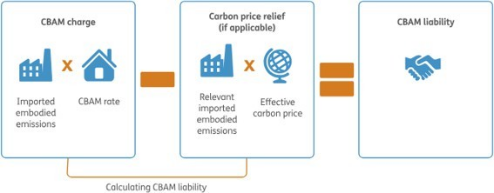
Figure shows an overview of the CBAM liability calculation, with the following steps; CBAM charge: the CBAM charge which is calculated by multiplying the imported embodied emissions by the CBAM rate; Carbon Price Relief (CPR): the CPR which is calculated by multiplying the relevant imported embodied emissions by the effective carbon price; CBAM liability: CBAM liability which is calculated by subtracting the CPR, where applicable, from the CBAM charge.
Interoperability with the EU CBAM has been a consideration for current CBAM sectors. Refinery products are not yet included in the EU CBAM, nor is there a proposal for how the EU would approach inclusion of these goods. There is no other international precedent for how refinery products could be included in CBAM. More generally, the government is interested to learn from international partners’ experience of carbon pricing, emissions monitoring and product traceability in the refining sector.
This chapter has four sections:
- Section 1: scope – products
- Section 2: scope – emissions
- Section 3: CBAM rate
- Section 4: delivery
Section 1: scope – products
A large range of products are produced in refineries worldwide. Many of these products can also be produced in other ways. For example, organic chemicals can be made at refineries but also at chemical plants. This affects the feasibility of bringing refinery products into scope of CBAM.
CBAM operates by applying liability to specified products listed by commodity code in primary legislation. Commodity codes are an internationally recognised method for defining types of goods. You can search for specific commodity codes and see their detailed descriptions on the UK Integrated Online Tariff database.
To balance feasibility against mitigating the risk of carbon leakage for the refining sector, CBAM liability could initially apply to some, but not all products produced by refineries. Additional products could be brought in at a later stage as the scope of CBAM remains under review.
Fuels and blending components
One option is that CBAM product scope could initially be extended to only fuels and blending component products that come from a refinery.
This would reduce the scale and complexity of implementation by limiting scope to the main products made at refineries. Including only refinery fuels and blending components covers most refinery output, providing carbon leakage protection for the refining sector.
The following list of refinery fuels and blending components could be subject to CBAM under this approach. This list describes each good by its 8-digit commodity code. It covers types of petrol, diesel, jet fuel and kerosene.
Light oils and preparations
- 2710 1225 - Other special spirits
- 2710 1231 - Aviation spirit
- 2710 1241 - Motor spirit, with a lead content not exceeding 0.013 grams per litre, with a research octane number (ron) of less than 95
- 2710 1245 - Motor spirit, with a lead content not exceeding 0.013 grams per litre, with a research octane number (ron) of 95 or more but less than 98
- 2710 1249 - Motor spirit, with a lead content not exceeding 0.013 grams per litre, with a research octane number (ron) of 98 or more
- 2710 1250 - Motor spirit, with a lead content exceeding 0.013 grams per litre
- 2710 1270 - Spirit type jet fuel
- 2710 1290 - Other light oils
Medium oils
- 2710 1921 - Kerosene, jet fuel
- 2710 1925 - Kerosene, other
- 2710 1929 - Other medium oils for other purposes
Heavy oils (not containing biodiesel)
- 2710 1944 - Gas oils for other purposes, with a sulphur content not exceeding 0.001% by weight, other than gas oils of 2710 1942
- 2710 1946 - Gas oils for other purposes, with a sulphur content exceeding 0.001% by weight but not exceeding 0.002% by weight
- 2710 1947 - Gas oils for other purposes, with a sulphur content exceeding 0.002% by weight but not exceeding 0.1% by weight
- 2710 1948 - Gas oils for other purposes, with a sulphur content exceeding 0.1% by weight
Fuels and blending components
11) Does initially including only a subset of fuels and blending components made at refineries in CBAM best balance feasibility and carbon leakage mitigation for the refining sector?
- yes
- no
- don’t know
12) Are there any products which should be added to the list of refinery products included in CBAM, and on what grounds? Please include commodity codes if possible.
- yes
- no
- don’t know
13)Are there any products which should be removed from the list of refinery products included in CBAM, and on what grounds? Please include commodity codes if possible.
- yes
- no
- don’t know
Low carbon fuels
Some refineries use biomass as a feedstock to produce low carbon fuels. Incentivised by UK policies like the Renewable Transport Fuel Obligation (RFTO) and Sustainable Aviation Fuel (SAF) Mandate, UK refineries also blend low carbon fuels with fossil fuels.
Low carbon fuels include SAF which can be blended into jet fuel, hydrotreated vegetable oil (HVO) and fatty acid methyl ester (FAME) which can be blended into diesel, and ethanol which can be blended into petrol. These are often called biofuels.
Low carbon fuels can be produced using a range of feedstocks and production pathways. The low carbon fuel sector is diverse, extending beyond refineries, and assigning emissions to low carbon fuel products to reflect the different production pathways could be complex. One approach could be to initially exclude low carbon fuels from scope to simplify implementation, while still providing carbon leakage risk mitigation for the refining sector. The government seeks views on whether initially excluding low carbon fuels would meet those aims.
The following list of ‘neat’ low carbon fuels could be excluded from CBAM under this approach. This list describes each good by its 8-digit commodity code.
Ethanol
- 2207 1000 – Undenatured ethyl alcohol of an alcoholic strength by volume of 80% or higher
- 2207 2000 – Denatured ethyl alcohol and other spirits of any strength
Fatty Acid Methyl Esters (FAME)
- 3826 0010 - Fatty-acid mono-alkyl esters (famae), containing by weight 96.5% or more of esters
- 3826 0090 - Other biodiesel and mixtures thereof, not containing petroleum oils or oils obtained from bituminous minerals, or not containing less than 70% by weight of petroleum oils or oils obtained from bituminous minerals
Two codes are included for ethanol. In the UK, it is more likely that ethanol being imported for use as fuel arrives as denatured ethanol. However, it is possible for undenatured ethanol to be used as fuel.
The government seeks views on the approach for low carbon fuel blended products. In blended fuels a proportion of the finished fuel is low carbon. It may not be clear from the commodity code whether a fuel has a low carbon component, and if so, in what proportion. Some products imported under the commodity codes listed at paragraph 4.10 will be blends. For example, SAF can be reported under 2710 1921: kerosene, jet fuel.
If low carbon fuels are excluded, then a feasible approach would be needed for these blended fuels. One option could be to exclude the low carbon fuel proportion from CBAM liability on a mass balance basis. For example, E10 petrol is made up of between 5.5% and 10% ethanol. Here, CBAM liability could apply only to the percentage of the product which is petrol, and not to the percentage which is ethanol. For this to work, evidence would be needed to prove the low carbon proportion of the fuel.
The following list of blended low carbon fuels may require such an approach. This list describes each good by its 8-digit commodity code.
Heavy oils (not containing biodiesel, but may contain other biofuels)
- 2710 1942 - Gas oils of petroleum or bituminous minerals, with a sulphur content not exceeding 0.001% by weight, having a bio-based carbon content of at least 80% by weight
Heavy oils (containing biodiesel)
- 2710 2011 - Gas oils, with a sulphur content not exceeding 0.001% by weight
- 2710 2016 - Gas oils, with a sulphur content exceeding 0.001% by weight but not exceeding 0.1% by weight
- 2710 2019 - Gas oils, with a sulphur content exceeding 0.1% by weight
Low carbon fuels
14) Does initially excluding low carbon fuels from CBAM best balance feasibility and carbon leakage mitigation for the refining sector?
- yes
- no
- don’t know
15)What is your assessment of the feasibility of excluding ‘neat’ low carbon fuels such as FAME and ethanol?
16) What is your assessment of the feasibility of excluding the low carbon fuel proportion of a blended fuel such as for biodiesel?
17) Are there any other commodity codes for low carbon fuels which should be considered? Please specify.
- yes
- no
- don’t know
Off-spec products, waste, by-products and scrap
For current CBAM sectors, off-spec products, by-products, waste and scrap produced during the production process are excluded from CBAM. For example, imported scrap products within the aluminium and iron and steel sectors, identified via their relevant commodity code, will not be within the scope of CBAM.
These products are also excluded from calculations of embodied emissions of CBAM goods, unless sold as a saleable product.
This framework for treatment of off-spec products, waste, by-products and scrap should also apply to the refining sector. Refinery waste products might include oily and non-oily sludges and process water.
Off-spec products, waste, by-products and scrap
18) What off-spec products, waste, by-products and scrap are relevant to the refining sector?
Precursor goods
CBAM charges will apply to the emissions embodied in relevant precursor goods used in the production of complex CBAM goods. A relevant precursor good is:
- an in-scope CBAM good, which is
- used as an input into the production process of another good (a ‘complex good’), which is also within scope of CBAM
Hydrogen could be a relevant precursor good to refinery products. This is because hydrogen is within the current scope of CBAM and is used as an input for the production processes of many complex refinery products. For example, hydrogen is used in the hydro-cracking process to convert heavy products to lighter products like petrol, diesel and jet fuel.
This would mean that emissions relating to the production of hydrogen would need to be factored into calculations of the embodied emissions of the refinery product. This would be relevant for overseas refineries which import their hydrogen from a separate installation or installations. Emissions of any separate hydrogen production facility would then need to be taken into account when calculating actual emissions of the refinery product. If this is not feasible, then default emissions values would need to be used.
Many refineries meet all their hydrogen requirements with hydrogen produced on-site because hydrogen is a by-product of other refining production processes. If hydrogen is entirely made and consumed on-site by a refinery, then relevant emissions would be attributed to the production of refinery products as appropriate.
For current CBAM sectors, the system boundaries document sets out which precursor products are relevant to each CBAM good, and detailed rules are set out in the Emissions and Verification force of law notice. Similar rules would need to be developed for precursor goods for the refining sector before implementation.
Precursor goods
19) Which CBAM precursor goods are relevant to the refining sector? A CBAM precursor good here would be a product which is currently in scope of CBAM and is used to produce refinery products.
- hydrogen
- other(s), please specify
- don’t know
20) What is your assessment of the feasibility of calculating emissions relating to production of hydrogen, or any other relevant goods, as a CBAM precursor good to refinery products?
Section 2: scope – emissions
For current CBAM sectors, CBAM will apply to direct emissions embodied in imported CBAM goods. This section covers options for calculating the imported embodied emissions of refinery products.
This is relevant for overseas refineries, emissions verifiers, and UK-based importers of refinery products. The importer is the liable person for CBAM purposes and responsible for reporting emissions to HM Revenue and Customs. Emissions are reported in tonnes of carbon dioxide equivalent (tCO2e) for each CBAM good.
Under current CBAM rules, imported embodied emissions can be worked out using either:
- independently verified actual emissions, or, if not available
- default emissions values
Actual emissions are calculated by the overseas installation and verified by an accredited independent verifier.
Default emissions values are government-calculated emissions intensities for CBAM goods. The provision of default values means the liable person can meet CBAM obligations when actual emissions data is not available.
The government has set the system boundaries specifying which direct emissions and production processes are relevant for each CBAM good. CBAM system boundaries reflect ETS system boundaries, to ensure a carbon price is applied to the same emissions-generating activities.
Calculating actual embodied emissions of refinery products
A particular challenge for the refining sector is calculating product-level emissions. This is because refineries produce multiple products simultaneously, making it difficult to work out which emissions relate to the production of which products.
The extent of this ‘co-production’ differentiates the refining sector from others currently included in CBAM. Many installations currently within scope of CBAM produce CBAM goods within a dedicated production process – and it is therefore clearer which emissions relate to which products.
This difference in production processes may necessitate a bespoke method for calculating actual emissions of products produced at refineries. The government has identified two potential options and seeks information on the feasibility of each approach, as well as the trade-offs between accuracy and administrative burden.
Option 1(a): emissions intensity at the installation level
Under this option, a refinery would calculate a single emissions intensity value for the installation as a whole. All processes relating to oil refining would be in scope, but process units relating to other sectors, such as petrochemicals, which are sometimes physically integrated with the refinery, would be excluded.
A starting point for setting the system boundaries for which production processes are relevant could be the definition of processes for refinery products in Annex 1 of the Free Allocation Regulation. This definition also excludes petrochemical process units.
The steps for this option could be:
- the refinery measures or calculates the total emissions from the installation, including emissions associated with precursor products, over the monitoring period
- the total emissions are divided by the total product mass output to calculate an installation-level emissions intensity per tonne of product
- an accredited independent verifier verifies that the refinery’s total emissions have been monitored correctly
This is a relatively simple approach to calculating embodied emissions which minimises the administrative burden on refineries and verifiers. It means overseas refineries would only need to monitor and arrange verification of total emissions of their installation, and quantity of each product.
UK refineries carry out similar monitoring to comply with the ETS using a combination of metering equipment and calculations on sources of combustion and process emissions such as those deriving from a Fluid Catalytic Cracker.
However, this would be a less accurate approach than Option 2. It reflects an overall measure of the emissions intensity of the installation, not accounting for variation in efficiency of each production process.
Applying a single emissions intensity value to all products also does not account for different production pathways of different products. For example, literature has indicated that heavier refinery products (e.g. petroleum coke, heavy fuel oil) are less emissions intensive to produce than lighter products (e.g. hydrogen, LPG, naphtha), as heavier products require less processing. This suggests heavier products should be assigned a lesser share of a refinery’s total emissions, and lighter products a greater share.
Option 1(b): installation level emissions are redistributed across groupings of products
A variation of this option could be to apply a rating to redistribute emissions across groupings of products. This could assign a greater share of an installation’s emissions to more emissions-intensive products and vice versa. Products could be grouped according to the extent of processing required. A detailed methodology for developing appropriate product groupings and ratings would need to be developed by the government.
There is some precedent for grouping of emissions in existing CBAM sectors described in the system boundaries document, albeit in a different way. Multifunctional production processes group together emissions for different CBAM goods where they are produced through the same processes. For example, there may be multifunctional production processes at an integrated iron and steel works where the same processes are used to make a variety of steel products of different shapes.
Joint production processes group together emissions where precursor and complex CBAM goods are produced in the same installation. For example, where all clinker is ground into cement, the operator can calculate emissions for those processes together instead of separating out emissions for production of clinker and cement.
The extent of integration of processes in a refinery is significant and therefore may necessitate further groupings of emissions. The sector specific guidance for the refining sector under the ETS could be used as a starting point, as it describes typical refinery process units and products (‘UKETS18 FAR – Sector specific guidance’, ETS Authority, April 2025). The description of refinery processes in Annex 2 of the Free Allocation Regulation may also be useful.
Option 2: Emissions intensity at the production process level
Under this option, refineries would calculate emissions for individual production processes and use these to determine emissions intensities for specific products.
The steps could be:
- the refinery measures or calculates emissions for specific production processes, including emissions associated with precursor products
- emissions from each production process are divided by the mass of products produced through that process
- an accredited independent verifier verifies that the refinery’s production process level emissions have been monitored correctly
This is a more complex approach to calculating embodied emissions compared with Option 1.
More detailed collection of data to split emissions across production processes would be needed. To work out emissions under this option, a refinery would need to install metering equipment or systems that would allow emissions to be assigned to specific production processes. In practice, this would likely mean additional meters are needed to track flows of different products through the production process. This increases the administrative burden and cost on overseas refineries compared with Option 1.
The complexity would make it more difficult for independent verifiers to establish that CBAM requirements have been met compared with Option 1. This increases risk of error and fraud. If overseas refineries cannot provide their actual emissions under this Option, then there would be greater reliance on default emissions values.
Rules would also be needed to guide how emissions are allocated where there is co-production. For other CBAM goods, the government has mapped which production processes are relevant to each product in the system boundaries document. Specialist input would be needed to create an equivalent for the refining sector which maps products to production processes.
The sector specific guidance for the refining sector under the ETS could be used as a starting point, as it describes typical refinery process units and products (‘UKETS18 FAR – Sector specific guidance’, ETS Authority, April 2025).
There is also an equation in the force of law notice for current CBAM sectors which describes how to attribute emissions to hydrogen or fertiliser goods when made through a multifunctional process. The equation – Equation 34 – assigns more emissions to the lower molecular weight products. A similar approach could be explored for refinery products produced through multifunctional processes.
This option more closely resembles the approach for other CBAM sectors. If applied well, it should also give more accurate emissions intensity values per product.
Under either Option 1 or 2, emissions would need to be monitored by the overseas refinery and verified by an independent verifier. The overseas refinery would need to develop an appropriate monitoring process, including installation of any necessary metering equipment in a way that is consistent with the government’s monitoring specifications. The government is interested in evidence on the feasibility and costs of installing metering equipment and developing suitable processes to monitor and verify emissions.
The government consulted on detailed monitoring, reporting and verification rules for the current CBAM sectors, and would do so for inclusion of refinery products.
Calculating actual embodied emissions of refinery products
21) Do you consider Option 1(a), Option 1(b) or Option 2 best balances feasibility, administrative burden and accuracy? Explain your views.
- option 1(a)
- option 1(b)
- option 2
- none
- don’t know
22) For Option 1(b), how could refinery products be grouped and how could a rating be set to redistribute emissions?
23) What would be required to implement monitoring, reporting and verification systems in refinery supply chains to enable a CBAM applying to refinery products? How would this vary for Options 1(a), 1(b) and 2?
Default emissions values
Default emissions values are government-calculated emissions intensities for CBAM goods. Default emissions values are available to ensure liable persons can comply with CBAM, even where actual reported emissions data is not available. If refinery products were to be included in CBAM, the government would calculate and publish default emissions values ahead of implementation.
The government’s guiding principle in setting default emissions values is ensuring liable persons do not gain an advantage from using default emissions values rather than determining the actual embodied emissions of imported CBAM goods.
For current CBAM sectors, the government will implement country-specific default emissions values from 2029, with one default emissions value per CBAM good per relevant country. This will help to provide a more granular and accurate reflection of the emissions embodied in CBAM goods. Until then, each CBAM good will have a single default emissions value.
The government is interested in the feasibility of using country-specific default values for refinery products. Feasibility may depend on the quality of evidence available to importers on the country of origin of their goods.
The government is interested in options for suitable data sources to inform default emissions values for refinery products. Data could relate to the emissions intensity of producing each refinery product worldwide (for single default emissions values), or by country (for country-specific default emissions values). Data could also split out emissions at the level of the refining sector, or at a production process level, to align with the method identified for attributing emissions to specific refinery products (Options 1 and 2, above).
For current CBAM sectors, default emissions values are based on data sourced from the EU. The EU does not have default emissions values for refining. The government welcomes evidence from international partners and overseas producers on global, national, installation level or production process level emissions data for refining that could inform default emissions values.
Default emissions values
24) What data sources could be used for setting default emissions values for refinery products?
25) What is your assessment of the feasibility of setting country-specific default emissions values, compared with one country-neutral default emissions value per refinery product?
26) What is your assessment of the feasibility of calculating default emissions values based on installation level emissions (Options 1(a) and 1(b)) compared with production process level emissions (Option 2)?
Indirect emissions
CBAM will initially only apply to direct emissions. At Budget 2025, the government confirmed that inclusion of indirect emissions will be delayed until 2029 at the earliest.
Direct emissions are emissions related to the production processes of CBAM goods. This includes, but is not limited to, emissions from the production of heating and cooling consumed during the production processes, irrespective of whether the heating or cooling was produced on or off site.
Indirect emissions are emissions related to the production of electricity which is consumed during the production of CBAM goods, irrespective of whether the electricity was produced on or off site.
UK refineries separate out monitoring of direct and indirect emissions for the purposes of the ETS, and often also in corporate reports. The government seeks evidence on the feasibility of calculating direct and indirect emissions separately at a refinery for CBAM purposes.
Indirect emissions
27) What is your assessment of the feasibility of calculating direct and indirect emissions separately at a refinery?
Evidence of origin of imported refinery products
If refinery products are included in CBAM, the UK-based importer would need to hold evidence on the origin of its imported refinery products. This is because the UK-based importer would be the liable person for CBAM purposes, and responsible for declaring the imported emissions associated with its imports.
If reporting actual emissions, the liable person would need to evidence the refinery of origin. If using default emissions values, the liable person may need to evidence the country of origin. This depends on whether country-specific default emissions values are used for refinery products.
Fuels are extensively globally traded on wholesale markets. Some refinery products are imported through major trading hubs such as in Amsterdam, Rotterdam and Antwerp where they are commonly blended or comingled with products from other refineries. There may also be no direct commercial relationship between the UK importer and the overseas refinery. These factors make it more complicated for a UK importer to identify the specific refinery from which a product originated, potentially limiting the feasibility of reporting actual emissions.
Verification systems are already used to determine country of origin for fuels, but not necessarily the refinery of origin. For example, under UK sanctions the import of Russian origin oil and oil products is prohibited. Traders must be able to demonstrate that any oil or oil product imported into the UK does not originate in Russia. The Department for Transport also operates assurance on the emissions intensity of imported low carbon fuels for compliance with the Renewable Transport Fuel Obligation and SAF Mandate. There are different evidential requirements to establish country of origin for the purposes of each policy.
Options to corroborate the origin of refinery products could include:
- commercial contracts
- bill of lading documents
- import declarations
- voluntary certification schemes (currently used for low carbon fuels)
- chemical testing results
The government is interested in documentary or testing evidence which might be suitable to establish the refinery or country of origin of imported refinery products. The administration and cost of any testing would need to be met by the liable person.
The government would welcome views from partner governments, overseas refineries, and operators and authorities at major trading and blending hubs, on the systems that already exist to trace product origin through international supply chains, and how these could be used or built on.
Evidence of origin of imported refinery products
28) What documentary or testing evidence could be used to establish refinery of origin? Do you foresee any issues with obtaining this evidence?
29) What documentary or testing evidence could be used to establish country of origin? Do you foresee any issues with obtaining this evidence?
30) Do you foresee any other issues with suppliers providing necessary compliance information to liable persons?
- yes
- no
- don’t know
31) Are there any specific considerations regarding establishing origins of low carbon fuels compared with fossil fuel equivalents?
- yes
- no
- don’t know
Section 3: tax rate
Sections 1 and 2 are about the tax base of CBAM: the imported embodied emissions of refinery products. This section is about the tax rate – the CBAM rate and the carbon price relief.
CBAM rate
The CBAM rate is the tax rate that applies to the emissions embodied in CBAM goods imported into the UK. For current CBAM sectors, there will be a single rate per sector. In October 2026, the government published illustrative CBAM rates for current sectors.
The CBAM rates will reflect the effective carbon price in the UK. The rates will therefore be set with reference to the UK’s primary carbon pricing mechanism — the ETS. The headline carbon price under the ETS is the same for all sectors. To arrive at a rate per sector, an adjustment will be made to account for the allocation of Free Allowances under the ETS: the free allocation adjustment.
The free allocation adjustment will be based on a sectoral average of emissions covered by Free Allowances over a baseline period, adjusted annually by a ‘reduction factor’ to reflect the phase-out of Free Allowances under the ETS.
If refinery products are included in CBAM, the government proposes using the same methodology for the refining sector. The government would calculate a specific CBAM rate for the refining sector using free allocation data.
Separately, the UK ETS Authority indicated in its 2025 Free Allocation Review response that it would need to consider the approach to Free Allowances for any further sectors brought within the scope of CBAM in the future.
CBAM rate
32) Do you agree or disagree with applying the current CBAM rate methodology to the refining sector?
- agree
- disagree
- don’t know
Carbon price relief
For current CBAM sectors, the liable person can claim carbon price relief (CPR) which will reduce its CBAM liability if the embodied emissions in the CBAM goods it has imported have already been subject to a qualifying carbon pricing scheme. The liable person will need to hold the necessary verification documents to evidence eligibility. It may again be relevant here whether a liable person can evidence the origin of an imported refinery product to establish it has been subject to a carbon pricing scheme.
If refinery products are included in CBAM, the government proposes applying the same approach to carbon price relief. This would mean CBAM liability can be reduced where a refinery product has already been subject to a qualifying carbon price relief scheme. This would be consistent with the environmental rationale for CBAM.
Carbon price relief
33) Do you agree or disagree with applying the current approach to carbon price relief to the refining sector?
- agree
- disagree
- don’t know
Section 4: delivery
Implementation
CBAM commences on 1 January 2027 and implementation of the registration and tax returns system will continue into 2028. Further detailed policy work, legislation and suitable systems and IT would be needed to include refinery products in CBAM.
Commencement of CBAM in 2027 for the current sectors will take place three years after the initial consultation on the policy design. CBAM is a technical tax and applying it to refinery products would be a world first.
This consultation tests some fundamental design questions around how to assign emissions to refinery products and calculate default emissions values, as well as considering traceability of refinery products across complex supply chains. In considering this scope expansion to refinery products, the government will also draw on learnings from the initial 2027 sectoral scope, with registration opening and CBAM returns becoming due in 2028.
The government’s intention is therefore to include a subset of refinery products in CBAM as soon as it is feasible, subject to consideration of responses to this consultation on the feasibility and impacts of doing so, and will set out a timeline in due course.
The government is interested in the overall feasibility of implementing and complying with a CBAM applying to refinery products from the perspective of UK importers.
Delivery
34) What is your assessment of the feasibility of UK importers of refinery products complying with CBAM requirements?
- very difficult
- difficult
- neutral
- easy
- very easy
- don’t know
5. Impacts of including refinery products in CBAM scope
CBAM is an environmental measure, designed to mitigate the risk of carbon leakage. Nevertheless, it may have other impacts beyond that primary objective. Throughout the design and delivery of CBAM, the government has been committed to understanding those possible impacts, including on trading partners, and has engaged with international partners bilaterally and in multilateral fora.
Impacts on the UK refining sector and supply chains (manufacturers, producers, traders and importers)
CBAM may generate indirect effects for the different players within the domestic refining sector and its supply chains.
Those indirect effects could be varied, from improved investor confidence in the decarbonisation of UK assets to higher administrative burdens for those complying with the tax. The indirect effects will also depend on the scope of products added to CBAM. The exact scale and specifics of the administrative burden would depend on the final methodology for apportioning emissions and associated monitoring, reporting and verification requirements.
Impacts on the UK refining sector and supply chains
35) Beyond carbon leakage risk mitigation, what other impacts could CBAM on refinery products have on the UK refining sector and supply chains?
36) What is your assessment of the scale of administrative impact for supply chains?
- negligible
- reasonable
- significant
- don’t know
Impacts on downstream consumers and industries
As with the CBAM for existing sectors, the government anticipates that initial liabilities from the inclusion of refinery products would be modest. That is because CBAM reflects the domestic market’s current effective exposure to the carbon price – and therefore accounts for any entitlement of domestic producers to free allocation of ETS allowances.
Nonetheless, CBAM could affect prices paid by importers, distributors and end-users of CBAM goods – and in this case, for fuel products widely used throughout the economy, including supply chains and households. The scale and distribution of any impacts would depend on several policy decisions, such as specific product scope, which are still to be determined, but also including the extent to which additional costs are absorbed versus passed through supply chains.
The government is interested in understanding both direct and indirect impacts on businesses, supply chains and consumers.
Impact on downstream consumers and industries
37) What impacts could CBAM applying to refinery products have on downstream sectors that purchase or use refinery products, at any stage of their supply chain, including small and medium-sized enterprises?
- overall positive
- neutral
- overall negative
- don’t know
38) To what extent do you anticipate any additional costs associated with CBAM applying to refinery products to be passed through to consumers?
- all or most costs
- some costs
- no costs
- don’t know
Territorial, devolved and regional impacts
CBAM is a UK-wide measure, applying across all four nations and all regions within them. The government is interested to understand its implications at a local level – including the implications for regional and national fuel markets, and how CBAM could potentially impact each nation and local area in unique and distinct ways. This may include, for example, specific impacts on a regional basis for households that use kerosene for heating.
Territorial, devolved and regional impacts
39) What impacts could CBAM applying to refinery products have for England, Scotland, Wales, Northern Ireland, and/or local UK regions?
- overall positive
- neutral
- overall negative
- don’t know
Impacts for trade and international partners
CBAM has been designed to reflect UK circumstances and policy objectives, and to be compliant with UK international trade obligations. It remains the government’s view that the best solution to carbon leakage is an international one. However, making progress on international solutions will take time, and that is why the UK is taking this domestic action on CBAM, while remaining committed to continued dialogue with international partners on carbon leakage and international cooperation in addressing it.
Ensuring the stability and security of our energy and fuels market is essential – and the government recognises that the UK market includes imports from a wide range of trading partners, as well as domestically produced goods. Before any final decision is taken, the government is interested in understanding how different stakeholders, including international partners, overseas producers and exporters, assess the potential impact on trade flows, market access and supply chains.
Refinery products are not currently in scope of other operational CBAMs globally. The government is interested to understand whether UK CBAM being the ‘first mover’ presents unique risks for our broader trade context – both for the UK and for its trading partners, and how the UK could work with partners to support coherence between approaches as policies develop internationally.
Impacts for trade and international partners
40) What impacts do you expect CBAM applying to refinery products to have on relevant exports to the UK, or other related trade matters?
- overall positive
- neutral
- overall negative
- don’t know
41) Do you anticipate any trade diversion as a consequence of differing sectoral scopes with other jurisdictions’ carbon pricing measures?
- yes
- no
- don’t know
42) What is your assessment of the scale of administrative impact for overseas producers?
- negligible
- reasonable
- significant
- don’t know
6. How to respond to this consultation
How to respond to this consultation
This consultation will be open for 12 weeks, starting from 28 October 2026 and concluding at 23:59 on 20 January 2027.
The government invites respondents to submit responses via the online form.
Further evidence can be provided via email to cbampolicyteam@hmrc.gov.uk
After this consultation
The government will consider the responses it receives to this consultation and use them to inform a response and decisions on the final policy.
Use of Artificial Intelligence (AI)
Artificial Intelligence (AI) may be used to support the analysis and summarisation of responses. Where this occurs, reasonable efforts will be made to remove personal data (such as email addresses) before analysis takes place. AI tools are securely hosted. AI is used to assist staff and does not replace human judgement or make automated decisions. This activity does not involve automated decision making or profiling. This means that decisions which may affect you are not made solely by automated means without human involvement, and your data is not subject to analysis intended to evaluate or predict aspects such as your behaviour, preferences, or interests.
Summary of questions
1) Name and/or Organisation
2) Email address
3) Job title
4) What type of respondent are you?
a. a UK manufacturer/producer
b. an overseas manufacturer/producer
c. a downstream user/consumer
d. a trade body
e. local, regional or national government
f. an interest group
g. an academic
h. an individual
i. other – please specify
5) Which sector are you in?
a. aluminium
b. cement
c. chemicals
d. fertilisers
e. hydrogen
f. iron and steel
g. low carbon fuels
h. refining
i. transport
j. other - please specify
6) If you are in business, where does your business operate?
a. England
b. Scotland
c. Wales
d. Northern Ireland
e. Isle of Man
f. EU - please state which country
g. Non-EU - please state which country
7) If you are in business, how many staff do you employ across the UK?
a. fewer than 10
b. 10 – 100
c. 101 – 500
d. more than 500
8) Please provide any further information about your organisation or business activities that you think might help us put your answers in context.
9) Would you like your response to be confidential? If so, why? Please note the information in our privacy notice.
a. yes
b. no
10) Do you view CBAM (in its current legislated design) as an appropriate intervention to mitigate the risk of carbon leakage in the UK refining sector?
a. yes
b. no
c. don’t know
11) Does initially including only a subset of fuels and blending components made at refineries in CBAM best balance feasibility and carbon leakage mitigation for the refining sector?
a. yes
b. no
c. don’t know
12) Are there any products which should be added to the list of refinery products included in CBAM, and on what grounds? Please include commodity codes if possible.
a. yes
b. no
c. don’t know
13) Are there any products which should be removed from the list of refinery products included in CBAM, and on what grounds? Please include commodity codes if possible.
a. yes
b. no
c. don’t know
14) Does initially excluding low carbon fuels from CBAM best balance feasibility and carbon leakage mitigation for the refining sector?
a. yes
b. no
c. don’t know
15) What is your assessment of the feasibility of excluding ‘neat’ low carbon fuels such as FAME and ethanol?
16) What is your assessment of the feasibility of excluding the low carbon fuel proportion of a blended fuel such as for biodiesel?
17) Are there any other commodity codes for low carbon fuels which should be considered? Please specify.
a. yes
b. no
c. don’t know
18) What off-spec products, waste, by-products and scrap are relevant to the refining sector?
19) Which CBAM precursor goods are relevant to the refining sector? A CBAM precursor good here would be a product which is currently in scope of CBAM and is used to produce refinery products.
a. hydrogen
b. other(s), please specify
c. don’t know
20) What is your assessment of the feasibility of calculating emissions relating to production of hydrogen, or any other relevant goods, as a CBAM precursor good to refinery products?
21) Do you consider Option 1(a), Option 1(b) or Option 2 best balances feasibility, administrative burden and accuracy? Explain your views.
a. option 1(a)
b. option 1(b)
c. option 2
d. none
e. don’t know
22) For Option 1(b), how could refinery products be grouped and how could a rating be set to re-distribute emissions?
23) What would be required to implement monitoring, reporting and verification systems in refinery supply chains to enable a CBAM applying to refinery products? How would this vary for Options 1(a), 1(b) and 2?
24) What data sources could be used for setting default emissions values for refinery products?
25) What is your assessment of the feasibility of setting country-specific default emissions values, compared with one country-neutral default emissions value per refinery product?
26) What is your assessment of the feasibility of calculating default emissions values based on installation level emissions (Options 1(a) and 1(b)) compared with production process level emissions (Option 2)?
27) What is your assessment of the feasibility of calculating direct and indirect emissions separately at a refinery?
28) What documentary or testing evidence could be used to establish refinery of origin? Do you foresee any issues with obtaining this evidence?
29) What documentary or testing evidence could be used to establish country of origin? Do you foresee any issues with obtaining this evidence?
30) Do you foresee any other issues with suppliers providing necessary compliance information to liable persons?
a. yes
b. no
c. don’t know
31) Are there any specific considerations regarding establishing origins of low carbon fuels compared with fossil fuel equivalents?
a. yes
b. no
c. don’t know
32) Do you agree or disagree with applying the current CBAM rate methodology to the refining sector?
a. agree
b. disagree
c. don’t know
33) Do you agree or disagree with applying the current approach to carbon price relief to the refining sector?
a. agree
b. disagree
c. don’t know
34) What is your assessment of the feasibility of UK importers of refinery products complying with CBAM requirements?
a. very difficult
b. difficult
c. neutral
d. easy
e. very easy
f. don’t know
35) Beyond carbon leakage risk mitigation, what other impacts could CBAM applying to refinery products have on the UK refining sector and supply chains?
36) What is your assessment of the scale of administrative impact for supply chains?
a. negligible
b. reasonable
c. significant
d. don’t know
36) What impacts could CBAM applying to refinery products have on downstream sectors that purchase or use refinery products, at any stage of their supply chain, including small and medium-sized enterprises?
a. overall positive
b. neutral
c. overall negative
d. don’t know
37) To what extent do you anticipate any additional costs associated with CBAM applying to refinery products to be passed through to consumers?
a. all or most costs
b. some costs
c. no costs
d. don’t know
38) What impacts could CBAM on refinery products have for England, Scotland, Wales, Northern Ireland, and/or local UK regions?
a. overall positive
b. neutral
c. overall negative
d. don’t know
39) What impacts do you expect CBAM applying to refinery products to have on relevant exports to the UK, or other related trade matters?
a. overall positive
b. neutral
c. overall negative
d. don’t know
40) Do you anticipate any trade diversion as a consequence of differing sectoral scopes with other jurisdictions’ carbon pricing measures?
a. yes
b. no
c. don’t know
42) What is your assessment of the scale of administrative impact for overseas producers?
a. negligible
b. reasonable
c. significant
d. don’t know
Privacy Notice
Introduction
This Privacy Notice should be read alongside HM Treasury’s (HMT’s) Personal Information Charter. The Charter sets out:
- the standards you can expect from HMT when we use your personal information;
- the contact details for our Data Protection Officer;
- how to exercise your Data Protection Information Rights (including access);
- how to exercise your right to complain to the Information Commissioner’s Office.
https://www.gov.uk/government/organisations/hm-treasury/about/personal-information-charter
This Privacy Notice supplements the Personal Information Charter and outlines additional information in relation to Consultation and Calls for Evidence responses from all interested parties and stakeholders.
This Privacy Notice should be read in conjunction with the relevant consultation guidance, as the consultation documentation will provide additional information about how consultation responses will be used. Where this Notice and the consultation documentation differ, the latter will take precedence.
Data Controller
A data controller makes decisions about processing activities. They exercise overall control of the personal data being processed and are ultimately in charge of and responsible for the processing.
The data controller for this activity is HMT.
Data Processors
A data processor is an organisation or company that handles personal information on our behalf, following our instructions. Data processors do not use your information for their own purposes; they only process it as directed by us.
The following organisations are directed to process your personal information on our behalf:
| Processor Name | Function |
| SmartSurvey | If you elect to complete the digital form, this will be conducted using SmartSurvey, an industry-leading online survey provider with the highest standards of data security. As with other organisations processing personal data, SmartSurvey is subject to data protection compliance requirements. In this context, SmartSurvey acts solely as a data processor under instruction from HMT and will not use your personal data for any purposes other than to provide the service to HMT. For more information on how SmartSurvey handles respondents data, please refer to their privacy policy here - https://www.smartsurvey.co.uk/company/privacy-policy |
| Microsoft | Provision of enterprise IT services including email, document storage, collaboration tools, and infrastructure support |
Who we process personal data about
The table below outlines the categories of individuals whose personal data we will process in this activity, alongside the types of personal data we will use.
| Category of individual | Types of personal data |
| Members of the public | Name Email address |
| Representatives of businesses or organisations | Job title and employer (where an individual is making representations on behalf of an organisation) Personal opinion |
We may also process special category data or data about criminal convictions, if you volunteer such information. Special categories of personal data may include:
- Data about racial or ethnic origin
- Political opinions
- Religious or philosophical beliefs
- Trade union membership
Source of Your Personal Data
Personal data of the individuals listed above will be collected in the following ways:
Directly - from Respondents (you). SmartSurvey responses will be managed by HMT, responses submitted by email will be managed by HMRC, and both departments will carry out joint analysis of all responses.
Indirectly - from other agency and government department-led consultations, where HMT has policy interest
Purpose and Lawful Basis
We will process your personal data for the following purposes and using the specified lawful bases:
| Purpose | Lawful Basis | Further Information |
| Obtaining opinions about government policies, proposals, or an issue of public interest. | Article 6(1)(e) of the UK GDPR – Public task Article 9(2)(g) of the UK GDPR – Substantial public interest Schedule 1, Part 2, Paragraph 6(2)(b) of the Data Protection Act – necessary in the exercise of a government department. |
To help HMT understand who has responded to this consultation and, in some cases, contact respondents to discuss their response. |
Who we share your personal data with
HMT and HMRC will share consultation responses received with each other for the joint operation of this consultation process.
We will also share your personal data with the following types of recipients:
- HMT staff and Ministers - who have a business need to access the data as part of the consultation process
- Other government departments – who have policy functions relevant to the consultation topic. Sharing in this context will ordinarily be anonymised unless information about the respondent is necessary to inform policy
- HM Treasury may share responses with the Department for Transport (DfT) for analysis purposes, including information entered within the free-text fields of the survey, which may include personal data
Please be aware that if we receive correspondence or communication which we consider threatening in nature or suggests a possible risk to you or a third party, we may share this correspondence (along with your personal data) with relevant law enforcement / safeguarding authorities.
International Transfers
Your personal data will not be transferred to an international recipient during this activity.
How long we hold your personal data
We will retain your personal data only for as long as necessary to fulfil the purposes for which it was collected.
For consultations and calls for evidence, personal data will typically be held for the duration of the consultation and review period.
In addition, specific retention periods applicable to your personal data are as follows:
| Type of processing | Retention period |
| Collection and storage of Smart Survey digital form data | No longer than 1 year from response deadline |
Automated Decision-Making and Profiling
This activity will involve the use of AI tools to analyse consultation responses, however does not involve automated decision making or profiling. This means that decisions which may affect you are not made solely by automated means without human involvement, and your data is not subject to analysis intended to evaluate or predict aspects such as your behaviour, preferences, or interests.
HM Treasury October 2026