Summary of responses and government response
Updated 15 April 2026

© Crown copyright 2026
This publication is licensed under the terms of the Open Government Licence v3.0 except where otherwise stated. To view this licence, visit nationalarchives.gov.uk/doc/open-government-licence/version/3 or write to the Information Policy Team, The National Archives, Kew, London TW9 4DU, or email: psi@nationalarchives.gov.uk.
Where we have identified any third party copyright information you will need to obtain permission from the copyright holders concerned.
This publication is available at https://www.gov.uk/government/consultations/biodiversity-net-gain-for-nationally-significant-infrastructure-projects/outcome/summary-of-responses-and-government-response
1. Introduction
The consultation on the implementation of biodiversity net gain (BNG) for nationally significant infrastructure projects (NSIPs) was launched in May 2025 and ran for 8 weeks. The consultation outlined government’s proposals for the BNG requirement for NSIPs and proposed model text for a biodiversity gain statement that would apply across NSIP sectors.
A separate consultation on improving the implementation of BNG for small, medium and brownfield sites ran in parallel.
This document summarises responses to the BNG for NSIPs consultation and the government’s response to that consultation. The sections of the document mirror the sections of the model text of the biodiversity gain statement in the consultation.
The updated model text for biodiversity gain statements (‘model text’), which will apply across all NSIP types, is presented in Annex 1.
2. Overview of responses
The consultation received 260 responses from a wide range of respondents across multiple sectors. The greatest number of responses were from developers and consultancies. A full breakdown is shown in Figure 1 below.
In addition, 10,143 responses were submitted via email from a Royal Society for the Protection of Birds (RSPB) campaign that responded to both this consultation and the other on improving the implementation of BNG for minor, medium and brownfield sites. These campaign responses were not attributed to specific organisation types.
Overall, a significant proportion of responses originated from the co-ordinated campaign. As a result, the percentage breakdowns presented in the summary of responses should not be interpreted as a statistically representative sample of stakeholder views.
We are grateful to everyone who took the time to respond and share their experience, views and suggestions.
Figure 1: Breakdown of respondents by reported or assigned type of organisation (not including campaign responses)
| Respondent type | Number of responses received | Percentage of total responses (not including campaign responses) |
|---|---|---|
| Developer | 46 | 18% |
| Consultancy | 43 | 17% |
| Local authority | 39 | 15% |
| Non-governmental organisation (NGO) | 36 | 14% |
| Off-site provider / BNG services | 32 | 12% |
| Professional body / association | 24 | 9% |
| Individual | 22 | 8% |
| Landowner / rural | 8 | 3% |
| Government body | 6 | 2% |
| Academic | 2 | 1% |
| Unknown | 2 | 1% |
Stakeholder events
Defra held a series of roundtable events. Policy officials from Defra also attended other external events in June and July 2025 to engage stakeholders with the consultation and to hear their views. Engagement involved a broad range of NSIP sectors, industry bodies, developers, consultancies, local planning authorities and non-governmental organisations.
3. Analysis methodology
All consultation responses were taken into account in shaping policy and informing this government response. Where multiple submissions were received from the same individual respondent (for example, they responded via Citizen Space and sent an email response), these were treated as a single response, with all content considered collectively.
Responses that did not directly address a specific question were analysed under the most relevant question, often question 18 (‘Any other comments’).
The total responses to each question have been counted and all text responses analysed for themes and suggestions.
The consultation responses received for each question have been summarised. The summaries do not attempt to capture every point made, nor do they cover comments on aspects of policy that fall outside the scope of the consultation. Responses to questions 3 and 4 were similar, so much so that these have been consolidated to avoid repetition.
When summarising responses, the following terms have been used to describe the frequency of themes in qualitative responses and refers to the percentage of responses to that question as shown below:
| Term | Description |
|---|---|
| Large majority | Greater than 80% |
| Majority or most | Greater than 50% and less than or equal to 80% |
| Half the respondents | 50% |
| Many | More than 20% but less than 50% |
| Small number, several, a few or some | Less than or equal to 20% |
There is one government response per section of the model text, covering all relevant questions for that section. The response explains changes being made to the model text and where relevant, decisions not to make changes.
3.1 RSPB campaign response
A large e-mail campaign coordinated by the RSPB was received during the consultation. The campaign was generated by individuals using a pre-constructed template hosted on the organisations’ website, meaning all of the campaign responses were broadly the same.
All campaign responses were analysed and have been considered as part of the government response. Responses containing unique text were identified and totalled 1,491. These individual responses were read in full. A majority of these differed only in adding additional weight to certain parts of the response, or with minor changes of wording and grammar. As the views expressed in the campaign responses were not specifically attributed to individual consultation questions, they are not included in the individual question statistics, although relevant points from the campaign response have been referred to where there is a link.
A summary of the views in the campaign responses relevant to this consultation on BNG for NSIPs is provided below. Elements of these responses that relate to the BNG consultation for minor, medium and brownfield sites were analysed separately, and are not reported as part in this response.
Summary of the RSPB campaign response
The RSPB campaign generated 10,143 responses, all of which expressed:
- strong support for maintaining BNG and referred to it as “an essential tool for restoring nature and creating greener, healthier places to live”
- calls for greater ambition in BNG delivery, stating that we should be aiming higher than 10%, especially for major infrastructure projects
- that the current metric will not deliver nature recovery at a scale that matches the impact of NSIP projects, and that major infrastructure requires an offsetting system specifically designed for it
- the need for “a BNG framework that is ambitious, fit for purpose, and able to deliver for both people and nature”
3.2 Nuclear Regulatory Review Recommendations
The Nuclear Regulatory Review 2025 was published on 24 November 2025.
Recommendation 18 of the review focused on the implementation of BNG to NSIPs and was taken into consideration in this government response. The different parts of the recommendation and a summary of the government position is below.
Recommendation A: “Exclude land used for temporary purposes”
The report articulated a concern with securing gains for 30 years on land to be returned to its former owner and or purpose. A question was asked on this issue in the consultation, and the detailed government position can be found in the government response to questions 8, 9 and 10.
Recommendation B: “Cover only land actually affected, rather than the entire Order Limits”
A question was asked on whether BNG should apply to all habitats within the order limits in the consultation. The detailed government position can be found in the government response to questions 5, 6 and 7.
Recommendation C: “Include preserved habitats as a positive outcome of the end state”
The statutory biodiversity metric counts any ‘preserved’ (retained) habitats towards the post-development biodiversity value for the project. This means if an NSIP has any habitat within its baseline that will be retained, this will count towards the project’s BNG outcome. More detail can be found in the ’pre-development biodiversity value (baseline value)’ section of the model text and in the statutory biodiversity metric user guide.
Recommendation D: “And keep to one BNG calculation throughout, even if policy changes during the approvals process”
Updates to the statutory biodiversity metric will always come with transitional arrangements meaning that once an application is submitted, it can continue to use the same version of the metric rather than moving to the new one.
Recommendation E: “Decommissioning activities (both civil and defence) should be entirely excluded from BNG requirements.”
Nuclear decommissioning activities can sometimes require planning permission under the Town and Country Planning Act 1990 (TCPA) and therefore subject to the BNG requirement. Government have recently announced reforms to BNG to simplify the planning system whilst retaining our commitment to nature recovery. This will remove the need for smaller decommissioning activity under 0.2 hectares to deliver BNG. Existing exemptions for larger sites, made up mainly of hardstanding or existing buildings where little or no habitat is impacted are also exempt. Defra is working with DESNZ (Department for Energy Security and Net Zero) and the Nuclear Decommissioning Authority to gather evidence on how BNG functions for nuclear decommissioning and make further improvements where necessary.
4. Approach and scope of biodiversity net gain
4.1 Scope
As set out in the consultation, BNG will apply to NSIP applications submitted under section 37 and determined under section 104 or 105 of the Planning Act 2008. This is as well as applications made following an order under section 35 of the Planning Act (where the Secretary of State directs that a project should be treated as development that requires development consent).
BNG will apply to NSIPs, or components of NSIPs, onshore in England, as far as the mean low-water mark. Projects, or components of projects, in the marine environment beyond the intertidal zone are not included within the scope of the mandatory requirements for BNG for TCPA or NSIP schemes.
Applying BNG to other types of infrastructure consented through other routes, such as Hybrid Bills is not in scope and will require additional legislation. Defra will provide further information in due course.
There are provisions in the Environment Act 2021 to allow Marine Net Gain to be made mandatory for NSIPs in the future. Defra will provide further information on the development of Marine Net Gain in due course.
4.2 Core approach and introduction
Due to the significant scale and complexity of NSIPs, it is particularly important to ensure that developers have sufficient time to incorporate the final BNG framework into their designs. Therefore, BNG will apply to all NSIP applications made on or after 2 November 2026.
The mandatory BNG requirement does not apply to changes to development consent orders that were not subject to mandatory BNG at the time of the initial application (for example where the development consent order application was submitted before 2 November 2026). This is to ensure BNG is not retrospectively applied to developments, which can be difficult to calculate and implement.
Following a comprehensive review of the consultation responses, Defra are applying a consistent approach to BNG for NSIP sectors and types. This creates a level playing field and reduces complexity. More discussion of this decision can be found in the summary of and government response to questions 16 and 17.
The process for implementing BNG for NSIPs is set out in the Environment Act 2021. Defra will coordinate the publication of biodiversity gain statements for every National Policy Statement (NPS). These statements, which will be published in May 2026, will have the same effect as if they were in the NPS (once BNG is live) and will later be incorporated into the relevant NPS when they are next reviewed. Defra will also publish a biodiversity gain statement, or statements, for NSIPs without an NPS.
5. Biodiversity net gain for NSIPs summary process
Figure 2: summary of the overall BNG process for NSIPs
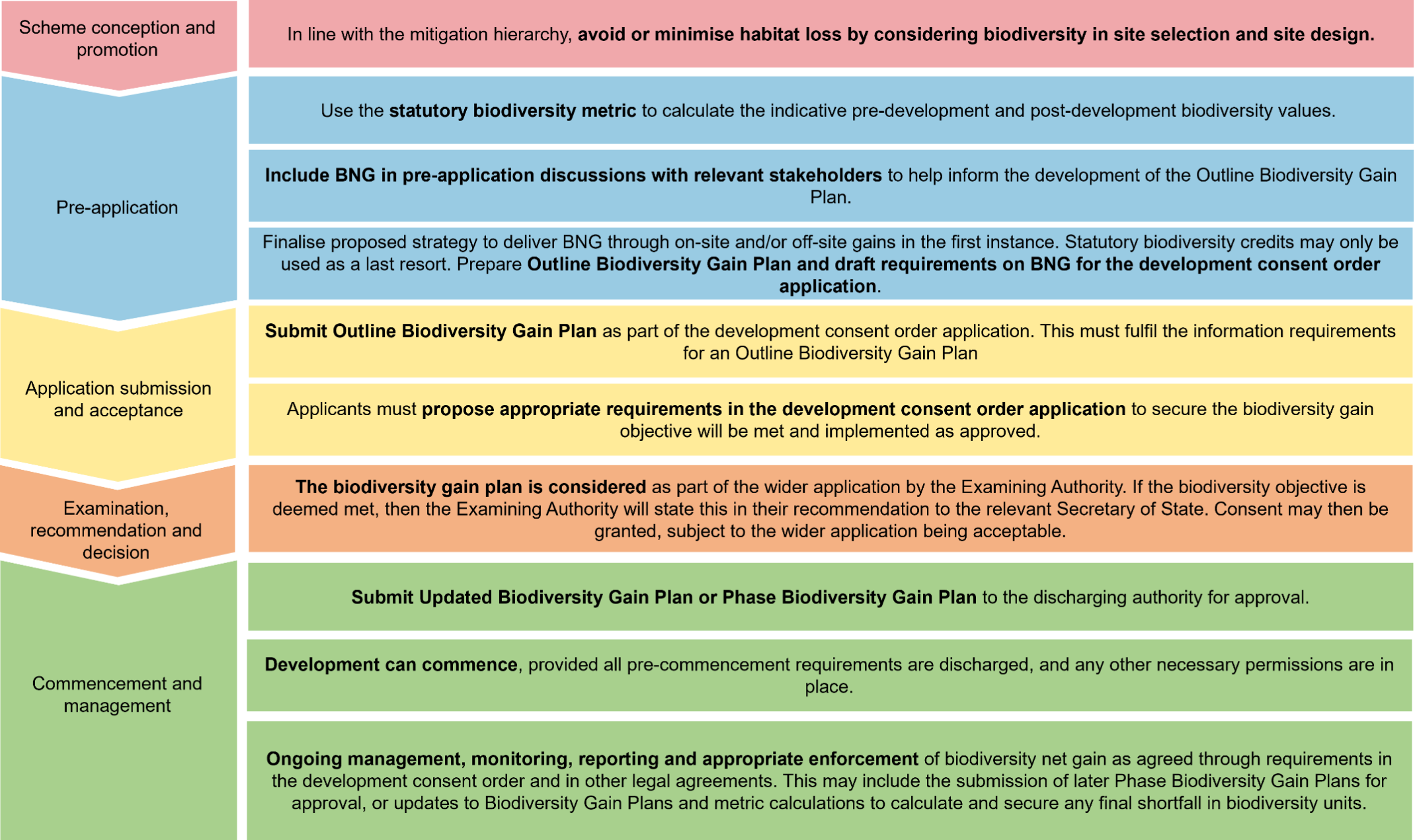
Scheme conception and promotion
In line with the mitigation hierarchy, avoid or minimise habitat loss by considering biodiversity in site selection and site design.
Pre-application
- Use the statutory biodiversity metric to calculate the indicative pre-development and post-development biodiversity values.
- Include BNG in pre-application discussions with relevant stakeholders to help inform the development of the Outline Biodiversity Gain Plan.
- Finalise proposed strategy to deliver BNG through on-site and/or off-site gains in the first instance. Statutory biodiversity credits may only be used as a last resort. Prepare Outline Biodiversity Gain Plan and draft requirements on BNG for the development consent order application.
Application submission and acceptance
- Submit Outline Biodiversity Gain Plan as part of the development consent order application. This must fulfil the information requirements for an Outline Biodiversity Gain Plan.
- Applicants must propose appropriate requirements in the development consent order application to secure the biodiversity gain objective will be met and implemented as approved.
Examination, recommendation and decision
- The biodiversity gain plan is considered as part of the wider application by the Examining Authority. If the biodiversity objective is deemed met, then the Examining Authority will state this in their recommendation to the relevant Secretary of State. Consent may then be granted, subject to the wider application being acceptable.
Commencement and management
- Submit Updated Biodiversity Gain Plan or Phase Biodiversity Gain Plan to the discharging authority for approval.
- Development can commence, provided all pre-commencement requirements are discharged, and any other necessary permissions are in place.
- Ongoing management, monitoring, reporting and appropriate enforcement of biodiversity net gain as agreed through requirements in the development consent order and in other legal agreements. This may include the submission of later Phase Biodiversity Gain Plans for approval, or updates to Biodiversity Gain Plans and metric calculations to calculate and secure any final shortfall in biodiversity units.
6. Summary of responses and government response
The summary of responses and government response mirror the sections of the model text of the biodiversity gain statement in the consultation:
- biodiversity gain objective
- irreplaceable habitat
- calculating BNG
- the pre-development biodiversity value
- delivering BNG
- considerations for the delivery of biodiversity gains
- evidence for submission and decision making
- supporting evidence
- variation for different NSIP types and sectors
- other comments
- guidance
6.1 Biodiversity gain objective
Question 1 asked: Do you agree that the proposed model text provides sufficient information on the biodiversity gain objective?
Responses
231 (89% of total respondents) answered question 1. Of those:
- 121 agreed (52%)
- 69 disagreed (30%)
- 5 did not know (2%)
- 36 chose ‘other’ (16%)
In addition, 1 person did not specifically answer the question but provided explanatory text.
The 10,143 campaign responses coordinated by the RSPB did not directly answer this question and are therefore not included in the response figures above. However, these responses called for a higher biodiversity gain objective for major infrastructure projects due to their high-impact and long-lasting nature.
Explanatory text responses
127
Summary of text response main themes
The majority of respondents agreed that the model text provided sufficient information on the biodiversity gain objective. The text responses summarised below were mainly from respondents that disagreed and were providing additional information.
Many respondents suggested that the biodiversity gain objective needs more detail or clarity. Common suggestions include referencing the:
- BNG provisions in the Environment Act 2021
- mitigation hierarchy
- statutory biodiversity metric, trading rules, and the need to provide 10% BNG across the different habitat types (area, watercourse and hedgerow)
Many respondents argued that the biodiversity gain objective for NSIPs should be higher than 10% to reflect their larger environmental impact. This was also supported by the RSPB campaign responses.
Some suggested broadening the objective to focus on nature recovery and the overarching aim of BNG (to ensure development leaves nature in a better state than it was in beforehand).
Question 1 government response
A new introductory section has been added to the model text, which sets out the purpose and scope of the biodiversity gain statement and includes reference to the relevant legislation. This responds to requests for greater clarity on the statutory framework and the overarching aim of biodiversity net gain.
A line stating that development consent order applications made on or after 2 November must meet the biodiversity gain objective, has been added to clarify when the mandatory BNG requirement will apply from.
The mitigation hierarchy section has also been moved so that it follows directly after the biodiversity gain objective. This better reflects its guiding importance and the existing policy expectation that it should be considered early in the process.
Defra has decided to retain the biodiversity gain objective at 10%. While the RSPB campaign and many other respondents called for a higher percentage for NSIPs, maintaining alignment with the TCPA regime ensures consistency and provides certainty for developers and stakeholders.
To avoid duplication, no further details have been added to this section of the model text as many of the suggestions are addressed elsewhere in other sections of the model text or in supporting materials such as the statutory biodiversity metric user guide.
6.2 Irreplaceable habitat
Question 2 asked: Do you agree that the proposed model text provides sufficient information on irreplaceable habitat?
Responses
220 (85% of total respondents) answered question 2. Of those:
- 98 agreed (45%)
- 86 disagreed (39%)
- 10 did not know (5%)
- 26 chose ‘other’ (12%)
Figures total 101% due to rounding.
In addition, 4 people did not specifically answer the question but provided explanatory text.
Explanatory text responses
139
Summary of text response main themes
Many respondents agreed that the model text provided sufficient information on irreplaceable habitat. The text responses summarised below were mainly from those respondents that disagreed and were providing additional information.
Most respondents suggested that additional detail should be added to the model text or in guidance. The common suggestions for more detail included:
- examples, or the full list of, irreplaceable habitat
- detail on what a compensation strategy should include and when it needs to be finalised and submitted
Many respondents suggested wording or policy changes to clarify the application of BNG to irreplaceable habitat. Suggestions included:
- emphasising the mitigation hierarchy and the need to first avoid impacts to irreplaceable habitat
- changing the model text to remove reference to “on-site” and instead refer to impacts to any irreplaceable habitat as a result of the proposed development
- clarifying the circumstances when irreplaceable habitat can be enhanced and counted towards BNG
Many respondents also raised specific comments on or requested an update to the existing list and definition of irreplaceable habitats as set out in regulations.
Question 2 government response
In response to feedback, Defra has restructured and revised the model text to clarify how the biodiversity gain objective applies in different scenarios and to align more closely with existing guidance on this topic. Updates include:
- new text requiring applicants to demonstrate how they have avoided, as well as minimised, impacts to irreplaceable habitat, in accordance with the mitigation hierarchy
- reorganised structure, separating scenarios involving loss, no impact, or enhancement, aligning more closely with the Planning Practice Guidance on BNG for the TCPA regime – the text confirms that the biodiversity value of irreplaceable habitat is excluded from pre-development calculations unless enhancement is proposed
- closer alignment with the statutory biodiversity metric user guide, including detail on how irreplaceable habitat should be recorded and clarity on when they are excluded from the baseline calculation
References to “on-site” have been retained where necessary to reflect the requirements of the primary legislation for NSIPs, but removed when referring to wider planning policy on irreplaceable habitat. The full list of irreplaceable habitats has not been included in the model text to avoid duplication with the list already set out in the Biodiversity Gain Requirements (Irreplaceable Habitat) Regulations 2024.
Defra has removed the model text on irreplaceable habitat evidence requirements to avoid repetition with the section on evidence for submission.
6.3 Calculating BNG
The government’s response to questions 3 and 4 are combined and given after the response summary for question 4.
Question 3 asked: Do you agree that the proposed model text, alongside the statutory metric user guide, provides sufficient detail on the process for calculating biodiversity net gain?
Responses
228 (88% of total respondents) answered question 3. Of those:
- 110 agreed (48%)
- 68 disagreed (30%)
- 11 did not know (5%)
- 39 chose ‘other’ (17%)
In addition, 2 people did not specifically answer the question but provided explanatory text.
The 10,143 campaign responses coordinated by the RSPB did not directly answer this question and are therefore not included in the response figures above. However, these responses stated that the metric will not deliver nature recovery at a scale that matches the impact of NSIP projects, and that major infrastructure requires an offsetting system specifically designed for it.
Explanatory text responses
130
Summary of text response main themes
Many respondents agreed that the model text provided sufficient detail on calculating biodiversity net gain. The text responses summarised below were mainly from respondents that disagreed and were providing additional information.
Many respondents suggested additional detail or clarity in the model text on calculating BNG. Suggestions include:
- strengthening the model text to clarify that credits can only be used as a last resort
- clarifying that 10% BNG must be met for each unit type (areas, hedgerow and watercourse)
- adding text to explain that the metric should be applied alongside wider ecological consideration and judgement to ensure the project delivers positive outcomes for nature
Some respondents highlighted the insufficient number of rows in the metric excel tool for NSIPs or asked for clarity on whether habitat data can be consolidated to overcome this issue. Many respondents also raised other concerns or suggestions on the statutory biodiversity metric tool and its inputs, including:
- concern on the metric outcomes for specific habitat types (for example, individual trees, peat, watercourses, and intertidal habitats)
- digitise the metric
- remove, revise or simplify the metric multipliers for NSIPs
- tailor the metric for different types of NSIPs (for example, linear vs non-linear)
Some respondents mentioned the importance of independent review and quality assurance of metric submissions, and the need for assessments and metrics to be completed by qualified and trained professional ecologists.
Many respondents also provided suggestions to add detail or make changes to the statutory metric user guide. These suggestions have been incorporated and analysed alongside responses to question 4, which related to that topic.
Question 4 asked: Do you think any additional guidance is required in the statutory metric user guide to clarify how it should be applied for NSIPs?
Responses to question
222 (85% of total respondents) answered question 4. Of those:
- 138 agreed (62%)
- 31 disagreed (14%)
- 35 did not know (16%)
- 18 chose ‘other’ (8%)
In addition, 2 people did not specifically answer the question but provided explanatory text.
Explanatory text responses
182 respondents provided suggestions for the metric user guide in answer to either question 3 or 4.
Summary of text response main themes
Defra has reviewed all suggestions for updates to the user guide provided in response to question 3 and question 4 together and provided one summary below.
The majority of respondents agreed that further guidance was required, and the text responses summarise those guidance requirements.
There were a broad range of suggestions for additional guidance for the metric user guide. Common requested themes included:
- clearer guidance on how to assess and account for temporary habitat loss and reinstatement of habitats
- updates clarifying the metric application for projects that cross local planning authority (LPA) or country boundaries
- sector-specific examples (for example, solar) and best practice case studies
- clarity on the metric user guide differences for NSIPs
There was support for the proposal that NSIPs can deliver off-site biodiversity gains in any local planning authority the scheme is in without incurring a spatial risk multiplier penalty. However, there was stakeholder concern about applying this principle to watercourses.
Question 3 and 4 government response
NSIPs must use the statutory biodiversity metric. This provides consistency across the planning regimes and ensures that NSIPs are able to purchase biodiversity units from the existing off-site market. Adjusting the application of multipliers as suggested by some respondents, or having a separate offsetting system for NSIPs as suggested by RSPB campaign respondents, would require the creation of a new metric, delaying go-live and complicating the interaction with the existing off-site market.
Proposals to clarify the spatial risk multiplier guidance for NSIPs where they cross multiple LPAs, NCAs or Marine Plan Areas for area-based habitats will be implemented in time for BNG go-live for NSIPs. This will mean that NSIPs can allocate off-site biodiversity gains, from any LPA, NCA or Marine Plan Areas the NSIP BNG boundary is located within, to their development without any spatial risk multiplier penalty. This approach will be mirrored in future changes to the assessment of the spatial risk multiplier for area‑based habitats, which will move to using Local Nature Recovery Strategy (LNRS) boundaries (see longer term metric updates below).
However, in response to stakeholder concern on the importance of impacts to watercourses to be compensated within the same catchment, Defra will not be changing how the spatial risk multiplier applies to watercourse units where a project spans multiple catchment areas as previously proposed.
Defra recognise concerns on the number of data entry rows for NSIPs in the metric and intends to increase the number ahead of go-live. The biodiversity metric user guide troubleshooting section already states that where there are not enough data entry rows, multiple parcels of the same habitat type, condition and strategic significance can be combined into one row if the post-development outcome for those habitat parcels is the same. Defra will amend this guidance for NSIPs, making it more prominent in the user guide, and recognising that this is likely to be standard practice for large scale NSIPs.
Some stakeholders raised concern on the compensation ratios applied when individual trees are impacted and expressed a preference for delivering more strategic compensation rather than individual trees. It should be noted that the existing metric trading rules, which apply up to no-net-loss, already provide some flexibility for strategic compensation. Individual trees can be compensated for with high or very high distinctiveness habitats. If the planned compensation aligns with a mapped measure in the LNRS, this will receive an uplift under the metric strategic significance multiplier, meaning it will achieve a higher biodiversity unit score .
In response to stakeholder feedback on the model text, Defra has added a line to the model text stating that the statutory biodiversity metric should be applied alongside wider ecological judgement to ensure positive outcomes for nature.
Defra has not added further detail to the model text, as many of the suggestions raised are already addressed in the statutory metric user guide and supporting materials. This includes how the metric should be applied to different unit types and the use of credits.
To avoid duplication, Defra has reduced the level of detail in the model text and added a link to the statutory biodiversity metric user guide and tools, which provide all the necessary technical guidance. The model text also clarifies that applicants must have regard to the full statutory biodiversity metric package.
Defra agrees with feedback on the importance of ensuring that biodiversity metric calculations for NSIPs are carried out by qualified ecologists. To support this, there will be new requirements for applicants to confirm within their biodiversity gain plan how qualified ecologists have contributed to the development of the plan, the metric calculation, and the habitat management and monitoring proposals.
There were a number of suggestions for additional guidance. Defra has addressed some points, including calls for additional detail on temporary habitat loss and reinstatement, in the Delivering BNG section of the model text. Defra will also update the statutory metric user guide to address some of the other points raised, and will publish the revised version ahead of go-live.
Longer term metric updates
The government response to the consultation on BNG for minor, medium and brownfield sites includes some decisions to take forward or explore metric changes that will apply to all development types including NSIPs. The decisions that are relevant to NSIPs are set out in full in the following sections of the government response:
- Section 4.1 on digitising the statutory biodiversity metric Excel tool
- Section 4.4 on watercourses
- Section 5.2 on the spatial risk multiplier
- Section 6 on open mosaic habitat
NSIPs should use the current version of the statutory metric tool and user guide to prepare for BNG go-live. Transitional arrangements will be set out when these metric changes are implemented in the future. Refer to section 7 of the government response for detail on timings and transitional arrangement.
6.4 The pre-development biodiversity value
The government’s response to questions 5, 6 and 7, which cover this section of the model text, are combined and given after the response summary for question 7.
Question 5 asked: Do you agree with the proposal that all habitats within the development site boundary (i.e. the order limits) must be included in the pre-development biodiversity value?
Responses
235 (90% of total respondents) answered question 5. Of those:
- 142 agreed (60%)
- 67 disagreed (29%)
- 7 did not know (3%)
- 19 chose ‘other’ (8%)
In addition, 4 people did not specifically answer the question but provided explanatory text.
Explanatory text responses
135
Summary of text response main themes
The majority of respondents agreed that all habitats within the development site boundary must be included in the pre-development biodiversity value (the baseline). The text responses summarised below were from respondents that selected disagree or other and who were asked to provide alternative suggestions.
Respondents raised some concerns with this proposal. The most common was around proportionality and costs implications. A smaller number raised issues such as land ownership or access complexities making baseline surveys and ongoing habitat management across the whole development area challenging.
A range of alternatives were proposed in response to this question.
Many respondents suggested a refined approach that would exclude areas of unimpacted (or retained) habitats from the pre-development biodiversity value. For example, this includes specific suggestions to use the “maximum construction footprint”, “realistic-worst case scenario construction footprint”, or “area of impact” instead of the entire order limits.
Some of these suggestions specifically highlighted the importance of excluding areas where there is underground infrastructure with no impact to surface habitats (for example, where horizontal drilling or other low impact techniques are used) to avoid a disincentive for using these practices. There were mixed views on whether and how temporary impacts to habitats should be included in the baseline value. Respondents were asked about this specifically in question 10 and the summary of responses is later in this document.
Some respondents suggested that habitats enhanced or created for biodiversity net gain or other ecological mitigation or compensation should be excluded from the baseline. Respondents argued that it could be considered as double counting as the 10% BNG uplift would also apply to the on-site areas included for the purpose of meeting biodiversity net gain. A smaller number of respondents suggested the opposite, that biodiversity enhancements in the order limits should be included in the baseline.
There were a few other specific suggestions for alternative approaches raised by respondents. These include proposals to:
- apply the order limits as the default, but allow exclusions where justified, which could be supported by guidance
- exclude unimpacted habitats along any cable routes from the baseline
- include all habitats within the order limits plus habitats beyond the order limits that may be impacted by the development (for example, indirectly impacted habitat)
Respondents mentioned a range of considerations and suggestions around post-consent refinement to the baseline. Some highlighted the importance of allowing refinement once the actual areas of impact are known, whereas a smaller number argued that excessive post-consent refinement would lead to wasted effort. Some mentioned implications around excessive costs having to be factored in for a worst-case scenario at the early stages that wouldn’t be realised.
A few respondents also raised wider points on policy or guidance suggestions on this topic, including:
- that if an alternative to the order limits is used, applicants should be required to provide a plan clearly showing the areas included in BNG calculations
- guidance to ensure that habitats above or below infrastructure that will not be impacted are excluded from the baseline (for example, where horizontal directional drilling will avoid impacts to the habitats above)
- a clear process for post-consent updates to the baseline
- examples or case studies to support guidance in complex cases including non-contiguous sites, associated development, or long linear projects
Question 6 asked: Do you agree that the proposed model text provides sufficient information on: a) what the pre-development biodiversity value consists of?
Responses
224 (86% of total respondents) answered question 6. Of those:
- 130 agreed (58%)
- 47 disagreed (21%)
- 18 did not know (8%)
- 29 chose ‘other’ (13%)
In addition, 3 people did not specifically answer the question but provided explanatory text.
Explanatory text responses
95
Summary of text response main themes
The majority of respondents agreed that the model text provided sufficient information on what the pre-development biodiversity value (the baseline) consists of. The text responses summarised below were mainly from respondents that disagreed and were providing additional information.
Many respondents requested greater clarity and detail in the model text, particularly in the following areas:
- guidance on survey standards, including the timing, frequency, acceptable data sources, and how to handle outdated or incomplete ecological assessments
- a more precise definition of the ‘development boundary’ and what must be included in the pre-development biodiversity value, including how to treat irreplaceable habitats, and land not permanently impacted
- additional text to discourage development on registered gain sites except in exceptional circumstances, and guidance on how to assess the baseline when this does occur
Some respondents commented on proposals for an earlier baseline to be used where degradation has taken place. Some asked for more safeguards against deliberate degradation, whereas others warned of potential to penalise applicants for degradation outside their control. These issues were also frequently raised in response to question 7.
Question 7 asked: Do you agree that the proposed model text provides sufficient information on: b) the relevant date for calculating the pre-development biodiversity value?
Responses
211 (81% of total respondents) answered question 7. Of those:
- 124 agreed (59%)
- 42 disagreed (20%)
- 21 did not know (10%)
- 24 chose ‘other’ (11%)
In addition, 4 people did not specifically answer the question but provided explanatory text.
Explanatory text responses
89
Summary of text response main themes
The majority of respondents agreed that the model text provided sufficient information on the relevant date for calculating the pre-development biodiversity value (the baseline). The text responses summarised below were mainly from respondents that disagreed and were providing additional information.
Some respondents raised practical challenges around calculating the baseline on the application submission date (for example, due to seasonal survey windows, access issues, or the scale of land to survey). Many respondents stressed the need for flexibility in this date, and the need to allow earlier survey data collected in a reasonable timeframe before the application. Some suggested that a declaration could be added to the gain plan or metric for applicants to confirm that the data reflects the site condition at the time of submission. There were also several suggestions to refer to industry guidance on the acceptable shelf-life of surveys.
Some raised support for applying an earlier date where habitat degradation has occurred, and there were several calls for precautionary principles to be applied or the highest verifiable value to be used where degradation is suspected. However, some were concerned that applicants could be penalised for degradation that is not within their control (for example, carried out by third party landowners). There were also concerns that the fixed 2020 backstop date will become more difficult to evidence over time.
There were some requests for further guidance such as clarity on when the baseline should be updated (for example, if the habitats change between submission and construction), and detail on how to agree and evidence the need for an earlier baseline date.
Questions 5, 6 and 7 government response
After careful consideration of the wide range of views and evidence on which elements of the site boundary should be subject to BNG, Defra has decided that unimpacted habitats do not need be included in the BNG baseline. The 10% BNG requirement will therefore apply to a smaller area, referred to as the BNG boundary. This includes habitats within the order limits that are:
- negatively impacted by the development (both temporary and permanent impacts)
- used to contribute towards BNG
60% of respondents supported applying BNG to the entire Order limits. However, a large majority of developers did not support it as Order limits are often drawn much wider than the impacted area. The Nuclear Regulatory Review 2025 also recommended that for low-carbon infrastructure, BNG should only apply to ‘land actually affected rather than the entire Order limits’. Consultation feedback highlighted substantial concerns about proportionality and costs, particularly for NSIPs with extensive linear cable or pipeline routes
Government is committed to supporting the delivery of major infrastructure projects that are critical for economic growth and achieving net zero. Reducing the baseline to impacted habitats balances requiring ambitious biodiversity outcomes and ensuring that requirements remain proportionate to the scale of impact developments will have.
This approach also reflects stakeholder suggestions for a more targeted method and maintains incentives for applicants to minimise construction impacts, as unimpacted areas are excluded from the baseline by default. Applicants may choose to include unimpacted habitats within the Order limits in their baseline, for example, to simplify their baseline calculation and reporting, or to demonstrate a more ambitious approach, however they are not required to do so.
As suggested by some respondents, Defra is requiring applicants to provide a BNG boundary plan as part of their outline biodiversity gain plan. This should identify all areas of habitat included in the baseline to provide clarity and transparency.
Date for calculating the pre-development value
Defra has revised the model text to clarify that habitat value should be assessed at the time of submission of the biodiversity gain plan, rather than submission of the Development Consent Order (DCO) application. This also applies to updated biodiversity gain plans, addressing stakeholder requests for greater clarity on whether values need to be updated for later submissions.
Defra has also added additional text to state that the baseline value must be based on survey data collected within an appropriate timeframe prior to the gain plan submission. This should reflect industry best practice on survey validity. There is also an allowance for the use of older surveys where no material habitat changes have occurred, and applicants are asked to confirm the appropriateness of the survey data within their biodiversity gain plan. These changes address comments from stakeholders.
Defra has added provisions on survey assumptions to the model text to address concerns about data gaps and access constraints. This allows use of the highest supported biodiversity value from desk-based sources (for example, GIS data) in outline plans, with updates expected in later submissions.
In response to concerns that all applicants will have to provide evidence that no degradation has taken place on site since the 30 January 2020 backstop, Defra has rephrased the model text on when an earlier baseline should be agreed. Defra has removed the reference to this backstop date which caused some confusion, and will instead issue guidance to encourage proportionate evidence requirements for agreeing an earlier date where needed. This will include reference to the backstop date, with a clear explanation that its purpose is to ensure any degradation prior to that date is not considered.
Defra has clarified that an earlier baseline date must also be used in the updated or phase gain plans. This is where degradation takes place after the submission of the outline gain plan. For example, if there is any permitted site clearance that takes place after consent is granted, but before the submission of an updated or phase plan. These are important safeguards to ensure that this habitat degradation is not inadvertently included in the updated gain plans.
6.5 Delivering BNG
The government’s response to questions 8, 9 and 10, which cover this section of the model text, are combined and given after the response summary for question 10.
Question 8 asked: Do you agree that the proposed model text provides sufficient information on delivering biodiversity net gain on-site, off-site and using credits?
Responses
235 (91% of total respondents) answered question 8. Of those:
- 87 agreed (37%)
- 88 disagreed (37%)
- 12 did not know (5%)
- 49 chose ‘other’ (21%)
In addition, 7 people did not specifically answer the question but provided explanatory text.
Explanatory text responses
158
Summary of text response main themes
There was an equal split in respondents agreeing and disagreeing that the model text provided sufficient information on delivering BNG on-site, off-site and using credits. The text responses summarised below were mainly from respondents that disagreed or chose ‘other’ and were providing additional information.
Many responses debated the balance between on-site and off-site delivery. A greater number stressed the importance of maximising on-site gains, with some of these arguing that the TCPA hierarchy should be maintained for NSIPs. There were also many comments supporting the proposal to deliver off-site or on-site in the first instance. This was particularly because of the strategic ecological benefits, with some respondents arguing that delivering off-site locally was still over incentivised. Some commented on the importance of a strong off-site market to be able to deliver the scale of requirement likely to be needed by NSIPs joining the mandatory regime.
There was no detail included on compulsory acquisition in the model text. However, respondents were divided on the expectation in the consultation text that compulsory acquisition would only be used for BNG in exceptional circumstances. Supporters of using compulsory acquisition often argued existing Planning Act tests were sufficient – they cited potential ecological benefits and better value for money in comparison with statutory credits. Others favoured restrictions on using compulsory acquisition, arguing that it should only be for delivering exceptional ecological value on-site and that overuse of compulsory acquisition risked undermining the off-site market. Some respondents requested criteria for the exceptional circumstances where compulsory acquisition can be used.
Some suggested securing gains for 30 years or the project lifetime (whether longer or shorter), potentially with reduced requirements for the lifespan beyond 30 years.
Some opposed NSIPs selling excess gains entirely, others suggested only gains above the DCO-stated percentage or those not fulfilling other environmental obligations could be sold.
Common proposals for more clarity in the text included:
- clarifying the wording of the post-development biodiversity value
- detail on what counts as on-site delivery if the proposal for the Order limits to be used as the pre-development biodiversity value is changed
- detail on requirements for habitat management and monitoring plans to ensure quality
- how to buy statutory credits and the justification for using them
- how BNG is delivered by projects that cross multiple boundaries or linear projects
Question 9 asked: Do you agree that the proposed model text provides sufficient guidance on how to determine what counts as a significant on-site enhancement?
Responses
219 (84% of total respondents) answered question 9. Of those:
- 75 agreed (34%)
- 98 disagreed (45%)
- 25 did not know (11%)
- 21 chose ‘other’ (10%)
Explanatory text responses
126
Summary of text response main themes
A majority of respondents wanted clearer guidance on what constitutes a significant on-site gain, including examples. Many expressed concern about inconsistent interpretations between developers, the Examining Authority (ExA), Secretary of State, and LPAs. This concern stems from:
- the proposal for case-by-case determination by the ExA and Secretary of State
- lack of detail and examples in the model text
- existing variation in LPA interpretations under TCPA
This inconsistency was seen as a potential source of uncertainty and delay. To create clarity, some respondents suggested setting quantitative and qualitative thresholds – linked to the biodiversity metric and criteria such as habitat distinctiveness, condition, size, and strategic significance (for example, LNRS alignment).
Many respondents raised concerns about the treatment of non-significant gains. Some respondents were unsure whether these require 30-year monitoring, maintenance, or legal agreements. Others were concerned that developers may be incentivised to deliver non-significant gains to avoid long-term obligations.
Some argued that all gains, whether significant or not should be secured. This could either be through standard DCO articles or 30-year legal agreements.
Question 10 asked: Do you think there needs to be a bespoke policy on delivering BNG where land is temporarily used for construction of NSIP schemes?
Responses
239 (92% of total respondents) answered question 10. Of those:
- 140 agreed (59%)
- 60 disagreed (25%)
- 17 did not know (7%)
- 22 chose ‘other’ (9%)
In addition, 2 people did not specifically answer the question but provided explanatory text.
Explanatory text responses
196
Summary of text response main themes
Whilst the majority of respondents agree there should be a bespoke policy for how BNG applies to temporarily acquired land, the most common sentiment in the text responses was that the final policy must ensure biodiversity is not lost on temporarily used land.
Many respondents agreed that a bespoke approach was required because of the challenge of securing gains long term on land that will be returned to its previous owner. There were some themes in proposals from respondents (though each was only put forward by a small number):
- BNG requirements on temporary land to reflect criteria (such as habitat distinctiveness, ecological impacts and duration of impact)
- a clear definition of ‘temporary’ (with a longer definition that reflects NSIP timescales, for example 5 or 10 years) and certainty on restoration requirements
- removal of requirements to secure any gains delivered on temporary land. BNG could align instead with standard DCO articles that require land to be reinstated and returned to the satisfaction of the previous landowner
- no bespoke policy because BNG can be delivered elsewhere on-site or off-site rather than on the temporarily acquired land
- exclusion of all temporary land from the baseline
A small number of responses highlighted the importance of ensuring that any bespoke policy on temporary land did not create a loophole. Suggestions made to avoid this included requiring confirmation following construction that the land was only held temporarily, or for a shorter legal obligation of 2 to 5 years to ensure habitat has been properly restored.
Questions 8, 9 and 10 government response
After careful consideration, Defra has decided to proceed with the approach that developers can deliver on-site or off-site in the first instance as suits the particular development need. The scale of NSIPs creates the potential to produce better ecological outcomes through strategic delivery that may involve off-site gains. It is expected that the introduction of mandatory BNG for NSIPs will bring further confidence to the off-site market to provide the supply of units needed.
Defra has refined the model text to make it clearer that both options can be used in the first instance and that statutory biodiversity credits should only be used as a last resort. Defra recognises the importance of meaningful local delivery of gains and Defra will provide guidance on maximising the biodiversity gains that can be delivered on-site.
Defra recognises the issues with delivering BNG on land that is acquired temporarily and typically returned to its prior owner and that DCO requirements are typically used to secure that the land is returned in a condition that is to the owner’s satisfaction. This issue was also raised in the Nuclear Regulatory Review 2025 resulting in a recommendation to exclude temporary land from BNG. Defra also notes that consultation respondents highlighted uncertainty over what is considered a ‘significant biodiversity gain’.
Defra has therefore updated the model text to state that all on-site habitat creation and enhancement counted towards the post-development biodiversity value is to be considered significant and therefore must be secured. Reinstatement of existing habitats (replacing a temporary loss of habitat with the same habitat type and condition) is considered non-significant and does not need to be secured. This approach is intended to create more certainty on what is considered significant and resolves the issue set out above on land being returned to its previous owner and use.
10% BNG is still required on temporarily used land, as it has been impacted by the development. But as per existing BNG requirements, these can be delivered anywhere on-site or off-site or through statutory biodiversity credits as a last resort.
Defra will amend the BNG metric user guide to reflect that NSIPs typically have longer timescales for temporary impacts than TCPA development. There is an existing rule that allows habitats which are temporarily impacted and then restored to their previous habitat and condition within 2 years to be counted as retained – for NSIPs, this will be extended to 5 years for habitats of low and very low distinctiveness. This incentivises developers to use the least ecologically valuable habitats for temporary impacts. As set out above, reinstated habitats do not count as significant and do not need to be secured.
Defra has not added any model text on compulsory acquisition because the existing process and guidance applies. In line with this guidance, developers are expected to explore reasonable alternatives for delivering biodiversity net gain before using compulsory acquisition.
Other detailed changes made to this section of the model text are:
- additions to clarify that excess gains can be secured and attributed to the development or legally secured, registered and allocated as off-site gains for another development in line with requirements for biodiversity gain sites
- additions stating that as well as the requirement to secure and maintain significant on-site habitat for 30 years, there should be basic maintenance of habitats after this period for the remaining lifespan of the NSIP
- edits to make it more explicit that on-site or off-site can be used in the first instance, with statutory credits only as a last resort
- edits to clarify wording on the post-development biodiversity value
- refined wording of statutory biodiversity credits section for conciseness
6.6 Considerations for the delivery of biodiversity gains
Question 11 asked: Do you agree that the proposed model text provides sufficient information on the wider considerations for delivering biodiversity gains?
Responses
221 (85% of total respondents) answered question 11. Of those:
- 81 agreed (37%)
- 80 disagreed (36%)
- 18 don’t know (8%)
- 42 chose other (19%)
In addition, 5 people did not specifically answer the question, but provided explanatory text.
Explanatory text responses
141
Summary of text response main themes
There was almost an equal proportion of respondents who agreed and disagreed that the model text provided sufficient information on the wider considerations for delivering biodiversity gains. The text responses summarised below were mainly from respondents that disagreed or chose ‘other’ and were providing additional information.
Respondents asked for greater detail and clarification on a wide range of topics, in particular:
- the strategic risk multiplier
- best practice for BNG delivery
- stakeholder engagement during the design process
- the interaction between BNG and LNRS
There were also requests to further clarify that BNG is additional to and does not override other requirements.
Many respondents suggested that requirements to adhere to the mitigation hierarchy be strengthened. Others requested clarification on the differences between mitigation hierarchy, BNG hierarchy and spatial hierarchy.
Question 11 government response
Defra has removed this section of model text. Respondents requested additional detail on a range of topics in response to this question. These details are or will be provided more appropriately, in guidance or other supporting documents. For example, the technical detail on applying the spatial risk multiplier and strategic significance (based on LNRS measures), is provided in the statutory biodiversity metric user guide.
Refer to question 19 for more detail on our plans to publish guidance.
Defra has retained the model text on the mitigation hierarchy and moved it directly after the biodiversity gain objective to highlight its importance during BNG design and delivery. Defra has also added a statement in the decision-making section to ensure the Secretary of State considers this when determining whether the biodiversity gain objective is met.
Defra has moved the ‘interaction with other policies and obligations’ text into the ‘Delivering BNG’ section to provide greater emphasis and has made the wording more concise. Defra will incorporate stakeholder feedback on this section into guidance where possible.
Defra has removed the remaining sections from the model text as they are already included in the statutory biodiversity metric user guide in the calculating BNG section. Defra has added a link to the statutory biodiversity metric and will add a link to the BNG guidance page for NSIPs once it’s available.
6.7 Evidence for submission and decision making
The government’s response to questions 12, 13 and 14 which cover this section of the model text are combined and given after the response summary for question 14.
Question 12 asked: Do you agree that the proposed model text provides sufficient information on the following: a) Evidence for submission?
Responses
224 (86% of total respondents) answered question 12. Of those:
- 99 agreed (44%)
- 62 disagreed (28%)
- 26 don’t know (12%)
- 37 chose other (16%)
Explanatory text responses
107
Summary of text response main themes
The majority of respondents agreed that the model text provided sufficient information on evidence for submission. The text responses summarised below were mainly from respondents that disagreed and were providing additional information.
Many respondents commented on the timing or phasing of biodiversity gain plans. Some raised concern about submitting a biodiversity gain plan at the application stage due to the lack of certainty on the design details at this point, or the administrative burden. Several respondents suggested that an outline biodiversity gain plan could be submitted at the application stage, then a final gain plan after consent, once more design details are known.
Some respondents asked for more guidance on the phased approach to biodiversity gain plans, and there were mixed suggestions on how much certainty or flexibility there should be on the percentage contribution that each phase will make towards the overall 10% BNG requirement.
Many respondents wanted more clarity on what constitutes acceptable evidence. There were suggestions for defined standards on a range of details including the quality of surveys, the use of GIS data, or the use of maps or plans to evidence BNG. There were also several suggestions to ensure the biodiversity metric calculations are independently reviewed or verified.
Several respondents asked for clearer definitions in the model text to avoid misinterpretation, including the reference to “most” biodiversity units, “commencement of development”, and what it means for units to be “secured”.
Question 13 asked: Do you agree that the proposed model text provides sufficient information on the following: b) Decision making?
Responses
218 (84% of total respondents) answered question 13. Of those:
- 118 agreed (54%)
- 50 disagreed (23%)
- 38 did not know (17%)
- 12 chose ‘other’ (6%)
In addition, 3 people did not specifically answer the question, but provided explanatory text.
Explanatory text responses
84
Summary of text response main themes
The majority of respondents agreed that the model text provided sufficient information on decision making. The text responses summarised below were from the respondents that disagreed or replied ‘other’, who mentioned a range of areas that they would like to see more detail or clarity on in the model text.
The following are the more common points that were each raised by several respondents.
There were suggestions to remove ambiguity in the sentence: “The Secretary of State can consider the biodiversity gain objective as met if there are requirements in the development consent order securing it will be.” There were calls for more detail on what constitutes a “secured gain” in this context to ensure consistency in interpretation. Several respondents offered alternative wording.
There were requests for more detail on the steps and timelines involved in the BNG decision making process, including a checklist or criteria that biodiversity gain plans will be assessed against, and a defined process for when a biodiversity gain plan is deemed inadequate.
There were calls for clarity on the LPA responsibilities approving gain plans post-consent (including where there are multiple LPAs), and how this interacts with the role of PINS and Natural England.
There were requests for additional text to ensure that decision-makers assess the credibility of the BNG proposals, and calls to ensure the proposals undergo independent ecological review.
Question 14 asked: Do you agree with the proposal to allow updated biodiversity gain plans to be submitted to the relevant local planning authority for approval after consent is granted?
Responses
225 (87% of total respondents) answered question 14. Of those:
- 116 agreed (51%)
- 45 disagreed (20%)
- 15 did not know (7%)
- 49 chose ‘other’ (22%)
In addition, 2 people did not specifically answer the question, but provided explanatory text.
Explanatory text responses
131
Summary of text response main themes
The majority of respondents agreed with allowing updated biodiversity gain plans to be submitted after the consent is granted, and highlighted the importance of this flexibility, but half of respondents raised the need for safeguards or further guidance to ensure the process is robust. Common suggestions include:
- clear criteria for when an update is required and which elements of the biodiversity gain plan can be changed
- defined timelines for the approval of updated plans, and a process for handling refusals or unsatisfactory submissions
- safeguards to prevent misuse or weakening of BNG commitments made at the application stage
Many respondents commented on the proposal for LPAs to act as the approving authority post-consent. Many either raised concerns on the capacity, resource or expertise of LPAs to handle post-consent approvals, or highlighted the need for additional funding and support for LPAs.
There were also suggestions for alternative approving authorities, including the Secretary of State, Natural England, or a dedicated independent body. Some respondents raised concerns about the complexity of projects crossing multiple LPAs and called for clarity on how approvals would be managed. Suggestions included appointing a lead authority to coordinate approvals or assigning the role to the Secretary of State or Natural England to avoid delays and conflicting decisions.
Questions 12, 13 and 14 government response
Defra has made substantial changes to this section of the model text in response to stakeholder feedback on each of these questions.
Evidence for submission
To address concerns about submitting full biodiversity gain plans at the application stage, Defra has adopted the proposal raised by some respondents to require an outline biodiversity gain plan at the application stage. The updated model text now requires:
- applicants to submit an outline biodiversity gain plan at the application stage
- applicants to submit an updated or phase biodiversity gain plan for approval prior to the commencement of development (or each phase of development)
- applicants to calculate and secure any final shortfall in gains later in the process, once the final impacts on habitats are certain (before project operation at the latest)
This approach offers flexibility for projects with evolving designs while ensuring biodiversity gains are secured at appropriate stages. Defra has added model text to ensure this process is embedded within the DCO requirements, and will issue further guidance on drafting suitable BNG-related requirements.
Defra has also made minor edits to the list of details required in biodiversity gain plans. These edits include a new item asking for a statement on the role and input of qualified ecological professionals in preparing the biodiversity gain plan, biodiversity metric calculation and habitat management and monitoring plan. This change addresses stakeholder comments on the need for ecological review.
Defra acknowledges requests for clarity around securing “most” biodiversity gains early in the process, but has not prescribed a fixed proportion in the model text as this will vary by project. Instead, Defra will provide guidance to promote best practice in securing gains as early as possible. Guidance will also be provided to give additional detail on the phased approach to biodiversity gain plan submission as requested by stakeholders.
Defra has added new model text on survey assumptions to the pre-development biodiversity value section of the biodiversity gain statement. This helps address stakeholder requests for additional detail on the use of GIS data and survey quality.
Decision making
In response to calls for greater transparency and consistency in assessing biodiversity gain plans, Defra will provide guidance for decision-makers to ensure a clear and consistent BNG regime. Defra has not taken forward the suggestion to include a checklist of considerations the Secretary of State must take into account when determining whether the biodiversity gain objective is met, as this would duplicate the detail already set out in the model text in relation to the evidence applicants must provide.
Defra notes concerns about ambiguity around what constitutes “secured gain”. This is addressed in the sections on securing gains and evidence for submission. To avoid repetition, Defra has not added detail to the decision making section on how biodiversity gains must be secured or what requirements need to be included in the DCO. However, Defra will provide separate guidance with additional detail for both applicants and decision-makers on these topics.
Defra recognises requests for certainty on the process for handling inadequate or refused biodiversity gain plans. This will follow established practice, whereby DCOs can include appeal mechanisms for the discharge of requirements. There is an intention to publish guidance to support a consistent approach, including provisions for applicants to appeal to the Secretary of State if the LPA does not approve an updated biodiversity gain plan within the recommended timeframe.
LPA approval
Defra has introduced flexibility in who can act as the discharging authority for post-consent biodiversity gain plans. This role may now be fulfilled by any relevant planning authority, such as the host LPA or a lead LPA (for projects spanning multiple authorities). Alternatively, the role could be fulfilled by the Secretary of State, in consultation with relevant planning authorities.
This arrangement addresses the risk of disagreements and delays where multiple LPAs are involved, or where LPAs have insufficient resource or expertise to fulfil the role. Further guidance will be provided to support agreement on a suitable discharging authority.
Defra recognises the need to ensure LPAs have sufficient resource and funding to carry out their role on BNG for NSIPs effectively and to prevent delays. LPAs can currently recover costs for their involvement in the development consent order process through Planning Performance Agreements with applicants, and MHCLG (Ministry of Housing, Communities and Local Government) are working to bring in statutory backing for LPAs to charge to ensure full cost recovery, which is due to come into effect in Spring–Summer 2026.
Government will also provide support to LPAs to prepare them for mandatory BNG for NSIPs. In partnership with the Planning Advisory Service, Defra are developing resources to help LPAs in their role in BNG for NSIPs. Government has funded LPAs to implement mandatory BNG from 2021/22 to 2026/27. LPAs may choose to use this funding to help prepare for their involvement in BNG for any upcoming NSIPs in their areas, including investing in staff skills or processes for monitoring and compliance.
6.8 Supporting evidence
Question 15 asked: Do you have any evidence for us to consider as part of our final impact assessment on implementing BNG for NSIPs?
Responses
216 (83% of total respondents) answered question 15. Of those:
- 71 said ‘yes’ (33%)
- 117 said ‘no’ (54%)
- 12 did not know (6%)
- 16 chose ‘other’ (7%)
In addition, 2 people did not specifically answer the question, but provided explanatory text.
Explanatory text responses
93
Summary of text response main themes
Respondents provided a wide range of data and evidence, highlighting both successful and failed mitigation efforts.
Several organisations submitted cost estimates for delivering BNG. Those estimates provided ranged from only small additional costs to additional costs in the tens of millions. The methodologies of these estimates are very varied. Many noted significant cost differences between on-site and off-site delivery. Evidence was also presented on the limitations of the current biodiversity metric, particularly for linear infrastructure and intertidal habitats, with suggestions to revise baseline calculations and improve metric accuracy. Habitat banks reported active demand and capacity to supply biodiversity units, while academic institutions contributed research on governance gaps, metric variability, and compliance risks.
Some submissions included links to published reports, ecological assessments, and biodiversity plans. These offer concrete examples of how BNG is being integrated into infrastructure planning and delivery.
Question 15 government response
Defra is grateful for the evidence provided by respondents and has published an Impact Assessment that has supported the development of the final policy set out in this document.
6.9 Variation for different NSIP types and sectors
The government’s response to questions 16 and 17 are combined and given after the response summary for question 17.
Question 16 asked: Do you think the policy proposals and model text for the biodiversity gain statements outlined in this consultation need amending for any specific NSIP type?
Responses
219 (84% of total respondents) answered question 16. Of those:
- 95 agreed (43%)
- 55 disagreed (25%)
- 48 did not know (22%)
- 21 chose ‘other’ (10%)
In addition, 3 people did not specifically answer the question, but provided explanatory text.
Explanatory text responses
128
Summary of text response main themes
Many respondents agreed that text or policy amendments were needed for specific NSIP types to reflect their different characteristics. The main areas mentioned were linear projects, intertidal habitat and net zero infrastructure.
Linear projects
Respondents suggested reducing requirements where there are large amounts of unimpacted habitats within the Order limits, particularly projects with works above or below ground (where direct impacts do not occur). Many respondents also reflected the themes already outlined under question 10 of reducing requirements on temporarily used land on linear projects. Guidance was wanted on the specific challenges of linear projects such as working across LPAs, using the metric and the strategic multiplier and phasing a large linear development.
Intertidal habitat
Several respondents commented that BNG is challenging for projects with an intertidal component and that a different regime or metric would be more appropriate for intertidal parts of projects.
Net zero infrastructure
A small number of respondents suggested projects with environmental, or net zero benefits should have lesser or more flexible requirements. These often cited the challenges of the linear aspect of the project.
Question 17 asked: Do you think there are any NSIP types or circumstances that should have different requirements or remain in a voluntary regime (noting this would continue to exclude them from buying registered off-site biodiversity gains and statutory biodiversity credits)?
Responses
207 (80% of total respondents) answered question 17. Of those:
- 32 agreed (15%)
- 130 disagreed (63%)
- 27 did not know (13%)
- 18 chose ‘other’ (9%)
In addition, 6 people did not specifically answer the question, but provided explanatory text
Explanatory text responses
94
Summary of text response main themes
The majority of respondents did not think any NSIP types should be exempt. The reasons cited were:
- consistency in policy and across regimes to reduce confusion
- all NSIPs should account for their biodiversity impacts which are often higher due to the size and locations in which they are needed,
- to further encourage investment in nature
However, many of these respondents did note that there will be specific complexities for some NSIP types and that flexibility should be built into the regime for different NSIPs, supported by sector specific guidance and case studies.
Many of the ‘Yes’, or ‘Other’ responses, did not actually agree with any NSIPs being exempted. Rather, they supported a bespoke approach on temporarily used land.
As with question 16, there was some support for different requirements or exemptions for linear, marine and intertidal projects, and those that provide significant environmental or social benefits (such as reservoirs, renewable energy and other net zero projects).
Questions 16 and 17 government response
After careful consideration, Defra has decided to apply a consistent BNG requirement across all NSIP types without exemptions or voluntary approaches. This will ensure simplicity and fairness across sectors, consistency with the TCPA BNG regime, and supports a coherent national framework for nature recovery. This was supported by the majority of respondents, who emphasised the importance of consistency and accountability for biodiversity impacts for all NSIP types.
Most of the concerns raised were related to temporarily used land which can feature in many types of NSIP development. Therefore, Defra has decided not to introduce any sector specific exemptions. The other policy changes set out above will be applied consistently to all NSIP types to address these challenges. In particular, Defra’s decisions to extend the temporary loss function in the metric, and the clarification that reinstated habitats are not considered significant and do not need to be legally secured. These changes will help many NSIPs deliver BNG more easily, particularly large, linear schemes or other projects with extensive areas of temporary habitat loss and reinstatement.
Defra notes that some stakeholders were concerned about whether infrastructure above or below ground would be considered as impacting on the ground habitat. As set out in response to question 5, Defra’s intention is that all unimpacted habitat within Order limits is excluded from the BNG boundary. Defra will provide guidance to support applicants and their ecologists determine when on the ground habitat can be considered unimpacted where there the development will be built above or below it.
Defra also intends to provide other guidance that addresses challenges commonly raised in relation to linear NSIPs, such as working across multiple LPAs.
In response to concern about the deliverability of BNG on intertidal habitat, Defra will closely monitor and take steps to encourage the growth of the off-site intertidal market to help reduce costs. All flexibilities that apply to development on intertidal habitat under the TCPA regime will also be applied to NSIPs.
Additional sector-specific guidance or case studies which could help support proportionate delivery for complex circumstances or NSIP types will also be considered.
The statutory metric already allows deviation from the trading rules, or the use of the ‘habitat created in advance’ function, in exceptional ecological circumstances (rule 4 of the metric user guide). NSIP applicants may rely on rule 4 to justify such deviations, and Defra is reviewing guidance to ensure that these provisions encompass all potential ecological scenarios where flexibility may be required.
6.10 Other comments
Question 18 asked: Do you have any additional comments on the draft biodiversity gain statement or on the next steps that are not covered by the previous questions?
Explanatory text responses
109 (42% of the total respondents) provided additional comment in question 18.
Summary of text response main themes
Comments covered a wide range of topics. Common themes included:
- guidance: many respondents suggested specific topics to be addressed in future guidance
- policy interaction: respondents requested greater clarity on how BNG interacts with existing and emerging frameworks, including the Nature Restoration Fund (NRF) and LNRSs
- policy coverage: several responses recommended extending the 10% BNG requirement to other planning routes as soon as possible to ensure consistency (such as Hybrid Bills and infrastructure delivered under permitted development rights)
- LPAs: some respondents called for government support, training, and funding to enable LPAs to fulfil their role in BNG delivery for NSIPs – there were also calls for clearer definitions of LPA responsibilities, particularly for NSIPs that span multiple authority areas
- monitoring: there was strong emphasis on the need for robust, long-term monitoring of biodiversity gains, alongside flexible, adaptive management approaches to ensure effective delivery over time
Question 18 government response
Defra will provide guidance for many of the topics raised by respondents. This includes guidance to support LPAs in their role in relation to NSIPs as well as monitoring and enforcement around BNG and flexible and adaptive management requirements throughout the 30-year management period. New burdens funding has been provided to LPAs from 2021/22 to 2026/27 to help them implement BNG and this will continue to be reviewed.
Defra recognise the importance of providing clarity on how BNG interacts with other frameworks, including the NRF. As the details of the NRF are developed, Defra will provide further information on any interactions with BNG to support joined-up delivery.
Defra also acknowledges the desire for consistency across consenting regimes. Applying BNG to other types of infrastructure consented through other routes, such as Hybrid Bills will require additional legislation and further information in due course.
Defra agrees with stakeholder comments on the need for robust monitoring of biodiversity gains. This will be achieved through the requirement for all significant on-site and all off-site gains to be secured for 30 years.
6.11 Guidance
Question 19 asked: Do you think there are any other topics that should be covered in BNG guidance for NSIPs?
Responses
192 (74% of total respondents) answered question 19. Of those:
- 89 said ‘yes’ (46%)
- 51 said ‘no’ (27%)
- 48 did not know (25%)
- 4 chose ‘other’ (2%)
In addition, 5 people did not specifically answer the question but provided explanatory text.
Explanatory text responses
102
Summary of text response main themes
There were a number of themes identified for guidance which overlap in many cases. The four most common were:
- requirements for long-term management, maintenance, monitoring and enforcement of habitat gains
- how to balance delivering strategic off-site gains with local, equitable gains, particularly for large, phased projects and delivery of watercourse units (also included was how to undertake stakeholder engagement around this decision making)
- timing and use of different legal agreements for securing gains - what is needed at different stages of the consenting process, and how it applies to tenanted land and agreements across LPA boundaries
- delivery of onsite gains including the definition of significant gain, access for future management and monitoring, site and sector specific implications (such as operational constraints), defining when the 30-year management and maintenance period begins
Many of the other guidance topics requested are discussed earlier in this consultation response.
Question 19 government response
Defra understands guidance is essential to support applicants and give them certainty in how to prepare high quality biodiversity gain plans. Defra will produce guidance on a range of topics, as set out in earlier sections of this document. Priority guidance will be published early in 2026, and additional guidance provided subsequently.
7. Next steps
7.1 Publishing of biodiversity gain statements and guidance
BNG for NSIPs will be implemented in November 2026. This is in line with the decisions set out in this document. Between now and go-live, Defra will:
- lay statutory instruments and publish biodiversity gain statements for all NSIP types in May 2026
- publish an updated metric user guide with the updated detail for NSIPs
- publish guidance
To support stakeholder readiness and smooth implementation, Defra will continue to engage with industry stakeholders to ensure requirements are clear. Defra will work with the Planning Inspectorate and LPAs to support preparations for the mandatory BNG for NSIPs regime. This includes working with the Planning Advisory Service, as mentioned above.
7.2 Ongoing monitoring and future updates
Defra intends to maintain a clear and stable BNG regime for NSIPs while allowing for evidence-based improvements in future where needed. After go-live, Defra will monitor and evaluate the effectiveness of the mandatory BNG regime for NSIPs and use evidence gathered through this process to help inform whether any policy improvements are required. This could include future exemptions where justified, following consultation and the laying of secondary legislation.
Defra’s intention is to maintain consistency across sectors and over time, unless there is strong justification for change. To provide certainty for developers, off-site providers, and decision makers, Defra will consult stakeholders before making any changes to biodiversity gain statements or major updates to the statutory biodiversity metric. Defra will implement any changes with a suitable transition period to allow time for all to adapt.
As set out in the legislation, once BNG is live for NSIPs, biodiversity gain statements will be incorporated into the relevant NPS when they are next reviewed. To ensure long-term stability in the BNG approach and consistency across sectors, Defra will work across Government to ensure biodiversity gain statements for individual sectors do not diverge without strong justification. Defra will seek to implement any necessary future changes to BNG for all NSIPs at the same time for consistency. This will include using guidance, metric updates, or secondary legislation where relevant.
Annex 1: updated model biodiversity gain statement text for nationally significant infrastructure projects
Government will implement BNG for NSIPs in November 2026 by laying biodiversity gain statements for every National Policy Statement before Parliament.
Defra has updated the model biodiversity gain statement text following the consultation, as set out below. The biodiversity gain statements laid before parliament will replicate this model text. However, the model text in this annex does not have the effect of a final biodiversity gain statement.
The model text contains several placeholders to mark where statement‑specific information will be added. These fields will be completed in the final biodiversity gain statements that are laid before parliament.
Purpose
Biodiversity net gain (BNG) is an approach to development that aims to leave the natural environment in a measurably better state than it was in beforehand. Nationally significant infrastructure projects (NSIPs) are large scale developments which deliver essential services and contribute to economic growth. By applying BNG to NSIPs, this much needed infrastructure can be delivered alongside the wider benefits of protecting and restoring nature at scale.
The Planning Act 2008, as amended by Section 99 and Schedule 15 of the Environment Act 2021, introduces a BNG requirement for NSIPs through amendments to sections 103 to 105 and the insertion of Schedule 2A.[footnote 1] Under this statutory framework, the Secretary of State may not grant an application for development consent unless satisfied that the proposed development meets the biodiversity gain objective as set out in the relevant biodiversity gain statement to which the development relates.
The purpose of this biodiversity gain statement is to set out the biodiversity gain objective and the process through which biodiversity gains must be calculated, demonstrated, and verified. This statement details how applicants for Development Consent Orders (DCOs) of [Placeholder 1: NSIP type name] NSIPs can achieve the biodiversity gain objective. It provides the basis for the BNG aspect of the examination by the Examining Authority and decisions by the Secretary of State on applications for DCOs. Applicants should also have regard to the relevant government guidance on BNG for NSIPs, which supports this statement.
Scope of the biodiversity gain statement
The biodiversity gain objective set out in this statement applies to NSIP applications for DCOs submitted under section 37 and determined under section 104 or 105 of the Planning Act 2008 that meet the following description: [Placeholder 2: description of development, to align with each NPS], unless excluded development.[footnote 2] It also applies to applications made following a direction under section 35 of the Planning Act 2008 (where the Secretary of State directs that a project should be treated as development for which development consent is required).
The biodiversity gain objective only applies to NSIPs, or components of NSIPs, in England. Where NSIP project boundaries include areas outside England, the BNG requirement only applies to the components of the project in England.
The BNG requirement applies to NSIP projects, or components of projects as far as the mean low-water mark, including the intertidal zone. Projects, or components of projects, in the marine environment beyond the intertidal zone are not included within the scope of the biodiversity gain objective.
Biodiversity gain objective
The biodiversity gain objective requires that the biodiversity value attributable to a development exceeds the pre-development biodiversity value of the on-site habitat by at least 10% . This is also referred to as 10% BNG. The following sections of this biodiversity gain statement detail how the biodiversity gain objective must be calculated, met and evidenced.
The biodiversity gain objective must be met for DCO applications:
- for development of the description set out in [para X containing development description] of this biodiversity gain statement
- made on or after 2 November 2026 until the statement is amended or revoked.
Mitigation hierarchy
BNG should be applied alongside the mitigation hierarchy.[footnote 3] Applicants should avoid significant harm to biodiversity resulting from the proposed development in the first instance. Where it is not possible to avoid significant harm to biodiversity, applicants should include appropriate mitigation measures to reduce the impact, and as a last resort, provide compensation for any harm to biodiversity. Applicants must include detail in their outline biodiversity gain plan on how their proposals follow the mitigation hierarchy.
Calculating BNG
Applicants must use the statutory biodiversity metric (referred to in paragraph 4 of Schedule 7A to the Town and Country Planning Act 1990) to calculate the biodiversity value or relative biodiversity value of any habitat or habitat enhancement for the purpose of meeting the biodiversity gain objective. The statutory biodiversity metric should be applied alongside wider ecological consideration and judgement to ensure the proposed project will deliver positive outcomes for nature. The statutory biodiversity metric calculation tool must be used to prove the statutory metric formula has been applied properly. To inform the proper use of the statutory biodiversity metric calculation tool, users must have regard to the full statutory biodiversity metric package (including the statutory biodiversity metric guidance and condition assessments).
For a development to meet the biodiversity gain objective, the biodiversity value attributable to a development (which may include on-site units, off-site units and statutory biodiversity credits) must exceed the pre-development biodiversity value of the on-site habitat by at least 10%.
The pre-development biodiversity value (baseline value)
The baseline must include the pre-development biodiversity value of habitats within the Order limits[footnote 4] that will be negatively impacted by the development (through temporary or permanent habitat loss or deterioration). It must also include the pre-development biodiversity value of any areas of habitat within the Order limits that will be used to contribute towards BNG (where on-site biodiversity gains will be located) through enhancement or creation of new habitat.
Habitats within the Order limits that will remain unimpacted by the development do not need to be included in the baseline, although applicants may choose to voluntarily include them.
Applicants must provide a BNG boundary plan in their outline biodiversity gain plan. The BNG boundary plan must show the entire Order limits with the BNG boundary overlaid, and must differentiate the following categories:
- areas of habitat that will be negatively impacted
- areas of habitat that will be used to contribute towards BNG
- unimpacted habitat included in the BNG boundary and baseline (retained habitat)
- unimpacted habitat within the Order limits that are excluded from the BNG boundary and baseline
For the purpose of this statement and associated guidance, all habitats within the BNG boundary are referred to as “on-site”.
Where there are areas of design uncertainty or limits of deviation, applicants must apply the realistic worst-case extent of habitat loss or deterioration based on the maximum design and construction parameters. It must include all expected areas of habitat loss or deterioration from the development, including permanent and temporary impacts from construction, enabling works, access routes, and associated development. This approach ensures the BNG strategy demonstrates how 10% BNG will be delivered in a realistic worst-case scenario and avoids underestimating habitat losses.
The baseline and BNG boundary plan must be updated in subsequent updated and phase biodiversity gain plans and metric calculations if the extent or value of habitat loss and deterioration is greater than in the outline biodiversity gain plan.
The baseline may also be updated in subsequent updated and phase biodiversity gain plans and metric calculations where applicants can demonstrate, through detailed design or construction plans, that habitat impacts will be lower than in the outline biodiversity gain plan. Any changes to the baseline must be clearly documented in updated or phase biodiversity gain plans, including:
- an updated BNG boundary plan showing revised habitat parcels included in the baseline
- a clear description and justification for the changes, supported by evidence of changes to project design, location or construction practices that reduced impacts
Baseline date
The baseline used in the outline biodiversity gain plan and in the statutory biodiversity metric calculation must be calculated with reference to the date of the outline biodiversity gain plan submission, to ensure it reflects the value of habitat on the date of submission.
When the biodiversity gain plan or phase plans are updated prior to commencement of development, or a phase of development, the baseline must be calculated with reference to the date of submission of the updated plan.
Surveys
Survey data must be collected within an appropriate timeframe prior to submission of the outline biodiversity gain plan and updated or phase biodiversity gain plan, taking into account the habitats present and industry best practice guidance on survey data validity, to ensure it reflects the condition of the on-site habitat on the date of submission.
Older surveys outside the best practice timescales may only be used if the applicant’s ecologist can confirm in their biodiversity gain plan there has been no material change to the on-site habitats since the survey date.
Surveys from the outline gain plan may be used in updated or phase plans if the applicant’s ecologist can confirm that no material changes to habitats have occurred. Where changes have taken place, updated surveys must be carried out to reflect the current condition - this may apply to part or all of the development site.
Where it is not possible to access any part of the site and there is insufficient alternative evidence about the biodiversity value of the habitats on the site at the outline biodiversity gain plan stage, the baseline calculation should be taken to be the highest biodiversity value of the on-site habitat which is reasonably supported by the available evidence relating to the site (for example, aerial images, photographs, GIS data layers). For the subsequent updated or phase biodiversity gain plans, additional surveys should be carried out to replace these assumptions where possible, to ensure an accurate reflection of the baseline value before development commences.
Earlier date
An earlier baseline date should be discussed with the Examining Authority and subsequently agreed with the Secretary of State in the following circumstances:
- if unauthorised degradation has taken place before the submission of the DCO application.
- if activities carried out in connection with an existing planning permission or DCO that has not begun or has not been completed result in a lower biodiversity value of the on-site habitat than it would otherwise have been – for example, if a site is cleared under an existing planning permission, but the development is not built
The earlier date should be used consistently across all outline, updated or phase biodiversity gain plans and biodiversity metric calculations for the project.
An earlier baseline date for an updated or phase biodiversity gain plan should also be agreed with the discharging authority in the following circumstances:
- if unauthorised degradation has taken place on-site after submission of the DCO application and before the submission of an updated or phase biodiversity gain plan
- if activities carried out in connection with an existing planning permission or different DCO that has not begun or has not been completed have taken place on-site after submission of the DCO application and before the submission of an updated or phase biodiversity gain plan, and result in a lower biodiversity value than the baseline in the outline biodiversity gain plan
- if habitat clearance permitted through the DCO takes place on-site before the submission of an updated or phase biodiversity gain plan
The earlier date should be immediately before the degradation activities were carried out, or the closest date prior to the degradation that sufficient data on the biodiversity value of the site is available. If there has been degradation and there is insufficient evidence about the biodiversity value of the on-site habitat immediately before the degradation, the baseline value of the on-site habitat should be taken to be the highest biodiversity value of the habitat which is reasonably supported by any available evidence relating to the site (for example, aerial images, photographs, GIS data layers).
Applicants are encouraged to engage with the Planning Inspectorate at the pre-application stage, and the relevant discharging authority before the submission of an updated or phase biodiversity gain plan, to discuss the need for an earlier baseline date. If an earlier date is used, applicants must justify the date used in the biodiversity gain plan, and provide supporting evidence.
Development on registered biodiversity gain sites
If a proposed development will take place on a registered biodiversity gain site, the applicant must use the projected size, type and condition of habitats, as recorded on the register, as the baseline in the metric calculation for that land.
Where development is proposed on land containing significant on-site biodiversity gains secured through another planning permission or DCO, the applicant must also use the projected size, type and condition of habitats as the baseline in the metric calculation for that land, where this information is available.
Delivering BNG
The biodiversity value attributable to a development can include, in the first instance, either or both of the:
- post-development biodiversity value of the on-site habitat (on-site gains)
- biodiversity value of any registered off-site biodiversity gain allocated to the development (off-site gains)
As a last resort option, it can include the biodiversity value of any statutory biodiversity credits purchased for the development.
The post-development biodiversity value of the on-site habitat (on-site gains)
To deliver BNG, developers can create or enhance habitat on-site.
The on-site post development biodiversity value is the projected value, calculated by the statutory biodiversity metric, of retained, reinstated, enhanced or newly created habitats on-site, provided that they are appropriately maintained and secured (as explained below).
Significant gains
All habitat creation and enhancement on-site that is counted towards the post-development biodiversity value (except for the purposes of reinstatement, which is defined below), is considered significant.
Significant on-site gains must be maintained for at least 30 years from the completion of the habitat creation or enhancement works. The maintenance of significant on-site gains must be secured through requirements in the DCO, planning obligations or conservation covenants, and must have a habitat management and monitoring plan that covers this entire period. If the lifespan of the project is longer than 30 years, the habitat should still be generally maintained for this remaining period.
Non-significant gains
Retained habitats or habitats which have been temporarily impacted and reinstated are considered non-significant. They can be included in metric calculations to contribute to the post-development biodiversity value but do not have to be secured.
A habitat is considered reinstated if it will be replaced with the same habitat type and condition as was lost.
The biodiversity value of any off-site biodiversity gain allocated to the development (off-site gains)
For an applicant to meet their BNG requirement, they can also attribute biodiversity value to the development through allocating registered off-site biodiversity gain[footnote 5] (on the biodiversity gain site register) to the development.
All off-site biodiversity gains will be appropriately secured with a legal agreement to ensure they are created and maintained for at least 30 years, as required by the biodiversity gain sites register. This could be in the form of a conservation covenant or planning obligation.
The allocation of registered off-site gains must be recorded on the biodiversity gain site register, and the reference number must be added to the updated or phase biodiversity gain plans in line with timings approved in the outline biodiversity gain plan.
Statutory biodiversity credits
If applicants cannot meet the BNG requirement through on-site and off-site units, they can, as a last resort, purchase statutory biodiversity credits from the UK government. Applicants must provide evidence in their biodiversity gain plan that they were unable to meet the biodiversity gain objective through on-site and off-site options and that statutory biodiversity credits have only been used as a last resort.
Excess gains
If a development delivers on-site biodiversity gains that exceed the 10% required to meet the biodiversity gain objective, these additional gains can either be:
- secured and attributed to the proposed development as additional on-site gains
- legally secured, registered, and allocated as off-site gains for another development, in accordance with the requirements for biodiversity gain sites
Applicants must confirm in their outline biodiversity gain plan, and in any updated or phase biodiversity gain plans, if any excess gains are attributed to the development or are available to be allocated to another development. This ensures the Secretary of State can accurately assess the biodiversity outcomes associated with the application.
Interaction with other policies and obligations
BNG will be delivered alongside existing environmental policies and obligations and does not change or replace these.
Some habitat creation or enhancement for other purposes (such as green infrastructure, protected sites and species mitigation and compensation, and sustainable drainage) may be able to count towards the biodiversity gain objective in part or in full. Applicants must adhere to the latest guidance on how to count other schemes towards BNG. If an applicant proposes to count other habitat creation or enhancement work towards BNG, they must include it in the metric calculation and the biodiversity gain plan.
Irreplaceable habitat
Irreplaceable habitats are those which would be technically very difficult (or take a very significant time) to restore, recreate or replace once destroyed. The biodiversity gain objective does not change the existing protections and compensation requirements for irreplaceable habitat. Where a proposed development will result in the loss or deterioration of any irreplaceable habitats, applicants and decision makers should refer to relevant planning policy and guidance on irreplaceable habitats.[footnote 6]
How BNG applies to development on irreplaceable habitat
Irreplaceable habitat for the purpose of BNG is defined in The Biodiversity Gain Requirements (Irreplaceable Habitat) Regulations 2024 or any future update.
The biodiversity gain objective is applied differently where there is irreplaceable habitat on-site (within the BNG boundary). This is because the loss or deterioration of irreplaceable habitat cannot be adequately captured by the biodiversity metric alone.
All irreplaceable habitats must be recorded in the irreplaceable habitat sheet of the biodiversity metric tool as detailed in the user guide. However, the biodiversity value of the irreplaceable habitat will not be included in the baseline, and the 10% biodiversity objective will not apply, unless there is a proposed enhancement to the irreplaceable habitat.
Where there are losses or deterioration to irreplaceable habitat on-site, there must be a suitable bespoke compensation strategy. The compensation strategy must be relative to the pre-development habitat type and cannot involve the purchase of statutory biodiversity credits. Compensation agreed for the loss or deterioration on irreplaceable habitat cannot count towards the 10% biodiversity gain objective.
Bespoke compensation is not necessary if evidence confirms there will be no losses or deterioration to the irreplaceable habitats.
Where there are proposed enhancements to irreplaceable habitat on-site, the biodiversity value of the irreplaceable habitat is included in the calculation of baseline, and the 10% biodiversity gain objective applies. As there are no negative effects on the habitat, a bespoke compensation package is not necessary. The value of the proposed enhancement to the irreplaceable habitat can contribute towards the 10% biodiversity gain objective. Enhancement works must be ecologically appropriate and not have any adverse impacts on irreplaceable habitat.
When development sites contain irreplaceable and non-irreplaceable habitat, the biodiversity gain objective must still be met for any non-irreplaceable habitat present on-site.
Evidence for submission
Pre-application
During pre-application, applicants are encouraged to share the indicative BNG requirement for the project (calculated using the statutory biodiversity metric) and their proposed approach to deliver the required gains with the Planning Inspectorate and other relevant stakeholders, to help inform the development of the outline biodiversity gain plan.
Evidence for submission – application stage
Applicants must submit an outline biodiversity gain plan to the Planning Inspectorate as part of their DCO application. The purpose of the outline biodiversity gain plan is to set out a strategy for how the proposed development will deliver the statutory biodiversity gain objective of at least 10%.
The outline biodiversity gain plan must include the following matters:
- Name and address of the applicant, and (if different) the person completing the plan.
- A brief statement outlining the role and input of qualified ecological professionals in preparing the biodiversity gain plan, including the biodiversity metric calculation and habitat management and monitoring plan.
- A description of the development to which the plan relates.
- Statement confirming that the baseline reflects the value of the on-site habitat on the date of gain plan submission, or an earlier date. If using an earlier date, justification and evidence for proposing that date.
- A BNG boundary plan drawn to an identified scale, showing the direction of north, and identifying the different habitat impact categories (lost or deteriorated habitat, areas of habitat used to contribute towards BNG, unimpacted habitat included in the baseline, and unimpacted habitat excluded from the baseline).
- The completed biodiversity metric calculation tool, stating the publication date of the tool, and showing the calculation of the baseline and the post-development biodiversity value. If the applicant proposes to submit biodiversity gain plans for approval on a phased approach, this must also include the post-development biodiversity value of the on-site habitat for each phase of development.
- Supporting detail to describe and justify the proposed use of biodiversity metric multipliers and rules, where relevant.
- Proposed arrangements for maintenance and monitoring of significant on-site gains. If these significant on-site gains will be secured through a DCO requirement, a draft habitat management and monitoring plan must be provided.
- A description and a plan showing the location of any irreplaceable habitat within the BNG boundary on the baseline date, and where necessary, a compensation strategy for any impacts of the development resulting in loss or deterioration of the irreplaceable habitat .[footnote 7] The compensation strategy may need to be updated after submission to reflect changes in anticipated impacts to the irreplaceable habitat, feedback from consultees, or new ecological survey data.
- Information about the steps taken or to be taken to avoid and minimise the adverse effect of the development on the biodiversity of the on-site habitat and any other habitat, including irreplaceable habitat (how the mitigation hierarchy is being followed).
- Strategy to meet the biodiversity gain objective, including the proposed use of any on-site gains , off-site gains, and statutory biodiversity credits, and a schedule for securing these gains, which must ensure all final gains are secured before the operation of the project at the latest.
- Description of any remaining uncertainty on the detailed design of the proposed development, and how any changes to the BNG requirement will be addressed.
- Where applicable, confirmation on whether excess on-site biodiversity gains will be secured and attributed to the proposed development or will be allocated to another development. Provide detail to identify the excess gains including the location within the BNG boundary.
Applicants may also submit other relevant information in their outline biodiversity gain plan to help demonstrate to the Secretary of State that the biodiversity gain objective for the development is met.
Applicants must propose requirements in the draft DCO to secure the biodiversity gain objective.
Requirements must secure the following:
- 1. Either an updated biodiversity gain plan must be submitted and approved prior to commencement of development, or a phase biodiversity gain plan must be submitted and approved prior to commencement of each phase of development. These updated plans must include:
- a) An updated metric calculation.
- b) Evidence of any biodiversity units that have already been secured. This evidence can include:
- i. significant on-site gains with a habitat management and monitoring plan secured either through a requirement in the DCO, conservation covenant or s106 agreement.
- ii. registered off-site biodiversity gain allocated to the development
- iii. statutory biodiversity credits purchased for the development
- c) Detail and justification for any changes from the approved outline gain plan.
- d) Strategy to secure the remaining biodiversity units needed to meet the biodiversity gain objective, including the proposed use of any additional registered off-site biodiversity gains or statutory biodiversity credits, and planned times to secure these units.
- e) Any other matters identified in the outline biodiversity gain plan for subsequent approval.
- 2. Any final shortfall in biodiversity units to meet the biodiversity gain objective must be calculated and any outstanding units must be secured before the operation of the project at the latest.
- 3. The biodiversity gain objective must be implemented as set out in the approved outline biodiversity gain plan and any subsequent approved updated biodiversity gain plans or phase biodiversity gain plans.
- 4. If applicants propose to secure any significant on-site biodiversity gains through requirements in the DCO, they must include these provisions in the draft DCO. This must secure:
- a) The submission of a habitat management and monitoring plan for approval as part of the updated biodiversity gain plan prior to commencement of development.
- b) That habitats are managed and maintained for at least 30 years from the habitat creation or enhancement works and monitoring reports are submitted, in line with the approved habitat management and monitoring plan.
- c) The habitat management and monitoring plan is updated and reapproved if there are changes to the significant on-site gains allocated to the development as part of subsequent updates to the biodiversity gain plan or metric calculations.
The relevant discharging authority for these BNG requirements must be specified in the DCO requirements. This will normally be the relevant planning authority, which could be the host local planning authority or a lead local planning authority where there are multiple hosts. Alternatively, the Secretary of State may be the discharging authority in consultation with relevant planning authorities. If the applicant proposes to submit biodiversity gain plans for approval on a phased approach, this should be discussed with the Planning Inspectorate and the relevant discharging authority at the pre-application stage.
Applicants should secure as many units as can reasonably be secured prior to commencement of development, only leaving any final shortfall where there is substantial uncertainty in the exact scale or type of habitats that will be impacted by the development.
For further information, applicants should refer to guidance on biodiversity gain plans and securing BNG. To avoid duplication in reporting, applicants can cross-refer to relevant information submitted in other documents and previous biodiversity gain plans where applicable.
Decision making
In accordance with sections 104 and 105 of the Planning Act 2008, the Secretary of State will not grant an application for development consent unless satisfied that the proposed development meets the biodiversity gain objective contained in this biodiversity gain statement. The Secretary of State can consider the biodiversity gain objective as met if there are requirements in the DCO securing it will be met.
-
Section 99 of and Schedule 15 to the Environment Act 2021 introduced the requirement for biodiversity net gain in relation to NSIPs by way of the amendment to Sections 103 to 105 and the insertion of the new Schedule 2A to the Planning Act 2008 ↩
-
Schedule 2A to the Planning Act 2008 includes provisions for development to be excluded from the biodiversity gain objective through regulations made by the relevant Secretary of State. No regulations have been made at the time of writing. ↩
-
The principle that environmental harm resulting from a development should first be avoided, adequately mitigated, or, as a last resort, compensated for. The mitigation hierarchy is set out in [placeholder for related NPS] and the National Planning Policy Framework (NPPF). The NPPF may be considered as a matter that is both important and relevant to the Secretary of State’s decision. ↩
-
The Order limits are the geographic limits of the powers the applicant is seeking through the DCO. ↩
-
Registered off-site biodiversity gain as defined in paragraph 10 of Schedule 7A to the Town and Country Planning Act 1990. ↩
-
[Placeholder for related NPS] and the National Planning Policy Framework (NPPF). The NPPF may be considered as a matter that is both important and relevant to the Secretary of State’s decision. ↩
-
This compensation strategy may also be required to meet wider planning policy on irreplaceable habitat as set out in [placeholder for related NPS] and the NPPF. The NPPF may be considered as a matter that is both important and relevant to the Secretary of State’s decision. The same compensation strategy can be used for both purposes. ↩