Southampton helps residents explore the local plan online
Southampton tested interactive maps and early-stage 3D modelling to help residents understand and respond to local plan proposals more easily.
Estimated reading time: 9 minutes
Southampton City Council carried out two pilot programmes to test digital tools that supported engagement on its local plan.
- Outcome: The council used digital tools to break down complex planning information and gather insight on what formats residents engaged with most.
- Technology used: An online consultation platform delivered with support from Bang the Table, alongside early-stage 3D model content developed with VU.CITY.
This was a PropTech Innovation Fund round 1 and 2 pilot (2021 to 2023) and describes what was tested at the time.
The planning challenge
Southampton’s emerging local plan needed to explain issues such as housing need, movement around the city, regeneration and climate change. The council wanted to:
- make technical information clearer and more accessible
- improve the way residents could explore site-specific issues and development options
- communicate long-term spatial change more clearly
- increase participation across different parts of the city
- support a hybrid approach alongside in-person activity
Traditional long-form documents were difficult for many residents to navigate. The pilots tested how digital tools could help structure the consultation and offer more intuitive ways to respond.
What they did
The case study covers activity delivered across two pilots.
Pilot 1: testing interactive consultation tools
Southampton worked with Bang the Table platform to test a fully digital approach to their early engagement consultation. The team:
- structured content around five themes (access and movement, environment and climate change, growth and investment, homes, place shaping)
- used a mix of polls, surveys, maps and ideas boards to understand which tools residents engaged with most
- embedded a short registration process to collect demographic data (later removed due to low initial participation)
- delivered a digital-first communication campaign supported by targeted email alerts and social media promotion
This helped the council understand how residents used the tools and which formats worked best for different types of content.
Pilot 2: integrating early 3D modelling and refining the platform
For the draft plan consultation, the council further developed their digital approach. The team:
- used the consultation platform again to break the plan into themes and make navigation easier
- worked with VU.CITY to develop the 3D model, covering the city centre and district centres
- embedded 3D model screenshots to support policy areas such as tall buildings and site allocations
- expanded the communications and engagement plan, including library drop-ins and existing community meetings
- refined questions and site layouts based on learning from the previous pilot
- used a hybrid approach, because some in-person activity was still essential
Campaign materials directed residents to the consultation site. Image courtesy of Southampton City Council.
Image description: Screenshot showing Southampton City Vision campaign graphics, including icons for key themes and a web address for the consultation website.
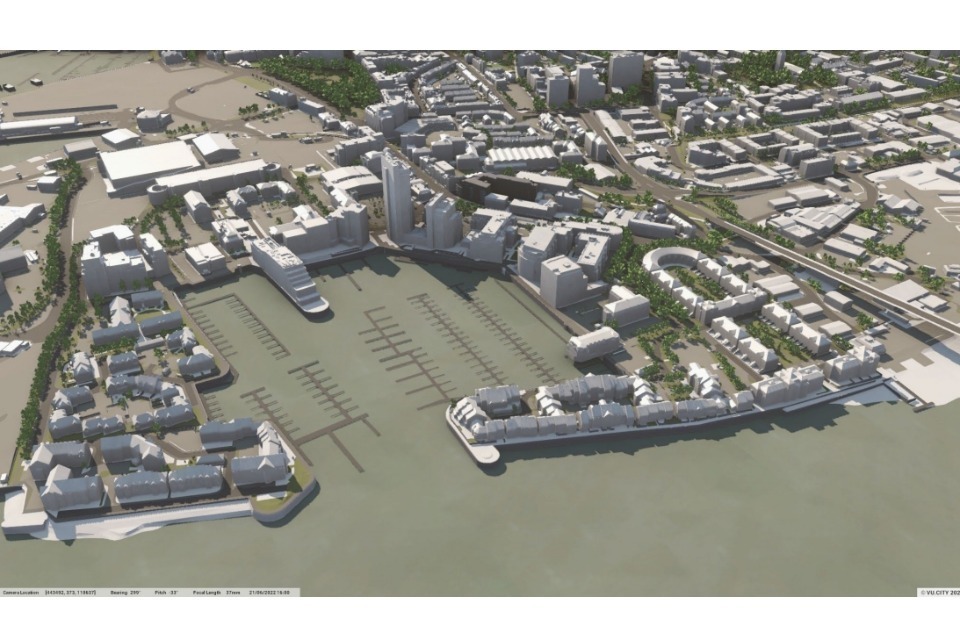
Trialled 3D model views helped residents understand how proposals for taller buildings might look in the city. Image courtesy of Southampton City Council.
Image description: Screenshot of a 3D model showing how proposed taller buildings could look in Southampton.
Results and impact
Pilot 1 findings
The first pilot generated a clear picture of how residents engaged with different tools:
- 186 residents participated, providing almost 800 contributions across polls, maps, ideas boards and surveys
- the access and movement and environment and climate change themes saw the highest engagement
- polls and surveys generated the most responses, while maps and ideas boards received fewer interactions
- 36 map pins and 34 related comments were submitted on night-time economy zones
- demographic data showed over-representation of residents aged 60 to 69 and under-representation of residents aged 20 to 29 and residents from Black and minority ethnic groups
- registration requirements were identified as a barrier; removing registration increased engagement
These insights shaped how the next pilot was designed, including simplifying some tools and reviewing demographic-data collection.
Pilot 2 findings
The second pilot focused mainly on delivery and lessons learned.
Key findings included:
- breaking the draft plan into accessible, theme-based sections made navigation easier for residents
- embedding 3D screenshots helped illustrate height and scale
- the 3D model was less suited to high-level local plan content and may be more effective for site-specific masterplanning
- hybrid engagement remained important, as in-person sessions helped with awareness-raising and answering detailed questions
These insights fed into planning for future consultations and for Southampton’s continuous improvement project.
What they learned
The council identified important lessons. They found that:
- quick, structured tools like polls and surveys generate the most responses, while map tools and ideas boards need clear purpose to be effective
- collecting demographic data through registration is important, but can discourage participation if it feels burdensome
- 3D modelling adds most value to site-specific projects and masterplans, rather than high-level local plan policies
- digital engagement alone is not enough to reach younger groups — proactive in-person sessions in schools and youth groups are essential
- successful digital engagement needs a multidisciplinary team, with planning, communications, consultation and IT teams working together
Future plans
Southampton plans to develop its use of digital tools for the next stages of the local plan. The council will make more use of the 3D model to support site-specific masterplanning, because the model can show scale and form more clearly. It will also improve its hybrid engagement approach so it can reach people who are less likely to take part digitally.
The council plans to look at ways to reduce reliance on email consultation responses, which take significant time to process, and will strengthen its communication and engagement planning for the next consultation.
Help us improve this case study by completing our short feedback form.
Useful resources
Explore tools and suppliers on the Digital Planning Directory.
Use the Digital community engagement toolkit for planning consultations.
Read guidance on using community engagement platforms in planning consultations.
Explore the Open Digital Planning community.
External links on this page are included to help users find relevant information. Their inclusion does not imply government endorsement of any organisation, product or service.