Plymouth, South Hams and West Devon improve analysis with AI
Plymouth, South Hams and West Devon tested AI tools to tag and summarise consultation responses, improving insight for officers and reducing processing time.
Estimated reading time: 8 minutes
Plymouth City Council, South Hams District Council and West Devon Borough Council worked together as a Joint Local Plan (JLP) partnership. They carried out 2 linked pilot programmes to test digital consultation and benchmarking tools designed to improve consultation analysis.
- Outcome: Digital tools helped increase participation across most wards. AI-assisted tagging and summaries sped up early analysis, while digital mapping and Power BI improved how officers compared and reported findings.
- Technology used: Natural language processing (NLP) tagging and summarisation tested with Commonplace. A benchmarking tool developed with City Science compared consultation outcomes with open data, while Power BI supported public reporting.
This was a PropTech Innovation Fund round 3 pilot (2023 to 2024) and describes what was tested at the time.
The planning challenge
The joint local plan area covers a large and diverse geography, from a major city to rural and coastal communities. Previous consultations often required extensive manual processing and struggled to:
- reach new or under-represented groups
- reflect the everyday experiences of residents across the 3 authorities
- process large volumes of free text responses quickly
- provide timely insight to inform plan making
The councils wanted to explore whether digital tools could:
- increase participation through more targeted engagement and better monitoring
- speed up consultation analysis and reduce the time it takes to close the feedback loop with communities
- provide clearer reporting and data visualisation, with less reliance on officers trained in GIS (geographic information system)
- free up officer time from administrative tasks so they can focus on engagement and policy evidence work
What they did
The councils partnered with Commonplace and City Science to redesign their approach to collecting and analysing consultation responses.
For the consultation, they:
- ran a digital survey with an interactive map where residents could record views on access to facilities, local issues, travel and open space
- designed the survey using plain language, quick polls and short open-text options
- used targeted communications, posters, drop-in events and paid social media to widen geographic reach
- monitored responses during the consultation and adapted communications where needed
For the analysis, they:
- worked with City Science to develop a benchmarking tool that linked public sentiment to open data on access to services
- co-designed and tested an NLP model in Commonplace to categorise responses by theme, location and sentiment
- used dashboards, maps and charts to help officers identify trends and support public reporting
- used Power BI to produce a pilot interactive strategic planning consultation report
The main aim was to test whether these tools could reduce processing time and help officers understand emerging issues more quickly.
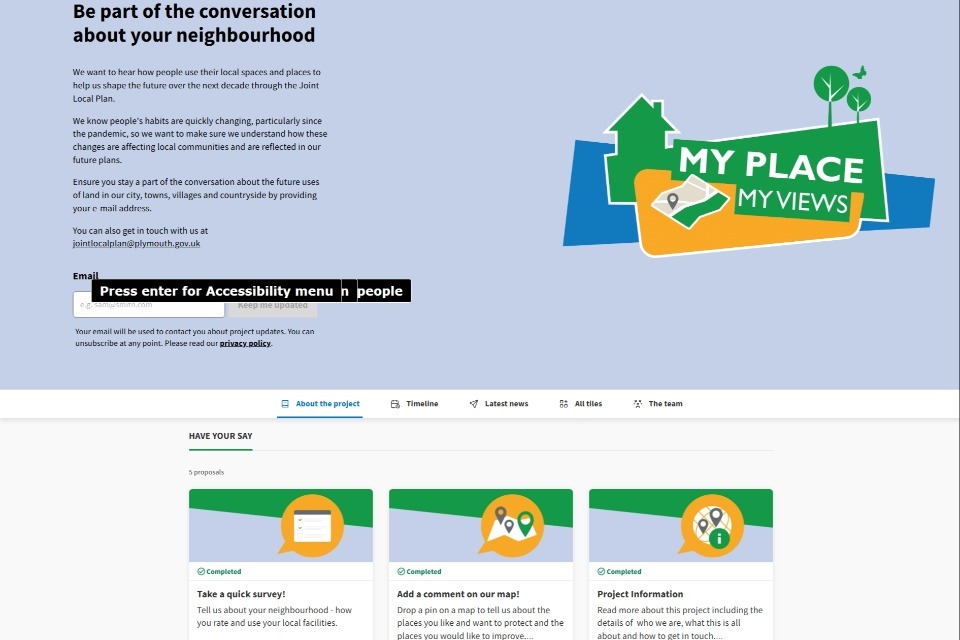
The consultation hub brought all materials together in one place. Image courtesy of Plymouth City Council, South Hams District Council and West Devon Borough Council.
Image description: Screenshot of the Plymouth, South Hams and West Devon consultation hub home page showing the project introduction and options for taking part.
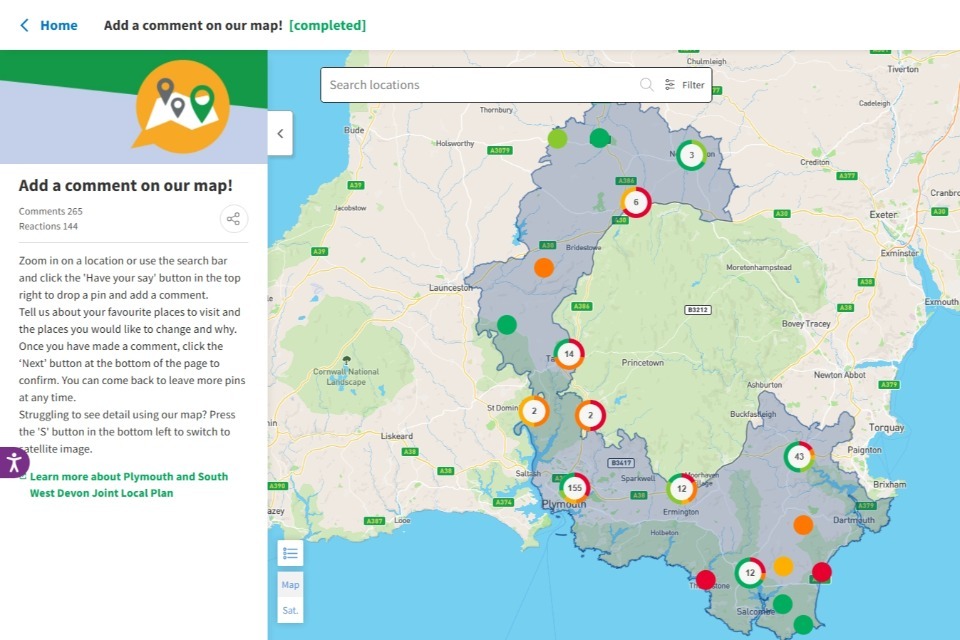
Live data helped the councils identify which groups were engaging. Image courtesy of Plymouth City Council, South Hams District Council and West Devon Borough Council.
Image description: Screenshot of the Plymouth, South Hams and West Devon consultation map where users can add comments on specific locations.
Results and impact
The pilot delivered measurable improvements in reach, insight and efficiency. The councils found that:
- more than 1,400 residents took part in the consultation
- participation increased in 3 out of 4 electoral wards across the area compared with the previous consultation
- 69% of participants had not taken part in a joint local plan consultation before
- 75% of participants said the survey was easy or very easy to complete
- NLP testing delivered a 66% improvement in processing time, saving up to 10 minutes per response
- testing suggested officers could produce initial high-level analysis within a week of the consultation closing
- residents under 35 were still under-represented compared with population estimates
- participation in areas with higher deprivation remained lower, reflecting wider national trends in planning participation
What they learned
The councils found that:
- simple survey design helped attract residents who had not taken part before
- workshops and in-person events still play an important role in reaching a broader demographic
- AI-assisted tools can reduce the time spent tagging and summarising consultation responses
- officer oversight remains essential — NLP can support early analysis, but cannot replace professional judgement
- models performed better when trained on local datasets
- consistent data standards increase the value of benchmarking tools for developing planning strategies and evidence documents
The pilot showed early potential for using AI in consultation analysis, but also highlighted the importance of transparency and human review.
Future plans
The councils plan to continue refining the NLP model and benchmarking approach ahead of future stages of the joint local plan. They intend to expand the training data, test AI summarisation on longer technical responses and explore how AI tools could integrate with existing consultation platforms. They also aim to strengthen outreach to younger residents and areas with lower participation, and to align their analytical methods with emerging planning data standards.
Help us improve this case study by completing our short feedback form.
Useful resources
Explore tools and suppliers on the Digital Planning Directory.
Use the Digital community engagement toolkit for planning consultations.
Read guidance on using community engagement platforms in planning consultations.
Explore the Open Digital Planning community.
External links on this page are included to help users find relevant information. Their inclusion does not imply government endorsement of any organisation, product or service.