Cotswold uses digital consultation hub to double engagement
Cotswold District Council used a consultation hub to make its local plan easier to understand, increase participation and reduce officer processing time.
Estimated reading time: 7 minutes
Cotswold District Council carried out a pilot project to test digital tools for improving its local plan consultation.
- Outcome: The council increased participation and reduced officer time by introducing a digital consultation hub for its local plan.
- Technology used: Commonplace (now Zencity), a digital consultation platform used to publish documents, interactive maps and video content in one place.
This was a PropTech Innovation Fund round 1 pilot (2021 to 2022) and describes what was tested at the time.
The planning challenge
The council was preparing a partial update to its local plan focused on carbon reduction. It needed a way to present large amounts of technical information in an accessible and engaging format.
Cotswold wanted to:
- increase participation and reach under-represented groups
- make complex planning information clearer and easier to navigate
- reduce officer time spent processing responses
- replace an older consultation system and reduce licensing costs
What they did
The council created a new online consultation hub to bring all local plan materials together. The hub offered several ways for residents to view and respond to information.
To make the consultation accessible and engaging, the team:
- developed a clear visual identity so residents could recognise the consultation
- split the consultation into 18 themed topics, each with a one-page summary in plain language
- produced short videos and an animation to explain development scenarios
- created interactive maps so residents could comment on individual sites
- published documents online, in council offices and in local libraries
- created a section with shorter questions for younger residents
- monitored demographic data in real time and targeted groups who were under-represented
- promoted the consultation through a district-wide postcard mailout, posters, social media adverts, public events and email updates
The team also adapted the hub while the consultation was live. For example, they added a dedicated area for town and parish councils after early feedback showed this would make responding easier.
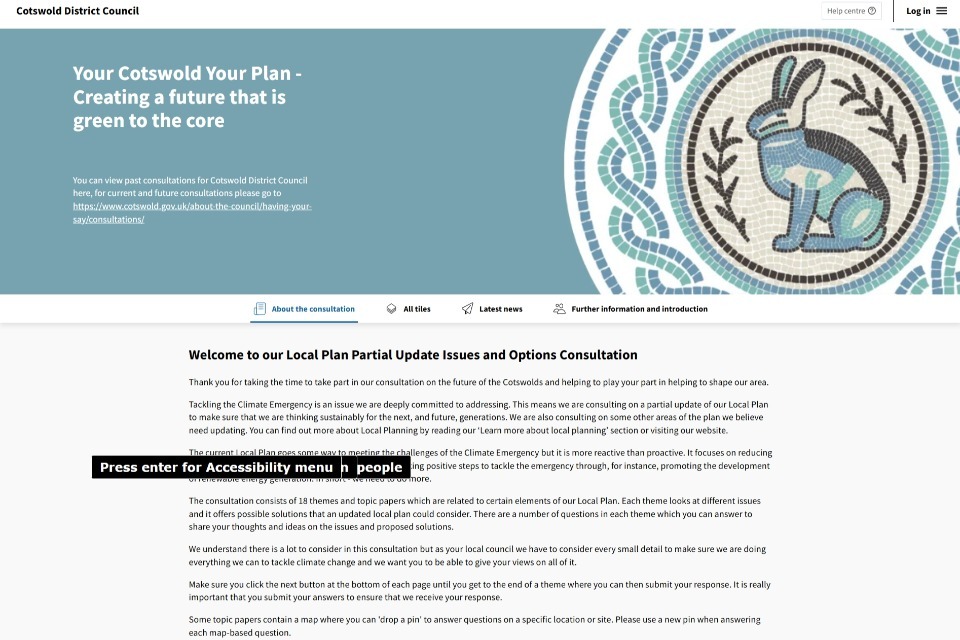
Cotswold District Council’s consultation hub brought together all local plan materials in one place. Image courtesy of Cotswold District Council.
Image description: Screenshot of the Cotswold consultation hub showing the welcome page.

Visual icons helped residents quickly identify topics of interest. Image courtesy of Cotswold District Council.
Image description: Screenshot of the Cotswold consultation hub showing clickable tiles for topics such as biodiversity, green infrastructure, design and economy and employment.
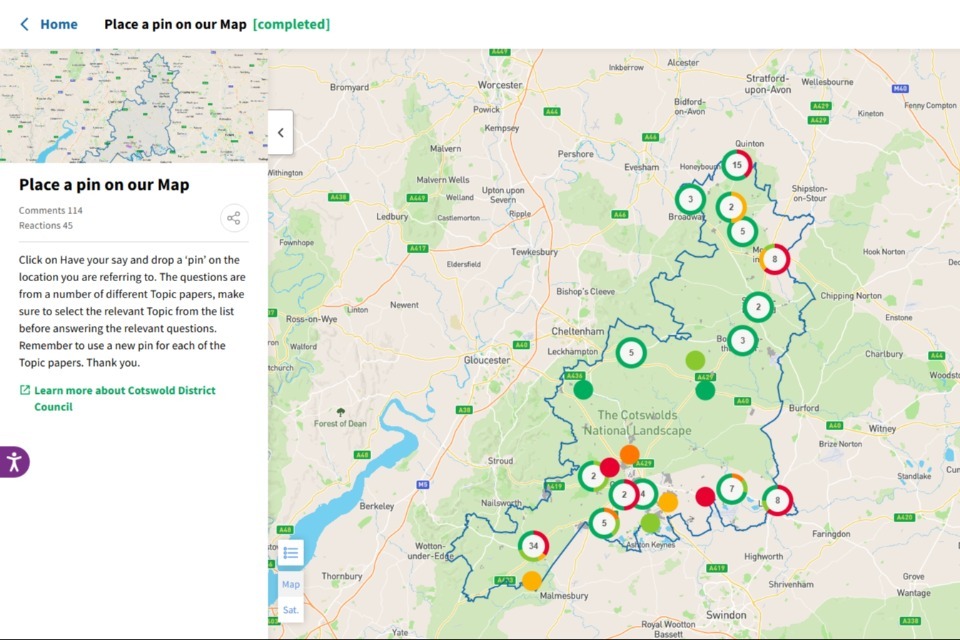
Live data helped the council identify which groups were engaging. Image courtesy of Cotswold District Council.
Image description: Screenshot of the Cotswold consultation map where users can place a pin and comment on specific locations.
Cotswold District Council: Our vision for a net zero future
Cotswold District Council created a short video to explain the consultation in a more accessible and engaging way.
Results and impact
The consultation performed significantly better than previous ones.
It led to:
- 755 respondents, making just over 2,900 representations
- 81% of responses submitted online, up from 28% previously
- 40% reduction in officer time spent inputting or categorising responses
- 29% increase in subscribers to the local plan mailing list
- improved demographic insight, showing who was and was not participating
- some positive feedback from participants about the hub being easier to use
The pilot showed that digital tools supported wider engagement, though some professional stakeholders continued to prefer email or written submissions.
What they learned
The council found that:
- one-page summaries encouraged engagement with complex topics
- understanding the platform earlier would have reduced rework
- preparing accessible content, videos and maps took longer than expected
- mobile access needed more consideration at the start
- live data helped the team target under-represented groups
- involving communications, digital, IT and procurement teams supported faster decisions
The volume of information was still challenging for some residents. Younger residents remained under-represented despite targeted outreach.
The software isn’t a silver bullet, it is vital that we also adapt and evolve our internal consultation and engagement practices to get the most value from these new tools.
– Cotswold District Council
This was a time-limited pilot and reflects the approach taken at that stage of the local plan process.
Future plans
The council plans to keep using digital consultation platforms in future stages of the local plan and to apply what it has learned to improve how information is presented. It plans to refine the structure of larger consultations to reduce information overload, make greater use of spatial and interactive mapping for site-based engagement, and increase participation among younger residents. The council also sees potential to use these platforms to support digital engagement in other service areas.
Help us improve this case study by completing our short feedback form.
Useful resources
Explore tools and suppliers on the Digital Planning Directory.
Use the Digital community engagement toolkit for planning consultations.
Read guidance on using community engagement platforms in planning consultations.
Explore the Open Digital Planning community.
External links on this page are included to help users find relevant information. Their inclusion does not imply government endorsement of any organisation, product or service. .