Business Rates: Review of Valuation Methodology for Public Houses and Hotels Call For Evidence
Published 24 August 2026

© Crown copyright 2026
This publication is licensed under the terms of the Open Government Licence v3.0 except where otherwise stated. To view this licence, visit nationalarchives.gov.uk/doc/open-government-licence/version/3 or write to the Information Policy Team, The National Archives, Kew, London TW9 4DU, or email: psi@nationalarchives.gov.uk.
Where we have identified any third party copyright information you will need to obtain permission from the copyright holders concerned.
This publication is available at https://www.gov.uk/government/calls-for-evidence/valuation-methodology-review-for-pubs-and-hotels/business-rates-review-of-valuation-methodology-for-public-houses-and-hotels-call-for-evidence
1. Foreword
I was pleased to accept the invitation from the Financial Secretary to HM Treasury to conduct this review.
I have long supported business rates as an appropriate levy within the basket of taxes on businesses, aimed at supporting the provision of local services. Yet I have always challenged governments to bring the rates system closer to Adam Smith’s widely-accepted four fundamental tenets of a good tax; i.e. fairness, certainty, convenience, and efficiency.
Over my extensive career as a rating advisor, I also became convinced of the importance of transparency to ensure public trust in the rating system and for its effective functioning.
The business rates system asks for a significant contribution from businesses of every sector and size. There should therefore be a basic expectation that that the taxpayer is provided with sufficient information to allow them to understand the valuation methodology utilised by the assessing body and how their individual valuation has been arrived at.
If businesses are provided with this it prevents many frustrations and misunderstandings that can arise in a system as complicated as business rates. And those concerns that remain can be more clearly, fairly, and efficiently considered.
There is considerable concern in the pub and hotel sectors about the outcomes of the 2026 revaluation. That is understandable, given significant changes in the overall valuations for the sectors and sizeable increases for many at the individual property level. Economic and operational changes in those sectors mean they are especially concerned that valuations remain relevant and responsive to market changes.
That’s why I want to begin my review with this Call for Evidence. It seeks to outline the approach, evidence and methodology the Valuation Office uses to value pubs and hotels, and invite comments and suggestions from industry, pub and hotel operators, valuers and other stakeholders.
Of course, this review cannot answer every question about how pubs and hotels experience the business rates system. My review is not directed to commenting on the overall level of liabilities faced by these industries.
I have never myself undertaken valuations for business rates of a pub or a hotel and I am keen to learn from all stakeholders, to hear their concerns, expectations and suggestions. I approach this review with a completely open mind and look forward to our discussions. The intention is that any changes I recommend which are accepted by Government will come in for the next revaluation.
My hope is that this review, this call for evidence, and all the discussions that flow from it, lead to a fairer and more transparent valuation system that better commands the trust of pubs and hotels.
Jerry Schurder FRICS FIRRV
Date 24/08/2026
2. Introduction
Pubs and hotels play a vital role in communities and local economies across the United Kingdom. They provide employment, support the visitor economy, and act as important social and cultural hubs. The government recognises both their economic contribution and the specific challenges they have faced in recent years.
In January, the government announced a package of support for pubs, including through business rates and licensing. A key element of this package was a review of how pubs and hotels are valued for business rates. In July 2026, the government announced further support for pubs, clubs and live music venues through a 20% business rates discount from April 2027.
Business rates are an important part of the taxation framework affecting these sectors. The system depends on fair and accurate property valuations to ensure that liabilities are based on evidence‑based assessments of rental value. Established valuation methodologies have been used for many years across different property types, including public houses (pubs) and hotels.
However, the government has heard concerns from ratepayers and representative bodies about the methodologies used in these sectors. These concerns relate to whether current approaches fully reflect market practice, are representative of market conditions, are applied consistently, and are sufficiently transparent to those affected.
In response, the government has commissioned a focused review of the valuation methodologies for pubs and hotels. The review will consider whether the existing approaches remain appropriate, how they are applied in practice, and how they might be improved. It will not revisit the statutory basis of valuation, which provides an important foundation for stability and certainty in the system with fairness across all property types.
This Call for Evidence is a central part of that review. It seeks to gather robust, practical evidence from across the sectors, including from businesses, representative bodies, valuers, academics and individual ratepayers. The government is particularly interested in evidence on how rents are determined in the market, how trading performance is reflected in rents, and where current approaches to valuations for business rates may not align with market reality.
Business rates are devolved across the nations of the United Kingdom. Northern Ireland and Scotland have separate assessment arrangements, while the Valuation Office discharges its statutory valuation functions for England and Wales. The valuation methods under review are applied consistently across England and Wales by the Valuation Office. As the same approach is used across England and Wales, the review welcomes evidence from across those two nations. The Scottish Government is running a separate independent review of valuation of the licenced hospitality sector in Scotland.
This review is distinct from the government’s work to address the perceived challenges for large infrastructure properties, like airports, in predicting the outcome of their valuations, and the subsequent impact on long-term, high-value investments. The government explored those questions through a Call for Evidence published at Budget 2025 and intends to publish a Summary of Responses in due course, with a view to addressing the issues raised ahead of the next revaluation.
As the government has recently said when launching the 20% relief for Pubs, Clubs and Live Music Venues, “This is just one step of the government’s plans to back our communities and high streets and we will return to our commitment to reform the wider business rates system, including Small Business Rates Relief, at the Budget.”
3. How properties are valued for business rates
The Local Government Finance Act 1988 (as amended) requires the Valuation Office to value non-domestic properties, including pubs and hotels, for business rates. The Valuation Office has been a part of HMRC since April 2026. The Valuation Office Agency operates independently of Ministers in carrying out property valuations and applying valuation methodologies
The Valuation Office must determine the ‘rateable value’ (RV) of the property, which is the estimated annual open-market rental value at a set valuation date making certain assumptions about repairing and insuring obligations. Properties are revalued periodically to reflect changes in the economy and property market and provide a more up-to-date basis for calculating business rates liabilities.
The government sets an ‘antecedent valuation date’ (AVD), which is the date used to assess the rental values of properties for business rates purposes. Using a single valuation date ensures that all properties are assessed consistently and fairly, based on the same market conditions. The AVD is set two years before new rateable values come into effect. For example, the most recent revaluation came into effect in England and Wales on 1 April 2026 but was based on rental values and economic factors as they stood on 1 April 2024. This means that if there were changes in rental value or economic changes after April 2024, those changes were not reflected until a later revaluation.
To calculate the RV, the Valuation Office normally applies one of three principal methods of valuation, depending on the availability and quality of evidence.
Figure 1: Three primary valuation methods for non-domestic rates, England and Wales

Flowchart showing the three primary valuation methods. Rental Comparison, Receipts and Expenditure and Contractor's basis.
3.1 Rental/comparative method
The Valuation Office uses the rental comparison method as the preferred method of valuation where open-market rental evidence is available at the AVD, either for the property itself or for comparable properties.
It involves analysing rents agreed in the market and adjusting them where necessary to reflect differences between properties, such as location, size, layout, and other relevant physical characteristics. This is the most direct and straightforward way of valuing a property for business rates, and is used for at least 90% of properties, including, for example, most properties in the retail, office, and industrial sectors.
3.2 Receipts and expenditure
The Valuation Office uses the receipts and expenditure (R&E) method where rental evidence is limited or not available, and the property is occupied primarily with a view to generating a profit. Examples of sectors where R&E is often used include leisure attractions, ranging from theme parks to motorway service areas. It is also used for the valuation of some large infrastructure properties such as airports, docks, and harbours.
The method uses relevant trading income and expenses to arrive at a ‘divisible balance’ (i.e. the net amount from deducting all relevant expenses from trading receipts) which is used to estimate what the rental value is – normally a proportion of the divisible balance.
The divisible balance comprises two main elements:
i. The Tenant’s share – to provide a return on any tenant’s capital employed and a reward to the tenant for his venture reflecting the extent of the risk and the need for profit. This is deducted from the divisible balance to leave:
ii. The Landlord’s share, i.e. the rent payable (which becomes the RV).
3.3 Contractor’s basis
The Valuation Office uses the contractor’s basis for properties that are rarely, if ever, let on the open market and where there is no direct rental or trading evidence. The method estimates the rental value by reference to the cost of constructing a modern equivalent building, adjusted for factors such as age and obsolescence, and applies a statutorily defined percentage of the cost as its RV. This method is typically used for specialised properties such as schools and hospitals.
4. The 2026 revaluation for pubs and hotels
The most recent business rates revaluation came into effect on 1 April 2026. There was significant movement in pub and hotel values between the April 2023 and the April 2026 revaluations. This reflected rental value changes between the AVD of 1 April 2021 for the 2023 revaluation and 1 April 2024 for the 2026 revaluation.
On 1 April 2021, pubs could not open their premises to the public due to COVID restrictions, and hotels also faced significant changes to their usual ways of working. This meant there was far less evidence of open market rents or trading data for the Valuation Office to consider.
The Valuation Office decided, in consultation with the pubs and hotel sectors, to apply substantial valuation adjustments to the pre-COVID trading evidence to estimate rental values in 2021.
By the time of the next AVD of 1 April 2024, no COVID restrictions applied. This contributed to significant rises in RVs at the 2026 revaluation as the COVID-era adjustments were no longer appropriate.
Table 1: Median RV changes in Retail, Leisure and Hospitality (including Pubs and Hotels) sectors, 2023-2026, England and Wales[footnote 1]
| RV increases between 2023 and 2026 revaluations | |
|---|---|
| Pubs | 32.8% |
| Hotels | 32.2% |
| All Retail, Hospitality & Leisure | 12.7% |
| All Sectors | 15.4% |
Historically, however, pubs and hotels saw more substantial declines in median rateable value between the 2017 and 2023 revaluations than the remainder of the retail, hospitality and leisure (RHL) sectors. Pub and Hotel RVs reduced at the 2023 revaluation by 22.4% and 15.2% respectively, compared with a 3.8% increase for RHL overall. The reduction for pubs and hotels was primarily a result of COVID-19 and associated valuation adjustments.
This decline and recovery pattern becomes more clearly visible when considered alongside the total change across the whole period from 2017 to 2026 (i.e. across the 2017, 2023 and 2026 revaluations) in which pubs and hotels show increases of 4.1% and 18% compared with 18.4% for all RHL.
Table 2: Median RV changes in Retail, Leisure and Hospitality (including Pubs and Hotels) sectors, 2017 – 2026, England and Wales[footnote 1]
| 2017-2023 | 2023-2026 | 2017-2026 | |
|---|---|---|---|
| Pubs | -22.4% | 32.8% | 4.1% |
| Hotels | -15.2% | 32.2% | 18.0% |
| All Retail, Hospitality & Leisure | 3.8% | 12.7% | 18.4% |
| All Sectors | 11.5% | 15.4% | 28.6% |
Table 3 below shows an example of a property valued for £20k in 2017 and the following changes for 2023 and 2026 when the median percentages are applied.
Table 3: RVs for property valued at £20,000 in 2017, experiencing median growth by sector, to the nearest £100, England and Wales[footnote 1]
| Revaluation | Pub | Hotel | Retail, Hospitality & Leisure |
|---|---|---|---|
| 2017 | £20,000 | £20,000 | £20,000 |
| 2023 | £15,500 | £17,000 | £20,800 |
| 2026 | £20,600 | £22,400 | £23,400 |
Pubs in particular saw far more variable outcomes at the individual property level than the rest of RHL. For example, 5% of all pubs experienced RV increases of greater than 150% at the 2026 revaluation.
5. Valuation Methodology for Pubs
5.1 Overview of the Sector and Market Context
The pubs sector is a core part of the hospitality industry, comprising around 40,000 pubs across England and Wales. The sector includes a wide range of businesses, from small rural pubs to large urban venues, many of which combine drinks, food and, in some cases, accommodation.
Figure 2: Number of pubs by region, 2026 Revaluation, England and Wales
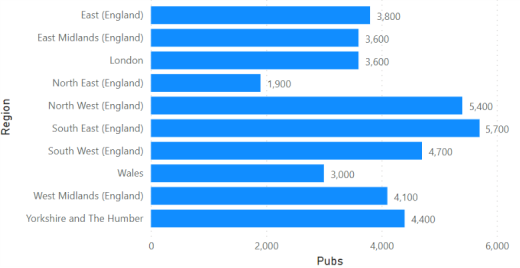
Chart showing number of pubs by region in England and Wales, with South East England having the highest count at 5,700 and North East England the lowest at 1,900.
Figure 3: Median 2026 Revaluation RV of pubs by region, England and Wales
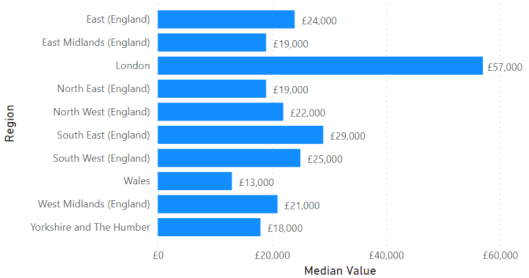
Chart showing median RVs by region in England and Wales. London stands out with the highest median value of £57,000, followed by the South East at £29,000. Wales has the lowest at £13,000, highlighting significant regional disparities.
A variety of ownership and operating models exist within the sector, including independent pubs, tied pubs (typically owned by pub or brewing companies and leased to a publican subject to restrictive supply agreements), and managed pubs operated directly by larger chains or breweries. These different models influence how pubs generate income and their cost structures.
There is a high degree of variation across the sector. Pubs differ widely in size, layout and customer base, with value shaped by factors such as location, local demand and each property’s physical characteristics. Some pubs operate at relatively low levels of trade, while others are high‑turnover venues attracting large numbers of customers. This variation means there is no single “average” pub, and outcomes for individual businesses are closely linked to their local market conditions.
5.2 Valuation methodology
Pubs are valued for the purposes of business rates utilising the rentals/comparative approach, occasionally using floorspace as the point of comparison, but normally by using their trading potential.
Some locations may have a distinct market in a defined geographical area that includes pubs, bars and restaurants. This will tend to be modern units in major towns and cities, often co-located with restaurants or occupying sites close to, or on the edge of, the prime retail location. Alternatively, they may be located on retail parks or within in-town shopping centres. Where market evidence shows that rental values for pubs follow that of, for example, restaurants in the same location, a floor area comparative basis of valuation can be used, based upon a value per square metre.
The Valuation Office use the floor space direct rental comparison method to value approximately 1200 pubs/bars in England and Wales.
Most pubs are, however, valued on a scheme that, whilst founded upon market rental evidence, uses a receipts approach rather than floor area as the unit of comparison to determine RVs. As a very simple example, if a pub is rented at the AVD at, £100,000 per annum and can generate a turnover of £1m annually at that date, its rent represents 10% of turnover.
In practice pub rents are largely driven by trading potential. Operators typically agree rent based on how much profit the property can generate, rather than on factors such as floorspace where it is often observed that increased size does not necessarily result in increased profit.
However, not all pub rents can be treated as open market rents. In many cases, they form part of wider arrangements, such as tied tenancies, where tenants are required to purchase products from the landlord. This means the payments made by tenants cover more than just the use of the property and as they do not provide a clear measure of rental value they may be of little or no relevance to valuations for business rates purposes.
Developing a valuation scheme for pubs
To develop a valuation scheme for rating purposes, the Valuation Office collects both rental and trading data from across the sector. For the most recent revaluation, this included issuing information requests to pubs nationwide.
The Valuation Office initially issues targeted information requests to approximately a third of pubs where records suggest useful rental evidence might be available, to collect that rental evidence as early as possible, followed up by trading information requests to the remainder, which also seek rental data if available.
The Valuation Office looks at which rents are most relevant, based on factors such as how close to the AVD they were set, and how much adjustment would have to be made to the rents given the individual terms of the lease to bring them into line with the statutory definition of RV. The Valuation Office needs to have both relevant rental evidence and associated trading receipts for the subject pubs in order to utilise this information in a valuation scheme. This allows rents to be expressed as a percentage of receipts, with the results then fed into the valuation process.
Most tied rents would require difficult to quantify adjustment to account for the fact tied pubs are required to purchase certain products from the brewery to which they were tied. For this reason, the Valuation Office does not consider tied rents as representative of market rental values at the AVD, although it considers them to provide useful context to other more reliable rental evidence.
At the most recent revaluation, the Valuation Office analysed the rental evidence it had gathered and identified around 2,000 rents as relevant rental evidence for comparison with trading receipts.
Analysis of this data by the Valuation Office produces a wide range of rents expressed as a percentage of receipts. The Valuation Office then undertakes detailed analysis to identify the key characteristics that contribute to this variation. It also analyses income streams from drinks (alcoholic and non-alcoholic), food and accommodation receipts, reflecting the differing levels of profitability capable of being generated from these sources.
The Valuation Office considers rental evidence alongside wider information on market conditions and how rents relate to turnover to develop the valuation scheme. The rental evidence is anonymised and discussed with an industry forum, including representatives from across the pubs and hospitality sector. This provides an opportunity for the sector to contribute evidence and expertise to the scheme’s development, including on changing business models, sources of income and wider market trends. This helps to ensure that the scheme reflects how the sector operates in practice and that valuations are based on the best available understanding of the market.
Categorisation of pubs for the valuation scheme
Based upon analysis of the relevant rental data and associated trading information, the current scheme for the 2026 revaluation groups pubs into 3 broad categories for drinks sales:
- city and town centre houses (which benefit from higher levels of passing trade and footfall),
- destination houses (which draw trade from a wide area), and
- urban fringe, local and rural houses (which rely more on local and repeat trade).
Figure 4: Number / share of pubs by type, 2026 revaluation, England and Wales
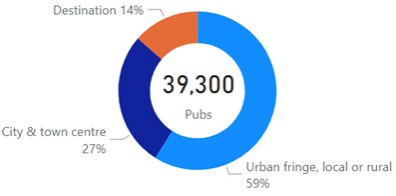
Donut chart showing the distribution of 39,300 pubs by location type in three segments: Urban fringe, local or rural (59%) City & town centre (27%) and Destination (14%).
Following analysis of the relevant rental evidence and associated trading information, the Valuation Office sets different percentages of receipts for different categories of pubs and income streams to derive RVs.
The scheme also provides 3 geographical categories for drinks trade, being Central London, Outer London, and the remainder of regional England and Wales where differing percentages of receipts are applied to each of these categories.
The Valuation Office values food trade using one of two scales. A higher food scale applies where food receipts exceed £650,000 or where food receipts account for more than 55% of total food and drink turnover; all other properties are valued using the standard food scale.
The Valuation Office values accommodation trade separately and, depending on the type of property, it can be valued at a level similar to, or somewhat above, that used for food trade. Where there is lodge accommodation, similar to that seen at modern hotel lodges or aparthotels, the appropriate hotel valuation scheme is applied to the accommodation parts of the premises.
Grouping pubs in this way helps valuers compare similar properties and provides an efficient way for the Valuation Office to value large numbers of broadly comparable properties. The categorisation framework has been updated at successive revaluations to reflect changes in the sector, including shifts towards food‑led operations, hybrid venues and changes in consumer behaviour.
The current valuation scheme is provided in Annex A. Within each category the percentage of receipts analysed by the scheme falls within a range, expressed as a maximum and minimum percentage. This allows the valuer to fine tune the resultant valuation by reflecting any characteristics of the property or its trading performance which lead it to be more or less valuable.
Q1. What alternative valuation approaches could the government consider?
Q2. What evidence do respondents have that an alternative approach would provide a more accurate valuation of pubs?
Q3. How well do respondents think this evidence-gathering and analysis allows the valuation scheme to accurately reflect the market?
Q4. What evidence do respondents have on how well the categorisation of pubs and their trades described in 5.17 to 5.21 above reflects the market?
Q5. What other evidence could the government consider to develop a scheme?
Applying the valuation scheme to individual pubs
Once the valuation scheme has been finalised, the Valuation Office revalues all pubs. A valuer considers each property individually and applies the appropriate percentages to the pub’s Fair Maintainable Trade (FMT). The FMT represents the annual trade that a reasonably efficient operator could maintain at the AVD.
The actual trade will be the starting point to guide the valuer but may not in all cases be the best evidence of what is a reliable and sustainable level of FMT. The scheme includes scope for the individual valuer to make judgements about whether the trading data represents reasonable trading, over- or under-trading, and where to place the given property within the benchmark ranges.
When assessing FMT, the Valuation Office may exclude elements of trade that are attributable to a particular operator rather than to the property itself, and which a reasonably efficient operator would not be expected to replicate. For example, if a pub benefits from unusually high levels of trade because it is owned by a celebrity or attracts customers for reasons specific to the current operator, a valuer may conclude that this additional trade would not be maintained by a reasonably efficient operator and should therefore be excluded from FMT.
Along with ongoing training for its valuers, the Valuation Office provides specific internal training in the new scheme at each revaluation. This includes guidance as to how to determine where to place each pub within the range of percentages provided by the scheme and the required approach to judge over or under-trading performance.
The Valuation Office has a number of internal review and quality assurance processes at revaluations, which apply to pubs. This can include checking samples of valuations, and checks of unusually high or low changes in value.
Q6. What evidence do respondents have about how well the Valuation Office applies the scheme to individual pubs?
How the Valuation Office develops the scheme with stakeholders
Other than for the 2026 revaluation, schemes have been agreed with representatives of the pubs industry at each revaluation since 1995, in the form of an Approved Guide. The wording of the guide is fully discussed and agreed, along with the rental percentages.
The Approved Guide was agreed from 1995 to 2010 with the trade body now called the British Beer and Pub Association, with input from other trade associations. For the 2017 and 2023 revaluations the Approved Guide was agreed with several bodies forming the Pubs Rating Forum.
The Pubs Rating Forum is a joint working group comprising the Valuation Office and industry representatives including the British Beer and Pub Association, British Institute of Innkeeping, Society of Independent Brewers and Associates, and UK Hospitality. It provides a structured forum for sharing evidence, testing assumptions, and developing the valuation framework for pubs, including the categories and percentage ranges used in the scheme.
The Valuation Office invites the Pubs Rating Forum to provide any additional rental and market evidence they hold and provides an anonymised analysis of the rental evidence. After discussion, a valuation framework and the rental percentages are normally agreed, along with the published Guides.
This process recommenced in 2024, ahead of the revaluation on 1 April 2026. Members of the Pubs Rating Forum have told the government that the discussions were less productive than in previous years. By 2026, it became clear that none of the members of the Forum agreed with proposals for a valuation framework and a published Guide. The Valuation Office published its own “Licensed Property Guidance Note” to inform the valuation of pubs for that revaluation.
The timeline for the various stages of the revaluation process for pubs is summarised in Figure 5 below.
Figure 5: Pub valuation scheme timeline, England and Wales
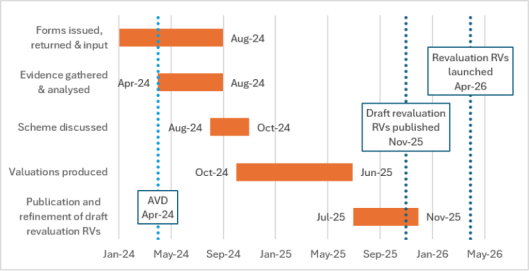
Gantt chart illustrating the timeline for revaluing pubs from January 2024 to May 2026. Key milestones include: AVD in April 2024, draft revaluation RVs published in November 2025 and the launch of revaluation RVs in April 2026.
Q7. What alternative or additional approaches could the government consider to better engage industry, ratepayers, and other stakeholders on developing and agreeing a valuation scheme for pubs?
How values are communicated to ratepayers
Ratepayers can view their RVs, and those of other properties, on gov.uk when draft revaluation assessments are published, normally in the autumn before the revaluation takes effect, and when the final RVs come into effect. Ratepayers who wish to view fuller details of their own trade-based valuation must register with the Valuation Office.
The Valuation Office embarks on a public communications campaign to make ratepayers aware of the availability of a new RV for their property. However, the Valuation Office does not write to each individual ratepayer to inform them of their valuation.
Further information on the current valuation methodology for pubs, including explanatory guidance, valuation manuals and supporting materials published by the Valuation Office, is provided at Annex A.
Once a ratepayer has registered, they can request a ‘summary valuation’ for their property which sets out the calculations made by the Valuation Office in valuing their property, including the FMT adopted and valuation percentage/s used. An anonymised example Summary Valuation is provided at Annex A.
Once the revaluation comes into force, ratepayers can engage with the formal Check Challenge Appeal system to query and challenge their valuation.
Q8. What evidence do respondents have about whether ratepayers understand the valuations of their properties?
Q9. Is there additional information that could be made available to assist ratepayers’ understanding of their valuations?
Q10. Would it be beneficial for summary valuations to be supplied at an earlier stage?
6. Valuation Methodology for Hotels
6.1 Overview of the Sector and Market Context
The hotel sector represents a substantial element of the hospitality industry and includes around 7,600 properties across England and Wales. The sector ranges from small independent hotels and guesthouses to large national and international chains.
Many hotels generate income from a mix of accommodation, food and other services such as events or conferencing. There is also a range of ownership and operating models, including independent operators and large branded groups, which shape how businesses generate income and manage their costs.
Figure 6: Number of hotels by region, 2026 Revaluation, England and Wales
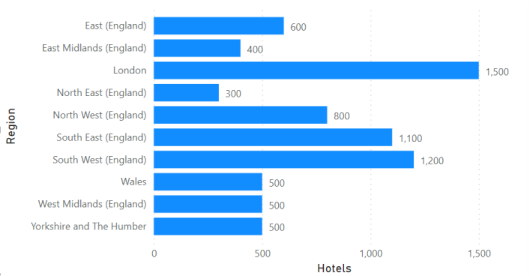
Chart showing the number of hotels in England and Wales by region, with London having the highest count at 1,500 and North East England the lowest at 300. The chart highlights significant hotel concentration in London, South West, and South East England.
Figure 7: Median 2026 revaluation RV of hotels by region, England and Wales
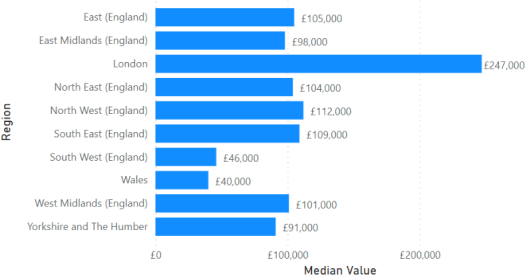
Chart comparing median hotel RVs across England and Wales by region. There are significant regional disparities, especially between London at £247,000 (the second highest being the North West at £112,000) and Wales at £40,000.
The sector is also highly varied. Hotels differ widely in size, quality, and trading profile, from small rural or seasonal businesses to large city‑centre hotels with year‑round demand.
London is a particularly large and distinct market, with around 1,500 hotels, giving it a much higher concentration of hotel activity than elsewhere in England and Wales. It also has a greater share of higher‑value hotels and stronger international demand.
6.2 Valuation methodology for hotels
Unlike pubs, there are relatively few open-market rental transactions for hotels, particularly for those operated by large groups. Instead, they are often owner‑occupied, or operate under management agreements, franchise arrangements or long-term leases that may not reflect open market conditions.
In many cases, these agreements are made across portfolios of hotels rather than on an individual property basis. Smaller independent hotels may be rented, although these rents can be influenced by wider factors, including whether the operator has non-commercial motives for running a small hotel.
Most hotels, including chain, larger independent and boutique hotels are valued for business rates in line with a published scheme of valuation. Given the paucity of open market rental evidence, the valuation scheme is founded upon the receipts and expenditure method outlined in Chapter 3 and expanded upon below.
Smaller London hotels, B&Bs and guest houses are typically excluded from the scheme, and these properties are more commonly assessed reflecting local rental evidence where applicable. This is because where rental evidence is available, it is the most appropriate evidence to use.
In order to fairly value over 7,000 hotels for rates revaluations, the Valuation Office undertakes full R&E valuations for a sample of hotels and designs schemes of valuation to be applied to all hotels following analysis of the outcomes of the R&E valuations of the representative sample.
Development of the scheme – evidence gathering
The Valuation Office requests full R&E information on a sample of hotels. This sample is largely consistent between revaluations and is bolstered by extra accounts for categories of hotel which may be under-represented or where the market may be changing. For the most recent revaluation, the Valuation Office received R&E information for approximately 300 hotels, which formed the sample underlying the scheme.
The sample is selected to be representative of the sector, drawing from properties across a range of geographic locations, capturing differences in local market conditions and demand, and across different types of hotels, including variation in size, service level and operating model.
The R&E information returned is then analysed to derive a rental value for each hotel in the sample. The analysis follows the principles in The Receipts and Expenditure Method of Valuation for Non-Domestic Rating: A Guidance Note, by the Joint Professional Bodies, including the Royal Institution of Chartered Surveyors.
An anonymised example of a R&E valuation is provided at Annex B. In this example a hotel shows receipts of £6,105,000, costs of sales of £242,000 and working expenses of £4,923,000, leaving a divisible balance of £940,000. This divisible balance is shared between the hypothetical landlord and tenant, and the result is a derived rental value of £470,000. For the purposes of devising a valuation scheme, this derived rental value is expressed as a percentage of the hotel’s receipts - in the example at Annex B the rental value is represented as 7.7% of receipts.
The Valuation Office undertakes this process for every hotel in the sample and uses the resulting percentages to develop a valuation scheme that can be applied to all hotels.
The latest scheme breaks hotels into three categories, varying whether the hotel is within Central London or outside it. There is a separate, fourth valuation scale for lodges and aparthotels (wherever in England or Wales) where only rooms, or rooms and minimal other services, are provided.
Table 4: Hotel types in the valuation scheme, England and Wales
| Categories of hotel | |
|---|---|
| In Central London | Out of Central London |
| 2/3/4 star hotels or equivalent | Lower Service Provision budget/lodge (with bar/restaurant facilities) Also includes Inner London budget hotels |
| 4/5 star hotels or equivalent | Standard Service Provision at 3/4 star or equivalent |
| Top 5 star plus or equivalent | Higher Service Provision at top 4/5 star or equivalent |
| Aparthotels, room-only lodges, etc. (whole Eng + Wales) |
The scheme reflects the differing levels of profitability capable of being generated from revenue sources additional to accommodation, such as food, drink, conferencing and events. It does this by providing for differing percentages of receipts to be adopted as its RV, depending upon the proportion of total turnover represented by accommodation. As accommodation receipts normally generate higher levels of profitability, the greater the proportion of accommodation receipts at any given hotel, the higher will be the percentage adopted in order to calculate its RV. More information on these percentages can be found in the Rating Manual in Annex B.
The Valuation Office reviews this evidence alongside wider information on market conditions and the relationship between turnover and value. The evidence is anonymised and discussed with representatives of the hotel industry, allowing the Valuation Office to take account of industry input and ensure the scheme reflects how the market operates.
Q11. What alternative valuation approaches could the government consider?
Q12. What evidence do respondents have that an alternative approach would provide a more accurate valuation of hotels?
Q13. How well do respondents think this evidence-gathering and analysis allows the valuation scheme for hotels to account for the market?
Q14. What evidence do respondents have on how well the categorisation of hotels in paragraphs 6.15 to 6.16 above reflects the market?
How the Valuation Office develops the scheme with stakeholders
Specific schemes have been agreed since at least the 2000 revaluation with the main hotels trade body, UK Hospitality. The agreed element is generally the valuation approach and the range of rental percentages to be applied, while the remainder of the guidance is written by the Valuation Office.
The 2026 scheme was agreed with UK Hospitality following discussions held with the appointed professional agent for UK Hospitality, who liaised with other agents. The properties to use for Receipts and Expenditure analysis, and the categories and geography to use in the scheme, formed part of this discussion.
The scheme is published as a Practice Note by the Valuation Office. No approved guide is produced comparable to the pubs guide, and as there is only one trade body, there is no structured forum like the pubs forum.
The scheme provides a set of rental percentages and categories to guide the valuer in choosing an appropriate rental percentage for each property. The 2026 scheme percentages are provided as Annex B.
Q15. What alternative or additional approaches could the government consider to better engage industry, ratepayers, and other stakeholders on developing a valuation scheme for hotels?
Applying the valuation scheme to individual hotels
The Valuation Office then undertakes the revaluation of all hotels, where each property is considered individually by a valuer. As for the valuation of pubs, the scheme requires the valuer to assess the FMT that could be generated by a reasonably efficient operator and adopt a percentage of FMT derived from the scheme to represent its rental/rateable value. The scheme includes scope for the individual valuer to make judgements about whether the trading data represents reasonable trading, over- or under-trading, and where to place the given property within the benchmark ranges.
Along with ongoing training for valuers, the Valuation Office provides specific training in the new scheme each revaluation.
The Valuation Office has a number of internal review and quality assurance processes at revaluations, which apply to hotels. This can include checking samples of valuations, and checks of unusually high or low changes in value.
The scheme includes the possibility that in exceptional circumstances where a hotel does not fit with those covered by the agreed scheme, it can be valued individually using the R&E method.
The timeline for the various stages of the revaluation process for hotels is summarised in the chart below.
Figure 8: Hotel valuation scheme timeline
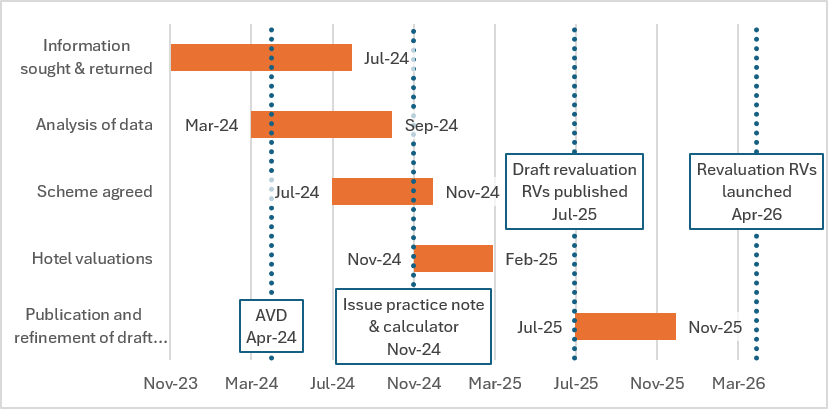
Gantt chart illustrating the timeline for revaluing hotels from November 2023 to April 2026. Key milestones include the AVD in April 2024, practice note issuance in November 2024, publication of draft revaluation RVs in July 2025, and launch of revaluation RVs in April 2026.
Q.16. What evidence do respondents have about how well the Valuation Office applies the scheme to individual hotels?
How values are communicated to ratepayers
Ratepayers can view their RVs, and those of other properties, on gov.uk when draft revaluation assessments are published, normally in the autumn before the revaluation takes effect, and when the final RVs come into effect. Ratepayers who wish to view fuller details of their own trade-based valuation must register with the Valuation Office.
The Valuation Office embarks on a public communications campaign to make ratepayers aware of the availability of the new RV of their property. However, the Valuation Office does not write to each individual ratepayer to inform them of their valuation.
Further information on the current valuation methodology for hotels, including explanatory guidance, valuation manuals and supporting materials published by the Valuation Office, is provided at Annex B.
Once a ratepayer has registered, they can request a ‘summary valuation’ for their property which sets out the calculations made by the Valuation Office in valuing their property, including the FMT adopted and valuation percentage/s used. An anonymised example is provided at Annex B.
Once the revaluation comes into force, ratepayers can engage with the formal Check Challenge Appeal system to query and challenge their valuation.
Q17. What evidence do respondents have about whether ratepayers understand the valuations of their hotels?
Q18. Is there additional information that could be made available to assist ratepayers’ understanding of their valuations?
Q19. Would it be beneficial for summary valuations to be supplied at an earlier stage?
7. Summary of Questions
Respondents are encouraged to provide supporting evidence wherever possible. This may include rental data, trading data, worked examples, case studies, surveys of relevant groups, or analysis. Where evidence cannot be provided, respondents are invited to clearly explain the basis for their views.
7.1 Questions on Valuation Methodology for Pubs
Q1. What alternative valuation approaches could the government consider?
Q2. What evidence do respondents have that an alternative approach would provide a more accurate valuation of pubs?
Q3. How well do respondents think this evidence-gathering and analysis allows the valuation scheme to accurately reflect the market?
Q4. What evidence do respondents have on how well the categorisation of pubs and their trades described in 5.17 to 5.21 above reflects the market?
Q.5 What other evidence could the government consider to develop a scheme?
Q6. What evidence do respondents have about how well the Valuation Office applies the scheme to individual pubs?
Q7. What alternative or additional approaches could the government consider to better engage industry, ratepayers, and other stakeholders on developing and agreeing a valuation scheme for pubs?
Q8. What evidence do respondents have about whether ratepayers understand the valuations of their properties?
Q9. Is there additional information that could be made available to assist ratepayers’ understanding of their valuations?
Q10. Would it be beneficial for summary valuations to be supplied at an earlier stage?
7.2 Questions on Valuation Methodology for Hotels
Q11. What alternative valuation approaches could the government consider?
Q12. What evidence do respondents have that an alternative approach would provide a more accurate valuation of hotels?
Q13. How well do respondents think this evidence-gathering and analysis allows the valuation scheme for hotels to account for the market?
Q14. What evidence do respondents have on how well the categorisation of hotels in paragraphs 6.15 to 6.16 above reflects the market?
Q15. What alternative or additional approaches could the government consider to better engage industry, ratepayers, and other stakeholders on developing a valuation scheme for hotels?
Q.16 What evidence do respondents have about how well the Valuation Office applies the scheme to individual hotels?
Q17. What evidence do respondents have about whether ratepayers understand the valuations of their hotels?
Q18. Is there additional information that could be made available to assist ratepayers’ understanding of their valuations?
Q19. Would it be beneficial for summary valuations to be supplied at an earlier stage?
8. Next Steps
8.1 How to respond
Please send responses by email to: PubsHotels.Valuation@hmtreasury.gov.uk. Please also direct any enquiries, or requests to meet, to this address.
8.2 Timelines
This consultation will open on 24 August 2026 and close on 16 October 2026 at 23:59.
All responses will be analysed in depth, but it will not be possible to give substantive replies to individual representations.
8.3 Privacy notice
Introduction
This section sets out how we will use your personal data and explains your relevant rights under the UK General Data Protection Regulation (UK GDPR). For the purposes of the UK GDPR, HM Treasury is the data controller for any personal data you provide in response to this call for evidence.
This Privacy Notice should be read alongside HM Treasury’s (HMT’s) Personal Information Charter. The Charter sets out:
- the standards you can expect from HMT when we use your personal information;
- the contact details for our Data Protection Officer;
- how to exercise your Data Protection Information Rights (including access);
- how to exercise your right to complain to the Information Commissioner’s Office.
https://www.gov.uk/government/organisations/hm-treasury/about/personal-information-charter
Data subjects
The personal data we will collect relates to individuals responding to this call for evidence. Responses will come from a wide group of stakeholders with knowledge of a particular issue.
The personal data we collect
The personal data will be collected directly from data subjects through voluntary email submissions, or the digital form provided, in response to this call for evidence and are likely to include respondents’ names, addresses, email addresses, business information (such as job titles), and opinions.
Respondents are asked not to include information that identifies them or others unless it is necessary for their representation. We recommend that you do not include personally identifiable information in free-text fields. We do not ask respondents to provide special category data or criminal offence data for this activity. If you volunteer such information in a free-text response, HMT may process it only to the extent necessary to consider your representation.
How we will use the personal data
This personal data will be processed for the purpose of obtaining opinions about government policies, proposals, or an issue of public interest to inform the further development or implementation of the call for evidence subject
Processing of this personal data is necessary to help us understand who has responded to the call for evidence and, in some cases, contact certain respondents to discuss their response.
HM Treasury will not include any personal data when publishing its response to this call for evidence.
We may contact you to clarify or follow up on your response to the Call for Evidence.
Lawful basis for processing the personal data
The lawful basis we are relying on to process the personal data is Article 6(1)(e) of the UK GDPR; processing is necessary for the performance of a task we are carrying out in the public interest. This task is seeking evidence for the development of departmental policies or proposals and obtaining evidence to help us to develop effective policies.
Who will have access to the personal data
The personal data will only be made available to those with a legitimate need to see it as part of the call for evidence process.
We sometimes issue calls for evidence in partnership with other agencies and government departments and, when we do this, this will be apparent from the branding and wording of the call for evidence itself. For joint calls for evidence, personal data received in responses will be shared with these partner organisations in order for them to also understand who responded to them.
We will share your personal data with the following types of recipients, where necessary for this activity:
- HMT staff and Ministers - who have a business need to access the data as part of the Budget process.
- Other government departments where they lead on, or have a policy interest in, the subject matter of a submission.
An anonymised version or a summary of your response may be published, or otherwise shared with third parties, during the consultation, in subsequent review reports, and where otherwise required by law.
Please be aware that if we receive correspondence or communication which we consider threatening in nature or suggests a possible risk to you or a third party, we may share this correspondence (along with your personal data) with relevant law enforcement / safeguarding authorities.
As the personal data is stored on our IT infrastructure, it will be accessible to our IT service providers. They will only process this data for our purposes and in fulfilment with the contractual obligations they have with us.
How long we hold the personal data for
We will retain the personal data until our work on the call for evidence is complete and no longer needed. Identifiable details will be removed from responses where it is necessary to retain responses beyond the end of the call for evidence.
International Transfers
Your personal data will not be transferred to an international recipient during this activity; however, some personal data may be stored outside the UK. In such cases, your personal data will be protected by measures that ensure an equivalent level of legal protection to that provided in the UK.
Automated Decision-Making and Profiling
Although an HMT-owned AI tool may be used to support search, analysis, and summarisation of responses, this activity does not involve automated decision-making or profiling. AI is used to assist staff and does not replace human judgement or make automated decisions. Decisions that may affect you will not be made solely by automated means, and the AI tool will not be used to evaluate or predict your behaviour, preferences or interests. Reasonable efforts will be made to remove personal data (such as email addresses and telephone numbers) before analysis takes place.
Respondents should not include personally identifiable information in free-text fields.
Your data protection rights
You have the right to:
- request information about how we process your personal data and request a copy of it
- object to the processing of your personal data
- request that any inaccuracies in your personal data are rectified without delay
- request that your personal data are erased if there is no longer a justification for them to be processed
- complain to the Information Commissioner’s Office if you are unhappy with the way in which we have processed your personal data
How to submit a data subject access request (DSAR)
To request access to your personal data that HM Treasury holds, please email: dsar@hmtreasury.gov.uk
Complaints
If you have concerns about Treasury’s use of your personal data, please contact our Data Protection Officer (DPO) in the first instance at: privacy@hmtreasury.gov.uk
If we are unable to address your concerns to your satisfaction, you can make a complaint to the Information Commissioner at casework@ico.org.uk or via this website: https://ico.org.uk/make-a-complaint.
9. Annex A: Public House Valuation Schemes and Further Guidance
This annex provides further information on the valuation of pubs for business rates purposes. It includes the Valuation Office’s 2026 public house valuation scheme, guidance for ratepayers, technical valuation manuals and supporting materials explaining how pubs are valued and how RVs are derived.
9.1 2026 Public House Valuation Scheme
The Valuation Office’s 2026 public house valuation scheme sets out the approach used to value pubs for the 2026 Rating Lists. It explains how pubs are categorised, how FMT is assessed, and how percentage scales are applied to derive RVs. The guidance also describes how different trading patterns and property characteristics are reflected within the valuation process.
View the 2026 Public House Valuation Scheme
Introduction to the valuation of pubs and licensed trade
Provides an overview for ratepayers of how pubs and licensed premises are valued for business rates purposes, including an explanation of the FMT approach and how RVs are derived.
Introduction to the valuation of pubs and licensed trade
Valuation Office Rating Manual: Pubs, Inns and Bars
- Provides detailed technical guidance on the valuation of pubs, including the evidence used, operation of the valuation scheme and treatment of different types of trade.
Valuation Office Rating Manual: Pubs, Inns and Bars
Valuation Office video guide
Provides a high-level overview of the valuation of trade-related properties for business rates purposes.
9.2 Summary Valuations
Once registered with the Valuation Office, a ratepayer can request information explaining how their property has been valued for business rates purposes. This includes details of the FMT adopted, the category applied within the scheme, and the valuation percentages used to derive the property’s RV. The example below is an anonymised summary valuation and is provided for illustrative purposes only. It reflects the information made available to the ratepayer.
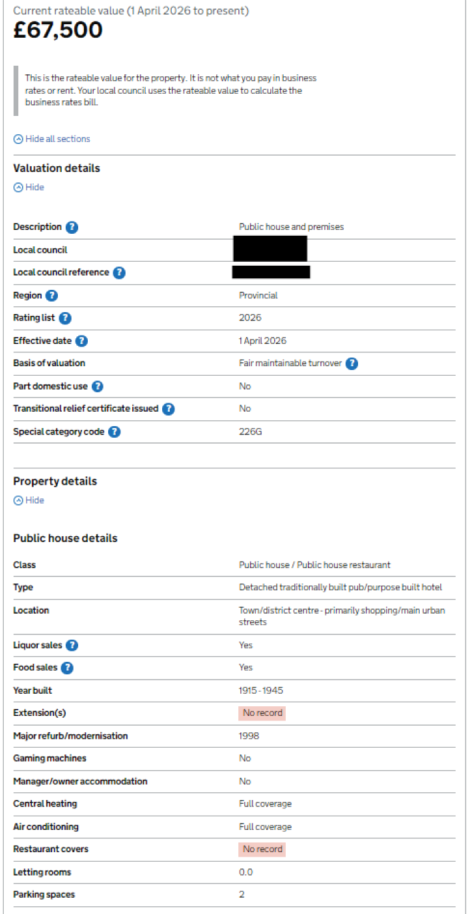
Screenshot of a property valuation summary for a public house and premises with a current rateable value of £67,500 effective from 1 April 2026. Details include location in a town/district centre, classification as a detached purpose-built hotel, presence of liquor and food sales, full coverage of central heating and air conditioning, and no parking spaces or gaming machines.
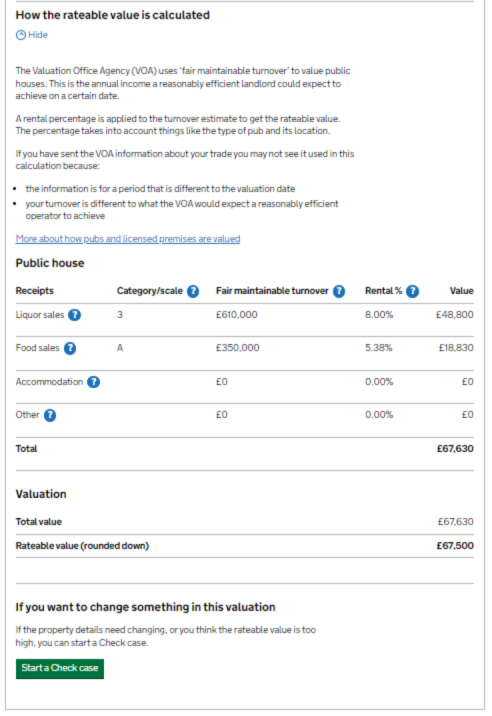
Screenshot of a valuation calculation table from the Valuation Office Agency showing public house receipts divided into categories: liquor sales, food sales, accommodation, and other. Key data includes fair maintainable turnover values, rental percentages, and resulting value amounts, with a total valuation of £67,630 and a rounded rateable value of £67,500.
10. Annex B: Hotel Valuation Examples, Schemes and Further Guidance
This annex provides further information on the valuation of hotels for business rates purposes. It includes a worked example of a R&E valuation, the 2026 hotel valuation scheme, guidance published by the Valuation Office, and information available to ratepayers seeking to understand their valuation.
10.1 Worked Example of an R&E Valuation
An anonymised example of an R&E valuation is included in this annex. The example illustrates how the Valuation Office analyses a hotel’s receipts and expenditure to derive a rental value. It shows how receipts, operating costs and the resulting divisible balance are considered, and how that balance is shared between the hypothetical landlord and tenant to arrive at a rental value. The example also demonstrates how the derived rental value can be expressed as a percentage of receipts for the purpose of developing a valuation scheme.
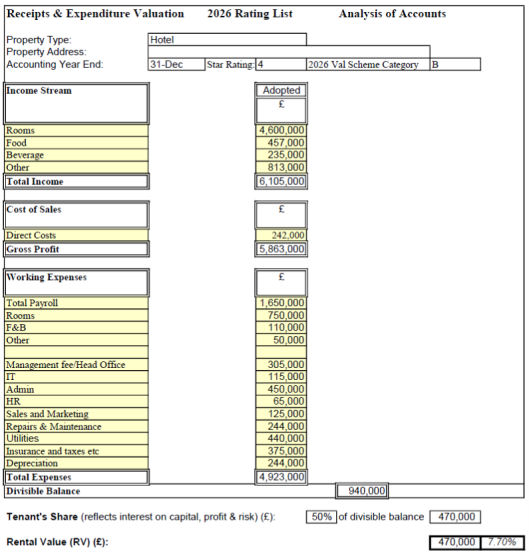
Table displaying receipts and expenditure valuation for a hotel with a 4-star rating, detailing income streams, costs, and expenses for accounting year ending 31 December 2026. Key figures include total income of £6,105,000, gross profit of £5,863,000, total expenses of £4,923,000, and a divisible balance of £940,000, with tenant's share calculated at 50%.
10.2 2026 Hotel Valuation Scheme
This annex also includes the 2026 hotel valuation scheme. The scheme sets out the categories and percentage scales used by the Valuation Office to derive RVs from a hotel’s FMT and accommodation receipts.
How hotels are valued for business rates
An overview of the hotel valuation process aimed at ratepayers and other interested parties.
How hotels are valued for business rates
Valuation Office blog: How we value hotels
An explanation of the valuation methodology and the evidence used by the Valuation Office.
Valuation Office Rating Manual: Hotels
Detailed technical guidance used by valuers when assessing hotels for business rates purposes.
10.3 Summary Valuations
Once registered with the Valuation Office, a ratepayer can request a summary valuation for their property. This sets out the calculations used by the Valuation Office in determining the property’s RV, including the FMT adopted and the valuation percentages applied. The example below is an anonymised summary valuation and is provided for illustrative purposes only. It reflects the information made available to the ratepayer.
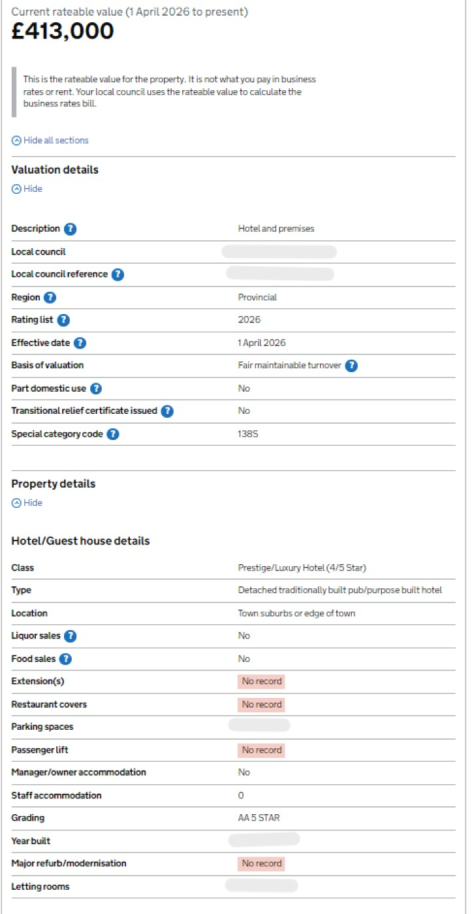
Screenshot of a property valuation report showing a current rateable value of £413,000 for a detached traditionally built hotel classified as a Prestige/Luxury 4/5 Star. Details include location in a town suburb or edge of town, no liquor or food sales, no parking or passenger lift, and a special category code of 1385, with valuation based on fair maintainable turnover effective from 1 April 2026.
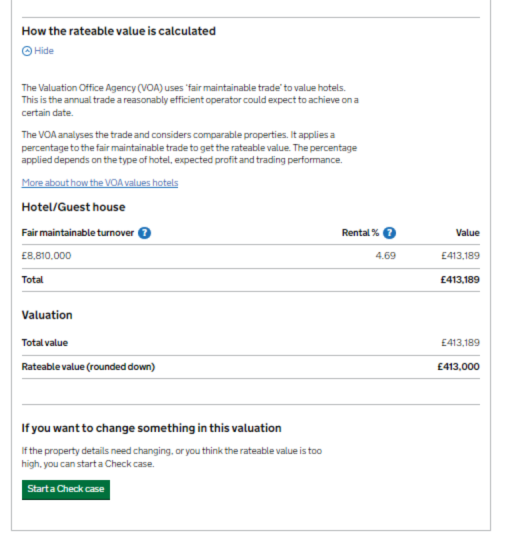
Screenshot of a valuation calculation table showing how the Valuation Office Agency determines rateable value for a hotel or guest house using fair maintainable trade. It includes figures for fair maintainable turnover (£8,810,000), rental percentage (4.69%), and calculated value (£413,189), with a total rateable value rounded down to £413,000.