Sudan
Subscriptions
Warnings and insurance
Your travel insurance could be invalidated if you travel against advice from the Foreign, Commonwealth & Development Office (FCDO).
Areas where FCDO advises against travel
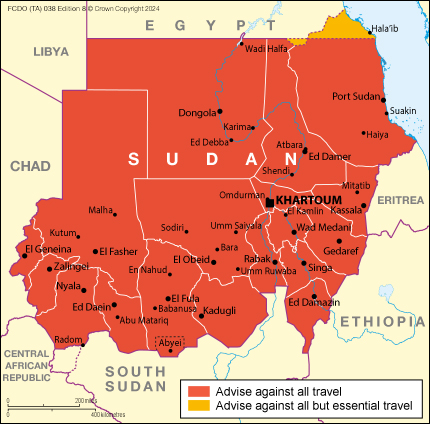
FCDO advises against all travel to Sudan because of the ongoing military conflict in Khartoum and other parts of the country. This does not include the Hala’ib Triangle and the Bir Tawil Trapezoid where FCDO advises against all but essential travel.
There have been several ceasefires, but these have been regularly broken.
Monitor travel advice and other media reports for the latest information.
Find out more about safety and security in Sudan.
Get help in Sudan
The British Embassy in Khartoum is closed due to the conflict. There are no British consular staff in Sudan. Our ability to provide consular support is severely limited and we cannot provide in-person support inside Sudan.
If you’re a British national in Sudan, you can call our 24/7 telephone helpline: +44 1908 516 666. Select option 2 for consular services for British nationals.
Leaving Sudan
The UK government is no longer evacuating people from Sudan.
FCDO cannot offer advice on the safety of travelling to any potential departure point. Consider carefully whether you want to take any of the available options.
Use your own judgement to move towards a departure point if and when you judge it is safe to do so.
The UK government’s ability to facilitate onward travel from countries in the region is limited and you’ll be expected to cover the cost of visas, accommodation, insurance and onward travel yourself.
Any travel options you pursue are taken at your own risk.
FCDO cannot help non-British dependants of British nationals.
Travel insurance
If you choose to travel against FCDO advice, research your destinations and get appropriate travel insurance. Insurance should cover your itinerary, planned activities and expenses in an emergency.
About FCDO travel advice
FCDO provides advice about risks of travel to help you make informed decisions. Find out more about FCDO travel advice.
Get travel advice updates
Sign up to get email notifications when this travel advice is updated.
Follow FCDO: