Iraq
Subscriptions
Warnings and insurance
Your travel insurance could be invalidated if you travel against advice from the Foreign, Commonwealth & Development Office (FCDO).
Areas where FCDO advises against travel
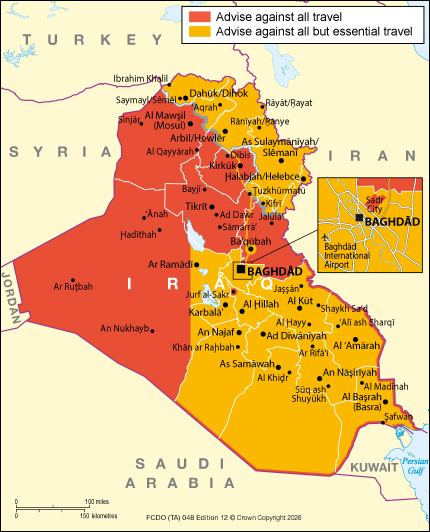
Federal Iraq
FCDO advises against all travel to:
- The parts of Anbar province which are west of, but not including Ramadi City
- Diyala province except for Baqubah City
- Kirkuk province
- Ninawa province
- Salah al-Din province
- Jurf al-Sakr town in Babil province
- Sadr City, part of Baghdad province
- Within 5km of areas that border Iran in Wasit, Maysan and Basra provinces
- Within 5km of Iraq’s borders with Saudi Arabia and Kuwait
FCDO advises against all but essential travel to:
- The remainder of Al-Muthanna province
- Al-Qadasiyah province
- The remainder of Anbar province
- Babil province (except Jurf al-Sakr town)
- Baghdad province (except Sadr City)
- The remainder of Basra province, including Highways 1 and 8 and the Safwan-Kuwait border crossing
- Dhi Qar Province
- Karbala Province
- The remainder of Maysan province
- The remainder of Najaf province
- The remainder of Wasit province
- Baqubah City in Diyala province
- The road sections of Highway 34 between Baghdad and Baqubah, and Highway 2 between Baqubah and Erbil
Kurdistan Region of Iraq
FCDO advises against all but essential travel to the Kurdistan Region of Iraq
Find out more about why FCDO advises against travel.
Consular support
Consular support is severely limited in areas where FCDO advises against travel.
Regional tensions
The context in the Middle East remains deeply unpredictable and the risk of sudden escalation is high. Since conflict began in early 2026, Iran has stated its intention to target locations associated with the US and Israel, including, but not limited to, organisations, businesses, facilities, and institutions. There have been strikes and retaliatory attacks by Iran and others across the region against civilian and US military infrastructure.
British nationals in, or planning to travel through, the Middle East should be prepared for possible flight cancellations, airspace closures, and travel disruptions. You should:
- read If you’re affected by a crisis abroad - GOV.UK. This includes guidance on “how to prepare for a crisis” with suggestions on what you might include in your emergency supplies and “what to do in a crisis”
- sign up to FCDO Travel Advice email alerts
- follow advice from the local authorities
- monitor local and international media for the latest information, including updates relating to airports and airspace which could close at short notice
- stay away from areas around security or military facilities
- keep your departure plans under review, and ensure your travel documents are up to date
- if advised to take shelter, stay indoors or find the nearest safe building or designated shelter. An interior stairwell or a room with as few external walls or windows as possible may provide additional protection. The greatest risk is from falling debris caused by intercepts, and you are safest inside a secure structure. Do not approach or touch any drone or missile fragments or unusual objects
Travel insurance
If you choose to travel despite FCDO advice, research your destinations and get appropriate travel insurance. Insurance should cover your itinerary, planned activities and expenses in an emergency.
About FCDO travel advice
FCDO provides advice about risks of travel to help you make informed decisions. Find out more about FCDO travel advice.
Get travel advice updates
Sign up to get email notifications when this travel advice is updated.
Follow FCDO: