Tailoring public health messages for diverse audiences
This resource provides practical guidance on how to build trust, foster partnerships and empower communities to enable more accessible and inclusive public health communication.
About tailored communication
Tailored communication is a user-centred approach to designing, delivering and evaluating messages which takes into consideration the needs, preferences and values of target audiences.
While the benefits of tailoring messages for diverse audiences are increasingly recognised, it can be challenging to know how to incorporate community insights into public health campaigns in practice. This resource supports practitioners by introducing key principles for effective tailored communication and providing tools that can be used to support strategic planning, response and evaluation.
Benefits of tailored communication
Effective tailoring of public health messages can enhance reach and accessibility, improve knowledge and awareness of symptoms and increase uptake of recommended protective health behaviours.
The TAPIE model for tailoring communication
The TAPIE model is an evidence-based practical framework that has been designed to support professionals with responsibility for communicating about public health emergencies to tailor messages for diverse audiences.
Development of the TAPIE model
The TAPIE model for tailoring communication is based on insights from multiple collaborative research projects, incorporating input from local public health and community organisations across England, along with diverse public audiences who are the intended beneficiaries of tailored messages. The core research underpinning the model included three waves of data collection with four communities in two cities, involving 17 public health and community organisations and more than a hundred residents in four languages. The toolkit was developed and tested in collaboration with local, regional and national UKHSA, NHS and local authority teams to ensure that it is practical and effective. For more information on the methodology, see annex A.
TAPIE model overview
The TAPIE model is built on five pillars that highlight key principles for effectively tailoring communication: Trust, Accessibility, Partnership, Inclusivity and Empowerment.
The TAPIE model can be used by anyone involved in the design, delivery or evaluation of tailored public health communications. The TAPIE toolkit applies this model to communicable disease outbreak preparation, response and recovery. However, the core principles apply across a range of public health emergency contexts.
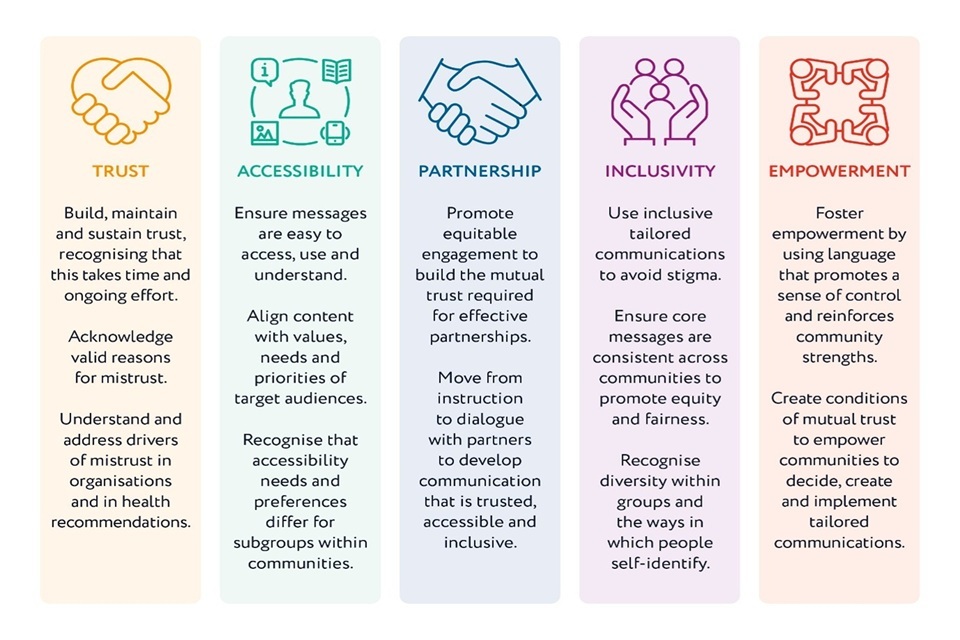
The graphic provides an overview of TAPIE model for tailoring public health communication.
Key principles for effective tailored communication
Trust
- Aim: To build, maintain and sustain trust in organisations and interventions.
- Why it matters: People are more likely to adopt recommended health behaviours when they trust the individuals and organisations providing advice and believe these actions will be beneficial without causing harm.
Accessibility
- Aim: To provide messages that are easy to access, use and are relevant.
- Why it matters: People can only act on advice that they have seen, understood and recognised as personally relevant.
Partnership
- Aim: To establish trusted and equitable relationships with key partners at local, regional and national levels.
- Why it matters: Effective partnerships foster mutual trust, cohesive and timely communication, and increase message accessibility and inclusivity.
Inclusivity
- Aim: To promote fairness and equality of access to public health messages.
- Why it matters: Inclusive tailored communication helps build and maintain trust and reduces the risk of unintended stigmatisation.
Empowerment
- Aim: To reduce power disparities and support effective community engagement.
- Why it matters: Fostering empowerment builds confidence, mutual trust and supports individuals to make informed decisions.
The TAPIE toolkit
The TAPIE toolkit consists of four short, practical guides to support the tailoring of public health messages for diverse communities before, during and after communicable disease outbreaks. It has been designed for flexible use by multiagency teams as a resource to support strategic planning and guide actions. It can also be used by individuals for self-directed development. It aligns with guidance in the Communicable Disease Outbreak Management Guidance and the Community Engagement Approach to Health Protection.
The toolkit applies the TAPIE model across the preparation, response and recovery phases of communicable disease outbreaks. Key actions are identified at each stage, with practical examples for implementation. Actions are broken down into the steps required to meet each principle, but in practice a single activity may be used to address multiple principles. For example, a single mapping exercise can be used for Step 1 of Trust, Step 1 of Accessibility and Step 2 of Inclusivity during outbreak preparation.
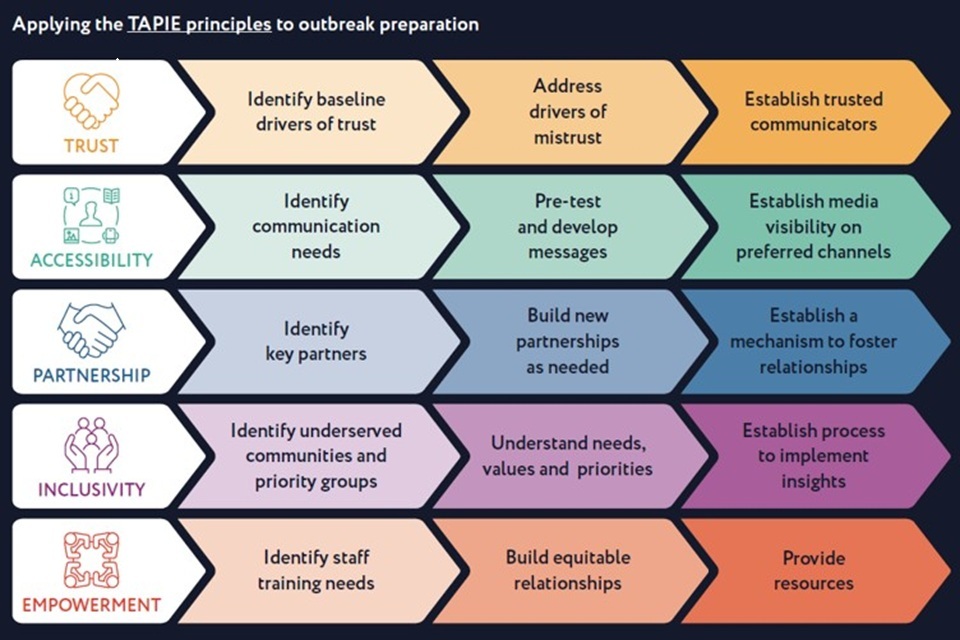
This graphic provides an overview of key actions for each pillar at the prepare stage.
Toolkit overview
Guide 1: Key principles for effective tailored communication
This guide introduces the TAPIE model and provides key tailoring principles that can be applied to all phases of communication development, implementation and evaluation.
Guide 2: How to tailor communications to prepare for outbreaks
This guide demonstrates how TAPIE principles can be applied prior to outbreaks to establish trusted, empowered partnerships and develop communications that are inclusive and accessible.
Guide 3: How to tailor communications during an outbreak
This guide demonstrates how TAPIE principles can be applied during an outbreak to build and maintain trust, and to implement inclusive and accessible communications in partnership with other agencies and community organisations.
Guide 4: How to tailor communications after an outbreak
This guide demonstrates how TAPIE principles can be applied after an outbreak to support evaluation, sustain partnerships, and capture learning to enhance preparedness for future outbreaks.
Annex A: Methodology
The core research underpinning the TAPIE model was conducted by King’s College London and Birmingham City University in partnership with UKHSA. This research was funded by the Economic and Social Research Council (ESRC) as part of the UK Research and Innovation’s rapid response to COVID-19 to understand drivers of COVID-19 vaccine uptake among minority ethnicity groups and the impact of tailored communications. This included:
-
Three waves of focus groups and interviews with four communities in two cities
-
17 public health and community organisations
-
More than a hundred residents across four languages.
The TAPIE model was then tested and developed into a toolkit for tailoring communication before, during and after communicable disease outbreaks. Toolkit development was funded by the NIHR Health Protection Research Unit (NIHR HPRU) in Emergency Preparedness and Response, a partnership between the UKHSA, King’s College London and the University of East Anglia. This research included a survey (N=141), focus groups (N=46) and workshops (N=54) with national, regional and local public health authorities to test and establish:
-
The applicability of the TAPIE model for ongoing and future communicable disease outbreaks (including those that differ significantly from COVID-19 in scale, transmission dynamics, affected populations and overall public health impact)
-
The applicability of the TAPIE model across a broader range of disproportionately affected groups with varying functional needs.
-
How to translate the TAPIE model into a format to best support public health teams to tailor communications for diverse populations for communicable disease outbreaks.
Acknowledgements
Atiya Kamal, Birmingham City University
Julia Pearce, King’s College London
UKHSA Health Equity and Inclusion Health