4. Joining up services and addressing gaps in support
This chapter describes ways in which Changing Futures teams influenced services to work in more joined-up ways.
The Changing Futures programme sought to address gaps in support, to enable better access to services, and to provide higher-quality support for people experiencing multiple disadvantage. Greater collaboration and integration between local services can:
1. Make it easier for people experiencing multiple disadvantage to access the support they need, by simplifying entry points into support, reducing the number of transitions between services, and making any necessary transitions more straightforward.
2. Enable services to work together more effectively, to provide multi-agency support that better meets their needs and preferences. This includes being able to share and access information to understand people’s needs, circumstances and goals. It also includes jointly planning and delivering support that is more holistic, person-centred and trauma-informed.
3. Increase the extent to which people experiencing multiple disadvantage are engaged by services and have positive experiences of support. This makes it more likely that they will be supported to move away from crisis and towards meaningful goals that they want to achieve.
4. Make the most of limited resources across services by improving efficiency, minimising duplication, and reducing the repeat demand and service delivery costs caused by ineffective support.
Most Changing Futures areas introduced or expanded their provision of specialist caseworker roles to work directly with people experiencing multiple disadvantage, and to help coordinate support around them. This chapter does not cover these roles, which are explored in detail in a separate report (PDF, 435KB). Instead, it describes ways in which Changing Futures teams influenced services to work in more joined-up ways.
How could local services be more joined-up?
- When and where do people experiencing multiple disadvantage ‘fall through the gaps’? Needs assessments and insights from people with lived experience can help develop this understanding.
- Which services are less engaged in joint working? Understanding the reasons why some services are less involved can help with planning practical ways to promote greater collaboration.
- Are there opportunities for more fundamental changes to promote more joined-up services, such as changes in service design, commissioning or delivery models? Opportunities could arise when services are re-commissioned, or from strategic leads and commissioners with an understanding and interest in multiple disadvantage.
- How could you support professionals to collaborate more effectively within existing service structures and pathways? Sometimes more fundamental changes are not possible, but finding effective ways to promote collaboration is important.
What is available to build on?
- Are there partnerships and forums that you can tap into? For example, several Changing Futures areas supported and developed the work of multi-agency meetings.
- Can you capitalise on common goals across services? Changing Futures teams highlighted how a more joined-up approach helped services to achieve their objectives, and reduced inefficiencies in the system.
Who needs to be involved?
- Which frontline staff are most likely to work with people experiencing multiple disadvantage? These are the staff members best placed to join multi-agency meetings to plan support around individuals, or to help identify barriers and blockages at the frontline level.
- Which service managers and operational leads can help to develop better cross-service pathways and partnerships? It is important to involve more senior operational stakeholders with the capacity and authority to develop new pathways and partnerships, and who will agree to changes to delivery within their own services.
- Which commissioners and strategic leads can build service integration into planning and commissioning, and help create the conditions for greater flexibility and collaboration? Involving strategic stakeholders is necessary to create services that are joined-up from the outset. They are also needed to ensure that changes at the operational level are supported.
Barriers to more joined-up services were recognised nationally and locally, as a key systems challenge that the Changing Futures programme was designed to address. Such barriers are a problem not only in relation to multiple disadvantage. However, because people experiencing multiple disadvantage require input from multiple services, the impact of fragmented and uncoordinated services is especially acute for them.
Siloed commissioning and service delivery
Services often worked in siloes, focused on a single issue, such as mental health or substance use. This largely reflected the funding streams, structures and processes which underpin local service design and commissioning. Perceived competition for funding and contracts, service-level targets and key performance indicators (KPIs), high service demand, and limited resources often act as disincentives to working in a more collaborative and flexible way with other services.
Limited awareness of multiple disadvantage
Within some services, there was limited awareness of multiple disadvantage, including people’s needs and the approaches that might most effectively engage and support people. This meant that professionals did not always understand the need or rationale for more joined-up services, which can facilitate more person-centred, relational, flexible and trauma-informed support.
Challenges with information sharing
A lack of shared case management systems and hesitancy in sharing data between organisations made it more challenging to share useful information, which would help to understand people’s needs, circumstances, goals and risks.
A complicated system of services that is difficult to navigate
As a result of siloed services, people experiencing multiple disadvantage were faced with a complicated system which could be difficult to navigate. People experiencing multiple disadvantage often have negative experiences of trying to access services, such as needing to retell their story multiple times to different services. This built mistrust, added to trauma, and could result in people not receiving the support they need.
I think everybody was probably trying to find the solutions on their own, and it wasn’t joined up as much as it could be. Then obviously the impact of that is that the people who needed that support would have to go to all the different services and try and navigate the system…
Changing Futures areas took a variety of approaches to improve the extent to which services are joined up. Several strategies involved finding ways to help professionals deliver more joined-up support within existing local service structures and pathways. Some also altered pathways or the service configuration to bring about greater integration of services.
Below we highlight what can be learned from successful efforts to join up support, with more detailed examples from two Changing Futures areas, Hull and Greater Manchester. For more on local areas’ experiences of joining up support, please see the Evaluation of the Changing Futures programme: Third Interim report (PDF, 1603KB).
Using multi-agency operational meetings
Multi-agency meetings have been a key method of bringing together professionals from a variety of services, to jointly plan and deliver support for people experiencing multiple disadvantage on a case-by-case basis. These meetings enable the coordination of support around people’s needs and preferences, and assist with wider learning about systemic barriers (see Spotlight on: Greater Manchester – working towards individuals’ goals below).
Multi-agency operational meetings have provided the opportunity for services to share information and plan care, such as by identifying how to prioritise support, and who would be best placed to provide what is required:
It’s like a jigsaw. Everyone brings their piece of the jigsaw and they put it all together and then they work out, I’ll stick with my piece or I might take over your piece because I’ve got a better relationship with this person, and it varies from client to client. There’s no one prescriptive thing, but having that meeting space enables them to do that.
Spotlight on: Greater Manchester – services working together to be more flexible
In Oldham, the team shifted the focus of local multi-agency meetings from discussions around allocating support to individuals, towards understanding what each individual’s goals are, and how services can work together differently to help them achieve these.
The recovery service is like, ‘Oh, they’ve just not turned up.’ And we might go, ‘Oh, actually, because this has happened, they need to have a home visit, would you agree to do that in this particular case?’ ‘Yes, okay we’ll do that.’ So, it’s pulling that agreement of what goals we need to work on; how can services be adaptable and flexible to meet those particular goals?
Helping professionals to better understand local services and roles
Changing Futures areas sought to ensure that staff in different local services had a good working knowledge of the local service landscape. This included knowing what services exist locally and their referral routes, and understanding the roles, remit and priorities of different services.
Some areas produced resources to help staff in frontline and operational roles to understand and navigate the local services. For example, one area mapped out referral processes for relevant local services. Other strategies used by Changing Futures areas include communities of practice, joint learning and reflection activities (see the chapter on creating a learning culture), and multi-agency training (see the chapter on supporting trauma-informed working). Multi-agency meetings have also provided a forum for staff in different services to exchange information about their remit, service offers and ways of working, to deepen mutual understanding.
Spotlight on: Greater Manchester – building collaboration into induction
Making collaboration a part of new staff’s induction can help to support learning. In Wigan, frontline Changing Futures workers were encouraged to shadow staff in other services, particularly during their induction. This can help workers develop a deeper understanding of what other roles involve, the barriers and facilitators to their work, and when and how they might be able to flex their ways of working. It can also support new staff to develop relationships with staff in other services, and increase awareness of who to call on for specific types of support.
Stakeholders reflected on the importance of taking a positive approach to collaboration. Some Changing Futures staff received training to support their understanding of the remit of adult social care, and how to best work with them.
If you’re just going in saying, ‘You’ve not done this, you’ve not done that,’ and the social worker is well within their rights to say, ‘That’s not my job to do.’ We need to be more specific [in our requests] and understanding [of] what their role is. What are they legally bound to do? What do they have capacity to do? But also, when we’re asking for additional support or additional help, what are we actually asking for? Because otherwise you’re not going to get it.
Promoting the benefits of collaborative working
In order to encourage more joined-up support, Changing Futures programme teams promoted the benefits of better collaboration and integration for services and professionals.
One way of doing this was to identify and emphasise the ways in which different services’ goals and interests are aligned, such as in aiming to reduce reoffending or prevent repeat contact with emergency services. You can read about this in the chapter on securing strategic alignment.
Spotlight on: Greater Manchester – creating buy-in to joint working
In Oldham, the Changing Futures team re-engaged the police in multi-disciplinary team meetings by highlighting the benefits they would gain from attending meetings to access collective expertise and problem solving, in cases where there was a clear link between people’s experience of multiple disadvantage and their offending. The Changing Futures team worked with specialist officers to identify the factors that drive repeat offending.
[The] police stopped attending, and then we started picking up some of the police cases a little bit more, and talking about those kind of cases that they needed some guidance on and that kind of stuff; and now they attend every Thursday. Just because it’s helping them as well. So, it’s that mutual benefit for services I’ve noticed support[s] engagement.
Jointly identifying and addressing barriers to coordination and access
In several areas, multi-agency operational meetings have been used as a forum for discussing and addressing barriers and challenges commonly experienced by professionals and the people they support, as they navigate the system.
All the partners are there, they talk about things. They talk about individual clients, but they also talk about some of the structural problems. So actually, they might say, ‘We didn’t know we had to fill out that form, or your forms are too complicated or your processes are too complicated. I can’t even understand them, never mind service users.’
As an example, multi-agency meetings in one area identified risk-management responses to people with a history of arson as a barrier to them accessing accommodation. This precipitated further collaborative work, and the development of a good practice guide to help professionals overcome this barrier.
Outside regular multi-agency meetings, areas used multi-agency learning and reflection activities to gain a shared understanding of common barriers to effective support. This is discussed further in the chapter on Creating a learning culture.
Journey mapping was used by some areas to identify system blockers, and to better understand people’s experiences with services. This involved gathering a variety of stakeholders from across the local system and pooling their intelligence, to learn when and how a person accessed services. Teams were then able to identify ways in which support could be improved. For example, one Changing Futures area undertook journey mapping with 40 stakeholders whose work related to homelessness in some way. Working in groups, they reconstructed different service users’ journeys. Much of the value was in the learning generated for those doing the mapping:
We found that the process of coming together as a group of professionals, and doing that mapping and adding in from different perspectives, surfaced a huge amount of learning about the way the system is currently working… I’ve had people say to me ‘I’ve been in the system a million years, I’ve never seen anything like it’… So, the mapping almost served as a reflective tool to facilitate these really profound, un-shaming conversations about the way the system currently works.
The mapping exercise resulted in insights that raised questions about established practices. In one case, the group was able to see that moving a service user had not made her safe, despite the fact that “everyone was acting on the assumption” that it would do so. This shifted attention to addressing the problem differently – in this case, by focusing professionals’ attention on the perpetrator of domestic abuse.
Journey mapping can also be helpful as a tool for engaging new stakeholders:
…it’s been a really helpful tool to open up discussions with stakeholders that maybe aren’t part of our immediate group. So, we don’t work with hospital teams because we’re in the communities, but that’s been a really helpful way to think about, ‘Oh okay, so if this person comes to hospital, perhaps if we maybe think about who might be working with him in the community and pick up the phone and see if we can work together.’
Improving information sharing
Several Changing Futures areas focused their efforts on joining up different information sources using shared case management systems or shared assessment tools.
One area invested in an additional referral module for a shared case management system that enabled more seamless referrals into the Changing Futures programme. They also coordinated ongoing multi-agency case recording for Changing Futures participants. The system was supported by a multi-agency information sharing protocol, led by the county council; services could opt into this to facilitate safe and consistent data sharing. The protocol enabled better multi-agency participant tracking, including recording of support plans, goals, engagement activity, and contact history. This strengthened joint accountability, risk management, and the support provided to people.
In several areas, Changing Futures teams were based in key local authority services, and used the case management system for that service. For example, some areas had Changing Futures teams based in adult social care, and used their case management system to both access information about Changing Futures participants and record their own case notes. This supported better information flow between the Changing Futures team and adult social care.
Some Changing Futures areas have sought ways to avoid the need for people to re-tell their story multiple times, and the re-traumatisation which can be linked to this. For example, one area supported the development and piloting of a co-produced tool which people can complete to share information about themselves. There are short and long versions of the tool to suit different situations. Examples of key questions are:
- What happened to you?
- How did it affect you?
- What support do you need now?
- What would you like people to know before they meet you?
In another area where a shared case management system has been introduced for Changing Futures participants, programme team members explored opportunities to transfer key information from the system (such as ‘About Me’ information) to care records used widely by local NHS service providers. This required relationship building and influence from the senior responsible officer for Changing Futures locally, as well as resources and time for coding the data to fit NHS categories in the care record.
Integrating services through embedded roles and co-location
Embedding multiple disadvantage workers within local services, and the co-location of services, have enabled more collaborative working, efficient information sharing, and better decision making in some Changing Futures areas. This way of working has facilitated smooth referrals between services and provided a better level of support for people, rather than requiring them to approach each service separately. Where multiple services are co-located in a hub (see the Hull case study), people who drop in to use one service can often also access support from other services available on the day, thereby meeting more of their needs at once.
In one area, services that supported people experiencing multiple disadvantage had struggled to engage with the probation service; so a Changing Futures-funded practitioner was embedded in the service. The practitioner was co-located with the probation team and had access to their case management system. Rather than having a caseload themselves, they provided advice and guidance to the probation team, and facilitated referrals into the Changing Futures caseworker service. They also attended local multi-disciplinary team meetings and worked to improve coordination across services. Furthermore, the Changing Futures team worked closely with the police, which enabled them to refer people found begging, rough sleeping or shoplifting to support from Changing Futures. Staff accompanied officers on patrol to meet people the police had concerns about. These activities helped to provide additional capacity to overstretched services, facilitated the development of new working relationships, and helped people to access support.
Spotlight on: Greater Manchester – co-location and front door teams
In Oldham, Changing Futures teams have been co-located in adult social care; they have a ‘Front Door’ team to triage support according to need. This has helped to prevent people experiencing multiple disadvantage from being referred to multiple different services and ‘falling through the gaps’. Link workers based in the Front Door team use their contacts in services, and their ability to advocate, to ensure that people are referred to the right service quickly and effectively. Although link workers have backgrounds in a variety of sectors, being based within a statutory service such as adult social care has enabled them to escalate cases to senior staff quickly if needed.
In Wigan, Changing Futures staff based in adult social care were also able to carry out capacity assessments. This provided additional staff resources to conduct capacity assessments, which helped to ensure these were completed as soon as possible.
Embedded roles and co-location can be beneficial for staff, too. Workers have been able to gain a better understanding of other roles and build closer working relationships, thus enabling staff to act quickly to more effectively address programme participants’ needs. Opportunities to work closely together, including more informal open discussions while working within the same offices, have helped to build trust between services and create a shift towards a shared culture – for instance, taking a more trauma-informed and person-centred approach. Such culture shifts can help to sustain change.
What [co-located workers are] actually doing is they’re constantly being asked questions by other roles that we don’t fund in these organisations … that’s upskilling the workforce, if you like, in those locations. It’s also making those relationships better.
Commissioning approaches to joining up services
Changing Futures areas have sought to influence commissioning cultures and approaches, to enable more joined-up services. An important element of this work has been promoting buy-in from strategic stakeholders and commissioners to improve services and systems for people experiencing multiple disadvantage. This is discussed in the strategic alignment chapter.
It was more challenging to identify learning from Changing Futures areas about how to shift commissioning approaches so that they produce more joined-up support.
One Changing Futures area benefited from a pre-existing partnership approach to commissioning. The Alliance is a partnership between seven core providers, which were awarded a single contract by the council to provide services to people experiencing multiple disadvantage (such as housing advice, temporary accommodation, and treatment for substance use), as well as working arrangements with other local organisations. The Alliance works together to plan and implement support for people experiencing multiple disadvantage, and they share overall financial responsibility, risk, and day-to-day management. A ‘no wrong front door’ approach is used to engage the right services for a person, no matter where they engage first.
Other areas began to explore commissioning or provider alliances. One area has pursued a different approach of an alliance agreement between all organisations on the Changing Futures Board. This is based on the recommendations from the local needs assessment for multiple disadvantage, and asks those in the Alliance to agree to work differently to better meet the needs of people experiencing multiple disadvantage. 8 The intention is that signing up to this in principle will help to keep organisations accountable for providing better and more joined-up support to people experiencing multiple disadvantage.
Another way in which Changing Futures areas have sought to join up services is via the commissioning of new services to address gaps in the local system, such as gaps in support for groups of people who were particularly underserved by existing services. This is discussed in the chapter on Ensuring equity for underserved groups.
Strategic support is needed for lasting change
Stakeholders reflected that in order for staff from different services to work together most effectively, there needs to be sufficient strategic alignment to create an environment that enables operational and frontline staff to work differently. Further information on promoting buy-in and alignment with strategic stakeholders can be found in the Securing strategic alignment chapter.
An understanding of where the gaps are is needed to target joining up
Several areas developed local needs assessments to gain a better understanding of the ways in which services could respond more effectively to people experiencing multiple disadvantage, and to identify key gaps in support. Further information can be found in the chapter on Improving data and insight.
Informal relationship building between services can also be effective
More informal relationship building between different services was effective in enabling better collaboration and joined-up approaches to problem solving. Strategies suggested in this chapter, such as embedded workers and co-location, have helped to build relationships between service staff, but may not always be practically possible. Other methods can provide time and space for professionals to get to know each other’s activities, such as staff shadowing each other or regular virtual get-togethers. For more information, see Creating a learning culture.
I know nothing’s going to replace the occasional informal conversation across a table that ends up in a really positive outcome, but building those systems in place to do things virtually, like the virtual huddles and things like that … you can still get a lot of the benefits of that without having to face the challenges of practically having everyone in the same room.
Caseworker services play a key role in getting people the support they need
Although the aim of systems change is to help services to work together more closely to ensure that people’s needs are met, stakeholders often reflected that the caseworker services developed by the majority of Changing Futures areas have been key to getting people the support they needed. As well as providing people with practical and emotional support, caseworkers have connected participants with a variety of services, advocated for them, and supported their attendance at appointments using a trauma-informed, relational, person-centred approach. Caseworkers have also supported joint working by taking a role in multi-disciplinary meetings. For further information on the caseworkers’ role, see The role of Changing Futures caseworkers: A deep dive (PDF, 435KB).
Case study: Hull – A ‘hub’ approach to joining up support
The Changing Futures Hub has enabled Hull to move beyond helping people tackle a crisis or find accommodation, to supporting people’s continued recovery and progress towards a full life. Hull’s experience demonstrates how the co-location of staff from different services can not only join up support for service users, but also enable staff to better coordinate and identify gaps in support. Hull’s experience is also notable because the Hub developed through collaboration not only among services, but also through working with service users to develop a shared trauma-informed space.
Partnership working on multiple disadvantage had begun before the Changing Futures programme. The area was a Making Every Adult Matter (MEAM) Approach area, and services had started to work together more in response to the COVID-19 pandemic. The Hull Community Safety Team, MEAM, and the rough sleeper team collaborated to establish a hub in a council-owned building in Hull city centre. People could walk in to talk to the team and receive support.
The Hub successfully engaged people experiencing homelessness, but as more people accessed the service and discussed their circumstances, it became clear that people’s needs were more wide-ranging than the original partners had anticipated. The Hub team had limited capacity to address these needs effectively. Using Changing Futures funding, the team was expanded further, and a variety of professionals from drug and alcohol services, adult social care, probation, mental health, and the Department for Work and Pensions were seconded to work together at the Hub.
Taking part in multi-agency outreach, staff from a range of services go out with the rough sleeper outreach team to meet people where they are, and engage people who cannot or are not ready to come to the services and might otherwise not be reached. As the team build rapport and trust, they encourage people to visit the hub to access other services and support when they are ready.
As the team grew, it became difficult to accommodate the various workers and service users. Using funding from the Single Homelessness Accommodation Programme (SHAP) and the local authority, the Hub moved to a new location and larger venue. The new Hub is located about five minutes from Hull city centre, and has been designed to provide a calmer environment with more space for private discussion. As a result, there are fewer incidents, and the team can engage in more meaningful interactions with people. The new Hub also includes a small outside space, shower facilities, a clinic room, space for group meetings, and flats where people can be housed under a Housing First-style initiative. 9 A key benefit of the new hub has been the addition of a health clinic and mental health support, which means that when people come in to use a service, they have also been able to address health concerns that might otherwise have led to an A&E visit.
An important aspect of the new Hub’s set-up is that it has been co-produced with input from people with lived experience of multiple disadvantage. Those involved in the development of the hub visited other services to gain ideas and learn about what has worked elsewhere. This helped to highlight the importance of creating a welcoming and safe environment based on principles of psychologically informed environments. 10 This included giving thought to how information was communicated on signs and noticeboards, and how stimulating the environment was, as well as having staff on view and accessible.
The co-location of staff and weekly operational meetings, to which wider partners not based at the hub (such as voluntary and community groups, women’s groups) are also invited, helped to build stronger working relationships and cross-organisational understanding of how to support people experiencing multiple disadvantage.
A shared case management system was used to document interactions and share information on people receiving support from Changing Futures. This helped to enhance communication and risk management, and supported the team to develop, document and share single support plans, which the various services have fed into and work together to deliver.
The joint case management system has really pulled that together, because the utopia is when you get one support plan around a person, and it’s not the drug services support plan, the social care support plan, the housing worker support plan, but we’ve got one support plan.
By working more closely with other services, the Changing Futures team are able to better identify and address gaps in support. For example, they used Rough Sleeper Initiative funding to employ a worker to help people move on from living in hostels.
As the hub now provides room for meetings, the Changing Futures team are identifying meaningful and enjoyable activities that people can get involved in.
Now we’re [focusing] on meaningful use of time and what will keep people out of the city centre, off the streets, in their accommodation, without being bored and going back and relapsing again.
This chapter shows how Changing Futures teams laid the groundwork for joining up services, by helping professionals better understand the local service system and encouraging their collaboration.
One approach is to start from the perspective of the service user. By understanding how the system looked to people experiencing multiple disadvantage, and how people were moving through services, areas could identify opportunities to improve outcomes. Several Changing Futures areas did this by constructing service user journey maps.
Service user journey maps reconstruct service users’ interactions either with a single service or across multiple services over time. When maps are built for multi-service journeys, they can help stakeholders better understand how services are engaging with users, what systemic issues are impacting users’ experiences of support, and the opportunities for services to better coordinate support.
Below is an example of a composite service user journey map produced by the Fulfilling Lives South East Partnership. You can read more about their work in the report Ripple effect: The systems change impacts of Fulfilling Lives South East Project (PDF, 9.3MB).
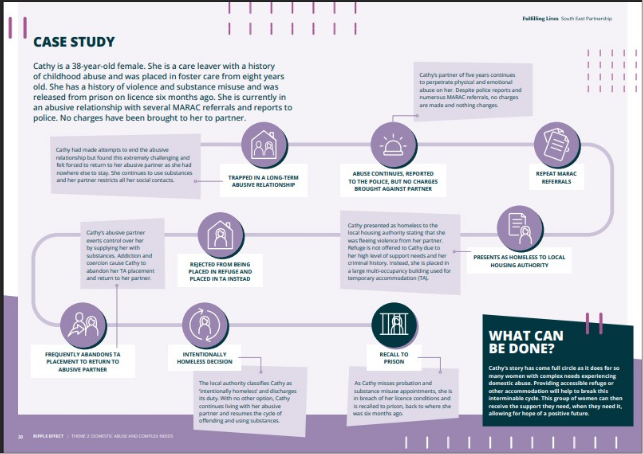
Service user journey maps can be constructed collaboratively with service users or employing service user data. In the case of Changing Futures, areas used both case histories and other data on individual service use as their starting points. An advantage of workshop-based approaches is that by enabling professionals to construct journey maps together, different services can contribute to analysing the problem.
Producing journey maps collaboratively can be the beginning of making changes in the system:
“The process that the professionals have gone on in creating that map is what is critical, and is often what has shifted things.”
For more on service user journey mapping, please see the Resources and further reading section, and the chapter Improving data and insight.
Golden Key Bristol (2022), Five System Challenges. This tool, developed as part of the Fulfilling Lives programme, provides reflections on five key system issues (lack of appropriate options, assessment and referral processes, transitions, shared accountability, culture and mindset) and tips for approaching them.
Health Improvement Scotland (2025), Journey map package. This suite of tools supports journey mapping. It includes videos explaining the difference between journey mapping and system mapping, and provides templates to support your mapping activity. It focuses on mapping a journey through a single service, but aspects could be adapted to continue service users’ journeys through the system of services.
The evaluation of Stoke-on-Trent’s Multi-agency Resolution Group (MaRG) (PDF, 556KB) discusses the potential for multi-agency meetings or case conferences to identify opportunities to improve interagency coordination and address ‘sticking points’ in the system. The article Team Around Me: a case coordination model for clients experiencing multiple disadvantage describes an approach to multi-agency case conferencing, developed as part of the National Lottery Community Fund’s Fulfilling Lives programme.
(8) Changing Futures Hull (2024). Break the Cycle report. ↩
(9) Housing First is an evidence-based approach to housing people with complex needs. See further information ↩
(10) Psychologically informed environments are designed to consider the emotions, trauma and past experiences of people entering that environment. See further information. ↩