6. Creating a learning culture
The Changing Futures programme set out to create lasting changes to local service systems, to ensure effective support for people experiencing multiple disadvantage.
The Changing Futures programme set out to create lasting changes to local service systems, to ensure effective support for people experiencing multiple disadvantage. A strong learning culture plays an important role in achieving this, by:
1. Fostering a sense of curiosity among stakeholders about how and why the system works as it does. Understanding the system is an important precursor to identifying areas for change.
2. Ensuring staff have opportunities to reflect on and improve their practice. As well as helping staff to deliver effective support to people, reflective practice can also benefit staff’s wellbeing and job satisfaction. See the chapter on Supporting trauma-informed working.
3. Capturing detailed learning on what has worked well and less well. This is essential to allow services to improve and adapt to changing circumstances and newly identified needs. Sharing this learning widely helps other services and areas to avoid the same mistakes and to implement effective practice.
4. Providing conditions conducive to partnership working and collaboration.
What changes could you make to promote a learning culture?
- Do organisations value and seek to capture knowledge developed by practitioners and service users? To what extent does learning from the frontline reach managers, commissioners and other decision-makers? How well does learning and expertise flow between services, organisations and commissioning teams?
- What barriers and enablers to learning and adapting their practice do staff face? Do you understand the organisational constraints (for example, workforce time) on learning and innovation that services are experiencing? How might you get more insight into these?
- What are the ways to make learning easy to engage in? Provide a range of channels for people to access learning. Focus on providing practical insights and tools that help people with their role.
- How could a learning culture become part of business as usual? Are time and resources for learning activities (training, reflective practice, etc.) built into funding and commissioning specifications? How are staff and contracts managed – are people encouraged to try news things and share failures?
What is available to build on?
What networks and forums are there in your local area? Could multiple disadvantage be introduced into their agenda? Could the membership be broadened to allow cross-sector learning and innovation?
Who needs to be involved?
- Where is there already energy to work on a particular issue? Connecting learning to agreed priorities, or to projects that people are already working on, can help to increase engagement with learning activities and grow the learning culture.
- Put people with lived experience at the centre. Exploring how services are experienced from the clients’ perspective can produce valuable learning. Involve people with lived experience in the design and delivery of learning activities, to maximise their impact.
- Who else has relevant expertise or practice learning to feed into your priority topics? Are there academics or local university teams whose work is relevant to multiple disadvantage, or to your priority system changes?
Lack of capacity
Working conditions for frontline staff in some services could be intense: strong demand and high levels of absence or staff turnover led to stretched capacity and large caseloads. This limited opportunities for staff learning and development during the working day. Stakeholders observed that commissioned service specifications rarely allowed for dedicated time to gather and share learning, or indeed to implement any changes as a result. Some stakeholders said that while there was a growing use of reflective practice, this existed only in pockets.
Everybody is so busy, capacity is relatively low in the system at the moment, and there’s almost no time to put your head up and have a look and think, ‘Right, how can we do this better and differently?’ Because you know, the minute you put your head up, you’ve got your next client coming towards you.
Risk aversion and rigid contracting
There was also a lack of willingness to try new approaches, due in part to risk aversion. Services staff lacked the necessary freedom and flexibility to make changes in response to learning from experience. Traditional approaches to project monitoring and contract management helped create a culture that did not support trialling new approaches, which might be unsuccessful but would generate learning. On the frontline, when things went wrong, such as aggressive incidents with service users, these were not recognised as opportunities for learning.
Barriers to learning flowing upwards and across the system
Where innovation and learning was happening, Changing Futures stakeholders said it was often in silos and not shared. This included learning and knowledge not being used to inform commissioning; there were instances where staff in one part of the system were planning to develop services without using knowledge from similar services elsewhere in the system.
Lines of communication with strategic players were often lacking. There were limited opportunities for people with lived experience and frontline staff to share their views and experiences with decision-makers. Furthermore, there was a lack of sufficient resources and infrastructure to support the flow of learning and collaboration.
Limited involvement of people with lived experience
The involvement of people with lived experience was less developed at the start of the programme. Issues highlighted by stakeholders included a lack of knowledge among services about lived experience groups, over-reliance on one group, or members of lived experience groups not being representative of the wider population of people experiencing multiple disadvantage. Current service users were less likely to be involved.
Where involvement did occur, it was sometimes judged to be tokenistic, just a ‘tick-box’ exercise. This was attributed to the persistence of historical power relations and top-down cultures:
There are power relationships … you should be able to dance a new dance and the people that are trying to do that and have been spending a lot of time doing that, are usurped by old power values that still exist.
Developing and protecting opportunities for learning
Changing Futures either created or built on processes and spaces that helped workers come together and share learning, both within and across organisations.
At an organisational level, some Changing Futures teams designed or redesigned processes such as staff supervisions and team meetings. For example, one project set up group sessions to review casework and capture frontline learning; it also looked at how to make the resulting insights available to stakeholders. It enabled staff to learn from and improve their professional practice by creating opportunities for reflection, and providing support and resources for personal development:
Staff get together and, again ¼ it’s not case management, it’s so they talk about their feelings, their emotions, their challenges around this work. Within that context as well, we have one-to-ones on a regular basis with staff and in terms of their development or training needs or anything they want to do, if we’ve got the budget to do it and it’s relevant, they can do it.
As a result, caseworkers began to have a different ‘cultural mindset’, to think more about work in terms of what they were learning.
Some Changing Futures partnerships set up or developed communities of practice, to enable practitioners from different organisations to collectively discuss aspects of working with people experiencing multiple disadvantage. Cross-organisational training programmes were also used to bring people together to pool learning, so that, as one stakeholder explained, local professionals would:
… get multiple perspectives on the same issue, which I think is much better than the separate organisations trying to do that training separately.
Training and learning activities included ones that focused on a particular issue, such as neurodiversity; on ways of working, such as involving people with lived experience; or on a particular sector, such as health.
Connecting training to projects and priorities
Changing Futures teams’ experiences with training suggest that it best supported change and adaptation when it connected to priority projects on which people were working. In some areas, those developing training consulted with partner organisations to understand areas of concern or interest, and learning support ran alongside partners’ efforts to make service improvements.
Centring the service user perspective
Activities to support learning and improvement in Changing Futures areas often focused on enabling organisations to examine their services from the user’s point of view. This included raising staff awareness of service users’ experiences, undertaking user experience research, and working directly with people with lived experience to review services.
In some areas, people with lived experience were involved in shaping and delivering training offers. This is discussed further in the chapter on trauma-informed working.
Some areas produced learning materials and resources that encouraged greater understanding of the lived experience perspective. For example, one area produced a video recreating the experience of prison release, to illustrate the challenges of travel and appointments (with probation, to secure benefits, housing etc.) expected on the day of release.
We produced a video where we did a fictitious prison release. It’s one of the staff members, but actually going through a real-life scenario of somebody being released and the expectation for them to do things … a bit like a video diary … [it demonstrated] the reality of it and what the different challenges were, and offering some solutions.
Areas undertook a range of research and evaluations to understand how people were experiencing services. For instance, one area had peer support workers collect feedback from service users, with conversations focused on service users’ goals. The peer support workers could engage in conversations that people might not feel they could have with their support worker:
The peer support workers will do three-monthly check-ins with that person to say, ‘Are you happy with how things are going?’ So, rather than the support worker being like, ‘Are you happy with me?’, you’ve got the peer support worker saying, ‘How’s it going? When I met you at the beginning you wanted to do some of this stuff, are you actually doing that?’
A key achievement of Changing Futures projects was promoting co-production to local commissioners and service providers. This involved both providing support for co-production, and demonstrating its benefits. Areas held training, provided staff expertise, and organised networking opportunities around co-production. They championed user involvement at every opportunity:
[When] we’re in different meetings, I will always say, ‘Well, have we consulted with the service users?’ And now it’s becoming commonplace that my peers, heads of different services within adult social care, are all making sure that happens.
Multi-stakeholder review and reflection
Bringing together people from different parts of the system, including service users, was key in helping services to learn and to identify ways to improve. Hearing from different perspectives, such as staff and board members with lived experience, injected new insights into conversations. People described that if they could connect to others who were working on solving the same problem, this allowed them to “just think about how we do things differently.”
Case study: Plymouth – Connecting learning support to improvement activity
The Plymouth Changing Futures team’s approach to fostering learning demonstrates how learning activity should flow from and into partners’ efforts to make changes in the local system. Their work to support learning started by identifying where partners were already collaborating to make changes. They used a three-stage strategy to support a local culture of learning:
- identifying specific topics or system weaknesses which could form the focus of learning and adaptation
- facilitating activity to encourage learning and reflection
- developing tools connected to these topics
Their support was based in approaches already valued by some local stakeholders, including appreciative enquiry, trauma-informed working, and co-production. This case study explores two particular strands of activity: co-production commissioning and anti-racism. As we describe below, as well as focusing on learning and change activity that was of interest or a priority for local stakeholders, the Changing Futures team developed what their area already had – including building on initial and informal reflections and discussions.
Co-production for commissioning
Plymouth Changing Futures had begun to embed the voices of lived experience in their commissioning processes related to domestic abuse and the Complex Lives Alliance, using community listening and appreciative enquiry to inform needs analysis. When the Changing Futures team supported the local authority in co-production of a new local refugee resettlement support service, Experts by Experience were central to the formal commissioning procedure.
Although the process of involving people with lived experience worked well, reflection afterwards identified areas for improvement – such as involving people as early as possible in the commissioning process, and establishing more appropriate ways to remunerate people for their time. The Changing Futures team recognised this was an opportunity to build on this learning and share it more widely within the local system, as this was a topic that other commissioners were increasingly interested in.
The team brought together a working group of stakeholders interested in the topic, to further reflect on how to improve co-production in service commissioning, and to produce a toolkit. The working group included a range of perspectives and experiences, including a local domestic abuse commissioner with a particular interest in learning about co-production, a voluntary sector service provider who had been involved in similar work previously, and a peer researcher with lived experience of multiple disadvantage.
The resulting toolkit is available online (see Resources and further reading). To support engagement with the toolkit and continued learning, the Changing Futures team ran a workshop with Plymouth City Council commissioners. This generated ideas for developing training to accompany the toolkit, focused on practical steps to increase co-production commissioning. The toolkit and training helped to increase local commissioners’ awareness and appetite for co-production and involving people with lived experience. Those who undertake the training are invited to attend a Co-production Community of Practice, where they can continue the discussion on co-production, problem-solve, and embed learning.
We are now delivering training to all the Plymouth City Council commissioners, so that co-production is really embedded in the work that they do; that’s a really direct impact that we’re seeing that is based on the learning culture.
Embedding anti-racism practice
Changing Futures Plymouth recognised that more could be done locally to embed anti-racist practice, and were able to formalise and add momentum to some existing strands of work. The aim was to better enable local services to provide support that is equitable, culturally responsive, and actively addresses the systemic barriers and discriminatory practices that disproportionately impact people from ethnic minority backgrounds.
To extend learning, the Changing Futures team convened an anti-racist working group made up of a variety of stakeholders, including bthechange (a local, specialist community interest company), Plymouth City Council, Plymouth and Devon Racial Equality Council (PDREC), the violence against women and girls (VAWG) strategic lead, and local voluntary sector organisations.
The working group went on to develop anti-racism training, taking inspiration from VAWG Bystander training. It was designed to suit Plymouth, which has a large majority white British population. The training, which was delivered in person by bthechange, was piloted with strategic leaders and then adapted to incorporate the learning obtained. The training deliberately targeted people in strategic leadership roles, as this had the potential to underpin and unlock further change elsewhere in the system.
There’s obviously a lot of anti-racism training out there, which is a good thing. But often it’s talking about a really big picture or it’s talking about a demographic that is not representative of where you’re being trained. …you’re talking about 93% of people are white British. That completely changes the dynamic for what it is to be racially minoritised, versus if you’re in a really diverse borough of London.
To sustain learning and reflection beyond the training, an Antiracism Allyship Network was created. This is a space for people to reflect on their personal experiences of racism at work and in their personal lives, and to share learning. At first it was open only to people who had attended the anti-racism training, but has since been expanded to anyone working in Plymouth. To help to get it off the ground, the Changing Futures team facilitated the network and sessions for the first year, and then identified external funding to continue the work. This has now been taken on by bthechange, which means it can be sustained without direct input from Changing Futures.
The Changing Futures team drew on external experts to help deliver training. They also tapped into other local structures and reflective spaces to help to embed a learning culture around anti-racism, and to connect this with other local systems change initiatives. For example, they invited organisations working with different marginalised groups to present at the local trauma-informed network. This helped to share learning and raise awareness of the work being done by different organisations locally; these connections might otherwise not have happened.
Local stakeholders say the success of this anti-racist work was due in part to the team pursuing opportunities to develop learning activity and tools collaboratively with local stakeholders; gathering lived and learned experiences from people with different roles and relationships with the local system; and gaining the buy-in and support of senior leaders. Early discussions with senior leadership of partner organisations has been especially effective in gauging interest, highlighting the benefits, and encouraging prioritisation of workforce development:
You need the support of strategic or senior leadership, to give people the time to engage with the toolkit, to give people the impetus, and be saying to people, ‘This is critical. It’s not a nice-to-have.’
Learning requires staff capacity
Service capacity played a key role in enabling learning activity: staff need time to engage with and benefit from learning activities, tools, and other resources. Within Changing Futures projects, having very low caseloads helped. Conversely, where there was considerable pressure on a workforce – as was the case with primary care following the COVID-19 pandemic – engaging the workforce was more difficult, and required ringfenced learning time. Building learning into the everyday routine may be particularly difficult for services where, as one stakeholder commented, “emergencies come in.”
So, some partners and colleagues have been really engaged with [learning opportunities], really connected, really involved; and some of them, a small number of them, we’re still trying to connect with and find that right way in.
Go where the energy is
Stakeholders described services as having different levels of willingness to engage and make change. Changing Futures teams found it useful to start with those more willing to adopt new ways of working. This helped to create momentum and generate learning and evidence that could be used to persuade others.
We just moved around [resistance] and carried on where the energy was, and focused on where there was that openness and that response to what we were doing. And because of the success and the energy that the [activities] have created, some of the organisations that, perhaps, were feeling quite risk-averse or concerned have come on board.
People need ‘permission to fail’
One local area described situations where people felt they had to demonstrate success. This could make people ‘performative’ and unwilling to share and work on problems with others. At the same time, Changing Futures teams said that their ability to test out new approaches to service delivery was helped by the programme’s openness to areas changing their plans and budgets, and the lack of performance targets:
Not having everything prescribed upfront and holding everyone solidly to their original plan was a really important part of conveying a message around wanting areas to be able to learn and evolve and develop their approach.
Build on what has gone before
Changing Futures’ learning and workforce development activity typically built on established learning practices. For example, the Human Learning Systems approach had been adopted in some areas before Changing Futures, and so had time to develop. For more on Human Learning Systems, please see the Resources and further reading at the end of this chapter.
Areas also made use of established partnerships and networks, including ones where partnerships of commissioners and service providers had shared responsibility for planning and improving services for people experiencing multiple disadvantage. This meant that learning-focused activity could be used to enhance the collaboration and improvement work being undertaken.
Case study: Stoke-on-Trent – Enabling service users to feed back directly to services
Bringing people with different experiences and views on an issue together, including people with lived experience, can help to generate new insights and learning. In Stoke, the Multi-agency Resolution Group (MaRG) unites different agencies to address issues relating to particular service user cases. Changing Futures added the lived experience voice to these meetings by inviting service users discuss their own case as part of the meeting.
A key issue identified in the MaRG meetings was service users with a history of arson and fire-setting being unable to access accommodation. Services were unwilling to consider the context of incidents and respond accordingly. However, if a service user attended the MaRG and presented their case, this helped services to see things differently.
We had a follow-on meeting from the MaRG. [The service users concerned] attended, and were able to advocate for themselves, present that this was the context when that behaviour occurred, this is where I’m at now, this is what my thoughts, desires, feelings, are. They were in the driving seat, and actually what came from that was actually more than one accommodation provider offering accommodation, and exploring risk mitigations.
Community of practice meetings were developed as a way of enabling stakeholders to jointly work on issues identified in the MaRG. These would be run as a round table, with ‘everyone pitching their ideas’. Through the community of practice, stakeholders, including service users, developed a good practice guide that helped practitioners and housing providers to more appropriately manage arson-related risk.
Stoke’s experience highlights the way that lived experience involvement can help services identify ways to improve services. Because of ongoing service-user involvement in the MaRG, local authority and partner staff have greater awareness of how decisions impact service users.
The experience also underlines the need to think about how to support both stakeholders’ and service-users’ engagement in learning and adaptation. A key aspect of maintaining services’ engagement has been the commitment to concrete outcomes from discussions. Changing Futures was assisted by a specialist user-led organisation, Expert Citizens, in supporting service users and training staff to work with people with lived experience. A local stakeholder described the importance of continuing to reach out to community organisations:
Recognising that we can’t know everything within our own little group, we have to recognise the skill-sets of others.
Case study: Nottingham – Pooling and co-producing learning
At Nottingham’s Practice Development Unit (PDU), training and learning materials are developed collaboratively, making use of existing expertise and responding to needs and preferences. PDU staff consult Changing Futures stakeholders on their learning needs, and then develop training and support that brings together knowledge from people with lived experience, practitioners, and academics. For example, when local stakeholders identified a need for resources to help people ‘wait well’ while seeking mental health support, the PDU developed a stress and trauma resource pack, working with both psychologists and people with lived experience.
The PDU seeks to connect both learners and learning, by sharing expertise that was previously only available to particular organisations, sectors or specialists. Its recent learning series on neurodivergence and multiple disadvantage was developed after the local place-based partnership identified this issue as a priority. The series combined expertise from academia, practitioners working in the fields of neurodivergence and multiple disadvantage, and knowledge from lived experience, to help stakeholders implement neurodivergent-affirmative approaches. The series has engaged over 500 people; it connects learners to speech and language therapists, neurodiversity clinical leads for offender health teams, educational researchers, forensic and clinical psychologists, social workers, and practitioners from street outreach. A related communication toolkit and training package to support changes to working practice is being developed.
The PDU’s collaborative approach to developing support also means understanding and responding to the needs of the end-user, and addressing barriers to access. It emphasises training and resources that are felt to be practical, and incorporates case studies and lived experience. It also offers a variety of channels for learning, from self-paced methods (online hub, e-learning, bulletin) through to facilitated sessions (training and multi-agency learning events). A range of outputs are created (e.g. webinar recordings, summaries, resource packs and guidance) for lasting use beyond events, to achieve a broader influence.
PDU support is available to practitioners and professionals from different sectors across the UK.
This chapter has shown how learning and innovation has been supported through the collaboration and involvement of diverse stakeholders. Working with people who have practice learning on the same or similar issue, but who are differently placed in the system, can assist learning by applying new perspectives and additional expertise to solve problems.
Stakeholder mapping can help you think about other people and organisations who could bring additional knowledge to solving a problem. For example, suppose that you are interested in developing anti-racist resources, as was the case for Plymouth. You might already be working with a VAWG organisation that has developed projects and expertise on this. But who else might have expertise to share, and might see the issue from different perspectives? To identify potential stakeholders:
1. Work with colleagues to identify people and organisations. Different members of staff, even within the same team, can have different networks.
2. Think about roles within your own service or organisation. Changing Futures areas identified opportunities to share learning between the frontline and strategic role-holders.
3. Think about the different types of people or organisations that your team or organisation connects with. For example, who uses your team’s outputs? Who do you receive information from?
4. Don’t forget about smaller organisations. Some Changing Futures areas found that, particularly at the start of the programme, smaller groups were less engaged and struggled to attend meetings.
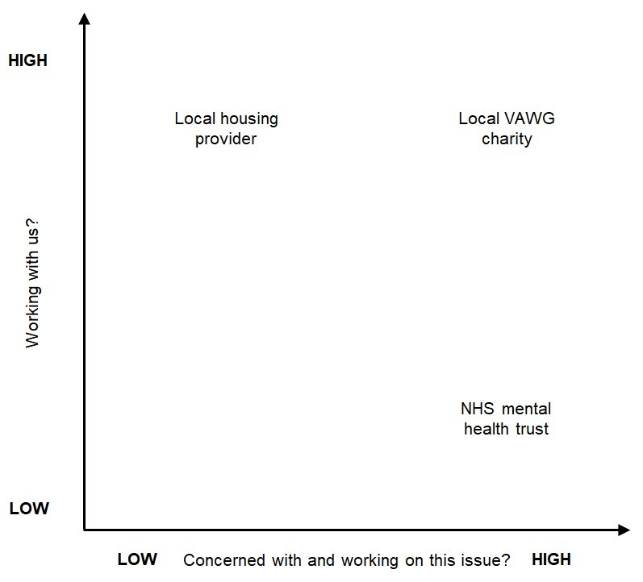
Mapping stakeholders on a matrix can help you build a picture of widespread learning on an issue, and to prioritise who you need to engage with. An example matrix is given on the following page. Place stakeholders on the matrix according to their expertise on the issue of concern, and the extent to which you are working with them. So, people and organisations with relevant experience and expertise, with whom you are already sharing learning, go in the top-right corner. Place those you are not working with, but who could have relevant expertise or experience, in the bottom-right corner. You may have other partners who are working closely with you but who don’t have significant practice in this area; these go in the top-left corner of the matrix.
Mapping your stakeholders will also help you to consider opportunities to share learning: for instance, through existing projects or networks. For more information on sharing practice learning, see the resources on communities of practice.
Communities of Practice. Management scholar Dr Etienne Wenger has influenced current understandings of how people and organisations learn, including developing the concept of communities of practice. Many useful talks by Wenger are available online.
Human Learning Systems. This website on Human Learning Systems provides a range of information and resources to support a different way of thinking about systems/public services, and how to work effectively, by embracing the complexity of the real world.
Getting started with co-production. This guide to co-production, co-created by MEAM and people with lived experience of multiple disadvantage, covers three sections: 1) what is co-production? 2) practical steps towards achieving coproduction, 3) support and next steps.
Nottingham’s Practice Development Unit provides learning opportunities to support practitioners and professionals from different sectors and roles across the UK, from an introductory offer to help people who are new to SMD, through to more advanced, shared learning opportunities for those working to develop their practice, skills and competencies. See a summary of the PDU.
A classic discussion of change by John Kotter, Is your iceberg melting?, illustrates organisational barriers to change, and offers practical solutions to help teams adapt, reduce fear, and encourage proactive responses in a rapidly changing world.
The Schumacher Institute resource outlines how to practice action experiments – trying new approaches and learning what effects they have through eight steps: 1) framing the issue, 2) identifying aspirations, 3) reflecting on the issue, 4) transitioning from question to action, 5) acting in the world, 6) noticing effects, 7) recording reflections, 8) beginning another cycle.
What is appreciative inquiry (AI)?, from the Centre for Appreciative Inquiry, outlines how to use Appreciative Inquiry’ 5-D process (define, discover, dream, design, destiny). It demonstrates how appreciative questions around best experience, values, and wishes can be used in interviews.
Plymouth’s Co-production Commissioning Toolkit (PDF, 846KB) includes guidance on how to get started with co-production, and a range of case study examples and links to other resources.