Small veterinary businesses: complying with the CMA's Order
A guide to help small veterinary businesses that provide care to household pets comply with the CMA's Veterinary Services Market Investigation Order 2026.
The information on this page is only for Veterinary Businesses with 14 or fewer practices. For a large Veterinary Business (with 15 or more practices) which provides care to household pets check our guide on what you need to do.
The Competition and Markets Authority (CMA) investigated the veterinary services for household pets market from September 2023 to March 2026.
In September 2026, we published an Order requiring Veterinary Businesses that provide care for household pets to help Pet Owners better navigate the veterinary services market.
Household pets are animals kept primarily for companionship or protection, and which habitually reside in the Pet Owner’s home. This excludes livestock, poultry, equines and any animals kept primarily for commercial, agricultural, sporting or working purposes.
The definitions of Veterinary Business, First Opinion Practice (FOP), Out-of-hours (OOH) Centre, OOH FOP Services and OOH Provider Services for the purposes of the Order are set out in Part 1 of the Order.
The Order is legally binding, and if the Veterinary Businesses to whom the Order applies do not comply, the CMA could:
- work with you to change your practices to stop the breach
- issue a set of instructions (‘directions’) requiring you to take steps to comply with the Order
- impose a financial penalty
This guide outlines what Veterinary Businesses caring for household pets need to do and by when. However, to be able to comply with the Order, you must engage with the full text of the Order and Explanatory Note to confirm the details of the requirements and the precise meaning of terms and expressions used in this guide. You should not rely solely on this guide.
When you need to comply
There are 4 deadlines for small Veterinary Businesses that look after household pets to comply with the Order:
- September 2026
- December 2026
- March 2027
- September 2027
This table outlines the deadline for each requirement. You need to comply with each requirement from the next working day after the relevant date.
Requirements already in effect
| Requirement | Where to find this in the Order |
|---|---|
| Notice period for OOH contracts (requirement to stop enforcing notice periods exceeding 12 months and early termination fees) | Articles 19(4) and 19(5)(a)-(b) |
Requirements coming into effect
| Compliance date: next working day after 22 December 2026 | Where to find this in the Order |
|---|---|
| Notice period for OOH contracts (requirement to inform FOPs) | Article 19(5)(c) |
| Compliance date: next working day after 22 March 2027 | Where to find this in the Order |
|---|---|
| Ownership Information | Article 5 |
| Practice Information | Article 6 |
| Price List | Article 7 |
| Parasiticide Price List | Article 8 |
| Pet Care Plans | Article 9 |
| Ensuring that Veterinary Professionals can act in accordance with the relevant provisions of the RCVS Codes and Guidance | Article 13 |
| Cremation options and prices for Pet Owners | Article 20 |
| In-house complaint processes | Article 21 |
| Complaint logs | Article 22 |
| Mediation | Article 23 |
| Compliance date: 3 months from the date on which the RCVS has fully complied with paragraph 4.1 of the Substantive RCVS Undertakings, or 22 September 2027, whichever is later | Where to find this in the Order |
|---|---|
| Submission of information to the RCVS for publication on the Find a Vet Platform | Article 10 |
| Compliance date: next working day after 22 September 2027 | Where to find this in the Order |
|---|---|
| Written estimates for higher cost treatments | Article 11 |
| Itemised Bills | Article 12 |
| Pet Owner awareness of written prescriptions | Article 14 |
| Provision of written prescriptions | Article 15 |
| Standard Flyer for Ongoing Medication | Article 16 |
| Own Brand medication | Article 17 |
| Prescription fees | Article 18 |
An overview of what you need to do
Ownership Information (Article 5)
Compliance date: next working day after 22 March 2027
This requirement applies to
Entities that carry out or operate a group or network of Veterinary Businesses and the FOPs, online retailers, Referral Centres, OOH practices, animal hospitals, diagnostic laboratories and pet crematoria which form part of those groups or networks.
What you need to do
You must clearly and prominently display the identity of your group or network on websites and in other online data, in premises, external signage and in various Pet Owner communications. This obligation applies across all business models and services, including in respect of any FOPs, online retailers, Referral Centres, OOH practices, animal hospitals, diagnostic laboratories and pet crematoria in your group or network of Veterinary Businesses.
The Order contains specific rules relating to how this information must be communicated to Pet Owners for it to be sufficiently clear and prominent.
Practice Information (Article 6)
Compliance date: next working day after 22 March 2027
This requirement applies to
Veterinary Businesses operating one or more FOPs (including where they provide OOH services in those FOPs), OOH Centres, Referral Centres, or Crematoria.
What you need to do
You must publish on your website, and display at each of your premises, certain information about your services:
- qualifications held by practice staff, including any RCVS professional accreditations (these can be anonymised)
- any current PSS (Practice Standards Scheme) accreditations and awards (including a link to RCVS supporting information for Pet Owners about the PSS)
- your OOH care: if you outsource your OOH service, you must publish details of where the services are provided, the identity of the OOH provider, their telephone number(s), premises and web addresses, and information about when the provider is available and the nature of the services provided
You will need to keep this information up to date and provide copies in practice if requested.
Price List (Article 7)
Compliance date: next working day after 22 March 2027
This requirement applies to
Veterinary Businesses operating one or more FOPs (including where they provide OOH services in those FOPs), OOH Centres, Referral Centres, or Crematoria.
What you need to do
You must publish a price list on your website which displays a price for each of the defined services listed in Schedule 1 of the Order (the ‘Price List Schedule’). You must also make the price list available at each of your premises.
When you send an initial email, text message or other digital communication to a Pet Owner to confirm a consultation booking, you must specify the price for that consultation and include a link to the webpage hosting your price list.
Additional information
Your price list should include prices for all of the 36 services listed in Schedule 1 to the Order, except those which are not offered at your practice(s). You must not include any additional text in the price list itself (beyond the name listed in the Price List Schedule), however supplementary information about the services and how they are delivered can be included elsewhere on your website.
You must present prices for relevant treatments and services based on the 6 standardised pet characteristic and weight categories set out in Article 7(2)(c) of the Order. Where your prices do not vary with pet characteristics (species or weight), prices do not need to be displayed separately by reference to such categories.
For each of the services on your price list, the prices displayed must represent the typical price a Pet Owner would pay for that service, meaning that prices must be based on a standard case with minimal complexity or complications.
When you change the price of any item on the price list, you must update your price list before the new price is charged to Pet Owners.
You must inform Pet Owners clearly via the price list that prices for any of the listed services may be adjusted upwards in more complex or complicated cases.
Parasiticide Price List (Article 8)
Compliance date: next working day after 22 March 2027
This requirement applies to
Veterinary Businesses operating one or more FOPs.
What you need to do
You must publish the prices of your most commonly sold flea, tick, and worming medicine products on your website, along with a prominent link to the VMD Register of Online Retailers. The price list must be clearly identifiable on your website and easily accessible. You must also make the same information available in practices.
Additional information
‘Most commonly sold’ pet parasiticide products are those for which your FOP sold at least 100 units in the previous financial year. If there were fewer than 10 products meeting this threshold, you should list the top 10 parasiticide medicine products by sales in the previous financial year. The listed prices must be for individual medicine products (with separate prices for products with different formulations, sizes and dosages).
The prices listed must be accurate and comprehensive. For each product they must include any charges, such as dispensing or administration fees, that are unavoidable when purchasing the product from the practice, and VAT. Where prices change, these must be reflected on the price list before new prices are charged.
You must include alongside the list a notice that Pet Owners should consult their Vet or Suitably Qualified Person (SQP) about whether their pet needs parasiticide product(s), and if they do, that the Vet or SQP will prescribe a specific medicine product based on their clinical judgement of what is best for the pet.
Pet Care Plans (Article 9)
Compliance date: next working day after 22 March 2027
This requirement applies to
Veterinary Businesses operating one or more FOPs offering pet care plans.
What you need to do
You must publish certain information about pet care plans you offer at your FOPs, both online and in your FOP premises. This includes the Pet Care Plan Standard Information (described below) and, where applicable, additional information about any parasiticides included within the plan and savings claims made in respect of a plan.
Additional information
Information you need to provide about each pet care plan
The ‘Pet Care Plan Standard Information’ you must provide, for each pet care plan you offer, includes:
- a list of all products and services included in the plan
- the number of times each service can be accessed, including making clear when an included service is typically used just once in a pet’s lifetime
- the time frame during which each service is available (for example per month, or per year)
- the total price of the plan stated both as a monthly and annual rate
- the standalone price for each service included
- information on cancellation terms
If the pet care plan includes parasiticides
In addition, where you include flea, tick and worming treatments (parasiticides) in a pet care plan, you will need to:
- provide a link to your parasiticide product price list (as explained in ‘Parasiticides Price List (Article 8)’ above)
- identify which parasiticides are included in the pet care plan or confirm that any parasiticides on the price list are included (subject to the Vet’s recommendation)
- include a message that Pet Owners should speak to their Vet or SQP to understand which parasiticides, dosages and frequency are likely to be appropriate for their pet
If you say the Pet Owner could save money with a pet care plan
Where you indicate that a Pet Owner could save money on a pet care plan in comparison to purchasing services separately, you will also need to comply with additional requirements around the calculation of such savings and the disclosure of savings information to Pet Owners. An explanation of these requirements is provided at paragraphs 82 to 87 of the Explanatory Note to the Order.
When you need to update the information
You must update the pet care plan pricing and standalone service pricing information when any prices change. The information must be updated before any revised prices are charged to Pet Owners. You will also be required to send Pet Owners a reminder if annual pet care plans automatically renew.
What the information could look like in practice
Here is an illustration of what the information could look like for a typical FOP:
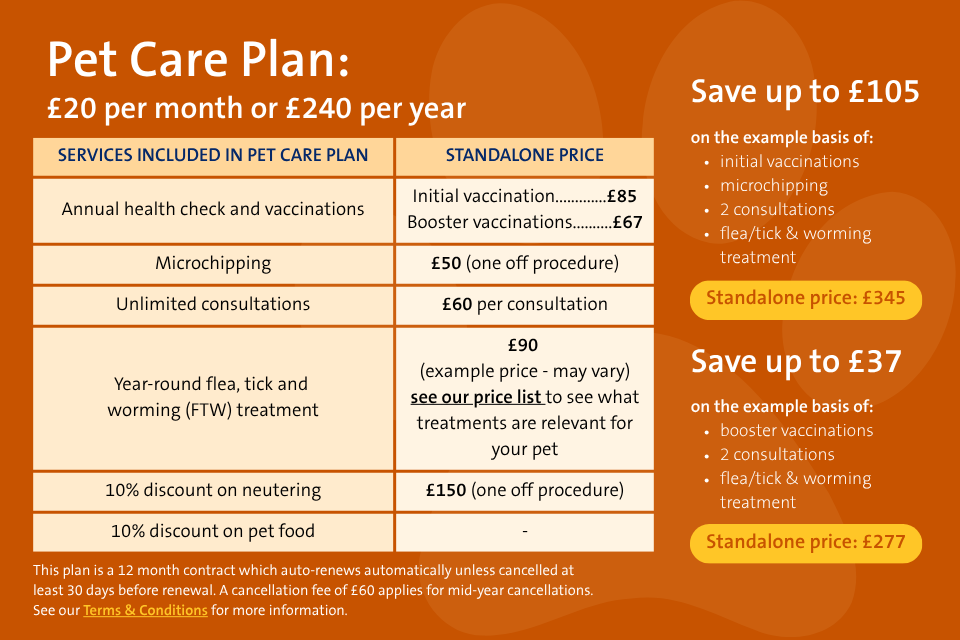
Image of what a pet care plan could look like. It shows the services available, including: annual health check and vaccinations; microchipping; unlimited consultations; year-round flea, tick and worming treatment; 10% discount on neutering; 10% discount on pet food. It also illustrates how you can save money with worked examples of plans available.
Submission of information to the RCVS for publication on the Find a Vet Platform (Article 10)
Compliance date: 3 months from the date on which the RCVS has fully complied with paragraph 4.1 of the Substantive RCVS Undertakings, or the next working day after 22 September 2027, whichever is later
This requirement applies to
Veterinary Businesses operating one or more FOPs (including where they provide OOH services in those FOPs), OOH Centres, or Referral Centres.
What you need to do
You are required to submit certain information to the RCVS through the Find a Vet Web Form, so that the RCVS can publish the information on its Find a Vet platform and share it with approved third parties.
The information required under Article 10 includes the following: the ownership information (described in Article 5), the practice information (in Article 6), the standard price list (in Article 7), the parasiticide price list (in Article 8) and the pet care plans information (in Article 9), as well as some basic information about your practices. You are also required to provide public URLs for the webpages on which such information has been published.
The information you are required to provide depends on the services that your practices offer. Read Article 10 of the Order carefully to see which information you must provide to the RCVS via the Find a Vet Web Form.
When you need to do this by
You must comply with Article 10 within 3 months of the RCVS having set up the Find a Vet Web Form (or alternative method of communication) and it informing Veterinary Business that it has done so, or by the first working day after 22 September 2027, whichever date is later.
Written Estimates for higher cost treatments (Article 11)
Compliance date: next working day after 22 September 2027
This requirement applies to
All Veterinary Businesses operating one or more FOPs (including FOPs which offer only OOH veterinary services) and OOH centres.
What you need to do
You must give the Pet Owner a Written Estimate if both of the following apply:
- the Treatment Pathway is reasonably likely to cost £500 or more, including VAT, and
- at least 20% of that reasonably likely cost relates to tests and/or treatments that have not yet been provided or chosen by the Pet Owner
You must give the Pet Owner a new Written Estimate if the total estimated cost of the Treatment Pathway for the same period becomes reasonably likely to exceed the previous estimate by:
- 20%, or
- £500 including VAT
whichever is lower.
You should base the estimate on:
- the information already reasonably available to you
- your professional judgement
You do not need to contact third parties, such as referral providers, or carry out additional investigations, analysis or modelling solely to prepare the estimate.
Additional information
What is a Treatment Pathway?
The Treatment Pathway is backwards- and forwards-looking. It covers tests and/or treatments which:
- have already been provided, or chosen by, the Pet Owner, in the previous 3 months; and
- you are recommending, or may refer the pet for, and which, if the Pet Owner chooses them, are reasonably likely to be provided in the next 12 months
You do not need to include every possible diagnosis or treatment. Include only those you judge reasonably likely to be recommended over the next 12 months, or a shorter period if you cannot reasonably anticipate that far ahead.
When a Written Estimate must be given
You must give the Pet Owner the Written Estimate before they decide whether to proceed with the tests and/or treatments you are recommending, unless either of the exceptions below apply.
You do not need to provide or update a Written Estimate if:
- you judge that the Pet needs urgent treatment and delaying treatment to provide a Written Estimate would adversely affect the Pet’s welfare; or
- the Pet Owner has told you that they do not want an estimate
How precise does the estimate need to be?
The estimate is not a binding offer or quote. Its purpose is to give the Pet Owner a realistic indication of what they are reasonably likely to have to spend.
The estimate can be:
- a single figure;
- a range; or
- a combination of both
If you give a range, you must indicate where within the range the final cost is most likely to fall and explain any known factors that could materially affect that position.
The information that must be provided
If the tests and/or treatments you are recommending will be provided at the FOP, the Written Estimate must break down the main, distinct and separately priced components of the Treatment Pathway which are reasonably likely to be provided in the next 12 months.
If the tests and/or treatments you are recommending involve Referral Services, you do not need to provide a breakdown of the referral costs. However, you must include:
- an estimate of the cost of the Referral Services; and
- a note advising the Pet Owner that they should confirm the price from the provider of the Referral Services
You do not need to update an estimate of the cost of Referral Services.
Itemised Bills (Article 12)
Compliance date: next working day after 22 September 2027
This requirement applies to
All Veterinary Businesses operating one or more FOPs (including FOPs which only offer OOH veterinary services) and OOH Centres.
What you need to do
You must give each Pet Owner an Itemised Bill for the treatment, goods and other services they receive before or at the same time as payment is sought (or taken).
You do not need to list every individual item. However, the Itemised Bill must at least show:
- the amount charged for each medicine product;
- the total amount charged for other goods and services; and
- any fees for services provided by an external provider, including any administration or arrangement charges
You must describe the items clearly enough for the Pet Owner to understand what they have been charged for. You can use your judgement to decide how much detail is needed.
For fixed-price bundles, the Itemised Bill must show the total price and a description of the main components. If any main component is also sold separately, the Itemised Bill must show its standalone price.
Ensuring that Veterinary Professionals can act in accordance with the relevant provisions of the RCVS Codes and Guidance (Article 13)
Compliance date: next working day after 22 March 2027
This requirement applies to
All Veterinary Businesses operating one or more FOPs (including FOPs which only offer OOH veterinary services) and OOH Centres.
What you need to do
You must put in place and maintain written policies and processes which ensure that Vets and Nurses are able to act in accordance with the provisions of the RCVS Codes and guidance relating to providing Pet Owners with:
- independent and impartial advice; and
- appropriate and timely information regarding a range of treatment and referral options and their costs
Additional information
Your policies and procedures must be sufficient to address the potential for conflict between:
- instructions, incentives, influence or actual or perceived pressure to or on Vets and Nurses to recommend particular diagnostic tests, treatments or referrals; and
- the Vet’s or Nurse’s ability to act in accordance with the relevant provisions in the RCVS Codes and guidance
Pet Owner awareness of written prescriptions (Article 14)
Compliance date: next working day after 22 September 2027
This requirement applies to
All Veterinary Businesses operating one or more FOPs.
What you need to do
You must inform Pet Owners of their ability to request a written prescription (which they can use to buy medicines elsewhere) and that medicines may be cheaper elsewhere. You must do this by providing written materials and oral prompts, as applicable, at specified times before, during and after each consultation.
Additional information
The information and materials that need to be provided to Pet Owners have been designed by the CMA and will be made available to you by the RCVS and the CMA. You will not need to develop these materials yourself.
In its Order, the CMA sets out:
- the specifications for a poster about written prescriptions (the Standard Written Prescription Notice)
- specific, standardised text about written prescriptions that FOPs will need to provide to Pet Owners. This includes the use of standardised literature, electronic messages and invoice/receipt notifications
The RCVS will produce, distribute to Veterinary Businesses, and publish on its website, standardised literature and information about the ability of Pet Owners to request written prescriptions. The RCVS standardised literature must be provided by FOPs to Pet Owners in a clear and prominent way at the following times and in the following ways:
- it must be placed on an easily accessible location on the FOP’s website (if it has one)
- Veterinary Businesses will need to give new customers a link to the digital version or a copy of the literature when they first register with a FOP
- Veterinary Businesses will need to provide existing customers with a link to the digital version, or a physical copy, of the literature
FOPs must provide the standardised text to Pet Owners by including it:
- on emails, texts or other electronic communications which confirm or remind Pet Owners of upcoming consultations; and
- on all invoices/receipts after a consultation where medicine was dispensed.
FOPs must also place the standard poster within waiting rooms in a sufficiently prominent place. As well as the standard poster (which must be displayed), FOPs can use their own posters to advertise the provision of medication in their own practices so long as the information they contain accurately reflects any savings which could be made, is not in any way misleading and does not undermine the requirement of the standard poster to be clearly and prominently displayed.
Oral prompts during consultations
Vets must orally offer Pet Owners a choice of a written prescription during each consultation in which medicine is prescribed. This obligation will not apply where, for clinical reasons, the medicine is required for urgent administration.
You do not need to say, during the consultation, that the medicine may be cheaper elsewhere.
Provision of written prescriptions (Article 15)
Compliance date: next working day after 22 September 2027
This requirement applies to
All Veterinary Businesses operating one or more FOPs (including where they provide OOH services in those FOPs).
What you need to do
Where requested by the Pet Owner, provide a written prescription either in hard copy by the end of the consultation, or digitally by the end of the second working day. Digital copies can either be sent directly to an online retailer or given to the Pet Owner (which is for vets and Pet Owners to discuss).
Standard Flyer for ongoing medication (Article 16)
Compliance date: next working day after 22 September 2027
This requirement applies to:
All Veterinary Businesses operating one or more FOPs.
What you need to do
Pet owners who are prescribed ongoing medication must be given a Standard Flyer which provides information about their ability to request a written prescription and the potential for savings from purchasing long term medication elsewhere.
You must either provide this information in the form of a physical flyer or on a dispensing bag provided along with the medication or, if the Pet Owner requests, by email sent at the same time or immediately after the medicine is dispensed.
This information must be provided when the ongoing medication is first dispensed as a repeat or, if that is not practical, the second time it is dispensed.
Additional information
In this context, an ‘ongoing medication’ means a second (or more) issue of the same medication, to treat the same condition, without any interruption or gap in the course of the medication, and includes parasiticides.
The RCVS will make available to FOPs by no later than the end of May 2027 (in digital format) a standardised A5 flyer.
You will not be required to provide the flyer where the medication is provided without charge at the point of dispensing – for example, where the Pet Owner has subscribed to a pet care plan including the relevant medications at no additional cost.
Own Brand medication (Article 17)
Compliance date: next working day after 22 September 2027
This requirement applies to
All Veterinary Businesses operating one or more FOPs that provide Own Brand medication.
What you need to do
When prescribing an Own Brand medication, you must inform Pet Owners that there is a Reference Product alternative available, and what it is, by complying with the following 3 requirements.
Consultation requirement
In a consultation when an Own Brand medication is prescribed, vets must inform the Pet Owner orally that they are being prescribed an Own Brand product, and that the Reference Product alternative is available for purchase from third parties, such as online retailers.
Dispensing requirement
When the Own Brand medication is dispensed, provide the Pet Owner with the name, in written format, of the Reference Product.
Labelling requirement
Specify clearly on both the labelling applied to Own Brand medicines and on the invoice, that the Reference Product alternative is available for purchase elsewhere.
Additional information
An Own Brand medicine is a version of veterinary medicine product that, rather than having the brand name of a manufacturer, has a brand name given by the retailer or distributor of the product (which could, for example, be a buying group). It can be referred to as a ‘private label’ or ‘white label’ product.
If there are clinical reasons why the Vet considers that they should not inform the Pet Owner about the Reference Product as the appropriate alternative to the Own Brand medicine (for example, because it is no longer available or a more appropriate formulation (for example, chewable versus non-chewable tablets) is available and preferable for a specific pet’s needs) they must instead comply with each of the above requirements in respect of a clinically appropriate alternative medicine.
It is not necessary for vets to tell Pet Owners about multiple medicines which are clinical alternatives to the Own Brand product.
The information provided on the labelling applied to the Own Brand medicine can be added as a separate label. This label does not need to state the name of the Reference Product or the clinically appropriate alternative medicine.
Prescription fees (Article 18)
Compliance date: next working day after 22 September 2027
Pet Owners who want to purchase medicines outside the FOP need to obtain a written prescription. It is important that Veterinary Businesses do not discourage this by charging unreasonably high prices for providing this prescription.
This applies to
All Veterinary Businesses operating one or more FOPs or OOH Centres.
What you need to do
The maximum fee for providing a written prescription is £21.40 for the primary prescription (in other words, the first medicine prescribed within or outside of a consultation). FOPs can charge up to £12.70 for each additional medicine prescribed within the same consultation or outside a consultation.
Additional information
These prescription fee caps figures apply until 31 March 2028. Thereafter, they will be adjusted annually for inflation (using CPI). Updated fee caps will be published on the CMA website by 14 February each year and any updated price caps will apply from 1 April of the same year.
These prescription fee caps are inclusive of VAT and apply across the UK – there are no regional variations.
To prevent circumvention of these fee caps, businesses are required to put in place policies and procedures to ensure that there should not be any difference between how long a medication is provided for when it is:
- dispensed within the FOP, or
- subject to a written prescription for dispensing elsewhere
Such policies and procedures are required for all POM-V medication other than controlled drugs, which are excluded.
Providers of outsourced out-of-hours services to FOPs (Article 19)
Compliance date: see ‘what you need to do’ below
This requirement applies to
Veterinary Businesses providing outsourced OOH services to FOPs.
What you need to do
Your contracts for the provision of third party OOH services must not have notice periods of longer than 12 months and there must be no termination fees payable unless a FOP client stops using the services before the notice period expires.
This requirement took effect when the Order came into place (in September 2026). You must write to your FOP clients by the next working day after 22 December 2026 to inform them of changes to their contracts.
Cremation options and prices for Pet Owners (Article 20)
Compliance date: next working day after 22 March 2027
This requirement applies to
All Veterinary Businesses operating one or more FOPs or OOH Centres.
What you need to do
- make Pet Owners aware of the full range of options available to them either shortly before or when their pet reaches the end of its life. These options are:
- to purchase an individual or communal cremation from the FOP
- to make separate arrangements themselves directly with a crematorium, or
- to take their deceased pet away for burial at home
- you also need to ensure that these options are published on your websites;
- offer a basic communal cremation service;
- ensure that clear pricing information is provided for both individual and communal cremations
Additional information
It is fine for the information to be provided in writing where appropriate – there does not need to be a conversation.
To meet the obligation to provide clear pricing information, businesses must:
- provide prices for the individual and communal cremation services which they offer and make it clear to Pet Owners what is included in these services. This pricing information must be:
- made available to all existing and prospective customers as part of the Veterinary Business’s prominently published price list (set out in the price list requirement)
- presented in writing prior to the Pet Owner making a decision on what to do with the deceased pet, for example, on a consent form or on a separate leaflet
- provide the price for each discretionary add-on which is charged as extra (where offered). This means that where Pet Owners are offered the option to pay extra for certain services (such as fur clippings, urns or paw prints), these must not be included in the cremation price but instead shown to Pet Owners separately (for example, these may be listed on a website or in a brochure). These add-ons do not need to be listed in the FOP’s standardised price list (under the price list remedy: Article 7)
In-house complaint processes (Articles 21 and 22)
Compliance date: next working day after 22 March 2027
This requirement applies to
All Veterinary Businesses operating one or more FOPs or OOH Centres.
What you need to do
Veterinary Businesses must have and follow a written in-house complaint process. This must, amongst other things, inform Pet Owners of how to complain about services received, how a Veterinary Business must respond and by when, and what steps Pet Owners can take if it is not possible to resolve the complaint in-house.
The minimum requirements of the in-house complaint process include that:
- Veterinary Businesses must seek to resolve Complaints informally, for example, during a phone call or discussion with the Pet Owner
- if a resolution is not reached within 10 working days of receiving a Complaint, it becomes an Actionable Complaint which the business must then acknowledge in writing within a further 5 working days
- Veterinary Businesses must send a full letter of response (incorporating the information specified in the Order) to the Pet Owner within 8 weeks of the Complaint becoming actionable
Veterinary Businesses must also, amongst other things, ensure that each FOP or OOH Centre they operate publishes the complaint process on its website. Further, they must display the Decision Tree in prominently placed signage in FOP or OOH Centre receptions and on their websites. The Decision Tree is being developed by the RCVS and will be made available by 22 January 2027. It will set out Pet Owners’ routes to redress when they have a complaint about a Veterinary Business.
Article 22 requires Veterinary Businesses to also keep a Complaint Log, review it periodically and make related improvements to services or process where it is reasonable to do so.
Veterinary Businesses must share the complaint process and Complaint Log with the RCVS, if requested to do so.
Mediation (Article 23)
Compliance date: next working day after 22 March 2027
This requirement applies to
All Veterinary Businesses operating one or more FOPs or OOH Centres.
What you need to do
Veterinary Businesses must, in respect of each FOP or OOH Centre they operate, participate in mediation in good faith where the Pet Owner wishes to do so and the in-house complaint process has been exhausted. This option should be communicated to Pet Owners as part of the business’s in-house complaint process.
Veterinary Businesses must select a specific Alternative Dispute Resolution (ADR) provider which offers mediation services to Pet Owners. The RCVS has undertaken to contract an ADR provider which meets these requirements and which Veterinary Businesses may choose to use by the next working day after 22 March 2027.
The requirement for Veterinary Businesses to engage in mediation in good faith means that they must engage proactively with the mediation process in a genuine attempt to resolve complaints fairly and without undue delay.
The outcome of mediation will, as is the case currently, not be binding unless both parties accept it as a full and final settlement of the complaint.
Monitoring and compliance (Articles 24 to 29)
If a Veterinary Business is aware that it is not compliant with any of the requirements in the Order it must report this non-compliance to the CMA or RCVS, as applicable, within 14 days of becoming aware that it is in breach.
Veterinary Businesses with more than one FOP or OOH Centre must submit attestations about their compliance with the Order to the RCVS or CMA, as applicable, by specified dates.
Veterinary Businesses which operate a FOP, OOH Centre, Crematorium or Referral Centre must submit certain information about their business to the RCVS via email (cma-help@rcvs.org.uk) by the end of the day on 30 November 2026. The information which must be submitted includes the business’s registered company name and head office address, and the contact details of someone who is responsible for communicating with the RCVS about the business’s compliance with the Order. If any of the information submitted changes, the Veterinary Business must inform the RCVS of these changes within 28 days.
Requirement to pay a levy to RCVS
To fund its new role, the RCVS will charge a Levy on Veterinary Businesses. The Levy funds the additional costs the RCVS will incur in carrying out various activities relating to the CMA’s package of remedies. This includes, for example, monitoring Veterinary Businesses’ compliance and enhancing the functionality of the Find a Vet website.
The Levy you must pay is set out in the Veterinary Services Market Investigation (Funding) Order 2026 and is calculated based on the number of FOPs and OOH Centres you operate.
Veterinary Businesses were required to inform the RCVS in writing if they operate a FOP or OOH Centre and provide the RCVS with relevant business and contact information by 4 September 2026. You must inform the RCVS in writing within 28 days if any of the information provided to the RCVS changes.
The initial Levy is calculated based on the RCVS’s estimate of the costs it will incur in the period from 24 March 2026 to 31 March 2027. Subsequent Levies will be based on the RCVS’s estimated costs for successive 24 month periods, with the first running from 1 April 2027. The Levy will continue to be paid annually during these periods.
For each such 24 month period, the RCVS must publicly consult Qualifying Veterinary Businesses and professional representative bodies on its estimate of its costs before submitting the final estimate to the CMA for approval.