MMO updates on the octopus bloom
During 2025 and into 2026, fishermen in South West England reported a surge in sightings and landings of common octopus (Octopus vulgaris), often referred to as an “octopus bloom”. This webpage provides updates on how the Marine Management Organisation (MMO) is responding to this situation, including access to an octopus reporting portal, data on octopus and shellfish landings, stakeholder engagement activities, an overview of relevant scientific research, and information on available funding.
Spotted an octopus? Let us know!
Inviting divers, recreational anglers and the general public who do not submit MMO landings data to report any octopus sightings through our Reporting Portal.
Since spring 2025, the South West of England has experienced an increase in the number of common octopus (Octopus vulgaris). The rise of common octopus in English waters is thought to be linked to environmental conditions, including increasing sea temperatures and elevated numbers have continued into 2026.
MMO is working closely with stakeholders and monitoring landings to build a better understanding of the bloom, its effects on other fisheries and the wider marine environment, and the development of the emerging octopus fishery.
MMO updates on the octopus bloom
MMO is monitoring landings of octopus, as well as stocks impacted by an increased presence of octopus, such as crab, lobster, scallops, crawfish and whelks. Current landings data is presented in the infographic linked below. We will look to update these infographics towards the start of each month following the official release of MMO Monthly Sea Fisheries Statistics.
We welcome feedback on the octopus infographics and other octopus data products. If you have any suggestions for improvement, please contact us by email.
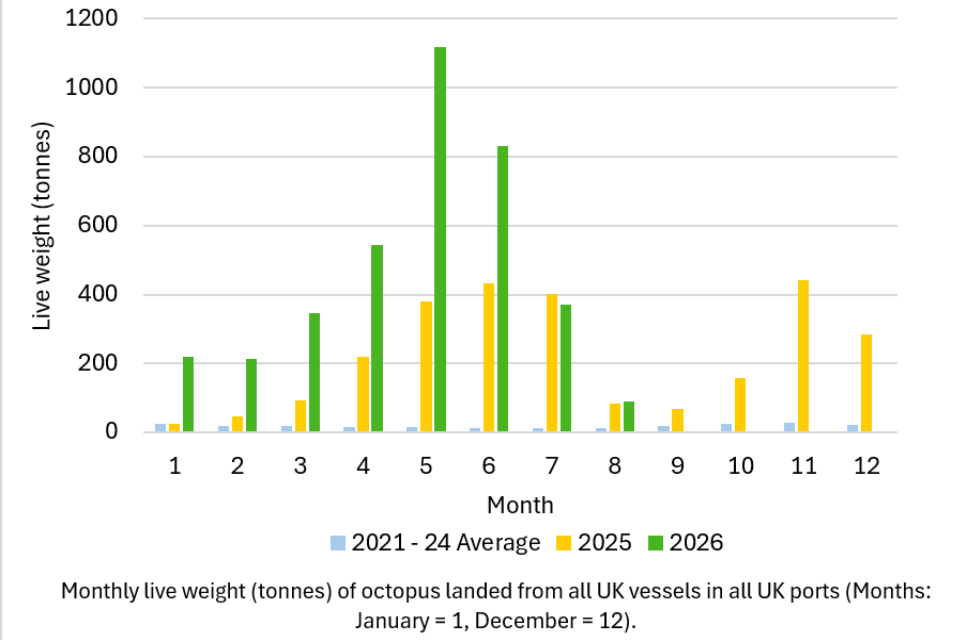
to see more data.
Octopus identification (ID) cards
MMO has developed ID cards for common and curled octopus (Elodene cirrhosa, also known as horned octopus) to help stakeholders identify each species and understand how they are currently managed in England.
These ID cards are available on the MMO Fisheries Management Plan Updates webpage and physical copies are also available at local MMO offices.
Wider Engagement
Octopus Management Group
The Octopus Management Group has been established to provide advice and support the development of a long-term strategy for octopus. The group provides a forum for stakeholder engagement and collaboration. It meets on an ad hoc basis, as required.
Octopus Science Group
The Octopus Science Group supports the coordinated identification, development and sharing of evidence related to octopus. This group provides a forum for those directly involved in evidence work, as well as those looking to undertake research, to discuss relevant topics and share updates.
Stakeholder Impact and Requests for Support Survey
MMO invited stakeholders impacted by the octopus bloom, either positively or negatively, to take part in an online survey.
The survey gathered information to help quantify the economic impact of the bloom on stakeholders across the South West and identify what support they would welcome.
The survey ran for 15 days from the 4 of March to 19 of March 2026, receiving a total of 43 complete responses. You can find the Analysis of response below.
Jersey and Guernsey Governments
MMO is in conversation with the Channel Islands (Jersey and Guernsey) to promote data sharing and cross-channel communication on changes in octopus abundance.
MMO and Defra are considering how best to engage with the EU to learn from existing octopus fisheries.
Scientific research
Feasibility of a Potential Emergent Octopus fishery
This project examined the potential feasibility of a targeted octopus fishery in South West England based on stakeholder observations of generally increasing abundance of octopus and subsequent increase in bycatches. Two case studies were also reviewed to inform potential monitoring and management needs.
This project was completed prior to recognising an octopus bloom in the South West in March 2025.
A two-page summary and the full report can be found on the project page.
Octopus research conducted by the Marine Biological Association
The Marine Biological Association (MBA), along with the University of Plymouth, the Plymouth Marine Laboratory and an independent consultant, have been commissioned to investigate the history and potential environmental causes of octopus blooms, the effects they are having on the fishing industry, and the potential for such blooms to happen again in the future.
Their findings can be found on mba.ac.uk.
Octopus sampling programme
In February 2026, MMO colleagues conducted preliminary market sampling at Brixham and Newlyn markets to test methods for collecting data. Since then, colleagues from Cornwall IFCA, Devon and Severn IFCA and CFPO have taken on the project and established a regular market sampling programme.
Data collected through this programme will be used to monitor octopus populations and inform future work. Research indicates that cephalopod market sampling should be undertaken regularly due to the life history of octopus, but also the environmental factors that may influence population dynamics.
Additional research
Several other research and data collection projects are currently being developed by members of the Octopus Science Group to enhance our understanding of common octopus life history and population dynamics in UK waters.
Fisheries and Seafood Scheme
The Fisheries and Seafood Scheme (FaSS) is a Department for Environment, Food & Rural Affairs (Defra) grant scheme administered and delivered by MMO. It is funded from the Fishing and Coastal Growth Fund, which will invest £304m into fishing and seafood businesses and coastal communities across England.
There are opportunities for support through the FaSS to fund octopus-related applications. FaSS can support a wide range of activities, including (but not limited to) scientific research, fishing-related activities, diversification and new income streams, health and safety improvements, cooperative initiatives, capability building, and advisory services.
For more details, please visit Fisheries and Seafood Scheme. You can find contact details for MMO Grants team to contact them directly.
Contact us
Would you like to report further details on octopus landings or share your experience? Please let us know by emailing us at FMP@marinemanagement.org.uk.