Local Authority Risk and Adaptation Toolkit: Heat Edition
The Local Authority Risk and Adaptation (LARA) Toolkit: Heat Edition is designed to help assess heat-related health risks and plan actions to protect health.
Why preparing for heat matters
High temperatures, hot weather and heatwaves can increase risks of illness and death, especially for vulnerable populations. With climate change driving more frequent and intense heatwaves, proactive planning is essential.
A toolkit to help local authorities prepare for heat risks
The Local Authority Risk and Adaptation (LARA) Toolkit: Heat Edition is designed to help councils understand and respond to the health risks posed by hot temperatures. It provides a simple, structured way to:
- assess preparedness for heat-related health risks, including current areas of strength
- identify gaps and areas for improvement in local plans and services
- a baseline against which you can benchmark future activity and demonstrate progress
- assess approaches to protect at risk groups such as older people, children, and those with health conditions
- plan practical actions guided by national guidance and good practice
- monitor your progress using our dashboard of visualisations
The tool includes sections on the following:
- Leadership.
- Local authority wide action and communications.
- Care settings: risk groups (for example, people aged 65 and over, the disabled, and those with underlying health conditions) living in care settings (such as care and nursing homes).
- Home and domiciliary settings: risk groups (for example, people aged 65 and over, the disabled, and those with underlying health conditions) living in their own home or domiciliary settings.
- Young people.
- Children and Young Peoples Settings: Schools, Education and Care.
- People experiencing homelessness, including rough sleepers and those who are unable to make adaptations to their living accommodation such as sofa surfers or those living in hostels.
- Settings: Homes.
- Planning.
- Vulnerability due to occupation.
- Infrastructure.
- Adverse Weather and Health Plan cross-cutting actions.
Example visualisations from the LARA pilot dashboard
Figure 1. LARA pilot dashboard
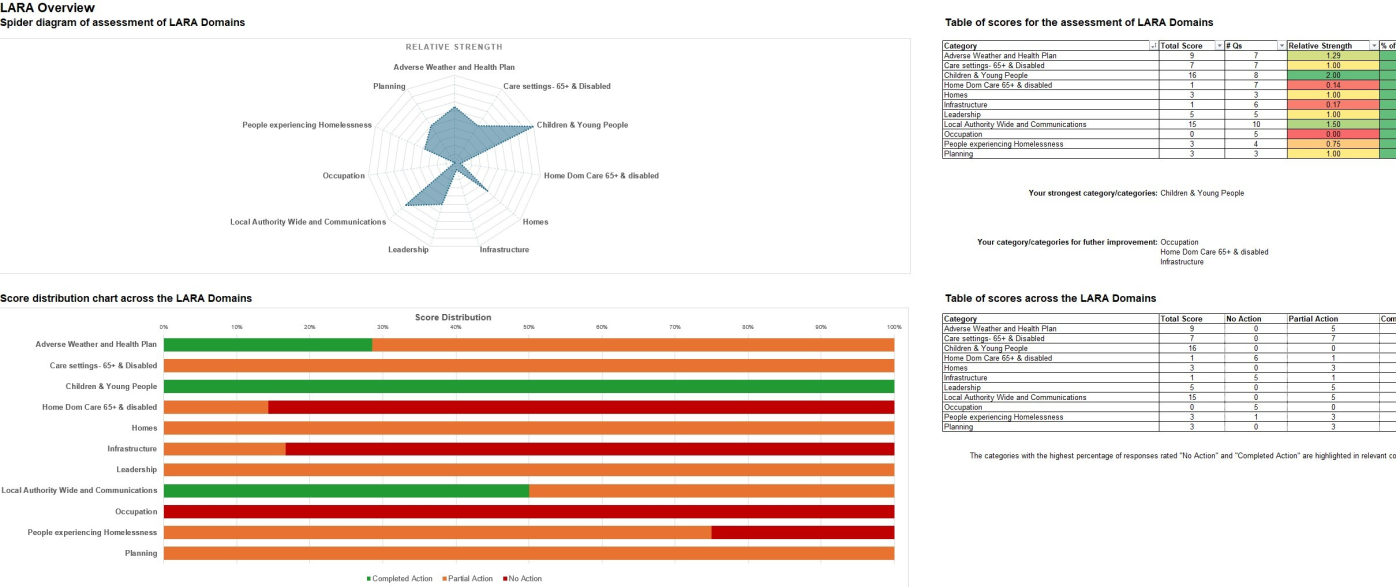
Figure 1 shows how on completion of the LARA Toolkit, the user will be provided with a number of data visualisations that demonstrate how their local authority is addressing heat risk. This includes a spider diagram covering all action areas and relative strengths, a table using colour coding to illustrate relative strengths and clearly identified strongest category as well as category for further improvement.
Guidance for using the tool
This framework is best completed with input and contributions from a range of local authority colleagues.
This may include colleagues from different authorities in two-tier and combined authority systems of local government.
Each local authority will have its own partnerships and collaborative mechanisms (such as partnership boards Inc Climate Change Boards, Health and Wellbeing Boards and other governance structures) which may assist in completing this tool.
However, we encourage Directors of Public Health and Public Health teams to lead its completion.
We encourage input from colleagues working within adult social care, children’s services, public health, sustainability, environment, emergency planning, housing, planning and education colleagues.
You will be required to give your authority a rating, detailed below, and are recommended to support your self-assessment with documentation and or links.
- No Action = No evidence to support local authority action on this activity.
- Partial Action = Some evidence to support local authority action on this activity.
- Completed Action = Good evidence of this to support local authority action on this activity.
Once completed, local authorities may want to consider how they can best use the framework to facilitate their future action on heat. They may also want to consider comparing their assessments with other local authorities to learn from each other.
Note: UKHSA will not ‘assess’ local authorities’ responses.
Once you have filled out each of these tabs the tool will generate a number of figures that are displayed in the Dashboard tab, including a spider diagram of relative strengths and a score distribution enabling comparison across the 12 areas of work. Across this tool, areas that are to be completed by the user will be filled blank, whilst locked sections which are for your reference will be filled in grey.