Information on native and imported ticks
Understand more about ticks which are native to the UK as well as non-native ticks which can be imported, potentially bringing new public or animal disease risks.
Ticks native to the UK
Globally, ticks are one of the most significant disease vectors. Whilst feeding on an infected animal host, a tick can pick up pathogens and transmit them to subsequent hosts that it may feed on. Many species of tick remain infected for the duration of their life span, maintaining infection from one life stage to the next (called trans-stadial transmission) with some infected female ticks also transmitting infection to their offspring via their eggs (called trans-ovarial transmission).
In recent years there has been a growing interest in ticks and their associated diseases, both of which appear to being increasingly reported. The reasons for this are complex and may include changes in land management, improved surveillance, climate change and host distribution or behaviour change.
Biology and ecology of the sheep and deer tick
Ticks are blood feeding ectoparasites, closely related to mites and more distantly related to spiders and scorpions. They are not insects, they are arachnids. Ticks feed on a large variety of hosts including mammals, birds, reptiles and occasionally amphibians. Many UK species are specialist wildlife parasites, feeding on a limited range of animal hosts and as such, have either a limited or patchy distribution. The life cycle of ticks generally involves four stages: the egg stage and three parasitic stages, larva, nymph, and adult.
Figure 1: Life cycle of native ticks
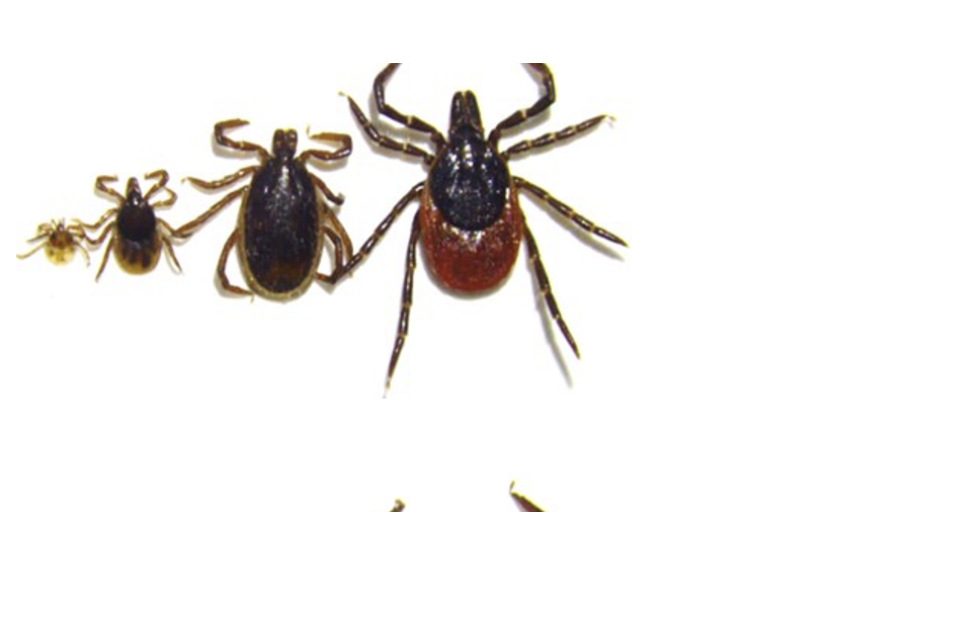
In the UK, Ixodes ricinus (sheep or deer tick) is the most encountered tick species, often found in woodland, rough upland or moorland pastures, heathland, grazed grasslands and some urban parks. Ticks are particularly abundant in ecotones (the transition zone between two vegetation communities, such as woodland and meadow or shrub communities) which permit a wider range of potential animal hosts to feed and move ticks around.
Vegetation cover and leaf litter at ground level offer protection from adverse temperatures, with high humidity. Thus, removal of ground cover exposes ticks to high temperatures and hinders their ability to maintain water balance and avoid desiccation when waiting for a host animal upon which to feed.
In the UK, Ixodes ricinus activity has been recorded sporadically at all times of the year, although generally larvae begin questing in spring or early summer (April/May), peaking in activity between June and August and declining in September. Nymphs are generally active from February through to November, activity peaking in May/June, with a smaller second peak between September and November.
Active ticks search for a host by clinging to vegetation at a height where they can withstand desiccation. They detect passing animals by holding out their front legs where their sensory Haller’s organs are located; this sensory gland being acutely responsive to changes in carbon dioxide, heat, odour and physical disturbances.
Ticks wait for a host until they either successfully attach or have lost excessive amounts of water requiring them to retreat to ground level where they will recover and later quest again. Ticks will die if they are unsuccessful in finding and attaching to a host before their energy reserves are used up.
Non-native tick species
Non-native tick species can potentially transmit pathogens that are not currently found in the UK, posing a risk to both humans and animals. They can be imported into the UK via several routes, including on animals (exotic reptile trade, migratory birds and importation of companion animals or livestock), humans and in goods.
Several factors are important for non-native species to be able to establish in the UK, including climate, habitat and host availability. Currently, none of these have successfully established and are therefore considered exotic species. Importation events are detected through our Tick Surveillance Scheme.
See the tick species profiles.
Key resources for native and imported ticks:
Additional resources: