Deep Space Advanced Radar Capability (DARC)
The Ministry of Defence (MOD) is proposing to redevelop Cawdor Barracks as the UK host site for the DARC radar programme.
In December 2023 the United Kingdom, United States and Australia announced the creation of the Deep Space Advanced Radar Capability (DARC) programme. DARC will enable detection, identification, and tracking of objects in Earth orbit. The Ministry of Defence (MOD) is proposing to house the UK DARC site at the former Cawdor Barracks in Pembrokeshire and to refurbish the site to accommodate new DARC facilities.
Deep Space Advanced Radar Capability Pre-Application Consultation
UK Space Command: Keeping space safe, secure, and sustainable
This short video contains an introduction to UK Space Command and the work that we do.
About DARC
DARC will form the cornerstone of the UK’s ability to detect, identify and track objects in Earth orbit, including satellites, space debris, and asteroids. This is essential for ensuring our continued ability to safely and securely operate space-based services. This includes satellites which are used to provide critical infrastructure support in the UK (such as coordinating emergency services, national security, weather forecasting, agriculture, environmental monitoring, and logistics support) as well as everyday user services (such as navigation, broadband internet, satellite cellular, and supply chain handling).
The use of three sites for DARC (in the UK, US and Australia) will enable 360 degree coverage of the sky at all times of day and under any weather conditions. The UK’s contribution to this project is therefore crucial to its success.
The MOD is proposing to house the main UK contribution to DARC at the Cawdor Barracks site in Pembrokeshire. This would see the site remain operational beyond the original planned closure date of 2028. The MOD proposes to invest in and refurbish the airfield site at Cawdor Barracks to accommodate DARC. DARC’s presence will provide employment and upskilling opportunities within the local community across all sectors. These will include operations and operations management, information technology and high-performance computing, HR, logistics, and facilities.
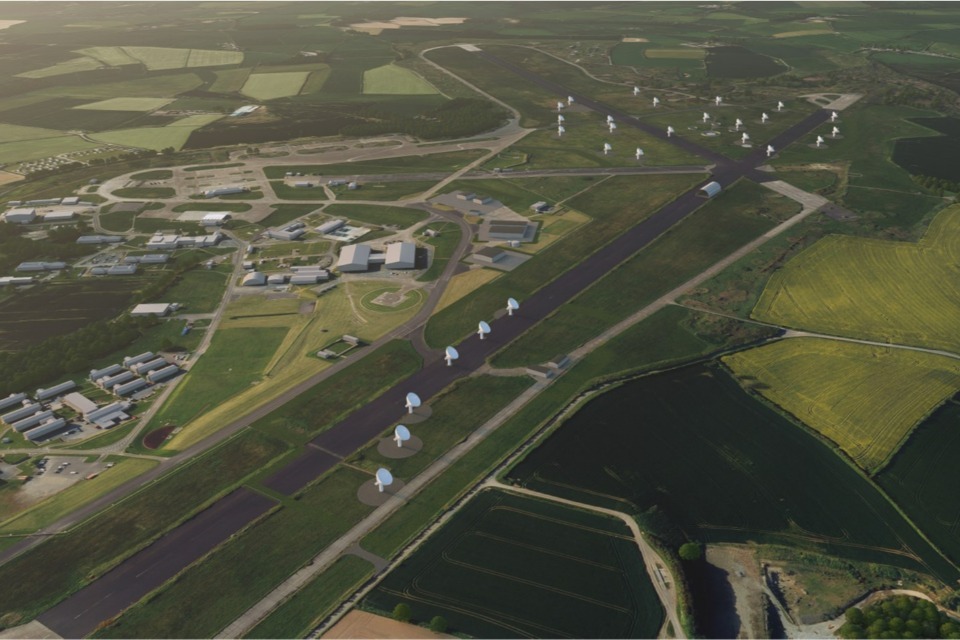
DARC aerial view showing a layout of the radar antennae on the disused airfield alongside the existing buildings at Cawdor Barracks. MOD Crown Copyright.
What is non-ionising radiation?
DARC will bounce radio waves off objects in space to detect, track, and characterise them.
The radio waves used by DARC are non-ionising radiation. They are not hazardous to health because they do not have enough energy to cause harmful ionisation. Radio waves are used in a wide variety of household devices including mobile phones, WiFi and GPS.
Additionally, MOD safety processes will ensure that DARC meets or exceeds international environmental and health standards for non-ionising radiation including those set by the International Commission on Non-Ionizing Radiation Protection (ICNIRP) and the World Health Organisation (WHO).
Levels of non-ionising radiation in the area surrounding the DARC site would be less than or equal to that received from using a mobile phone, presenting no danger to members of the public in the area.
National Space Operations Centre (NSpOC)
This video explains how the National Space Operations Centre works to keep people and assets in the UK safe and secure.
Related information
National Space Strategy
Defence Space Strategy
New deep space radar will transform UK security