Family-related visa holder earnings, employment and Income Tax, year ending March 2026
Published 26 November 2026

© Crown copyright 2026
This publication is licensed under the terms of the Open Government Licence v3.0 except where otherwise stated. To view this licence, visit nationalarchives.gov.uk/doc/open-government-licence/version/3 or write to the Information Policy Team, The National Archives, Kew, London TW9 4DU, or email: psi@nationalarchives.gov.uk.
Where we have identified any third party copyright information you will need to obtain permission from the copyright holders concerned.
This publication is available at https://www.gov.uk/government/statistics/visa-holder-earnings-employment-and-income-tax-statistics-year-ending-march-2026/family-related-visa-holder-earnings-employment-and-income-tax-year-ending-march-2026
1. About this report
This report presents statistics on the earnings, employment and Income Tax liabilities of people granted family-related visas, using Home Office visa records matched to HMRC data. Statistics for further routes are available in the accompanying data tables, Visa holder earnings, employment and Income Tax statistics.
This report covers the period up to and including the year ending (YE) March 2026, with each YE March covering the 12 months from 1 April to 31 March. Figures refer to those whose visa was granted before each YE period and who were eligible to work for at least one month during that period. For example, figures for YE March 2026 include those granted a visa before 1 April 2025.
Earnings figures are based on gross pay from Pay As You Earn (PAYE) only and include both part-time and full-time employment. Where visa holders were not found to have PAYE earnings in every month, earnings are adjusted to be indicative of full-year earnings.
Employment figures show the proportion of visa holders found to have PAYE earnings and should not be interpreted as employment rates. This is because they do not account, for example, for visa holders who were self-employed, on a long-term unpaid absence from work, had alternative payroll arrangements, had left the UK before their visa expired, or may never have arrived in the UK. Some visa holders may have also remained unmatched due to differences between Home Office and HMRC data. These figures are therefore best interpreted as lower bounds.
Income Tax figures relate to Income Tax liabilities deducted through PAYE and are not annually adjusted.
Comparisons between visa routes and over time should be made with caution, as the populations, visa conditions and eligibility requirements can differ between routes and change over time. Further information on the data, methodology and limitations is provided in the User Guide.
Back to ‘Visa holder earnings, employment and Income Tax statistics, YE March 2026’ contents page
This chapter covers Family: Partner (Partner) visa holders and Refugee Family Reunion (RFR) visa holders. Partner visa holders are people joining or remaining with a partner in the UK, while RFR allowed partners and children to join a family member with protection status. These groups do not include dependants on other visa routes, such as work and study routes. RFR has been closed to new applications since September 2025, pending a review.
2. Family-related entry clearance visas
2.1 Earnings and Employment
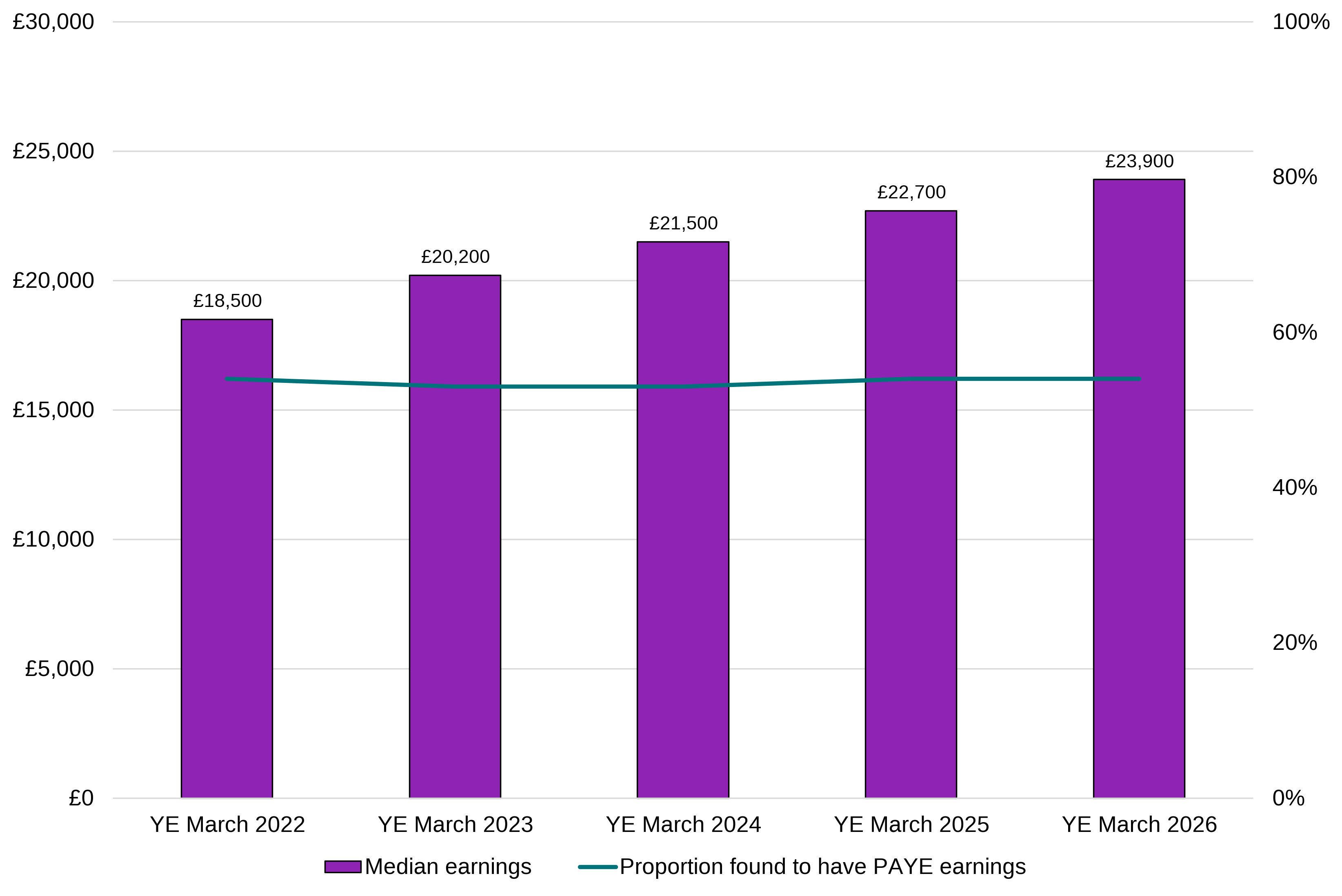
In YE March 2026, median earnings for Partner visa holders were £23,900, while at least 54% had PAYE earnings.
Figure 1: Median earnings and proportions found to have PAYE earnings for Family: Partner visa holders, YE March 2022 to YE March 2026
Source: Visa holder earnings, employment and Income Tax statistics - 1.1_ME_and EC01 & 1.4_PROP_EC04
Notes:
- Proportions found to have PAYE earnings should not be interpreted as employment rates and are best considered lower-bound estimates. See the ‘About the report’ section and the User Guide.
Figure 1 shows that, compared with YE March 2022, median earnings in YE March 2026 were 29% (£5,400) higher for Partner visa holders. Over the same period, the proportion found to have PAYE earnings remained broadly stable at around 53% to 54%.
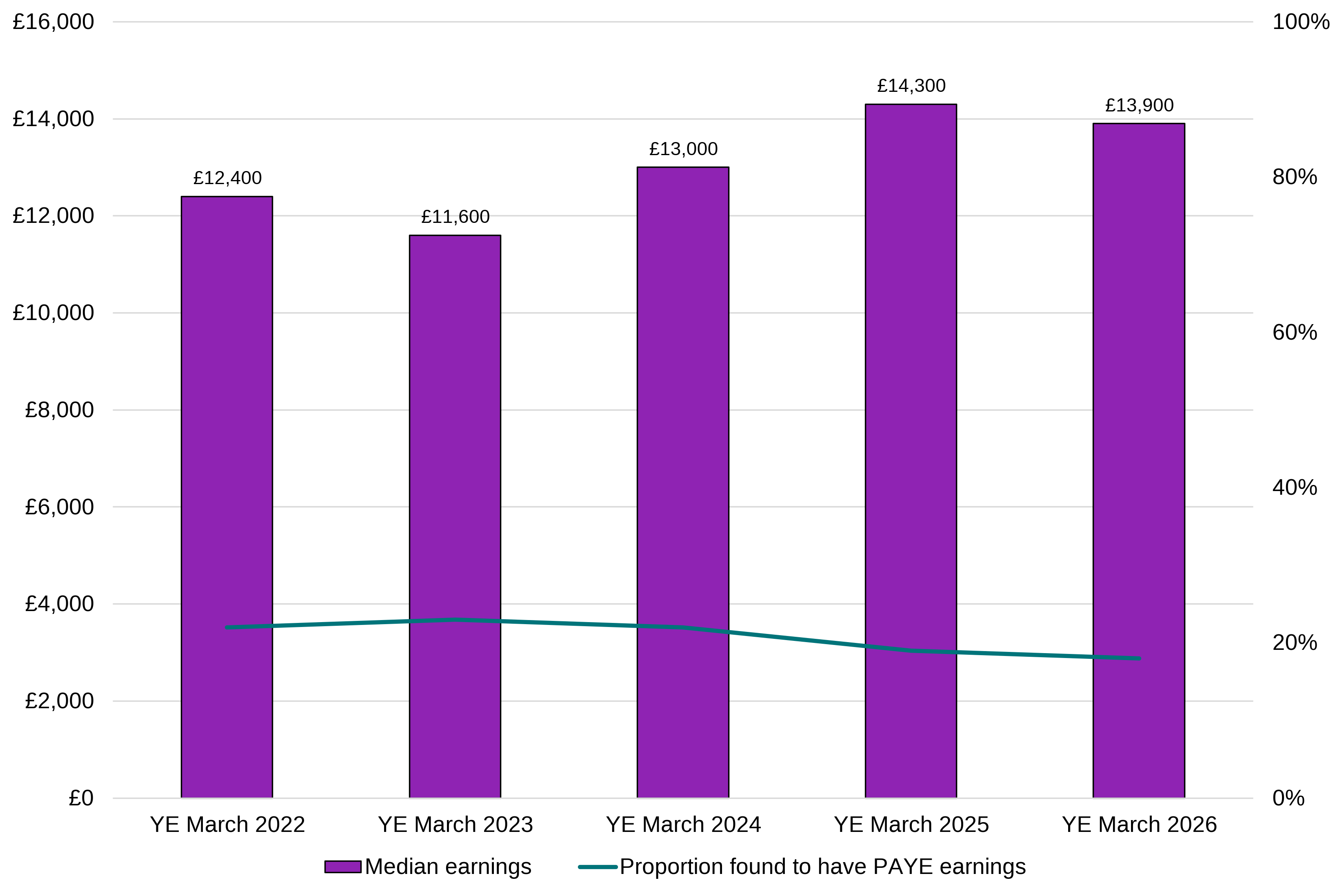
In YE March 2026, median earnings for RFR visa holders were £13,900, while at least 18% had PAYE earnings.
Figure 2: Median earnings and proportions found to have PAYE earnings for Refugee Family Reunion visa holders, YE March 2022 to YE March 2026
Source:Visa holder earnings, employment and Income Tax statistics - 1.1_ME_EC01 and 1.4_PROP_EC04
Notes:
- Proportions found to have PAYE earnings should not be interpreted as employment rates and are best considered lower-bound estimates. See the ‘About the report’ section and the User Guide.
Figure 2 shows that, compared with YE March 2022, median earnings in YE March 2026 were 12% higher for RFR visa holders. Over the same period, the proportion found to have PAYE earnings was lower (18% compared with 22%).
In YE March 2026, RFR visa holders had lower median earnings and proportions found to have PAYE earnings than Partner visa holders. Median earnings for both Partner and RFR visa holders were also lower than for dependants on Work and Student routes. Further findings on these routes are presented in the Work and Study chapters and in the accompanying data tables.
2.2 Earnings and employment by industry
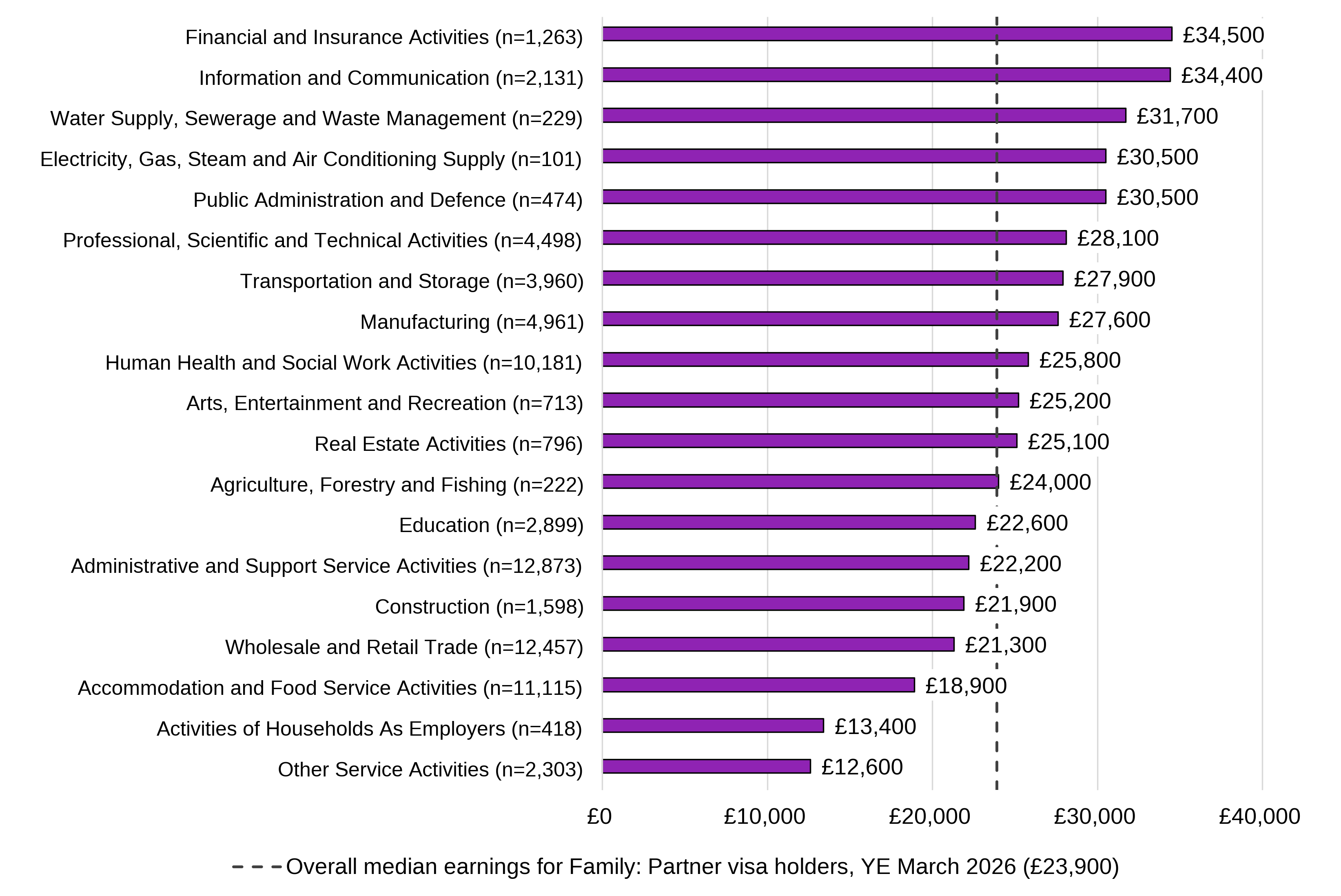
In YE March 2026, ‘Administrative and Support Service Activities’ was the most common industry of highest paying employment for Partner visa holders, while median earnings were highest in ‘Financial and Insurance Activities’ (£34,500).
Figure 3: Median earnings for Family: Partner visa holders, by industry of highest paying employment, YE March 2026
Source:Visa holder earnings, employment and Income Tax statistics - 1.3_ME_EC03
Notes:
1.Industry is based on the Standard Industrial Classification (SIC) 2007 code of a visa holder’s highest paying employer. Where a visa holder had more than one PAYE employment, earnings across all employments are included, so some earnings may therefore relate to other industries.
2.‘n’ refers to the number of visa holders whose highest paying employer was in each industry. Industries with fewer than 100 visa holders are excluded from the figure but are available in the accompanying data tables. Industry proportions presented in this report are based on all industries, including those not shown in the corresponding figure.
In YE March 2026, the most common industries of highest paying employment for Partner visa holders were ‘Administrative and Support Service Activities’ (18%), ‘Wholesale and Retail Trade’ (17%) and ‘Accommodation and Food Service Activities (15%).
Figure 3 shows that, in YE March 2026, median earnings were highest among Partner visa holders whose highest paying employment was in ‘Financial and Insurance Activities’ (£34,500) and ‘Information and Communication’ (£34,400). Among those whose highest paying employment was in ‘Human Health and Social Work Activities’, median earnings were lower for Partner visa holders (£25,800) than for Health and Care Worker main applicants (£33,500).
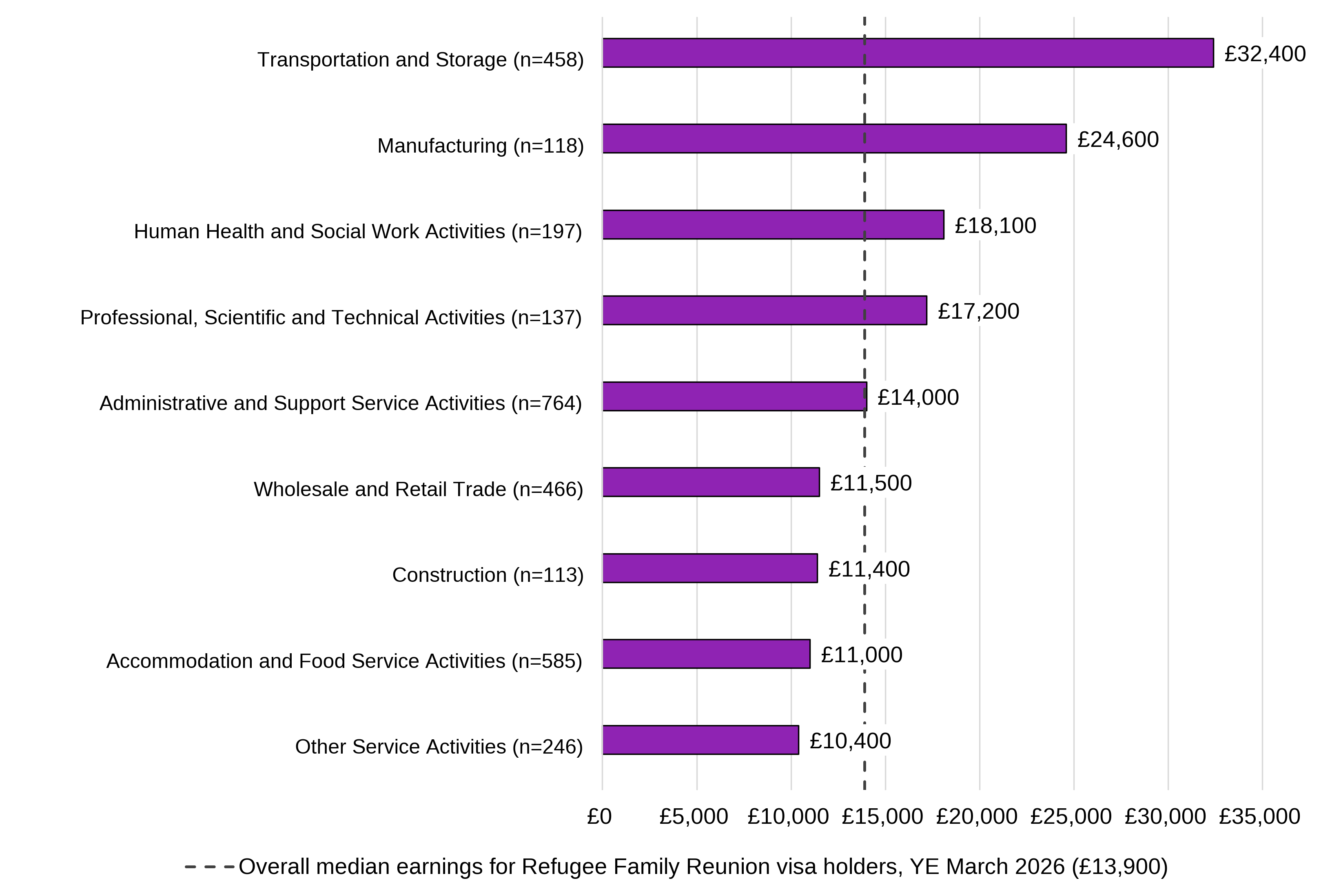
In YE March 2026, ‘Administrative and Support Service Activities’ was the most common industry of highest paying employment for RFR visa holders, while median earnings were highest in ‘Transportation and Storage’ (£32,400).
Figure 4: Median earnings for Refugee Family Reunion visa holders, by industry of highest paying employment, YE March 2026
Source:Visa holder earnings, employment and Income Tax statistics - 1.3_ME_EC03
Notes:
1.Industry is based on the Standard Industrial Classification (SIC) 2007 code of a visa holder’s highest paying employer. Where a visa holder had more than one PAYE employment, earnings across all employments are included, so some earnings may therefore relate to other industries.
2.‘n’ refers to the number of visa holders whose highest paying employer was in each industry. Industries with fewer than 100 visa holders are excluded from the figure but are available in the accompanying data tables. Industry proportions presented in this report are based on all industries, including those not shown in the corresponding figure.
In YE March 2026, the most common industries of highest paying employment for RFR visa holders were ‘Administrative and Support Service Activities (23%), ‘Accommodation and Food Service Activities’ (18%) and ‘Wholesale and Retail Trade’ (14%). Figure 4 shows that median earnings were highest among those whose highest paying employment was in the ‘Transportation and Storage’ industry (£32,400), followed by ‘Manufacturing’ (£24,600) and ‘Human Health and Social Work Activities (£18,100).
2.3 Earnings and Employment by nationality
In YE March 2026, among the 5 most common nationalities for Partner visa holders found to have PAYE earnings, Ghanaian nationals had the highest median earnings (£29,600), while Ghanaian and Nepalese nationals had the highest proportion found to have PAYE earnings (88%). Among RFR visa holders, Eritrean nationals had the highest median earnings (£26,800), while Sri Lankan nationals had the highest proportion found to have PAYE earnings (42%).
Table 1: Median earnings and proportion found to have PAYE earnings, for family-related visa holders by nationality, YE March 2026
| Family-related visa | Nationality | Count found to have PAYE earnings | Median earnings | Proportion found to have PAYE earnings |
|---|---|---|---|---|
| Family: Partner | ||||
| Pakistan | 13,477 | £20,300 | 45% | |
| India | 6,225 | £24,900 | 63% | |
| Nepal | 4,598 | £27,200 | 88% | |
| Ghana | 3,789 | £29,600 | 88% | |
| Nigeria | 3,121 | £26,600 | 74% | |
| Refugee Family Reunion | ||||
| Eritrea | 775 | £26,800 | 36% | |
| Iran | 494 | £11,000 | 12% | |
| Syria | 225 | £11,300 | 6% | |
| Sri Lanka | 203 | £12,000 | 42% | |
| Pakistan | 162 | £14,000 | 34% |
Source:Visa holder earnings, employment and Income Tax statistics - 1.2_ME_EC02 and 1.5_PROP_EC05
Notes:
- Lists the 5 most common nationalities among family-related visa holders eligible to work for at least one month in YE March 2026.
- Proportions found to have PAYE earnings should not be interpreted as employment rates and are best considered lower-bound estimates. See the ‘About the report’ section and the User Guide.
Table 1 shows that, among the 5 most common nationalities for Partner visa holders, Ghanaian nationals had the highest median earnings (£29,600), followed by Nepalese (£27,200) and Nigerian nationals (£26,600). The proportion found to have PAYE earnings was highest for Ghanaian and Nepalese nationals, at 88%.
Among the 5 most common nationalities for RFR visa holders, Eritrean nationals had the highest median earnings (£26,800), considerably higher than the other nationalities shown. The proportion found to have PAYE earnings was highest for Sri Lankan nationals, at 42%.
Differences in earnings by nationality may partly reflect variation in pay across industries in which nationalities on different visa routes tended to work.
2.4 Income Tax liabilities
In YE March 2026, median Income Tax liabilities for Partner and RFR visa holders were £1,900 and £1,300 respectively.
Table 2: Income Tax liability for family-related visas, YE March 2026
| Family-related visa | Count of those found to have a PAYE Income Tax liability | Total Income Tax liability among those found to be liable | Median Income Tax liability |
|---|---|---|---|
| Family: Partner | 55,826 | £169 million | £1,900 |
| Refugee Family Reunion | 1,656 | £3 million | £1,300 |
Source:Visa holder earnings, employment and Income Tax statistics - 1.7_IT_EC07
Table 2 shows that, among those found to be liable for Income Tax in YE March 2026, median Income Tax liability was £1,900 for Partner visa holders and £1,300 for RFR visa holders.
These were broadly similar to median liabilities for dependants on the Skilled Worker (£2,500), Health and Care Worker (£2,500) and Student (£1,800) routes. However, a lower proportion of Partner and RFR visa holders were found to be liable for Income Tax. When considering all visa holders eligible to earn, average Income Tax liabilities were therefore lower for these family-related routes than for dependants on the Skilled Worker, Health and Care Worker and Student routes.
2.5 Family-related extensions
Partner visa holders are the only family-related route included in these extension of stay statistics. In YE March 2026, Partner main applicants granted an extension of stay had median earnings of £27,700 and at least 67% had PAYE earnings. Median Income Tax liability was £2,900. Further breakdowns are available in the accompanying data tables.
3. Other related data
In 2025, the Home Office published a research and analysis report: Sponsored Work and Family visa earnings, employment and Income Tax. Family-related visas were presented collectively in that report, while this release presents Partner and RFR separately and introduces more detailed breakdowns by nationality, industry and applicant type.
Subsequent improvements to underlying data, matching methodology and presentation have since been made. These figures should be used in preference to those published previously.
The Home Office publishes Immigration system statistics, a quarterly release covering people coming to the UK (including via illegal routes), extensions of stay, EUSS, citizenship, asylum, detentions, returns and stopping immigration crime.
The Home Office also publishes a range of research and statistics which can be found on the migration analysis pages.
4. Feedback
We welcome feedback on Visa holder earnings, employment and Income Tax statistics, which can be provided by email to:Managed_Migration_Research@homeoffice.gov.uk
Press enquiries should be made via telephone at: 0300 123 3535.