Venture Capital Trusts statistics: 2026
Updated 21 May 2026

© Crown copyright 2026
This publication is licensed under the terms of the Open Government Licence v3.0 except where otherwise stated. To view this licence, visit nationalarchives.gov.uk/doc/open-government-licence/version/3 or write to the Information Policy Team, The National Archives, Kew, London TW9 4DU, or email: psi@nationalarchives.gov.uk.
Where we have identified any third party copyright information you will need to obtain permission from the copyright holders concerned.
This publication is available at https://www.gov.uk/government/statistics/venture-capital-trusts-2026/venture-capital-trusts-statistics-2025
1. Main points and summary
Venture Capital Trusts (VCTs) issued shares to the value of £881 million in 2024 to 2025, which is an increase compared with the 2023 to 2024 figure of £872 million.
The number of VCTs raising funds has remained consistent in the 2024 to 2025 tax year at 45.
The number of VCTs managing funds has decreased by 3, to 46 in the tax year 2024 to 2025.
In 2024 to 2025, Venture Capital Trust (VCT) investors claimed Income Tax (IT) relief on £825 million of investment. This is an increase of 1% from 2023 to 2024.
The number of VCT investors who claimed Income Tax relief has decreased by 8% to 22,430 in 2024 to 2025.
2. Introduction
2.1 About these statistics
This is an annual Accredited Official Statistics publication of Venture Capital Trusts (VCTs) statistics.
Section 3 (number of VCTs and funds raised) includes figures covering the period up to tax year 2024 to 2025. This section utilizes HMRC administrative data, improving the quality of the underlying data. Section 4 (investors claiming relief on VCT investments) includes first estimates for 2024 to 2025. The deadline for submitting Self Assessment returns for the tax year 2024 to 2025 was 31 January 2026 but individuals may submit late claims. Therefore, the data for 2024 to 2025 is partial for this publication and has been uplifted to account for potential late returns. Further information about the data sources and methodology can be found in the Background Quality Report.
In Table 1, figures for the 2023 to 2024 tax year are revised and are provisional for the 2024 to 2025 tax year.
In Tables 2a and 2b, figures prior to the 2024 to 2025 tax year are revised. Figures for the 2024 to 2025 tax year are provisional and are uplifted to account for potential late returns.
The next release of these statistics is expected to be in Spring 2027. If you would like to comment on these statistics, please see the contacts named at the end.
2.2 What are Venture Capital Trusts?
The VCT scheme, introduced in 1995, is one of three tax-based venture capital schemes that were active in the 2024 to 2025 tax year. VCTs raise funds for investments, normally annually, through new and/or top-up share issues to investors.
For more information about Venture Capital Trusts and the policy background, see the Venture Capital Trusts statistics: Introductory note.
3. Amount of funds raised and number of Venture Capital Trusts
The amount of funds raised and number of VCTs is derived from a combination of HMRC administrative data and other publicly available data sources, primarily FE Investegate VCTs information and news announcements. In the 2024 and 2025 publications, the amount of funds raised and number of VCTs were presented as separate overlapping series derived from different data sources.
For this publication, the two data sources have now been combined into a single series with data from 1995 to 1996 up until 2018 to 2019 derived from public data sources and data from 2019 to 2020 onwards utilizing HMRC administrative data.
Amounts raised have been rounded to the nearest £5 million for data up to 2016 to 2017 and £1 million for 2017 to 2018 onward.
Table 1: Amount of funds raised and number of Venture Capital Trusts (VCTs) by year, 1995 to 1996 to 2024 to 2025
| Year | Funds raised (£ million) | VCTs raising funds | VCTs managing funds | Rate of IT relief (%) |
|---|---|---|---|---|
| 1995-96 | 160 | 12 | 12 | 20 |
| 1996-97 | 170 | 13 | 18 | 20 |
| 1997-98 | 190 | 16 | 26 | 20 |
| 1998-99 | 165 | 11 | 34 | 20 |
| 1999-00 | 270 | 20 | 43 | 20 |
| 2000-01 | 450 | 38 | 61 | 20 |
| 2001-02 | 155 | 45 | 70 | 20 |
| 2002-03 | 70 | 32 | 71 | 20 |
| 2003-04 | 70 | 31 | 71 | 20 |
| 2004-05 | 520 | 58 | 98 | 40 |
| 2005-06 | 780 | 82 | 108 | 40 |
| 2006-07 | 270 | 32 | 121 | 30 |
| 2007-08 | 230 | 54 | 131 | 30 |
| 2008-09 | 150 | 46 | 129 | 30 |
| 2009-10 | 340 | 68 | 122 | 30 |
| 2010-11 | 350 | 78 | 128 | 30 |
| 2011-12 | 325 | 76 | 124 | 30 |
| 2012-13 | 400 | 65 | 118 | 30 |
| 2013-14 | 440 | 66 | 97 | 30 |
| 2014-15 | 435 | 57 | 94 | 30 |
| 2015-16 | 445 | 45 | 80 | 30 |
| 2016-17 | 570 | 38 | 75 | 30 |
| 2017-18 | 705 | 43 | 68 | 30 |
| 2018-19 | 716 | 42 | 61 | 30 |
| 2019-20 | 606 | 43 | 60 | 30 |
| 2020-21 | 682 | 40 | 57 | 30 |
| 2021-22 | 1112 | 45 | 52 | 30 |
| 2022-23 | 1051 | 45 | 49 | 30 |
| 2023-24 | 872 | 45 | 49 | 30 |
| 2024-25 | 881 | 45 | 46 | 30 |
Venture Capital Trusts (VCTs) have raised funds to the value of £881 million in 2024 to 2025, which is 1% higher compared to the 2023 to 2024 figure of £872 million.
Figure 1: Amount of funds raised by VCTs (£ million), 1995 to 1996 to 2024 to 2025
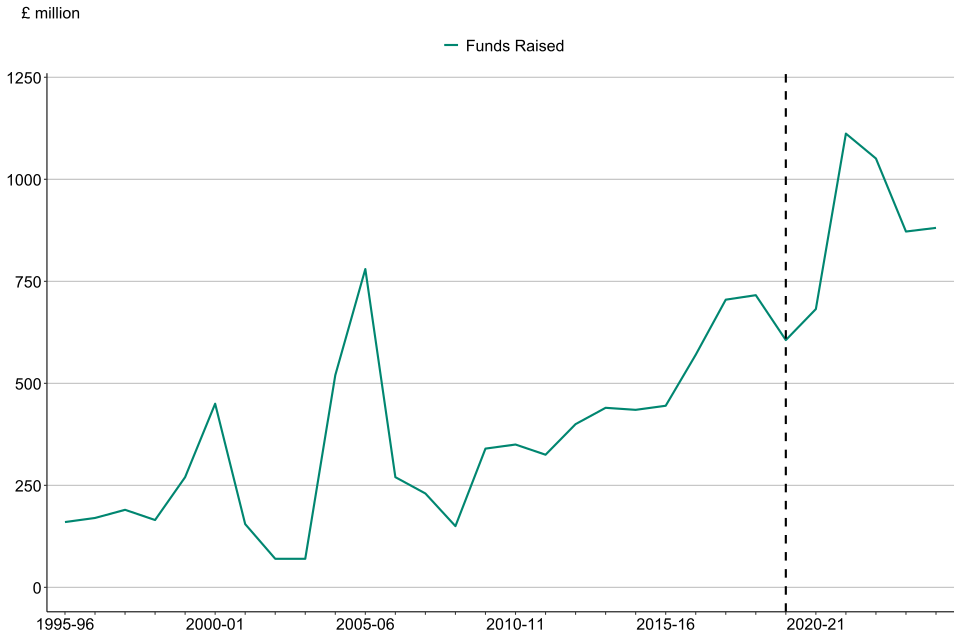
Figure 1 reports the funds raised by VCTs using publicly available data between tax years 1995 to 1996 to tax year 2018 to 2019. From the 2019 to 2020 tax year, funds raised are presented using HMRC administrative data, with the change in data source marked by the black vertical dashed line. The amount of funds raised by VCTs has been on a rising trend in recent years and has more than doubled since the 2009 to 2010 tax year. Much of this increase is likely due to the increasing appeal of the tax benefits of VCT investment as an alternative or addition to pension investment where allowances have been reduced or capped in the same period. This made traditional pensions less attractive, and the introduction of pension freedoms, which allow for cash to be taken out of the pot for investment, rather than buying an annuity, means there is also more freedom for investment in alternatives such as VCTs.
Whilst the impacts of Covid-19 would have affected the end of the 2019 to 2020 tax year, funds raised in 2020 to 2021 increased slightly despite covering the main pandemic period. Funds raised in the 2021 to 2022 tax year increased substantially which may be, in part, the result of a strong recovery from the Covid-19 pandemic. Additionally, the VCT market broadly follows the wider venture capital market and 2021 to 2022 was a particularly strong fundraising year for the venture capital industry. In the tax year 2022 to 2023, the slight decrease in amount of funds raised is likely a reflection of a slowdown in the wider venture capital industry, but the value of funds raised remained the second highest on record. This trend is continued into the 2023 to 2024 tax year with a further decrease in the value of funds raised, again following the trends seen in the wider venture capital industry.
The value of funds raised in 2024 to 2025 remained broadly consistent with the previous year, with a 1% increase in value.
Figure 2: Number of VCTs raising and managing funds, 1995 to 1996 to 2024 to 2025
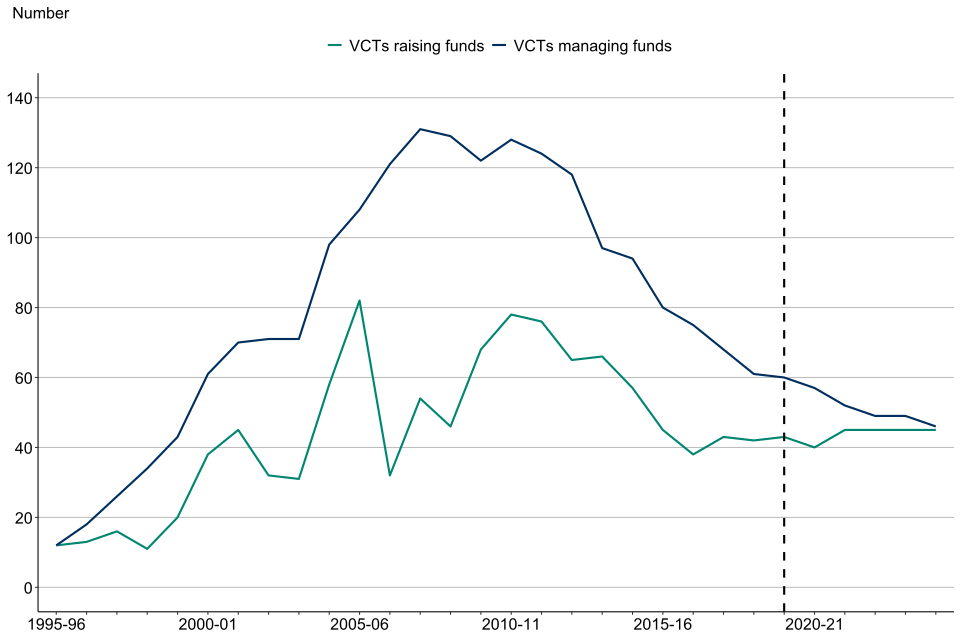
Figure 2 reports the number of VCTs raising and managing funds using publicly available data for tax year 1995 to 1996 to tax year 2018 to 2019. From tax year 2019 to 2020 onwards, funds raised are presented using HMRC administrative data. The change in series is marked by the black vertical dashed line.
In the past, the amount of funds raised by VCTs and the number of VCTs raising funds have been closely linked. However, this has been less evident in recent years where similar amounts of funds have been raised by a smaller number of large VCTs. This trend continued into 2022 to 2023 with funds raised reaching the second highest level but the number of VCTs raising funds remaining consistent. In 2023 to 2024 there is a further decrease in the value of funds raised, whilst the number of VCTs raising funds remains consistent. The number of VCTs raising funds in 2024 to 2025 has remained consistent at 45 with only a 1% increase in the value of funds raised in this tax year.
As shown in Figure 2, VCTs have been merging over time to achieve economies of scale. However, it is worth noting that there are still new entrants into the VCT industry.
VCTs managing funds include VCTs which raised funds in the tax year and also those VCTs which managed funds raised in previous years but not those who have entered into liquidation. The number of VCTs managing funds has decreased in 2024 to 2025 compared to the previous year. Since 2010 to 2011, the number of VCTs managing funds has generally been decreasing, dropping to 46 in 2024 to 2025.
4. Investors claiming Income Tax relief and amounts invested
The amount of VCT investment on which Income Tax relief was claimed increased by 1% in 2024 to 2025, compared to the previous year. The number of investors has decreased by 8% to 22,430 in 2024 to 2025. This information only covers claims made through Self Assessment and will not cover investors making Income Tax relief claims through other systems (for example PAYE) or those not making any claims.
Table 2a and Table 2b present the distribution of investors claiming Income Tax relief under the VCT scheme, and the amounts invested, respectively.
Total figures provided in Tables 2a and 2b on the amount of investment on which Income Tax relief was claimed are not directly comparable with the figures on the amount of investment received by VCTs in a tax year shown in Table 1, as some relief could be claimed outside Self Assessment, or not claimed at all.
4.1 Number of investors claiming VCT relief
In the 2024 to 2025 tax year, there was a significant decrease in the number of VCT investors compared to the previous year.
Most investors tend to invest under £50,000 into VCT funds. The average amount invested by an individual in the 2024 to 2025 tax year was around £37,000.
Numbers have been rounded to the nearest 5. Totals may not sum due to rounding.
Table 2a: Number of investors claiming VCT relief by size of investment, 2022 to 2023 to 2024 to 2025
| Investment band | 2022-23 | 2023-24 | 2024-25 |
|---|---|---|---|
| Up to £1,000 | 1,635 | 2,185 | 1,910 |
| £1,000 to £2,500 | 1,405 | 1,760 | 1,480 |
| £2,500 to £5,000 | 2,320 | 2,425 | 1,850 |
| £5,000 to £10,000 | 4,500 | 4,195 | 3,645 |
| £10,000 to £15,000 | 2,295 | 2,015 | 1,895 |
| £15,000 to £20,000 | 2,585 | 2,210 | 2,120 |
| £20,000 to £25,000 | 1,770 | 1,390 | 1,305 |
| £25,000 to £50,000 | 4,730 | 3,860 | 3,765 |
| £50,000 to £75,000 | 1,530 | 1,180 | 1,260 |
| £75,000 to £100,000 | 1,400 | 1,095 | 1,170 |
| £100,000 to £150,000 | 815 | 620 | 645 |
| £150,000 to £200,000 | 1,605 | 1,335 | 1,385 |
| Total | 26,595 | 24,270 | 22,430 |
Figure 3: Distribution of the proportion of investors claiming VCT relief by size of investment 2023 to 2024 to 2024 to 2025

Figure 3 shows the distribution of investors claiming VCT relief grouped by size of investment. Around 80% of VCT investors claimed income tax relief under the VCT scheme for an investment of £50,000 or less; the largest number being in the £25,000 to £50,000 group with 17% of the total followed closely by the £5,000 to £10,000 group with 16% of the total. In 2024 to 2025 the proportion of VCT investors in the higher investment size categories (above £25,000) increased slightly compared to the 2023 to 2024 tax year.
Figure 4: Number of investors claiming VCT relief via Self Assessment, 2004 to 2005 to 2024 to 2025
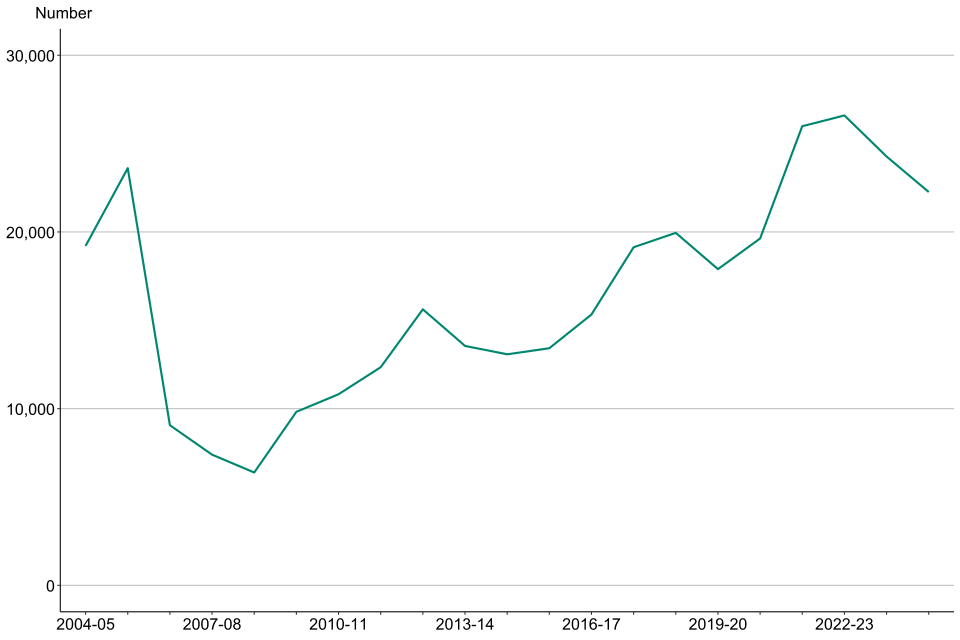
Figure 4 shows a time series of the number of investors who have claimed VCT relief from tax years 2004 to 2005 to 2024 to 2025. The increase in investors between 2005 to 2006 and 2018 to 2019, as well as the rise in funds raised between this period shown in table 1, reflect the impacts of the pension changes and the Patient Capital Review. The tax year 2021 to 2022 saw an increase in the number of investors. This continued into 2022 to 2023 which saw the highest number of investors since 2004 to 2005. In the 2023 to 2024 tax year, the number of investors decreased by 9% compared to the 2022 to 2023 tax year. This trend continued into the 2024 to 2025 tax year, with an 8% decrease compared to 2023 to 2024.
4.2 Amounts invested by VCT investors
Table 2b shows an increase of 1% in the amount of relief claimed by VCT investors in 2024 to 2025.
Amounts have been rounded to the nearest £5 million. Totals may not sum due to rounding.
Table 2b: Amount of investment on which VCT relief was claimed by size of investment, 2022 to 2023 to 2024 to 2025
| Investment band | 2022-23 | 2023-24 | 2024-25 |
|---|---|---|---|
| Up to £1,000 | 0 | 0 | 0 |
| £1,000 to £2,500 | 0 | 5 | 0 |
| £2,500 to £5,000 | 10 | 10 | 5 |
| £5,000 to £10,000 | 40 | 35 | 30 |
| £10,000 to £15,000 | 30 | 25 | 25 |
| £15,000 to £20,000 | 50 | 40 | 40 |
| £20,000 to £25,000 | 40 | 35 | 30 |
| £25,000 to £50,000 | 185 | 150 | 145 |
| £50,000 to £75,000 | 95 | 75 | 80 |
| £75,000 to £100,000 | 130 | 105 | 110 |
| £100,000 to £150,000 | 100 | 75 | 80 |
| £150,000 to £200,000 | 315 | 260 | 270 |
| Total | 995 | 815 | 825 |
Figure 5: Distribution of the proportion of investment for which VCT relief was claimed by size of investment 2023 to 2024 to 2024 to 2025

In Figure 5, we see that the largest category of investment by amount in the 2024 to 2025 tax year was investments between £150,000 to £200,000. More precisely, 33% of the total amount invested is accounted for by only 6% of investors.
Figure 6: Comparison of the amount of investment on which relief was claimed via Self Assessment and total funds raised (£ million), 2004 to 2005 to 2024 to 2025
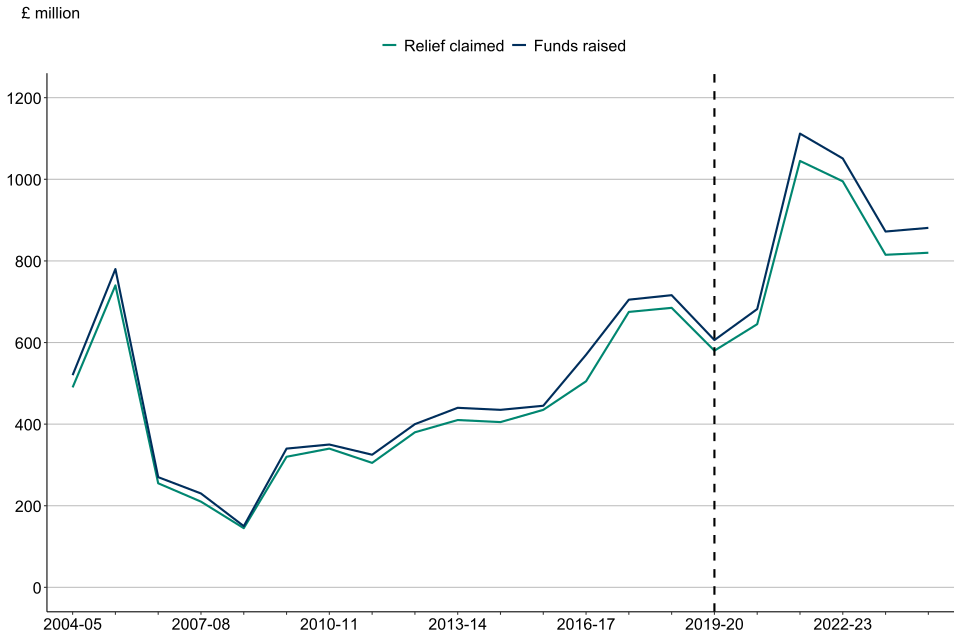
Figure 6 shows that the amount of relief claimed, and total funds raised by VCTs follow largely consistent trends year on year. From tax year 2019 to 2020, funds raised are presented using the new series. The change in series is marked by the black vertical dashed line. In the 2024 to 2025 tax year, approximately 93% of the total VCT investments were claimed through Self Assessment. The remaining amounts are assumed to be either claimed outside Self Assessment or not claimed at all.
The tax year 2021 to 2022 was a record-breaking year for the amount of investment Income Tax relief was claimed on, which is consistent with funds raised by VCTs in 2021 to 2022 also reaching record breaking levels. In tax year 2022 to 2023 there was a decrease in the amount of relief claimed which was consistent with the decrease in funds raised by VCTs. This trend continued into the 2023 to 2024 tax year with the decrease in relief claimed falling further, remaining in line with the decrease seen in funds raised by VCTs in this tax year. In the 2024 to 2025 tax year, the difference between the amount of funds raised and the amount of investment on which relief was claimed remained consistent with the previous year.
5. Contact
Statistical contacts: M Hindley and M Solonina; venturecapital.statistics@hmrc.gov.uk
Queries relating to investing in VCTs: Venture Capital Reliefs Team; enterprise.centre@hmrc.gov.uk