Vehicle licensing statistics, United Kingdom: 2025
Published 29 April 2026

© Crown copyright 2026
This publication is licensed under the terms of the Open Government Licence v3.0 except where otherwise stated. To view this licence, visit nationalarchives.gov.uk/doc/open-government-licence/version/3 or write to the Information Policy Team, The National Archives, Kew, London TW9 4DU, or email: psi@nationalarchives.gov.uk.
Where we have identified any third party copyright information you will need to obtain permission from the copyright holders concerned.
This publication is available at https://www.gov.uk/government/statistics/vehicle-licensing-statistics-2025/vehicle-licensing-statistics-united-kingdom-2025
About this release
This release presents statistics on motor vehicles in the United Kingdom (UK) covering the period up to December 2025. They are based on administrative data held by the Driver and Vehicle Licensing Agency (DVLA). These statistics include:
- new vehicle registrations
- all licensed vehicles
- zero emission vehicles
A range of detailed data tables and large data files are available online. Also available is a full list of definitions used in this release.
These statistics cover the whole of the United Kingdom, which is Great Britain (England, Scotland, and Wales) and Northern Ireland. Data prior to July 2014 covers Great Britain only.
If you have any feedback on this release, please contact vehicle.stats@dft.gov.uk.
What vehicles are included?
Licensed vehicles include vehicles that are licensed for use on UK roads, which typically requires paying Vehicle Excise Duty (VED). Vehicles that are not licensed should typically be given a Statutory Off Road Notification (SORN). The keeper can then re-license their vehicle at any time.
New registration vehicles refer to vehicles that are registered with the Driver and Vehicle Licensing Agency (DVLA) for the first time. This includes both new vehicles and vehicles imported into the UK at the point of first UK registration.
Road using vehicles are defined as vehicles expected to make significant use of public highways and to serve as a mode of transport. Introduced in 2021, this concept supports more accurate interpretation of vehicle statistics by excluding certain vehicle types, such as those that rarely utilise public roads. Approximately 98% of vehicles in the DVLA database meet this definition, with exceptions detailed in Table 2 of the notes and definitions. References to road using vehicles are explicitly labelled throughout this publication.
For further information, see vehicle licensing statistics: notes and definitions
These are accredited official statistics and were independently reviewed by the Office for Statistics Regulation in April 2012. For more information, see the About these statistics section.
Headline figures
In 2025, the number of new vehicle registrations showed an increase of less than 1%, when compared to 2024. At the end of December 2025, there were 2,012,000 licensed zero emission vehicles, representing 4.8% of all licensed vehicles, with 1,874,000 being road using.
Comparing 2025 with 2024, in the UK there were:
- 2,617,000 vehicles registered for the first time, an increase of less than 1% (VEH0150)
- 528,000 zero emission vehicles registered for the first time, an increase of 24% (VEH1153b), with 510,000 being road using (VEH1153a)
- 473,000 zero emission cars registered for the first time, an increase of 24%
At the end of December 2025, compared to December 2024, in the UK there were:
- 42.3 million licensed vehicles, an increase of 1% (VEH0101a)
- 2,012,000 licensed zero emission vehicles, an increase of 31.2% (VEH1103b), with 1,874,000 being road using (VEH1103a)
- 1,737,000 zero emission cars, an increase of 35%
At the end of 2025 zero emission vehicles accounted for 4.8% of all licensed vehicles, an increase of 1.1 percentage points from the end of 2024.
New registrations of vehicles: overview
There were 2.6 million vehicles registered for the first time in the UK during 2025. This was relatively unchanged compared to 2024 (VEH0150).
Table 1: Vehicles registered for the first time in the year by body type, UK, 2025 and 2024 (VEH0150)
| Body type | 2025: New registrations (thousands) | 2024: New registrations (thousands) | New registrations (year on year % change) |
|---|---|---|---|
| Total | 2,617 | 2,605 | 0.5 |
| Cars | 2,071 | 2,000 | 3.6 |
| Light goods vehicles (LGVs) | 330 | 363 | -9.2 |
| Heavy goods vehicles (HGVs) | 47 | 51 | -6.9 |
| Motorcycles | 100 | 123 | -18.6 |
| Buses and coaches | 10 | 10 | 3.9 |
| Other vehicles | 58 | 58 | 0.7 |
Monthly seasonality
When DVLA issues a new registration plate series, there is usually a peak in new vehicle registrations. Since 1999, new plates have been issued twice a year, in March and September.
New registrations of zero emission vehicles
Zero emission vehicles (ZEVs) are vehicles that are reported to emit 0g of carbon dioxide (CO2) from the tailpipe for every kilometre travelled, currently only including:
- battery electric vehicles (BEVs)
- fuel cell electric vehicles (FCEVs, sometimes referred to as hydrogen powered)
There were 473,000 zero emission cars registered for the first time in 2025, an increase of 24% from 2024. Zero emission cars accounted for 23% of all new car registrations, compared to 19% in 2024.
There were 31,000 road using zero emission light goods vehicles (LGVs) registered for the first time in 2025, an increase of 36%, compared to 2024. Zero emission LGVs accounted for 9% of all new registrations on the road, compared to 6% in 2024.
Table 2: Zero emission road using vehicles registered for the first time by body type, with previous year and total new registrations comparison, UK, 2025 and 2024 (VEH1153a)
| Body type | 2025: New registrations of road using zero emission vehicles | 2025: Proportion (%) of all new road using vehicle registrations that are zero emission | 2024: Proportion (%) of all new road using vehicle registrations that are zero emission |
|---|---|---|---|
| Total | 510,332 | 19.9 | 16.1 |
| Cars | 473,226 | 22.8 | 19.1 |
| Light goods vehicles | 30,524 | 9.3 | 6.2 |
| Heavy goods vehicles | 632 | 1.4 | 0.6 |
| Motorcycles | 3,233 | 3.2 | 3.0 |
| Buses and coaches | 2,614 | 25.4 | 17.4 |
| Other vehicles | 103 | 2.8 | 3.4 |
Heavy vans
Cars and light goods vehicles (up to and including 3.5 tonnes) can typically be driven by those with a category B driving licence. Since July 2018, people with this licence can also drive alternatively fuelled vehicles up to 4.25 tonnes (which are classified as Heavy Goods Vehicles, HGVs, those over 3.5 tonnes) with some additional training. The statistics presented here place these “heavy vans” into the light goods vehicle category to align with these policy changes.
Chart 1: Zero emission road using car and light goods vehicles (LGVs) registered for the first time as a percentage of all new registrations, UK, 2021 to 2025 (VEH1153a)
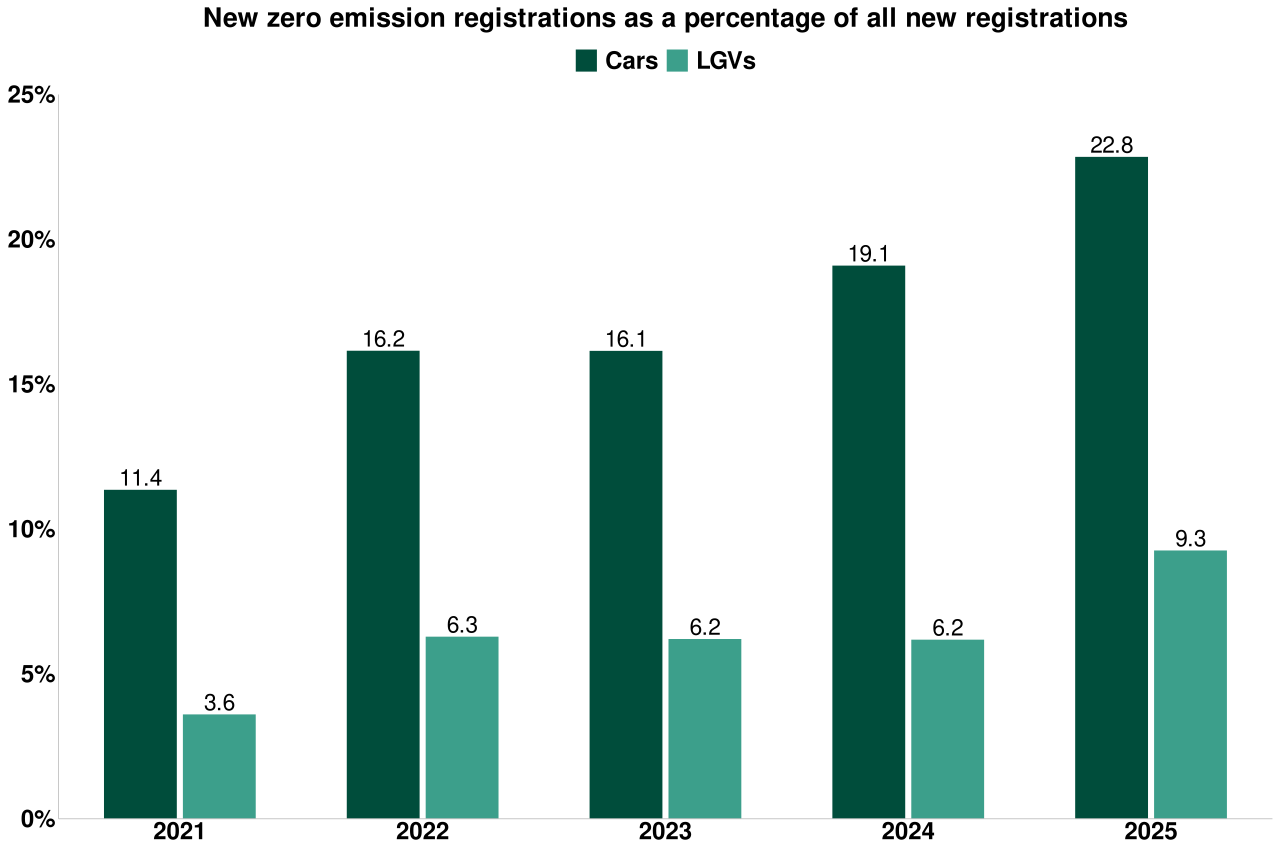
Chart 1 shows the new zero emission registrations of cars and road using light goods vehicles (LGVs) as a percentage of all new registrations since 2021. In 2025, zero emission cars accounted for 23% of new car registrations with road using zero emission LGVs accounting for 9%.
Longer term fuel trends
Chart 2: Thousands of cars registered for the first time by fuel type, UK, 2015 to 2025 (VEH1153a)
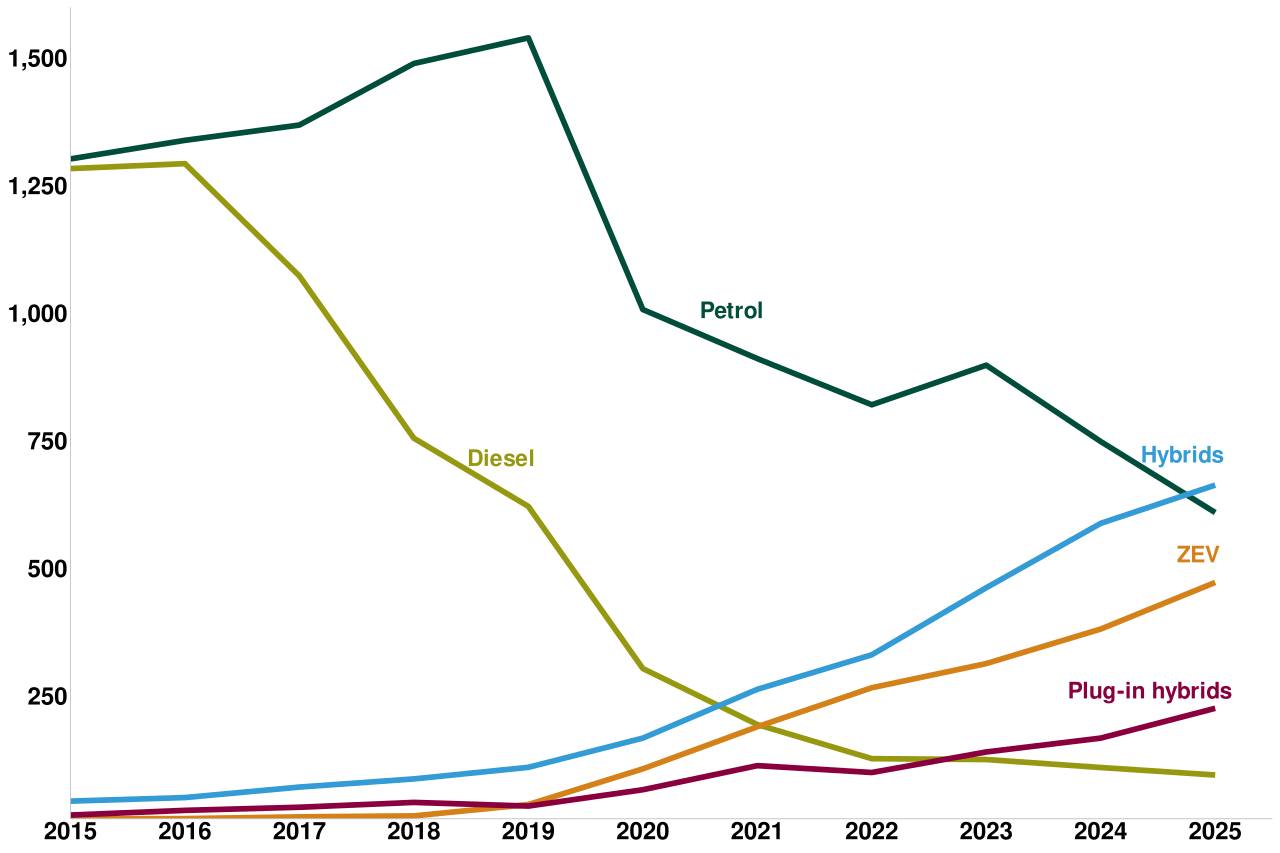
Chart 2 shows diesel car new registrations have followed a clear downward trend since 2016 and petrol car new registrations have generally declined since 2019, despite an increase in 2023. Registrations of new petrol cars fell from 750,000 in 2024 to 610,000 in 2025, a decrease of 19%. Both hybrid and plug‑in hybrid car new registrations have increased in recent years. New registrations of road using zero emission vehicles (ZEVs) have also risen steadily, reaching 473,000. In 2025, ZEVs accounted for 23% of all new car registrations, up from 19% in 2024.
Keepership
Registered keeper
Every registered vehicle, unless it is in the process of changing hands, has a registered keeper, whose details are held by DVLA. These statistics are based on the provided title of the keeper (for example Mr, Mrs, Ms).
Note that the registered keeper of a vehicle is not necessarily the person who uses it, and the vehicle is not always based at the keeper’s contact address. This is particularly true for company or fleet vehicles.
Chart 3: Proportion of new car registrations by keepership and fuel type, UK, 2025 (VEH1153b)
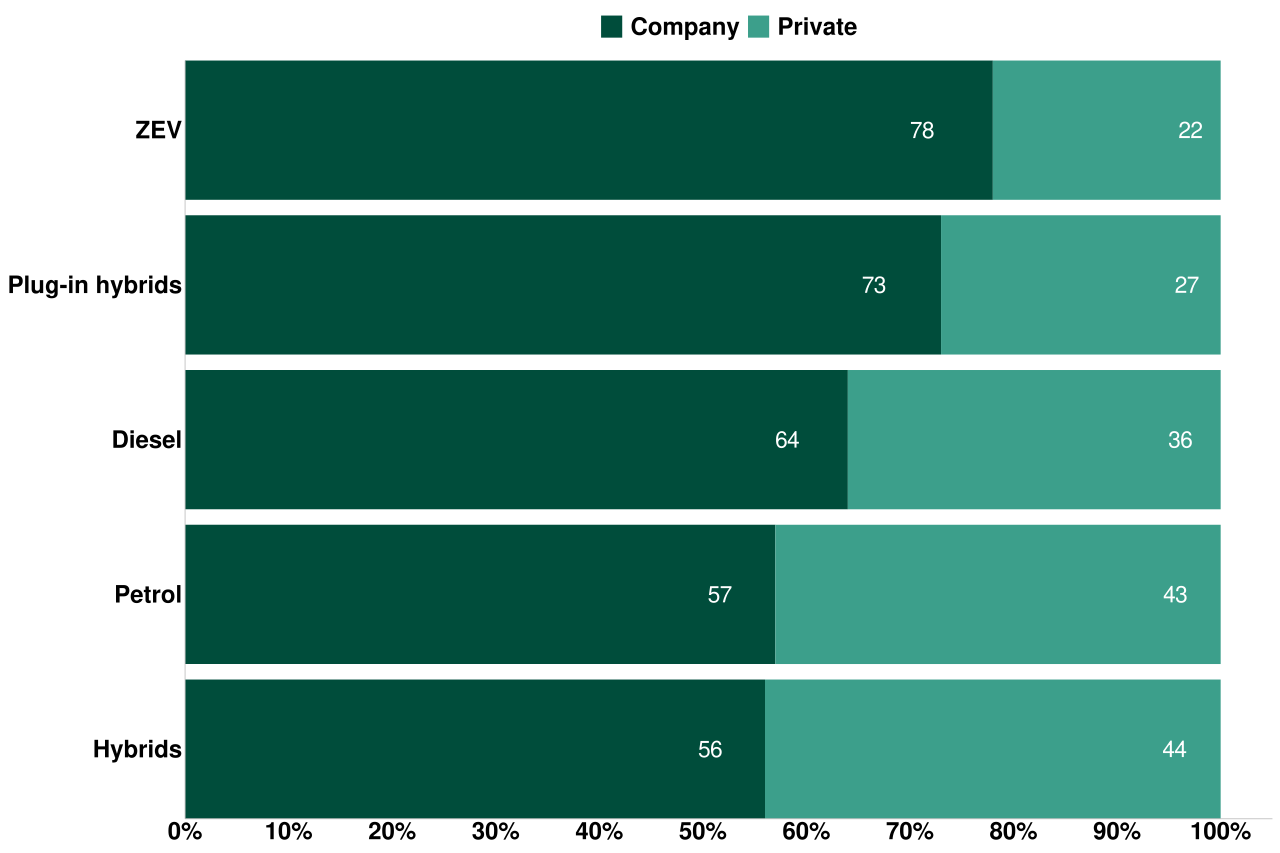
Chart 3 shows that zero emission cars have the highest proportion of new registrations to company keepers at 78%. This compares to:
- 73% for Plug-in hybrids
- 64% for Diesel
- 57% for Petrol
- 56% for Hybrids
Common zero emission generic models
Generic model
Generic model is a grouping of models to help compare models on the road.
Manufacturers vary in their approach on how many model versions they give a particular range of vehicles. For example, there are 3 model versions for Tesla Model 3, but there are over 800 model versions for Ford Fiesta.
Chart 4: Top 10 generic models for zero emission road using vehicles registered for the first time, UK, 2025 (VEH0181b)
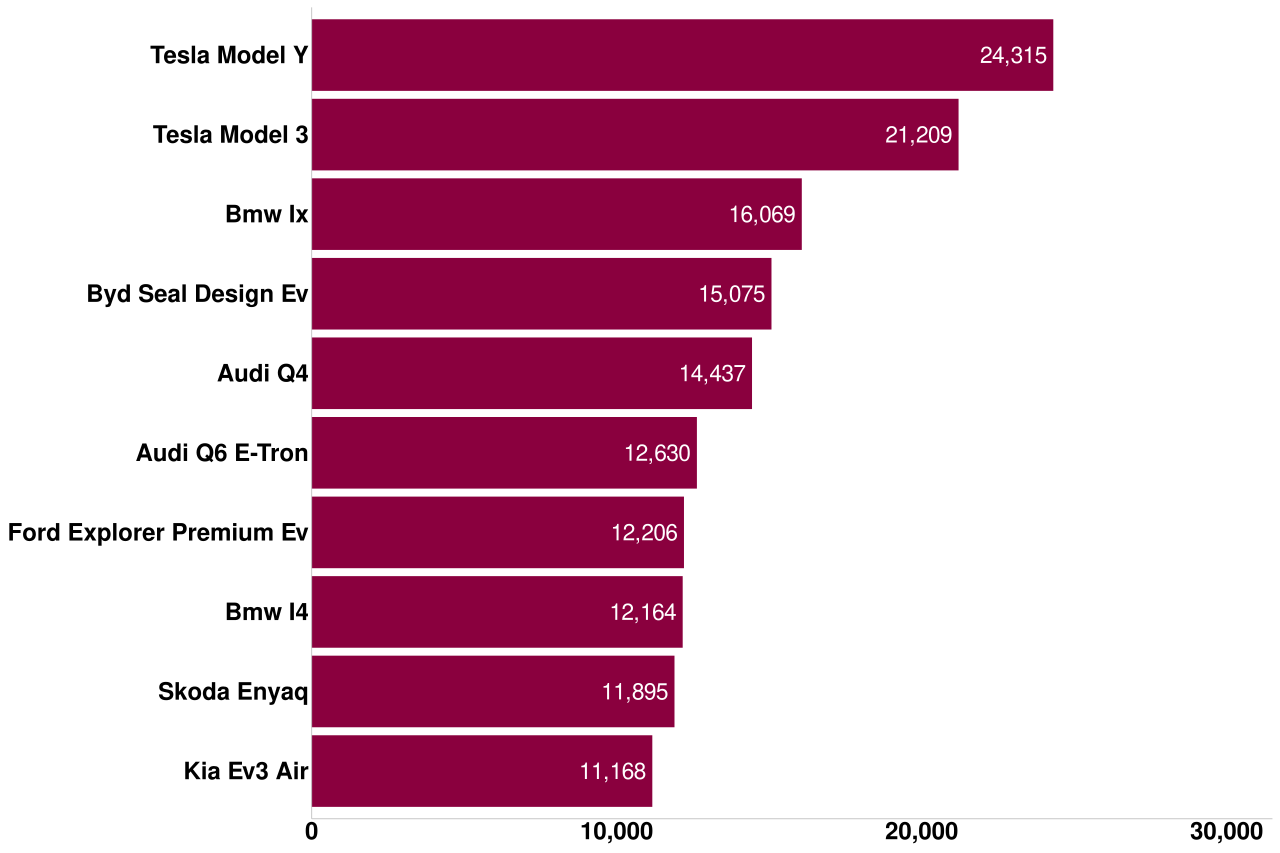
Chart 4 shows the top 10 generic zero emission models registered for the first time in 2025 for the UK. Tesla Model Y had the highest number of new registrations, with 24,315 vehicles, followed by Tesla Model 3 with 21,209 vehicles, and Bmw Ix with 16,069 vehicles.
Licensed vehicles
The number of licensed vehicles grows more slowly than the total number of new registrations. This is a consequence of vehicles leaving the on-road stock through a variety of routes, such as:
- receiving a Statutory Off Road Notification (SORN)
- being written off or scrapped
- being exported from the UK
Table 3: Licensed road using vehicles and licensed road using zero emission vehicles by body type, with one year and total stock comparison, UK, 2025, (VEH1103a)
| Body type | 2025: Licensed road using vehicles (thousands) | 2025: Licensed road using zero emission vehicles (thousands) | 2025: Proportion (%) of all licensed road using vehicles that are zero emission |
|---|---|---|---|
| Total | 41,462 | 1,874 | 4.5 |
| Cars | 34,485 | 1,737 | 5.0 |
| Light goods vehicles | 4,880 | 113 | 2.3 |
| Heavy goods vehicles | 520 | 1 | 0.3 |
| Motorcycles | 1,360 | 14 | 1.0 |
| Buses and coaches | 143 | 8 | 5.4 |
| Other vehicles | 73 | 1 | 0.9 |
What vehicles are included?
These figures only include vehicles that are licensed for use on UK roads, which typically requires paying Vehicle Excise Duty (VED).
Vehicles that are not licensed should typically be given a SORN. The keeper can then re-license their vehicle at any time. Detailed tables relating to vehicles with a SORN are available.
Vehicle age
At the end of December 2025, the average age of a licensed car in the UK was 10 years old, an increase of 14% compared to the end of December 2020.
Table 4: Average age since first use of licensed vehicles by body type, UK, end of December 2025 and 2020 (5-years earlier) (VEH1107)
| Body type | Average age (years) since first use at the end of December 2025 | Average age (years) since first use at the end of December 2020 |
|---|---|---|
| Total | 10 | 9 |
| Cars | 10 | 9 |
| Light goods vehicles | 9 | 8 |
| Heavy goods vehicles | 8 | 7 |
| Motorcycles | 16 | 15 |
| Buses and coaches | 12 | 11 |
| Other vehicles | 18 | 17 |
Improvements made in this release
If you have any feedback on this release, please contact vehicle.stats@dft.gov.uk.
Background notes
About these figures
Almost all the statistics in the vehicle licensing statistics series are derived by Department for Transport statisticians from extracts of the Driver and Vehicle Licensing Agency (DVLA) vehicle database. The main purpose of the database is to administer vehicle registration and licensing records in the United Kingdom.
For further information about the data used in this release, please see our guidance page which contains:
- detailed notes and definitions
- a note on users and uses of these statistics
There is also a Statement of Administrative Sources for the DVLA vehicles database.
In this release, numbers may not add up to totals and percentages may not add up to 100% due to rounding.
Geographic coverage
In July 2014, vehicle and registration services for Northern Ireland were centralised at DVLA, where these services for Great Britain were already administered. This created a single vehicle register for the United Kingdom, in place of separate registers for Great Britain and Northern Ireland. From this time, statistics can be provided for both Great Britain and the United Kingdom.
Data quality
The databases used for these statistics can be regarded as being virtually complete in terms of the number of vehicles registered for the first time, licensed vehicles, and vehicles with a SORN (Statutory Off Road Notification). However, there may be some errors in some of the specific details of individual vehicles.
The Department for Transport has previously estimated that under 2% of the vehicle records have an inaccuracy in one of the variables used for the statistics published. Other factors to consider in interpreting these statistics include:
- changes in legislation
- seasonal variation which affects some vehicle types
- foreign registered vehicles may also use UK roads without bring registered with DVLA
- Vehicle Excise Duty (VED) evasion
Most of these factors will only have a marginal effect for most uses of the data.
About these statistics
These official statistics were independently reviewed by the Office for Statistics Regulation in April 2012. They comply with the standards of trustworthiness, quality and value in the Code of Practice and should be labelled ‘accredited official statistics’.
Details of ministers and officials who receive pre-release access to these statistics up to 24 hours before release can be found in the pre-release access list.
Next release
Vehicle licensing statistics are published quarterly.
Dates of future releases will be advertised via the DfT statistical publications schedule.
To hear more about DfT statistics publications as they are released, please follow us on X.
Related sources of information
DfT also publishes ‘Cars and light goods vehicles registered for the first time by body type and fuel type’ as part of the monthly faster indicators of transport activity statistics series.
Data are sourced by a combination of vehicle registration data supplied by the DVLA, and the monthly published data from the Society of Motor Manufacturers and Traders (SMMT) to produce an early, provisional, estimate of the number of newly registered vehicles that DfT currently publishes as official statistics.
Further information and accompanying methodology notes are published on the department’s Developing faster indicators of transport activity page.
Although SMMT figures provide a very early indication of the vehicle market which broadly matches DfT official statistics, there are persistent differences between these figures as the SMMT data does not account for imported cars/LGVs or vehicle registrations from new manufacturers. The DfT faster indicators address these issues and so is closer to the final DfT estimates than SMMT data.
Comparison with the EU car market
The ACEA (European Automobile Manufacturers’ Association) produce new registration figures collected from trade bodies across Europe, covering the EU, the UK, and the EFTA (Iceland, Norway, Switzerland). UK data is provided by The Society of Motor Manufacturers and Traders (SMMT), which represents new car sales rather than new registrations with DVLA, so although the figures will be broadly comparable, they will not match.
Instructions for printing and saving
Depending on which browser you use and the type of device you use (such as a mobile or laptop) these instructions may vary.
You will find your print and save options in your browser’s menu. You may also have other options available on your device. Tablets and mobile device instructions will be specific to the make and model of the device.
How to search
Select Ctrl and F on a Windows laptop or Command and F on a Mac.
This will open a search box in the top right-hand corner of the page. Type the word you are looking for in the search bar and press enter.
Your browser will highlight the word, usually in yellow, wherever it appears on the page. Press enter to move to the next place it appears.
Contact details
Vehicles statistics