Total income of DCMS-funded cultural organisations 2023/24 and 2024/25: headline release
Published 29 April 2026
Applies to England

© Crown copyright 2026
This publication is licensed under the terms of the Open Government Licence v3.0 except where otherwise stated. To view this licence, visit nationalarchives.gov.uk/doc/open-government-licence/version/3 or write to the Information Policy Team, The National Archives, Kew, London TW9 4DU, or email: psi@nationalarchives.gov.uk.
Where we have identified any third party copyright information you will need to obtain permission from the copyright holders concerned.
This publication is available at https://www.gov.uk/government/statistics/total-income-of-dcms-funded-cultural-organisations-202324-and-202425/total-income-of-dcms-funded-cultural-organisations-202324-and-202425-headline-release
1. Details
Released: 29 April 2026
Next release: 2027
Geographic Coverage: England
Responsible statistician: Sam Alder
DCMS directly funds 19 cultural organisations via Grant-in-Aid. These include Arts Council England and their National Portfolio Organisations, the British Film Institute, British Library, Historic England and the 15 DCMS-sponsored museums and galleries.
Income figures for the Victoria & Albert (V&A) museum in Dundee are not collected as the site is operated as a separate charity to the main V&A museum group. As such, its figures are excluded from this publication and data set.
The data for this report covers income for these organisations for both 2023/24 and 2024/25 financial years (April 2023 to March 2025).
Throughout this report, monetary values are presented in nominal terms (£), while percentage changes are adjusted for inflation to compare between financial years.
Analysis of total income of DCMS-funded cultural organisations show that when adjusted for inflation, total income increased in 2024/25 compared to 2023/24, and remained above pre-pandemic levels in 2018/19 (the latest financial year completely unaffected by the COVID-19 pandemic). Year on year comparisons should be considered in the context of the COVID-19 pandemic, including the associated restrictions and support packages that may have influenced the different income figures.
2. Headline findings
2.1 Summary
In 2024/25, the total income of DCMS-funded cultural organisations was £5.6 billion, up from £4.5 billion in 2023/24. Adjusting for inflation, this was a 17.8% increase compared to 2023/24 and an increase of 22.6% compared to 2018/19 (the latest financial year completely unaffected by the COVID-19 pandemic).
The sources of this income have changed over time (Figure 1). The increase from 2023/24 to 2024/25 was mainly due to a rise in donated objects, primarily at the British Museum. Other key funding sources include fundraising, Grant-in-Aid, and other income.
Figure 1: Total income breakdown for DCMS-funded cultural institutions over time, 2018/19 to 2024/25.
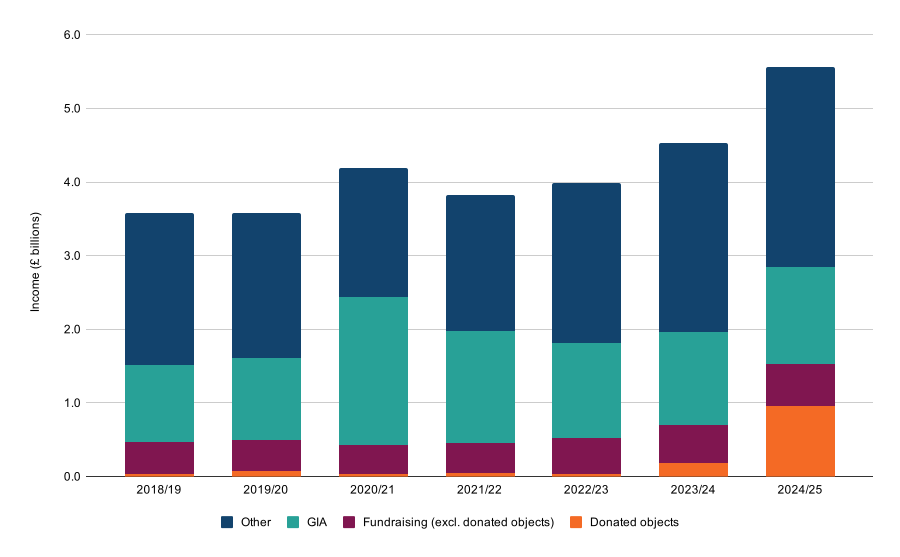
See Glossary for the definition of each income type.
2.2 Grant-in-Aid
In 2024/25, DCMS-funded cultural organisations received a total of £1.32 billion in Grant-in-Aid. When adjusted for inflation, this represents a slight 0.7% increase from the £1.31 billion provided in 2023/24, and a 1% decrease from £1.33 billion in 2018/19 (the last financial year completely unaffected by COVID-19). Funding through Grant-in-Aid increased to £2 billion in 2020/21, reflecting temporary COVID-19 support packages. Following the phasing out of this additional funding, Grant-in-Aid has since stabilised near pre-pandemic levels, particularly when adjusting for inflation.
The DCMS-funded cultural organisations have a variety of funding models, reflecting their diversity of size, type and purpose. The proportion of total income made up by Grant-in-Aid ranged from 7% (British Museum) to 99.6% (Arts Council England) in 2024/25. However, across the organisations overall, Grant-in-Aid accounted for 23.7% of total income. This represents a decrease from 27.7% in 2023/24 and from 29.3% in 2018/19 (the last financial year unaffected by COVID-19). This smaller proportion reflects a similar amount of Grant-in-Aid funding sitting within a larger total, and is driven by a notable rise in income raised through donated objects in 2024/25, rather than a reduction in government funding.
2.3 Fundraising income (charitable giving, excluding donated objects)
In 2024/25, DCMS-funded cultural organisations generated a total of £578.9 million through fundraising income (excluding donated objects). Adjusting for inflation, this is a 5.2% increase compared to 2023/24 and a 5% increase compared to 2018/19 (the last year unaffected by COVID-19).
The proportion of total income made up by fundraising (excluding donated objects) ranged from 0.2% (Historic England) to 46.8% (Sir John Soane’s Museum) across DCMS-funded cultural organisations in 2024/25. Over all institutions, fundraising income (excluding donated objects) accounted for 10.4% of total income, a decrease from 11.7% in 2023/24 and from 12.2% in 2018/19.
2.4 Fundraising income (donated objects)
Donated objects are included within fundraising income in this publication and have been recorded as income in line with accounting standards of organisations. However, they are non-cash in nature and therefore differ from other forms of income such as grants or fundraising revenue.
In 2024/25, DCMS-funded cultural organisations collectively received £956.8 million in the form of donated objects. Adjusting for inflation, this is more than five times higher compared to 2023/24 (£185.4 million) and nearly 20 times higher compared to 2018/19 (£48 million).
The proportion of total income made up by donated objects in 2024/25 ranged from 0% (Horniman Museum and British Library) to 86% (British Museum) across the cultural organisations. Across all the institutions collectively, income raised through donated objects accounted for 17.2% of total income, a substantial increase from 3.9% in 2023/24 and from 1.1% in 2018/19 (the last year unaffected by COVID-19).
The value of donated objects varies considerably over time, and between institutions. In the case of some organisations, a one off ‘star’ donation, or a large increase in donations, can dramatically increase this figure. In both 2023/24 and 2024/25, the recorded value of donated objects was notably higher than usual. This increase was primarily due to the British Museum, which accounted for 95.7% of total fundraising through donated objects in 2024/25, and 70.8% in 2023/24. Additionally, a few organisations do not, or rarely, receive donated objects due to their collecting policies. Caution should therefore be taken when making comparisons.
2.5 Fundraising income ratio to Grant-in-Aid
This section shows the ratio of fundraising income to Grant-in-Aid. Fundraising income (charitable giving) is one form of self-generated income. Therefore, fundraising income does not include self-generated income from trading or admission fees. This data is available in the DCMS-sponsored Museums and Galleries Annual Performance Indicators publication. Fundraising does include donations, legacies, and bequests, sponsorship, capital grants and membership schemes.
Excluding donated objects, this ratio was 44% in 2024/25. This means that for every £1 of Grant-in-Aid DCMS-funded cultural organisations received in 2024/25, they generated an additional 44 pence of fundraising income. This total is:
- Higher than in 2023/24 (42.1p fundraising generated per £1 Grant-in-Aid received)
- Higher than in 2018/19 (41.4p fundraising generated per £1 Grant-in-Aid received).
Recalculating these figures to account for donated objects (i.e. all fundraising income), the ratio of total fundraising income to total Grant-in-Aid was 116.6% in 2024/25. This means that for every £1 of Grant-in-Aid DCMS-funded cultural organisations received in 2024/25, they generated an additional £1.17 pence in fundraising income. This total is:
- Higher than in 2023/24 (56.3p fundraising income generated per £1 in Grant-in-Aid received)
- Higher than in 2018/19 (45p fundraising income generated per £1 in Grant-in-Aid received).
2.6 Other income
In 2024/25, DCMS-funded cultural organisations generated a total of £2.7 billion through other activities such as trading, investment income and admission fees. Adjusting for inflation, this is a 1.1% increase compared to 2023/24 and a 3.9% increase compared to 2018/19 (the last year unaffected by COVID-19).
In 2024/25, the proportion of total income made up by other income ranged from 4.8% (British Museum) to 72.5% (Arts Council England National Portfolio Organisations) across cultural organisations. Other income accounted for 48.7% of total income across the cultural institutions in 2024/25. This represents a decrease from 56.7% in 2023/24 and from 57.5% in 2018/19.
3. Glossary
3.1 Grant-in-Aid
Grant-in-Aid is money provided by central government departments to arms-length bodies in support of the general objectives of the organisation. It does not include other public funding, for example the DCMS/Wolfson Museums and Galleries Improvement fund or the National Lottery Heritage fund.
3.2 Fundraising income (charitable giving)
Fundraising income (charitable giving) does not include any money received from a publicly funded organisation, central government grants, investment income or lottery grant funding. It is defined as any money or gift received from an individual, charity or private company in one of the following forms:
- Donations, legacies, bequests and similar income
- Donated objects (also identified separately)
- Sponsorship
- Donations from connected charities + other donations
- Capital grants and donations (not from public bodies)
- Membership schemes
3.3 Other income
Other income is constituted of any other forms of income not included in the definitions for fundraising income and Grant-in-Aid. This is summarised as:
- Trading income
- Investment income
- Admissions & exhibition fees
- Development funds
- Activities for generating funds