Sustainable Aviation Fuel (SAF) Mandate statistics 2025: Final report
Published 19 November 2026

© Crown copyright 2026
This publication is licensed under the terms of the Open Government Licence v3.0 except where otherwise stated. To view this licence, visit nationalarchives.gov.uk/doc/open-government-licence/version/3 or write to the Information Policy Team, The National Archives, Kew, London TW9 4DU, or email: psi@nationalarchives.gov.uk.
Where we have identified any third party copyright information you will need to obtain permission from the copyright holders concerned.
This publication is available at https://www.gov.uk/government/statistics/sustainable-aviation-fuel-saf-mandate-statistics-2025-final-report/sustainable-aviation-fuel-saf-mandate-statistics-2025-final-report
Important information about these statistics
This publication presents final statistics for the first year of the UK SAF Mandate which came into effect as of 1 January 2025. It replaces the provisional statistics published earlier within the year and provides the first full annual assessment of SAF reported and certified under the scheme.
SAF was previously reported within the Renewable Transport Fuel Obligation (RTFO) statistical series. Greenhouse gas (GHG) savings reported under the SAF Mandate are not directly comparable with those previously reported under the RTFO because the schemes use different fossil fuel comparators when calculating GHG savings.
About this release
This final release covers the supply of sustainable aviation fuel (SAF) between 1 January 2025 and 31 December 2025, based on data available on 30 September 2026, which has been reported under the Sustainable Aviation Fuel (SAF) Mandate.
SAF is an alternative to conventional aviation fuel that can reduce the greenhouse gas emissions from aviation. It can be made from a range of sustainable materials and blended with conventional aviation fuel for use in existing aircraft without modification.
The SAF Mandate is the UK’s key policy mechanism to secure demand for SAF. It delivers greenhouse gas (GHG) emission savings by encouraging the supply of SAF within the aviation industry. It does this by setting a legal obligation on fuel suppliers in the UK to supply an increasing proportion of SAF over time.
The SAF Mandate has 2 obligations – the ‘main obligation’ and a ‘Power-to liquid (PtL) obligation’. In 2025, the main obligation was set at 2% of the total fossil aviation fuel supplied, and the PtL obligation was not yet in force.
For more information about SAF and the SAF Mandate, please refer to the SAF Mandate guidance pages.
These are official statistics. For more information, see the About these statistics section.
Headline figures
In 2025:
- A total of 320 million litres of SAF was certified under the Mandate, equating to 2.2% of all UK aviation fuel supply.
- 357 million SAF certificates were issued, meaning each litre of SAF generated an average of 1.1 certificates.
- All 14 solvent suppliers met their obligation with the supply of SAF and did not need to buyout – meaning the target was successfully met.
- Certified SAF delivered total GHG savings equivalent to 756 kilotonnes of CO2 (ktCO2e).
- Certified SAF achieved average lifecycle GHG savings of 78%, meaning its lifecycle emissions were over three-quarters lower than those of conventional aviation fuel.
Greenhouse Gas (GHG) savings
Lifecycle greenhouse gas (GHG) savings measure how much lower the emissions from SAF are compared with conventional aviation fuel, taking account of emissions across the fuel’s full lifecycle. For example, SAF made from used cooking oil (UCO) can have much lower lifecycle emissions because it reuses a waste material rather than relying on newly extracted fossil fuels.
Reported SAF and SAF certified under the Mandate are different measures
Fuel suppliers are required to report all fuel volumes accurately, including by fuel type, but do not have to apply for SAF Certificates for all reported volumes. Reported SAF may therefore include fuel that has not been verified and certified through the SAF Certificate process as meeting the Mandate’s eligibility and sustainability criteria.
This does not necessarily mean that those volumes would have failed to meet the criteria. Some may relate to commercial or voluntary arrangements, but the current data does not allow these volumes to be comprehensively identified. DfT will continue to monitor this as the market develops.
In 2025, a total of 398 million litres of fuel was reported as SAF under the Mandate, and 320 million litres were certified as having met the Mandate’s criteria.
How SAF was produced
SAF production pathways
All SAF certified under the Mandate in 2025 was produced through the HEFA (Hydroprocessed Esters and Fatty Acids) pathway, typically from waste oils and fats such as UCO. While HEFA fuels are the most commercially established form of SAF and currently dominate the global market, the SAF Mandate is designed to encourage a wider range of production pathways over time.
Feedstocks and sustainability
Feedstocks are any sustainable or renewable resource (biomass or renewable energy source) that can be converted into, or used directly, as a transport fuel or other energy product. They play an important role in determining the sustainability characteristics and greenhouse gas savings associated with SAF. Different feedstocks and production pathways can result in different lifecycle emissions.
- 99% of the fuel certified under the SAF Mandate in 2025 was produced from UCO.
- In total, 22 countries supplied feedstocks for use in the SAF Mandate in 2025 (Figure 1). The vast majority (68%) of this feedstock originated from China. Feedstocks sourced from within the UK contributed 3%.
Figure 1: Certified SAF supplied to UK aviation in 2025, by feedstock country of origin (SAF0105a)
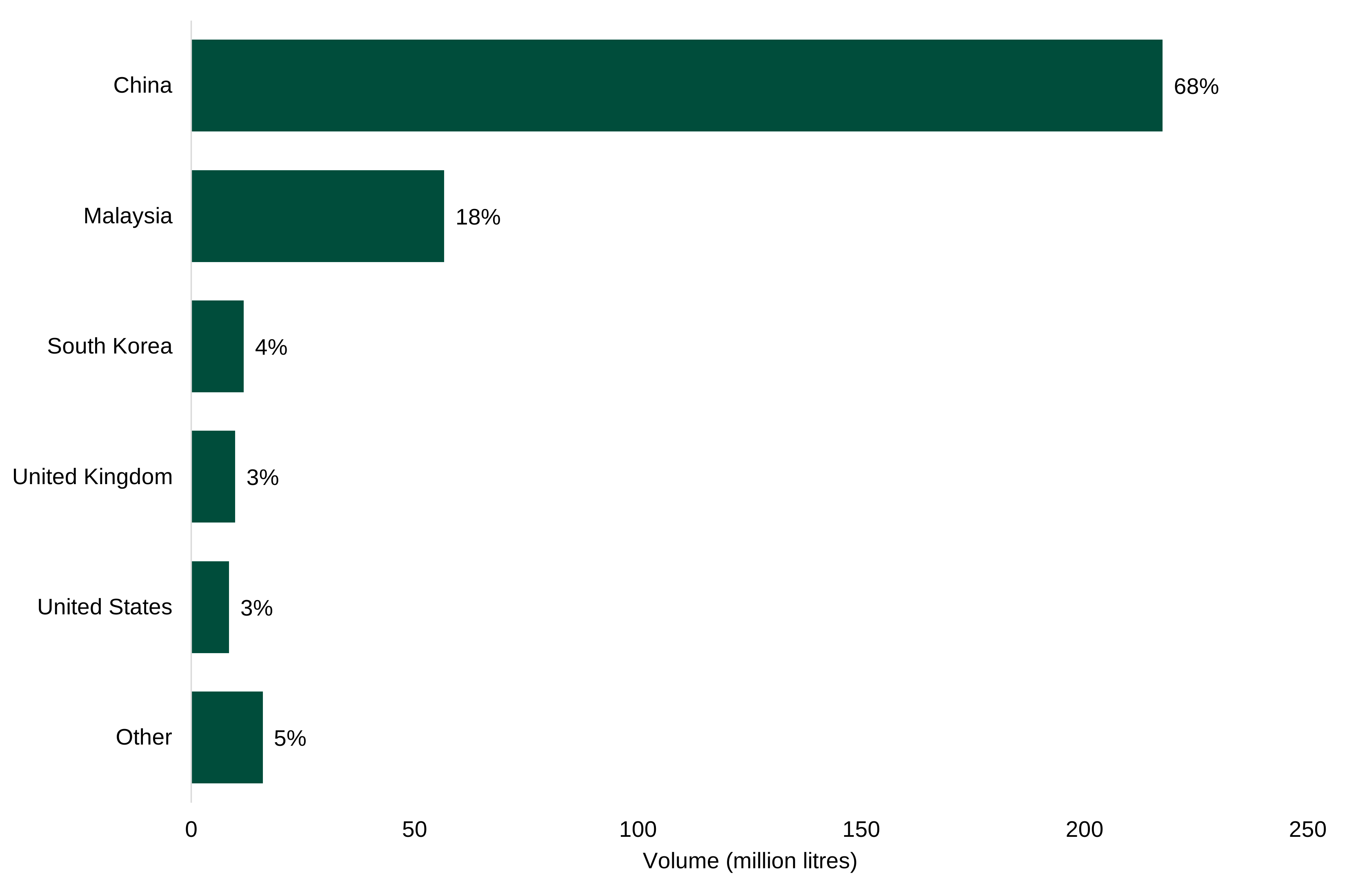
Figure 1 is a bar chart that shows the volume, and proportion, of certified SAF that came from feedstocks originating in different countries.
How suppliers met the SAF Mandate
How is compliance with the SAF Mandate assessed?
Fuel suppliers remain compliant with the SAF Mandate by meeting their annual obligations through the redemption of SAF certificates, payment of the relevant buy-out, or a combination of the two. Suppliers can apply for certificates for eligible SAF they supply, providing sufficient evidence that the fuel meets the required eligibility and sustainability criteria. Certificates can be retained and used by the supplier to meet its own obligation or traded to other parties.
Comprehensive guidance on how to comply with the SAF Mandate can be found in the SAF Mandate compliance guidance document.
- In 2025, 15 suppliers supplied SAF to the UK market. All 14 solvent suppliers met their obligation with the supply of SAF and did not need to buyout.
- SAF certificates are awarded according to the GHG savings delivered by the fuel. SAF that achieves a 70% GHG saving compared with fossil aviation fuel receives 1 certificate per litre, while fuels with higher GHG savings receive more than 1 certificate per litre.
- SAF certified under the Mandate in 2025 had average GHG savings of 78% and in total reduced emissions by 756 ktCO2e compared to fossil aviation use.
- The average number of certificates awarded per litre of SAF in 2025 was 1.1.
- A total of 67 million certificates remained after the 2025 obligation was met. These certificates can be carried over to meet up to 25% of 2026 obligation.
How sustainability is assured
Voluntary schemes and sustainability assurance
- 100% of the SAF that met the eligibility and sustainability criteria in 2025 was supported by the International Sustainability and Carbon Certification (ISCC) scheme.
- Carbon emissions were reported and verified in accordance with the SAF Mandate legislation and accompanying guidance.
Voluntary schemes
Voluntary schemes are schemes run by independent organisations that offer a route to providing assurance that eligible fuels meet certain sustainability criteria under the SAF Mandate.
Background information
For more information on the sources of data used in this report, please visit the SAF Mandate statistics collection pages. Further information on the SAF Mandate and SAF fuel can be found in the SAF Mandate guidance pages.
About these statistics
These statistics are official statistics. They comply with the standards of trustworthiness, quality, and value in the Code of Practice for Statistics.
Details of ministers and officials who received pre-release access to these statistics up to 24 hours before release can be found in the pre-release access list.
Instructions for printing and saving
Depending on which browser you use and the type of device you use (such as a mobile or laptop) these instructions may vary.
You will find your print and save options in your browser’s menu. You may also have other options available on your device. Tablets and mobile device instructions will be specific to the make and model of the device.
How to search
Select Ctrl and F on a Windows laptop or a Command and F on a Mac.
This will open a search box in the top right-hand corner of the page. Type the word you are looking for in the search bar and press enter.
Your browser will highlight the word, usually in yellow, wherever it appears on the page. Press enter to move to the next place it appears.
Contact details
Low carbon fuel statistics
Email environment.stats@dft.gov.uk
To hear more about DfT statistical publications, follow us on X at DfTstats.