Strategic export controls commentary: 1 January to 31 March 2026
Published 27 August 2026

© Crown copyright 2026
This publication is licensed under the terms of the Open Government Licence v3.0 except where otherwise stated. To view this licence, visit nationalarchives.gov.uk/doc/open-government-licence/version/3 or write to the Information Policy Team, The National Archives, Kew, London TW9 4DU, or email: psi@nationalarchives.gov.uk.
Where we have identified any third party copyright information you will need to obtain permission from the copyright holders concerned.
This publication is available at https://www.gov.uk/government/statistics/strategic-export-controls-licensing-statistics-1-january-to-31-march-2026/strategic-export-controls-commentary-1-january-to-31-march-2026
Statistical commentary
Coverage: UK
Frequency: quarterly
Date of publication: 27 August 2026
Statistical Contact: ecju.statistics@businessandtrade.gov.uk
Website: Strategic export controls licensing statistics
The strategic export controls licensing statistics provide data on decisions made on licence applications to the Export Control Joint Unit (ECJU) of the Department for Business, Innovation, Science and Trade (BIST) through the Shared Primary Information Resource Environment (SPIRE) and Licensing for International Trade and Enterprise (LITE) licensing systems.
These statistics are currently Official Statistics in Development.
Headline results
Latest quarter
In 2026 Q1 (between 1 January and 31 March 2026), there were a total of 2,705 licensing decisions for standard individual export licences (SIELs), an increase of 262 (11%) from 2,443 in the previous quarter (2025 Q4).
Of these standard licensing decisions in 2026 Q1, 2,594 (96%) were issued, 110 (4%) were refused, and 1 was revoked (<1%).
In 2026 Q1, 55% of SIEL applications closed in the SPIRE licensing system were closed within 20 working days, down from 58% in the previous quarter. 78% of SIEL applications closed in the SPIRE licensing system were completed within 60 working days, up from 77% in the previous quarter.
In 2026 Q1, 66% of SIEL applications closed in the LITE licensing system were closed within 20 working days, up from 63% in the previous quarter. 92% of SIEL applications in the LITE licensing system were completed within 60 working days, up from 88% in the previous quarter.
Note: The methodology used to calculate the initial processing time differs between SPIRE and LITE. Comparing LITE processing statistics with SPIRE processing statistics should be done so with care – see Background notes for further details.
Source: Table A and B, Strategic export controls licensing statistics.
Latest full calendar year
In the 2025 calendar year, there were a total of 10,921 licensing decisions for standard individual export licences (SIELs), down 494 (4%) from 11,415 in the previous calendar year (2024).
Of these standard licensing decisions in 2025, 10,416 (95%) were issued, 501 (5%) were refused, and 4 were revoked.
In the 2025 calendar year, 51% of SIEL applications closed in the SPIRE licensing system were closed within 20 working days, down from 60% in the previous year. 72% of SIEL applications closed in the SPIRE licensing system were closed within 60 working days, down from 84% in the previous year.
In the 2025 calendar year, 53% of SIEL applications closed in the LITE licensing system were closed within 20 working days, up from 47% in the previous year. 91% of SIEL applications closed in the LITE licensing system were closed within 60 working days, down from 93% in the previous year.
Note: The methodology used to calculate the initial processing time differs between SPIRE and LITE. Comparing LITE processing statistics with SPIRE processing statistics should be done so with care – see Background notes for further details.
Source: Table A and B, Strategic export controls licensing statistics.
Introduction
This commentary accompanies the latest strategic export controls licensing statistics, published on the BIST strategic export controls statistics web page on 27 August 2026.
These statistics provide data about decisions made on export and trade control licence applications to the ECJU of BIST. The ECJU is the regulatory body which controls exports of military goods and dual-use goods (civilian goods that can be used for military purposes) from the UK. ECJU’s issued licences give permission for certain strategic exports to be made from the UK to another destination, and for overseas trade in strategic goods.
These statistics are used within ECJU, to inform policy and operational decision-making. These statistics are also regularly used by the press, non-government organisations and academics to evaluate strategic export control policies – see Background notes for further details.
Period
These statistics cover licensing decisions made in each quarter from 2008 Q1 to 2026 Q1. Statistics are provided at both a quarterly and annual level. Statistics at an annual level are updated within the Q4 statistics for that year. For instance, the latest annual level statistics (2025) were released in the 2025 Q4 publication.
The data in this release is extracted from SPIRE and LITE and is accurate as of 10 July 2026.
System transition
Licence applications are submitted to and processed by ECJU online. Historically, a purpose-built digital licensing system called SPIRE has been used. However, ECJU is currently in the process of developing and rolling out a new digital licensing system, known as LITE, which will eventually replace SPIRE. During the transition period, ECJU is handling applications on both SPIRE and LITE.
These statistics have included data from LITE since 2021 Q3, the period in which the first licensing decision was made in LITE.
See Background notes for further details.
Official Statistics in Development
From the 2024 Q1 publication until further notice, these statistics have been reclassified and published as Official Statistics in Development – see Background notes for further details.
1. Commentary on licence types
Standard individual export licences (SIELs) are by far the most common licence type issued. The number of open individual export licences (OIELs) issued is much smaller than the number of SIELs issued, however the quantity of goods for exportation is generally not limited on OIELs. Notable historic trends in volumes of licence types have been highlighted in the commentary for previous publications.
Latest quarter
In 2026 Q1, the following licences were issued:
- 2,594 SIELs
- 75 OIELs
- 36 standard individual trade control licences (SITCLs)
- 5 open individual trade control licences (OITCLs)
There were 523 open general export licence (OGEL) registrations.
For context, the number of SIELs issued each quarter prior to 2026 Q1 (from 2008 Q1 to 2025 Q4) has averaged 3,074, much higher than for OIELs (73), SITCLs (39) and OITCLs (6). Registrations to use OGELs each quarter prior to 2026 Q1 (2008 Q1 to 2025 Q4) have averaged 362.
Source: Tables A and D, Strategic export controls licensing statistics.
Latest full calendar year
In 2025, the following licences were issued:
- 10,416 SIELs
- 247 OIELs were issued
- 121 SITCLs were issued
- 11 OITCLs were issued
There were 1,590 OGEL registrations.
For context, the number of SIELs issued each year prior to 2025 (2008 to 2024) has averaged 12,405, much higher than for OIELs (295), SITCLs (158) and OITCLs (25). Registrations to use OGELs each year prior to 2025 (2008 to 2024) have averaged 1,438.
Source: Tables A and D, Strategic export controls licensing statistics.
2. Commentary on licensing decisions
Chart 1 shows that the numbers of SIELs and SITCLs refused and OIELs and OITCLs rejected tend to be much lower than the numbers issued.
Chart 1: number of licences refused or rejected by licence type
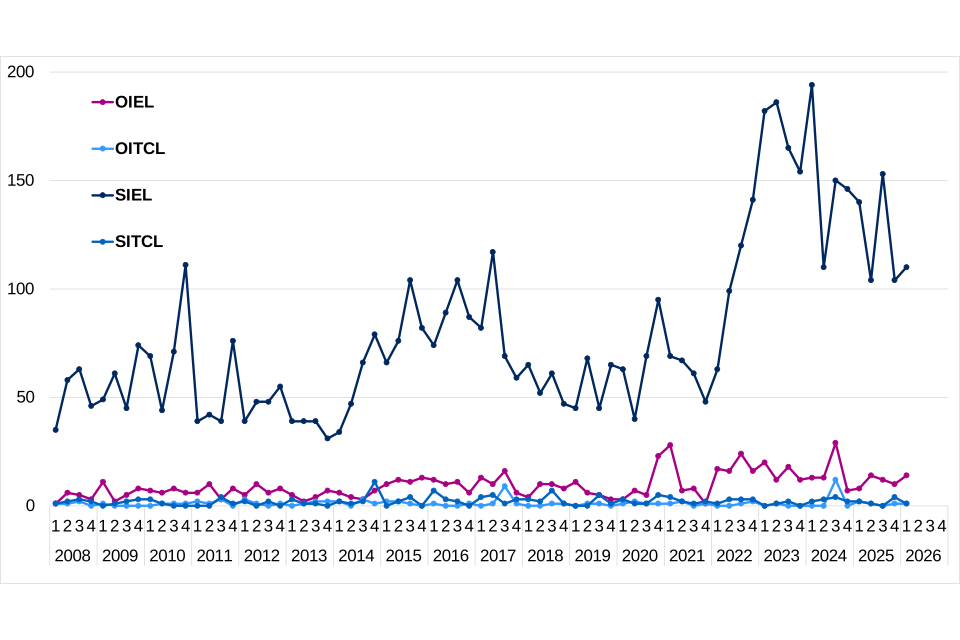
Source: Table A, Strategic export controls licensing statistics. Notable historic trends in refusals have been highlighted in the commentary for previous publications.
Latest quarter
In 2026 Q1, there were a total of 2,705 licensing decisions for SIELs. Of these, 2,594 (96%) were issued, 110 (4%) were refused, and 1 (<1%) was revoked.
In terms of issued licences, the 2,594 SIELs issued in 2026 Q1 was below average. For context, the number of SIELs issued each quarter prior to 2026 Q1 (2008 Q1 to 2025 Q4) has averaged 3,074.
In September 2024, ECJU launched its new licensing platform, LITE, into public beta. Following the launch of public beta, most new SIEL applications – except for a limited number of exemptions – were submitted through LITE.
Following this, there was a reduction in the number of licensing decisions (including licences issued) as case officers focused on supporting exporters with the transition and embedding new internal processes.
In terms of refused licences, the 110 SIELs refused in 2026 Q1 was above average. For context, the number of SIELs refused each quarter prior to 2026 Q1 (2008 Q1 to 2025 Q4) has averaged 79, but more recent periods have seen higher numbers of refusals, with each quarter since 2022 Q3 surpassing 100 total refusals (see Chart 1).
Source: Table A, Strategic export controls licensing statistics.
Latest full calendar year
In the 2025 calendar year, there were a total of 10,921 licensing decisions for SIELs. Of these, 10,416 (95%) were issued, 501 (5%) were refused, and 4 were revoked.
In terms of issued licences, the 10,416 SIELs issued in 2025 was notably below average. For context, the number of SIELs issued each year prior to 2025 (2008 to 2024) has averaged 12,405.
There was a combination of factors during 2025 that impacted upon ECJU’s ability to process licensing decisions (including issue licences).
These factors included:
- the growing complexity of casework (in particular dual-use goods)
- the challenging geopolitical environment (including the expansion of sanction measures)
- the ongoing impact of transitioning from our existing digital service (SPIRE) to a new digital licensing service (LITE), which transitioned to public beta in September 2024
In terms of refused licences, the 501 SIELs refused in 2025 was above average. The number of SIELs refused each year prior to 2025 (2008 to 2024) has averaged 304, but more recent periods have seen higher numbers of refusals, with 2023, 2024 and 2025 reaching at least 500 total refusals.
This is partly attributed to enhanced military end-use control introduced in May 2022, with the addition of China to the list of destinations subject to the military end-use control, being the main reason for an increase in refusals since it was introduced.
Source: Table A, Strategic export controls licensing statistics.
3. Commentary on value of licences
Chart 2 shows how the value of goods issued for exportation under SIELs can vary a lot from quarter to quarter, with a handful of high value licences often explaining peaks in the data. The goods included on the licence are valued by the exporter during the application process, which means that the actual exports that take place under the licence may not be of such a high value.
Note 1: The actual number and value of transactions made under the licences is likely to be less than the total made available under the licences issued. This is because some licences will not be used to make all of the exports authorised and others will not be used at all.
Note 2: Unlike SIELs for permanent export, a temporary SIEL may permit the export of the goods to multiple destinations, provided they are returned to the UK within 12 months of export. For example, an item might be exported from the UK for an exhibition in one country, before being moved directly to another exhibition in a second country, and so on, before they are returned to the UK. Currently the total value of temporary goods is calculated as the sum of temporary goods licensed to each destination, meaning that the same goods can be counted multiple times.
Chart 2: value of goods issued for exportation under SIEL licences
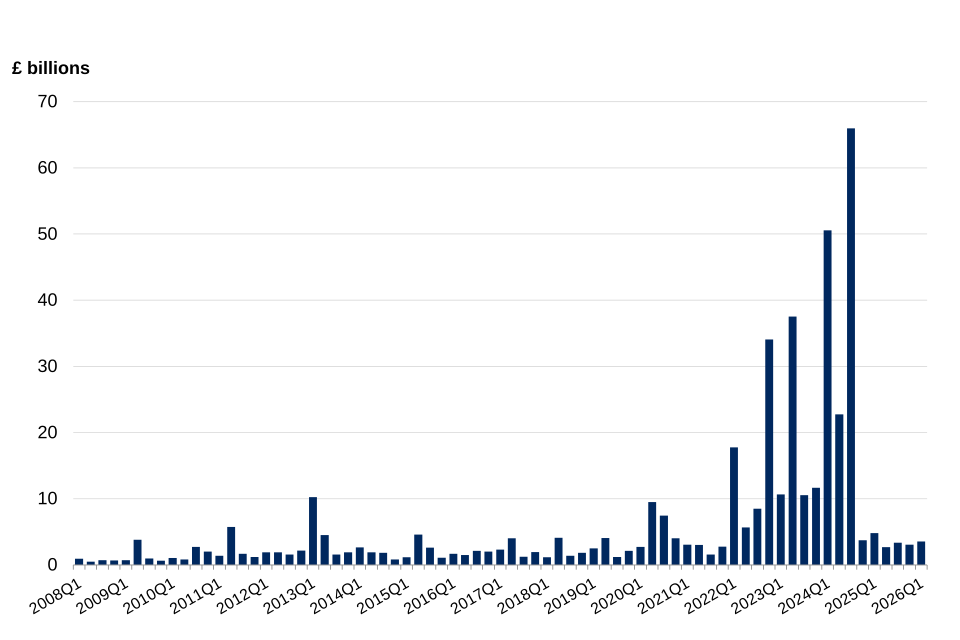
Source: Table E, Strategic export controls licensing statistics. Notable historic trends in licence values have been highlighted in the commentary for previous publications.
Latest quarter
In 2026 Q1, the total value of all SIELs issued was £3.53 billion, up from £3.04 billion in 2025 Q4.
Source: Table E, Strategic export controls licensing statistics.
Latest full calendar year
In 2025, the total value of all SIELs issued was £13.9 billion, down from £143.0 billion in 2024.
We currently understand that some high value licences may overestimate the final value exported and can border towards being speculative. Licence values are self-declared by exporters, and changes in the value of licences may reflect exporter behaviour rather than changes in export activity.
For example, some exporters may apply for licences with values significantly above anticipated exports to mitigate the risk of exceeding licence limits. This behaviour skews statistics presented on the value of licences. Consequently, licence value statistics should be interpreted with care.
Source: Table E, Strategic export controls licensing statistics.
4. Commentary on goods categories
The list of items subject to export control can be found on the UK strategic export control lists page.
Control entries are the codes assigned to each good on the consolidated list of goods that require export authorisation (herein ‘consolidated list’). For example, all control entries beginning ‘ML’ (such as ML1, ML8 and so on) are control entries for military goods. The process of assigning control entries to goods is called rating.
In some cases, goods can be made subject to control if they do not appear on the consolidated list. Goods that the exporter has been informed, is aware or suspects are, or may be, intended for ‘Weapons of Mass Destruction (WMD) purposes’ are given the rating ‘END’.
The following goods are given the rating ‘MEND’:
-
goods that the exporter has been informed are, or may be intended, in their entirety or in part, for use by a relevant entity (where a relevant entity is any military forces, para-military forces, police forces, security services or intelligence services of a country that is an embargoed destination, subject to an arms embargo imposed by a decision of the Organization for Security and Co-operation in Europe, or subject to an arms embargo imposed by a binding resolution of the Security Council of the United Nations).
-
goods that the exporter has been informed or is aware are, or may be, intended for use as components in, or production or test equipment for, military equipment in an embargoed destination; or may be intended for use as parts of military goods illegally obtained from the UK, irrespective of destination.
Both ’END’ and ‘MEND’ ratings are also sometimes referred to as ‘catch all’ ratings.
Control entries provide in-depth descriptions for the classification of licensable goods. Table 1 and Table 2 provide summary descriptions of control entries based on the consolidated list of goods that require export authorisation.
High ranking control entries have been combined where they cover similar goods (specified in square brackets in Tables 1 and 2). Note that licence counts are only an indication of export volumes and counts are not the same as goods quantity.
Military goods licensed
Table 1: top 5 military goods licensed on permanent standard SIELs in 2025, by number of licences
|
Top 5 military uses |
Number of licences |
|---|---|
| Aircraft, components and related equipment [ML10] | 678 |
| Firearms [ML1] | 472 |
| Military Technology [ML22] | 362 |
| Bombs, missiles and related equipment and components [ML4] | 265 |
| Ammunition [ML3] | 243 |
Source: Table H, Strategic export controls licensing statistics.
Non-military goods licensed
Table 2: top 5 non-military goods licensed on permanent standard SIELs in 2025, by number of licences
|
Top 5 non-military uses |
Number of licences |
|---|---|
| Equipment and software with ‘information security’ capability [5A002, 5D002] | 1,089 |
| Non-Military Firearms (Firearms Regulation Annex I) [FR AI] | 441 |
| Imaging cameras [6A003] | 371 |
| Chemical manufacturing facilities, equipment and components [2B350] | 250 |
| Technology for nuclear materials, facilities and equipment [0E001] | 226 |
Source: Table H, Strategic export controls licensing statistics.
5. Commentary on end-user destinations
End-user destinations by number of licences
In 2025, the United States of America was the end user destination with the highest number of licences issued for exportation of strategic goods under permanent standard SIELs, with 637 licences. The next end users with the highest number of licences issued for exportation of strategic goods under permanent standard SIELs were China (622) and India (523).
Source: Table E, Strategic export controls licensing statistics.
Chart 3: top 10 end-user destinations licensed, 2025
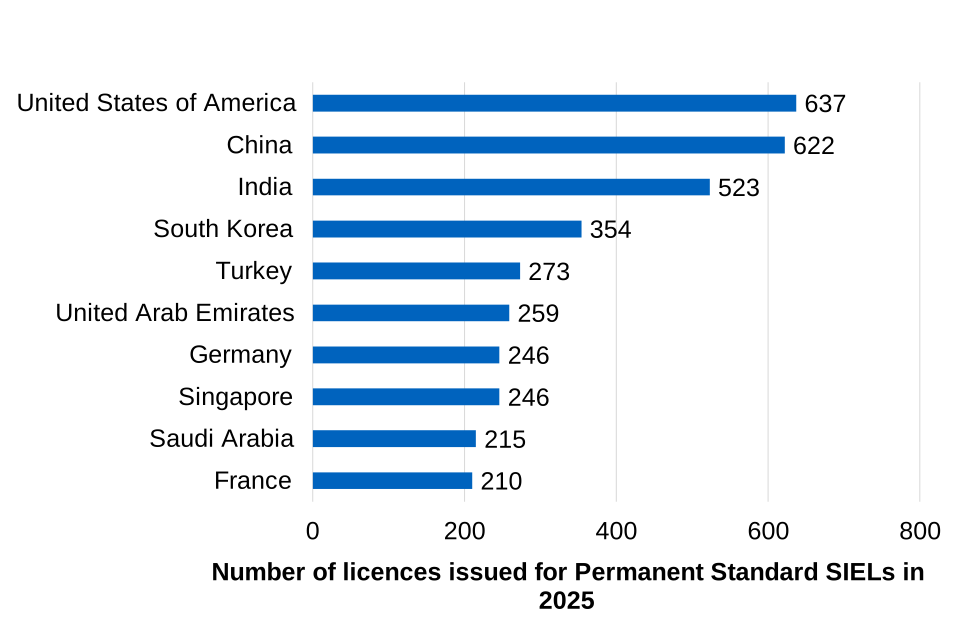
Source: Table E, Strategic export controls licensing statistics.
End-user destinations by value
In 2025, Spain was the end user destination with the highest value of licences issued for exportation of strategic goods under ‘permanent standard’ SIELs, with licences issued for exportation of £3.0 billion worth of goods (as valued by applicants).
The next end users with the highest value of licences issued for goods under Standard SIELs were the United States of America (£1.2 billion) and Ukraine (£0.9 billion).
The goods included on the licence are valued by the exporter during the application process, which means that the actual exports that take place under the licence may not be of such a high value.
Source: Table E, Strategic export controls licensing statistics.
Chart 4: top 10 end-user destinations licensed in terms of licence values, 2025
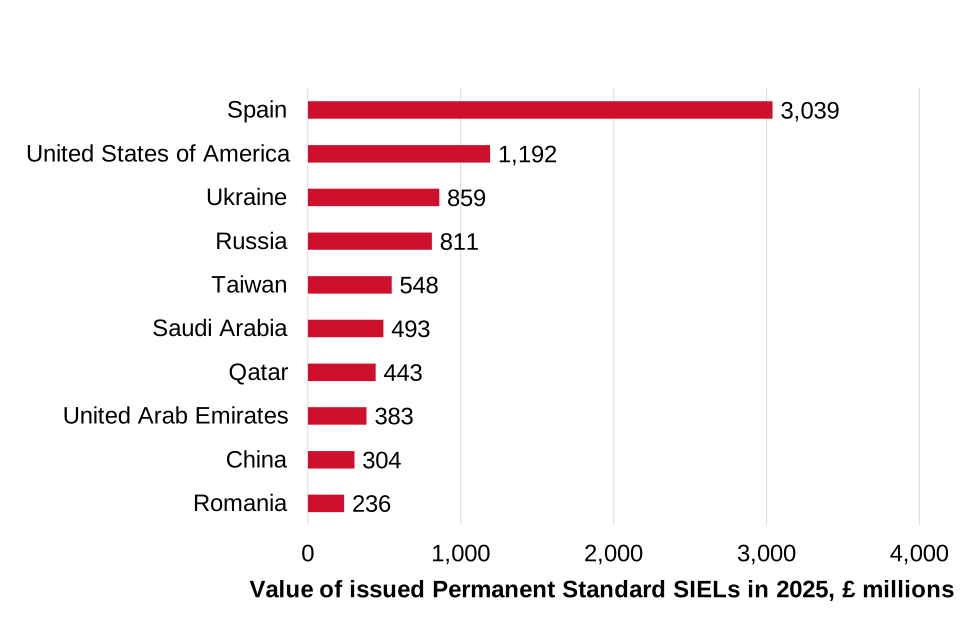
Source: Table E, Strategic export controls licensing statistics.
6. Commentary on performance data
Note: The methodology used to calculate the initial processing time differs between SPIRE and LITE. Therefore, LITE and SPIRE processing statistics are presented independently of one another. Comparing LITE processing statistics with SPIRE processing statistics should be done so with care – see Background notes for further details.
On receipt of a SIEL application, ECJU’s target is to process 70% of cases within 20 working days and 99% within 60 working days. ECJU also aims to process 60% of OIEL applications within 60 working days – see ECJU service and performance code for further details.
Latest quarter
In 2026 Q1, 55% of SIEL applications closed in the SPIRE licensing system were closed within 20 working days, down from 58% in 2025 Q4. 78% of SIEL applications closed in the SPIRE licensing system had been closed within 60 working days, up from 77% in 2025 Q4.
In 2026 Q1, 66% of SIEL applications closed in the LITE licensing system were closed within 20 working days, up from 63% in 2025 Q4. 92% of SIEL applications closed in the LITE licensing system were closed within 60 working days, up from 88% in 2025 Q4.
In 2026 Q1, 67% of OIEL applications closed in the SPIRE licensing system were closed within 60 days, up from 55% in 2025 Q4.
In 2026 Q1, 33% of OIEL applications closed in the LITE licensing system were closed within 60 days.
There was a combination of factors that impacted upon ECJU’s ability to meet processing targets during 2026 Q1.
These factors included:
- the growing complexity of casework (in particular dual-use goods)
- the challenging geopolitical environment (including the expansion of sanctions measures)
- the ongoing impact of transitioning from our legacy digital service (SPIRE) to a new digital licensing service (LITE) which transitioned to public beta in September 2024
Following the launch of public beta, of licensing decisions made within the 60-day target, 87% were made on LITE in 2025 Q2, 89% in 2025 Q3, 89% in 2025 Q4 and 89% in 2026 Q1. During this time, there was an impact on processing times, as case officers focused on supporting exporters with the transition and embedding new internal processes, while managing the impacts of dual running 2 licensing systems.
Source: Table B (B1 and B2), Strategic export controls licensing statistics.
Table 3A: initial processing time statistics for SIEL applications closed in the SPIRE licensing system during 2026 Q1
| Types of licences | Number of applications completed in 20 working days | % applications completed in 20 working days | Number of applications completed in 60 working days | % applications completed in 60 working days | Median processing time (days) |
|---|---|---|---|---|---|
| Total SIELs | 179 | 55 | 254 | 78 | 18 |
| Permanent | 118 | 48 | 179 | 73 | 21 |
| Temporary | 50 | 74 | 62 | 91 | 10 |
| Transhipment | [z] | [z] | [z] | [z] | [z] |
| Incorporation | 1 | 50 | 2 | 100 | 39 |
| For items covered by the torture regulation (permanent or temporary) | 10 | 91 | 11 | 100 | 14 |
Source: Table B1, Strategic export controls licensing statistics. [z] denotes a data point that is not applicable.
Table 3B: initial processing time statistics for SIEL applications closed in the LITE licensing system during 2026 Q1
| Types of licences | Number of applications completed in 20 working days | % applications completed in 20 working days | Number of applications completed in 60 working days | % applications completed in 60 working days | Median processing time (days) |
|---|---|---|---|---|---|
| Total SIELs | 2,261 | 66 | 3,151 | 92 | 16 |
| Permanent | 1,174 | 66 | 2,469 | 91 | 16 |
| Temporary | 75 | 69 | 104 | 95 | 15 |
| Transhipment | [z] | [z] | [z] | [z] | [z] |
| Incorporation | 412 | 67 | 578 | 94 | 17 |
| For items covered by the torture regulation (permanent or temporary) | [z] | [z] | [z] | [z] | [z] |
Source: Table B2, Strategic export controls licensing statistics. [z] denotes a data point that is not applicable.
Table 3A and 3B include data for applications that were stopped or withdrawn before the application was closed as well as applications that were processed but did not require a licence. Therefore, the number of applications completed will be different to the total number of licensing decisions.
Latest full calendar year
In the 2025 calendar year, 51% of SIEL applications closed in the SPIRE licensing system were closed within 20 working days, down from 60% in 2024. 72% of SIEL applications closed in the SPIRE licensing system had been closed within 60 working days, down from 84% in 2024.
In the 2025 calendar year, 53% of SIEL applications closed in the LITE licensing system were closed within 20 working days, up from 47% in 2024. 91% of SIEL applications closed in the LITE licensing system were closed within 60 working days, down from 93% in 2024.
In the 2025 calendar year, 55% of OIEL applications closed in the SPIRE licensing system were closed within 60 days, up from 45% in 2024. In 2025, both OIEL applications closed in the LITE licensing system were closed within 60 days. 2025 was the first year OIELs were closed in LITE.
There was a combination of factors during 2025 that impacted upon ECJU’s ability to meet processing targets.
These factors included:
- the growing complexity of casework (in particular dual-use goods)
- the challenging geopolitical environment (including the expansion of sanction measures)
- the ongoing impact of transitioning from our legacy digital service (SPIRE) to a new digital licensing service (LITE), which transitioned to public beta in 2024 Q4
Source: Table B (B1 and B2), Strategic export controls licensing statistics.
Glossary
Licence types
Standard individual export licences (SIELs)
SIELs are specific to an individual exporter and generally allow shipments of specified items to a specified recipient up to the quantity specified by the licence.
There are 5 main subtypes:
- permanent standard
- temporary standard
- incorporation
- transhipment
- SIELs for goods covered by the torture regulation
Open individual export licences (OIELs)
OIELs are specific to an individual exporter and cover multiple shipments of specified items to specified destinations and/or, in some cases, specified recipients. Licences permitting permanent export are generally valid for up to 5 years from the date of issue.
However, OIELs covering the export to EU member states of goods entered on the military list and dealer to dealer OIELs (an OIEL subtype) are generally valid for 3 years.
Open individual trade control licence (OITCL)
An OITCL is specific to a named trader and covers involvement in trading of a generally unlimited supply of specific goods between specific source and destination countries and/or specified senders, recipients and end-users. OITCLs are generally valid for 5 years.
Standard individual trade control licence (SITCL)
A SITCL is specific to a named trader and covers involvement in trading of a set quantity of specific goods between a specific source and destination country with a specified sender, recipient and end-user. SITCLs will normally be valid for 2 years.
Open general export licences (OGELs)
OGELs are pre-published licences allowing the export of certain goods to certain destinations. Generally, the quantity of goods allowed for shipment is not limited.
SIELs
Permanent standard SIELs
Permanent standard SIELs are for items that are for permanent export to a destination.
Temporary standard SIELs
Temporary standard SIELs are for where the export is temporary, for example for the purposes of demonstration, trial or evaluation, and the licence is generally valid for one year only. The goods must be returned before the licence expires. Temporary SIELs can cover more than one destination.
Incorporation SIELs
Incorporation SIELs are for goods that are due to be incorporated, that is, installing them into another product or higher-level system. For incorporation cases there are 2 tiers of end-user. The ‘end user’ is the person/organisation incorporating the goods. The ‘ultimate end user’ is defined as the entity that uses the product or the higher-level system into which the exported goods are installed or incorporated.
Transhipment SIELs
Transhipment SIELs are needed for the transit or transhipment of certain goods through the UK en route from one third country to another, providing certain conditions are met. This subtype of SIEL is also called a Standard Individual Transhipment Licence (SITL).
Most other transit or transhipments (of certain goods through the UK en route from one third country to another) either do not require a UK licence, or can be made under one of the open general transhipment licences, provided in all cases that the relevant conditions are met.
SIELs for goods covered by the torture regulation
These SIELs concern trade in certain equipment and products which could be used for capital punishment, torture or other cruel, inhuman or degrading treatment or punishment. These are classed as non-military goods but can appear separately to the statistics on licences for non-military goods.
Read the guidance about export controls on goods that can be used for torture or capital punishment.
OIELs
Open individual export licences (OIELs)
OIELs are specific to an individual exporter and cover multiple shipments of specified items to specified destinations and/or, in some cases, specified recipients. Licences permitting permanent export are generally valid for up to 5 years from the date of issue.
However, OIELs covering the export to EU member states of goods entered on the Military List and Dealer-to-dealer OIELs (an OIEL subtype) are generally valid for 3 years. Standard OIELs are the most common type of OIEL issued, but there are several other OIEL subtypes:
Dealer-to-dealer OIELs
Dealer-to-dealer OIELs authorise Northern Ireland registered firearms dealers to export certain categories of firearms and ammunition solely to other registered firearms dealers in the European Union only, provided that copies of valid documentation are forwarded to BIST at least 2 working days before each shipment.
Cryptographic OIELs
Cryptographic OIELs authorise the export of specified cryptography hardware or software and the transfer of specified cryptography technology. These licences do not cover hardware, software or technology which includes certain types of cryptanalytic functions.
Media OIELs
Media OIELs authorise the export of military helmets, body armour, non-military four-wheel drive civilian vehicles with ballistic protection and specially designed components for any of these items, mainly for the protection of aid agency workers and journalists in areas of conflict.
The licence permits these goods to be exported to all destinations on a temporary basis only; the goods must be returned to the United Kingdom when no longer required.
Continental shelf OIELs
Continental shelf OIELs authorise the export of controlled goods to the UK sector of the continental shelf for the use only on, or in connection with, offshore installation and associated vessels. The UK sector of the continental shelf is the region of waters surrounding the UK in which the UK has rights over the seabed, subsoil and their natural resources.
Global project licences
Global project licences (GPLs) are a form of export licence that was introduced by framework agreement partners (UK, France, Italy, Sweden, Spain and Germany) to streamline the arrangements for licensing military goods and technologies between them, where these transfers relate to their participation in specific collaborative defence projects.
In relation to the collaborative project, each partner state will, as appropriate, issue their own GPLs to permit transfers of specified goods and technology where these are required for that programme. The GPLs operate on a similar basis to UK OIELs. In the UK, applications for GPLs are assessed against the strategic export licensing criteria.
Background notes
System transition
Licence applications are submitted to and processed by ECJU online. Historically, a purpose-built digital licensing system called SPIRE has been used. However, ECJU is currently in the process of developing and rolling out a new digital licensing system, known as LITE, which will eventually replace SPIRE. During the transition period, ECJU is handling applications on both SPIRE and LITE.
These statistics have included data from LITE since 2021 Q3, the period in which the first licensing decision was made in LITE. This transition has previously impacted upon the timeliness and comprehensiveness of the publication.
In addition, there are some methodology differences between SPIRE and LITE data, including the methodology used to calculate the initial processing time. Therefore, LITE and SPIRE processing statistics are presented independently of one another.
Comparing LITE processing statistics with SPIRE processing statistics should be done so with care – see the quality and methodology information guidance for further details of known comparability issues.
Timeliness
From the 2021 Q3 publication until the 2025 Q2 publication, there were some delays in publishing these statistics due to the transition from SPIRE to LITE. However, recent publications have seen the impact of this minimised and we have now returned to pre-LITE publication timelines – see the quality and methodology information guidance for further details.
Comprehensiveness
From the 2023 Q1 publication until the 2025 Q1 publication, there were some limitations in the LITE data we published due to limitations in the ability to extract comprehensive and accurate licensing data from LITE, and the impact this had on the publication as LITE usage increased (impacted statistics were caveated in each impacted publication appropriately.)
However, these statistics can now be considered wholly comprehensive of all licensing data across both SPIRE and LITE. For further details, see the statement of administrative sources guidance and the quality and methodology information guidance.
Official Statistics in Development
Statistics for the reporting periods 2008 Q1 to 2023 Q4 were published as Official Statistics. However, these statistics have been reclassified and are being published as Official Statistics in Development from the 2024 Q1 publication until further notice (including this release).
This was initially due to limitations in the ability to extract comprehensive and accurate licensing data from LITE, and the impact this has had on the publication.
However, despite the fact that the release is now considered wholly comprehensive of LITE data, the current classification will be kept until there is full confidence in the newly established production processes and the quality of the data being published.
The application of the Official Statistics in Development reclassification is an established procedure set out by the Office for Statistics Regulation. It is used where Official Statistics are undergoing major changes likely to affect their quality for a period of time.
For further details, see the statement of administrative sources guidance and the quality and methodology information guidance.
Uses of the data
These strategic export controls licensing statistics are used within government, to inform policy and operational decision-making. Additionally, these licensing statistics are used in the annual report on the UK’s export control policy and practice during the year. This report is published by BIST but written in collaboration with the Foreign, Commonwealth and Development Office (FCDO) and the Ministry of Defence (MOD). See the United Kingdom strategic export controls annual report.
The Business and Trade Committee (BTC), previously the Committee on Arms Export Controls (CAEC), use these statistics to inform their work in examining the government’s expenditure, administration and policy on strategic exports.
Non-government organisations such as Campaign Against the Arms Trade (CAAT) and Amnesty International use these statistics to monitor strategic exports. Academic and research institutions such as Export Control Advisory Committee (ECAC) and Export Group for Aerospace, Defence and Dual-Use (EGADD) are also known to use these statistics.
Related guidance
The Strategic export controls: licensing statistics revisions policy guidance sets out the revision policy for these statistics, including how we may correct errors and show amendments within the publication.
The Strategic export control statistics: statement of administrative sources guidance sets out the administrative sources used to compile these statistics.
The Strategic export control statistics: licensing statistics quality and methodology information sets out the ECJU uses for data collection and compilation of these statistics, including how we source, process and quality check data.
Further information
The most recently published accompanying data tables can be found on BIST’s strategic export controls statistics page.
Footnotes have been supplied to provide more context for certain licences. Country footnotes are supplied in a data table and give country-specific information on how licence applications have been assessed. Case and goods footnotes are provided on the country pivot report only and aim to offer information on how licensing decisions were made with regards to particular goods and details of their use.
A small number of specialised licences have not been counted within this commentary due to how they are processed. Available data on these licences can be found in the ‘other standard licences’ data table as part of each quarterly report.