Strategic export controls commentary: 1 April to 30 June 2026
Published 26 November 2026

© Crown copyright 2026
This publication is licensed under the terms of the Open Government Licence v3.0 except where otherwise stated. To view this licence, visit nationalarchives.gov.uk/doc/open-government-licence/version/3 or write to the Information Policy Team, The National Archives, Kew, London TW9 4DU, or email: psi@nationalarchives.gov.uk.
Where we have identified any third party copyright information you will need to obtain permission from the copyright holders concerned.
This publication is available at https://www.gov.uk/government/statistics/strategic-export-controls-licensing-statistics-1-april-to-30-june-2026/strategic-export-controls-commentary-1-april-to-30-june-2026
1. Statistical commentary
Coverage: UK
Frequency: quarterly
Date of publication: 26 November 2026
Statistical Contact: ecju.statistics@businessandtrade.gov.uk
Website: Strategic export controls licensing statistics
The strategic export controls licensing statistics provide data on decisions made on licence applications to the Export Control Joint Unit (ECJU) of the Department for Business, Innovation, Science and Trade (BIST) through the Licensing for International Trade and Enterprise (LITE) and Shared Primary Information Resource Environment (SPIRE) licensing systems.
ECJU is in the process of transitioning all standard individual export licence (SIEL) applications to LITE but is continuing to accept a small proportion on SPIRE during this transition (see Background notes for further details). In 2025, the majority of export licence applications were processed through LITE. Of the 14,849 SIEL applications received in 2025, 13,353 (90%) were submitted through LITE.
These statistics are currently Official Statistics in Development.
2. Headline results
2.1 Latest quarter
In 2026 Q2 (between 1 April and 30 June 2026), there were a total of 2,355 licensing decisions for standard individual export licences (SIELs), a decrease of 350 (13%) from 2,705 in the previous quarter (2026 Q1).
Of these standard licensing decisions in 2026 Q2, 2,280 (97%) were issued, 75 (3%) were refused, and none were revoked.
In 2026 Q2, 66% of SIEL applications closed in the LITE licensing system were completed within 20 working days, unchanged from 66% in the previous quarter. 93% of SIEL applications in the LITE licensing system were completed within 60 working days, up from 92% in the previous quarter.
In 2026 Q2, 37% of SIEL applications closed in the SPIRE licensing system were completed within 20 working days, down from 55% in the previous quarter. 79% of SIEL applications closed in the SPIRE licensing system were completed within 60 working days, up from 78% in the previous quarter.
Note: the methodology used to calculate the initial processing time differs between SPIRE and LITE. Comparing LITE processing statistics with SPIRE processing statistics should be done so with care – see Background notes for further details.
Source: Table A and B, Strategic export controls licensing statistics
3. Introduction
This commentary accompanies the latest strategic export controls licensing statistics, published on the BIST strategic export controls statistics web page on 26 November 2026.
These strategic export controls licensing statistics provide data about decisions made on export and trade control licence applications to the ECJU. The ECJU is the regulatory body which controls exports of military goods and dual-use goods (civilian goods that can be used for military purposes) from the UK. ECJU’s issued licences give permission for certain strategic exports to be made from the UK to another destination, and for overseas trade in strategic goods.
These statistics are used within ECJU, to inform policy and operational decision-making. These statistics are also regularly used by the press, non-government organisations and academics to evaluate strategic export control policies – see Background notes for further details.
3.1 Time period covered
These statistics cover licensing decisions made in each quarter from 2008 Q1 to 2026 Q2. Statistics in this release are provided at a quarterly level. Commentary on statistics at an annual level are updated within the Q4 statistics for that calendar year, the latest annual level statistics (2025) are available from the 2025 Q4 publication. This release includes additional statistics on goods categorisation and end-user destinations, which are only available on an annual basis.
The data in this release is extracted from SPIRE and LITE and is accurate as of 18 September 2026.
3.2 System transition
Licence applications are submitted to and processed by ECJU online. Historically, a digital licensing system called SPIRE has been used. However, ECJU is currently in the process of developing and rolling out a new digital licensing system, known as LITE, which will eventually replace SPIRE. During the transition period, ECJU is handling applications on both SPIRE and LITE. These statistics have included data from LITE since 2021 Q3, the period in which the first licensing decision was made in LITE. With the ongoing transition between licencing systems, these statistics are not currently revised.
See Background notes for further details.
3.3 Official Statistics in Development
From the 2024 Q1 publication until further notice, these statistics have been reclassified and published as Official Statistics in Development – see Background notes for further details.
4. Commentary on licence types
Standard individual export licences (SIELs) are by far the most common licence type issued. The number of open individual export licences (OIELs) issued is much smaller than the number of SIELs issued, however the quantity of goods for exportation is generally not limited on OIELs. Notable historic trends in volumes of licence types have been highlighted in the commentary for previous publications.
4.1 Latest quarter
In 2026 Q2, the following licences were issued:
- 2,280 SIELs
- 63 OIELs
- 24 standard individual trade control licences (SITCLs)
- 0 open individual trade control licences (OITCLs)
There were 428 open general export licence (OGEL) registrations.
For context, the number of SIELs issued per quarter over the 5-year period preceding 2026 Q2 (from 2021 Q2 to 2026 Q1) has averaged 2,888, much higher than for OIELs (75), SITCLs (30) and OITCLs (4). Over the 5-year period preceding 2026 Q2 (2021 Q2 to 2026 Q1), registrations to use OGELs have averaged 388 per quarter.
Source: Tables A and D, Strategic export controls licensing statistics
5. Commentary on licensing decisions
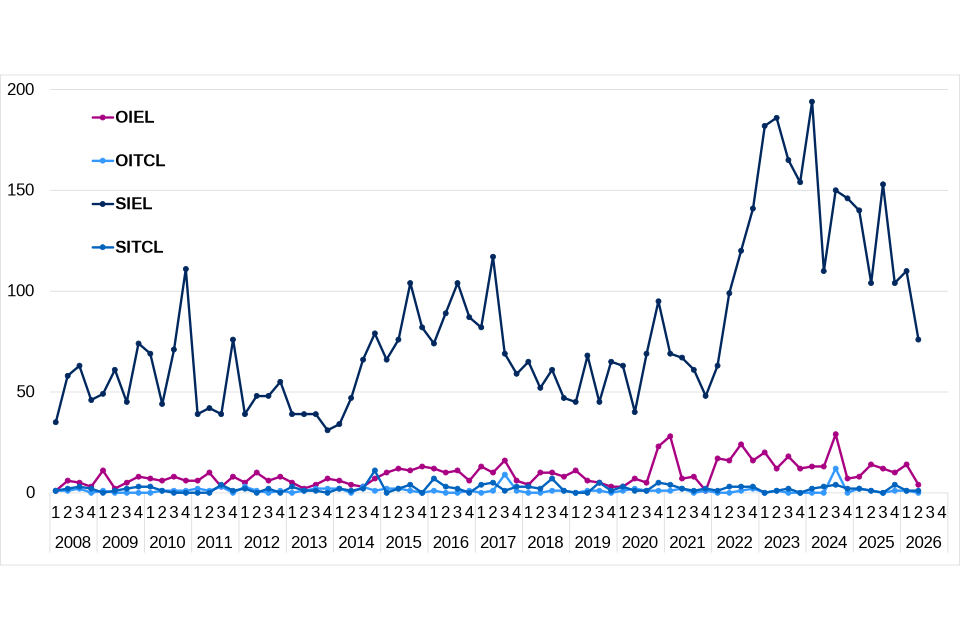
Chart 1 shows the number of SIELs and SITCLs refused and OIELs and OITCLs rejected.
Chart 1: number of licences refused or rejected by licence type
Source: Table A, Strategic export controls licensing statistics
5.1 Latest quarter
In 2026 Q2, there were a total of 2,355 licensing decisions for SIELs. Of these, 2,280 (97%) were issued, 75 (3%) were refused, and none were revoked.
The 2,280 SIELs issued in 2026 Q2 was below average. For context, the number of SIELs issued per quarter over the 5-year period preceding 2026 Q2 (2021 Q2 to 2026 Q1) has averaged 2,888.
The 75 SIELs refused in 2026 Q2 was below average. For context, the number of SIELs refused per quarter over the 5-year period preceding 2026 Q2 (2021 Q2 to 2026 Q1) has averaged 125. More recent periods have seen higher numbers of refusals, with each quarter since 2022 Q3 surpassing 100 total refusals until 2026 Q2. (see Chart 1).
5.2 Commentary on value of licences
Chart 2 shows how the value of goods issued for exportation under SIELs can vary a lot from quarter to quarter, with a handful of high value licences often explaining peaks in the data. The goods included on the licence are valued by the exporter during the application process, which means that the actual exports that take place under the licence may not be of such a high value.
Note 1: The actual number and value of transactions made under the licences is likely to be less than the total made available under the licences issued. This is because some licences will not be used to make all of the exports authorised and others will not be used at all.
Note 2: Unlike SIELs for permanent export, a temporary SIEL may permit the export of the goods to multiple destinations, provided they are returned to the UK within 12 months of export. For example, an item might be exported from the UK for an exhibition in one country, before being moved directly to another exhibition in a second country, and so on, before they are returned to the UK. Currently the total value of temporary goods is calculated as the sum of temporary goods licensed to each destination, meaning that the same goods can be counted multiple times.
Chart 2: value of goods issued for exportation under SIEL licences
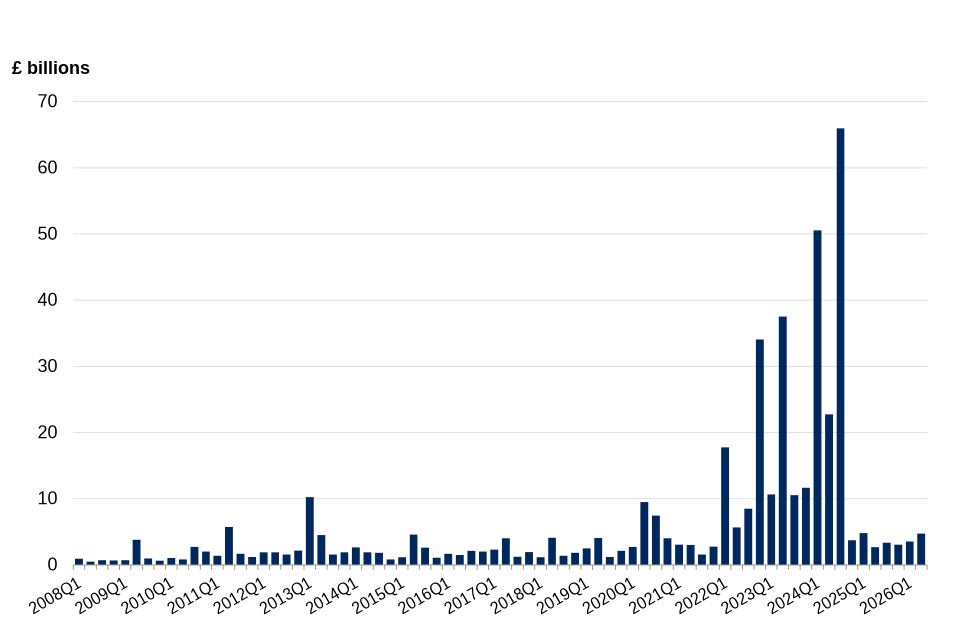
Source: Table E, Strategic export controls licensing statistics Notable historic trends in licence values have been highlighted in the commentary for previous publications.
5.3 Latest quarter
In 2026 Q2, the total value of all SIELs issued was £4.73 billion, up from £3.53 billion in 2026 Q1.
Source: Table E, Strategic export controls licensing statistics
6. Commentary on performance data
Note: The methodology used to calculate the initial processing time differs between SPIRE and LITE. Therefore, LITE and SPIRE processing statistics are presented independently of one another. Comparing LITE processing statistics with SPIRE processing statistics should be done so with care – see Background notes for further details.
On receipt of a SIEL application, ECJU’s target is to process 70% of cases within 20 working days and 99% within 60 working days. ECJU also aims to process 60% of OIEL applications within 60 working days – see ECJU service and performance code for further details.
6.1 Latest quarter
In 2026 Q2, 66% of SIEL applications closed in the LITE licensing system were completed within 20 working days, unchanged from 66% in 2026 Q1. 93% of SIEL applications closed in the LITE licensing system were completed within 60 working days, up from 92% in 2026 Q1.
In 2026 Q2, 37% of SIEL applications closed in the SPIRE licensing system were completed within 20 working days, down from 55% in 2026 Q1. 79% of SIEL applications closed in the SPIRE licensing system had been completed within 60 working days, up from 78% in 2026 Q1.
In 2026 Q2, 0% of OIEL applications closed in the LITE licensing system were completed within 60 working days. OIEL applications are currently undergoing private testing with exporters in LITE.
In 2026 Q2, 45% of OIEL applications closed in the SPIRE licensing system were completed within 60 working days, down from 67% in 2026 Q1.
A combination of long-term factors have continued to affect upon ECJU’s ability to meet processing targets during 2026 Q2.
These factors include the growing complexity of casework (in particular of emerging and dual-use technologies); and the challenging geopolitical environment (including the expansion of sanctions measures, and the conflict in the Middle East). This meant more applications needed detailed review and cross-government input, which has increased processing times. In addition, ECJU’s performance has been substantially affected by the ongoing impact of transitioning from our legacy digital service (SPIRE) to a new digital licensing service (LITE).
Following the launch of public beta, there was a notable reduction in performance against the 20-working-day target in the early part of 2025 as exporters and ECJU operational teams adapted to using a new system, with 41% of SIELs in LITE completed in 20 working days in Q1 2025, and 50% in Q2 2025.
As with the transition to any new digital system, new issues became apparent when operating at scale in a live environment, rather than in a development phase and were subsequently remedied. ECJU is committed to delivering LITE and managing this transitional phase in a way that maintains operational performance. There has been a focus on critical improvements to the SIELs service in LITE, as well as a range of other continuous improvement initiatives, to ensure ECJU address the issues having the greatest effect on performance.
Source: Table B (B1 and B2), Strategic export controls licensing statistics
Table 3A: initial processing time statistics for SIEL applications closed in the SPIRE licensing system during 2026 Q2
| Types of licences | Number of applications completed in 20 working days | % applications completed in 20 working days | Number of applications completed in 60 working days | % applications completed in 60 working days | Median processing time (days) |
|---|---|---|---|---|---|
| Total SIELs | 102 | 37 | 217 | 79 | 25 |
| Permanent | 57 | 30 | 142 | 74 | 29 |
| Temporary | 33 | 58 | 52 | 91 | 17 |
| Transhipment | 1 | 50 | 1 | 50 | 35 |
| Incorporation | 1 | 17 | 5 | 83 | 28 |
| For items covered by the torture regulation (permanent or temporary) | 10 | 59 | 17 | 100 | 20 |
Source: Table B1, Strategic export controls licensing statistics [z] denotes a data point that is not applicable.
Table 3B: initial processing time statistics for SIEL applications closed in the LITE licensing system during 2026 Q2
| Types of licences | Number of applications completed in 20 working days | % applications completed in 20 working days | Number of applications completed in 60 working days | % applications completed in 60 working days | Median processing time (days) |
|---|---|---|---|---|---|
| Total SIELs | 2,016 | 66 | 2,824 | 93 | 16 |
| Permanent | 1,494 | 66 | 2,086 | 92 | 16 |
| Temporary | 67 | 68 | 95 | 96 | 15 |
| Transhipment | [z] | [z] | [z] | [z] | [z] |
| Incorporation | 455 | 66 | 643 | 94 | 17 |
| For items covered by the torture regulation (permanent or temporary) | [z] | [z] | [z] | [z] | [z] |
Source: Table B2, Strategic export controls licensing statistics [z] denotes a data point that is not applicable.
Table 3A and 3B include data for applications that were stopped or withdrawn, as well as applications that were processed but did not require a licence. Therefore, the number of applications completed will be different to the total number of licensing decisions.
7. Glossary
7.1 Licence types
Standard individual export licences (SIELs) are specific to an individual exporter and generally allow shipments of specified items to a specified recipient up to the quantity specified by the licence. There are 5 main subtypes: permanent standard, temporary standard, incorporation, transhipment and SIELs for goods covered by the torture regulation
Open individual export licences (OIELs) are specific to an individual exporter and cover multiple shipments of specified items to specified destinations and/or, in some cases, specified recipients. Licences permitting permanent export are generally valid for up to 5 years from the date of issue. However, OIELs covering the export to EU member states of goods entered on the military list and dealer to dealer OIELs (an OIEL subtype) are generally valid for 3 years.
An open individual trade control licence (OITCL) is specific to a named trader and covers involvement in trading of a generally unlimited supply of specific goods between specific source and destination countries and/or specified senders, recipients and end-users. OITCLs are generally valid for 5 years.
A standard individual trade control licence (SITCL) is specific to a named trader and covers involvement in trading of a set quantity of specific goods between a specific source and destination country with a specified sender, recipient and end-user. SITCLs will normally be valid for 2 years.
Open general export licences (OGELs) are pre-published licences allowing the export of certain goods to certain destinations. Generally, the quantity of goods allowed for shipment is not limited.
7.2 SIELs
Permanent standard SIELs are for items that are for permanent export to a destination.
Temporary standard SIELs are for where the export is temporary, for example for the purposes of demonstration, trial or evaluation, and the licence is generally valid for one year only. The goods must be returned before the licence expires. Temporary SIELs can cover more than one destination.
Incorporation SIELs are for goods that are due to be incorporated, that is, installing them into another product or higher-level system. For incorporation cases there are 2 tiers of end-user. The ‘end user’ is the person/organisation incorporating the goods. The ‘ultimate end user’ is defined as the entity that uses the product or the higher-level system into which the exported goods are installed or incorporated.
Transhipment SIELs are needed for the transit or transhipment of certain goods through the UK en route from one third country to another, providing certain conditions are met. This subtype of SIEL is also called a Standard Individual Transhipment Licence (SITL). Most other transit or transhipments (of certain goods through the UK en route from one third country to another) either do not require a UK licence, or can be made under one of the open general transhipment licences, provided in all cases that the relevant conditions are met.
SIELs for goods covered by the torture regulation concern trade in certain equipment and products which could be used for capital punishment, torture or other cruel, inhuman or degrading treatment or punishment. These are classed as non-military goods but can appear separately to the statistics on licences for non-military goods. Read the guidance about export controls on goods that can be used for torture or capital punishment.
7.3 OIELs
Open individual export licences (OIELs) are specific to an individual exporter and cover multiple shipments of specified items to specified destinations and/or, in some cases, specified recipients. Licences permitting permanent export are generally valid for up to 5 years from the date of issue. However, OIELs covering the export to EU member states of goods entered on the Military List and Dealer-to-dealer OIELs (an OIEL subtype) are generally valid for 3 years. Standard OIELs are the most common type of OIEL issued, but there are several other OIEL subtypes:
-
Dealer-to-dealer OIELs authorise Northern Ireland registered firearms dealers to export certain categories of firearms and ammunition solely to other registered firearms dealers in the European Union only, provided that copies of valid documentation are forwarded to BIST at least 2 working days before each shipment.
-
Cryptographic OIELs authorise the export of specified cryptography hardware or software and the transfer of specified cryptography technology. These licences do not cover hardware, software or technology which includes certain types of cryptanalytic functions.
-
Media OIELs authorise the export of military helmets, body armour, non-military four-wheel drive civilian vehicles with ballistic protection and specially designed components for any of these items, mainly for the protection of aid agency workers and journalists in areas of conflict. The licence permits these goods to be exported to all destinations on a temporary basis only; the goods must be returned to the United Kingdom when no longer required.
-
Continental shelf OIELs authorise the export of controlled goods to the UK sector of the continental shelf for the use only on, or in connection with, offshore installation and associated vessels. The UK sector of the continental shelf is the region of waters surrounding the UK in which the UK has rights over the seabed, subsoil and their natural resources.
7.4 Global project licences
Global project licences (GPLs) are a form of export licence that was introduced by framework agreement partners (UK, France, Italy, Sweden, Spain and Germany) to streamline the arrangements for licensing military goods and technologies between them, where these transfers relate to their participation in specific collaborative defence projects. In relation to the collaborative project, each partner state will, as appropriate, issue their own GPLs to permit transfers of specified goods and technology where these are required for that programme. The GPLs operate on a similar basis to UK OIELs. In the UK, applications for GPLs are assessed against the strategic export licensing criteria.
8. Background notes
8.1 System transition
Licence applications are submitted to and processed by ECJU online. Historically, a purpose-built digital licensing system called SPIRE has been used. However, ECJU is currently in the process of developing and rolling out a new digital licensing system, known as LITE, which will eventually replace SPIRE. During the transition period, ECJU is handling applications on both SPIRE and LITE.
These statistics have included data from LITE since 2021 Q3, the period in which the first licensing decision was made in LITE. This transition has previously affected the timeliness and comprehensiveness of the publication.
In addition, there are some methodology differences between SPIRE and LITE data, including the methodology used to calculate the initial processing time. Therefore, LITE and SPIRE processing statistics are presented independently of one another. Comparing LITE processing statistics with SPIRE processing statistics should be done so with care – see the quality and methodology information guidance for further details of known comparability issues.
Timeliness
We acknowledge that there have been some delays in publishing these statistics due the manual production process to deliver these statistics and ongoing system transition – see the quality and methodology information guidance for further details.
Comprehensiveness
From the 2023 Q1 publication until the 2025 Q1 publication, there were some limitations in the LITE data we published due to limitations in the ability to extract comprehensive and accurate licensing data from LITE, and the impact this had on the publication as LITE usage increased (affected statistics were appropriately caveated in each relevant publication.) However, these statistics can now be considered wholly comprehensive of all licensing data across both SPIRE and LITE. For further details, see the statement of administrative sources guidance and the quality and methodology information guidance
8.2 Official Statistics in Development
Statistics for the reporting periods 2008 Q1 to 2023 Q4 were published as Official Statistics However, these statistics have been reclassified and are being published as Official Statistics in Development from the 2024 Q1 publication until further notice (including this release). This was initially due to limitations in the ability to extract comprehensive and accurate licensing data from LITE, and the impact this has had on the publication.
However, despite the fact that the release is now considered wholly comprehensive of LITE data, the current classification will be kept until there is full confidence in the newly established production processes and the quality of the data being published. The application of the Official Statistics in Development reclassification is an established procedure set out by the Office for Statistics Regulation. It is used where Official Statistics are undergoing major changes likely to affect their quality for a period of time.
For further details, see the statement of administrative sources guidance and the quality and methodology information guidance.
8.3 Uses of the data
These strategic export controls licensing statistics are used within government, to inform policy and operational decision-making. Additionally, these licensing statistics are used in the annual report on the UK’s export control policy and practice during the year. This report is published by BIST but written in collaboration with the Foreign, Commonwealth and Development Office (FCDO) and the Ministry of Defence (MOD). See the United Kingdom strategic export controls annual report.
The Business and Trade Committee (BTC), previously the Committee on Arms Export Controls (CAEC), use these statistics to inform their work in examining the government’s expenditure, administration and policy on strategic exports.
Non-government organisations such as Campaign Against the Arms Trade (CAAT) and Amnesty International use these statistics to monitor strategic exports. Academic and research institutions such as Export Control Advisory Committee (ECAC) and Export Group for Aerospace, Defence and Dual-Use (EGADD) are also known to use these statistics.
8.4 Related guidance
The Strategic export controls: licensing statistics revisions policy guidance sets out the revision policy for these statistics, including how we may correct errors and show amendments within the publication.
The Strategic export control statistics: statement of administrative sources guidance sets out the administrative sources used to compile these statistics.
The Strategic export control statistics: licensing statistics quality and methodology information sets out the ECJU uses for data collection and compilation of these statistics, including how we source, process and quality check data.
8.5 Further information
The most recently published accompanying data tables can be found on BIST’s strategic export controls statistics page.
Footnotes have been supplied to provide more context for certain licences. Country footnotes are supplied in a data table and give country-specific information on how licence applications have been assessed. Case and goods footnotes are provided on the country pivot report only and aim to offer information on how licensing decisions were made with regards to particular goods and details of their use.
A small number of specialised licences have not been counted within this commentary due to how they are processed. Available data on these licences can be found in the ‘other standard licences’ data table as part of each quarterly report.