Main findings: state-funded schools inspections and outcomes as at 31 March 2026
Updated 12 August 2026
Applies to England

© Crown copyright 2026
This publication is licensed under the terms of the Open Government Licence v3.0 except where otherwise stated. To view this licence, visit nationalarchives.gov.uk/doc/open-government-licence/version/3 or write to the Information Policy Team, The National Archives, Kew, London TW9 4DU, or email: psi@nationalarchives.gov.uk.
Where we have identified any third party copyright information you will need to obtain permission from the copyright holders concerned.
This publication is available at https://www.gov.uk/government/statistics/state-funded-schools-inspections-and-outcomes-as-at-31-march-2026/main-findings-state-funded-schools-inspections-and-outcomes-as-at-31-march-2026
This is the main findings report for the state-funded schools inspections and outcomes as at 31 March 2026 release. The following are also available:
- underlying data
- methodology
- pre-release access list
This is the first official statistics release covering the renewed education inspection framework, which came into effect on 10 November 2025.[footnote 1] These statistics are therefore published as official statistics in development – please see the accompanying methodology for further details.
Your feedback will help us improve future publications. Please share your views by completing this survey.
Data produced under the previous version of the framework remain available on the Ofsted schools statistics page for reference.
Summary
This release includes:
- data for inspections completed between 10 November 2025 and 31 March 2026 where the reports were published by 30 April 2026
- schools’ most recent inspections and outcomes as at 31 March 2026
- revised data for inspections completed between 1 September 2024 and 31 August 2025
Since 10 November 2025, we have carried out 937 inspections.
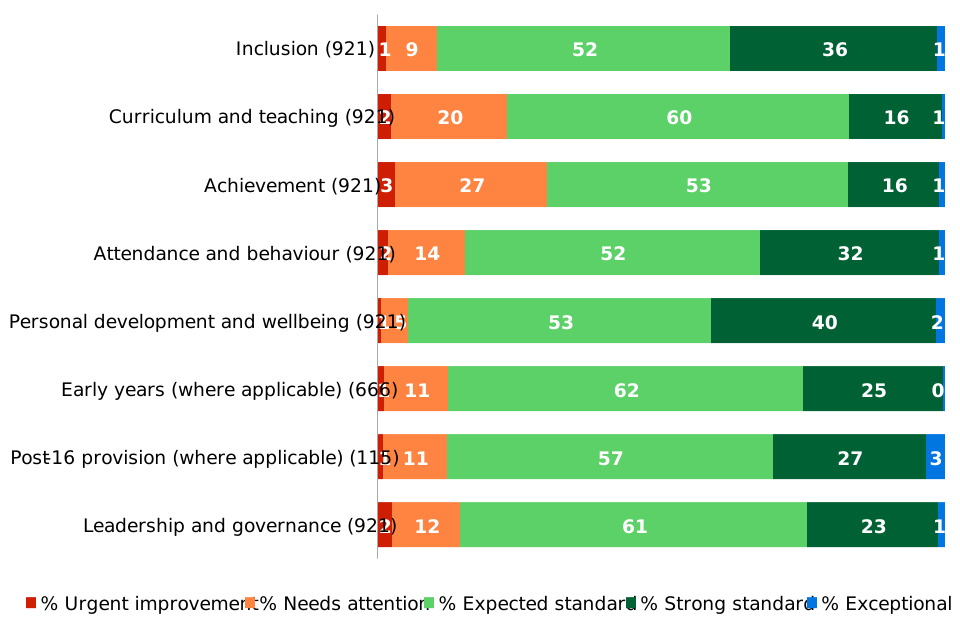
The proportion of schools graded ‘expected standard’ or better for each evaluation area at a full inspection were:
- 89% for ‘inclusion’
- 77% for ‘curriculum and teaching’
- 70% for ‘achievement’
- 85% for ‘attendance and behaviour’
- 95% for ‘personal development and wellbeing’
- 85% for ‘leadership and governance’
Number of providers
There are currently 21,965 state-funded schools. Forty-six per cent of these are maintained by local authorities and 54% are academies and free schools.
Inspections between 10 November 2025 and 31 March 2026
Since 10 November 2025, we have carried out 937 inspections.
Since the renewed education inspection framework (EIF) came into effect on 10 November 2025, we have carried out 937 inspections, comprising 921 full inspections and 16 monitoring inspections (5 focused monitoring inspections and 11 legacy monitoring inspections).[footnote 2] We have not yet carried out any of the new-style monitoring inspections under the renewed EIF, whereby individual evaluation areas can be re-graded.
The 937 schools inspected so far this year represent only 4% of all state-funded schools, so the grade profile is not representative of all schools.
All of the 125 schools inspected from 10 to 30 November 2025 were volunteers. By being a self-selecting group of schools, volunteers are inherently biased in terms of their readiness and preparedness for an Ofsted inspection, which may mean their inspection outcomes are not representative of the wider school population.
As we inspect lower-performing schools more often than high-performing schools, the mix of schools inspected in any single year is not typically representative of all schools. Of the 921 schools inspected this year, 18% were graded ‘requires improvement’ or ‘inadequate’ for overall effectiveness at their last full inspection. This 18% compares to 10% of all 21,879 schools being graded ‘requires improvement’ or ‘inadequate’ at their most recent inspection in August 2024, and an estimate of 8% in August 2025.[footnote 3]
Grades at full inspections
The proportion of schools graded ‘expected standard’ or better for each evaluation area at a full inspection were:
- 89% for ‘inclusion’
- 77% for ‘curriculum and teaching’
- 70% for ‘achievement’
- 85% for ‘attendance and behaviour’
- 95% for ‘personal development and wellbeing’
- 85% for ‘leadership and governance’
In full inspections, we look at 6 core evaluation areas in all inspections as well as grading early years and post-16 provision, where relevant.
So far, the evaluation area with the highest proportion of schools graded ‘expected standard’ or better is ‘personal development and wellbeing’ (95%), while the lowest is ‘achievement’ (70%).[footnote 4]
The evaluation area with the largest difference between primary and secondary schools so far is ‘attendance and behaviour’ (87% expected standard or better in primary compared with 78% in secondary).[footnote 5]
Figure 1 shows a breakdown of the inspection outcomes from the 921 full inspections we’ve carried out so far under the renewed EIF.
Figure 1: Full inspection grades by evaluation area since 10 November 2025
1. Percentages are rounded and may not add up to 100. For those rounded to 0, see the accessible table for these percentages to 1 decimal place.
2. Numbers of inspections are in brackets.
View data in an accessible table format.
Safeguarding standards were met in 99% of inspections. In the 8 schools (0.9%) where safeguarding standards were not met, safeguarding was rarely the only problem identified in the school. All 8 schools were graded ‘urgent improvement’ for ‘leadership and governance’, and 6 were graded ‘urgent improvement’ for at least one other evaluation area.
Four per cent of schools were graded ‘urgent improvement’ for at least one evaluation area. These schools were placed into a category of concern (59% require special measures and 41% require significant improvement).[footnote 6]
Three per cent of schools were graded ‘exceptional’ for at least one evaluation area.
The relationship between grades for the different evaluation areas
Seventy-three per cent of schools received a mix of different grades across the 6 core evaluation areas.[footnote 7] Of the 27% of inspections where the grades match, the most common scenario is that all 6 evaluation areas were graded ‘expected standard’ (accounting for 16% of all inspections).[footnote 8]
The evaluation areas where the grades are most closely aligned are ‘achievement’ and ‘curriculum and teaching’ (where 80% of schools had the same grades for these 2 evaluation areas); and ‘leadership and governance’ and ‘curriculum and teaching’ (also 80%).
Figure 2: The proportion of full inspections with the same grade for each evaluation area since 10 November 2025
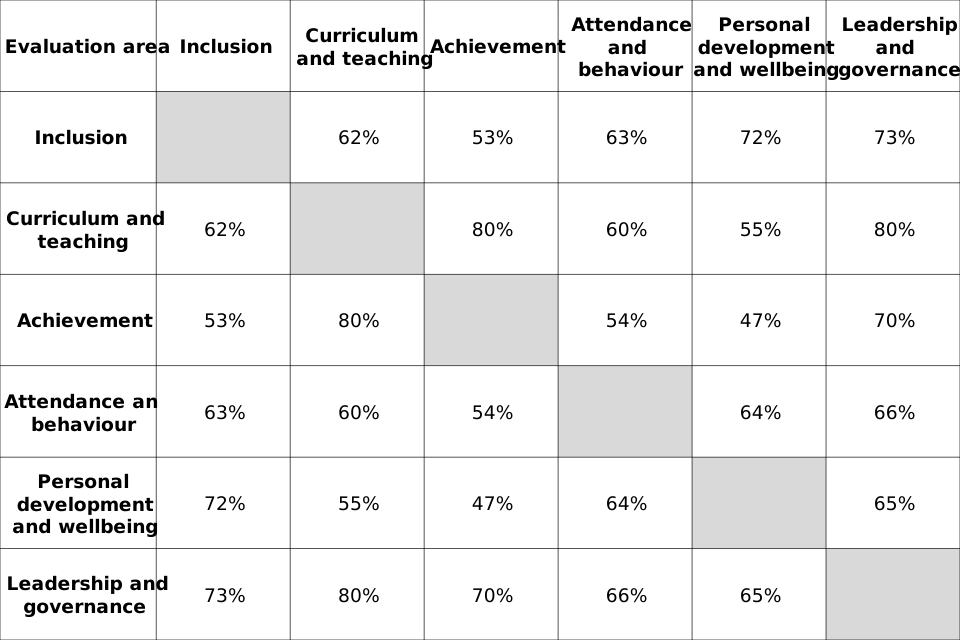
1. Each box shows the proportion of full inspections where the outcome for the evaluation area listed on the left matched that of the evaluation area listed at the top.
2. Based on the 921 full inspections carried out so far under the renewed EIF.
View data in an accessible table format.
Monitoring inspections
So far this year we have carried out 11 ‘legacy’ monitoring inspections of schools placed into a category of concern under the original EIF. These all found that leaders were taking effective action to improve the school.
Under the renewed EIF, if a school is graded ‘urgent improvement’ or ‘needs attention’ for one or more evaluation areas, it will have a follow-up monitoring inspection to look at progress in those areas. Unlike with monitoring inspections under the original EIF, monitoring inspections under the renewed EIF can result in a change to the grades for those evaluation areas.[footnote 9] These new monitoring inspections had not started in the period covered in this release but will be included in future releases.
Revisions to previous release
The provisional data in the previous release related to inspections that took place between 1 September 2024 and 31 August 2025, with the reports published by 30 September 2025. Revised data for inspections in this period is provided in tables 1R and 2R of the data file accompanying this release: State-funded schools inspections and outcomes as at 31 March 2026, charts and tables.
This revised data includes an additional 17 graded inspections that had not been published by 30 September 2025 but were published by 30 April 2026. See table 2R for details of the revised inspection outcomes across the period.
We publish revisions to data in this publication, in line with our revisions policy for official statistics.
Notes
You can find an explanation of the main uses of this data, further contextual information and the arrangements for quality assurance in the methodology report. The methodology report provides information about the strengths and limitations of the statistics.
Glossary
Definitions of terms are in the statistical glossary.
Further information
Contacts
If you are a member of the public and have any comments or feedback on this publication, please contact Louise Butler on 03000 131 457 or the schools data and analysis team on inspectioninsight@ofsted.gov.uk.
Press enquiries should be sent to our press team, at pressenquiries@ofsted.gov.uk.
Acknowledgements
Thanks to the following for their contribution to this statistical release: Chris Foley, James Jordan, Naveen Lankipalli and Matthew Spencer.
How to search
Click on Ctrl + F on a Windows laptop or Command + F on a Mac.
This will open a search box in the top right-hand corner of the page. Type the word you are looking for in the search bar and press enter.
Your browser will highlight the word, usually in yellow, wherever it appears on the page. Press enter to move to the next place where it appears.
Data tables for figures
Data for Figure 1: Full inspection grades by evaluation area since 10 November 2025
| Evaluation area | Number of inspections | % Urgent improvement | % Needs attention | % Expected standard | % Strong standard | % Exceptional |
|---|---|---|---|---|---|---|
| Inclusion | 921 | 1 | 9 | 52 | 36 | 1 |
| Curriculum and teaching | 921 | 2 | 20 | 60 | 16 | 1 |
| Achievement | 921 | 3 | 27 | 53 | 16 | 1 |
| Attendance and behaviour | 921 | 2 | 14 | 52 | 32 | 1 |
| Personal development and wellbeing | 921 | 1 | 5 | 53 | 40 | 2 |
| Early years (where applicable) | 666 | 1 | 11 | 62 | 25 | 0.5 |
| Post-16 provision (where applicable) | 115 | 1 | 11 | 57 | 27 | 3 |
| Leadership and governance | 921 | 2 | 12 | 61 | 23 | 1 |
See Figure 1.
Data for Figure 2: The proportion of full inspections with the same grade for each evaluation area since 10 November 2025
| Evaluation area 1 | Evaluation area 2 | Proportion where grades match |
|---|---|---|
| Inclusion | Curriculum and teaching | 62% |
| Inclusion | Achievement | 53% |
| Inclusion | Attendance and behaviour | 63% |
| Inclusion | Personal development and wellbeing | 72% |
| Inclusion | Leadership and governance | 73% |
| Curriculum and teaching | Achievement | 80% |
| Curriculum and teaching | Attendance and behaviour | 60% |
| Curriculum and teaching | Personal development and wellbeing | 55% |
| Curriculum and teaching | Leadership and governance | 80% |
| Achievement | Attendance and behaviour | 54% |
| Achievement | Personal development and wellbeing | 47% |
| Achievement | Leadership and governance | 70% |
| Attendance and behaviour | Personal development and wellbeing | 64% |
| Attendance and behaviour | Leadership and governance | 66% |
| Personal development and wellbeing | Leadership and governance | 65% |
See Figure 2.
-
This release does not include inspections that took place between 1 September and 9 November 2025 as these were carried out under the original education inspection framework. For details of these inspections, please see our management information dataset as at 31 December 2025. ↩
-
Based on events carried out by 31 March 2026 where the inspection report was published by 30 April 2026. Additional inspections were carried out but not published by the cut-off point; see Table 1 (inspection events) of our monthly management information datasets for details of the number carried out by the end of each month. ↩
-
This is based on the latest overall effectiveness grades for all schools, apart from those that were inspected in 2024/25 and so did not have an overall effectiveness grade – for these, we have used the ‘quality of education’ grade instead. ↩
-
For further details on the ‘achievement’ grade and its relationship with attainment data, see our data commentary The ‘achievement’ grade, attainment data and schools in challenging circumstances, May 2026. ↩
-
See Table 1 in the accompanying ODS file for the grades for each evaluation area broken down by phase of education. ↩
-
See the School inspection operating guide for inspectors for further information on placing a school in a category of concern and the difference between the 2 possible categories. ↩
-
The 6 core evaluation areas exclude early years and sixth-form provision, which are only graded in schools with the relevant age group. ↩
-
See Table 7a of the ODS file for further details. ↩
-
The new monitoring inspections can also be deemed a full inspection. Where that is the case, all evaluation areas will be graded, not just those previously graded ‘urgent improvement’ or ‘needs attention’. ↩