Smoking profile: statistical commentary, July 2026
Updated 17 July 2026
Applies to England

© Crown copyright 2026
This publication is licensed under the terms of the Open Government Licence v3.0 except where otherwise stated. To view this licence, visit nationalarchives.gov.uk/doc/open-government-licence/version/3 or write to the Information Policy Team, The National Archives, Kew, London TW9 4DU, or email: psi@nationalarchives.gov.uk.
Where we have identified any third party copyright information you will need to obtain permission from the copyright holders concerned.
This publication is available at https://www.gov.uk/government/statistics/smoking-profile-july-2026-update/smoking-profile-statistical-commentary-july-2026
What’s new
New data has been added to existing indicators in the smoking profile for:
- smoking-attributable mortality for the period 2022 to 2024
- smoking-attributable hospital admissions for the financial year ending March 2023
One new indicator has been added:
- proportion of local smoking population referred to stop smoking services for the financial year ending March 2025
Indicators of smoking prevalence have not been updated in this release, but inequality breakdowns have been added for regions, providing data by age, ethnicity, country of birth and religion within the English regions.
Regional data have also been added for indicators of smoking prevalence at age 15.
Updated indicators, listed in the appendix, are available at local authority level, as well as for England and the English regions.
Introduction
Until this release, indicators of smoking-attributable mortality and hospital admissions had not been updated since 2019. This is because producing these indicators requires accurate estimates of the proportion of disease which can be attributed to smoking tobacco. As COVID-19 has been a cause of mortality and hospital admission since 2020, it has been necessary to establish what proportion of these could be attributed to smoking.
This update is accompanied by Developing smoking-attributable fractions (SAFs) for COVID-19, which describes the literature review undertaken to establish the risk of death or hospital admission from COVID-19 for people who smoke, or used to smoke, compared with the risk for those who have never smoked. It details the methods used to update the indicators of smoking-attributable harm reported here.
Data for these indicators is not provided for 2020 and 2021 (nor the 3-year periods containing these 2 years), as it is unlikely to be reliable due to the exceptional nature of mortality and healthcare in those years.
Main findings
Smoking-attributable mortality
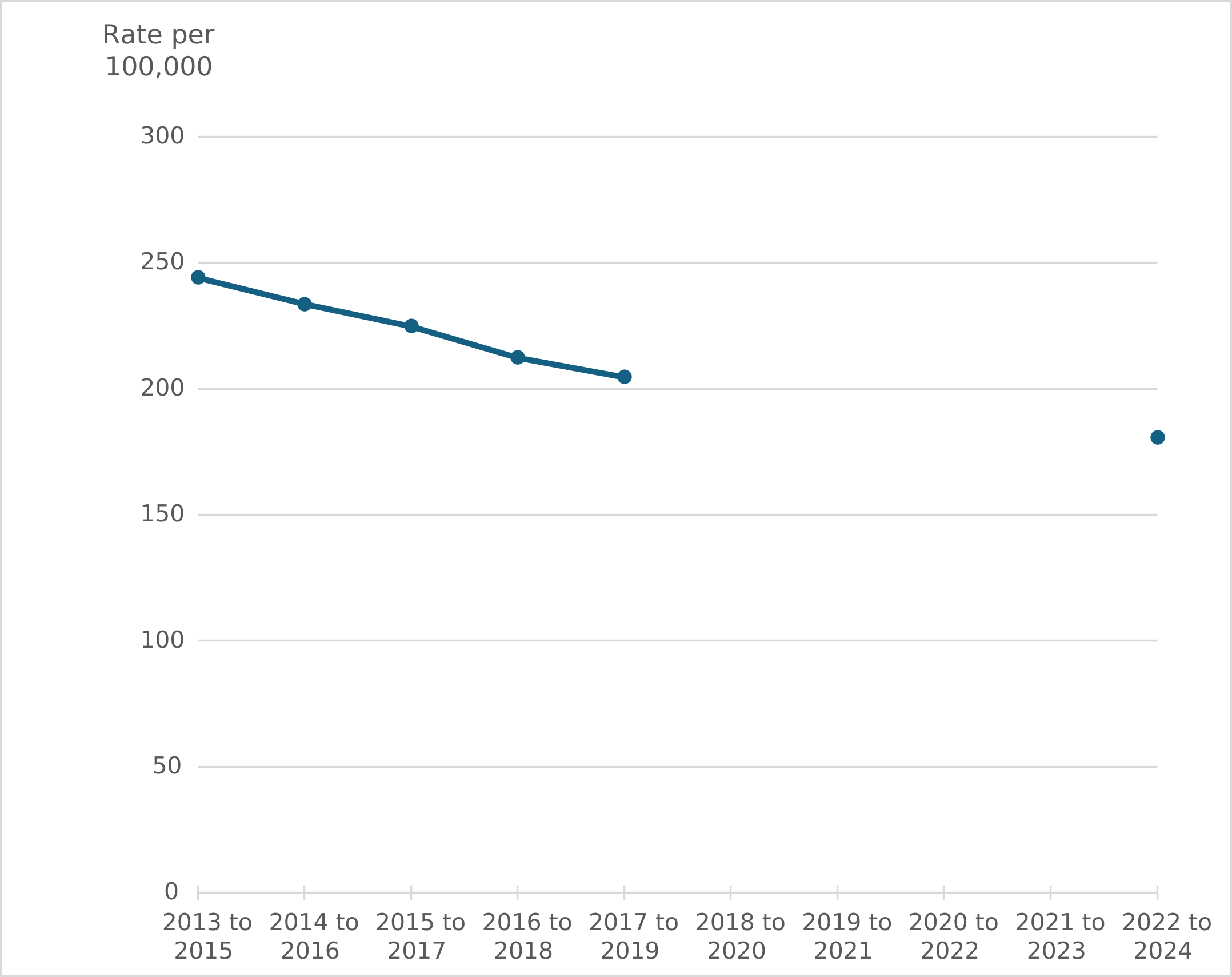
There were an average 61,439 smoking-attributable deaths each year in England in 2022 to 2024. In that period, the smoking-attributable mortality rate was 181 per 100,000 population. This was a significant decrease of 11.7% from the pre-pandemic rate for 2017 to 2019 of 205 deaths per 100,000.
Despite the definition now including deaths from COVID-19, the smoking-attributable mortality rate in 2022 to 2024 was the lowest since the time series began in 2013 to 2015. The rate has fallen in each period since then (see figure 1). Compared with 2013 to 2015, there were 10,154 fewer smoking-attributable deaths each year in 2022 to 2024.
Figure 1: age-standardised smoking-attributable mortality rates for people aged 35 and over, England, 2013 to 2015 to 2022 to 2024
Source: Office for Health Improvement and Disparities (OHID), based on Office for National Statistics (ONS) death registration data and ONS mid-year population estimates
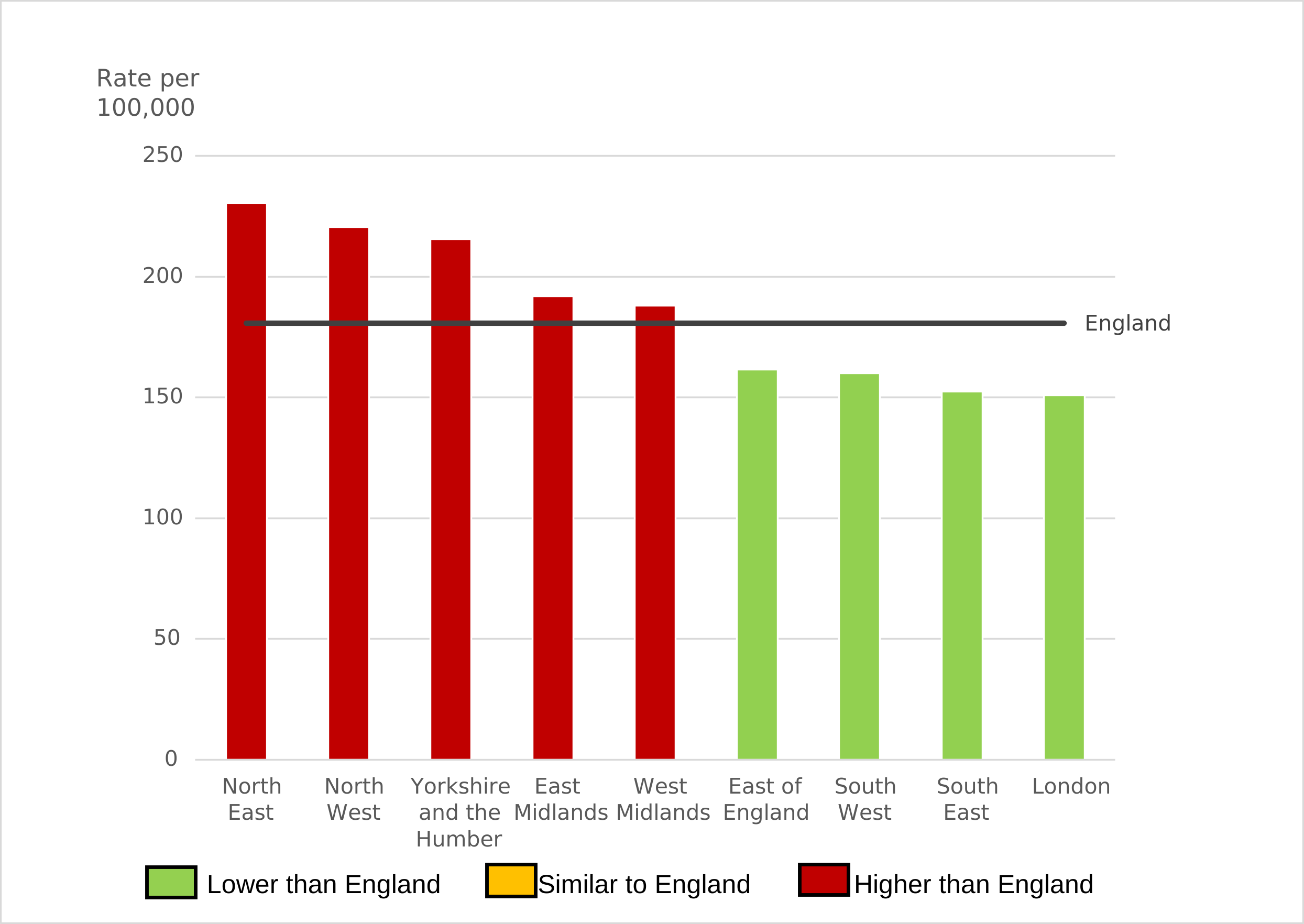
Although smoking-attributable mortality rates have fallen in all regions, geographical inequalities persist with a clear north-south divide in the results (see figure 2). The region with the highest smoking-attributable mortality rate in 2022 to 2024 was the North East, with 231 deaths per 100,000. The rate was lowest in London (151 per 100,000).
Figure 2: age-standardised smoking-attributable mortality rates for people aged 35 and over, England and the English regions, 2022 to 2024
Source: OHID, based on ONS death registration data and ONS mid-year population estimates
Inequality was even greater between upper tier local authorities. The highest rate of smoking-attributable mortality in 2022 to 2024 was in Blackpool. Its rate of 360 per 100,000 was 3.6 times higher than Wokingham, the area with the lowest rate (99 per 100,000).
Smoking-attributable admissions
The rate for smoking-attributable hospital admissions in England in the financial year ending in March 2023 was 1,242 per 100,000 population. This is a significant decrease from the financial year ending in March 2019, when the rate was 1,378 per 100,000. The region with the highest rate of smoking-attributable admissions in the financial year ending in March 2023 was the North East. Its rate of 1,817 per 100,000 was double that of the region with the lowest rate (the South East, 894 per 100,000).
Proportion of local smoking population referred to stop smoking services
In England, 6.4% of people who smoked were referred to stop smoking services in the financial year ending March 2025. This represents 335,288 referrals into the system. The North East had the highest proportion of referrals, at 7.9% of the smoking population, compared with the West Midlands with the lowest, at 4.8%.
Methods
The smoking-attributable mortality and hospital admission rates are directly age-standardised rates which adjust for differences in the age structure of the population between areas and population groups.
Full details of the methods used for each indicator can be found in the definitions section of the smoking profile.
Revisions
Trend data for the following indicators has been revised in the July 2026 update:
- smoking-attributable mortality: 2013 to 2015 to 2017 to 2019
- smoking-attributable hospital admissions: financial year ending March 2014 to financial year ending March 2019
The following changes have been made:
- all rates have been produced with revised population estimates based on the 2021 Census
- comparability ratios have been applied to numbers of smoking-attributable deaths. The ratios take account of coding changes made by ONS to implement revisions to rules which determine the selection of the underlying cause of death
- all indicators are calculated using revised smoking-prevalence estimates from the Annual Population Survey
- a consistent methodology is now used across all time periods
Enquiries
For enquiries or feedback about the smoking profile, email pha-ohid@dhsc.gov.uk.
Appendix
In this update, new data is available for:
-
smoking-attributable mortality, 2022 to 2024
-
smoking-attributable deaths from cancer, 2022 to 2024
-
smoking-attributable deaths from heart disease, 2022 to 2024
-
smoking-attributable deaths from stroke, 2022 to 2024
-
smoking-attributable hospital admissions, financial year ending March 2023
The following new indicator is available:
- proportion of local smoking population referred to stop smoking services, financial year ending March 2025
Data for smoking-attributable hospital admissions are available for both upper and lower tier local authorities. Indicators of smoking-attributable mortality and the proportion of smoking population referred to stop smoking services are available only for upper tier local authorities.
Regional data has been added for:
-
smoking prevalence age 15 years, regular smokers, 2011 to 2014, 2023
-
smoking prevalence age 15 years, occasional smokers, 2011 to 2014, 2023
-
regular e-cigarette users, 15-year-olds, 2023
-
have ever used e-cigarettes, 15-year-olds, 2023
Using the Annual Population Survey, regional data has been added for:
-
current smokers by age, ethnicity, country of birth and religion, 2024
-
ex-smokers by age and ethnicity, 2024
-
never smokers by age and ethnicity, 2024