Road conditions in England to March 2025
Published 21 January 2026
Applies to England

© Crown copyright 2026
This publication is licensed under the terms of the Open Government Licence v3.0 except where otherwise stated. To view this licence, visit nationalarchives.gov.uk/doc/open-government-licence/version/3 or write to the Information Policy Team, The National Archives, Kew, London TW9 4DU, or email: psi@nationalarchives.gov.uk.
Where we have identified any third party copyright information you will need to obtain permission from the copyright holders concerned.
This publication is available at https://www.gov.uk/government/statistics/road-conditions-in-england-to-march-2025/road-conditions-in-england-to-march-2025
About this release
This annual release presents information on the condition of roads in England, covering surface condition, skidding resistance and highway maintenance treatments and expenditure.
Automated survey machines and visual surveys are used by local authorities and National Highways (NH) to monitor the condition of the road surface.
In 2025, all local authorities in England returned data to DfT on the condition of their roads, excluding Isles of Scilly who are exempt (153 Local Authorities). Of these returns, 149 LAs included data on ‘A’ road which should have been considered for maintenance and 133 for ‘B’ and ‘C’ road.
Additional data has also been collected for 2024 and has been included in this publication, see Revision of previous data for more information.
These are official statistics. For more information, see the About these statistics section.
Headline figures
In 2025, the percentage of ‘A’ road that should have been considered for maintenance increased but for ‘B’ and ‘C’ roads and unclassified roads this was unchanged from the previous year. Local authorities reported the percentage of:
-
local ‘A’ road that should have been considered for maintenance to be 5%, an increase from 4% in 2024
-
‘B’ and ‘C’ road that should have been considered for maintenance to be 7%, unchanged since 2023
-
unclassified road that should have been considered for maintenance to be 17%, unchanged from the previous year. Data for unclassified roads is less robust than for classified roads and can show greater yearly fluctuations than other road classifications
Chart 1: Line chart showing the trend in the percentage of local road that should have been considered for maintenance (red), in England, by road type, for the years 2008 to 2025 (RDC0120, RDC0130)
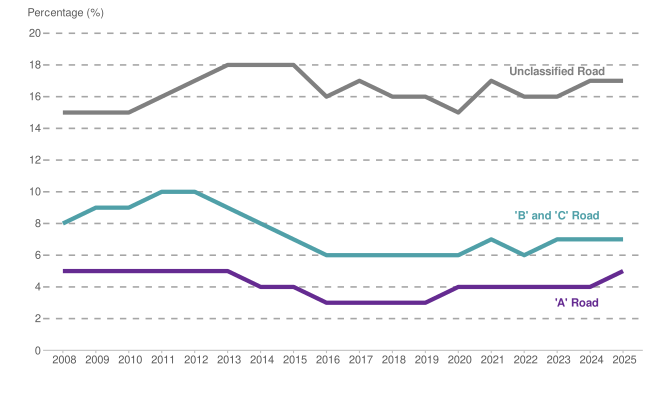
Interpretation:
When referring to the percentage of road, this is as a percentage of total road network length rather than on an individual road-by-road basis. Road condition monitoring data is measured in 10-metre sections, so for example, a figure of 5% red indicates that 5% of the 10-metre sections should have been considered for maintenance, rather than 5% of the number of roads.
Data coverage:
Data is collected over different time periods (2 to 4 financial years) for different parts of the road network. For improved readability, this publication cites the year at the end of the data collection cycle (for example, ‘2025’) when referring to that period. Further detail of collection periods is covered in the road type sections of this release.
Categorisation of road condition
Definition of road surface condition categories:
Red
Should have been considered for maintenance. Treatment may or may not be required, but the road should be investigated fully.
Amber
Maintenance may be required soon.
Green
No further investigation or work is needed.
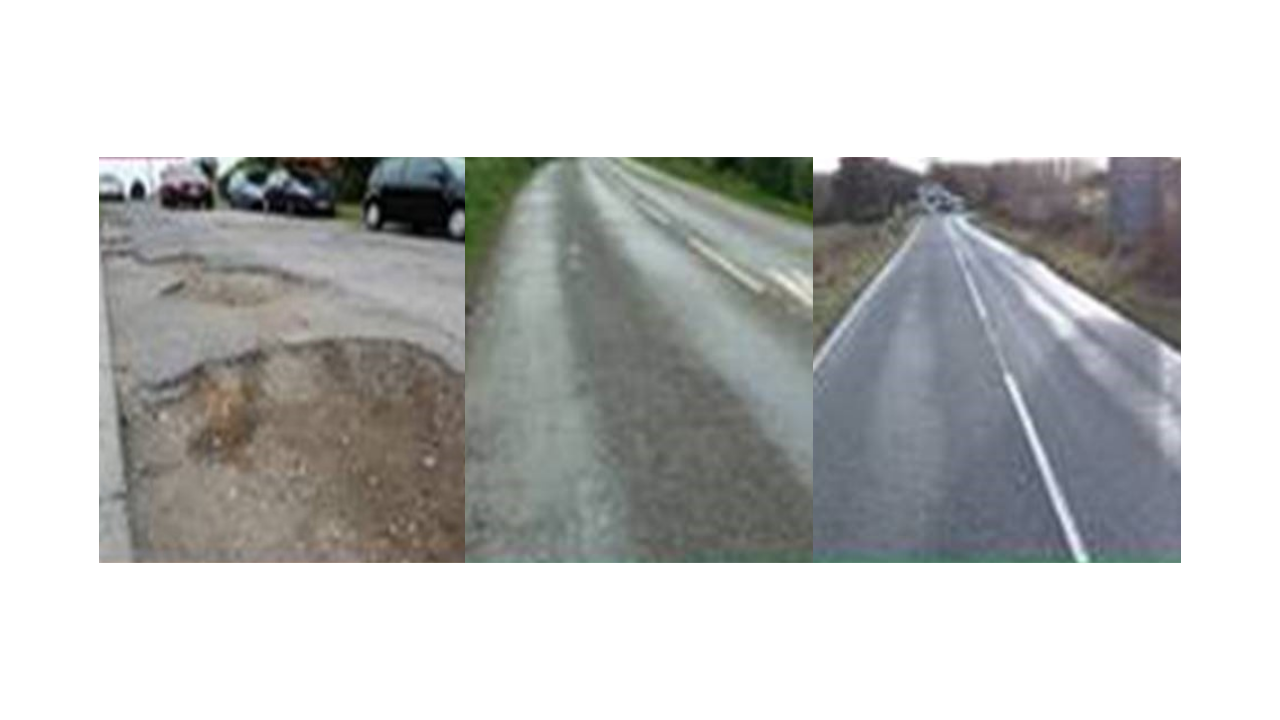
Figure 1: Examples of roads categorised as red, amber, and green
Important information about comparing the road condition data across different types of roads
Road surface condition categories are based on multiple parameters collected by Surface Condition Assessment for the National Network of Roads (SCANNER) machines and scored against different definitions for different types of roads. This is so that maintenance is prioritised for roads that have heavier traffic flows and act as key arterial routes. This means that the percentage of red road is not comparable across road classes (‘A’, ‘B’, ‘C’ and unclassified). For example, an ‘A’ road categorised as red could be in identical condition to a ‘B’ road categorised as amber.
Amber and green percentages for ‘A’ road and ‘B’ and ‘C’ road are provided to us on a voluntary basis. This meant that some local authorities previously provided data on the percentage of red road, but not the percentages of amber and green. Therefore, trends seen in the percentages of amber and green road could be influenced by the subset of local authorities included each year, and the percentage of red road reported together with amber and green (presented in table RDC0122) may be slightly different from the percentage of red road alone (presented in table RDC0120). For example, in 2022, we received data from 119 local authorities for the percentage of red ‘A’ road alone, compared to data from 104 local authorities for the percentages of red, amber, and green ‘A’ road together. However, in 2025, all local authorities that provided us with valid ‘A’ road data provided the complete set of red, amber and green data.
Condition of local ‘A’ roads
Local ‘A’ roads and locally managed motorways accounted for around 10% of the local authority managed road network in England and carried approximately 31% of all traffic in calendar year 2024.
This section refers to local ‘A’ roads but includes the 26 miles of locally managed motorways in England, which account for around 0.01% of local roads.
Timing and coverage: Local authorities are required to carry out SCANNER surveys on 90% of their ‘A’ road and motorway in both directions over a 2-year period, therefore the data presented for 2025 was collected between April 2023 and March 2025.
Chart 2: A line chart showing the percentage of local ‘A’ road categorised as red, amber, or green, in 2018 to 2025 (RDC0122, RDC0123)
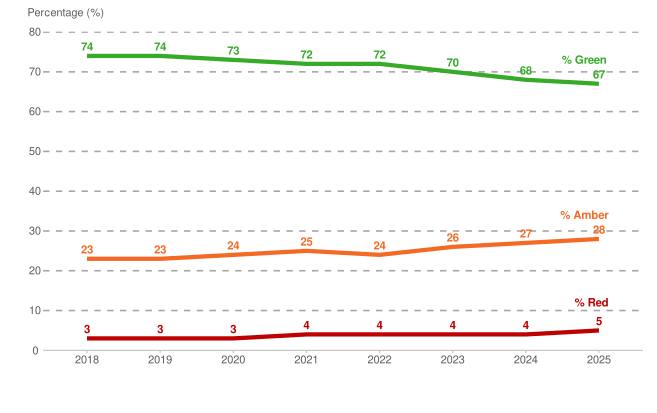
In 2025, 5% of local ‘A’ road was categorised as red, 28% was categorised as amber, and 67% was categorised as green. Note that, due to rounding, the percentages for a given year may not sum to 100. These figures are based on 149 local authorities. Since 2018, the percentage of green road has decreased by 7 percentage points from 74% to 67% in 2025. Over the same time, the percentage of amber road increased by 5 percentage points from 23% in 2018 to 28% in 2025.
Note:
The data presented in Charts 2 and 5 (table RDC0122) for amber and green roads was collected on a voluntary basis from local authorities. The figures shown in this chart are based on local authorities that provided this information for all three categories, for example, red, amber and green, and so local authorities who only provided the mandatory percentage red figure are omitted. As a result, the percentage of red road may differ slightly to the headline figure presented in Charts 3 and 6 (table RDC0120).
Chart 3: A line chart showing the percentage of local ‘A’ road categorised as red, in 2008 to 2025 (RDC0120, RDC0121)
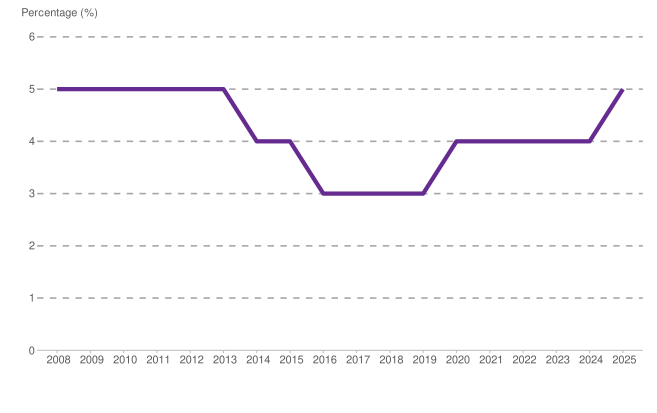
The percentage of local ‘A’ road categorised as red has increased from 4% in 2024 to 5% in 2025, having remained stable at 4% since 2020 when it increased from 3% in 2019.
The percentage of road categorised as red varies across the country, as demonstrated in Chart 4.
Chart 4: A map showing the difference in the percentage of red local ‘A’ road across local authorities in England, for every other year from 2015 to 2025 (RDC0120, RDC0121, Interactive Map)
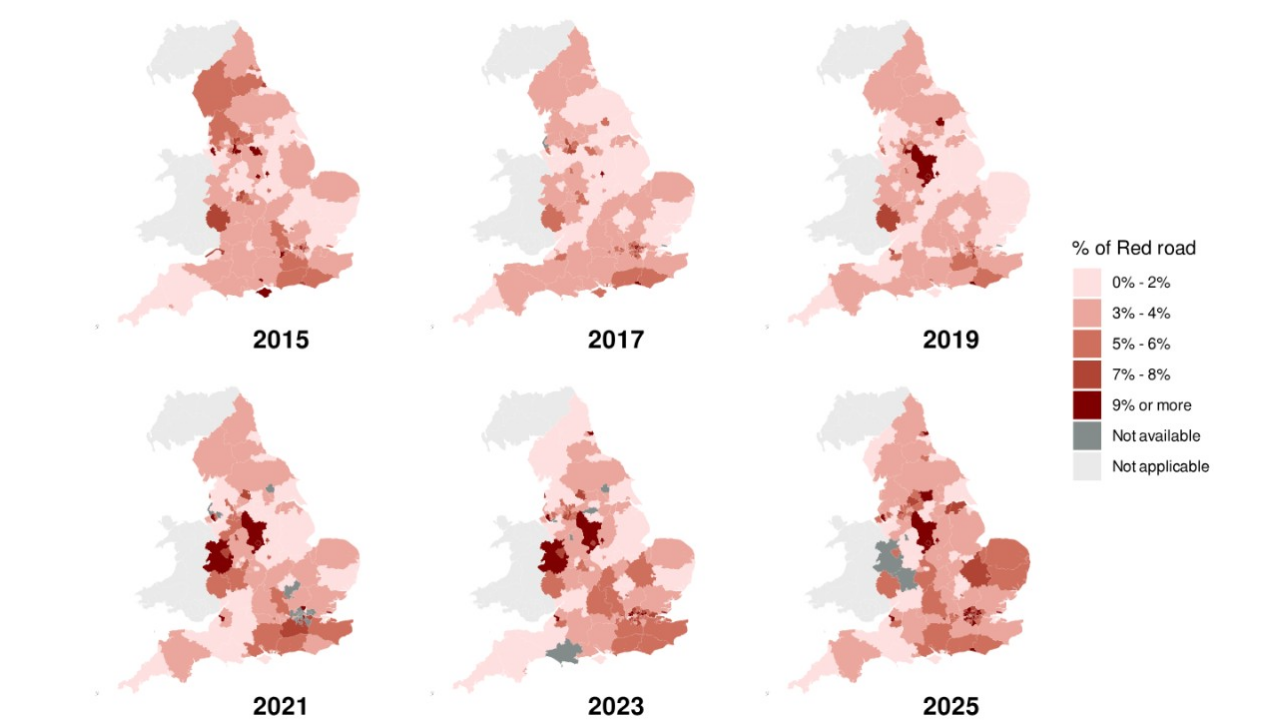
Of the 149 local authorities that provided valid data for 2025, 37 local authorities reported their percentage of red ‘A’ road to be no more than 2%, while 16 local authorities reported a percentage of 10% or higher.
When looking at longer term trends in the percentage of ‘A’ road categorised as red between 2015 and 2025:
-
52% of local authorities reported roads to be in worse condition
-
22% of local authorities reported no change
-
26% of local authorities reported improved condition
In the shorter term, between 2022 and 2025:
-
47% of local authorities reported roads to be in worse condition
-
31% of local authorities reported no change
-
22% of local authorities reported improved condition
Condition of ‘B’ and ‘C’ roads
‘B’ and ‘C’ roads together accounted for around 29% of all local authority managed roads in England.
Timing and coverage: Local authorities are required to carry out SCANNER surveys on 85% of their ‘B’ road network in both directions and 80% of their ‘C’ road network in one direction over a 2-year period. The data presented for 2025 was collected between April 2023 and March 2025.
Chart 5: A line chart showing the percentage of local ‘B’ and ‘C’ road that was categorised as red, amber or green, in 2020 to 2025 (RDC0122, RDC0123)
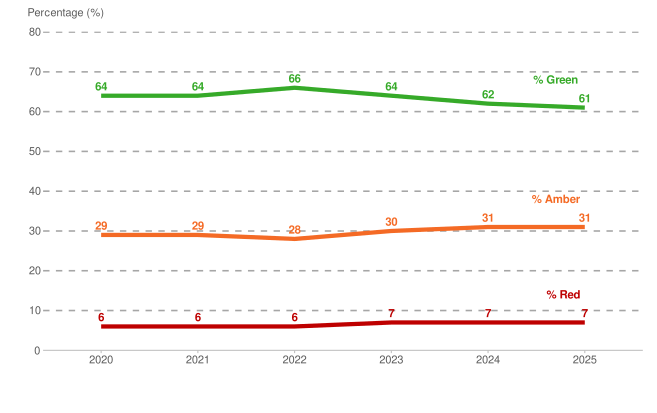
In 2025, for ‘B’ and ‘C’ road:
-
7% was categorised as red
-
31% was amber
-
the majority of the road network was green, at 61%
Note that these figures do not sum to 100 due to rounding.
Over the past four years, the percentage of road categorised as green has decreased by five percentage points from 66% in 2022 to 61% in 2025. The percentage of road categorised as amber and red has increased over the same period. The percentage of amber road increased three percentage points from 28% in 2022 to 31% in 2025, whilst the percentage of red road has increased one percentage point from 6% in 2022 to 7% in 2023, and has since remained at 7%.
Chart 6: A line chart showing the percentage of local ‘B’ and ‘C’ road that was categorised as red, in 2008 to 2025 (RDC0120, RDC0121)
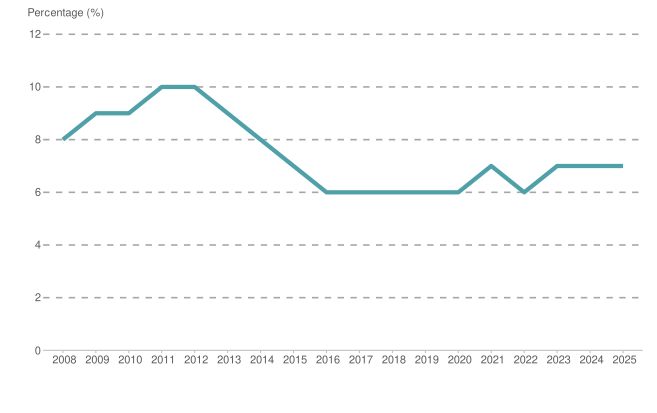
After reaching a peak in 2011 and 2012, where 10% of ‘B’ and ‘C’ road was categorised as red, the percentage fell to 6% in 2016 and remained there until it increased to 7% in 2021. Following some fluctuation, this figure has remained at 7% since 2023.
Chart 7: A map showing the difference in the percentage of red local ‘B’ and ‘C’ road across local authorities in England, for every other year from 2015 to 2025 (RDC0120, RDC0121, Interactive Map)
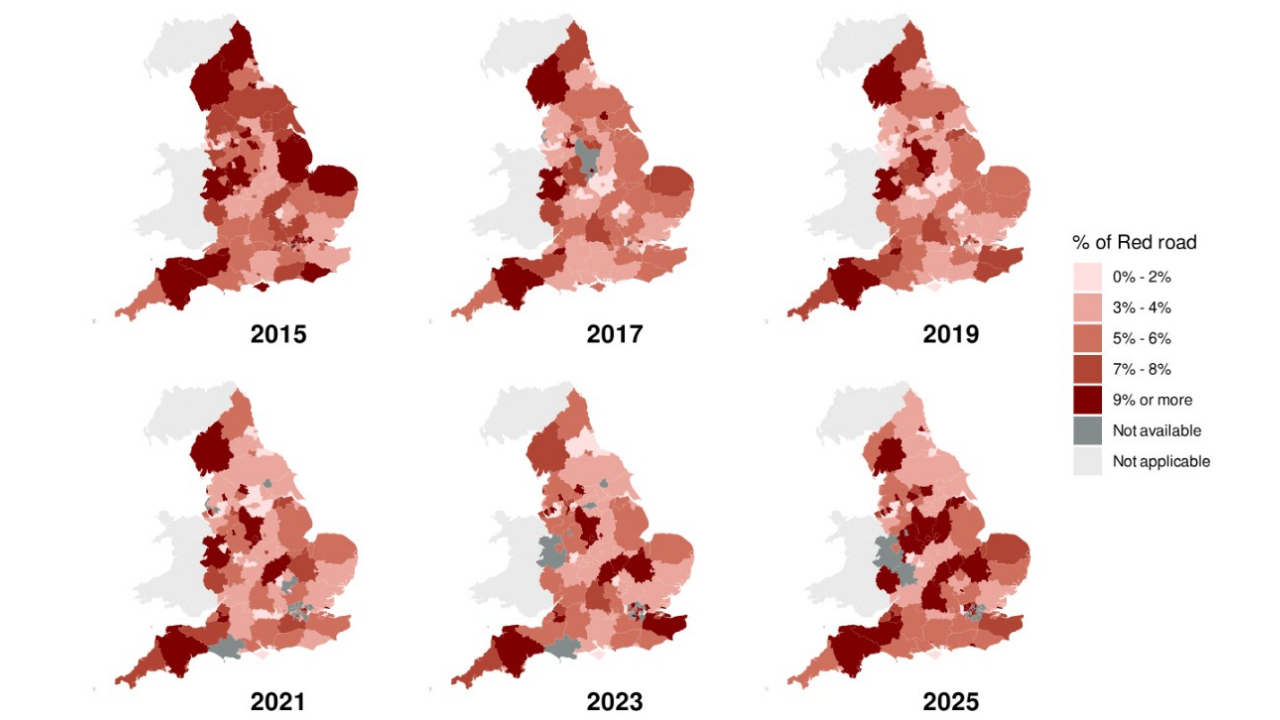
In 2025, of the 133 local authorities that provided valid data, 20 local authorities reported a percentage of red ‘B’ and ‘C’ road of 2% or less, while 31 local authorities reported a percentage of at least 10%.
When looking at the percentage of ‘B’ and ‘C’ road categorised as red over time, between 2015 and 2025:
-
43% of local authorities reported road to be in worse condition
-
12% of local authorities reported no change
-
46% of local authorities reported improved condition
Note that these figures do not sum to 100 due to rounding.
More recently, between 2022 and 2025:
-
52% of local authorities reported road to be in worse condition
-
29% of local authorities reported no change
-
19% of local authorities reported improved condition
Condition of unclassified roads
Unclassified roads accounted for around 62% of the local authority managed road network in calendar year 2024.
Timing and coverage:
Local authorities are expected to survey 90% of their unclassified road over a 4-year period, with the data presented for 2025 being collected between April 2021 and March 2025.
Unclassified roads are more likely to see larger changes year on year, likely caused by less comparable and more varied data sources, lower expected annual data coverage and less frequent surveys due to the size of the unclassified road network, and the variation in road surfaces.
Chart 8: A line chart showing the percentage of unclassified road categorised as red, in 2008 to 2025 (RDC0130, RDC0131)
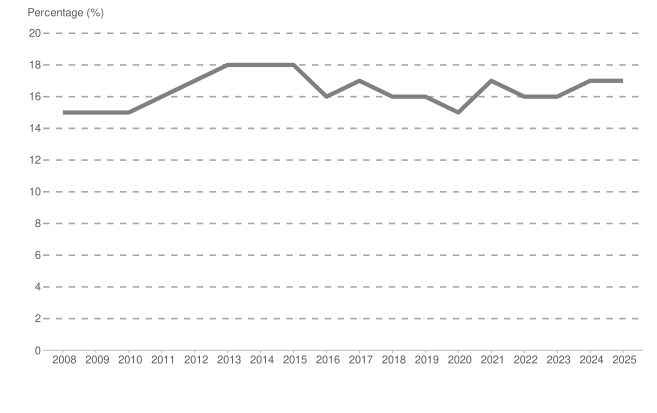
The percentage of the unclassified road network categorised as red has fluctuated between 15% and 18% since current reporting started in 2008, and currently stands at 17%, unchanged from 2024.
Strategic Road Network
The Strategic Road Network (SRN) is made up of the motorways and ’A’ roads in England that are managed by National Highways. These roads account for around 2% of the road network in England but carry approximately 34% of all traffic.
Timing and coverage:
TRAffic-speed Condition Surveys (TRACS) are carried out on the SRN each year; the data presented for 2025 was collected between April 2023 and March 2025.
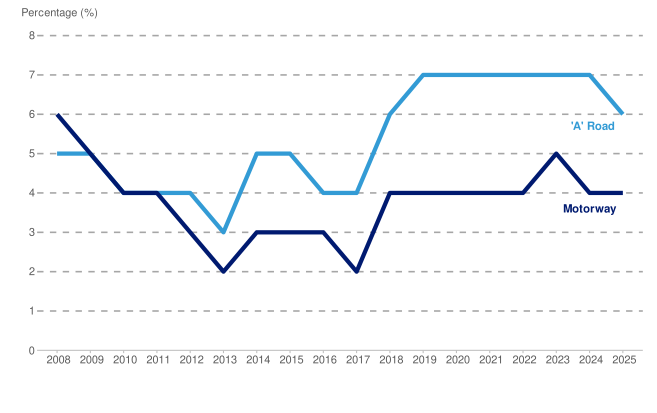
For roads that make up the SRN in 2025:
-
4% of motorway should have been considered for maintenance
-
6% of ‘A’ road should have been considered for maintenance
The percentage for ‘A’ road has decreased from 7% in 2024 to 6% in 2025, having been at 7% from 2019 to 2024. The percentage for motorway was unchanged from 2024, staying at 4% in 2025.
Chart 9: A line chart showing the percentage of National Highways managed road that should have been considered for maintenance, by road type, in 2008 to 2025 (RDC0201)
National Highways’ management of the SRN is also monitored by the Office of Rail and Road (ORR), who produced a report covering April 2024 to March 2025 as well as April 2020 to March 2025, which includes a road condition metric and target. For the period April 2024 to March 2025, National Highways set a target of 96.2% of the SRN pavement requiring no further investigation; their target for each year has been met for the past 8 years.
The methods used by National Highways to calculate this target level of condition vary from those used to present information on surface condition and skidding resistance in this report, therefore are not directly comparable. See the Technical Note for further information on these differences.
Skidding resistance
Skidding resistance surveys are undertaken by local authorities and National Highways. They provide a measure of the road surface contribution to the frictional forces developed between a vehicle’s tyres and the road when accelerating, braking, or cornering. This publication presents the figures for National Highways on the SRN only. Based on feedback from local authorities, the department is currently reviewing how skidding resistance data is reported by local authorities to ensure the quality and accuracy of this information. This means that Table RDC0140 has been excluded from this publication.
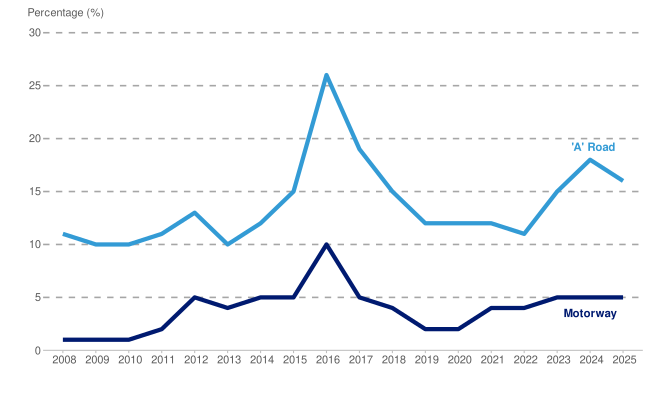
In 2025, the following conclusions were drawn relating to skidding resistance:
-
of the motorway that makes up part of the SRN, 5% required further investigation, unchanged since 2023
-
of the ‘A’ road that makes up part of the SRN, 16% required further investigation, down from 18% reported in 2024
Chart 10: A line chart showing the percentage of National Highways managed road requiring further investigation for skidding resistance, by road type, for the years 2008 to 2025 (RDC0210)
Maintenance treatments on local roads
Different types of treatment are applied to sections of road to preserve, repair, or improve the condition of the road. These are influenced by factors such as weather, funding, and nature of the defect requiring treatment. The roads selected for treatment by a local authority is likely to include a broader group of roads than just those categorised as red, according to local priorities.
The maintenance treatment information presented here is based on the length of the carriageway treated. Maintenance treatments range from patching the road surface to a complete reconstruction of the road. Although measurements account for if only one or both sides of a carriageway have been treated, it does not fully account for the width of the carriageway, nor does it account for depth of treatment or the use of multiple treatments on the same length of road. The amount of maintenance does not necessarily determine the condition of road, local highway authorities will consider efficiency of planned maintenance schemes, for example by prioritising preservative treatment to increase the lifespan of the road surface.
The categorisation of maintenance treatments are reported as follows:
-
Strengthening, consisting of reconstruction excluding in-situ recycling, and in-situ recycling
-
Resurfacing, consisting of resurfacing, overlay, and thin surfacing
-
Preservation, consisting of surface dressing, micro surfacing, and preservation and rejuvenation
In 2025:
-
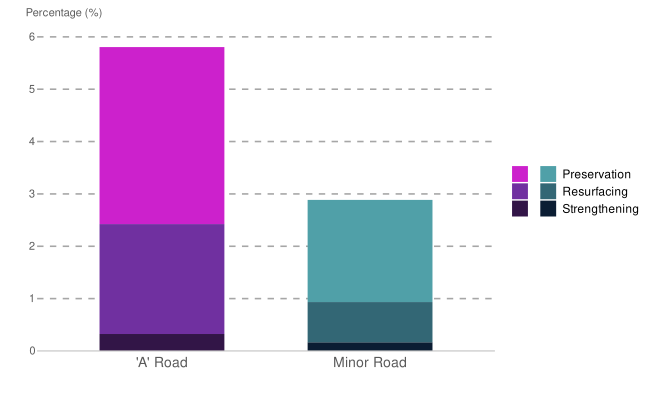
for the local ‘A’ road network (excluding locally managed motorways), 5.8% received maintenance treatment; for the minor road network (‘B’, ‘C’ and unclassified roads), this was 2.9%
-
preservation remains the most frequent maintenance type on both ‘A’ and minor roads; this reflects the guidance for local authorities to use treatments that will improve the longevity of the road surface
Chart 11: A stacked bar chart showing separately the percentage of local ’A’ road and minor road receiving maintenance treatments in 2025, split by treatment type (RDC0320)
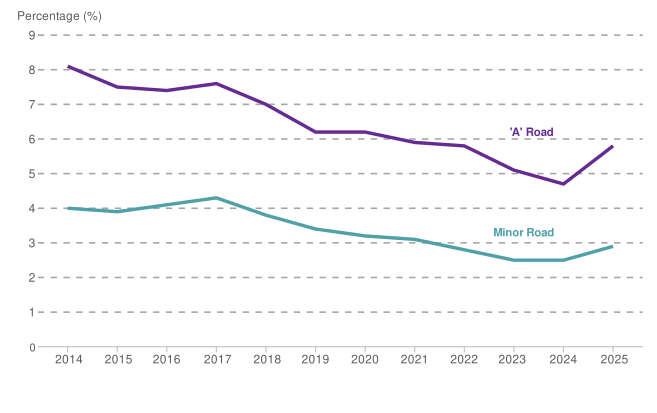
The percentage of ‘A’ and minor road receiving maintenance treatment increased between 2024 and 2025. Prior to this the percentage of ‘A’ road receiving maintenance gradually decreased from 2014 to 2024, falling from 8.1% in 2014 to 4.7% in 2024. In 2025 this increased to 5.8%, but is still lower than the 8.1% seen in 2014. For the minor road network, the percentage receiving maintenance treatment had been falling since 2017. The 2.9% reported in 2025 was an increase on the 2.5% reported in 2024, but remains below the 4.3% reported in 2017.
Chart 12: A line chart showing separately the percentage of local ’A’ road and minor road receiving maintenance treatments, for the years 2014 to 2025 (RDC0320)
Revision of previous data
The data presented for 2025 in this release is provisional, and data from 2024 is revised. Each year local authorities provide information for the current year and have the opportunity to revise the previous year’s data. To ensure data quality and accuracy, additional revisions to previous years may be made, including new submissions. For example, in 2025, 20 local authorities revised the percentage of red ‘A’ road for 2024, and 3 local authorities provided the percentage of red ‘A’ road for 2024 for the first time. 16 of the local authorities revising this 2024 data were London boroughs, after a data-processing error was corrected with London data.
About these statistics
These statistics are official statistics. They comply with the standards of trustworthiness, quality, and value in the Code of Practice for Statistics. More information about these statistics can be found in the guidance, notes and definitions, and technical note.
User perception
This statistical measures of road condition presented are designed for road maintenance purposes and may not align precisely with user perception of roads. Whilst road condition surveys are used as a tool to identify road sections that require maintenance treatments, the maintenance of roads is not solely determined by the result of these surveys. Other factors, based on local needs and priorities, will determine where maintenance is carried out to ensure the safety and longevity of the entire road network through a risk-based, highway asset management approach.
Additionally, user perception may be heavily influenced by the condition of the unclassified road network, which makes up the majority of the local road network in England. Due to the size and relatively lower priority (lighter traffic flow and fewer key arterial routes compared to classified roads) of the unclassified road network, a smaller proportion of the network is surveyed annually (recommended coverage at 90% of the network over 4 years) compared to the classified network (required coverage at over 80% of the network over 2 years), and the data is from less comparable data sources. This lower annual coverage and longer survey period, as well as the varied nature of the unclassified network, results in trends in road condition that fluctuate more over time. The data may also not be fully representative of the current condition of the entire unclassified road network, as it could include some older information, and there is likely to have been some changes to road condition between surveying and reporting.
Data source
For local roads, local authorities are required to report the percentage of road surface that should be considered for maintenance (such as, categorised as red) under the Single Data List. They are also asked to provide information on the percentage of road surface categorised as amber or green, as well as information about skidding resistance and highway maintenance treatments.
While local authorities are currently required to undertake SCANNER surveys on their classified roads, surveys on unclassified roads are not limited to SCANNER and other methods can be used. The condition of the Strategic Road Network is measured using TRACS, which uses a similar methodology to SCANNER.
Some local authorities use alternative road condition surveys to SCANNER and convert the data to an equivalent score.
Comparisons of road condition across different road types should be made with caution due to the differing methods used.
In 2025, the DfT collected additional information from local authorities on local highway condition, maintenance and expenditure in a transparency report, which included information published in these statistics. The data published in the transparency report may be different to what is published in this statistical release; the reasons for this are outlined in the basic guide and quality asssessment.
Further information about road condition data and surveys can be found in the Road Condition Statistics guide, notes and definitions and technical note.
Road condition surveys used by local authorities
Data on the condition of local roads are collected by local authorities. This is mandated by the Ministry of Housing Communities and Local Government (MHCLG) Single Data List requirements, but in recent years, fewer local authorities have complied with the full conditions of this mandate which includes the use of SCANNER surveys.
In 2025, 79% of local authorities who submitted valid data used SCANNER surveys on their ‘A’ road network and 65% used it on their ‘B’ and ‘C’ road networks. This is a fall from 99% on ‘A’ roads and 98% on ‘B’ and ‘C’ roads in 2018. This means that trends seen in recent years may be influenced by the increasing use of alternative survey technologies.
Although requirements during the 2025 survey period specified that SCANNER surveys should be carried out by local authorities on their classified road network (local Motorways, ‘A’ roads, ‘B’ and ‘C’ roads), other technologies have been used by local authorities. The data in this publication is based on responses from both those local authorities using SCANNER and those who have supplied data from alternative technologies; this means there are some inconsistencies when comparing data from different local authorities.
The new standard for road condition monitoring
In September 2024, DfT published PAS 2161: Road condition monitoring (RCM) data Specification. DfT has worked with the British Standards Institute, Transport Research Laboratory, local authorities, and a wide variety of industry experts to develop a new approach for road condition monitoring data. This new standard will increase innovation by removing the single technology mandate and instead allow the use of multiple technologies, including existing SCANNER technology, to report local road conditions to DfT.
To ensure data quality, accuracy, and comparability, prospective RCM technologies will be required to undergo an approvals process to demonstrate that they can meet the PAS requirements, which will benchmark the results of surveys from RCM technologies alongside highway engineers. In September 2025, the list of road condition monitoring technologies approved for use against PAS 2161 was published, with approvals valid from September 2025 to March 2027. A report detailing the methods used in this process will be published in early 2026. Local authorities will be required to use an approved survey technology for the reporting period April 2026 to March 2027, so the information presented in this publication will change from Autumn 2027.
The new standard will move away from the current red, amber and green categorisation of condition, to 5 categories. These new categories were designed in collaboration with local authorities and technology companies and are based on the amount of potential treatment required to return the carriageway to a satisfactory condition. This new categorisation of condition will not directly map to the percentage of red, amber and green roads, so there will be a break in the time series of this statistical series. The move to the new standard could also mean there is a risk of having smaller data sets for the next couple years whilst the change takes place. To mitigate the impact of this change, DfT are planning to dual run the standards, with a complete move to the new reporting specified in PAS 2161 in financial year ending March 2028.
Strengths and weaknesses
Figures in this publication come from a wide range of sources. Consequently, the accuracy of figures will vary between tables. Users are recommended to refer to separately published road conditions statistics guidance for more detail on how information for each table was collected.
SCANNER data are collected using automated road condition survey machines. Although each machine is accredited for accuracy and readings fall within the accepted boundaries of the SCANNER specification for road condition, there is still variability between the results that each machine delivers. It can lead to small changes in the figures over time that are for reasons beyond the condition of the road, and above the expected range of variability that already exists within the data. Caution should therefore be taken when comparing the figures over time, particularly for the Local authorities and regions flagged in the publication tables.
SCANNER has been the recommended survey method since 2008 for local ‘A’, ‘B’ and ‘C’ roads. Due to the increase in the use of other technologies besides SCANNER on the classified road network, it is important to note that the technology used can affect the percentage of road categorised as red, amber and green, and the comparability of local authority data. As explained above, DfT is implementing a data standard for local road condition monitoring which will improve the consistency of data from different road condition technologies.
More information
Other measures of condition exist. The Asphalt Industry Alliance carry out the Alarm Survey of local highway authorities and report a measure condition alongside other measures annually. Data for the Alarm survey is collected before the end of the financial year, so is generally reporting information based on 10 months of recorded data and 2 months of forecast data, this differs from this release which is based on data collected across the full 12 month period. The RAC also produce a pothole index and Report on Motoring using their members’ breakdown data.
The next update, Road conditions in England, year ending March 2026, and accompanying tables are due to be published in Autumn 2026. In the meantime, continued engagement with stakeholders will be undertaken to improve the usability and relevance of the statistics.
Instructions for printing and saving
Depending on which browser you use and the type of device you use (such as a mobile or laptop), these instructions may vary.
You will find your print and save options in your browser’s menu. You may also have other options available on your device. Tablets and mobile device instructions will be specific to the make and model of the device.
How to search
Select Ctrl and F on a Windows laptop or Command and F on a Mac.
This will open a search box in the top right-hand corner of the page. Type the word you are looking for in the search bar and press enter.
Your browser will highlight the word, usually in yellow, wherever it appears on the page. Press enter to move to the next place it appears.
Contact details
Road condition statistics
Email roadmaintenance.stats@dft.gov.uk
Media enquiries 0300 7777 878
To hear more about DfT statistical publications as they are released, follow us on X at DfTstats.