Police protest powers, June 2022 to March 2025
Published 5 February 2026
Applies to England and Wales

© Crown copyright 2026
This publication is licensed under the terms of the Open Government Licence v3.0 except where otherwise stated. To view this licence, visit nationalarchives.gov.uk/doc/open-government-licence/version/3 or write to the Information Policy Team, The National Archives, Kew, London TW9 4DU, or email: psi@nationalarchives.gov.uk.
Where we have identified any third party copyright information you will need to obtain permission from the copyright holders concerned.
This publication is available at https://www.gov.uk/government/statistics/police-protest-powers-june-2022-to-march-2025/police-protest-powers-june-2022-to-march-2025
1. Background
On June 28 2022, police forces were given additional powers to manage protests as part of the Police, Crime, Sentencing and Courts Act 2022. This included amendments to sections 12 and 14 of the Public Order Act 1986, as well as the creation of a new section 14ZA. Along with these changes, a legal obligation was placed on the Home Secretary to lay in Parliament a report on the use of these powers. This obligation was fulfilled by a report published in December 2024.
The full Police, Crime, Sentencing and Courts Act 2022 will also be subject to post-legislative scrutiny between April 2025 and April 2027. This will include a review of sections 73, 74, 75 and 79, as well as the other public order measures in the Act.
The Police, Crime, Sentencing and Courts Act 2022 amended the definition of ‘serious disruption to the life of the community’ in section 12 and 14 of the Public Order Act 1986 to broaden the circumstances in which conditions may be imposed on those organising or taking part in public processions and public assemblies. It also clarified explicitly the meaning of the term ‘serious disruption to the life of the community’ including disruptions such as access to the supply of money, food, water, energy or fuel, communication systems, places of worship, transport facilities, educational institutions and services relating to public health.
On 15 June 2023, the definition was further amended by the Public Order Act 1986 (Serious Disruption to the Life of the Community) Regulations 2023. This amendment lowered the threshold from disruption that is both ‘significant’ and ‘prolonged’ to anything ‘more than minor’. The 2023 Regulations were challenged by way of judicial review brought by Liberty on 23 June 2023. In May 2025 the Court of Appeal upheld that changing the threshold to ‘more than minor’ went beyond the scope of the enabling power in the 2022 Act and the regulations have been quashed.
2. Data coverage and quality
From April 2023, data was requested retrospectively for the period of 28 June 2022 onwards under the Annual Data Requirement from the 43 territorial police forces in England and Wales and the British Transport Police on their use of protest powers under sections 12, 14 and 14ZA of the Public Order Act 1986 (as amended by the Police, Crime, Sentencing and Courts (PCSC) Act 2022).
The data in this release covers the period from 28 June 2022 (when the powers came into effect) up to 31 March 2025.
The information presented does not give an indication of the total number of processions and assemblies that have taken place, rather the data in this release includes only those where at least one of the additional protest powers was used.
Data was provided by all 43 territorial police forces in England and Wales and the British Transport Police, however, 2 forces (Metropolitan Police Service and West Yorkshire Police) were only able to provide data from April 2023, when the data collection was first introduced. In total, 17 forces (including the British Transport Police) had made use of the protest powers under sections 12, 14 or 14ZA of the Public Order Act 1986, and the remaining 27 forces confirmed that they had not used these protest powers in the specified period.
There were a range of reasons given from forces who reported they had not made use of the protest powers. Some forces indicated that there had not been any large-scale assemblies or processions within their area, and it would have been disproportionate to use the legislation during the smaller protests that had taken place. Other forces indicated that while protests in their area had caused some disruption, the threshold of ‘serious disruption’ (as required by legislation) had not been met for conditions to be imposed on events.
Additionally, others indicated that engagement between Police Liaison Teams and protestors to outline what would be acceptable ahead of any event, with a threat of imposing conditions if this was compromised, had negated the need to use the powers outlined in this report.
3. Official statistics in development
The protests powers data in this report has been labelled as ‘Official statistics in development’ to indicate they are new and further development is ongoing. The Home Office continues to work with forces, the National Police Coordination Centre (NPoCC), and the National Policing Chiefs’ Council (NPCC) to improve the quality and consistency of the data in this collection. Figures in this release may be subject to revision in future editions of these statistics.
Following the first publication of these statistics in December 2024, we have engaged with stakeholders and users of the police protests data, including the NPoCC, NPCC and College of Policing. This feedback indicated a preference for protests data to be published as an annual standalone report within the wider ‘Police powers and procedures’ statistical series. Additionally, following feedback from stakeholders, the report and accompanying data tables have been expanded to present more detailed breakdowns of the data.
We welcome feedback, and if you have any immediate feedback or enquiries about this release, please contact policingstatistics@homeoffice.gov.uk.
4. Main facts and figures
Data from the 43 territorial police forces in England and Wales, and the British Transport Police (BTP), shows that:
- in the period 28 June 2022 to 31 March 2025, 17 forces made use of the powers under sections 12, 14 or 14ZA of the Public Order Act 1986 (as amended by the PCSC Act 2022)
- since sections 12, 14 and 14ZA of the Public Order Act 1986 (as amended by the PCSC Act 2022) came into force, they have been used to apply conditions to 640 protests
- of these 640 protests, 465 were recorded as processions (conditions imposed under section 12) and 175 were recorded as assemblies (conditions imposed under section 14); the powers have not been used to apply conditions to any one-person protests (section 14ZA)
- of the 17 police forces in England and Wales (including BTP), who used at least one of these powers on at least one occasion, the Metropolitan Police used these powers most often, applying them to 570 protests between 1 April 2023 and 31 March 2025 (89% of the total)
- there were 519 people arrested for breaching conditions at processions or assemblies
5. What data has been collected?
Data has been collected from all 44 police forces in England and Wales (including BTP) on their use of protest powers under section 12, 14 and 14ZA of the Public Order Act 1986 (as amended by the Police, Crime, Sentencing and Courts (PCSC) Act 2022).
Additional information has also been collected on the theme of the procession or assembly, the conditions that were put in place on the procession or assembly, and the trigger for applying such conditions.
5.1 Theme categories (multiple options may be chosen)
- social justice
- anti-fascism
- cultural nationalism
- animal rights
- international
- anti-government
- environment
- none or unknown
5.2 Trigger categories (multiple options may be chosen)
- noise that may result in serious disruption to the activities of an organisation
- noise that may result in the alarm, distress, intimidation or harassment of persons
- serious disruption to life of the community
- disorder
- damage to property
- intimidation
5.3 Conditions applied categories (multiple options may be chosen)
- number of attendees
- location or route taken
- duration
- noise
- other
Data has also been collected on the number of resulting arrests, including the conditions breached and demographic information of the person arrested.
6. Use of powers under section 12 - Processions data
Section 12 of the Public Order (PO) Act 1986 gives police powers to impose conditions on public processions which they reasonably believe are necessary to prevent intimidation, serious public disorder, serious damage to property or serious disruption to the life of the community.
Section 73 of the Police, Crime and Sentencing Courts (PCSC) Act 2022 expands on the legislation to include examples of what could constitute serious disruption in this context and adds a new trigger for imposing conditions where noise resulting from the procession may cause serious disruption to the activities of an organisation or a significant detrimental impact on persons in the vicinity.
A procession is defined as a march or moving protest.
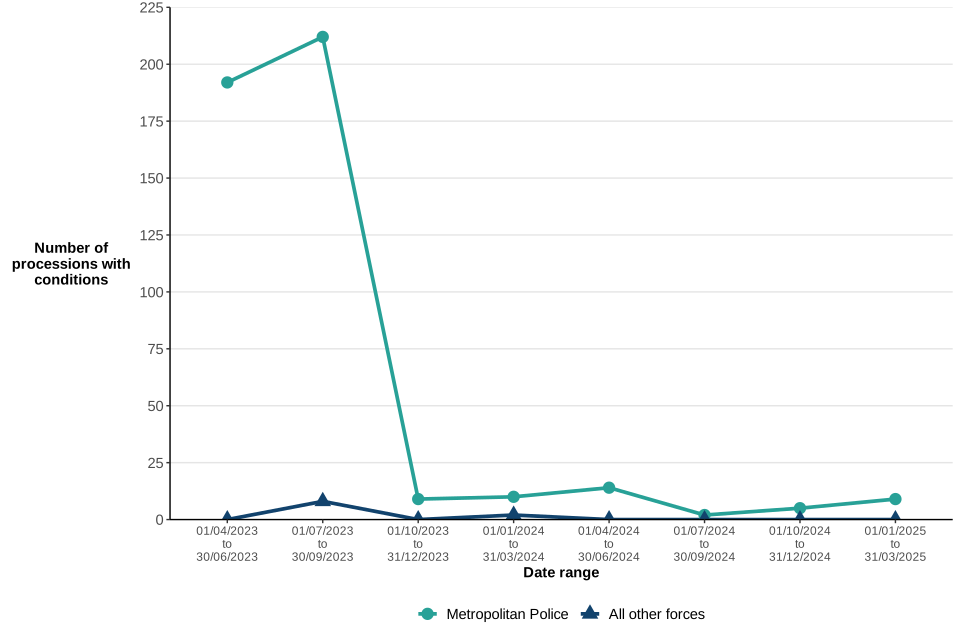
Between 28 June 2022 and 31 March 2025, 465 processions had conditions imposed upon them under section 12 of the Public Order Act. Five police forces used this power to impose conditions on processions, with the Metropolitan Police accounting for most of these (453 out of 465, or 97% of the total). The other 4 police forces to use this power were City of London (8 times), West Mercia (2 times), Bedfordshire and South Wales (one time each).
Looking at the data over time shows the majority of processions that had conditions applied to them occurred between 1 April 2023 and 30 September 2023. During this 6-month period, the powers were used on 412 processions (Figure 1). The Metropolitan Police were the only force to impose conditions under section 12 of the Public Order Act in the 12 months ending 31 March 2025.
Figure 1: Quarterly breakdown of processions data, 1 April 2023 to 31 March 2025
Source: Home Office, Police protest powers data tables, June 2022 to March 2025, PP_02
Notes:
- The chart begins from 1 April 2023 as this was the quarter the Metropolitan Police were first able to supply data. Between 22 June 2022 and 31 March 2023, the powers were used twice by other forces.
6.1 Theme of processions with conditions applied
Of the processions where conditions were applied, most had an ‘environment’ theme (411 out of 464 processions where a theme was provided, or 89% of that total). The next most common theme was processions inspired by ‘international’ events (43 out of 464 processions where a theme was provided, or 9% of that total) (Table 1). Four processions had an anti-government theme, 6 had an anti-fascism theme and a further 2 had a ‘cultural nationalism’ theme. Lastly, there was one procession where powers were used but there was no applicable theme to apply from the categorisations listed.
Table 1: Theme of processions with conditions applied to them between 28 June 2022 and 31 March 2025, England and Wales
| Theme | Number of processions | Percentage of processions where the theme was known |
|---|---|---|
| Environment | 411 | 89% |
| International | 43 | 9% |
| Anti-fascism | 6 | 1% |
| Anti-government | 4 | 1% |
| Cultural nationalism | 2 | <1% |
| Not Applicable | 1 | [z] |
Source: Home Office, Police protest powers data tables, June 2022 to March 2025, PP_03
Notes:
- No processions with conditions applied were recorded with a social justice or animal rights theme.
- Percentages exceed 100% because processions can have more than one theme applied to them.
- [z] = not applicable.
All 411 processions with an ‘environment’ theme took place between 1 April 2023 and 31 December 2023. In the year ending 31 March 2025, the ‘international’ theme was most prevalent, accounting for 25 out of 30 processions, or 83% of the total in that year (Source: Home Office, Police protest powers data tables, June 2022 to March 2025, PP_04).
6.2 Triggers for conditions being placed on processions
Each procession can have multiple triggers for placing conditions on it. Therefore, the total number of triggers applied is higher than the number of processions.
The most common trigger for putting conditions on processions was concerns around serious disruption from the event (431 out of 444 processions where the trigger was known, or 97% of that total). Twenty-four processions (5%) had a trigger of ‘disorder’, 12 (3%) had a trigger of ‘damage’, 2 (0.5%) had a trigger of ‘intimidation’ and a further 2 (0.5%) had a trigger of noise causing disruption to an organisation in the vicinity of the protest. There were also 21 processions (5% out the total 465 processions) where the trigger was not known or not recorded, which were all from the Metropolitan Police.
Table 2: Triggers for applying conditions to processions between 28 June 2022 and 31 March 2025, England and Wales
| Trigger | Number of processions | Percentage of processions where the trigger was known |
|---|---|---|
| Serious disruption | 431 | 97% |
| Disorder | 24 | 5% |
| Damage | 12 | 3% |
| Intimidation | 2 | <1% |
| Noise (organisation) | 2 | <1% |
| Not known or not recorded | 21 | [z] |
Source: Home Office, Police protest powers data tables, June 2022 to March 2025, PP_05
Notes:
- No processions with conditions applied were recorded with a trigger of noise that may result in the alarm, distress, intimidation or harassment of persons.
- Percentages exceed 100% because processions can have more than one trigger for applying conditions.
- [z] = not applicable.
6.3 Conditions applied to processions
Each procession can have multiple conditions applied to it (including before and during the event). Therefore, the total number of conditions is higher than the number of processions.
The most common condition placed on processions was on its location or route (456 out of 465 processions, or 98% of the total). Nineteen processions (4%) had conditions placed on their duration, and 13 (3%) had ‘other’ conditions placed upon them.
Table 3: Conditions applied to processions between 28 June 2022 and 31 March 2025, England and Wales
| Condition | Number of processions | Percentage of processions |
|---|---|---|
| Location or route | 456 | 98% |
| Duration | 19 | 4% |
| Other | 13 | 3% |
Source: Home Office, Police protest powers data tables, June 2022 to March 2025, PP_06
Notes:
- No processions with conditions applied were recorded with conditions placed on numbers or noise.
- Percentages exceed 100% because processions can have more than one condition applied to them.
7. Use of powers under section 14 - Assemblies data
Section 14 of the Public Order (PO) Act 1986, as amended by section 74 of the Police, Crime and Sentencing Courts (PCSC) Act 2022, gives police the same powers as section 12 but specifically in regard to public assemblies. It also removes the restriction on the types of conditions that can be placed.
An assembly is defined as a static gathering.
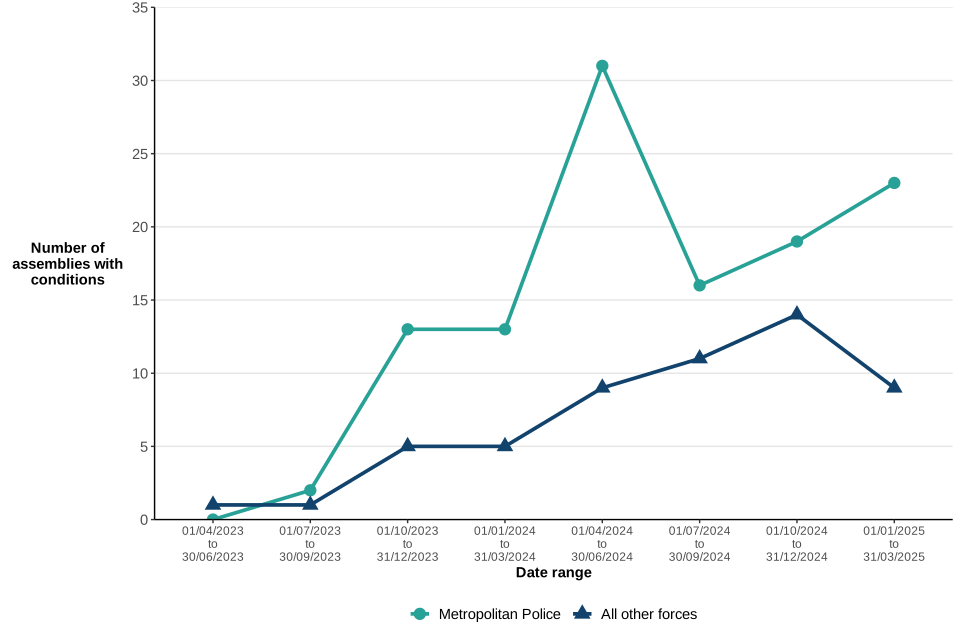
Between 28 June 2022 and 31 March 2025, 175 assemblies had conditions imposed upon them under section 14 of the Public Order Act. Fourteen police forces used this power to impose conditions on assemblies, with the Metropolitan Police accounting for most of these (117 out of 175, or 67% of the total). The other 13 police forces to use this power were Northumbria (27 times), West Yorkshire (7 times), Lancashire (5 times), Gwent, South Yorkshire and British Transport Police (3 times each), Hampshire, Leicestershire and West Mercia (2 times each), Avon and Somerset, Cambridgeshire, Gloucestershire and North Wales (one time each).
Looking at the data over time shows a general increase in the number of assemblies that have had conditions imposed on them. In the 12 months from 1 April 2023 to 31 March 2024, 40 assemblies had conditions imposed. In the following 12 months from 1 April 2024 to 31 March 2025, that number increased to 132.
Figure 2: Quarterly breakdown of assemblies data, 1 April 2023 to 31 March 2025
Source: Home Office, Police protest powers data tables, June 2022 to March 2025, PP_09
Notes:
- The chart begins from 1 April 2023 as this was the quarter the Metropolitan Police were first able to supply data. Between 22 June 2022 and 31 March 2023, the powers were only used 3 times by other forces.
7.1 Theme of assemblies with conditions applied
The majority of assemblies with conditions applied had an ‘international’ theme (145 out of 174 assemblies where a theme was provided, or 83% of that total). Only 9 assemblies had an ‘environment’ theme (5% of the total).
Table 4: Theme of assemblies with conditions applied to them between 28 June 2022 and 31 March 2025, England and Wales
| Theme | Number of assemblies | Percentage of assemblies where the theme was known |
|---|---|---|
| International | 145 | 83% |
| Social justice | 31 | 18% |
| Anti-fascism | 12 | 7% |
| Environment | 9 | 5% |
| Cultural nationalism | 7 | 4% |
| Anti-government | 5 | 3% |
| Animal rights | 2 | 1% |
| Not known | 1 | [z] |
Source: Home Office, Police protest powers data tables, June 2022 to March 2025, PP_10
Notes:
- Percentages exceed 100% because assemblies can have more than one theme applied to them.
- [z] = not applicable.
7.2 Triggers for conditions being placed on assemblies
Each assembly can have multiple triggers for placing conditions on it. Therefore, the total number of triggers applied is higher than the number of assemblies. The most common trigger for putting conditions on assemblies was concerns around serious disruption from the event (103 out of 120 assemblies where the trigger was known, or 86% of that total). Thirty-seven assemblies (31%) had a trigger of ‘disorder’, 20 (17%) had a trigger of ‘damage’, 14 (12%) had a trigger of ‘intimidation’, 6 (5%) had a trigger of noise causing disruption to an organisation in the vicinity of the protest and 4 (3%) had a trigger of noise causing disruption to people in the vicinity of the protest. Fifty-five assemblies out of the total of 175 (31%) had unknown triggers for applying conditions, which were all from the Metropolitan Police.
Table 5: Triggers for applying conditions to assemblies between 28 June 2022 and 31 March 2025, England and Wales
| Trigger | Number of assemblies | Percentage of assemblies where the trigger was known |
|---|---|---|
| Serious disruption | 103 | 86% |
| Disorder | 37 | 31% |
| Damage | 20 | 17% |
| Intimidation | 14 | 12% |
| Noise (organisation) | 6 | 5% |
| Noise (people) | 4 | 5% |
| Not known | 55 | [z] |
Source: Home Office, Police protest powers data tables, June 2022 to March 2025, PP_12
Notes:
-
Percentages exceed 100% due to the fact that assemblies can have more than one trigger for applying conditions.
-
[z] = not applicable.
7.3 Conditions applied to assemblies
Each assembly can have multiple conditions applied to it (including before and during the event). Therefore, the total number of conditions is higher than the number of assemblies.
The most common condition placed on assemblies was on its location (167 out of 173 assemblies where the condition was known, or 97% of that total). Seventy-eight assemblies (45%) had conditions placed on their duration, 8 (5%) had a condition placed on the number of attendees, 2 (1%) on noise and 26 (15%) had ‘other’ conditions placed upon them.
Table 6: Conditions applied to assemblies between 28 June 2022 and 31 March 2025, England and Wales
| Condition | Number of assemblies | Percentage of assemblies where the conditions were known |
|---|---|---|
| Location or route | 167 | 97% |
| Duration | 78 | 45% |
| Numbers | 8 | 5% |
| Noise | 2 | 1% |
| Other | 26 | 15% |
| Not known | 2 | [z] |
Source: Home Office, Police protest powers data tables, June 2022 to March 2025, PP_13
Notes:
- Percentages exceed 100% because assemblies can have more than one condition applied to them.
- [z] = not applicable.
Most assemblies had conditions applied prior to the event (116 out of 174 assemblies where the information was provided), rather than during the event (59 out of 174) (Source: Home Office, Police protest powers data tables, June 2022 to March 2025, PP_14).
8. Single-person protest data
Section 79 of the Police, Crime and Sentencing Courts (PCSC) Act 2022 inserts a new section 14ZA into the Public Order (PO) Act 1986 which allows police to place conditions on protests being carried out by one person. The relevant triggers for the use of this power relate to noise resulting from the protest which may cause serious disruption to the activities of an organisation or a significant detrimental impact on persons in the vicinity.
No police forces reported use of this power to apply conditions to any one-person protests.
9. Persons arrested for breaching conditions at protests
Police forces were asked to provide details of persons arrested for specifically breaching conditions imposed on protests, and not all arrests related to protest activity. Therefore, the numbers in this section should not be used as an indicator of the total number of people arrested at protests, instead, it is a count of those arrested for breaching the conditions imposed. For example, a person arrested for criminal damage would not be included in these figures if it did not relate to a condition applied. Furthermore, people can be arrested for breaching multiple conditions. Therefore the number of conditions breached may be higher than the number of people arrested.
In total, 519 persons were arrested for breaching conditions applied to either a procession (226 people arrested) or assembly (293 people arrested) (Source: Home Office, Police protest powers data tables, June 2022 to March 2025, PP_16).
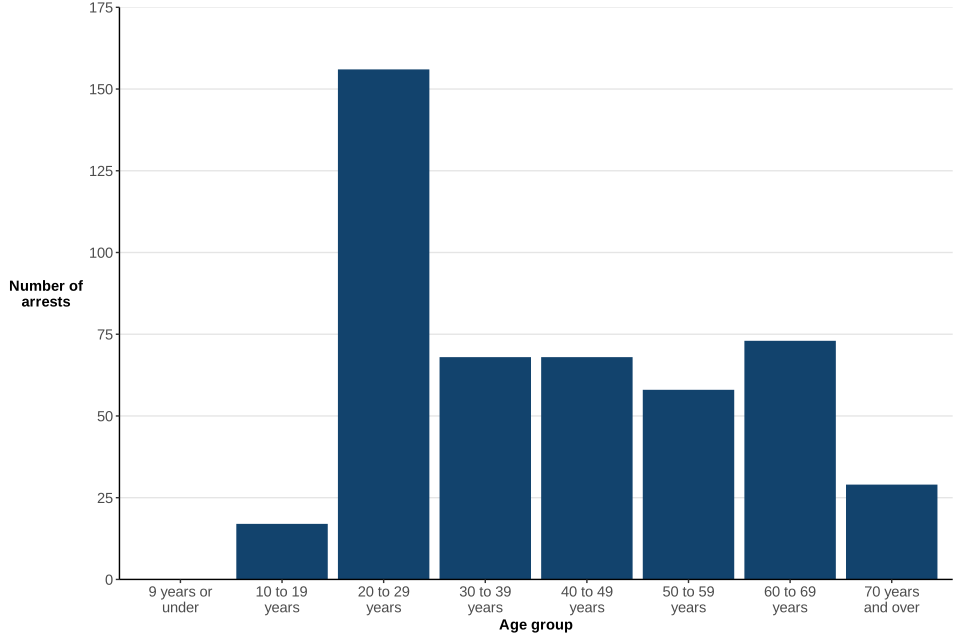
The age of the person arrested was known for 469 arrests. Seventeen of those were aged between 10 and 19 years old, 156 were aged 20 to 29, 68 were aged 30 to 39, 68 were aged 40 to 49, 58 were aged 50 to 59, 73 were aged 60 to 69 and 29 were aged 70 and over (Figure 3).
Figure 3: Number of people arrested for breaching conditions at protests, by age group, 28 June 2022 to 31 March 2025
Source: Home Office, Police protest powers data tables, June 2022 to March 2025, PP_18
Notes:
- Excludes 50 arrests where the age of the person arrested was not known.
The sex of the person arrested was not known or not recorded for 358 out of 519 arrests (69%). Of the 161 arrests where the sex was known, there were 92 males arrested (57% of the total where sex was known) and 69 females (43% of the total where sex was known) (Source: Home Office, Police protest powers data tables, June 2022 to March 2025, PP_19). The proportion of female arrests is substantially higher than the proportion of overall arrests for notifiable offences in the year ending March 2025 that were females (16%). However, given the low volume of arrests for breaching protest conditions, this finding should be interpreted with some caution.
Self-defined ethnicity was not stated or not recorded for 407 out of 519 arrests (78%). Of the 112 arrests where self-defined ethnicity was stated, 81 people were White (72% of arrests where the information was known). Fourteen people stated their ethnicity as Asian or Asian British (13% of the total), 4 people (4%) stated their ethnicity as Mixed, 3 (3%) as Black or Black British and 10 (9%) as ‘Other’ (Source: Home Office, Police protest powers data tables, June 2022 to March 2025, PP_20).
Officer-defined ethnicity was not recorded for 374 out of 519 arrests (72%). Of the 145 arrests where officer-defined ethnicity was recorded, 106 were White (73% of arrests where the information was known). Twenty people (14%) were defined by officers to be of Asian appearance, 7 (5%) as Black and 12 (8%) as ‘Other’ (Source: Home Office, Police protest powers data tables, June 2022 to March 2025, PP_21).
10. Future reporting and other sources of data related to this report
The Home Office continues to collect data on the use protest powers under sections 12, 14 and 14ZA of the Public Order Act 1986 (as amended by the Police, Crime, Sentencing and Courts (PCSC) Act 2022) as part of the Annual Data Requirement. These statistics are now included as an annual release within the wider ‘Police Powers and Procedures’ statistical publications. Analysts will continue to proactively engage with users and stakeholders to ensure these statistics provide transparency and value on the use of these powers.
The Home Office also publishes Accredited Official Statistics on the police power of arrest for all notifiable offences on an annual basis.
The Office for National Statistics publish data on crime in England and Wales, including public order offences: Crime and justice - Office for National Statistics (ons.gov.uk).
In line with the Code of Practice for Statistics and as part of our commitment to continuous development and improving the statistics, we invite users to provide feedback on the statistics and analysis within this bulletin and associated data tables. Users can contact Home Office statisticians at policingstatistics@homeoffice.gov.uk.