Planning Inspectorate Management Information - Nationally Significant Infrastructure Projects - July 2026
Updated 23 September 2026
Applies to England and Wales

© Crown copyright 2026
This publication is licensed under the terms of the Open Government Licence v3.0 except where otherwise stated. To view this licence, visit nationalarchives.gov.uk/doc/open-government-licence/version/3 or write to the Information Policy Team, The National Archives, Kew, London TW9 4DU, or email: psi@nationalarchives.gov.uk.
Where we have identified any third party copyright information you will need to obtain permission from the copyright holders concerned.
This publication is available at https://www.gov.uk/government/publications/planning-inspectorate-ad-hoc-analysis-and-statistics/planning-inspectorate-management-information-nationally-significant-infrastructure-projects-july-2026
1. Introduction & purpose
The Planning Inspectorate is an executive agency, sponsored by the Ministry of Housing, Communities and Local Government and administers the Nationally Significant Infrastructure Project (NSIP) applications process in England and Wales. The Planning Inspectorate provides the application service across six primary sectors: Energy, Transport, Business & Commercial, Waste, Water and Waste Water.
This ad-hoc statistical release provides summary information on the time it has taken for NSIPs to complete different stages of the application process since January 2024. As of the date of release, this bulletin and the accompanying data table provides the most up-to-date statistics on NSIP application timeliness and casework volumes. The sub-sectors defined in this bulletin are based on information from Section 14 of the Planning Act 2008 which sets out the types of projects that can be NSIPs.
This release is classed as Management Information and not Official Statistics. These statistics are not routinely published and were previously shared as part of conference proceedings at the National Infrastructure Planning Association Annual Conference 2026 on 6th July 2026.
Other sites where we have previously released statistics on NSIPs are:
- Planning Inspectorate Management Information - Nationally Significant Infrastructure Projects - March 2026 - GOV.UK
- Planning Inspectorate Quarterly and Annual Volume Statistics - GOV.UK
To see a complete list of all NSIPs, visit the Find a National Infrastructure Project website.
You can contact us about this release by emailing statistics@planninginspectorate.gov.uk.
2. NSIP application process timeliness statistics
2.1 Time taken in different stages of the NSIP application process, 2024 to 2026
The average timeliness for four key stages of the NSIP application process is shown in Table 1.
Methodology: The mean time for NSIP applications in each stage is calculated by grouping projects by the year in which they finished the particular stage. The pre-application stage is defined as the time from the inception meeting date to the date of application submission. The pre-examination stage is defined as the time from the date the application was accepted to the date examination started. The examination stage is defined as the time from the date examination started to the date examination closed. The recommendation stage is defined as the time from the date examination closed to the date of recommendation to the Secretary of State.
The sample size for calculating the mean (i.e. the number of projects included in each calculation) is shown in square brackets. Applications which have been withdrawn before decision have not been included in these averages. Material Change applications are not included in the pre-application average as an inception meeting is not required in these cases. One application where we consider the scoping opinion date to be the beginning of pre-application (as it preceded the inception meeting date) has also been excluded from the pre-application average for 2024. The mean times for 2026 only include the projects finishing each stage in this year until the data extraction date (16/06/2026). The mean value can be highly influenced by outliers, particularly when the sample size is small, so these small-sample mean values should be interpreted with caution.
Source: Planning Inspectorate internal management information
Table 1: The mean time taken by NSIP applications in each stage; January 2024 to June 2026.
| Process Stage | Average timeliness for projects completing stage in 2026 (to date) [number of projects] | Average timeliness for projects completing stage in 2025 [number of projects] | Average timeliness for projects completing stage in 2024 [number of projects] |
|---|---|---|---|
| Pre-application | 2.58 years [4] | 2.03 years [19] | 2.40 years [19] |
| Pre-examination | 4.70 months [11] | 4.68 months [16] | 4.68 months [20] |
| Examination | 5.31 months [10] | 5.78 months [19] | 5.74 months [17] |
| Recommendation | 2.95 months [7] | 2.85 months [19] | 2.84 months [17] |
2.2 Pre-application and post-submission NSIP casework volumes, November 2024 to June 2026, split by sub-sector
Figure 1 below shows how the casework volume that the Inspectorate deals with in pre-application has changed over time. Figure 2 below shows how the casework volume that the Inspectorate deals with in post-submission stages has changed over time. ‘Post-submission’ projects are defined as NSIP applications which are in any of the following stages: acceptance, pre-examination, examination, reporting/recommendation or decision, i.e. any NSIP application which has been submitted but not yet received a decision from the Secretary of State. Both figures show the change in NSIP casework volume in three sub-sectors of interest (Solar, Offshore Wind and Electric Lines), with all other sub-sectors, listed below, grouped together as ‘Other’:
- Airports
- Dams and Reservoirs
- Energy from Waste
- Gas Transport Pipelines
- Generating Stations
- Harbour Facilities
- Hazardous Waste Facilities
- Highways
- Industrial Processes
- Interconnectors
- Leisure
- LNG Facilities
- Nuclear Power Stations
- Onshore Wind
- Other Pipelines
- Railways
- Rail Freight Interchanges
- Transfer of Water Resources
- Underground Gas Storage
- Waste Water
As an NSIP can remain in pre-application and post-submission stages for many months, there will be repeated counts of the same project in several consecutive snapshots. The changes represented by peaks and troughs are indicative of periods of increased/decreased workload for the Inspectorate in that particular sub-sector.
Figure 1: Number of NSIPs in the pre-application stage at different snapshots in time across different sub-sectors. The colour represents the sub-sector of the projects.
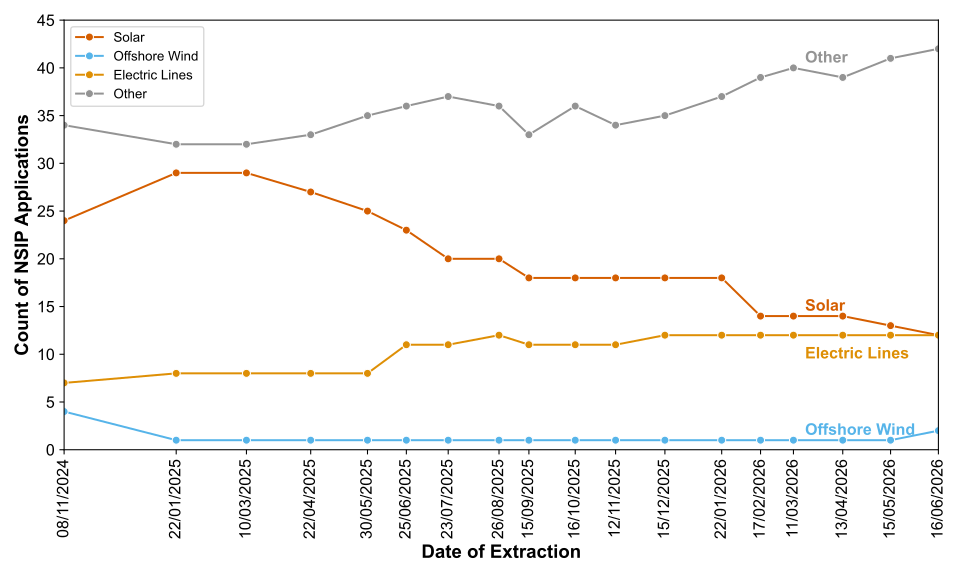
Note: The number of projects shown here in pre-application may differ from the data published on the Find a National Infrastructure Project website because some projects are not published in their early stages but are still counted in this analysis.
Figure 2: Number of NSIPs in post-submission stages at different snapshots in time across different sub-sectors. The colour represents the sub-sector of the projects.
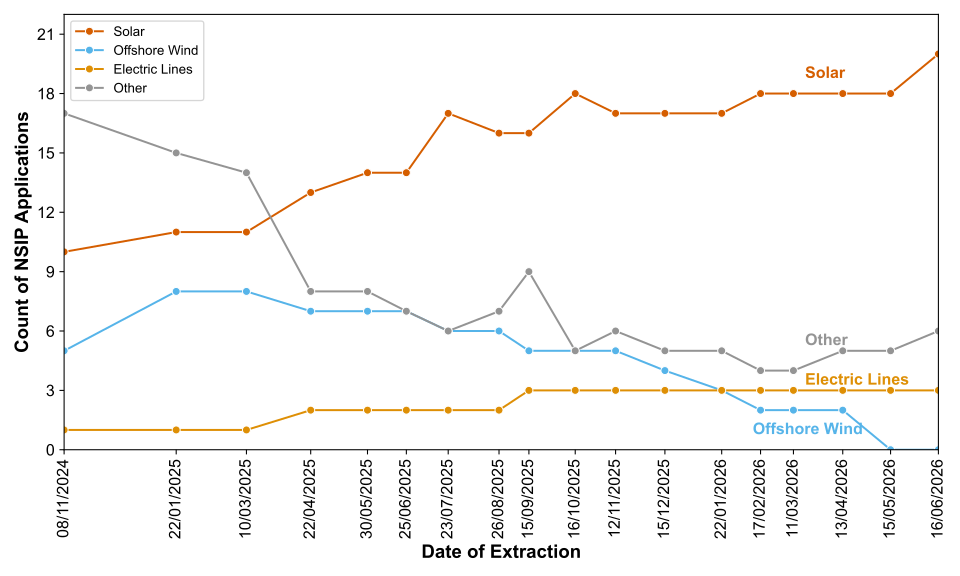
Source: Planning Inspectorate internal management information
The changes in pre-application casework volumes are a result of new projects starting pre-application, projects moving from pre-application to post-submission stages, and any withdrawals while in pre-application. The post-submission casework volume has been variable across the three individual sub-sectors and the ‘other’ categories. The changes in the post-submission casework volumes are a result of projects in pre-application converting to submissions, projects being decided, and any withdrawals.
The data table with the counts used to generate these figures can be found here: Planning Inspectorate Management Information - Nationally Significant Infrastructure Projects - July 2026 data file
The table shows the count of NSIPs being dealt with as pre-application or post-submission projects by the Planning Inspectorate at various dates between November 2024 and June 2026. The sub-sector of each project is recorded as either ‘Solar’, ‘Offshore Wind’, ‘Electric Lines’ or ‘Other’, which encompasses all the NSIP sub-sectors listed above in this bulletin.