Planning applications in England: January to March 2026 - statistical release
Published 19 June 2026
Applies to England

© Crown copyright 2026
This publication is licensed under the terms of the Open Government Licence v3.0 except where otherwise stated. To view this licence, visit nationalarchives.gov.uk/doc/open-government-licence/version/3 or write to the Information Policy Team, The National Archives, Kew, London TW9 4DU, or email: psi@nationalarchives.gov.uk.
Where we have identified any third party copyright information you will need to obtain permission from the copyright holders concerned.
This publication is available at https://www.gov.uk/government/statistics/planning-applications-in-england-january-to-march-2026/planning-applications-in-england-january-to-march-2026-statistical-release
1. Main points
Between January to March 2026, district level planning authorities in England:
-
received 79,600 applications for planning permission, down 10% from the same quarter a year earlier;
-
decided 68,400 applications for planning permission, down 4% from the same quarter a year earlier;
-
granted 59,400 decisions, down 3% from the same quarter a year earlier; this is equivalent to 87% of decisions, unchanged from the same quarter a year earlier;
-
decided 91% of major applications within 13 weeks or the agreed time, unchanged from the same quarter a year earlier; and decided 19% of major applications within the statutory period of 13 weeks, unchanged from the same quarter a year earlier;
-
granted 6,700 residential applications, down 5% from the same quarter a year earlier;
-
granted 1,300 applications for commercial developments, down 10% from the same quarter a year earlier; and
-
decided 33,500 householder development applications, down 7% from the same quarter a year earlier. This accounted for 49% of all decisions, down from 51% a year earlier.
In the year ending March 2026, district level planning authorities:
-
granted 259,600 decisions, down 2% from the year ending March 2025; and
-
granted 28,100 residential applications, down 4% from the year ending March 2025.
To view this data in more detail please see our interactive dashboard.
2. Introduction
Accredited Official Statistics are called National Statistics in the Statistics and Registration Service Act 2007. These statistics have been independently reviewed by the regulator and found to comply with the standards of trustworthiness, quality and value in the Code of Practice for Statistics.
This statistical release presents Accredited Official Statistics on authorities that undertake district and county level planning activities in England. It covers information on planning applications received and decided, including decisions on applications for residential developments (dwellings) and enforcement activities. Data are provided at national and local planning authority level and are based on information reported for the relevant quarters as at 28 May 2026 for the PS1/2 return (‘District matters’) and the CPS1/2 return (‘County matters’).
The separate Technical Notes document includes figures for response rates and a Definitions section which provides a link to a glossary containing details of the main terms used within this release and associated live tables.
The department has produced an interactive dashboard comprising data from the PS1/2 and CPS1/2 returns and open data (.csv) files to complement the ongoing use of live tables in spreadsheets which are available from the planning applications statistics web page.
3. Authorities undertaking district level planning
A summary of the trends in applications, decisions and permissions granted is provided in Figure 1. The number of applications, decisions and permissions at district level in this publication is usually rounded to the nearest hundred[footnote 1]; unrounded figures are available in the accompanying Live Tables and Dashboard.
3.1 Planning applications received
During January to March 2026, authorities undertaking district level planning in England received 79,600 applications for planning permission, down 10% from the same quarter a year earlier. In the year ending March 2026, authorities received 315,900 planning applications, down 5% from the year ending March 2025 (Live Table P134, PS1 Dashboard). The applications in these figures include applications for outline planning permission, applications for approval of reserved matters, applications for full planning permission and applications to vary or remove a planning condition.
The figures collected by the department are the total numbers of planning applications submitted to local planning authorities, and don’t include a breakdown of the type of application or, in the case of residential applications, the number of units included in each application, such as the number of homes in the case of housing developments. The department supplements this information by obtaining statistics on housing applications from a contractor, Glenigan[footnote 5].
The Glenigan applications data is a new addition to MHCLG’s Planning Application Statistics series this quarter. Data up to December 2025 has undergone quality checks by MHCLG and is published below.
Residential units - outline applications
The latest provisional figures show that 3,110 outline residential applications were made in the year to December 2025, down 3% from the 3,200 outline residential applications made in the year to December 2024. Within these applications, 206,000 units were applied for in the year to December 2025, up 54% from the 134,000 units applied for in the year to December 2024.
Table 3a: Number of housing units in outline applications
England, up to the year ending December 2025
| Rolling annual total to | Number of applications made | Percentage change in applications from prior year | Number of units applied for | Percentage change in units from prior year |
|---|---|---|---|---|
| 2022 Q4 | 4,400 | -9 | 239,000 | 24 |
| 2023 Q4 | 4,110 | -7 | 166,000 | -31 |
| 2024 Q4 | 3,200 | -22 | 134,000 | -19 |
| 2025 Q4 | 3,110 | -3 | 206,000 | 54 |
Source: Glenigan planning permission data: snapshot as at 11 June 2026.
Applications figures are rounded to the nearest ten, units figures are rounded to the nearest thousand.
Residential units - detailed applications
The latest provisional figures show that 20,430 detailed residential applications were made in the year to December 2025, down 3% from the 21,030 detailed residential applications made in the year to December 2024. Within these applications, 303,000 units were applied for in the year to December 2025, up 19% from the 254,000 units applied for in the year to December 2024.
Table 3b: Number of housing units in detailed applications
England, up to the year ending December 2025
| Rolling annual total to | Number of applications made | Percentage change in applications from prior year | Number of units applied for | Percentage change in units from prior year |
|---|---|---|---|---|
| 2022 Q4 | 30,020 | -12 | 355,000 | -17 |
| 2023 Q4 | 26,450 | -12 | 294,000 | -17 |
| 2024 Q4 | 21,030 | -20 | 254,000 | -14 |
| 2025 Q4 | 20,430 | -3 | 303,000 | 19 |
Source: Glenigan planning permission data: snapshot as at 11 June 2026.
Applications figures are rounded to the nearest ten, units figures are rounded to the nearest thousand.
A more detailed breakdown of these figures can be seen in the annex at the end of the release.
3.2 Planning decisions
Authorities reported 68,400 decisions on planning applications in January to March 2026, down 4% from the same quarter a year earlier. In the year ending March 2026, authorities decided 298,100 planning applications, down 3% from the year ending March 2025 (Live Tables P120/P133/P134, PS1/PS2 Dashboard).
3.3 Applications granted
During January to March 2026, authorities granted 59,400 decisions, down 3% from the same quarter a year earlier. This represented 87% of all decisions, unchanged from the same quarter a year earlier. In the year ending March 2026, authorities granted 259,600 decisions, down 2% from the year ending March 2025. Authorities granted 87% of all decisions, up 1 percentage point from the year ending March 2025 (Live Tables P120/P133, PS2 Dashboard).
3.4 Applications on hand
Authorities reported that they had 107,500 applications on hand as at 1 January 2026, up 2% from the same quarter a year earlier. This is 57% above the number of decisions made during the quarter. The corresponding figure for the same quarter a year earlier was 49%. Taking account of numbers of applications received, decisions made and applications withdrawn during the quarter gives a total of 114,600 applications on hand as at the end of March 2026, down 3% from the same quarter a year earlier (Live Table P133, PS1 dashboard).
3.5 Historical context
Figure 1 shows that, since about 2009-10, the numbers of applications received, decisions made and applications granted have each followed a similar pattern. As well as the usual within-year pattern of peaks in the Summer (July to September quarter) and troughs in the Autumn and Winter (October to December and January to March quarters), there was a clear downward trend during the 2008 economic downturn, followed by a period of stability. There was a large dip in 2020 following the start of the pandemic and a subsequent recovery in early 2021, including a particular peak in applications received, but since the peak there has been a steep downward trend.
Figure 1: Number of planning applications received, decided and granted (thousands)
England, quarter ending June 2005 to quarter ending March 2026
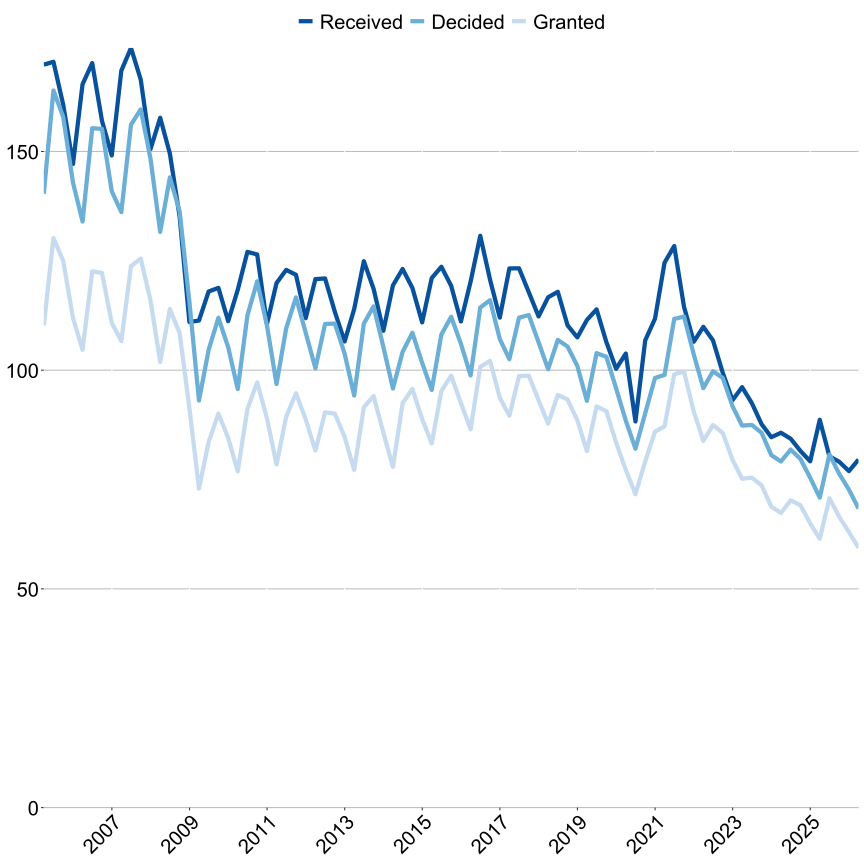
Historical figures for all district level decisions dating back to 2013-14 are set out in Live Table P120, with separate breakdowns for residential and commercial decisions being shown in Live Tables P120A and P120B respectively. These latter two tables are discussed below in the sections on residential and commercial decisions. Alternatively an extended time series is available within the Dashboard and the full time series is available within the PS1 and PS2 open data tables. Revisions are made to the figures submitted by local authorities but are generally very small[footnote 2].
3.6 Regional breakdowns
Table 1 shows how numbers of applications received, decisions made and decisions granted varied by region. It also shows how the percentage of decisions granted varies widely by region, from 81% in London to 90% in South West (Live Table P133, PS1/PS2 Dashboard).
Table 1: Regional breakdown of applications and decisions
Quarter ending March 2026:
| Number of applications received | Number of applications decided | Number of applications granted | Percentage of decisions granted | |
|---|---|---|---|---|
| England | 79,600 | 68,400 | 59,400 | 87 |
| East Midlands | 5,900 | 5,100 | 4,500 | 89 |
| East of England | 10,500 | 8,900 | 7,700 | 87 |
| London | 13,900 | 12,000 | 9,800 | 81 |
| National Parks | 1,300 | 1,200 | 1,000 | 89 |
| North East | 2,400 | 2,100 | 1,900 | 89 |
| North West | 8,000 | 6,500 | 5,800 | 88 |
| South East | 15,300 | 13,100 | 11,500 | 88 |
| South West | 9,400 | 8,500 | 7,600 | 90 |
| West Midlands | 6,700 | 5,500 | 4,800 | 87 |
| Yorkshire and the Humber | 6,200 | 5,400 | 4,700 | 87 |
Table 2 like Table 1 shows how numbers of applications received, and planning decisions made, varied by region. It also shows the percentage change in number of applications received and decided compared to the same quarter a year earlier. The percentage change in the number of applications received varies widely by region, from -15% in South West to -4% in West Midlands (PS1 Dashboard).
Table 2: Regional breakdown of changes in applications received and decided
Quarter ending March 2026 compared to the quarter ending March 2025:
| Number of applications received | Percentage change from previous year | Number of applications decided | Percentage change from previous year | |
|---|---|---|---|---|
| England | 79,600 | -10 | 68,400 | -4 |
| East Midlands | 5,900 | -13 | 5,100 | 1 |
| East of England | 10,500 | -9 | 8,900 | -3 |
| London | 13,900 | -9 | 12,000 | -7 |
| National Parks | 1,300 | -8 | 1,200 | -4 |
| North East | 2,400 | -7 | 2,100 | 8 |
| North West | 8,000 | -9 | 6,500 | 1 |
| South East | 15,300 | -12 | 13,100 | -7 |
| South West | 9,400 | -15 | 8,500 | -5 |
| West Midlands | 6,700 | -4 | 5,500 | -3 |
| Yorkshire and the Humber | 6,200 | -8 | 5,400 | 2 |
3.7 Decisions granted
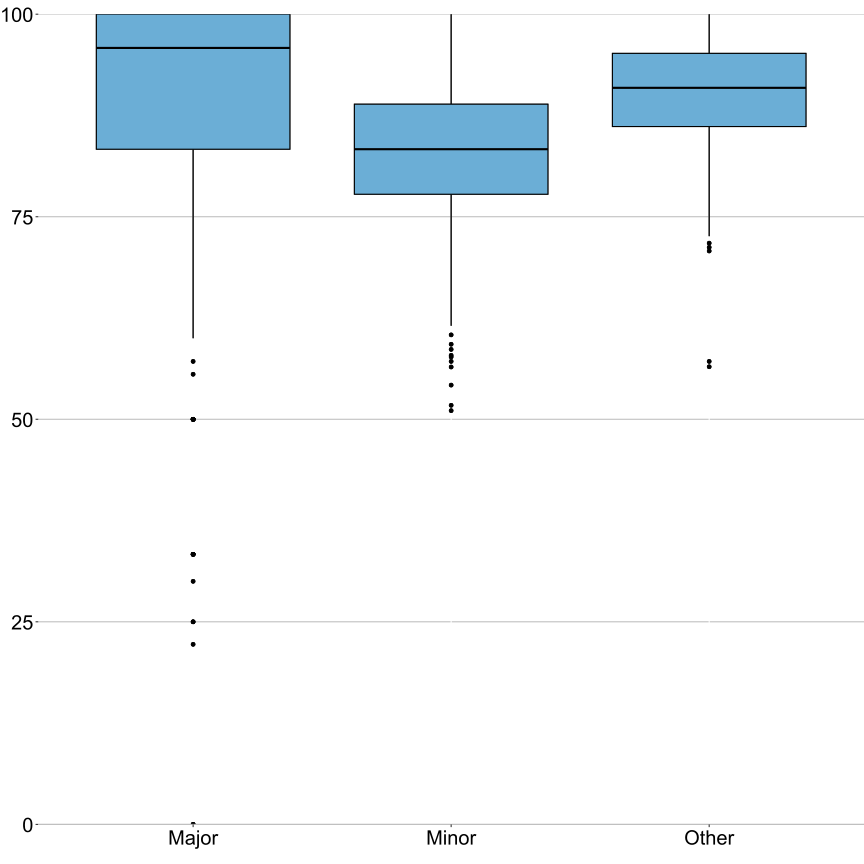
Figure 2 summarises the distribution of the percentage of decisions granted across authorities for major, minor and other developments using box and whisker plots. The ends of the box are the upper and lower quartiles, meaning that 50% of local authorities fall within this range, with the horizontal line in the centre of the box representing the median. The whiskers are the two lines above and below the box that are 1.5 times the size of the box (the interquartile range) with the dots representing outliers. Figure 2 shows that the range between the whiskers for the percentage of applications granted is widest between authorities for major developments (60% to 100%), followed by minor developments (62% to 100%) and other developments (73% to 100%) (PS2 Dashboard).
Figure 2: Percentage of planning decisions granted, by type of development
Local planning authorities, quarter ending March 2026
3.8 Speed of decisions
In January to March 2026, 91% of major applications were decided within 13 weeks or within the agreed time, unchanged from the same quarter a year earlier. 19% of major applications were decided within the statutory time period of 13 weeks, unchanged from the same quarter a year earlier.
In the same quarter, 87% of minor applications were decided within 8 weeks or within the agreed time, down 1 percentage point from the same quarter a year earlier. 38% of minor applications were decided within the statutory time period of 8 weeks, down 1 percentage point from the same quarter a year earlier.
Also in the same quarter, 90% of other applications were decided within 8 weeks or within the agreed time, down 1 percentage point from the same quarter a year earlier. 56% of other applications were decided within the statutory time period of 8 weeks, down 2 percentage points from the same quarter a year earlier.
For more information on major, minor and other developments please see the PS1 and PS2 district planning matter guidance notes.
Figure 3 shows that range between the whiskers for the percentage of decisions made in time this quarter for major developments was 71% to 100%, for minor developments it was 65% to 100% and for other developments it was 74% to 100% (PS2 Dashboard).
Figure 3: Percentage of planning decisions made in time, by type of development
Local planning authorities, quarter ending March 2026
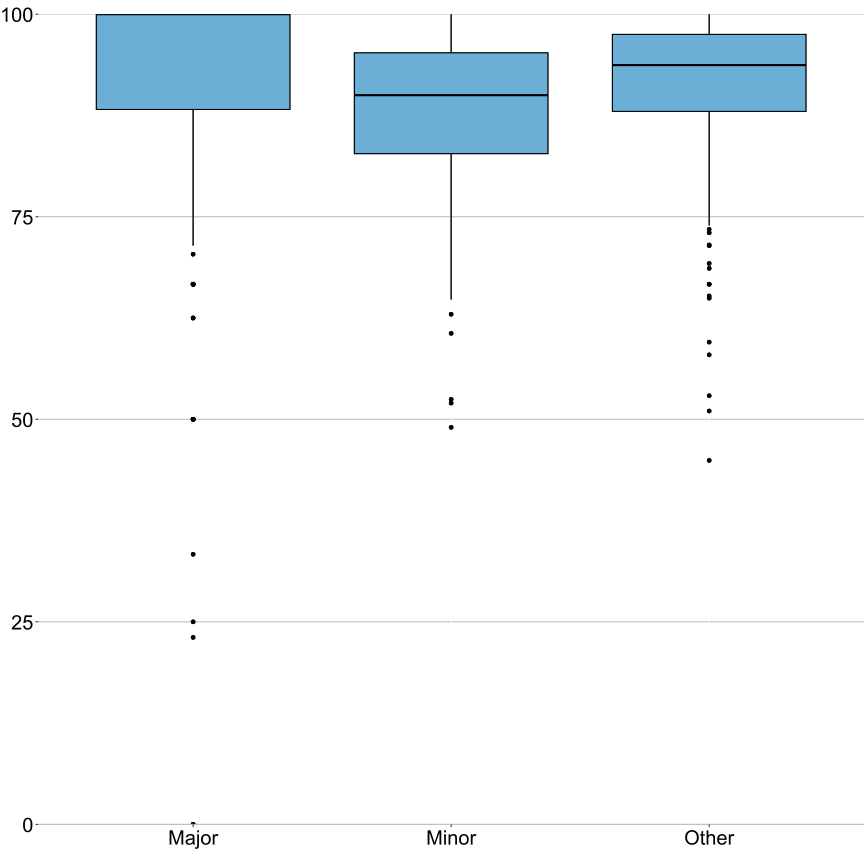
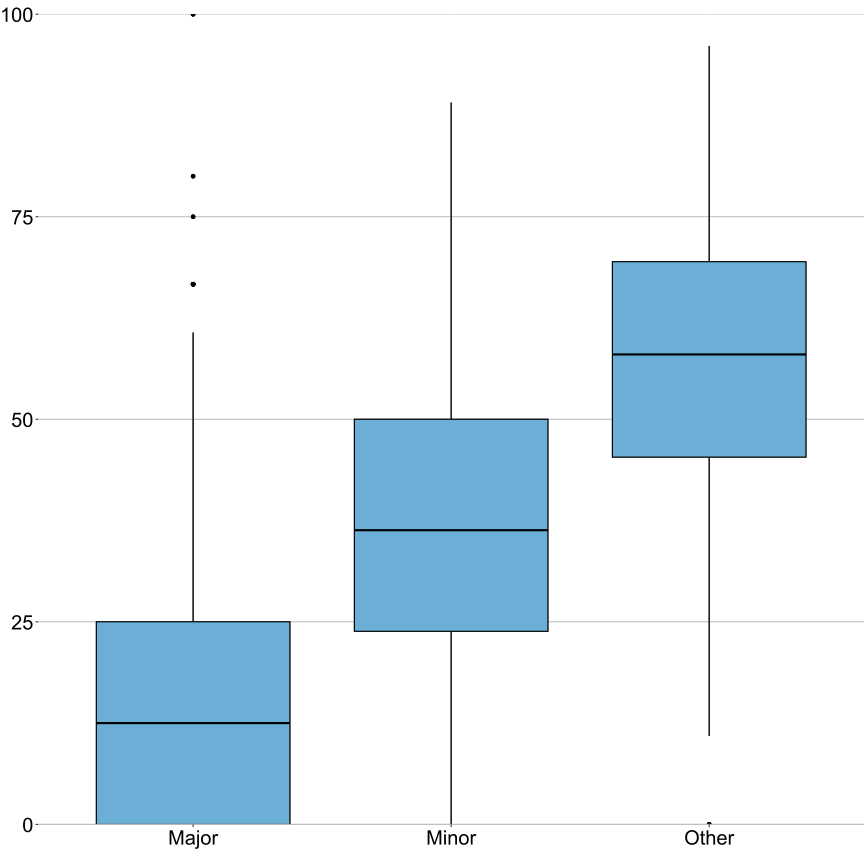
Figure 3b shows that range between the whiskers for the percentage of decisions made by the statutory deadline this quarter for major developments was 0% to 61%, for minor developments it was 0% to 89% and for other developments it was 11% to 96% (PS2 Dashboard).
Figure 3b: Percentage of planning decisions made in time, by type of development, excluding performance agreements
3.9 Use of performance agreements
‘Performance agreement’ (PA) is an umbrella term used here to refer to Planning Performance Agreements, Extensions of Time and Environmental Impact Assessments (EIAs). The EIA process is undertaken to assess whether a project will have a substantial impact on the environment, with applications having an accompanying Environmental Statement[footnote 3] (see Technical Notes for further definitions of PAs). Between January to March 2026, 43% of all planning application decisions involved a performance agreement. Major developments were more likely to involve a performance agreement compared to minor and other developments with 77% of major decisions involving a performance agreement, compared with 54% of minor decisions and 37% of other decisions (Reference Table 2, PS2 Dashboard).
Figure 4 shows, from April 2010, the numbers of decisions on major, minor and other developments made involving a performance agreement, compared with numbers without a performance agreement. Notwithstanding definition changes, there has been a marked increase in the use of agreements since early 2013 (see Technical Notes for more information). This longer upward trend has been driven by both the additional scope for recording them and their additional use (Live Table P120, PS2 Dashboard).
Figure 4: Use of performance agreements with applications for major, minor and other developments
England, quarter ending June 2010 to quarter ending March 2026
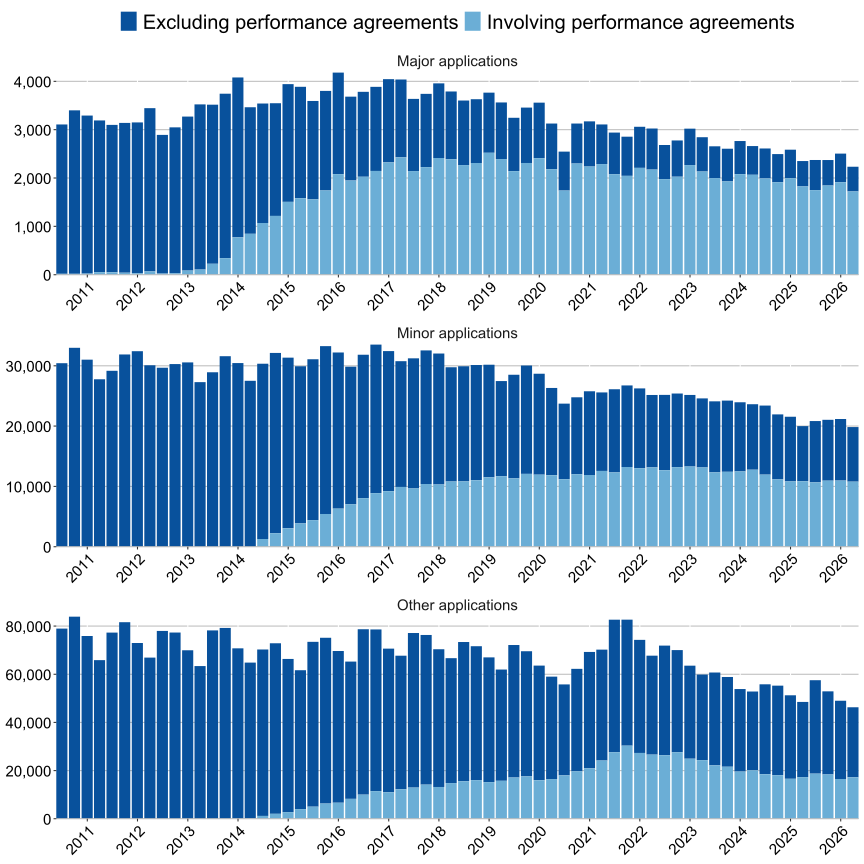
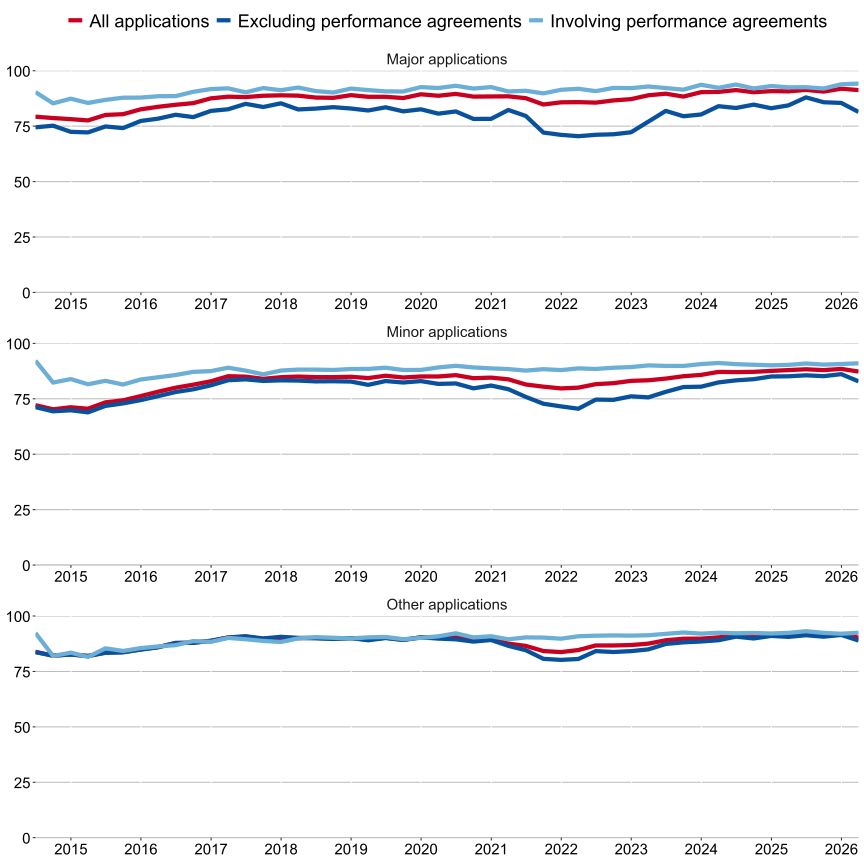
Figure 5 shows that in the quarter to March 2026, 94% of major development decisions involving performance agreements were made on time. In comparison, 81% of major decisions not involving performance agreements were made within the statutory time limit of 13 weeks (see Reference Table 2, PS2 Dashboard).
Figure 5: Percentage of major, minor and other development decisions made in time
England, quarter ending June 2014 to quarter ending March 2026
3.10 Performance of individual district level local planning authorities
The existing approach to measuring the performance of authorities was introduced by the Growth and Infrastructure Act 2013 and is based on assessing local planning authorities’ performance on the speed and quality of their decisions on applications for major and non-major development (minor, change of use and householder developments). Where an authority is formally designated by the Secretary of State as underperforming, applicants have had the option of submitting their applications for the category or categories for which the authority has been designated (and connected applications) directly to the Planning Inspectorate (who act on behalf of the Secretary of State) for determination. See Improving planning performance: criteria for designation for more information. Further details of designated authorities, including of applications submitted to the Planning Inspectorate, are available at Planning Applications (s62A).
Speed of decisions
The designation thresholds, below which a local planning authority is eligible for designation are:
-
For applications for major development: less than 60% of an authority’s decisions made within the statutory determination period or such extended period as has been agreed in writing with the applicant;
-
For applications for non-major development: less than 70% of an authority’s decisions made within the statutory determination period or such extended period as has been agreed in writing with the applicant.
See Live Tables P151/P153
Quality of decisions
The threshold for designation on applications for both major and non-major development, above which a local planning authority is at risk of designation, is 10% of an authority’s total number of decisions on applications made during the assessment period being overturned at appeal.
Once the figures for the relevant period have been published in Live Table P152 or P154, which identify local planning authorities are at risk of designation by exceeding the threshold, they are invited to contact departmental officials with any data corrections, and information on any exceptional circumstances applying to the authority that might be used as reasons why the Secretary of State should not designate them. The Secretary of State then takes this evidence into account when making decisions on which authorities should be designated.
See Live Tables P152/P154
Ten local planning authorities are currently designated by the Secretary of State in relation to the quality of decision-making for major applications. These are:
-
Cherwell District Council
-
Dacorum Borough Council
-
Epping Forest District Council
-
Hertsmere Borough Council
-
Lewes District Council
-
Malvern Hills District Council
-
Rossendale Borough Council
-
South Tyneside Council
-
Staffordshire Moorlands District Council
-
Wychavon District Council
Lewes District Council was designated on 8th May 2024, while the rest were designated on 15 June 2026.
3.11 Residential decisions
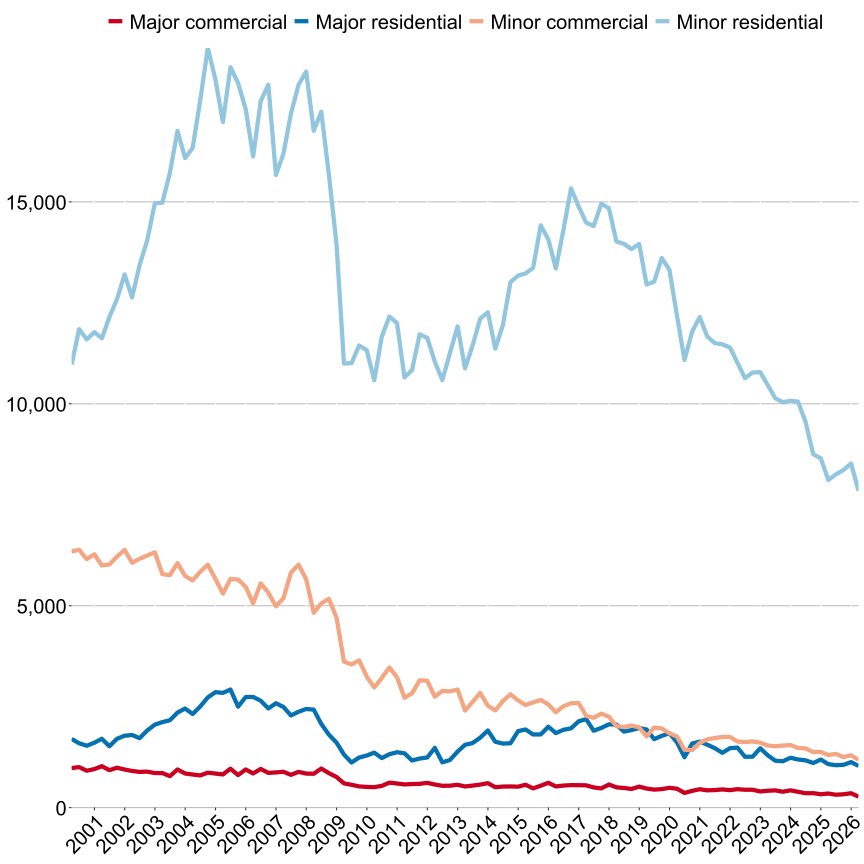
In January to March 2026, 8,900 decisions were made on applications for residential developments[footnote 4], of which 6,700 (76%) were granted. The number of residential decisions made was down 3% from the same quarter a year earlier, with the number granted down 5% from the same quarter a year earlier. 900 major residential decisions were granted, down 2% from the same quarter a year earlier and 5,800 minor residential decisions were granted, down 5% from the same quarter a year earlier (Live Table P120A, PS2 Dashboard).
In the year ending March 2026, 37,200 decisions were made on applications for residential developments, of which 28,100 (76%) were granted. The number of residential decisions made was down 6% from the previous year, with the number granted down 4% from the year ending March 2025. 3,600 major residential decisions were granted, down 3% from the previous year and 24,500 minor residential decisions were granted, down 4% from the previous year.
3.12 Residential units granted permission
The figures collected by the department are the numbers of decisions on planning applications submitted to local planning authorities, rather than the number of units included in each application, such as the number of homes in the case of housing developments. The department supplements this information by obtaining statistics on housing permissions from a contractor, Glenigan[footnote 5].
The latest figures on the number of residential units permitted provided by Glenigan have been removed from this publication while MHCLG and Glenigan undertake further quality assurance. We will publish the estimate as soon as possible, once data quality has been further assured.
3.13 Commercial decisions
In January to March 2026, 1,500 decisions were made on applications for commercial developments[footnote 6], of which 1,300 (90%) were granted. The number of commercial decisions made was down 12% from the same quarter a year earlier, with the number granted down 10% from the same quarter a year earlier. 300 major commercial decisions were granted, down 22% from the same quarter a year earlier and 1,100 minor commercial decisions were granted, down 7% from the same quarter a year earlier (Live Table P120B, PS2 Dashboard).
In the year ending March 2026, 6,300 decisions were made on applications for commercial developments, of which 5,700 (90%) were granted. The number of commercial decisions made was down 8% from the previous year, with the number granted down 7% from the year ending March 2025. 1,200 major commercial decisions were granted, down 9% from the previous year and 4,500 minor commercial decisions were granted, down 6% from the previous year.
3.14 Trends in the percentage of residential and commercial applications
Figure 6: Number of planning applications decided by district authorities, by type of development
England, quarter ending March 2000 to quarter ending March 2026
3.15 Householder developments
Householder developments are those developments to a residence which require planning permission such as extensions, loft conversions and conservatories (see Definitions section of the Technical Notes).
The number of decisions made on householder developments was 33,500 in the quarter ending March 2026, accounting for 49% of all decisions, down from 51% of all decisions made in the quarter ending March 2025. Authorities granted 91% of these applications and decided 93% within eight weeks or the agreed time (Reference Table 2, PS2 Dashboard).
In the year ending March 2026, 151,900 decisions were made on applications for householder developments, accounting for 51% of all decisions, unchanged from 51% of all decisions made in the year ending March 2025. Authorities granted 90% of these applications and decided 93% within eight weeks or the agreed time.
3.16 Major public service infrastructure development decisions
Since August 2021, major public service infrastructure developments broadly defined as major developments for schools, hospitals and criminal justice accommodation have been subject to an accelerated decision-making timetable.
Separate figures on major public service infrastructure development decisions have been collected on the quarterly PS2 return with effect from October 2021. During January to March 2026 there were 13 decisions, of which all 13 were granted and 11 were decided in time (Live Table MJPSI, PS2 Dashboard). Please note that figures are not collected on the CPS1/2 return and so don’t include education developments by county councils.
3.17 Permission in Principle/Technical Details consent decisions
Since April 2017, local planning authorities have had the ability to grant permission in principle (PiP) to sites which have been entered on their brownfield land registers. Where sites have a grant of permission in principle, applicants have been able to submit an application for Technical Details Consent (TDC) for development on these sites. In addition, since June 2018, it has also been possible to make an application for PiP for minor housing-led development as a separate application, independently of the brownfield register. Where a site has been granted PiP following an application, it is possible to apply for a TDC.
Figures on PiP/TDC decisions have been collected on the quarterly PS2 return from January 2020. During January to March 2026, local planning authorities reported 429 PiP (minor housing-led developments) decisions, 35 TDC (minor housing-led developments) decisions and 1 TDC (major developments) decisions. The number of PIP decisions has increased notably since 2020, when there were about 60 decisions per quarter. The figure of 429 in January to March 2026 is up 137% from the same quarter a year earlier. (Live Table PiP/TDC1, PS2 dashboard).
3.18 Permitted development rights
Planning permission for some types of development has been granted nationally through legislation, and the resulting rights are known as ‘permitted development rights’ (PDRs). For certain permitted development rights, if the legislation is complied with, developments can go ahead without the requirement to notify the local planning authority. Hence no way of capturing this data exists and these are not accounted for in this report. In other cases, the permitted development right legislation requires an application to the local planning authority to determine whether or not prior approval is required and to determine as appropriate (see the Definitions section of the Technical Notes).
Between January to March 2026, 5,200 applications were reported, of which prior approval was not required for 2,700, permission was granted for 1,500, and 1,000 were refused. This resulted in an overall acceptance rate[footnote 7] of 81%. Large householder extension accounted for 53% of all PDR applications reported, with 32% relating to All others, 6% relating to Agricultural to residential, and 6% relating to Commercial Business and service to residential (Live Tables PDR1/PDR2).
In the quarter to March 2026, 700 permitted development right applications were made for changes to residential use, of which 500 (69%) were given the go-ahead without having to go through the full planning process.
Overall during the 48 quarters from April 2014 to March 2026, district planning authorities reported 380,300 applications for prior approvals for permitted developments. For 209,900 of them prior approval was not required, 91,700 were granted and 78,700 were refused (Live Table PDR2).
Figure 7: Permitted development rights decided by district planning authorities
England, quarter ending June 2014 to year ending March 2026
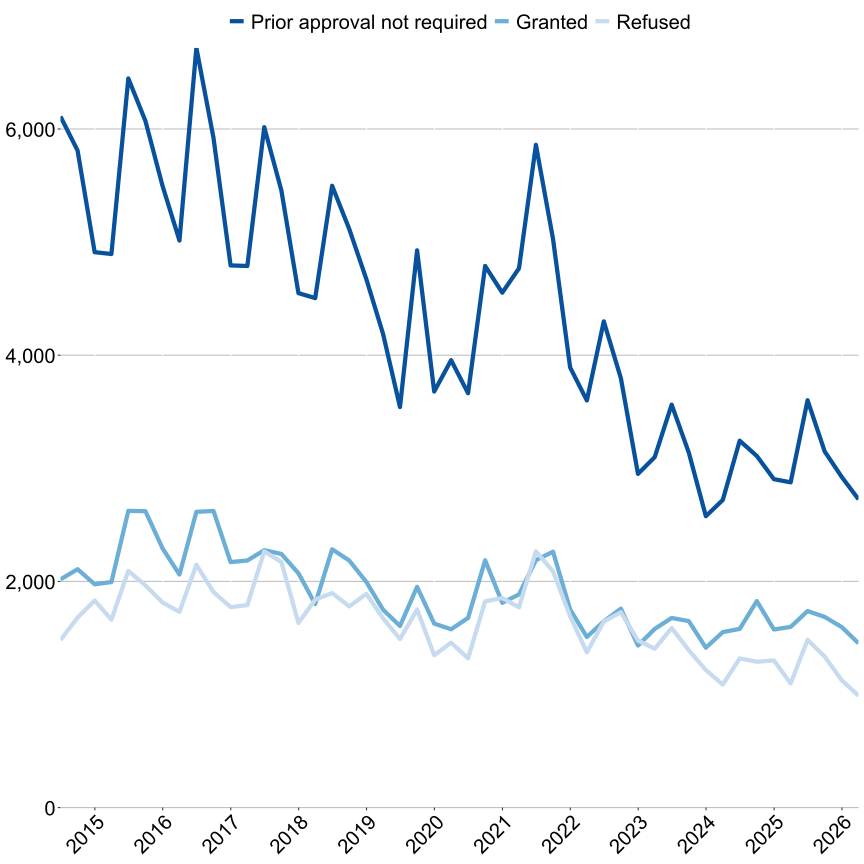
Please note, different rights have come to into force and ceased to have effect since 2014, and therefore the annual figures are not directly comparable. See Live Table PDR1 and PDR2 for more information.
3.19 Other information
England totals for all the items of information collected on the PS1 and PS2 returns for January to March 2026 are given in Reference Tables 1 and 2 respectively. These include the following, for which definitions are given in the Definitions section of the Technical Notes:
Delegated decisions
Of the 68,400 decisions made during the quarter, 65,900 (96%) were delegated to officers. This percentage has been stable since 2014, having previously increased from around 75% in 2000 (Live Table P133).
Enforcement activity
During the quarter, authorities issued 1,435 enforcement notices and served 1,411 planning contravention notices, 180 breach of condition notices, 18 stop notices and 73 temporary stop notices, while 9 enforcement injunctions were granted by the High/County Court and 0 injunctive applications were refused. In recent years, this level of activity has remained broadly proportionate to the number of planning decisions made (Live Table P127).
Enforcement warning notices (EWNs) provide a way of formalising the process for a local planning authority to invite a retrospective planning application. Where a local planning authority considers that unauthorised development has a reasonable prospect of being acceptable in planning terms, it can issue an EWN. 10 were issued nationally between January to March 2026.
Regulation 3 and 4 decisions
205 ‘Regulation 3’ and 32 ‘Regulation 4’ decisions were made. Relative to the number of planning decisions made in recent years, numbers of ‘Regulation 3’ decisions have dropped and those for ‘Regulation 4’ have remained stable (Live Table P128).
Traveller pitches
During the quarter, authorities decided 7 major applications for traveller pitches, granting 4 of them, and deciding 7 of them within 13 weeks or the agreed time.
They also decided 93 minor applications for traveller pitches, granting 62 of them and deciding 74 of them within eight weeks or the agreed time.
For both major and minor applications for traveller pitches, the numbers of decisions, and percentages of applications granted and decided on time, have remained broadly stable since figures were first collected in 2008 (Live Table P137, PS2 Dashboard).
4. Authorities undertaking county level planning
Authorities that undertake county level planning activity include counties, unitary authorities, London boroughs, metropolitan districts, national parks and development corporations. ‘County matter’ applications include the winning and working of minerals and the deposit of waste. In the year to March 2026 county planning authorities received 590 applications, compared to the 315,900 applications received by district planning authorities.
Between January to March 2026, county level planning authorities in England:
-
received 147 applications for planning permission, down 18% from the same quarter a year earlier;
-
decided 136 applications for planning permission, up 5% from the same quarter a year earlier;
-
granted 129 decisions, up 11% from the same quarter a year earlier. This is equivalent to 95% of decisions, up 5 percentage points from the same quarter a year earlier; and
-
decided 93% of applications within 13 weeks or the agreed time, down 2 percentage points from the same quarter a year earlier.
4.1 Planning decisions
Waste developments accounted for 58% of the total decisions, mineral developments for 37% and other developments for 5% (CPS2 Dashboard).
4.2 Permitted development rights
Between January to March 2026, 19 applications were reported, of which prior approval was not required for 10, permission was granted for 9, and 0 were refused. This resulted in an overall acceptance rate of 100% (Live Table PDR3, CPS1 Dashboard).
4.3 Other information
England totals for all the items of information collected on the CPS1 return for January to March 2026 are given in Reference Table 3. These include the following, for which definitions are given in the Definitions section of the Technical Notes:
Delegated decisions
Of the 136 decisions made during the quarter, 103 (76%) were delegated to officers. This percentage has been stable since 2014 in recent years (CPS1 Dashboard).
Enforcement activity
During the quarter, authorities issued 24 enforcement notices and served 26 planning contravention notices, 1 breach of condition notices, 2 stop notices and 2 temporary stop notices, while 0 enforcement injunctions were granted by the High/County Court and 0 injunctive applications were refused. In recent years, this level of activity has remained broadly proportionate to the number of planning decisions made (CPS1 Dashboard).
Enforcement warning notices (EWNs) provide a way of formalising the process for a local planning authority to invite a retrospective planning application. Where a local planning authority considers that unauthorised development has a reasonable prospect of being acceptable in planning terms, it can issue an EWN. 2 were issued nationally between January to March 2026.
Regulation 3 and 4 decisions
53 ‘Regulation 3’ and 0 ‘Regulation 4’ decisions were made. Relative to the number of planning decisions made in recent years, numbers of ‘Regulation 3’ decisions have dropped and those for ‘Regulation 4’ have remained stable (CPS1 Dashboard).
4.4 Performance of individual county level local planning authorities
Speed of decisions
The designation thresholds, below which a local planning authority is eligible for designation are:
- For applications for major development: less than 60% of an authority’s decisions made within the statutory determination period or such extended period as has been agreed in writing with the applicant;
See Live Tables P151 (all developments) and P155 (oil/gas developments)
Quality of decisions
The threshold for designation on applications above which a local planning authority is eligible for designation, is 10% of an authority’s total number of decisions on applications made during the assessment period being overturned at appeal.
See Live Table P152
There are no county level local planning authorities currently designated by the Secretary of State in relation to the quality of decision-making for major applications.
See Improving planning performance: criteria for designation for more information.
5. Accompanying tables and open data
Accompanying tables are available to download alongside this release.
An interactive dashboard comprising data from the PS1/2 and CPS1/2 returns is also available on the planning application statistics landing page.
PS1/2 open data (.csv files)
-
Two files of PS1 data (.csv files) are available, with one holding data for the four most recent quarters only and the other holding data back to Q2 1996.
-
Similarly, two files of PS2 data (.csv files) are available, with one holding data for the four most recent quarters only and the other holding data back to Q2 1979.
Open data tables and supporting documents
CPS1/2 open data (.csv files)
-
Two files of CPS1 data (.csv files) are available, with one holding data for the four most recent quarters only and the other holding data back to Q2 1995.
-
In addition, two files of CPS2 data (.csv files) are available, with one holding data for the four most recent quarters only and the other holding data back to Q2 1989.
Open data tables and supporting documents
6. Glenigan Applications Annex
The figures below provide a finer breakdown of the Glenigan applications data given under ‘Authorities undertaking district level planning.’
6.1 Outline applications
Table 4a: Numbers of housing units applied for in the year to December 2025: by size and number of projects
England, up to the year ending December 2025
| Site size | Number of applications made | % of total number of applications | Number of units | % of total number of units |
|---|---|---|---|---|
| Large (2000+ units) | 10 | 0.3 | 26,000 | 13 |
| Standard (under 2000 units) | 3,100 | 99.7 | 179,800 | 87 |
Source: Glenigan planning permission data: snapshot as at 11 June 2026.
Note: number of units is rounded to the nearest 100 and number of projects is rounded to the nearest 10.
Table 5a: Housing units applied for in the year to December 2025: by region
England, up to the year ending December 2025
| Region | Number of applications | % of total number of applications | Number of units applied for | % of total number of units |
|---|---|---|---|---|
| East Midlands | 370 | 12 | 23,800 | 12 |
| East of England | 600 | 20 | 43,600 | 21 |
| London | 80 | 2 | 5,800 | 3 |
| North East | 40 | 1 | 4,800 | 2 |
| North West | 300 | 10 | 21,100 | 10 |
| South East | 510 | 17 | 37,300 | 18 |
| South West | 480 | 15 | 24,000 | 12 |
| West Midlands | 450 | 15 | 33,300 | 16 |
| Yorkshire and The Humber | 260 | 8 | 11,900 | 6 |
6.2 Detailed applications
Table 5b: Housing units applied for in the year to December 2025: by region
England, up to the year ending December 2025
| Region | Number of applications | % of total number of applications | Number of units applied for | % of total number of units |
|---|---|---|---|---|
| East Midlands | 1,700 | 8 | 20,100 | 7 |
| East of England | 3,110 | 15 | 44,200 | 15 |
| London | 2,340 | 12 | 40,800 | 14 |
| North East | 400 | 2 | 10,200 | 3 |
| North West | 1,920 | 9 | 31,200 | 10 |
| South East | 4,180 | 21 | 79,100 | 26 |
| South West | 3,360 | 17 | 31,600 | 10 |
| West Midlands | 1,810 | 9 | 25,400 | 8 |
| Yorkshire and The Humber | 1,410 | 7 | 19,400 | 6 |
7. Technical Notes
Please see the accompanying Technical Notes document for further details of definitions, related statistics and other technical details.
Please see the glossary of terms and definitions used in MHCLG housing statistical publications and English Housing Survey reports.
Information on the UK Statistical System is available via the UK Statistics Authority website: https://www.statisticsauthority.gov.uk/
Information about statistics at Ministry of Housing, Communities & Local Government is available via the department’s website: https://www.gov.uk/government/organisations/ministry-of-housing-communities-local-government/about/statistics
8. Enquiries
Date of next release: September 2026
Media enquiries: 0303 444 1209 newsdesk@communities.gov.uk
Public enquiries and responsible statistician: Andrew Presland
Email: planning.statistics@communities.gov.uk
Information on Official Statistics is available via the UK Statistics Authority website.
Information about statistics at MHCLG is available via the department’s website.
-
National Statistics are accredited official statistics. Accredited official statistics are called National Statistics in the Statistics and Registration Service Act 2007. Please see the Office for Statistics Regulation website for further details.
-
Our statistical practice is regulated by the Office for Statistics Regulation (OSR). OSR sets the standards of trustworthiness, quality and value in the Code of Practice for Statistics that all producers of official statistics should adhere to. You are welcome to contact us directly with any comments about how we meet these standards. Alternatively, you can contact OSR by emailing regulation@statistics.gov.uk or via the OSR website.
-
The three exceptions are the permissions and applications England totals provided by Glenigan Ltd (rounded to the nearest 1,000 due to the relative turbulence of the figures), numbers of applications provided by Glenigan Ltd (rounded to the nearest ten because some numbers are very low) and the enforcement actions towards the end of the section (unrounded, because some numbers are very low). ↩
-
Glenigan routinely collects data on planning applications submitted to all English local planning authorities and records the information by maintaining a ‘planning application’ for every project. The data have been updated over time as subsequent applications are submitted and decisions made, with all new applications being matched against the existing database at entry stage. This has involved an automated process supplemented by manual checking to identify any further matching projects. More details are given in the Definitions section of the Technical Notes. ↩ ↩2
-
The largest revision made this quarter to an England total for October to December 2025 was an increase of 673 (0.9%) in the number of applications received during the quarter. ↩
-
Environmental Statement is a term used in some live tables, and are produced at the end of the EIA process. ↩
-
‘Residential’ is used in this release to refer only to developments involving the construction or conversion of dwellings, rather than also including other developments involving people’s homes, such as householder developments and some changes of use. ↩
-
Commercial developments are defined in this release as: ‘Offices, research and development, light industry’, ’General industry, storage, warehousing’ and ‘Retail and service’. ↩
-
The acceptance rate is defined as the number of applications for which prior approval was not required, or for which permission was granted, as a percentage of the total number of applications. ↩