Offender management statistics quarterly: October to December 2025
Published 30 April 2026
Applies to England and Wales

© Crown copyright 2026
This publication is licensed under the terms of the Open Government Licence v3.0 except where otherwise stated. To view this licence, visit nationalarchives.gov.uk/doc/open-government-licence/version/3 or write to the Information Policy Team, The National Archives, Kew, London TW9 4DU, or email: psi@nationalarchives.gov.uk.
Where we have identified any third party copyright information you will need to obtain permission from the copyright holders concerned.
This publication is available at https://www.gov.uk/government/statistics/offender-management-statistics-quarterly-october-to-december-2025/offender-management-statistics-quarterly-october-to-december-2025
Quarterly: October to December 2025 and annual 2025
Prison population: 31 March 2026
Main Points
| 87,342 prisoners in England and Wales as at 31 March 2026 | The total prison population has decreased (1% compared to the same point in 2025. |
| 18,379 first receptions into prison between October and December 2025 | The number of first receptions represented a 2% increase compared to the same period in 2024. |
| 14,643 releases from sentences between October and December 2025 | The number of releases represented a 7% decrease compared to the same period in 2024. |
| 70,275 adjudication outcomes between October and December 2025 | This was virtually unchanged (less than 0.5% decrease) compared to the same period in 2024. Additional days were awarded as punishment on 1,838 occasions. |
| 14,349 licence recalls between October and December 2025 | This was a 38% increase on the same quarter in 2024. |
| 248,568 offenders under probation supervision as at 31 December 2025 | This represented a 3% increase compared to 31 December 2024. |
This publication provides offender management quarterly statistics for the latest date available and provides comparisons to the previous year.
For technical detail please refer to the accompanying guide, ‘Guide to offender management statistics’.
Points to note
Contact
Users are encouraged to contact OMSQ-SiC-publications@justice.gov.uk with any comments relating to any of the below points / changes.
Standard Determinate Sentence 40% (SDS40) data
Updated transparency data on early releases under SDS40 has been published in parallel with this release:
‘https://www.gov.uk/government/collections/standard-determinate-sentence-sds40-release-data’
This includes monthly SDS40 releases from 01 October 2024 to 31 December 2025 with demographic and offence characteristics breakdowns.
Changes to the prison adjudications tables
As proposed in previous editions of this publication, published 30th October 2025 and published 29th January 2026, in support of readability we have now removed five tables relating to the ‘average number of punishments per proved adjudication’, previously tables 4_Q_36 to 4_Q_40. Users are still able to calculate this rate themselves if desired from published totals (by dividing the number of punishments by the number of proven adjudications).
We have also removed the corresponding annual table (previously Table 4_A_8) using the same rationale.
The annual adjudications tables have also been renumbered (the splitting out of stacked table content into separate tables in order to better meet user accessibility requirements), please see the Contents sheet of the Adjudications tables for further information.
Changes to underlying prisoner religion codes
As part of wider ongoing data improvement work, following consultation with operational colleagues the prisoner religion / belief codes and associated religion groups have been streamlined to aid more accurate data entry and initial processing.
These changes began in mid-June 2025 and concluded by the end of June 2025. As a result, a number of prisoners have moved between religion / belief groups impacting the 30 June 2025 breakdowns (Population table 1_Q_8 and adjudications tables 4_Q_5, 10, 15, 20, 25, 30 & 35), as well as the corresponding annual Adjudication tables (Tables 4_A_5, 10, 15, 20, 25, 30 & 35).
It is important to note that the implementation of these changes means that the breakdown of the prison population by religion (Table 1_Q_8) for before and after 30 June 2025 are no longer consistent and, therefore, not compatible.
Suspension of the HDC recall tables
Effective from 3rd June 2025, the maximum amount of time spent on HDC was expanded from 180 to 365 days. Therefore, HDC recalls can now occur up to four quarters after the release quarter, and to enable complete reporting the reporting period for HDC recalls now lags four quarters, rather than two quarters, behind that of other releases tables. The affected releases tables are 3.Q.13, 3.Q.14, and 3.Q.15. As it has not yet been 4 quarters since the HDC expansion, these tables contain [z]’s in the latest column (April-June 2025) because there is not yet data on HDC recalls for that quarter. HDC recalls data for HDC releases occurring between April-June 2025 will first be published in October 2026’s OMSQ.
Suspension of Ex-service personnel tables
As indicated in the previous two quarterly publications, we have taken the decision to indefinitely suspend Table 2_Q_12: ‘First receptions of former members of the armed services’ on data quality / data completeness grounds, with a view to resuming the publication if and when we have identified a replacement data source of sufficient quality, or BCST veteran status recording returns to publishable quality.
In the light of these recording limitations, partially noted in recent OMSQs, we would also advise users to exercise caution when using the existing published data as an evidence base, particularly in relation to the COVID period onwards (when our investigation suggests completion rates fell).
Restricted Patients
This can now be found on its own page (to help users searching from the gov.uk home page). Please see the ‘Related content’ link on the right-hand side of the OMSQ publication page.
Statistician’s comment
In this publication we are reporting on the prison population as at 31 March 2026, with comparisons to the same point in 2025. Whilst there has been some fluctuation in the population over this 12-month period, the prison population as at 31 Mar 2026 was around 600 (0.7%) lower than the same point in 2025.
The ‘month end’ high point during this 12-month period was at the end of August 2025 (with a prison population of 88,423) before falling back by around 1,000 to 87,465 at the end of the following month (Sep 2025), followed by a further fall of around 1,850 to 31 Dec 2025. The month-on-month falls after August 2025 are likely to due to the implementation of Fixed-Term Recall changes from early September 2025 (more information can be found in the ‘Recall to custody’ section of the Population chapter below), on top of which the ‘as at 31 December’ population is usually lower than at other times of the year given factors such as court closures over the Christmas period. Since December 2025, the population has risen month-on-month to reach 87,342 as at the end of March 2026.
The remand population has been rising since early 2020, but there was a 9% decrease in the size of the remand population between 31 March 2025 and 31 March 2026. Over the same period there were falls in both elements of the remand prison population: a 7% decrease for the ‘untried’ remand population (those held pre-conviction) and a 13% fall in the ‘convicted unsentenced’ remand population (those held after having been convicted but awaiting their sentencing outcome). This fall in the remand population is likely linked to the increase in Magistrates’ Sentencing Powers [footnote 1] (from November 2024) as well as an increase in the number of Crown Court sitting days [footnote 2] (from December 2024).
The prisoner flows data in this publication covers the period of October to December 2025 (with the comparison period being October to December 2024), together with annual statistics on the calendar year 2025 compared to previous years. The number of prisoner first receptions from October to December 2025 was around 18,400 (2% higher than the same period in 2024).
In the latest quarter, remand and sentenced admissions increased slightly compared to the same quarter in 2024 (by 1% and 4% respectively). Recall admissions saw a large increase (up 36% from the same period in 2024, continuing the trend seen since early 2022. This continued increase is likely due to the Suitability for Fixed Term Recall Order 2024 (effective from 2 April 2024) which mandated fixed term recalls for offenders sentenced to less than 12 months in custody, subject to some exceptions, and its expansion to offenders serving determinate sentences of 4 years or less from 2 September 2025. Early release schemes, which have seen more prisoners released on licence earlier in their sentences, may also have impacted the volume of recall admissions.
There were around 14,600 prisoners released in the latest quarter, a decrease of 7% compared to the same period in 2024. The number of prisoners released on Home Detention Curfew (HDC) also decreased, down 23%. This decrease reflects the impact of policy changes that occurred during 2024 which led to a high volume of HDC and conditional releases during the comparison period (October to December 2024). These were the introduction of the SDS40 early release scheme, beginning on 10th September 2024, with a bulk of ‘tranche 2’ releases on 22 October 2024, and changes to HDC policy in June 2024 which expanded HDC eligibility to prisoners serving longer determinate sentences (4 years or more).
1. Population
The prison population was 87,342 on 31 March 2026.
The sentenced prison population stood at 70,829 (81% of the total); the remand prison population stood at 16,025 (18%) and the non-criminal prison population stood at 488 (1%).
Figure 1: Prison population, March 2016 to March 2026
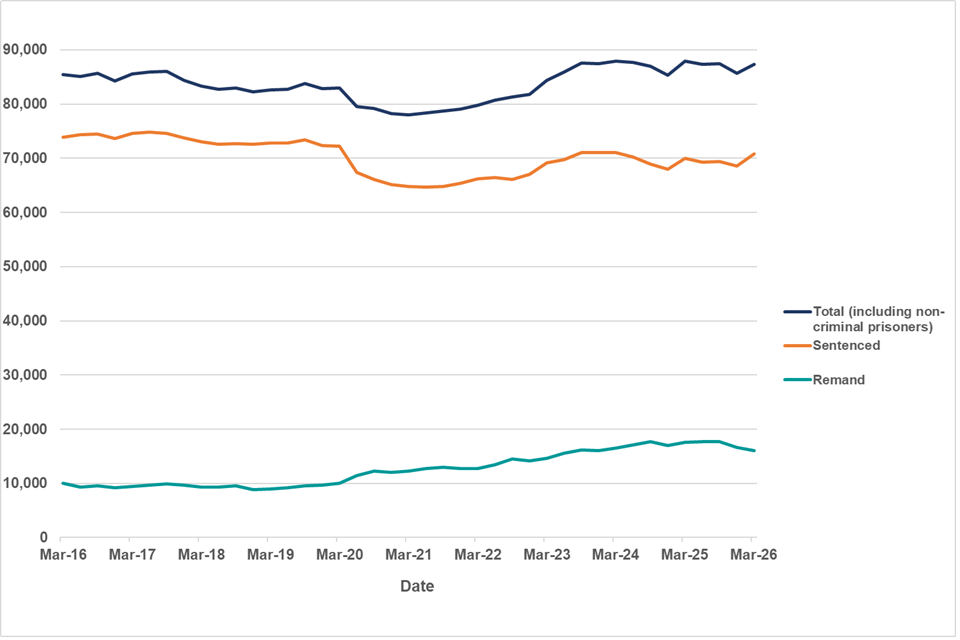
Chart description text
Description of Figure 1: Line chart showing a time series (March 2016 to March 2026) of the total prison population (including non-criminal), and subsets showing the sentenced and remand populations.
The sentenced population trends quite closely follow those of the total population. In March 2016 the total population was around 85,000, with sentenced around 74,000, and remand around 10,000. The total and sentenced populations remained broadly steady until the COVID-19 pandemic began in 2020, when both dropped. They started to rise from 2022. By March 2026 the total and sentenced population sit at roughly 87,000 and 71,000, respectively.
Between 2016 and 2020, the remand population also remained broadly stable, averaging around 10,000. It then increased during the COVID-19 pandemic, to around 13,000 by March 2022, and has since continued to trend upwards, dipping slightly to reach around 16,000 in March 2026.
The data for March 2025 to March 2026 is included in table 1_Q_1 of the Quarterly Prison Population tables of this publication. The earlier data, going back to March 2016, is included in table 1_A_1 of the Annual Prison Population tables, part of the July 2025 publication.
Remand prison population
The 31 March 2026 remand population figure of 16,025 is lower than in March 2025 (a decrease of 9%). This decreasing trend began in August 2025, counter to the overall annual increase in the remand population that had been seen since 2020.
The untried remand population and the convicted unsentenced remand population both fell when compared to the end of March 2025, to 10,585 (down 7%) and 5,440 (down 13%), respectively. These are likely linked to the increase in Magistrates’ Sentencing Powers [footnote 1] (from November 2024) as well as an increase in the number of Crown Court sitting days [footnote 2] (from December 2024).
The two largest offence groups for those held on remand were ‘violence against the person’ (44% of the untried population and 29% of the convicted unsentenced population) and ‘drug offences’ (10% of the untried population and 18% of the convicted unsentenced population).
While white prisoners make up 73% of the sentenced population, they make up only 64% of the remand population. All other reported ethnic groups have a larger proportional representation in the remand population than they do in the sentenced population.
Sentenced prison population
The sentenced population was 70,829, an increase of 1% compared to March 2025. The population serving sentences of 12 months to less than 2 years and 2 years to less than 4 years both increased by 11% from the previous year. The populations serving the shortest sentences either fell (less than or equal to 6 months, down 1%) or rose minimally (greater than 6 months to less than 12 months, up 2%). This suggests that the initial rises in these populations seen since the introduction of increased powers for magistrates have now levelled out.
Around 7 in 10 prisoners serving an immediate custodial sentence have been convicted of a violence against the person offence (34%), sexual offence (22%) or drug offence (13%).
Extended Determinate Sentences (EDS)
EDS constitute a custodial term, the majority of which is served in prison, followed by an additional extended period of licence in the community. They can be imposed if the offender is found guilty of, or has a previous conviction for, a specific sexual, violent, or terrorist offence. On 31 March 2026, 9,532 prisoners were serving such sentences, up 8% since 31 March 2025. EDS prisoners account for around 1 in 9 of the total prison population.
Indeterminate sentences
On 31 March 2026, there were 8,486 (8,120 male; 366 female) ‘unreleased’ prisoners serving indeterminate sentences (Imprisonment for Public Protection (IPP) and life sentences). Overall and for males, this is virtually unchanged compared to 31 March 2025, however for females this represents an increase of 4%.
The number of ‘unreleased’ prisoners serving life sentences (7,590) has increased by 1% compared to one year ago whereas the number of ‘unreleased’ IPP prisoners fell by 11% to 896. At point of sentencing, offenders are given a minimum time period (“tariff”) that they must serve in prison before they can apply to the Parole Board for release. Of the ‘unreleased’ IPP prisoners who have served their minimum tariff period 78% have been held for at least ten years beyond the end of their tariff.
The number of ‘recalled’ prisoners serving life sentences increased by 3% to 893 when compared to 31 March 2025, and the number of ‘recalled’ IPP prisoners has decreased by 6% to 1,433 over the same period.
Recall to custody
The population recalled to custody (12,089 prisoners) decreased by 11% relative to the total a year earlier.
There were changes to fixed-term recall from 2 September 2025 [footnote 3] such that those recalled to prison from certain sentences of less than 4 years being largely mandated to receive a 28-day fixed term recall as opposed to a standard recall. Eligible prisoners who were in prison on recall (and who had been in prison on recall for more than 28 days) would have been released when the policy change was enacted - as can be seen from the corresponding month-end decreases from September to December 2025. The month-end figures for January to March 2026 have fluctuated but remain similar to the figures for the end of 2025.
Further information on recent trends in prison recalls can be found in the “Licence recalls” chapter.
Foreign National Offenders (FNOs)
There were 10,487 (3,588 remand, 6,458 sentenced and 441 non-criminal) foreign nationals held in custody on 31 March 2026; representing 12% of the total prison population. The number of FNOs in the prison population dropped by 3% compared to 31 March 2025. The most common nationalities after British Nationals in prisons are Albanian (9% of the FNO prison population), Irish (7%), Polish (7%), Romanian (6%) and Indian (4%).
2. Prison receptions and admissions
Summary of annual statistics
75,578 individuals were received into custody as first receptions in 2025.
This represents a 3% increase from last year.
Prisoner first receptions
The number of annual first prison receptions was broadly stable during the 15-year period between 1994 and 2009 (with an average of around 129,200 each year). Since 2011 the number of annual first prison receptions had fallen year-on-year to a low of 59,440 in 2021. However, since 2022 the number of first receptions has increased again, to 75,578 in 2025.
Among sentenced first receptions in 2025, sentence lengths of greater than 6 months to less than 12 months increased by 43% compared to 2024. This is likely associated with the increase in the maximum custodial sentence that magistrates may issue for a single offence, which was doubled from 6 months to up to 12 months in November 2024. You can find further information about increased sentencing powers for magistrates on GOV.UK [footnote 1].
First prison receptions of Foreign Nationals
Around 18% of the total first prison receptions in 2025 were of foreign nationals, this is a similar proportion to that observed since 2020.
Five nationalities accounted for just under two-fifths of the total foreign national first prison receptions in 2025: Albanian (1,779), Romanian (1,353), Polish (1,025), Irish (657), and Indian (567). Of these 5 nationalities, first receptions of Indian nationals showed the greatest growth from the previous year, up 29% from 2024, with the 3 largest nationalities falling each year since 2023.
Prison admissions
In 2025, there were 40,515 untried prison admissions (i.e. for those on pre-trial remand); this is 3% higher than in 2024, continuing the increasing trend seen since 2021 and reaching the highest level in at least the last decade [footnote 4]. The largest proportions of untried prison admissions during 2025 were for an alleged violence against the person (VATP) or drug offence, with just under half (48%) of untried prison admissions during 2025 being for one of those alleged offences.
There were 25,714 convicted unsentenced entries to custody during 2025 (i.e. after having been found guilty at court but awaiting their sentencing hearing), a 1% increase from 2024, and the highest level in at least the last decade7. When taken together, VATP, drug offences and theft offences represented 57% of all convicted unsentenced admissions, with VATP representing around twice as many convicted unsentenced admissions as each of the other two groups.
There were 47,769 sentenced admissions to prison in 2025, a 2% increase from 2024. Sentenced admissions for sentences of less than 12 months represented 44% of all sentenced admissions in 2025. This proportion was relatively stable at roughly 57% of all sentenced admissions in the pre-COVID-19 years but has been falling since.
The numbers of immediate custodial (i.e. excluding fine defaulter) sentenced admissions in 2025 was 47,742, a 2% increase from 2024. The most notable change for immediate custodial admissions between 2024 and 2025 occurred in the public order offence group with a 19% increase, likely associated with the violent disorder seen in Summer 2024 and other ongoing disorder since then. Untried and convicted unsentenced admissions for public order offences have also continued to increase, up 11% and 5% respectively from 2024.
After being released from custody, if an offender breaches their licence conditions, they can be recalled to custody. During 2025, there were 45,432 recall admissions to custody, a 28% increase compared to 2024. The increase in recall admissions is likely associated with the impacts of the Suitability for Fixed Term Recall Order 2024 (which came into effect in April 2024). This Order effectively removed ‘Standard Recalls’ as an option for those serving determinate sentences of less than 12 months. This was followed by the removal of standard recalls to those serving determinate sentences of 4 years or less on 2 September 2025 [footnote 3]. Recall admissions will also likely have been influenced by the continued impact of early release schemes and the subsequent increase in the licence population. Recall admissions from determinate sentences of 12 months or more increased by 33% compared to 2024 and represent just over half (51%) of all recall admissions.
Summary of quarterly statistics
There were 18,379 first receptions into custody between October and December 2025.
12,771 were remand first receptions, 5,502 were sentenced first receptions and 106 were non-criminal first receptions.
The total number of first receptions between October to December 2025 was 2% higher than the same quarter in 2024.
Compared to the same quarter in 2024, untried remand admission remained relatively unchanged with a less than 1% increase, to 9,699. Convicted unsentenced and sentenced admissions increased by 3% to 6,277 and 4% to 12,058 respectively. The largest percentage increase in admissions was in recall admissions, which increased by 36% to 13,310. This is likely due to the changes to recalls and impact of early release schemes previously mentioned in the annual report above.
Former Members of the Armed Forces
Following a data quality investigation, OMSQ Receptions Table 2_Q_12: ‘First receptions of former members of the armed services’ has been paused indefinitely. For further information, please refer to the ‘Points to note’ section of this publication.
3. Releases
Summary of annual statistics
56,923 offenders were released from custody during 2025.
56,581 releases from determinate sentences and 342 from indeterminate sentences.
Prison releases from custodial sentences
In 2025, there were 56,581 offenders released from determinate sentences. This is virtually unchanged from 2024 and remains below pre-pandemic levels (an average of around 69,000 per year from 2015-2019). There was a 35% increase in offenders released from determinate sentences greater than 6 months to less than 12 months when compared to 2024 (from 6,311 to 8,491 in 2025). This corresponds with a recent increase in the prison population serving sentences of this length and is likely associated with the increased powers given to magistrates, introduced in November 2024, which allowed them to hand down sentences of up to 12 months [footnote 5].
This increase in releases from short sentences was largely offset by a decrease in releases in all categories of determinate sentences longer than 2 years from 2024 to 2025. This is due to the high volume of these releases seen in 2024, linked to the early release schemes in operation (End of Custody Supervised Licence until 9 September 2024 and SDS40 from 10 September 2024) and the expansion of HDC to include prisoners serving sentences of 4 years or more (from 17 June 2024).
A total of 342 offenders were released from indeterminate sentences in 2025; a 23% decrease overall compared to 2024. Releases from both IPP and life sentences decreased, by 22% and 24%, respectively.
The mean sentence length for those released from determinate sentences in 2025 decreased to 27.6 months from 30.0 months in 2024. The mean time served (including time spent on remand) also decreased from 2024, from 16.7 months to 14.3 months in 2025.
The equivalent median sentence length for those released from determinate sentences in 2025 decreased from 16.0 months to 14.0 months. The median time served (including time spent on remand) also saw a decrease, from 7.3 months to 6.0 months.
Releases on Home Detention Curfew (HDC)
11,796 offenders were released on HDC in 2025, a 16% increase compared to 2024. Two main expansions of HDC eligibility have impacted the number of HDC releases in recent years: the expansion to include prisoners serving determinate sentences of 4 years or more (from 17 June 2024), and the doubling of the maximum length of time that can be spent on HDC from 180 days to 365 days (from 3 June 2025). This has particularly impacted HDC releases for those serving determinate sentences of 4 years or more, with 33% of HDC releases in 2025 being prisoners serving such sentences (compared to 23% in 2024).
Of offenders released on HDC in 2024 (the latest year for which recall data is currently available), 21% were recalled, an increase on the previous year’s 19%.
Releases on Temporary Licence (ROTL)
In 2025, there were 383,197 incidences of ROTL. This is a 5% decrease compared to 2024, the second consecutive decrease seen since the pandemic dip in 2020, and 12% lower than 2019’s figure of 436,531 incidences of ROTL.
The number of individuals released on temporary licence decreased by 7% from 2024, to 7,154. This figure also remains below that seen pre-pandemic, 18% below the highest number of individuals released on temporary licence, which was seen in 2019 (8,740).
Prisoner transfers
Incidences of prisoner transfer increased compared to 2024, rising 4% to 95,247. This figure surpasses that seen immediately pre-pandemic, 11% higher than 2019’s figure of 86,093, and is similar to the levels seen in 2015 and 2016. The number of individuals who received at least one transfer in the period also increased, by 3% to 66,471, the highest figure of the last decade.
Summary of quarterly statistics
14,643 offenders were released from custody in the latest quarter.
14,555 releases from determinate sentences and 88 from indeterminate sentences.
Prison releases from custodial sentences
The number of prisoner releases between October and December 2025 fell 7% compared to the same period in 2024.
Between October and December 2025, there was a continued increase in the number of prisoners released from sentences greater than 6 months to less than 12 months, up 19% compared to the same period in 2024. This may be related to the expansion of Magistrates Sentencing Powers (please see above summary of annual releases for more information).
Between October and December 2025, there were continued decreases in releases compared to the same period in 2024 for all determinate sentence length bands of 2 years to less than 14 years, and in particular for sentence lengths over 5 years, with the largest decrease (58%) in releases from sentences of 10 years to less than 14 years. This is likely due to the introduction of the SDS40 early release scheme in September 2024. ‘Tranche 2’ of releases under this scheme, which impacted eligible prisoners serving sentences of 5 years or more, started on 22nd October 2024 with bulk releases on the first day of this tranche.
Releases on Home Detention Curfew (HDC)
The number of prisoners released on HDC in the latest quarter fell to 2,624, down 23% compared to the same period last year, driven by decreases in releases for those serving determinate sentences of 2 years to less than 14 years. This is likely due to two policy changes which led to a high number of HDC releases in the second half of 2024 (please see the above summary of annual releases for more information) and the impact of ‘tranche 2’ of SDS40 in October 2024.
Of HDC releases between October and December 2025, 29% were of prisoners serving sentences of 4 years or more, down from 37% in the same period in 2024.
Releases on Temporary Licence (ROTL)
There were 105,920 incidences of ROTL during the quarter ending December 2025, an increase of 25% compared to the same quarter in 2024. Of the ROTL incidences in the latest quarter, 67% were for ‘Work Related’ reasons.
The number of individuals receiving at least one incidence of ROTL between October and December 2025 rose by 2% (to 4,179) compared to the same quarter in 2024.
There were 252 Temporary Release Failures (TRF) between October and December 2025, however this still indicates more than 99.5% of ROTL incidences in the latest quarter did not result in a failure.
Prisoner transfers
Between October and December 2025 there were 23,262 incidences of prisoner transfer, with 19,721 prisoners having at least one incidence of transfer. Both figures represent decreases of 5% since the same period of 2024
4. Adjudications
Summary of annual statistics
There were 281,688 adjudication outcomes in 2025.
62% of these adjudications were proven.
Changes to underlying prisoner religion codes
As part of wider ongoing data improvement work, following consultation with operational colleagues the prisoner religion / belief codes and associated religion groups have been streamlined to aid more accurate data entry and initial processing.
This has affected a number of the prisoner adjudications tables. For more information, please refer to the relevant section of the ‘Points to note’ text on page 2 of this document.
Table 4_ A_8 – “average punishments per proven adjudication”
In line with our recent removal of the quarterly “average punishments per proven adjudication” tables (as flagged to users in the edition of OMSQ published in October 2025 [here] as well as the edition published in January 2026 [here]), we have removed the corresponding ‘annual’ table (previously Table 4_A_8) using the same rationale. This has been done in order to improve general readability for users. If any users are still interested in the ‘average punishments per proven adjudication’ data, they will be able to easily calculate this themselves by dividing the ‘number of punishments’ by the ‘number of proven adjudications’.
During 2025 there were 281,688 adjudications – this is a rise of 6% compared to 2024. Of these, proven adjudications increased from 162,960 to 173,580 (a 7% increase) over the same period. The rise in adjudications can be seen across demographic and offence groups except for those aged under 21.
After a substantial fall observed between 2020 and 2022 followed by subsequent increases, the total number of proven adjudications for ‘unauthorised transactions’ (those include possession of alcohol, drugs and other prohibited items) increased by 8% (to 56,129) since 2024. Proven adjudications for ‘disobedience and disrespect’ offences, increased by 5% (to 51,439) over the same period. These are consistently the two biggest offence groups for proven adjudications and account for 32% and 30% of the total respectively in 2025.
Use of ‘Additional Days’ as punishment
The upward trend in the number of occasions where additional days were awarded reached a peak in 2018. While periods of national lockdowns and COVID-19 restrictions saw decreases in the use of ‘additional days’ as punishment, this has risen since, from 4,430 in 2023 to 6,738 in 2024, before rising further to 6,781 occasions in 2025. This remains lower than pre-pandemic levels (of around 20,000 incidences of additional days awarded per year).
When additional days were awarded as punishment in 2025, an average of 16 additional days were added (this remains lower than pre-pandemic levels and is largely unchanged since 2021).
Summary of quarterly statistics
There were 70,275 adjudication outcomes between October and December 2025.
This represents virtually no change from the same quarter in the previous year. Additional days were awarded as punishment on 1,838 occasions in this quarter.
Around three in five (62%) of adjudications were proven.
There was a 3% increase in the number of proven adjudications (to 43,749) from the same quarter in 2024. This, in turn, contributed to a 5% rise in the number of punishments, reaching 133,015 between October and December 2025.
Together ‘Disobedience or disrespect’ and ‘Unauthorised transactions’ accounted for 63% of all proven adjudications. Along with ‘Violence’, which represented 13% of the total, these three categories accounted for three-quarters of all proven adjudications.
On 31st May 2024, amendments to the Prison and Young Offender Institution (Adjudication) Rules were made. One change was to introduce three new sexual offences into these ‘Adjudication’ rules (Prison Rule 51 and Young Offender Institution Rule 55). A new ‘sexual offence’ category was added to our OMSQ Adjudications data to reflect these additions.
Linked to the changes made in mid-2024, there has been a 45% rise in adjudications for ‘sexual offences’ between October to December 2024 and 2025.
Between October and December 2025, additional days were awarded as punishment on 1,838 occasions. A total of 29,372 days were awarded in this period — a 12% increase compared to the same quarter in 2024, when 26,316 days were awarded.
Further insights into adjudication trends between 2011 and 2018 can be found in ‘The Adjudications Story’ publication.
5. Licence Recalls
Summary of annual statistics
The number of licence recalls in 2025 was 48,327, of which 2,350 were recalls from Home Detention Curfew (HDC).
The total number of recalls increased by 29% compared to last year.
The total number of annual recalls has more than doubled from 2015 to 2025, with the latest annual figure (48,327) being the highest in the annual series from 2015, representing an increase of 125% from 2015 and 29% from last year.
The annual numbers trended upwards from 2015 to 2019, mainly due to increases in the number of HDC recalls and recalls of offenders from determinate sentences of at least 12 months. These numbers then began to fall up to 2021, and the downward shift was accelerated by the introduction of COVID-19 restrictions.
From 2021, the number of annual recalls has gone up with notable increases from 2024 largely due to policy changes around releases and recalls of some determinate-sentence offenders.
Some major changes likely behind the increases in annual recalls from 2021 include (a) relaxation of COVID-19 restrictions, (b) the unification of the probation services in June 2021 (where recalls of offenders serving a sentence of less than 1 year, ORA recalls, came under a set of requirements different from that under the old Community Rehabilitation Companies), (c) End of Custody Supervised Licence (ECSL) in October 2023 (allowing some determinate-sentence offenders to be released up to 70 days earlier than they would have been released previously), (d) Fixed-Term Recall Statutory Instrument (FTR-SI) in April 2024 (retrospectively mandating fixed-term recalls and automatic release after 14 days in prison on recall for most ORA offenders), (e) Standard Determinate Sentences 40% (SDS40) in September 2024 (allowing certain prisoners serving a standard determinate sentence with a 50% conditional release point to be released at the 40% point of their sentence), and (f) Fixed-Term Recall 48 months (FTR48) in September 2025 (retrospectively mandating 28-day fixed term recall largely for those recalled to prison from certain sentences of less than 48 months).The combined effect expected from these changes is an increased number of offenders released on licence and therefore more opportunities for offenders to be recalled.
The latest annual ORA recall figure (22,956) is the highest in the annual series since data became available and represents an increase of 26% from a year ago. The number of recalls of offenders with a sentence of 12 months or more (including those with indeterminate sentences) in 2025 was 25,371, also the highest in the annual series since data because available, representing an increase of 31% from last year.
Ethnicity proportions in annual recalls have remained relatively stable, with about 8 in 10 recalls being white, 8% being black and 5% being Asian in 2025.
There usually is more than one reason for recalling an offender on licence. Of recalls in 2025, about 74% involved non-compliance, 38% involved failure to keep in touch, 24% involved failure to reside, and 22% involved a charge of further offending. The proportion of recalls involving a charge of further offending has trended downwards from 2016 when it was about 45%.
Summary of quarterly statistics
The number of licence recalls between October and December 2025 was 14,349, of which 573 were recalls from Home Detention Curfew (HDC).
The total number of recalls increased by 38% compared to the same quarter in 2024.
Quarterly recall numbers have been historically high in the last five quarters in both recalls of offenders released from a sentence of under 12 months (ORA recalls) and non-ORA recalls. This is likely to be associated with the policy changes introduced from 2024 (see the annual summary section). The latest overall quarterly recall figure (14,349) is the highest in the quarterly series since data became available, representing a 38% increase from a year ago and an increase of 12% from the previous quarter.
The latest quarterly ORA recall figure (6,320) represents an increase of 27% from a year ago and an increase of 3% from the previous quarter. There were 8,029 recalls of offenders with a sentence of 12 months or more (including those with indeterminate sentences) in October-December 2025, representing increases of 48% from a year ago and 20% from the previous quarter.
Of the recalls in October-December 2025, about 38% were 14-day fixed-term recalls, 35% were 28-day fixed-term recalls, 25% were standard determinate-sentence recalls, and 1% were standard indeterminate-sentence recalls. The increases in 28-day fixed-term recalls mostly drove the increase in the latest quarterly figure, likely linked to the impact of FTR 48. This distribution of recall length from July 2025 is not comparable to the distribution prior to July 2025; previously, some recalls were recorded as “emergency” recalls without reference to whether they were fixed-term or standard recalls, and these were placed in an ‘Other’ recall length category.
Ethnicity proportions in quarterly recalls have remained relatively stable, with about 8 in 10 recalls being white, 7% being black and 4% being Asian in the latest figures.
There usually is more than one reason for recalling an offender on licence. Of recalls in October-December 2025, about 73% involved non-compliance, 40% involved failure to keep in touch, 25% involved failure to reside, and 20% involved a charge of further offending.
Between October-December 2025, 90 IPP prisoners and 71 prisoners serving a life sentence were rereleased, having previously been returned to custody for a breach of licence conditions. The total of these releases is a decrease of 30% from a year ago, with IPP releases decreasing by 61 offenders and life-sentence releases decreasing by 9 offenders.
Offenders not returned to custody
Of all those released on licence and recalled to custody due to breaching the conditions of their licence between April 1999 and December 2025, there were 3,029 who had not been returned to custody by the end of March 2026.
A further 15 offenders had not been returned to custody as of March 2026 after recall between 1984 and April 1999, meaning the total number of offenders not returned to custody at the end of March 2026 was 3,044. These figures include some offenders believed to be dead or living abroad but who have not been confirmed as dead or deported.
Of the 3,044 not returned to custody by 31 March 2026, 465 had originally been serving a prison sentence for violence against the person offences and a further 85 for sexual offences.
6. Probation
The next release of this publication will include shorter commentary in this chapter; further detail is provided in the ‘Further information’ section at the end of this publication.
Summary of annual statistics
The total number of offenders on probation (i.e., court orders and pre/post-release supervision) in England and Wales at the end of December 2025 was 248,568.
This represents an increase of 3% compared with both the end of December 2024 and the end of December 2015.
Overall results
Latest figures show that, following a return to trends observed prior to the COVID-19 pandemic,[footnote 6] probation starts have experienced small year-on-year fluctuations but have maintained a steady increase since 2022. Meanwhile, the probation caseload remained relatively stable before rising more noticeably in 2025.
Probation reset
Between 29 April 2024 and 1 July 2024, the Probation Service introduced a change in practice that focuses probation practitioners on engagement at the beginning of orders, where intervention can have the most impact.[footnote 7] Unless offenders meet certain exemption criteria, this will suspend some sentence management contact for offenders on licence, post-sentence supervision, and those with rehabilitation activity requirements under community orders or suspended sentence orders. Although the reset will suspend some contact for eligible offenders, their orders and licences will remain active. Consequently, these offenders will still be accounted for in the probation caseload figures presented in this publication. This publication includes figures on the number of individuals on the caseload who have had their contact supervision suspended under Probation Reset, covering data from 31 December 2024 to the latest reporting period. These figures have been presented in the quarterly publication tables and can be found in Table 6.6.
Probation impact
On 28 April 2025, the Probation Service introduced Impact,[footnote 8] a new approach for managing low-risk individuals on probation. It applies to eligible individuals starting a community order or released on licence from this date onwards and is not retrospective. The new policy focuses on early engagement, supporting access to community services that address offender needs. Contact appointments are completed during the first 16 weeks. After this period, probation practitioner contact is suspended, though orders and licences will remain active. All other requirements and licence conditions remain unchanged and must still be completed. These individuals will continue to be included in published caseload statistics.
Other policy changes
Changes to the recall process,[footnote 9] effective from 2 April 2024, mandate the use of fixed term recalls rather than standard recalls for offenders sentenced to less than 12 months of custody, subject to certain exceptions. This policy was expanded from 2 September 2025,[footnote 10] to cover sentences of less than four years, again subject to certain exceptions. Additionally, the End of Custody Supervised Licence (ECSL) scheme,[footnote 11] which ran from 17 October 2023 to the 9 September 2024, and the introduction of the Standard Determinate Sentences (SDS40) scheme,[footnote 12]which came into force on 10 September 2024, both released eligible determinate sentenced prisoners prior to their conditional release date.[footnote 13] These changes are also likely to have had some effect on the probation caseload.
On 1 November 2024, changes to the licence termination criteria for Imprisonment for Public Protection (IPP) and Detention for Public Protection (DPP) offenders in the community came into force.[footnote 14] Reforms mean IPP offenders who were first released from custody at least five years ago but not recalled to prison in the last two years will have their licences automatically terminated. Those aged under 18 who were sentenced to a DPP can have their licences terminated four years following their first release, with the same provision that they must not have been recalled in the last two years. Further changes, effective from 1 February 2025, cut the eligibility period for the Parole Board to consider ending licences from 10 years after first release to three years for IPP offenders and two years for DPP offenders. Although the changes introduced on 1 November 2024 have now come into effect and the number of IPP offenders on the probation caseload has largely decreased, there are a handful of offenders who, in practice, have had their licences terminated, however, still remain in the probation caseload figures due to the data being drawn from administrative IT systems which, as with any large-scale recording system, are subject to possible errors with data entry and processing.
Caseload
Probation caseload is a snapshot of all supervision by the Probation Service that was active on the last day of each reporting period.
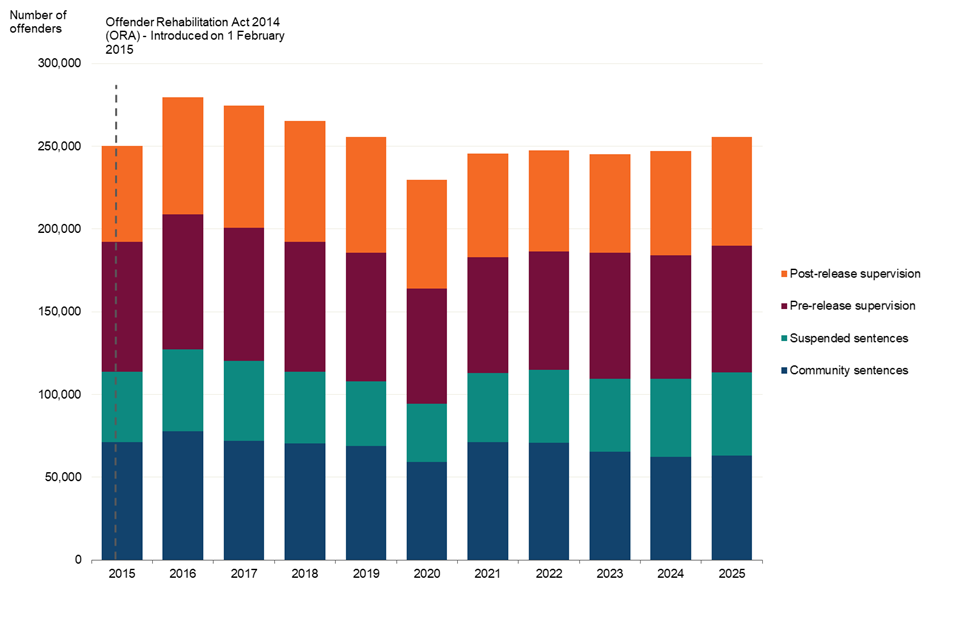
As at 31 December 2025, there were 248,568 offenders supervised by the Probation Service in England and Wales (Figure 2). This had remained broadly stable over recent years, however, has been rising steadily over the past year, increasing by 3% compared to 31 December 2024 and, more recently, by 0.8% compared to 30 September 2025.
When looking at December end-of-year caseloads, the number of offenders supervised by the Probation Service fell year-on-year until 2014, then rose to a peak of 267,146 in 2016 before falling to 223,973 by December 2020 – 10% lower than in 2019 and 16% below the 2016 peak. The caseload then recovered to 238,500 by December 2021 and remained broadly stable until December 2024, increasing by less than 1% over this period, indicating that caseload figures had recovered to pre-pandemic levels[footnote 15]. By December 2025, it had risen to 248,568, the highest December figure since 2018.
The increase in the probation caseload between 2014 and 2016 can be explained by the implementation of the Offender Rehabilitation Act (ORA) in February 2015 under which all offenders on a custodial sentence are subjected to statutory supervision on release from prison. Previously, only adults sentenced to over 12 months in custody and all young offenders were subject to statutory supervision.
Between the end of December 2024 and the end of December 2025, the court order caseload increased by 3% from 107,616 to 111,226, with the number of offenders on a community order (CO) increasing by 1% and those on a suspended sentence order (SSO) with requirements increasing by 6%.
The total court order caseload increased by 12% from 111,422 in 2015 to 124,643 in 2016, however, following a gradual decline between 2016 and 2019, it fell over the next year by 12% to stand at 93,027 at the end of December 2020. It then rose by 19% to 110,965 in the year up to December 2021 and again to 112,851 at the end of December 2022, before falling 4% to 107,785 in 2023. After remaining stable through 2024, the court order caseload increased back to 111,226 by December 2025.
The number of offenders on a CO also fluctuated over the years. Based on December totals, this peaked at 76,694 in 2016, dropped to 58,402 by the end of 2020, then rose by 20% to 70,371 in 2021. After stabilising between 2021 and 2022, it has gradually been decreasing again by 7% in 2023 and by a further 5% in 2024, however, increased slightly by 1% to 62,267 by December 2025. The number of offenders on an SSO with requirements also followed a similar trend in the earlier years. Using December counts, this increased to 49,541 in 2016 before decreasing to stand at the lowest December level of the series, at 35,198, at the end of 2020, followed by an increase of 19% to 41,892 in 2021. However, in contrast to the general decrease in COs between 2021 and 2025, the number of offenders on SSOs with requirements has been increasing over this period and, following year-on-year rises of 7% and 6% over 2024 and 2025, is now at a December peak of 50,266 in December 2025.
The total caseload of offenders supervised before or after release from prison at the end of December 2025 was 142,486, representing an increase of 4% compared to the end of December 2024, but still 3% below the figures recorded at the end of December 2019. While the overall growth in pre- and post-release supervision since September 2023 has been primarily driven by the post-release caseload, recent trends show a slight shift in this dynamic. Between December 2024 and December 2025, the increase was similar across both categories; the pre-release supervision caseload saw an increase of 3% (rising to 76,826) and there was a 4% increase in post-release supervision (rising to 65,743). This broader upward trend since late 2023 coincides with the introduction of both the ECSL and SDS40 schemes.
Figure 2: Number of offenders under Probation Service supervision, 31 December 2015 to 2025 [footnote 16]
Source: The table of data that this graph is based on is labelled as ‘Table 6.6’ in the quarterly probation tables from 2023. In probation tables published between 2018 and 2022, this table is labelled as ‘Table 4.6’. In probation tables published prior to 2018, this table is labelled as ‘Table 4.7’.
Starts
Probation starts cover all court order or pre-release supervision by the Probation Service which commenced within the reporting period.
The total number of offenders starting court order or pre-release supervision by the Probation Service in 2025 increased by 4% to 151,299 compared with 2024, and this was primarily due to large increases in the number of offenders starting pre-release and suspended sentence order (SSO) supervision. Of these:[footnote 17]
- 96,780 offenders started court order supervision – this is a 3% increase since 2024 and the highest number since 2019
- 61,937 offenders started pre-release supervision – this is a 7% increase since 2024 and the highest number since 2020
Of those under court order supervision:
- 60,591 offenders started community orders (COs) – this is an increase of 2% since 2024
- 38,165 offenders started suspended sentence orders with requirements (SSOs) – this is an increase of 5% since 2024 and the highest number since 2017
Of those under pre-release supervision, 767 offenders started a committal for breach of post-sentence supervision in 2025. This is a decrease of 49% from 1,502 in 2024 and of 64% since 2,102 in 2023. Similarly, the number of offenders starting a Supervision Default Order fell by 65% from 243 in 2024 to 85 in 2025. These large decreases correspond with the implementation of Probation Reset which suspended post-sentence supervision contact for some offenders.
The average length of CO starts decreased slightly from 13.8 months in 2024 to 13.6 months in 2025. The average length of SSO with requirements starts also decreased slightly from 18.1 months to 17.9 months over the same period.
Between 2015 and 2019, the number of court order starts decreased by 22% to 104,038, and then by a further 23% to 79,621 in 2020. In 2021, court order starts increased by 16% to 92,718 but subsequently decreased again by 3% to 89,885 in 2022 and remained constant in 2023. There was then a 5% increase in 2024, followed by a further 3% increase in 2025 to 96,780.
As a result of ORA being implemented in February 2015, the number of offenders starting pre-release supervision in custody increased by 114% from 45,063 in 2014 to 96,594 in 2016. Between 2019 and 2020, this figure decreased by 20% to 65,505 and then, unlike court order starts, which saw an increase in 2021, decreased by 8% in 2021 and by 12% in 2022. The number of pre-release supervision starts increased by 8% in 2023, the first year-on-year increase in pre-release supervision since 2016, then continued to rise by 1% in 2024 and by 7% in 2025.
Pre-sentence reports
Pre-sentence reports (PSRs) cover all Standard Delivery, Fast Delivery written, and Fast Delivery oral reports prepared by Probation Service staff for Magistrates’ and Crown Courts. They contain information on the offender and offence(s) committed to assist sentencing.
Between 2015 and 2019, the total number of pre-sentence reports (PSRs) prepared by the Probation Service decreased by 35% to 103,004, reflecting the downward trend in the number of offenders sentenced in all courts over the same period.[footnote 18],[footnote 19]This number then fell by 34% in 2020 to 68,077 before increasing by 30% in 2021 to 88,657.[footnote 20]A decrease of 6% was seen in 2022 to 83,240, however, this was followed by consecutive year-on-year increases of 10%, 8% and 5% to reach 104,264 in 2025, therefore returning to a similar level as seen in 2019.
Summary of quarterly statistics
Starts
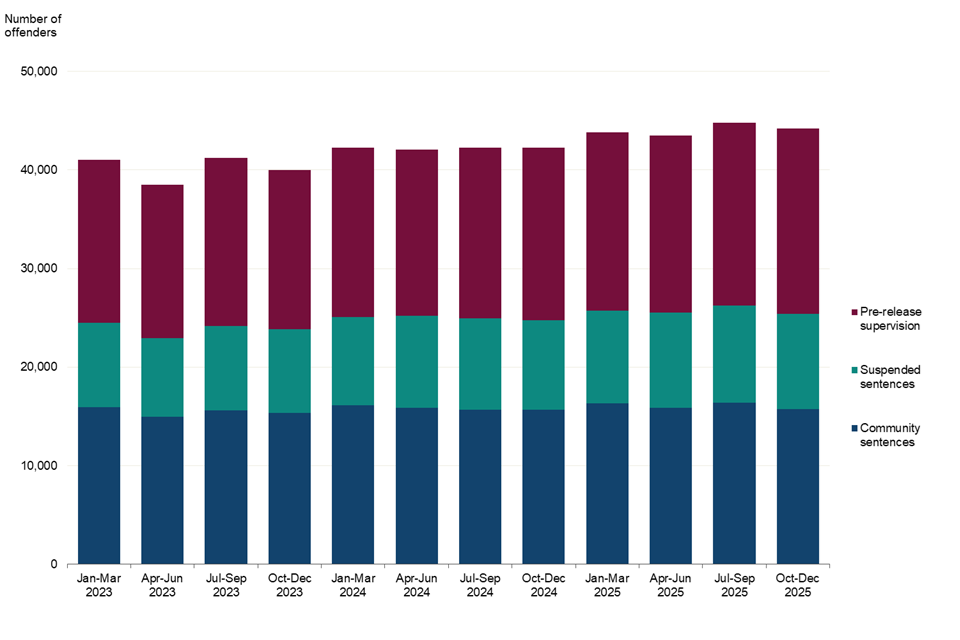
Between October and December 2025, 44,182 offenders started court order or pre-release supervision by the Probation Service (Figure 3). This is a drop of 1% compared to the previous quarter but is an increase of 5% compared to the same quarter a year ago. Of these:[footnote 17]
- 25,376 offenders started court order supervision – this represents a decrease of 3% compared to the previous quarter, but an increase of 3% compared with the same quarter in the previous year
- 18,821 offenders started pre-release supervision – this increased by 1% in comparison with the last quarter, and also increased by 7% compared with the same quarter last year
Of those under court order supervision:
- 15,671 offenders started community orders (COs) – this is a decrease of 4% since the previous quarter but a small increase of 0.6% compared to the same quarter in 2024
- 9,640 offenders started suspended sentence orders (SSOs) with requirements – this is a decrease of 2% compared to the previous quarter but an increase of 6% compared to the same quarter in the previous year
Of those under pre-release supervision, 234 offenders started a committal for breach of post-sentence supervision. This represents an increase of 5% compared to the previous quarter and an increase of 12% compared to the same quarter a year ago. However, compared to the same quarter in 2023, this is a 65% fall, and this noticeable change coincides with the implementation of Probation Reset.
Figure 3: Number of offenders starting supervision under the Probation Service, January 2023 to December 2025
Source: Table 6.1 of the quarterly probation tables published from 2023. Table 4.1 in quarterly probation tables published prior to 2023.
Overall, between October and December 2025, 25,649 requirements were started under COs and 17,525 under SSOs, representing a decrease of 2% and an increase of 0.7% respectively compared to the same period in the previous year.
In the latest quarter, a number of requirement types under COs and SSOs saw increases. Furthermore, rehabilitation remains the most common requirement included within a CO and SSO. Compared to the same quarter a year ago, the number of rehabilitation requirements started under COs rose by 1% to 11,766 and by 7% to 8,312 under SSOs.
Under COs, some of the most notable changes in requirements commenced between October and December 2025 compared to the same quarter in 2024 were:
- accredited programmes decreasing by 57% to 801
- prohibited activity increasing by 31% to 128
- exclusion increasing by 22% to 360
- mental health treatment (MHTR) decreasing by 15% to 714
- alcohol abstinence and monitoring (AAMR) increasing by 13% to 1,019
- electronic monitoring decreasing by 11% to 549
Under SSOs, some of the most notable changes in requirements commenced between October and December 2025 compared to the same quarter in 2024 were:
- accredited programmes decreasing by 43% to 1,036
- exclusion increasing by 26% to 187
- prohibited activity increasing by 23% to 81
- alcohol abstinence and monitoring (AAMR) increasing by 19% to 758
- drug rehabilitation (DRR) increasing by 10% to 951
- alcohol treatment (ATR) decreasing by 7% to 577
- electronic monitoring decreasing by 7% to 527
The decline in accredited programme requirements since April 2025 is likely driven by a new prioritisation process (announced in February 2025)[footnote 21], designed to ensure that accredited programmes are handed down by the courts to individuals assessed as having a higher risk of reoffending.
The general increase in MHTRs within COs and SSOs since July 2020 is linked to a scaling up of the availability to sentence to this requirement across the criminal courts of England. This follows the introduction of new MHTR services provided by NHS England and is part of an initiative [footnote 22] that aims to reduce reoffending and short custodial sentences by addressing the underlying mental health issues which may be contributing towards offending behaviours.
Since April 2022, there has been a noticeable decline in electronic monitoring requirements. This is likely associated with the mandating of domestic abuse and safeguarding enquiries in all cases where electronically monitored curfews are proposed. This policy mandates that electronically monitored curfews should not be recommended to the courts unless these enquiries have been made first, and this has likely led to the observed decrease in the overall number of electronically monitored curfews issued.
This policy was introduced in April 2022, and the decline was initially observed in curfew figures only. However, reforms to recording practices from October 2022, to more accurately record curfew requirements with and without electronic monitoring, mean that this decline has now shifted from curfew figures to electronic monitoring figures. Recent figures suggest this downward trend has now stabilised, indicating a possible levelling-off in the impact of this policy.
In terms of the most frequently used combinations of requirements commenced between October and December 2025, rehabilitation was the most common requirement to be combined with other requirements.
Compared to the same quarter in 2024, under COs, rehabilitation requirements combined separately with:
- AAMR and unpaid work together increased by 41% to 204
- AAMR increased by 16% to 500
- Unpaid work increased by 13% to 3,347
- ATR increased by 10% to 753
In contrast, rehabilitation requirements combined with accredited programmes and unpaid work together under COs decreased by 27% to 252, rehabilitation combined with only accredited programmes decreased by 17% to 256, and rehabilitation combined with mental health treatment requirements decreased by 14% to 305 over the same period.
Compared to the same quarter in 2024, under SSOs, rehabilitation requirements combined separately with:
- AAMR increased by 37% to 296
- AAMR and unpaid work together increased by 37% to 184
- Unpaid work increased by 14% to 2,434
- DRR increased by 13% to 580
In contrast, rehabilitation combined with accredited programmes and unpaid work together decreased by 17% to 288 and rehabilitation combined with alcohol treatment requirements decreased by 0.9% to 327 over the same period.
Terminations
Probation terminations cover all community order (CO) and suspended sentence order (SSO) supervision by the Probation Service which terminated within the reporting period.
Of the 14,146 COs and 8,331 SSOs terminated between October and December 2025, 72% and 77% respectively were terminated successfully. For COs, this means they either ran their full course or were terminated early for good progress, while for SSOs the supervision period ran its full course.
Pre-sentence reports
In the quarter October to December 2025, the total number of PSRs prepared by the Probation Service stood at 26,155, representing a 1% decrease from the previous quarter but a 5% increase compared to the same quarter in 2024.
The number of SSOs proposed in PSRs declined steeply from 12,762 in the year ending December 2018 to 2 in the year ending December 2025. This decline is associated with a change in 2018 of the guidelines to probation staff on recommending suspended sentence orders in PSRs.[footnote 23] As a result, concordance rates[footnote 24] for SSOs should be interpreted with caution.
In the year ending December 2025, 87% of immediate custodial sentences proposed in PSRs resulted in that sentence being given, representing the highest concordance between sentence proposed and sentence given, excluding SSOs. Furthermore, immediate custody represented 9% of all sentences proposed in PSRs over the same period, meanwhile community sentences, which had a concordance rate of 47%, represented 88%.
Imprisonment for Public Protection (IPP) offenders
Following the reforms to IPP and DPP licence termination criteria, which were introduced on 1 November 2024 and 1 February 2025, the number of IPP and DPP offenders on licence in the community as at 31 December 2025 fell to 891. This is a decrease of 6% compared to 30 September 2025 and of 35% compared to the end of December 2024.
Further information
This publication presents annual and quarterly data trends.
Our statisticians regularly review the content of publications. Development of new and improved statistical outputs is usually dependent on reallocating existing resources. As part of our continual review and prioritisation, we welcome user feedback on existing outputs including content, breadth, frequency, and methodology. Please send any comments you have on this publication including suggestions for further developments or reductions in content.
Following our latest review and prioritisation exercise, we plan to move the full Probation commentary to the annual publication only and a shorter Probation commentary will continue to be provided quarterly. As a result, the next release of the full Probation commentary will be in April 2027. Should you have any concerns/comments on this, or any other feedback related to the Probation chapter, please contact us at probation-statistics-enquiries@justice.gov.uk.
Accompanying files
As well as this bulletin, the following products are published as part of this release:
- A ‘Guide to Offender Management Statistics’, which provides comprehensive information about data sources and quality, as well as key legislative changes.
- A document outlining the ‘Users of Offender Management Statistics’
- A set of data tables, covering each section of this bulletin, including a prison population data tool.
Accredited official statistics status
National Statistics are accredited official statistics. These accredited official statistics were independently reviewed by the Office for Statistics Regulation in July 2012. They comply with the highest standards of trustworthiness, quality and value in the Code of Practice for Statistics and should be labelled ‘accredited official statistics’. (Note that accredited official statistics are called National Statistics in the Statistics and Registration Service Act 2007).
Our statistical practice is regulated by the Office for Statistics Regulation (OSR). OSR sets the standards of trustworthiness, quality and value in the Code of Practice for Statistics that all producers of official statistics should adhere to. You are welcome to contact us directly with any comments about how we meet these standards. Alternatively, you can contact OSR by emailing regulation@statistics.gov.uk or via the OSR website: https://osr.statisticsauthority.gov.uk/
It is the Ministry of Justice’s responsibility to maintain compliance with the standards expected for these accredited official statistics. If we become concerned about whether these statistics are still meeting the appropriate standards, we will discuss any concerns with the OSR promptly. This accredited status can be removed at any point when the highest standards are not maintained and reinstated when standards are restored
Contact
Press enquiries should be directed to the Ministry of Justice press office: https://www.gov.uk/government/organisations/ministry-of-justice/about/media-enquiries
Non-Press enquiries about the Probation chapter of this publication should be sent to: probation-statistics-enquiries@justice.gov.uk
Non-Press enquiries about all other chapters of this publication should be sent to: OMSQ-SiC-publications@justice.gov.uk
Next update: 30 July 2026
URL: https://www.gov.uk/government/collections/offender-management-statistics-quarterly
© Crown copyright Produced by the Ministry of Justice; Alternative formats are available on request from OMSQ-SiC-publications@justice.gov.uk
-
‘https://www.gov.uk/government/news/increased-sentencing-powers-for-magistrates-to-address-prisons-crisis’ ↩ ↩2 ↩3
-
‘https://www.gov.uk/government/news/2000-extra-sitting-days-to-help-address-courts-crisis’ ↩ ↩2
-
Data on prison receptions prior to 2015 are not comparable with data from 2015 onwards due to changes in the data extract used to produce statistics on the prison population. Further information can be found in the accompanying ‘Guide to Offender Management Statistics’. ↩
-
Increased sentencing powers for magistrates to address prisons crisis - GOV.UK ↩
-
Total caseload as at 31 December 2019 (i.e. the last reporting period prior to the pandemic) stood at 247,759. ‘https://assets.publishing.service.gov.uk/media/6088b20be90e076ab34f6f0d/Probation_Q4_2020.ods’. ↩
-
Further details are available at: ‘Prisons and Probation: Foreign National Offenders - Hansard - UK Parliament’ and ‘https://democracy.leics.gov.uk/documents/s183789/Probation%20Reset.pdf’. ↩
-
Further details are available at: ‘https://www.bedfordshire.pcc.police.uk/SysSiteAssets/public-information/meetings/cjb/29.04.2025/beds-pcc.pdf’ ↩
-
‘The Criminal Justice Act 2003 (Suitability for Fixed Term Recall) Order 2024’ ↩
-
‘The Criminal Justice Act 2003 (Suitability for Fixed Term Recall) Order 2025’ ↩
-
Figures on the number of prisoners released under the ECSL scheme are available here: ‘ECSL_Commentary_Transparency.pdf’ ↩
-
Figures on the number of prisoners released under the SDS40 scheme are available here: ‘Standard Determinate Sentence (SDS40) release data - GOV.UK’ ↩
-
Most prisoners sentenced to a standard determinate sentence (SDS) are automatically released at their conditional release date, which is the half-way point of sentence. Prisoners serving an SDS are on licence supervision until the end of sentence. ↩
-
‘End of lifetime licences for rehabilitated IPP offenders - GOV.UK’ ↩
-
Total caseload as at 31 December 2019 (i.e. the last reporting period prior to the pandemic) stood at 247,759. ‘Probation: October to December 2020.ods’. ↩
-
The number of offenders on the probation caseload in 2020 was substantially reduced as a result of the operational restrictions that were put in place on the 23 March 2020 in response to the COVID-19 pandemic. While the impact of these operational restrictions continued into subsequent periods, figures in more recent periods have recovered to pre-pandemic levels. ↩
-
Each person is counted once only for each type of probation supervision started within the time period. In addition, each person is counted once only in each total or sub-total even if they started several types of probation supervision within the time period. This means that the totals and sub-totals are less than adding the sum of their parts. For example, if a person started a community order and a Supervision Default Order within the time period, then the person would be counted once only within the total of all community sentences. ↩ ↩2
-
Table Q5.1a in the Criminal Justice System Quarterly Statistics publication states the number of offenders sentenced at all courts in the 12 months ending September 2015 to the 12 months ending September 2025. This can be found at: ‘Criminal Justice Statistics Quarterly: September 2025 - GOV.UK’. ↩
-
In the year ending September 2019, the number of offenders given sentences for community sentences, suspended sentence orders, and custodial sentences decreased by 18%, 27% and 12% respectively compared to the year ending September 2015; a decrease of 18% was seen when comparing the combined number of these sentences across this period. ↩
-
A sharp decrease in offenders sentenced between April and June 2020 caused by temporary court closures resulting from COVID-19 operational restrictions was followed by increases over the latter end of 2020 and into 2021 due to courts reopening and increasing workload again. The combined number of offenders sentenced to community sentences, SSOs and custodial sentences, consequently, increased by 6% between June 2020 and June 2021, potentially contributing to the rise in PSRs prepared over 2021. ↩
-
‘Lord Chancellor sets out her vision for the probation service - GOV.UK’ and ‘Probation Delivery.pdf’. ↩
-
The initiative started in 2017 in five areas, with a national roll out to be completed by mid-2024. ‘A Smarter Approach to Sentencing’. ↩
-
The Sentencing Council guideline, effective from 1 September 2025, provides guidance for sentencers on the imposition of community and custodial sentences, and is available at: ‘Imposition of community and custodial sentences’. ↩
-
Concordance refers to how closely the sentence recommended in a pre-sentence report aligns with the sentence ultimately imposed by the court. ↩