National non-domestic rates collected by councils in England: forecast for 2026 to 2027
Updated 20 April 2026
Applies to England

© Crown copyright 2026
This publication is licensed under the terms of the Open Government Licence v3.0 except where otherwise stated. To view this licence, visit nationalarchives.gov.uk/doc/open-government-licence/version/3 or write to the Information Policy Team, The National Archives, Kew, London TW9 4DU, or email: psi@nationalarchives.gov.uk.
Where we have identified any third party copyright information you will need to obtain permission from the copyright holders concerned.
This publication is available at https://www.gov.uk/government/statistics/national-non-domestic-rates-collected-by-councils-in-england-forecast-2026-to-2027/national-non-domestic-rates-collected-by-councils-in-england-forecast-for-2026-to-2027
This release provides data on the forecast of non-domestic rating income due to local authorities in 2026-27, including data relating to the amount of business rates reliefs forecast to be given to businesses. The 2026-27 forecasts are not directly comparable to previous years with the introduction of additional multipliers, the 2026 revaluation and changes from the Business Rates Retention reset.
1. In this release:
-
Local authorities estimate the non-domestic rating income for 2026-27 will be £35.8 billion. This is what authorities estimate they will collect after all reliefs, accounting adjustments, Section 31 grant compensation and sums retained outside the rates retention scheme are taken into consideration. This is not comparable to previous years as it adds in £6.5 billion of Section 31 grant which previously was accounted for separately and not included with non-domestic rating income.
-
Local authorities estimate that they will grant a total of £6.8 billion of relief from business rates in 2026-27. Of this, £5.5 billion is the cost of mandatory relief and £1.3 billion is the cost of discretionary relief.
-
Within the mandatory relief, £2.3 billion in relief is expected to be given as charitable occupation relief, £1.8 billion is expected to be given in small business rate relief and £1.2 billion in empty property relief.
-
Within discretionary relief, £1.1 billion is the cost of supporting small businesses relief.
Release date: 18 February 2026(original), 25 February 2026(revised)
Date of next release: February 2027
Contact: nndr.statistics@communities.gov.uk (Responsible Statistician: Jo Coleman)
Media enquiries: 0303 444 1209 / NewsDesk@communities.gov.uk
2. Introduction
This release has been compiled by the Ministry of Housing, Communities and Local Government (MHCLG) and it provides information on national non-domestic rates and associated information for the financial year 2026-27. This information is derived from the national non-domestic rates (NNDR1) returns submitted by the 296 billing authorities in England that will be in existence from 1 April 2026.
The 2026-27 forecasts are not directly comparable to previous years, following the 2026 revaluation, the introduction of additional multipliers and changes in accounting for Section 31 compensation following the Business Rates Retention reset. Further details are provided in this introduction.
Non-domestic rates, or business rates, are collected by billing authorities and are the way in which those that occupy a non-domestic property (or hereditament) contribute towards local services. Since 2013-14 local authorities are allowed to retain a proportion of the revenue that is generated in their area. The NNDR1 form collects data that estimates what authorities will collect and the outturn data (collected on the NNDR3) is what was collected.
Apart from properties that are exempt from business rates, such as agricultural land, parks and places of worship, each non-domestic property has a rateable value which is set by the Valuation Office Agency (VOA). Billing authorities work out the business rates liability for every hereditament by multiplying the rateable value of the property by the appropriate multiplier.
The multipliers are set each financial year for England according to formula set by legislation, which, from 2018-19 have been determined by the increase in the previous September’s Consumer Price Index. Government can decide to cap the multiplier and compensate authorities for the loss of income through Section 31 grant. Details about multipliers are in the Changes for 2026-27 section below.
Rateable properties may be eligible for discounts or reliefs on their business rates bills. Some of these are mandatory (i.e. they are automatic entitlements in any billing authority area) and some reliefs are discretionary, which are granted at a billing authority’s discretion. As new reliefs have been introduced since the start of this series, and some of these reliefs were time limited, changes across years are not strictly comparable. Further information about the types of reliefs available are presented in Table 2.
Further details about the business rates retention scheme and an explanation of hereditaments can be found in the Definitions section of the accompanying technical document.
2.1 Comparisons between years
The data presented in the tables for 2021-22 to 2023-24 are based on out-turn data provided via the NNDR3 form. Data for 2024-25 and 2025-26 are based on forecast data. Some differences arise in the reporting of data between the two forms.
Additionally, data should not be directly compared from year to year because of different changes to business rates arising from regular revaluations of businesses, changes to reliefs (additional and expired reliefs) and changes to the amount of discount given by the relief and changes to the business rates multipliers. Notes are provided to these changes under each table and explained in the special factors below.
2.2 Technical Information
Please see the accompanying technical notes document for further details.
Revaluation and transitional relief
Every few years, the government adjusts the rateable value of business properties to reflect changes in the property market. This is known as a revaluation. At revaluation, the government also revises the non-domestic multipliers to reflect the aggregate change in rateable values. This will mean that figures are not comparable to previous years when a revaluation has taken place.
The latest revaluation comes into effect on the 1 April 2026 and reflected the rental market as at 1 April 2024, assessed by the Valuation Office Agency (VOA). The tables in this release therefore show a discontinuity between 2025-26 and 2026-27 because revaluation affects gross business rates and the amount of relief granted. The previous revaluation came into effect on 1 April 2023, so there is also a discontinuity between 2022-23 and 2023-24 shown in this release. Further data on the draft revaluation list was published by the VOA and can be found at the following link.
At a Revaluation, the government also puts in place a transitional scheme that protects small and medium business ratepayers from significant step-changes in bills, by phasing in increases over a number of years. The cost of the transitional scheme is shown in Table 1. For 2026-27, there is also a transitional scheme supplement, where the cost of the revenue foregone by delaying the increase is partially offset by additional income raised by delaying reductions in bills. Therefore a net cost of the scheme has been reported. This is different to the last revaluation scheme (2023-24 to 2025-26) where the scheme only reflected the revenue foregone due to phasing down the rates bills of ratepayers as a result of the transitional scheme.
Multipliers
The Non-Domestic Rating (NDR) Act 2023 introduced changes to the way business rates multipliers are calculated and applied. The Act de-coupled the small business rating and standard rating multipliers, allowing the government to treat the multipliers differently and the concept of a supplement to be removed.
Until 2024-25, the standard multiplier was equal to the small business rating multiplier, plus a supplement figure (originally designed to recover the cost of small business rate relief), set at 1.3p above the small multiplier in recent years. The two multipliers therefore only changed when the small business rating multiplier changed. In some years, the small business rates multiplier was either frozen or capped below the CPI.
For 2024-25 and 2025-26, the Chancellor announced that the small business rates multiplier would remain frozen while the standard business rates multiplier would be uprated in line with September CPI.
From 1 April 2026, there will be five multipliers, with the introduction of two lower business rates multipliers for Retail, Hospitality and Leisure (RHL) properties (hereditaments) with rateable values (RVs) below £500,000. These are the small business RHL multiplier, for those with RVs under £51,000 and the standard RHL multiplier, for those with RVs between £51,000 and £499,999. There is also a new Higher Value multiplier, which will apply to all businesses with a RV over £500,000. The small and standard rates multipliers remain for non-RHL properties below £500,000.
Details on the multiplier value are shown in Table 1a, with further details of the multipliers can be found in the technical notes accompanying this release.
Changes arising from the Non-Domestic Rating Act
There were changes introduced in the Non-Domestic Rating Act that mean that the data from 2024-25 onwards will be different to previous years. These changes are set out in the 2025-26 statistical release and technical note.
2.3 Special factors affecting 2026-27
In addition to the revaluation described above, there are the following changes.
Effect of the revaluation
As described above, revaluation will change the rateable value of business hereditaments and this can mean some reliefs are more affected where rateable value affects eligibility or the level of relief.
In particular, the Supporting Small Business Rates relief is available to help those ratepayers who at the revaluation are seeing large increases in their bills as a result of losing some or all of their Small Business Rate Relief or Rural Rate Relief, 40% Retail Hospitality and Leisure Relief, and/or 2023 Supporting Small Business Relief.
Business rates reset
As part of the government’s Fair Funding Review 2.0, the government has reset the business rates retention system. Further details can be found at the following link.
The reset has changed the way in which authorities are compensated for providing reliefs to businesses and for the lower multipliers, which lower the income that authorities retain from business rates. This means that the net rating income for 2026-27 shown in Table 1 now includes the Section 31 compensation. Table 3 that has been in previous releases has been removed as it is not comparable to the new approach. Table 2a shows the S31 grant compensation split between the types of authority receiving the compensation.
Additional reliefs
In the Autumn Budget 2025, the Chancellor announced a relief for Electric Vehicle (EV) charging points. The guidance for this new relief was not published before the deadline for returning the 2026-27 NNDR1. This was therefore not included in this NNDR1 collection.
In late January 2026, the Chanceller announced a 15% relief for pubs and music venues. This was announced as the NNDR1 collection concluded. It will be collected in the 2026-27 NNDR3.
Expired reliefs
The introduction of specific lower multipliers for Retail, Hospitality and Leisure (RHL) businesses has meant the temporary RHL Relief has not been continued. The RHL relief was introduced in 2020 as support to businesses during the Covid-19 pandemic. Then was continued for each year since, albeit with different conditions on the value of the relief. Further details of the relief is described in the Technical notes.
Appeals provision
Businesses can challenge their rateable value at any time, but authorities may set aside more in the first year of revaluation. The forecasts will only reflect the amount charged in year to this appeals provision. The out-turn data will also contain changes in the provision, resulting in a net appeals provision that is shown in Table 1.
3. National non-domestic rates to be collected by local authorities in England 2026-27
Table 1 gives details of the amount of national non-domestic rates local authorities estimate they will collect in 2026-27 and the reliefs they will grant. Gross rates are estimated based on the rateable value multiplied by the relevant multiplier. The cost of reliefs accounting adjustments for items such as losses from bad debts and appeals provisions and any amounts retained are deducted from gross rates, and Section 31 compensation is added to estimate non-domestic rating income from the rates retention system. From 2026-27, the Section 31 compensation is now included in this calculation.
Transitional arrangements shown in the table reflect the schemes applied at each revaluation. The arrangements can differ for each period. In all years there has been a cost associated with bill increases being phased in, however in 2022-23 and 2026-27 the schemes also had a supplement to offset part of the cost of the scheme. This is reported as the net cost of the scheme.
Table 1a will show the multipliers that are applied to rateable values to calculate gross rates. In addition, authorities can add an element of expected further growth or decline.
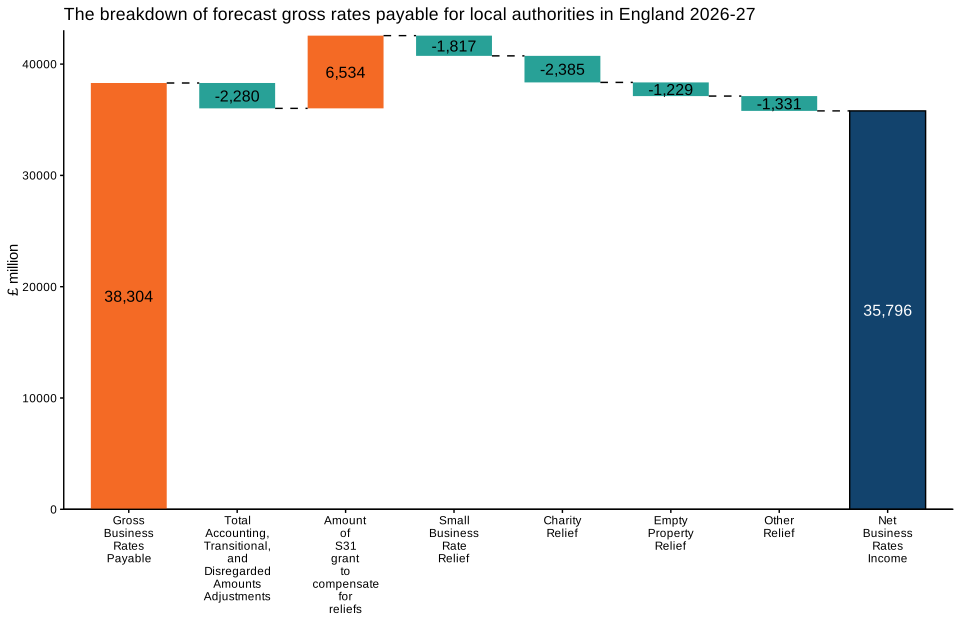
Chart 1 shows the flow from gross rates to net rates forecast in 2026-27. Chart 2 shows how gross and net rates have changed since 2017-18.
-
Local authorities estimate the non-domestic rating income for 2026-27 will be £35.8 billion. This is what authorities estimate they will collect after all reliefs, accounting adjustments, Section 31 funding and sums retained outside the rates retention scheme are taken into consideration. This is not comparable to previous years as it adds in £6.5 billion of Section 31 grant which previously was accounted for separately and not included with non-domestic rating income.
-
Local authorities report they will grant a total of £6.8 billion of relief from business rates in 2026-27. Of this, £5.5 billion is the cost of mandatory relief and £1.3 billion is the cost of discretionary relief.
3.1 Appeals
As part of the NNDR1 process authorities are required to make an estimate of how much income they expect to forego as a result of changes to rating lists, including appeals by businesses against their valuations. This includes both income not collected in year and also refunds in respect of previous years.
- Local authorities estimate the appeals provision will be £1.3 billion in 2026-27. The figure for 2026-27 represents authorities’ best estimate of the total future loss of non-domestic rates on the 2026 Rating list.
Table 1: National non-domestic rates to be collected by local authorities, England, 2022-23 to 2026-27
| Year | 2022 to 2023 Outturn | 2023 to 2024 Outturn | 2024 to 2025 Outturn | 2025 to 2026 Forecast | 2026 to 2027 Forecast [r] | ||||
|---|---|---|---|---|---|---|---|---|---|
| Gross rates payable in year | 30,733 | || | 32,333 | || | 35,439 | || | 37,068 | || | 38,304 |
| of which Small multiplier | [z] | [z] | [z] | [z] | 5,721 | ||||
| of which Standard multiplier | [z] | [z] | [z] | [z] | 10,418 | ||||
| of which Small RHL multiplier | [z] | [z] | [z] | [z] | 2,699 | ||||
| of which Standard RHL multiplier | [z] | [z] | [z] | [z] | 4,066 | ||||
| of which High Value multiplier | [z] | [z] | [z] | [z] | 15,400 | ||||
| Total cost of reliefs | 7,692 | || | 7,021 | || | 8,588 | || | 7,393 | || | 6,762 |
| Of which mandatory relief [Note 1] | 4,891 | || | 4,539 | || | 5,860 | || | 5,677 | || | 5,493 |
| Of which discretionary relief [Note 2] | 2,801 | || | 2,481 | || | 2,728 | || | 1,716 | || | 1,269 |
| Gross Rates Payable in year less total cost of reliefs | 23,041 | || | 25,312 | || | 26,852 | || | 29,676 | || | 31,543 |
| Net cost of transitional arrangement [Note 3][Note 4] | -121 | || | [z] | [z] | [z] | || | 990 | ||
| Of which Cost of transitional arrangement [Note 5] | [z] | || | 1,654 | || | 433 | || | 182 | || | 1,738 |
| Offset by Transitional Supplement (2026 Revaluation) | [z] | || | [z] | [z] | [z] | || | 741 | ||
| Net Rates Yield (Gross Rates Payable less reliefs less net cost of Transition) | 23,162 | || | 23,659 | || | 26,419 | || | 29,493 | || | 30,553 |
| Total cost of accounting adjustments | -199 | || | -169 | || | -30 | || | 1,378 | || | 1,663 |
| Of which losses in collection [Note 6] | 165 | || | 203 | || | 147 | || | 420 | || | 396 |
| Of which net addition to appeals provision [Note 7] | -364 | || | -389 | || | -222 | || | 958 | || | 1,267 |
| Of which interest payable | 0 | || | 16 | || | 45 | [z] | [z] | ||
| Other deductions from collectable rates [Note 8] | 217 | || | -1,557 | || | -335 | || | -85 | || | -892 |
| Of which transitional protection payments made to authorities | 121 | || | -1,654 | || | -433 | || | -182 | || | -990 |
| Of which other deductions | 96 | || | 97 | || | 97 | || | 98 | || | 98 |
| Amount of S31 grant to compensate for reliefs [Note 9] | [z] | [z] | [z] | [z] | 6,534 | ||||
| Total Disregarded Amounts | 220 | || | 305 | || | 387 | || | 401 | || | 519 |
| Of which amounts retained in respect of Designated Areas | 110 | || | 176 | || | 243 | || | 257 | || | 355 |
| Of which amounts retained in respect of Renewable Energy schemes | 109 | || | 129 | || | 143 | || | 145 | || | 164 |
| Non-domestic rating income from rates retention scheme [Note 10] | 22,924 | || | 25,079 | || | 26,397 | || | 27,798 | || | 35,796 |
Source: Outturn data are taken from NNDR3 forms, forecast data are taken from NNDR1 forms.
[r] Revised since the original publication of these tables. The tables were revised on 25 February 2026 to include figures submitted by Eastbourne and Lewes, whose data was not available in time to be included in the original release. There are some other minor revisions arising from late corrections received.
[Note 1] Prior to 2024-25, the small business rates relief was partially funded through the small business rates supplement. This was set at 1.3p. In 2024-25, the small and standard multipliers were decoupled, and the concept of the supplement removed. Therefore the total mandatory relief will appear to be greater, because there is no additional yield from the small business rates supplement.
[Note 2] Until 2026-27, the discretionary reliefs include the retail, hospitality and leisure relief. The level of discount of this relief changed each year. This relief is not available in 2026-27 following the introduction of RHL multipliers.
[Note 3] The transitional relief scheme from the 2017 revaluation expired in 2021-22, so the net cost in 2022-23 only refers net amount given in respect of previous years. In 2022-23, authorities could give the same support to businesses using the supporting small business relief (a discretionary relief), and so what would normally be the cost of the transitional scheme is included in the Discretionary Reliefs figure.
[Note 4] Transitional arrangements will vary in each revaluation period. The transitional scheme relating to the 2023 revaluation saw no supplement to offset the cost. The transitional scheme relating to the 2026 revaluation has a 1p supplement in 2026-27 which will partially offset the cost of the relief in the first year. This is shown as a net cost. While authorities will estimate the cost and the supplement, they may estimate an additional net cost amount for growth or decline. This will mean that the net cost does not exactly match the sum of the cost and the supplement.
[Note 5] The cost only reflects the revenue foregone by delaying increases to bills, with the percentage given tapering across the period between revaluations. Figures are presented as positive but the cost of relief is deducted from Net Rates Yield.
[Note 6] Write offs to the allowance for non-collection are not included in the Total cost of Accounting Adjustments.
[Note 7] The outturn data for net addition to appeals is systematically lower than the forecast data as local authorities do not forecast reductions in the appeals provision.
[Note 8] Other deductions from collectable rates includes an allowance for cost of collection & legal costs, a special authority deduction for the City of London, and the cost of transitional protection payments made to authorities to reverse the effects of transitional arrangements.
[Note 9] Following the Business Rates Retention Reset, from 2026-27, Section 31 (S31) grant that compensates for reliefs are included in the non-domestics rating income calculation.
[Note 10] Non-domestic rating income from the rates retention scheme is calculated as the Net Rates Yield (gross rates less reliefs) less accounting adjustments, other deductions and disregarded amounts. From 2026-27, the Section 31 grant compensation is added onto this calculation.
Table 1a: Multipliers, hereditaments and total aggregate rateable value, England, 2022-23 to 2026-27
| Year | 2022 to 2023 | 2023 to 2024 | 2024 to 2025 | 2025 to 2026 | 2026 to 2027 |
|---|---|---|---|---|---|
| Small business rate multiplier (pence) | 49.9 | 49.9 | 49.9 | 49.9 | 43.2 |
| Standard business rate multiplier (pence) [Note 1] | 51.2 | 51.2 | 54.6 | 55.5 | 48.0 |
| Small RHL multiplier (pence) | [z] | [z] | [z] | [z] | 38.2 |
| Standard RHL multiplier (pence) | [z] | [z] | [z] | [z] | 43.0 |
| High Value multiplier (pence) | [z] | [z] | [z] | [z] | 50.8 |
| Number of hereditaments on rating list close to 30 Sept (`000s) [Note 2] | 2,006 | 2,015 | 2,011 | 2,003 | 1,998 |
| Total aggregate rateable value of all hereditaments on rating list close to 30 Sept (million pounds) [Note 2] | 63,634 | 67,877 | 67,968 | 68,315 | 81,611 |
[Note 1] Prior to 2024-25 this was known as the Non-Domestic Rating Multiplier.
[Note 2] 2022-23 VOA data is as at 15 October 2021, 2023-24 VOA data is the draft 2023 list published on 17 November 2022, 2024-25 VOA data is at 4 October 2023, 2025-26 VOA data is at 3 October 2024 and 2026-27 VOA data is the draft 2026 list published on 26 November 2025.
3.2 Chart 1: Breakdown of gross rates payable
Chart 1 shows how reliefs and other adjustments are deducted from gross rates to arrive at the forecast net business rates income for 2026-27.
3.3 Chart 2: Business rates over time
Chart 2 shows gross rates collected increasing steadily until the pandemic in 2020-21. It then shows a period of little change, until a step change due to the 2023 revaluation. Gross rates increased in 2024-25 and 2025-26 due to the increase in the standard multiplier. Net rates income was increasing steadily prior to 2020-21, then fell sharply due to the retail, hospitality and leisure discount relief introduced in response to the pandemic but has increased steadily year on year since then as the relief and eligibility has changed. There is a step change in net income in 2026-27 reflecting the inclusion of section 31 compensation into the rates retention system, rather than accounting for it separately.

3.4 Map 1: Net rates income in England
There are data for each local authority in England in the tables accompanying this release covering the amount of business rates income and reliefs granted. Map 1 provides an overview of how forecast net business rates income in 2026-27 differs across England and has been split into 5 equal ranges.

3.5 Map 2: Net rates income in London
Map 2 provides an overview of how forecast net business rates income in 2026-27 differs between local authorities in London. Authorities have been split into the same 5 ranges as in Map 1.

4. Reliefs to be granted by local authorities in 2026-27
Table 2 shows figures for mandatory and discretionary reliefs which billing authorities expect they will grant in 2026-27. Mandatory reliefs are automatic entitlements in any billing authority area whereas discretionary reliefs are granted at a billing authority’s discretion. Chart 3 shows how the largest reliefs have changed since 2022-23.
-
Of the estimated £6.8 billion relief to be granted from business rates in 2026-27, £5.5 billion is mandatory relief which consists primarily of small business, charity and empty premises relief.
-
Authorities estimate the amount of relief to be granted to empty premises in 2026-27 will be £1.2 billion.
-
Total relief provided to charitable occupations is expected to amount to £2.4 billion in respect of 2026-27, of which £2.3 billion is mandatory. These reliefs account for 35% of the total relief to be granted.
-
Local authorities expect to grant a total of £1.3 billion discretionary relief in 2026-27, of which £1.1 billion is the cost of the Supporting Small Businesses relief. The Supporting Small Businesses relief accounts for 16% of the total relief to be granted.
Table 2: Cost of reliefs from national non-domestic rates: 2022-23 to 2026-27 [Note 1]
| Year | 2022 to 2023 Outturn | 2023 to 2024 Outturn | 2024 to 2025 Outturn | 2025 to 2026 Forecast | 2026 to 2027 Forecast | ||||
|---|---|---|---|---|---|---|---|---|---|
| Total cost of mandatory relief [Note 2] | 4,891 | || | 4,539 | || | 5,860 | || | 5,677 | || | 5,493[r] |
| Of which total mandatory relief in respect of current year [Note 2] | 4,806 | || | 4,695 | || | 5,785 | || | 5,617 | || | 5,448[r] |
| Of which small business relief in respect of current year | 2,211 | || | 1,947 | || | 2,056 | || | 2,128 | || | 1,817[r] |
| And of which relief on existing properties where a 2nd property is occupied | 5 | || | 4 | || | 4 | || | 3 | || | 3[r] |
| Of which deduction due to additional yield generated from the small business supplement [Note 2] | -626 | || | -674 | || | [z] | [z] | [z] | ||
| Of which charitable occupation | 2,036 | || | 2,191 | || | 2,387 | || | 2,346 | || | 2,338[r] |
| Of which community Amateur Sports Clubs (CASCs) | 22 | || | 21 | || | 21 | || | 23 | || | 21[r] |
| Of which rural rate relief [Note 3] | 4 | || | 3 | || | 6 | || | 6 | || | 5[r] |
| Of which Public Lavatories relief | 5 | || | 4 | || | 4 | || | 4 | || | 4[r] |
| Of which low carbon heat networks relief | [z] | [z] | 3 | || | 3 | || | 4 | ||
| Of which improvement relief | [z] | [z] | 13 | || | 5 | || | 15 | ||
| Of which partially occupied hereditaments | 13 | || | 15 | || | 19 | || | 17 | || | 14 |
| Of which empty premises | 1,141 | || | 1,188 | || | 1,276 | || | 1,085 | || | 1,229[r] |
| Of which mandatory relief in respect of previous years | 85 | || | -156 | || | 75 | [z] | [z] | ||
| Of which changes as a result of local estimates of growth or decline in mandatory relief | [z] | [z] | [z] | 60 | || | 45 | |||
| Total cost of discretionary relief | 2,801 | || | 2,481 | || | 2,728 | || | 1,716 | || | 1,269[r] |
| Of which discretionary relief unfunded through section 31 grants in respect of current year | 103 | || | 100 | || | 110 | || | 115 | || | 97[r] |
| Of which charitable occupation | 48 | || | 48 | || | 49 | || | 49 | || | 47[r] |
| Of which Non-profit making bodies | 36 | || | 37 | || | 39 | || | 39 | || | 40[r] |
| Of which Community Amateur Sports Clubs (CASCs) | 1 | || | 2 | || | 1 | || | 2 | || | 1 |
| Of which rural rate relief | 0 | || | 0 | || | [z] | [z] | [z] | ||
| Of which small rural businesses | 1 | || | 1 | || | 1 | || | 1 | || | 0 |
| Of which other ratepayers under s47 [Note 4] | 16 | || | 12 | || | 19 | || | 25 | || | 8[r] |
| Of which hardship relief | 0 | || | 1 | || | 1 | || | [z] | || | [z] |
| Of which unfunded discretionary relief in respect of previous years | 5 | || | -1 | || | 6 | || | [z] | || | [z] |
| Of which total cost of discretionary relief funded through S31 grant in respect of current year | 1,726 | || | 2,557 | || | 2,701 | || | 1,599 | || | 1,171[r] |
| Of which Flooding relief | 0 | || | 1 | || | 0 | [z] | [z] | ||
| Of which Rural Rate relief | 4 | || | 3 | || | [z] | [z] | [z] | ||
| Of which Local Newspaper Temporary relief | 0 | || | 0 | || | 0 | [z] | [z] | ||
| Of which Supporting Small Businesses relief [Note 5], [Note 6], [Note 7] | 20 | || | 237 | || | 198 | || | 201 | || | 1,108[r] |
| Of which retail, hospitality and leisure relief [Note 8] | 1,701 | || | 2,314 | || | 2,498 | || | 1,385 | || | [z] |
| Of which low carbon heat networks relief | 1 | || | 2 | [z] | [z] | [z] | |||
| Of which film studio relief | [z] | [z] | 4 | || | 13 | || | 21[r] | ||
| Of which Freeport relief | [z] | [z] | [z] | [z] | 38[r] | ||||
| Of which Investment Zone relief | [z] | [z] | [z] | [z] | 1 | ||||
| Of which EZ Case A relief | [z] | [z] | [z] | [z] | 2[r] | ||||
| Of which discretionary relief funded through S31 grants in respect of previous years | 966 | || | -175 | || | -88 | || | [z] | [z] | |
| Of which changes as a result of local estimates of growth or decline in discretionary relief | [z] | [z] | [z] | 2 | || | 2 | |||
| TOTAL COST OF ALL RELIEFS | 7,692 | || | 7,020 | || | 8,588 | || | 7,393 | || | 6,762[r] |
Source: Outturn data are taken from NNDR3 forms, forecast data are taken from NNDR1 forms.
[r] Revised since the original publication of these tables. The tables were revised on 25 February 2026 to include figures submitted by Eastbourne and Lewes, whose data was not available in time to be included in the original release. There are some other minor revisions arising from late corrections received.
[Note 1] 0 values are below £0.5 million.
[Note 2] Prior to 2024-25, the small business rates relief was partially funded through the small business rates supplement. This was set at 1.3p. In 2024-25, the small and standard multipliers were decoupled, and the concept of the supplement removed. Therefore the total mandatory relief will appear to be greater, because there is no additional yield from the small business rates supplement.
[Note 3] From 2024-25, mandatory rural rate relief has increased from 50% to 100%, and discretionary rural rate relief (both funded and unfunded) has not been required.
[Note 4] Prior to 2026-27, Enterprise Zone Case A relief, Freeport relief and Investment Zone relief were included in ‘Other ratepayers under s47’. Following the Business Rates Reset, from 2026-27, these reliefs are reported separately and included within the funded discretionary relief total.
[Note 5] The transitional relief scheme from the 2017 revaluation expired in 2021-22, so the net cost in 2022-23 only refers net amount given in respect of previous years. In 2022-23, authorities could give the same support to businesses using the supporting small business relief (a discretionary relief), and so what would normally be the cost of the transitional scheme is included in the Discretionary Reliefs figure.
[Note 6] From 2023-24 to 2025-26, supporting small business relief capped bill increases at £600 per year for businesses that lost eligibility for, or saw reductions in, Small Business Rate Relief (SBRR) or Rural Rate Relief (RRR) as a result of the 2023 business rates revaluation. This meant that there was a large increase in 2023-24 as the scheme applied to the new revaluation.
[Note 7] For 2026-27, supporting small business relief will cap bill increases at £800 per year or a percentage cap depending on rateable value (whichever is the greater) for businesses that as a result of the 2026 business rates revaluation see bills increase and lose some or all of their Small Business Rate Relief (SBRR), Rural Rate Relief (RRR), Retail, Hospitality and Leisure (RHL) relief or 2023 supporting small business relief.
[Note 8] In 2022-23 it was a 50% discount with a cap on the relief, increasing to 75% in 2023-24 and remaining unchanged in 2024-25. In 2025-26 it was a 40% discount with a cap on the relief. The relief was not extended but RHL multipliers were introduced for 2026-27.
Table 2a shows the S31 compensation that will be provided to local authorities in 2026-27. The business rates retention system means compensation is split between central government, billing authorities, applicable major precepting authorities and fire and rescue authorities. Compensation will not match the amount of relief given to businesses, as some will be unfunded discretionary reliefs. There is also compensation given to reflect the reduction in revenue from the retail, hospitality and leisure (RHL) multipliers, although this is partially offset by the increased revenue from from the high value (HV) multiplier, resulting in local government income being unaffected by the introduction of these new multipliers.
• Local authorities will receive £4.0 billion of the total £6.5 billion of in Section 31 grant to compensate for reliefs and lower multipliers. This is after the income received from the high value multiplier has been taken into account.
Table 2a: Section 31 compensation for reliefs and Multipliers, England: 2026-27 [note 1]
| Central Government [r] | Billing Authorities [r] | Major Precepting Authorities [Note 2][r] | Fire and Rescue Authorities [Note 3][r] | Total [r] | |
|---|---|---|---|---|---|
| National non-domestic rates measures funded by Section 31 grants | 2,513 | 3,224 | 757 | 40 | 6,534 |
| Of which total Section 31 due for reliefs and RHL multipliers | 2,827 | 3,599 | 905 | 44 | 7,376 |
| Of which additional revenue from High Value Multiplier | -314 | -376 | -148 | -4 | -841 |
[r] Revised since the original publication of these tables. The tables were revised on 25 February 2026 to include figures submitted by Eastbourne and Lewes, whose data was not available in time to be included in the original release. There are some other minor revisions arising from late corrections received.
[Note 1] The total and billing authority figures includes additional amounts of section 31 paid to billing authorities in respect of growth in Designated Areas.
[Note 2] These are County Councils, the Greater London Authority and West of England Combined Authority.
[Note 3] These include Combined Authorities who have responsibility for Fire and Rescue.
4.1 Chart 3: Business rates reliefs over time
Chart 3 shows the amount of the larger business rates reliefs granted since 2022-23. Charitable relief and empty property relief remain fairly consistent, whilst retail, hospitality and leisure relief has changed due to changes in the amount of relief given and the eligibility criteria of the relief and was not continued into 2026-27. Small business rates relief tends to be smaller in years when there is a revaluation, as properties move between thresholds. Other reliefs are much higher in 2026-27 as it reflects the increase in the Supporting Small Businesses relief.

5. Accompanying tables and open data
5.1 Symbols used
0 = zero or negligible (usually less than 0.5 million)
[r] = revision since the original publication
[z] = not relevant
| = represents breaks in the series where year on year changes are not directly comparable. These are in place when there are revaluations and changes in policy. |
5.2 Rounding
Where figures have been rounded, there may be a slight discrepancy between the total and the sum of constituent parts.
6. Tables
Accompanying tables are available to download alongside this release. These include Tables 1 to 2a for England and local authority level data. A table with the number of hereditaments in receipt of mandatory and discretionary rate relief and data for individual local authorities will be available at the end of March 2026.
7. Open data
These statistics are available in fully open and linkable data formats.
8. Technical notes
Please see the accompanying technical notes document for further details.
Information about statistics at MHCLG is available via the Department’s website.
Our statistical practice is regulated by the Office for Statistics Regulation (OSR).
OSR sets the standards of trustworthiness, quality and value in the Code of Practice for Statistics that all producers of official statistics should adhere to.
You are welcome to contact us directly with any comments about how we meet these standards.
Alternatively, you can contact OSR by emailing regulation@statistics.gov.uk or via the OSR website.