Mortgage and landlord possession statistics: October to December 2025
Published 12 February 2026
Applies to England and Wales

© Crown copyright 2026
This publication is licensed under the terms of the Open Government Licence v3.0 except where otherwise stated. To view this licence, visit nationalarchives.gov.uk/doc/open-government-licence/version/3 or write to the Information Policy Team, The National Archives, Kew, London TW9 4DU, or email: psi@nationalarchives.gov.uk.
Where we have identified any third party copyright information you will need to obtain permission from the copyright holders concerned.
This publication is available at https://www.gov.uk/government/statistics/mortgage-and-landlord-possession-statistics-october-to-december-2025/mortgage-and-landlord-possession-statistics-october-to-december-2025
1. Main Points
This publication presents quarterly mortgage and landlord possession statistics up to October to December 2025. In general, we have compared figures to the same quarter in the previous year. Should users wish to compare against previous years, they can do so using the accompanying statistical tables. For technical detail, please refer to the accompanying supporting document published alongside each quarterly publication here: Mortgage and landlord possession statistics - GOV.UK
| Mortgage claims, orders, and warrants have decreased while mortgage possessions have increased. | Compared to the same quarter in 2024 there were decreases in mortgage possession claims from 6,081 to 4,439 (27%) and orders from 4,167 to 3,754 (10%), warrants from 3,318 to 3,057 (8%) and increases in repossessions by county court bailiffs from 967 to 1,138 (18%). |
| Landlord possession claims, orders, and warrant actions have decreased, while repossessions increased. | When compared to the same quarter in 2024 there were decreases in landlord possession claims from 24,004 to 21,458 (11%), orders from 18,417 to 16,913 (8%), warrants from 10,927 to 9,606 (12%), and repossessions increased from 7,062 to 7,254 (3%). |
| Mortgage and Landlord claims have decreased across all regions. | Decreases in mortgage possession claims have been recorded across all regions. Landlord possession claims have recorded a decrease in all regions. All types of landlord claims remained concentrated in London. |
| Median timeliness for mortgage repossessions has increased. | The median average time from claim to mortgage repossession has increased to 46.7 weeks, up from 46.0 weeks in the same period in 2024. The median average time from claim to warrant has increased to 33.0 weeks, up from 31.3 weeks in the same period in 2024. |
| Median timeliness for landlord repossessions has increased. | The median average time from claim to landlord repossession has increased to 27.0 weeks, up from 25.0 weeks in the same period in 2024. |
A data visualisation tool has also been published that provides further breakdowns in a web-based application. The tool can be found here.
For feedback related to the content of this publication and visualisation tool, please contact us at CAJS@justice.gov.uk
2. Statistician’s Comment
There have been increases in both mortgage and landlord repossessions when compared to the same quarter in 2024, while the number of new claims issued have decreased for both over the same period. In 2025 the number of mortgage possession claims reached its highest level since 2019, and the number of orders was at its highest since 2014.
The rise in landlord repossessions was seen in private and social landlord claims while accelerated claim saw a decrease in repossessions. Whereas there was a fall in claims issued, orders and warrants for all landlord types. The median timeliness of landlord claims to repossessions has risen by two weeks when compared to the same period in 2024, continuing the general increases seen over previous quarters. The median timeliness for mortgage claims to repossession has remained relatively stable, increasing by less than a week over the same period.
3. Overview of Mortgage Possession
Mortgage possession claims, orders and warrants have decreased while repossessions continued to increase.
Compared to the same quarter in 2024, mortgage possession claims (4,439) are down 27%, mortgage orders for possession (3,754) are down 10%, warrants issued (3,057) are down 8% and repossessions (1,138) are up 18%.
Figure 1: Mortgage possession actions in the county courts of England and Wales, October to December 2020 to October to December 2025 (Source: Table 1)
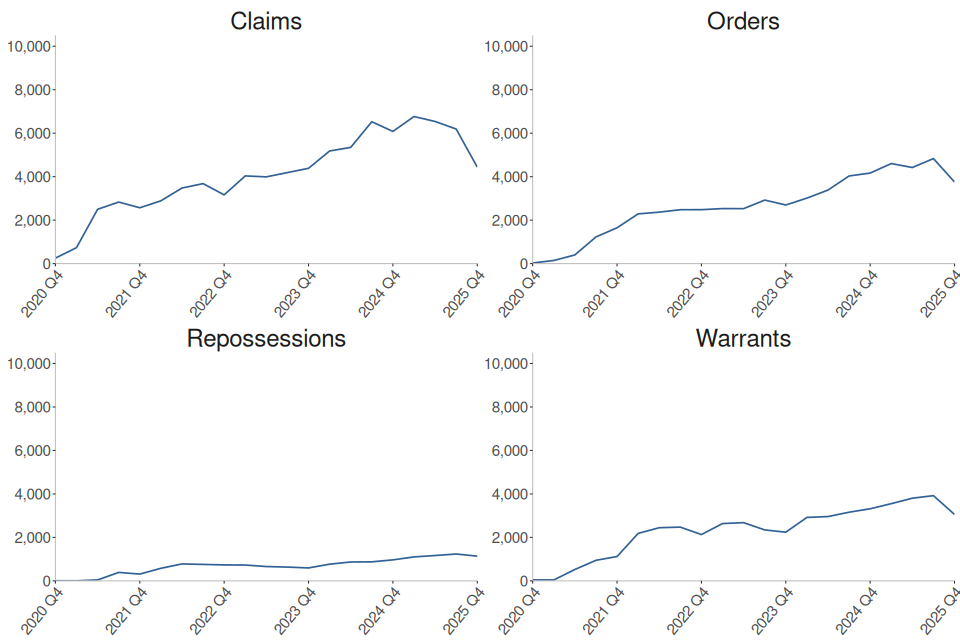
Following Covid-19, mortgage possession claims have generally risen since Q4 2021. In the most recent quarter, Q4 2025, there were 4,439 claims for possession, down 27% from the same quarter in 2024.
Orders and warrants for possession have followed a similar trend to mortgage claims. Compared to the same quarter in 2024, orders are down 10% to 3,754 and warrants are down 8% to 3,057 in Q4 2025. This data shows early signs of decreases but it is not yet known if this trend will continue. We will monitor this closely over the next quarters.
4. Mortgage Possession Action Timeliness
Claim to warrant median timeliness has increased by 1.7 weeks while claim to repossession median timeliness has increased by 0.7 weeks compared to the same quarter last year. Median timeliness for claim to order has remained stable.
The median average time from claim to repossession has increased to 46.7 weeks, up from 46.0 weeks in the same period in 2024.
Figure 2: Average timeliness of mortgage possession actions, October to December 2020 to October to December 2025 (Source: Table 3)
Number of weeks taken from initial mortgage claim to…
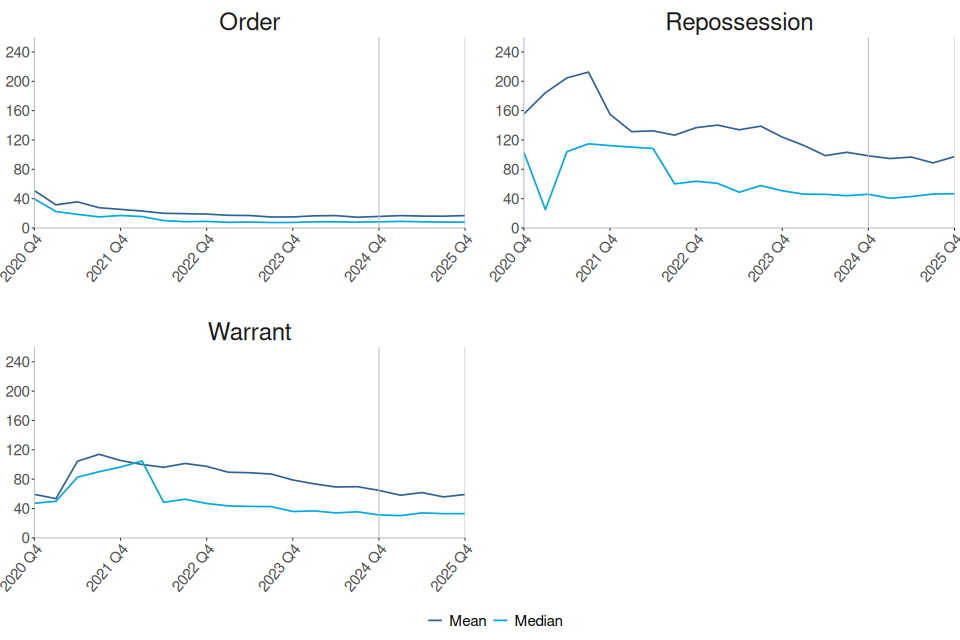
Median time taken to complete mortgage actions has remained relatively stable for claims to orders. Claims to warrants and claims to repossession median timeliness have increased compared to the same quarter in 2024. This quarter;
-
Claims to order median timeliness is currently 8 weeks, down from 8.4 weeks in the same period in 2024.
-
Claims to warrant median timeliness has increased to 33.0 weeks, up from 31.3 weeks in the same period in 2024.
-
Warrants to repossession median timeliness has increased to 11.2 weeks, up from 9.0 weeks in the same period in 2024.
-
Claims to repossession median timeliness has increased to 46.7 weeks, up from 46.0 weeks in the same period in 2024.
The trend for mortgage possession timeliness is driven by outright orders, which make up more than two thirds of all cases. In the most recent quarter, the median time taken from claim to repossession was 41 weeks for outright orders (an increase of 0.6 weeks), and 121.6 weeks for suspended orders (a decrease of 56.8 weeks).
The above charts distinguish between the timeliness of possession claims at different stages of a case. Average time taken from claim to warrant or claim to repossession can fluctuate and is affected by various factors. For example, the final two charts take account of the amount of time between the court order being issued and the claimant, such as the mortgage lender, applying for a warrant of possession.
Median figures are generally considerably lower than mean figures, demonstrating that progression from claim to successive stages can be positively skewed by outlying cases.
In Q4 2025 mean and median time between a warrant being issued to a repossession being carried out has been added to the accompanying tables. For mortgage data these new columns can be found in table 3.
5. Overview of Landlord Possession
The number of landlord possession actions across claims, orders, and warrants have decreased, while repossessions have increased compared to the same quarter of last year.
Claims (21,458), orders (16,913) and warrants (9,606) have decreased by 11%, 8% and 12% respectively compared to the same quarter in 2024. Repossessions (7,254) have increased by 3% in the same period.
Figure 3: Landlord possession actions in the county courts of England and Wales, October to December 2020 to October to December 2025 (Source: Table 4)
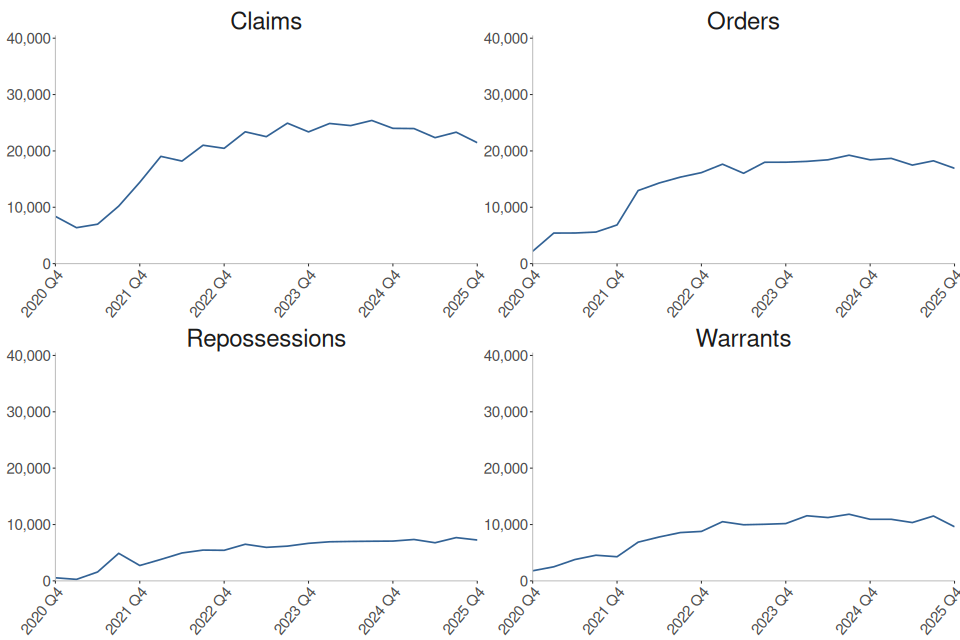
Landlord possession claims showed a general increase from Q2 2021 peaking in Q3 2024 at 25,402. These have fallen overall and are currently at 21,458. Within the landlord possession actions, accelerated claims are down 17%, private landlord claims are down 3% and social landlord claims are down 11% compared to the same quarter in 2024.At this time, it is unclear whether the falls in the most recent quarter are due to seasonal variation or a change in behavior in advance of the commencement of the Renters’ Rights Act on 1st May 2026. We will monitor the trends over the next quarters closely.
In Q4 2025, 38% (8,104) of all landlord possession claims were social landlord claims, compared to 32% (6,862) private landlord claims and 30% (6,492) accelerated claims. This contrasts with pre-covid proportions when a majority of claims (around 60%) were social landlord claims.
The fall in claim and orders volumes is observed in courts across most geographical regions. As in previous quarters, a concentration was seen in London, with 7,253 landlord claims and 5,114 landlord orders at London courts in Q4 2025, accounting for 34%, and 30% each of the respective totals. In London, there was a decrease of 13% (from 8,362 in Q4 2024) for landlord claims and a decrease of 13% for landlord orders (from 5,872 in Q4 2024).
The 12% decrease in landlord warrants compared to Q4 2024, was driven by a decrease in London. The largest regional number (3,324) was again found in London, making up 35% of all landlord warrants. There was a decrease of 21% for landlord warrants in London (from 4,230 in Q4 2024).[footnote 1]
The Housing Loss Prevention Advice Service (HLPAS) provides advice to tenants and homeowners as soon as they are served with a written notice asking them to leave their home. Individuals who require the service do not need to meet legal aid financial eligibility rules as the service is not means tested but they are required to show evidence that they are at risk of losing their home. More information can be found here.
The Renters’ Rights Act received royal assent on the 27th October 2025, and, following implementation, will change the law around rented homes in England. We will continue to monitor changes to the landlord statistics and review how the data is presented as the act is implemented. Further information on the act can be found here: Guide to the Renters’ Rights Bill - GOV.UK.
6. Landlord Possession Timeliness
Median timeliness figures for landlord claims to orders and warrants have remained relatively stable compared to the same period of 2024, while repossession timeliness increased by 2 weeks over the same period.
The median average time from claim to repossession has increased to 27.0 weeks, up from 25.0 weeks in the same period of 2024.
Figure 4: Average timeliness of landlord possession actions, October to December 2020 to October to December 2025 (Source: Table 6)
Number of weeks taken from initial landlord claim to…
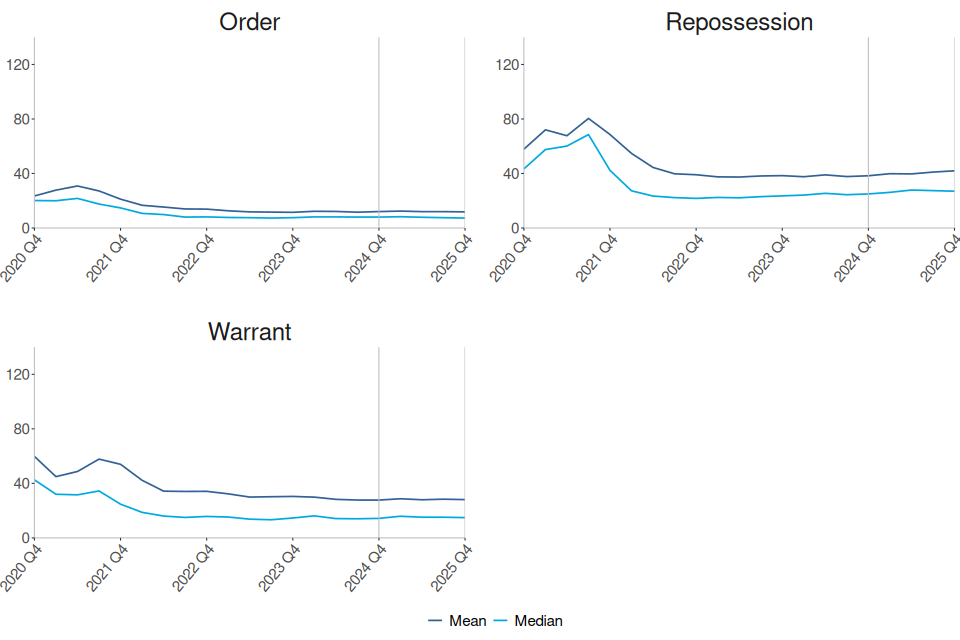
The median time taken to complete landlord actions increased for warrants and repossessions this quarter.
-
Claims to order median timeliness has decreased to 7.3 weeks, down from 8.0 weeks in the same period in 2024.
-
Claims to warrant median timeliness is currently 14.9 weeks, up from 14.3 weeks in the same period in 2024.
-
Warrants to repossessions median timeliness has increased to 9.6 weeks, up from 8.9 weeks in the same period in 2024.
-
Claims to repossessions median timeliness has increased to 27.0 weeks, up from 25.0 weeks in the same period in 2024.
As shown in Figure 4, median figures are generally considerably lower than mean figures, demonstrating that progression from claim to successive stages can be positively skewed by outlying cases.
In Q4 2025 mean and median time between a warrant being issued to a repossession being carried out has been added to the accompanying tables. For landlord data these new columns can be found in table 6.
7. Regional Possession Claims
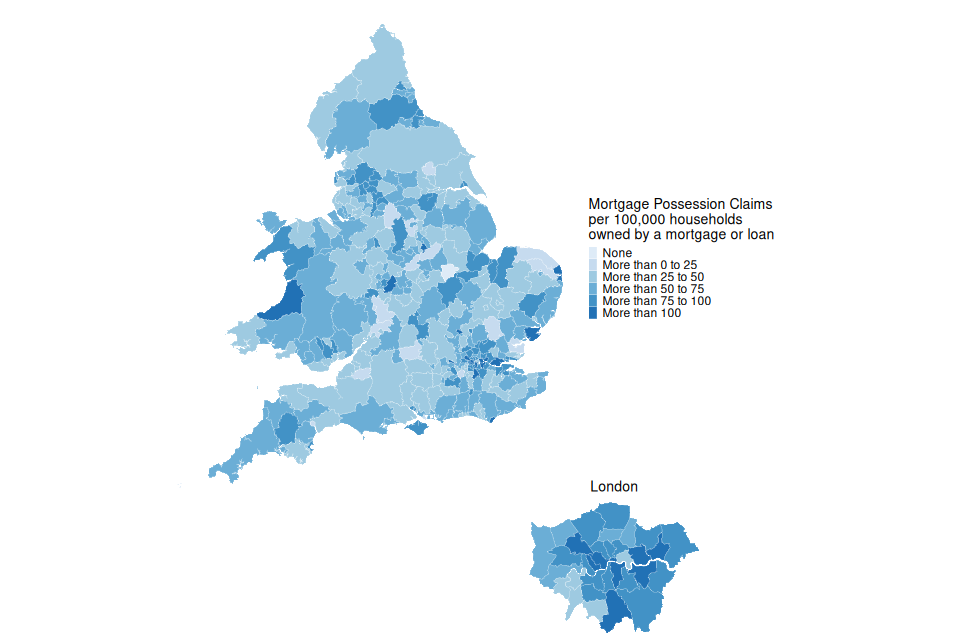
Kensington and Chelsea had the highest overall rate of mortgage claims at 203 per 100,000 households owned by a mortgage or loan.
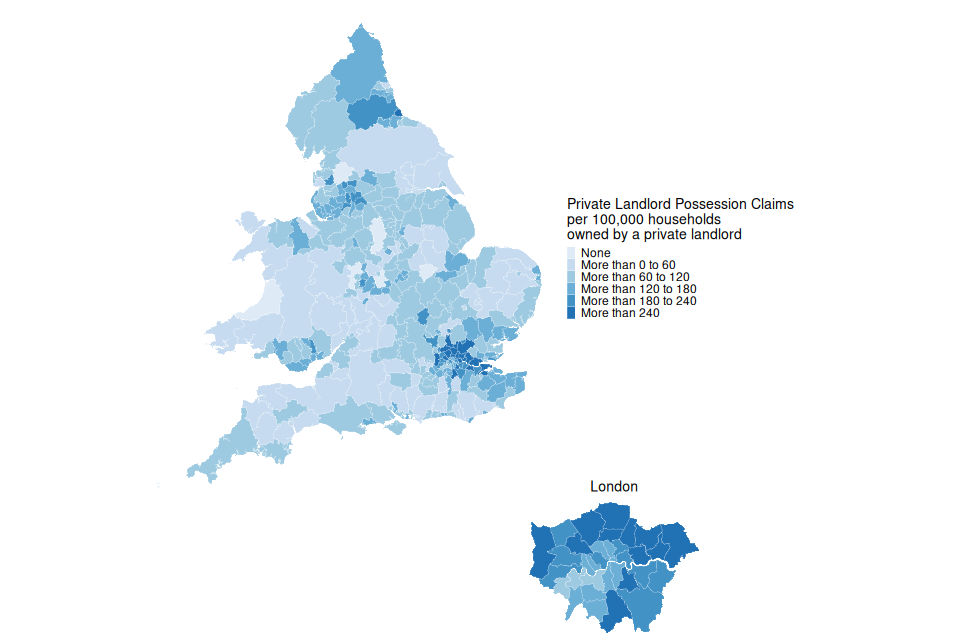
Private landlord claims were highest in Barking and Dagenham with 878 per 100,000 households owned by a private landlord.
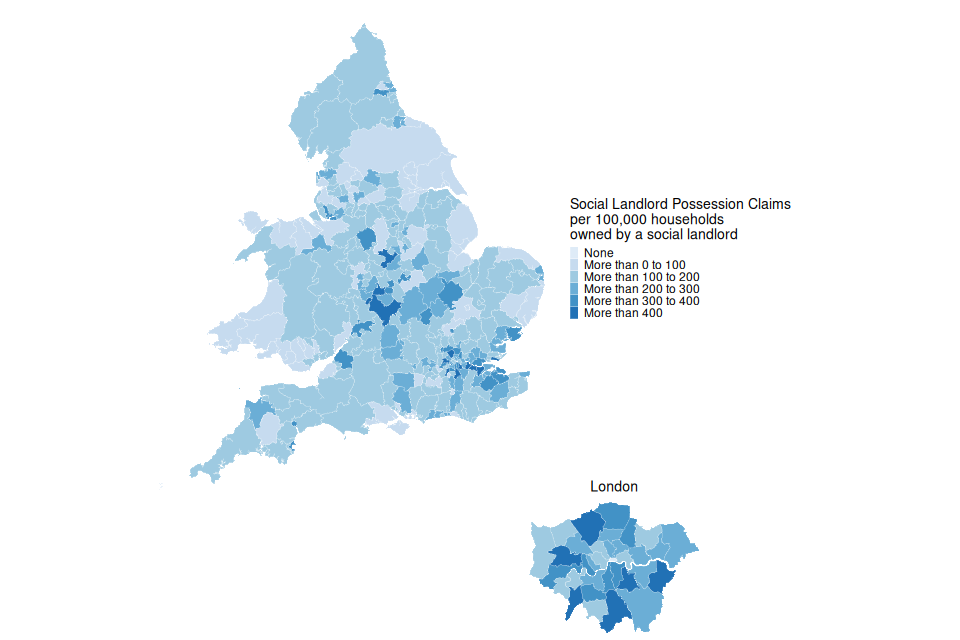
Social landlord claims were highest in Dartford with 839 per 100,000 households owned by a social landlord.
Since Q4 2022, the methodology used for calculating the rates of possession claims[footnote 2] and repossessions has been modified to take into account the variation in proportions of tenure[footnote 3] types in each local authority (LA) as measured by the 2021 census. More information on this change is provided in the accompanying guide to this publication here.
The Isles of Scilly and the City of London have very small populations (ranked 309th and 308th out of 309 respectively for population size) therefore rates may be less robust.
Figure 5: Mortgage possession Claims per 100,000 households owned by a mortgage or loan, October to December 2025 (Source: map.csv; see supporting guide)
| Local Authority | Rate (per 100,000 households owned by a mortgage or loan) | Actual number |
|---|---|---|
| Kensington and Chelsea | 203 | 16 |
| Westminster | 177 | 19 |
| Brent | 175 | 38 |
London boroughs accounted for 6 of the 10 local authorities with the highest rate of mortgage claims. Kensington and Chelsea, in the London region, had the highest rate of mortgage possession claims at 203 per 100,000 households owned by mortgage or loan, followed by Westminster (London region) and Brent (London region); with 177 and 175 claims per 100,000 respectively.
2 local authorities had no mortgage possession claims during this period. Excluding these Broadland had the lowest rate of mortgage claims (5.5 per 100,000 households owned by a mortgage or loan).
Figure 6: Private landlord possession Claims per 100,000 households owned by a private landlord, October to December 2025 (Source: map.csv; see supporting guide)
| Local Authority | Rate (per 100,000 households owned by a private landlord) | Actual number |
|---|---|---|
| Barking and Dagenham | 878 | 157 |
| Enfield | 438 | 155 |
| Newham | 436 | 194 |
London boroughs accounted for 6 of the 10 local authorities with the highest rate of private landlord claims. Barking and Dagenham (London region) had the highest rate for private landlord claims (878 per 100,000 households owned by a private landlord), followed by Enfield (London region) and Newham (London region) with 438 and 436 claims per 100,000 households owned by a private landlord respectively.
7 local authorities had no private landlord claims during this period. Excluding these, York had the lowest rate of private landlord claims (5.9 per 100,000 households owned by a private landlord).
Figure 7: Social landlord possession Claims per 100,000 households owned by a social landlord, October to December 2025 (Source: map.csv; see supporting guide)
| Local Authority | Rate (per 100,000 households owned by a social landlord) | Actual number |
|---|---|---|
| Dartford | 839 | 53 |
| Barnet | 774 | 155 |
| Solihull | 583 | 73 |
London boroughs accounted for 5 of the 10 local authorities with the highest rate of social landlord claims. Dartford (South East region) had the highest social landlord possession claim rate with 839 per 100,000 households owned by a social landlord. This was followed by Barnet (London region) and Solihull (West Midlands region) with 774 and 583 per 100,000 households owned by a social landlord respectively.
2 local authorities had no social landlord claims during this period. Excluding these, Bridgend had the lowest rate of social landlord claims (11.5 per 100,000 households owned by a social landlord).
8. Regional Repossessions (by County Court Bailiffs)
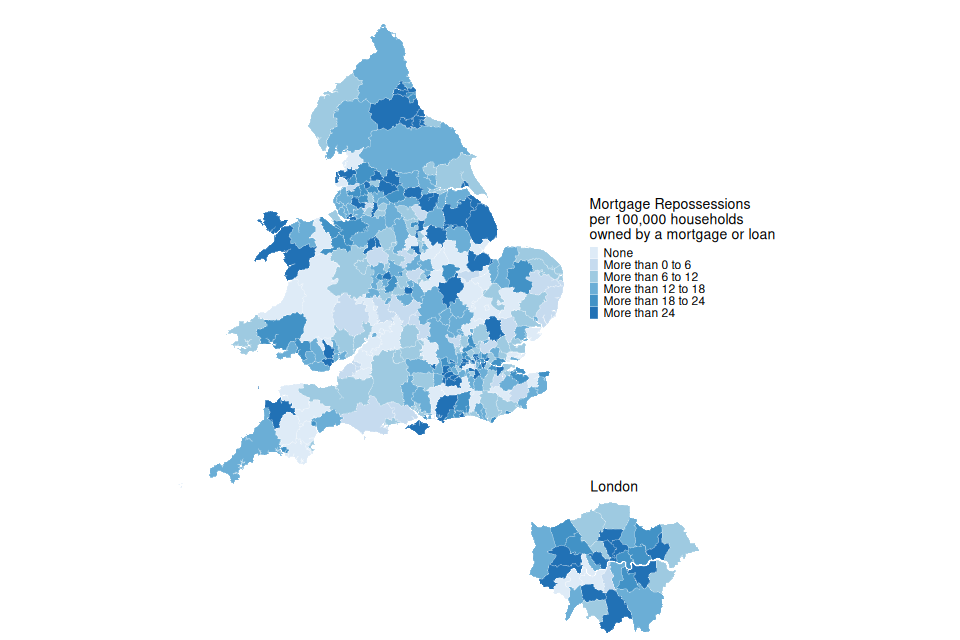
City of London had the highest overall rate of mortgage repossessions at 147 per 100,000 households owned by a mortgage or loan.
Private landlord repossessions were highest in Redbridge with 358 per 100,000 households owned by a private landlord.
Social landlord repossessions were highest in Reading with 183 per 100,000 households owned by a social landlord.
The Isles of Scilly and the City of London have very small populations (ranked 309th and 308th out of 309 respectively for population size) therefore rates may be less robust.
Figure 8: Mortgage repossessions per 100,000 households owned by a mortgage or loan, October to December 2025 (Source: map.csv; see supporting guide)
| Local Authority | Rate (per 100,000 households owned by a mortgage or loan) | Actual number |
|---|---|---|
| City of London | 147 | <10 |
| Hartlepool | 72 | <10 |
| Hyndburn | 70 | <10 |
Local authorities in London account for 3 of the 10 boroughs with the highest rate of mortgage repossessions.
No repossessions by county court bailiffs were recorded during this period in 51 local authorities out of a total of 318.
Figure 9: Private landlord repossessions per 100,000 households owned by a private landlord, October to December 2025 (Source: map.csv; see supporting guide)
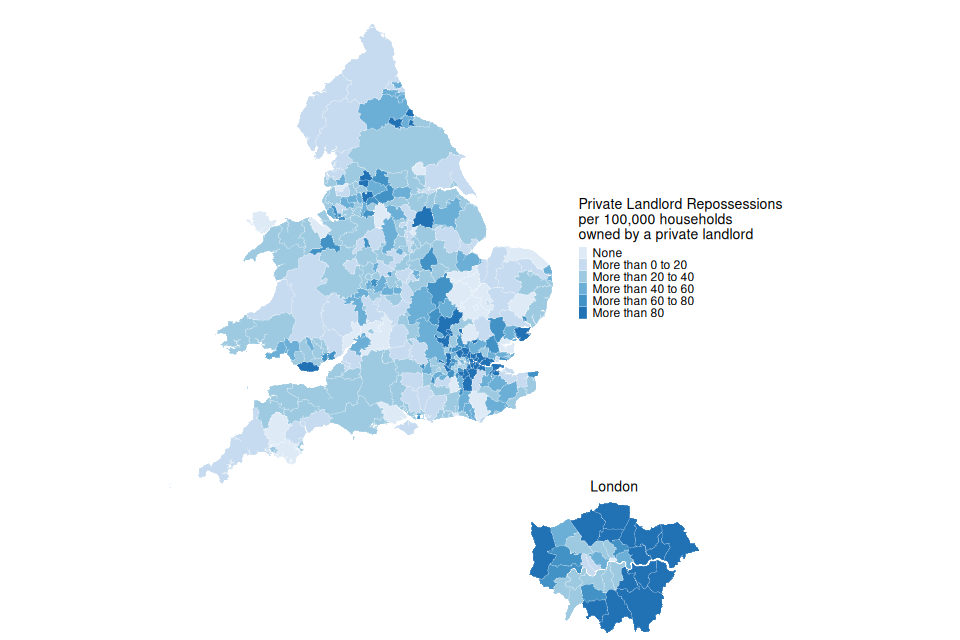
| Local Authority | Rate (per 100,000 households owned by a private landlord) | Actual number |
|---|---|---|
| Redbridge | 358 | 113 |
| Barking and Dagenham | 319 | 57 |
| Thurrock | 223 | 27 |
London local authorities account for 6 of the 10 boroughs with the highest rate of private landlord repossessions.
27 local authorities had no private landlord repossessions by county court bailiffs in Q4 2025.
Figure 10: Social landlord repossessions per 100,000 households owned by a social landlord, October to December 2025 (Source: map.csv; see supporting guide)
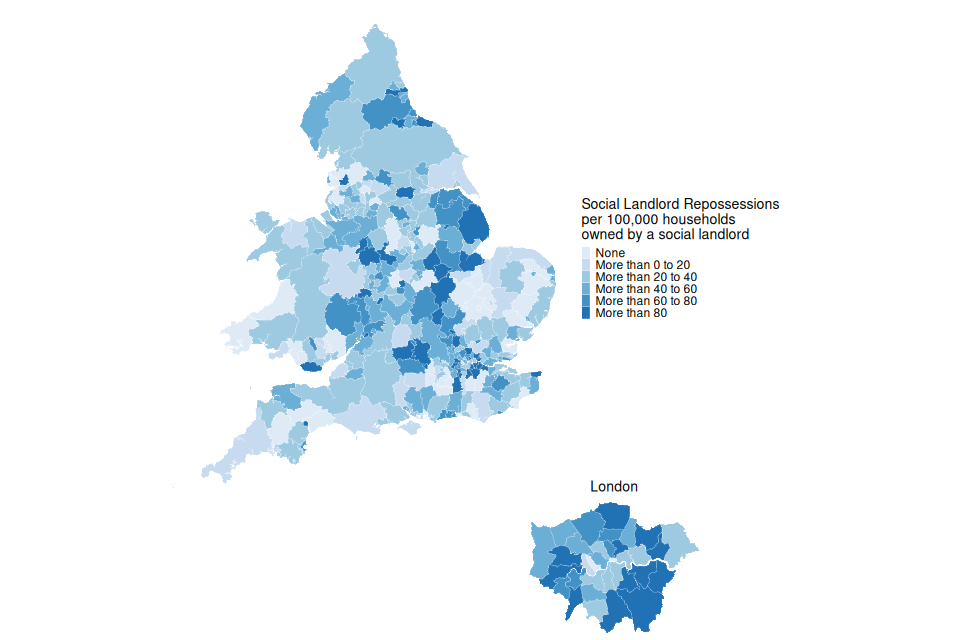
| Local Authority | Rate (per 100,000 households owned by a social landlord) | Actual number |
|---|---|---|
| Reading | 183 | 20 |
| Wakefield | 148 | 49 |
| Wyre Forest | 140 | <10 |
South East local authorities accounted for 3 of the 10 boroughs with the highest rate of social landlord repossessions.
47 local authorities had no social landlord repossessions by county court bailiffs in Q4 2025.
As with claims, it should be noted that for some of these areas the rates are based on a small number of repossessions.
9. Further information
The statistics in the latest quarter are provisional and revisions may be made when the next edition of this bulletin is published. If revisions are needed in subsequent quarters, these will be annotated in the tables.
9.1 Accompanying files
As well as this bulletin, the following products are published as part of this release:
-
A supporting guide providing further information on how the data is collected and processed, including a guide to the csv files, as well as legislation relevant to mortgage possessions and background information.
-
A set of overview tables (also available in accessible format), covering key sections of this bulletin.
-
CSV files of the map data and the possession action volumes by local authority and county court.
-
A data visualisation tool which provides a detailed view of the Mortgage and Landlord statistics. We welcome feedback on this tool to help improve it in later editions and to ensure it meets user needs.
These can be found here: https://www.gov.uk/government/statistics/mortgage-and-landlord-possession-statistics-october-to-december-2025
9.2 National Statistics status
National Statistics are accredited official statistics (https://osr.statisticsauthority.gov.uk/accredited-official-statistics/) that meet the highest standards of trustworthiness, quality and public value.
Accredited official statistics are called National Statistics in the Statistics and Registration Service Act 2007. These accredited official statistics were independently reviewed by the Office for Statistics Regulation in September 2021. They comply with the standards of trustworthiness, quality and value in the Code of Practice for Statistics and should be labelled ‘accredited official statistics’.
It is the Ministry of Justice’s responsibility to maintain compliance with the standards expected for National Statistics. If we become concerned about whether these statistics are still meeting the appropriate standards, we will discuss any concerns with the Authority promptly. National Statistics status can be removed at any point when the highest standards are not maintained, and reinstated when the standards are restored. These statistics have been audited and re-accredited as National Statistics. The most recent compliance check completed by the Office of Statistics Regulation can be found here.
9.3 Future publications
Our statisticians regularly review the content of publications. Development of new and improved statistical outputs is usually dependent on reallocating existing resources. As part of our continual review and prioritisation, we welcome user feedback on existing outputs including content, breadth, frequency and methodology. Please send any comments you have on this publication including suggestions for further developments or reductions in content.
9.4 Contact
Press enquiries should be directed to the Ministry of Housing, Communities and Local Government press office:
email: newsdesk@communities.gov.uk
Other enquiries and feedback on these statistics should be directed to the Courts and People unit of the Ministry of Justice:
Carly Gray - email: CAJS@justice.gov.uk
Next update: 21 May 2026
© Crown Copyright
Produced by the Ministry of Justice
-
These regions are based on the court that handled the possession claim not the region of the defendant postcode. ↩
-
Please note rates for private and social landlord possession claims and repossessions do not include accelerated claims. This is because accelerated claims are recorded onto the case management system at point of entry so do not specify the tenure type. ↩
-
Tenure - Office for National Statistics ons.gov.uk. ↩