Local authority revenue expenditure and financing: 2026-27 budget, England
Updated 25 June 2026
Applies to England

© Crown copyright 2026
This publication is licensed under the terms of the Open Government Licence v3.0 except where otherwise stated. To view this licence, visit nationalarchives.gov.uk/doc/open-government-licence/version/3 or write to the Information Policy Team, The National Archives, Kew, London TW9 4DU, or email: psi@nationalarchives.gov.uk.
Where we have identified any third party copyright information you will need to obtain permission from the copyright holders concerned.
This publication is available at https://www.gov.uk/government/statistics/local-authority-revenue-expenditure-and-financing-england-2026-to-2027-budget/local-authority-revenue-expenditure-and-financing-2026-27-budget-england
1. In this release:
Total Service Expenditure
- Local authority net current expenditure on services is budgeted to be £148.8 billion in 2026-27. This is £7.4 billion (5.2%) higher in real terms than was budgeted for 2025-26.
Within this, the following were the largest changes (in real terms) in budgeted service expenditure:
-
Education services net expenditure is budgeted to total £49.1 billion in 2026-27, £2.4 billion (+5.2%) higher in real terms than budgeted for 2025-26. This was largely due to an increase of £1.4 billion (+16.0%) and of £1.3 billion (18.0%) on Early Years and Special Schools and Alternative Provisions respectively.
-
Adult Social Care net expenditure (excluding funding via NHS) is budgeted to be £28.7 billion, £1.4 billion (+5.2%) higher than the amount budgeted for 2025-26.
-
Children’s Social Care net expenditure is budgeted to be £17.0 billion in 2026-27, £1.2 billion (+7.4%) higher than budgeted for 2025-26.
-
Housing Services net expenditure is budgeted to be £3.7 billion for 2026-27, an increase of £466 million (+14.3%), driven by an increase of £302 million (+14.7%) in spending to tackle homelessness.
Within service expenditure, only Cultural Services saw a budgeted decrease. Cultural Services net expenditure is budgeted to be £2.6 billion in 2026-27, £61 million (-2.3%) lower than 2025-26.
Revenue Expenditure
- The broader measure of local authority Revenue Expenditure is budgeted to be £151.3 billion in 2026-27. This is £6.8 billion (+4.7%) higher in real terms than budgeted for in 2025-26.
Release date: 11 June 2026
Date of next release: June 2027
Responsible Statistician: Tom Crowther
Contact: lgf1.revenue@communities.gov.uk
Media enquiries: NewsDesk@communities.gov.uk
2. Introduction
This Statistical Release, and all the associated tables, presents Accredited Official Statistics on budgeted revenue expenditure for local authorities in England for the financial year 2026-27. This release includes detail on how much authorities are budgeting to spend across the services they provide, and the sources of income to finance this expenditure.
Revenue Account returns and response rate
The information is compiled from Revenue Account (RA) budget returns submitted to the Ministry of Housing, Communities & Local Government (MHCLG) by local authorities in England. This information is then validated by MHCLG and any apparent inconsistencies and outliers are sent back to authorities for review and explanation.
This publication is based on returns from 406 out of 415 (98%) local authorities in England. Nine authorities have not submitted data: Guildford, South Gloucestershire, Castle Point, Cumberland, Epping Forest, Warwick, Coventry, Dudley and Greenwich.
Estimated England totals have been calculated using a grossing methodology. This works by calculating scaling factors drawn from sources where there was data for all authorities, principally from previous years’ budget data, as well as directly from grant allocations where these were readily available for 2026-27.
Key contextual information
Functions and responsibilities of local government can change from year to year, so comparisons between financial years may potentially not be wholly valid, but where major changes occur these are highlighted in the release.
Figures in this report and the associated tables are collected and reported as net current expenditure. So, for example, a decrease may be driven by decreases in expenditure or increases in fees or other income relating to a category of services.
Figures have been adjusted to real terms using the GDP Deflator, which is a general purpose and widely used deflator. It is sourced from the Office for National Statistics’ National Accounts, and the Office for Budget Responsibility’s forecast. Its values were +3.2% during 2025-26 and +2.0% in 2026-27.
Definitions of terms used in this release can be found toward the end of this document. The full definitions of what is included in each service category and guidance notes can be found in the forms section of our website.
Please tell us how you use the data
We are keen to know how these and related data (e.g. also Revenue Outturn and Quarterly Revenue Update) are used. Please feel free to send us a brief description at lgf1.revenue@communities.gov.uk, preferably with email subject: ‘How we use these data’. Please also feel free to send us any feedback and suggestions.
3. Local authority expenditure
Most local authority revenue expenditure can be divided into different service areas which sum to ‘Total Service Expenditure’. This is a net figure calculated as total expenditure minus total income that is specific to each service.
Service expenditure
Table 1a shows budget and outturn total service expenditure for the main areas of spend over recent years in real terms (values adjusted to 2026-27 prices), as are the following figures:
Budgeted Total Service Expenditure has increased by 5.2% to £148.8 billion in 2026-27 compared with 2025-26. Within this, the following are the most notable changes in budgeted service expenditure (in real terms):
-
Budgeted net current expenditure on education services for 2026-27 was £49.1 billion. This was £2.4 billion (5.2%) higher than the budget for 2025-26. This was largely due to an increase of £1.4 billion (+16.9%) in Early Years expenditure following the continued roll out of free childcare provision and an increase of £1.3 billion (+18.0%) in Special Schools and Alternative Provisions.
-
Adult Social Care net expenditure is budgeted to be £28.7 billion, £1.4 billion (+5.2%) higher in real terms than 2025-26. Within this, physical support for older people has increased by £483 million (+7.3%) and learning disability support for adults has increased by £414 million (+5.1%).
-
Children’s Social Care net expenditure is budgeted to increase by £1.2 billion (+7.4%) from 2025-26 to £17.0 billion in 2026-27. This increase was predominantly the result of an increased expenditure of £929 million (+10.8%) on children looked after. Additionally, budgeted spend on family support services has increased by £247 million (+13.1%)
-
Housing services net expenditure is budgeted to total £3.7 billion, £466 million (+14.3%) higher than was budgeted for in 2025-26. This was driven by an increase of £302 million (+14.7%) in spending to tackle homelessness. N.B This excludes costs of temporary accommodation that are reclaimed from central government.
Table 1a: General Fund Revenue Account: Outturn 2022-23 to 2024-25 and budget 2025-26 to 2026-27 (real terms) [note 1]
£ million – adjusted for inflation and are shown in 2026-27 prices. Source: Revenue Summary (RS) returns 2022-2023 to 2024-25, Revenue Account (RA) budget returns 2025-26 to 2026-27
| Service Category | 2022-23 (outturn) | 2023-24 (outturn) | 2024-25 (outturn) | 2025-26 (Budget) | 2026-27 (Budget) |
|---|---|---|---|---|---|
| Education [note 2] | 42,839 | 43,663 | 46,722 | 46,699 | 49,144 |
| Highways and transport | 5,501 | 5,407 | 5,636 | 6,113 | 6,352 |
| Highways and transport services (excl GLA) | 3,594 | 3,694 | 3,717 | 4,048 | 4,276 |
| Highways and transport services (GLA only) | 1,907 | 1,714 | 1,919 | 2,066 | 2,077 |
| Children’s Social Care | 14,803 | 15,967 | 16,481 | 15,861 | 17,039 |
| Adult Social Care [note 3] | 23,675 | 25,747 | 26,619 | 27,238 | 28,655 |
| Public Health | 4,420 | 4,271 | 4,357 | 4,270 | 4,538 |
| Housing (excluding Housing Revenue Account) | 2,633 | 3,066 | 3,392 | 3,254 | 3,721 |
| of which: | |||||
| Homelessness | 1,441 | 1,879 | 2,261 | 2,054 | 2,357 |
| Cultural, environmental and planning | 12,305 | 12,315 | 12,434 | 12,123 | 12,730 |
| Police | 16,862 | 17,327 | 17,807 | 18,031 | 18,422 |
| Fire & rescue | 2,795 | 2,852 | 2,950 | 3,083 | 3,142 |
| Central services | 4,877 | 4,688 | 4,799 | 3,614 | 3,817 |
| Other Services | 231 | 294 | 166 | 1,168 | 1,248 |
| Total Service Expenditure | 130,942 | 135,596 | 141,360 | 141,455 | 148,809 |
Notes:
- The figures in this table, as well as all service expenditure figures in the Revenue Account Budget data collection, are expenditure that are net of income from sales, fees and charges. Therefore, higher net expenditure can be the result of increased expenditure and/or reduced sales/fees/charges income.
- Expenditure on education is not comparable due to those schools that changed their status to became academies which are centrally funded rather than funded via local authorities.
- These figures exclude transfers from the NHS (including Better Care Fund).
Chart A shows the proportion of local authority service expenditure by service. This covers expenditure by councils, combined authorities and single-purpose local authorities, including police.
Education funding, which is ring-fenced, is budgeted to account for 33% of this total. Adult Social Care and Children’s Social Care are also large elements of council expenditure, accounting for 19% and 11% respectively across all authorities.
Chart A: Proportion of budgeted service expenditure by service, England, 2026-27
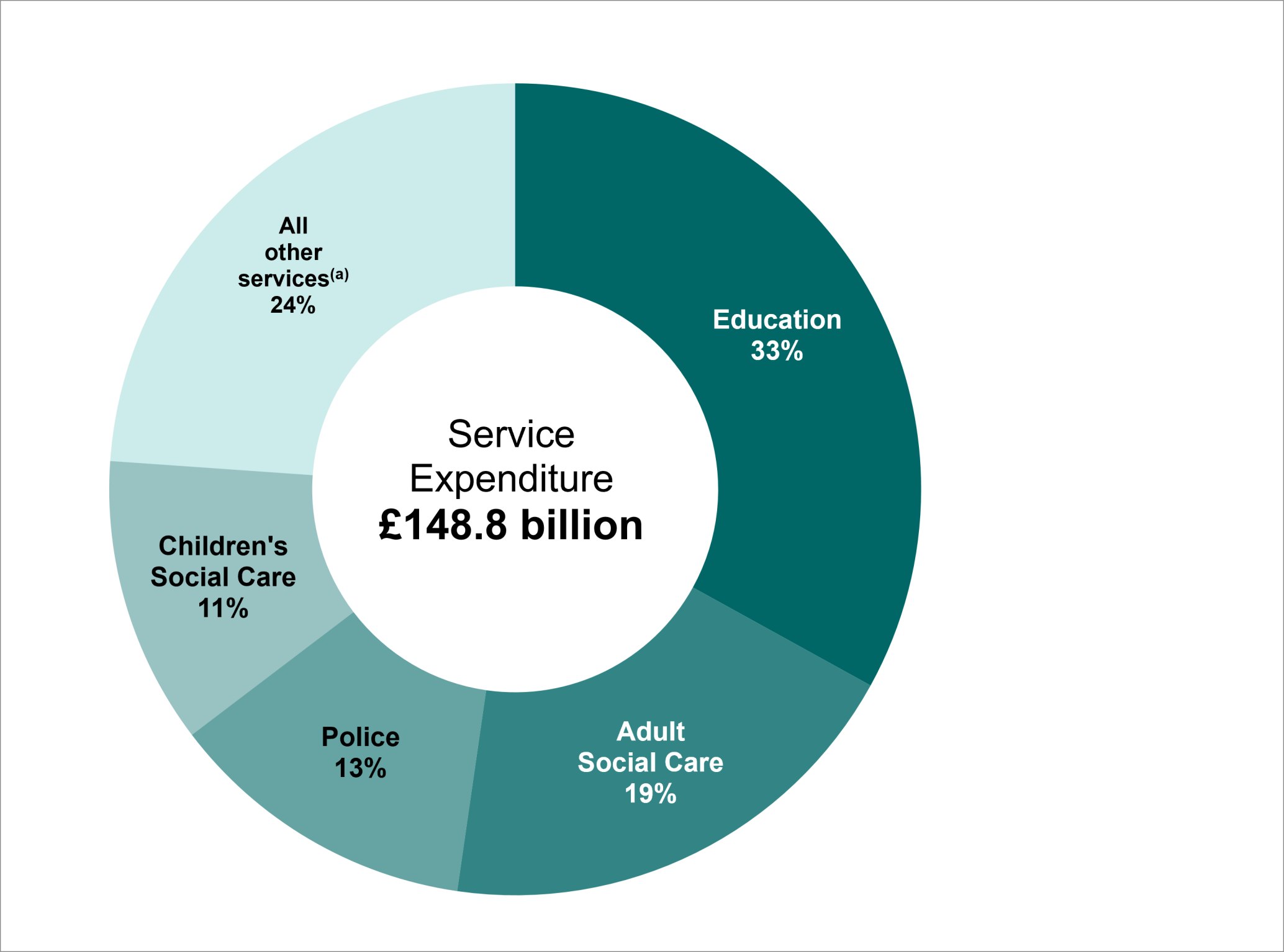
(a)‘Other’ includes Highways and Transport, Public Health, Fire and Rescue, Central services and other services.
Revenue expenditure and non-current expenditure
Revenue expenditure involves accounting for other current expenditure in addition to service expenditure, and non-current expenditure.
Other current expenditure includes housing benefits paid to residents, any money passed down to parish councils through local precepts and any additional levies and adjustments charged during the year.
Non-current expenditure includes financial payments necessary to balance local authorities’ budgets; generally, expenditure where the cash impact falls in one year but the cost is spread over more than one year.
Figures included in non-current expenditure also include interactions with local authority accounts other than the Revenue Account. The largest of these are with the capital account. The main interactions are capital financing (interest payments and leases) and CERA (capital expenditure charged to the Revenue Account).
Total Revenue Expenditure by local authorities in England is budgeted to be £151.3 billion in 2026-27, 4.7% higher in real terms than the 2025-26 budget.
Table 2a: Estimated net current expenditure by service, England, 2025-26 and 2026-27, (real terms) [note1]
£ million – adjusted for inflation and shown in 2026-27 prices.
| Service Category | Net Current Expenditure [note 1] 2025-26 | Net Current Expenditure [note 1] 2026-27 | Real terms change £m | Real terms change % |
|---|---|---|---|---|
| Education services | 46,697 | 49,144 | 2,447 | 5.2% |
| Highways and transport services | 6,113 | 6,352 | 239 | 3.9% |
| Highways and transport services (excl. GLA) | 4,047 | 4,276 | 228 | 5.6% |
| Highways and transport services (GLA only) | 2,066 | 2,077 | 11 | 0.5% |
| Children’s Social Care services | 15,861 | 17,039 | 1,178 | 7.4% |
| Adult Social Care services | 27,237 | 28,655 | 1,417 | 5.2% |
| Public Health services | 4,270 | 4,538 | 269 | 6.3% |
| Housing services (excluding Housing Revenue Account) | 3,254 | 3,721 | 466 | 14.3% |
| of which: | ||||
| Homelessness | 2,055 | 2,357 | 302 | 14.7% |
| Cultural, environmental and planning services | 12,123 | 12,730 | 608 | 5.0% |
| of which: | ||||
| Cultural services | 2,706 | 2,645 | -61 | -2.3% |
| Environmental services | 7,304 | 7,760 | 456 | 6.2% |
| Planning and development services | 2,112 | 2,325 | 213 | 10.1% |
| Police services | 18,031 | 18,422 | 391 | 2.2% |
| Fire and rescue services | 3,083 | 3,142 | 59 | 1.9% |
| Central services | 3,614 | 3,817 | 204 | 5.6% |
| Other Services | 1,168 | 1,248 | 80 | 6.9% |
| Total Service Expenditure | 141,450 | 148,809 | 7,359 | 5.2% |
| Precepts, levies, trading accounts and adjustments | ||||
| Housing Benefits [note 2] | 12,837 | 11,916 | -921 | -7.2% |
| Parish Precepts | 869 | 941 | 71 | 8.2% |
| Levies [note 3] | 11 | 28 | 17 | 151.9% |
| Trading Account Adjustments and Other Adjustments [note 4] | -257 | -166 | 91 | -35.6% |
| Non Current Expenditure and External Receipts | -15,652 | -15,330 | 322 | -2.1% |
| of which: | ||||
| Capital expenditure charged to Revenue Account (CERA) | 1,535 | 1,514 | -22 | -1.4% |
| Housing Benefits Subsidies | -10,018 | -9,436 | 582 | -5.8% |
| Community Infrastructure Levy (CIL) | -155 | -166 | -11 | 6.8% |
| Netting off expenditure capitalised by a direction under Section 16(2)b | -999 | -1,242 | -243 | 24.4% |
| Appropriations to(+)/from(-) dedicated schools grant adjustment account [note 5] | -844 | -1,262 | -418 | 49.5% |
| Capital financing and debt servicing [note 6] | 7,066 | 7,630 | 563 | 8.0% |
| Revenue Expenditure | 144,481 | 151,323 | 6,842 | 4.7% |
Notes:
- The figures in this table, as well as all service expenditure figures in the Revenue Account Budget data collection, are expenditure that are net of income from sales, fees and charges. Therefore higher net expenditure can be the result of increased expenditure and/or reduced sales/fees/charges income.
- Includes all Mandatory and Non-Mandatory Housing Benefits.
- Includes ‘Integrated Transport Authority levy’, ‘Waste Disposal Authority levy’, ‘London Pensions Fund Authority levy’ and ‘Other levies’.
- Includes ‘External Trading Accounts’, ‘Internal Trading Accounts’, ‘Capital items accounted for in External Trading Accounts’, ‘Capital items accounted for in Internal Trading Accounts’, ’Adjustments to net current expenditure’, and ‘Appropriations to/from Accumulated Absences Account’.
- Due to differing approaches that have been taken by the 22 eligible local authorities who have reported values for High Needs Stability Grant, users should exercise caution when interpreting figure relating to the DSG adjustment account, DSG reserve and associated appropriations, as they do not consistently reflect planned High Needs Stability Grant funding.
- Includes provision for repayment of principal, leasing payments, external interest payments and HRA item 8 interest payments and receipts.
4. Revenue expenditure financing
This section outlines the different funding streams that finance local authorities’ expenditure and how these are forecast to differ for 2026-27 from what was budgeted for 2025-26.
Authorities also receive income from sales, fees and charges. The Revenue Account Budget (‘RA’) data return collects expenditure for detailed categories of services that is already net of sales, fees and charges income. While sales, fees and charges income is not identified separately in the RA budget return, it is reported and published separately in the annual Revenue Outturn returns.
Tables 3 and 4 below show how local authorities intend to finance revenue expenditure.
Central Government funding comprises funding announced in the annual Local Government Finance Settlement plus grants from several government departments. Central government grants are expected to account for 53.9% of Revenue Expenditure (or 54.5% excluding appropriations from reserves), while council tax accounted for 30.9%, and the majority of the remainder to be financed through locally retained business rates.
Exceptional Financial Support (EFS)
For the financial year 2026-27 the government agreed to provide 35 councils with support to manage financial pressures via the Exceptional Financial Support process to the amount of £1.5 billion. Some authorities have not budgeted to use this support within the revenue account; others may have only budgeted for partial use. This is accounted for in the reported Total Revenue Expenditure in Table 2.
Changes for 2026-27
For 2026-27, several grants have been consolidated into the Revenue Support Grant resulting in a real terms increase of £9.4 billion (+399.2%) from 2025-26. The inverse impact can be seen in the total value of specific and special grants inside aggregate external finance (AEF), which is budgeted to decrease by £5.2 billion (-8.1%) from 2025-26.
A number of changes to the business rate retention system were introduced for 2026-27 as part of the Fair Funding view 2.0. Users should consider these changes when making comparisons with previous years at an England, class, or local authority level.
Central government grants
Central government grants are expected to total £81.5 billion in 2026-27. This is £4.9 billion (+6.3%) higher in real terms than was reported in 2025-26 budget data. In addition to wider consolidation into the Revenue Support Grant ,notable changes to individual grant include:
i) Public Health Grant: £4.1 billion (+12.2%) higher than in 2025-26. This grant now includes funding for the Local Stop Smoking Services and Support Grant, Swap to Stop programme, Drug and Alcohol Treatment and Recovery Improvement Grant as well as the Individual Placement and Support Grant.
ii) The Neighbourhood Policing Grant: £345 million (+80.8%) higher than in 2025-26 when it was initially introduced. The Officer Maintenance Grant has now been removed with funding reallocated to the Neighbourhood Policing Grant.
iii) The Families First Partnership (£825 million), Crisis and Resilience Fund (£798 million) and Homelessness, Rough Sleeping and Domestic Abuse Grant (£852 million) were all introduced in 2026-27 as part of the programme of consolidation.
Several grants that were previously recorded have been discontinued or consolidated into other grants in the financial year 2026-27. This includes:
- The Domestic Abuse Safe Accommodation Grant which has been consolidated into the new Homelessness, Rough Sleeping and Domestic Abuse Grant.
- The Income Protection Floor, which has replaced the Funding Floor.
- The Social Care Grant, Market Sustainability and Improvement Fund, New Homes Bonus and Employer National Insurance Contribution Grant, which have been consolidated and redistributed using the new Fair Funding assessment.
Payment to local authorities as part of the Homes for Ukraine and Packaging Extended Producer Responsibility (pEPR) programmes are newly recorded on the Revenue Account form.
Funding SEND deficits
All authorities with a Dedicated Schools Grant (DSG) deficit are eligible to receive the High needs Stability Grant in 2026-27, covering 90% of their deficit accrued up to March 2026. The provision of the grants is conditional on the Department of Education (DfE) approving the authority’s local special educational needs and disabilities (SEND) plan.
As this funding was announced after many budgets were finalised and is conditional, only 22 eligible local authorities have reported values for this grant. Where the grant has been reflected, authorities have taken differing approaches to earmarking the funding, including treatment through the DSG adjustment account, DSG reserves, or other earmarked reserves. These differences in recording practices reduce the comparability of reserves balances and appropriations between authorities. In particular, users should exercise caution when interpreting figures relating to the DSG adjustment account, DSG reserves and associated appropriations, as they do not consistently reflect planned High Needs Stability Grant funding. For more details, see the annex of this report.
Table 3a: Budgeted revenue expenditure and financing, England, 2025-26 to 2026-27 (real terms)
£ million – adjusted for inflation and are shown in 2026-27 prices.
| Service Category | Net Current expenditure 2025-26 | Net Current expenditure 2026-27 | Change £m | Change % |
|---|---|---|---|---|
| Revenue expenditure [note 1] | 144,481 | 151,323 | 6,842 | 4.7 |
| Financed by: | ||||
| Total Government Grants [note 2] | 76,661 | 81,515 | 4,853 | 6.3 |
| of which: | ||||
| Specific grants inside AEF | 64,456 | 59,250 | -5,206 | -8.1 |
| including: | ||||
| Dedicated Schools Grant (DSG) | 36,532 | 38,194 | 1,663 | 4.6 |
| Pupil Premium Grant | 1,130 | 1,052 | -79 | -7.0 |
| Universal Infants Free School Meals | 252 | 262 | 10 | 3.8 |
| Public Health Grant | 3,665 | 4,113 | 447 | 12.2 |
| Local Authority Better Care Fund Grant | 2,521 | 2,490 | -31 | -1.2 |
| Families First Partnership (within Children, Families and Youth Grant) | - | 830 | - | - |
| Other Children, Families and Youth Grant | - | 266 | - | - |
| Homelessness, Rough Sleeping and Domestic Abuse Grant | - | 852 | - | - |
| Crisis and Resilience Fund | - | 798 | - | - |
| The Private Finance Initiative (PFI) | 1,118 | 1,008 | -110 | -9.8 |
| Packaging Extended Producer Responsibility (pEPR) | - | 686 | - | - |
| Neighborhood Policing Grant | 191 | 345 | 154 | 80.8 |
| Other grants inside AEF | 19,046 | 8,355 | -10,692 | -56.1 |
| Revenue Support Grant [note 5] | 2,354 | 11,753 | 9,399 | 399.2 |
| Police grant | 9,851 | 10,512 | 660 | 6.7 |
| Council tax requirement [note 3] | 44,999 | 46,768 | 1,769 | 3.9 |
| Retained income from Business Rate Retention Scheme [note 6] | 21,220 | 21,384 | 164 | 0.8 |
| Appropriations to (-) / from (+) revenue reserves | 1,461 | 1,313 | -148 | -10.1 |
| Other items [note 4] | 223 | 174 | -49 | -21.9 |
Notes:
- The financing elements do not sum exactly to the Revenue expenditure total (a difference of £187 million, or 0.1% of revenue expenditure) because their grossing up to England figures was necessarily done separately to the grossing for all expenditure figures.
- Figures as reported by local authorities. These may differ from allocations amounts despite data collection forms having been pre-populated with allocations data for larger grants. This is partly due to the differing timelines of authorities confirming their budgets and receiving final grant allocations.
- Increases can be due to changes in both tax base and bills. A small number of queries challenging differences from the CTR return were unanswered at the time of publication.
- This comprises line 980 Council tax net collection fund deficits / surpluses from the previous year, plus line 985 other items where business rates surpluses/deficits have been recorded, and a balancing item of £81 million in 2025-26 and £187 million in 2026-27 arising from the separate grossing of the figures of the components in the financing section.
- Several grants have been consolidated into the Revenue Support Grant for 2026-27 resulting in a large increase in this grant value from the previous financial year and a reduction in the value of specific and special grants.
- A number of changes to the business rate retention system were introduced for 2026-27 as part of the Fair Funding Review 2.0. Users should consider these changes when making comparisons with previous years at an England,class, or local authority level.
Table 4a: Financing of revenue expenditure, England, outturn 2022-23 to 2024-25 and budget 2025-26 to 2026-27 (real terms)
£ million – adjusted for inflation and shown in 2026-27 prices.
Source: Revenue Outturn returns from England local authorities 2022-23 to 2024-25, Revenue Account Budget (‘RA’) returns 2025-26 to 2026-27.
| Year | Revenue Expenditure [note 1] | Government Grants [note 2] | % of total [note 3] | Retained income from Business Rate Retention Scheme [note 4],[note 5] | Council Tax [note 6] | Locally retained income | % of total [note 3] | Appropriations from (+) reserves excluding COVID BR relief grant [note 4],[note 5] | Other items [note 7] |
|---|---|---|---|---|---|---|---|---|---|
| 2022-23 (Outturn) | 135,259 | 72,256 | 54.3 | 18,887 | 41,885 | 60,772 | 45.7 | 2,242 | -12 |
| 2023-24 (Outturn) | 137,487 | 72,413 | 53.4 | 20,764 | 42,425 | 63,189 | 46.6 | 1,135 | 685 |
| 2024-25 (Outturn) | 142,495 | 76,136 | 54.0 | 21,408 | 43,411 | 64,819 | 46.0 | 780 | 815 |
| 2025-26 (Budget) | 144,481 | 76,661 | 53.7 | 21,220 | 44,999 | 66,219 | 46.3 | 1,461 | 223 |
| 2026-27 (Budget) | 151,323 | 81,515 | 54.5 | 21,384 | 46,768 | 68,151 | 45.5 | 1,313 | 174 |
Notes:
- The financing elements do not sum exactly to the Revenue expenditure total (a difference of £81 million in 2025-26 (0.1% of revenue expenditure) and £187 million in 2026-27 (a difference of 0.1% of revenue expenditure)). This occurs because the estimation for the authorities from which we had received no data; this grossing up to England figures is necessarily done separately to the grossing for all expenditure figures, and a slight mismatch is expected.
- Includes ‘Specific grants inside AEF’, ‘Revenue Support Grant’ and ‘Police Grant’.
- Percentage of total expenditure excluding use of reserves and council tax collection fund surplus and other items.
- The timing of the payment of COVID business rate relief grants impacted the reported retained income from business rates retention scheme. These items have been adjusted by moving relevant amounts from Appropriations from reserves onto retained business rates. Please note that some uncertainty remains as to the accuracy of these reported figures. For further details see the Revenue Outturn 2022-23 statistical releases and technical notes.
- A number of changes to the business rate retention system were introduced for 2026-27 as part of the Fair Funding Review 2.0. Users should consider these changes when making comparisons with previous years at an England class or local authority level.
- The increase in council tax receipts reflects the combination of increases of bills and the change in tax base (i.e. the effective number of households due to pay).
- Other items include any income from inter-authority transfers and net collection fund surpluses (+) / deficits (-) from the previous year.
Annex
Due to the differing approaches that have been taken by the 22 eligible local authorities who have reported values for the High Needs Grant, users should exercise caution when interpreting figures relating to the DSG adjustment account, DSG reserves and associated appropriations, as they do not consistently reflect planned High Needs Stability Grant funding.
Of those that recorded values for the High Needs Stability Grant:
- £444 million was moved to the DSG adjustment account
- £168 million was moved to other earmarked reserves
- £82 million was moved to the DSG reserve
- £26 million contributed toward expenditure
- And for £130 million, the use within the revenue account could not be identified
5. Accompanying tables
Symbols used
[x] = not available
0 = zero or negligible
- = not relevant
M = RA return not received in time for publication. England totals have been estimated by also drawing on grant allocations, where known, or the proportions within the previous year’s data
Rounding
Where figures have been rounded, there may be a slight discrepancy between the total and the sum of constituent parts.
Tables
This release does not include summary tables by class of local authority. Local authority classes are shown in the accompanying dropdown tables presenting detailed revenue expenditure and financing figures for 2026-27 for all local authorities are available to download alongside this release. Please note that nine local authorities across two classes of authority did not submit data in time for this publication.
These tables present all revenue information, by local authority, in a similar format as returned to MHCLG. This data forms the basis of the tables in this release.
These tables can be accessed at Local Authority Revenue Expenditure and Financing.
RA Part 1
Revenue Account Budget part 1 – contains all revenue expenditure and financing categories
RA Part 2
Revenue Account Budget part 2 – contains all other sections including reserves levels, local council support revenue foregone, capital items, and the investment properties memorandum section.
SG
Specific and Special Revenue Grants
6. Accredited Official Statistics status
These statistics are Accredited Official Statistics. This status means that these statistics comply with the highest standards of trustworthiness, quality and public value as set out in the Code of Practice for Statistics. Accredited Official Statistics are called National Statistics in the Statistics and Registration Service Act 2007.
Information on Official Statistics is available via the UK Statistics Authority website.
Information about statistics at MHCLG is available via the Department’s website: Statistics at MHCLG.
7. Technical notes
Please see the accompanying technical notes document for further details. This can be found at: Local authority revenue expenditure and financing England: 2026 to 2027 budget England.
8. Definitions
The most relevant terms for this release are explained below.
Aggregate External Finance – This is the total amount of grant provided to finance all local government expenditure, excluding that subject to separate arrangements under statutory schemes, rent allowances and rebates and council tax benefit, which are funded by specific grants outside Aggregate External Finance.
Central Government Grants – The biggest source of funding that local authorities receive is from central government. This is made up from ‘specific’ grants and a general grant (also called the Revenue Support Grant). Central government grant money pays for capital projects, such as roads or school buildings, as well as revenue spending, such as the cost of maintaining council housing and running services, including employee wages.
Central Services – These are services organised on a corporate basis that support the delivery of services to the public. Central services include building costs, administration and IT.
Council Tax Requirement – The amount of revenue a local authority needs to raise through council tax, (its council tax requirement) is calculated by deducting from its planned spending, any funding from reserves, income it expects to raise, and funding it will receive from the Government.
Current Expenditure – This is the cost of running local authority services within the financial year. This includes the staffing, heating, lighting and cleaning, together with expenditure on goods and services consumed within the year. This expenditure is offset by income from sales, fees and charges and other (non-grant) income, which gives total net current expenditure. Total net current expenditure also includes payments made by local authorities on behalf of central government, under statutory schemes and the payment of rent allowances and rebates. Such payments are fully funded by central government through specific grants outside Aggregate External Finance.
Dedicated Schools Grant (DSG) – There was a change in the funding of specific and formula grants in 2006-07 largely due to changes in the way that expenditure on schools is funded. From 2006-07, local authorities receive school funding through specific grant rather than funding previously included in formula grant.
Funding through the Settlement Grant – This is the main channel of government funding. This includes Retained income from the Rate Retention Scheme, Revenue Support Grant, and Police Grant. The distribution is determined by the Formula spending shares formulae, also taking account of authorities’ relative ability to raise council tax and the floor damping mechanism. There are no restrictions on what local government can spend on it.
Greater London Authority (GLA) Group – This includes the GLA (the Mayor of London and London Assembly) and it’s five constituent functional bodies; the Mayor’s Office for Policing and Crime (MOPAC), the London Fire Commissioner (LFC), Transport for London (TLF), the London Legacy Development Corporation (LLDC) which administers Queen Elizabeth Olympic Park and the Old Oak and Park Royal Development Corporation (OPDC). Transactions in their General Fund Revenue Account are reported by the GLA and the five functional bodies as a group.
Housing Revenue Account – The HRA is a local authority statutory account, it contains all the spending and income related to the housing stock owned by the council. Mandatory Housing Benefit – This is financial help given to local authority or private tenants whose income falls below the prescribed amounts as required by law. This usually consists of mandatory Rent Allowances and mandatory Rent Rebates, to HRA and non-HRA tenants.
Net Current Expenditure – see Current Expenditure
Reserves – These are sums set aside to finance future spending for purposes falling outside the definition of a provision. Reserves set aside for stated purposes are known as earmarked reserves.
Non-ringfenced revenue reserves comprise of unallocated reserves and other earmarked reserves. Local authorities often earmark reserves to meet known financial commitments and to mitigate known risks. As reserves of this type cannot be used without putting wider service delivery at risk, most local authorities will have significantly lower usable revenue reserves than their non-ringfenced revenue reserves balance would imply. It is not possible to identify usable revenue reserves in the current release.
Retained income from the Rates Retention Scheme – Since 2017-18 some local authorities have been able to retain 100% of their business rates revenue as part of their Devolution deal. In 2017-18, the local share for London boroughs was also increased to 67% to reflect additional functions given to the GLA. In 2018-19 and 2019-20, some local authorities participated in pilots to retain an increased share of revenue for that year only. For 2018-19, this was 100% and in 2019-20, this was 75% retention. These business rates pilots have now ended. A number of changes to the business rates retention system were introduced for 2026-27 as part of the Fair Funding Review 2.0.
Revenue Expenditure – Revenue expenditure involves accounting for other current expenditure in addition to service expenditure and non-current expenditure. Other current expenditure includes housing benefits paid to residents, any money passed down to parish councils through local precepts and any additional levies and adjustment charged during the year. It excludes expenditure financed by grants outside Aggregate External Finance. Revenue expenditure is financed by grants inside Aggregate External Finance, council tax and authorities’ reserves.
Revenue Support Grant – A general grant now distributed as part of Funding through the Settlement Grant.
Specific Grants inside AEF – These are revenue grants which are paid to local authorities by individual government departments, for which the local authority has sole responsibility for decisions on how the grant is allocated. The main purpose for the provision of these grants is to deliver core local authority services.
Specific Grants outside AEF – These are revenue grants, which are paid to local authorities by individual government departments. However, the local authority usually only acts as the ‘middle person’, as the grants are passed over to a third party who administers the service. The local authority does not normally have any control over the service for which the grant was intended for. This responsibility rests solely with the third party that receives the grant.