Resetting the business rates retention system from 1 April 2026
Published 20 November 2025
Applies to England

© Crown copyright 2025
This publication is licensed under the terms of the Open Government Licence v3.0 except where otherwise stated. To view this licence, visit nationalarchives.gov.uk/doc/open-government-licence/version/3 or write to the Information Policy Team, The National Archives, Kew, London TW9 4DU, or email: psi@nationalarchives.gov.uk.
Where we have identified any third party copyright information you will need to obtain permission from the copyright holders concerned.
This publication is available at https://www.gov.uk/government/publications/resetting-the-business-rates-retention-system-from-1-april-2026/resetting-the-business-rates-retention-system-from-1-april-2026
Chapter 1: Reset Delivery Overview
1.1.1. As set out in local government finance policy statement 2026-27 to 2028-29, the reset of the Business Rates Retention System (BRRS) from 1 April 2026 is a core part of the government’s Fair Funding Review (FFR) 2.0 to ensure that the local government funding system is fit for the future.
1.1.2. The FFR 2.0 will better align funding with need across the country. As part of this process, the BRRS reset will help to ensure local government resources are targeted where they are needed most. A reset is long overdue and will restore the balance between aligning funding with need and rewarding business rate growth locally.
1.1.3. The reset will allow government to redistribute retained rates income in line with relative need and resources. At the reset, all local authorities will be assigned new Business Rates Baselines (BRBs), Baseline Funding Levels (BFLs) and top-up or tariffs. New BFLs will be based on an updated assessment of need, developed as part of this government’s FFR 2.0.
1.1.4. The reset is a redistributive exercise. All resources that local government currently have available which are associated with the BRRS will remain with local government post 1 April 2026. This includes the growth currently retained by authorities over current BFLs, and the grant compensation that has been awarded in respect of government relief schemes and for historic under-indexation of business rates multipliers. However, as part of the reset, this funding will be distributed differently across the sector from 1 April 2026.
1.1.5. Delivering a full reset will help the system fulfil its intended purpose of providing a responsive funding stream for local government while rewarding business rates growth. Under a full reset, the vast majority of growth[footnote 1] accumulated to date will be redistributed. Locally retained business rates in Designated Areas and in connection with qualifying Renewable Energy schemes will be exempt from the reset.
1.1.6. As the 2026-27 policy statement sets out, the government continues to believe that transitional arrangements are necessary to enable local authorities to plan for changes whilst moving towards improved and updated funding allocations. In line with this view, current business rates income will be included in the government’s delivery of transitional arrangements that are intended to move local authorities from their current funding positions to new allocations. This will mean that local authorities will have their current business rates income protected as part of transitional arrangements which support the delivery of the FFR 2.0.
1.1.7. As consulted on as part of the FFR 2.0, the reset is also an opportunity to reshape how risk is shared in the system given the scale of reform being delivered in the business rates system. Government is increasing the level of business rates income protection available to authorities in 2026-27 by increasing the safety net threshold to 100%. This will support local authorities at the point when both changes to the administration of business rates, and the delivery of the BRRS reset will expose them to a significant degree of change. The levy on growth will also be redesigned, ensuring all local authorities who generate growth contribute proportionately to the increased risk protections in the system.
1.1.8. From 1 April 2026 growth that comes on stream will be retained for the duration of the future reset period, continuing to reward authorities for local business rates growth, subject to the new levy arrangements. As set out in the consultation on the objectives and principles for local government funding reform, this government intends to deliver regular resets to ensure funding allocations are kept up-to-date while providing future funding certainty to local authorities. The government will work with the sector to determine reset periods – the time elapsed between resets – to balance the objectives of rewarding business rates growth and providing a responsive funding stream for local government.
1.1.9. As highlighted in the government’s technical consultation on resetting the BRRS, the 2026 reset will be delivered alongside significant changes to the business rates tax system. Firstly, new business rate multipliers will be introduced into the business rates system. Secondly, a revaluation of business rates will also be delivered in 2026. Government plans to incorporate these tax changes into the delivery of the reset.
1.1.10. Technical changes are planned to the administration of the system to limit complexity and reduce the impact that new business rates multipliers would otherwise have on local authority income from business rates. From 1 April 2026, all funded business rates reliefs in the main retention system will be directly compensated by government under section 31 of the Local Government Act 2003 (s.31 grant). Compensation will be routed through local authority Collection Funds to streamline local government accounting for business rates retention.
1.1.11. In preparing to deliver the reset, the government has formally consulted on key proposals which form the basis of the reset, and extensive engagement has been held with sector experts, including its Implementation Working Group (IWG) formed of local authority representatives, to test a range of technical proposals related to delivery of the reset. The engagement with sector experts has been crucial in developing the proposals that are set out in this document.
1.1.12. This publication covers, in detail, the key considerations related to the delivery of the BRRS reset ahead of the provisional local government finance settlement in December. The contents of the document are intended to assist local government in understanding how the reset will be delivered, and it should help local authorities to incorporate the impacts of the reset into their future financial planning.
1.1.13. Chapter 2 of the document sets out how business rates income will be measured for the purposes of the reset following a technical consultation on how to set BRBs earlier this year. A response to the consultation can be found here and a summary of how BRBs will be constructed is illustrated at figure 1.1 at the end of this chapter.
1.1.14. Chapter 3 outlines how the government plans to set the aggregate BFL for local government as part of delivering the 2026 reset. Final BFL allocations for each local authority will be set in line with allocation shares defined by the outcome of the FFR 2.0 and will be published in the provisional 2026-27 local government finance settlement in December. The broad method for setting the aggregate BFL for England, and the treatment of historic business rate retention grant funding will be set out in this document. Figure 1.2 illustrates this at the end of the chapter.
1.1.15. Chapter 4 outlines changes to the levy and safety net which will take effect from 1 April 2026. Following strong support in responses to the FFR 2.0, the government is increasing the level of the safety net to protect 100% of authorities’ new BFLs in 2026-27, with a plan to move back to the current level of protection over the multi-year Settlement. This will provide increased certainty and assurance to the sector when budgeting for business rates income next year amongst the backdrop of business rates reforms including the reset and tax policy changes. The levy on business rates growth will also be redesigned. Growth in all local authorities will be subject to a proportional levy, which will maintain a strong growth incentive. Pooling invitations have been sent for 2026-27. Revised safety net and levy arrangements are illustrated in figure 1.3 at the end of the chapter.
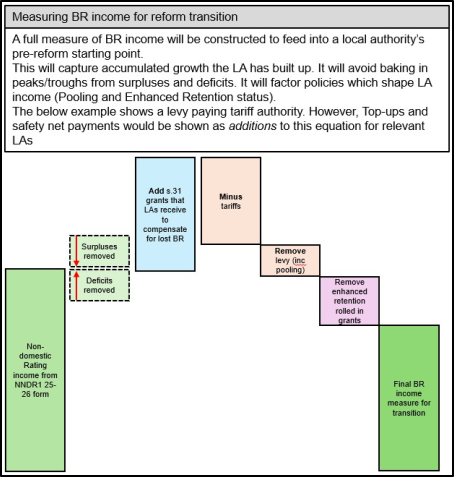
1.1.16. Chapter 5 confirms how the government plans to estimate each local authority’s current business rates income, specifically for the purpose of implementing transitional funding arrangements across the multi-year Settlement period. This chapter should be considered as one component part of the government’s overall plans to deliver transitional funding arrangements to local authorities when delivering the FFR 2.0. An illustration of how current business rates income will be measured is illustrated at Figure 1.4 at the end of the chapter.
1.1.17. Chapter 6 sets out a series of planned technical changes to the administration the BRRS which will be implemented from 2026-27.
- Firstly, it explains how the BRRS will deal with new business rates multipliers – maintaining the existing principles of the BRRS and ensuring that central government, not local government, bears the financial impacts of new multipliers. Local government income from business rates will be index-linked.
- Secondly, it sets out changes which will see business rates grant compensation, paid via s.31 grant, routed through local authority Collection Funds from 2026-27 to improve how the BRRS is reflected for local government accounting purposes.
- Thirdly, it details how Designated Area and Renewable Energy arrangements will operate from April 2026. These arrangements are exempt from the reset. However, new business rates multipliers will impact the disregarded amounts retained by local authorities. Changes are therefore required to deal with this. The government is also using the reset as an opportunity to improve how local government is compensated for business rates reliefs in designated areas, with a more nuanced method to judge what level compensation should be paid at.
- Lastly, it summarises the changes local government can expect to encounter when completing NNDR data collection forms for the financial years from 2026-27 onwards. The government has been engaging with local authority software representatives to ensure that local authority software is updated so that NNDR forms can be accurately completed.
Reset illustrations
1.1.18. Illustrations below are not to scale.
Figure 1.1 – BRB calculation (chapter 2)
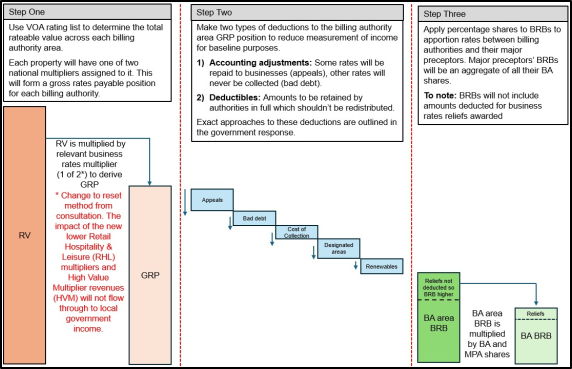
Figure 1.2 – Setting BFL aggregate and treatment of existing BR grant funding (chapter 3)
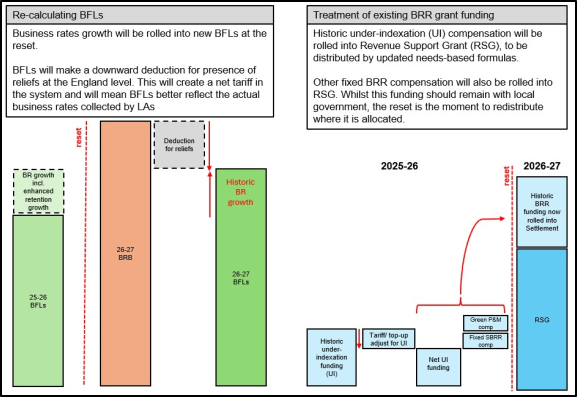
Figure 1.3 – Setting the safety net and levy (chapter 4)
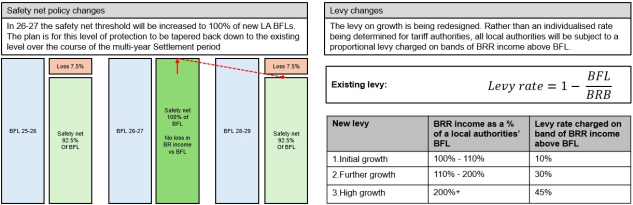
Figure 1.4 – Measuring pre-reset business rates income for 2025-26 (chapter 5)
Chapter 2: Calculation of Business Rates Baselines
2.1.1. The government ran an 8-week consultation: Local authority funding reform – Resetting the business rates retention system: technical consultation from April – June 2025 which set out its proposed approach to measuring Business Rates Baselines (BRBs) which, alongside Baseline Funding Levels (BFLs, see chapter 3), will be required to set new top-ups and tariffs to redistribute accumulated growth around the Business Rates Retention System (BRRS) from 2026-27.
2.1.2. The government has now fully considered representations made to that consultation and a government response to that consultation has been published alongside this document.
2.1.3. This chapter summarises the approach the government will take to setting BRBs at the reset. Further detail on the reasoning for changes from original proposals in the consultation, or for the choice of a method from options set out in the consultation, are given within the government response to the consultation.
Business Rates Baselines methodology following consultation
2.2.1. As set out in the consultation, BRBs will be formed by setting a gross rates payable (GRP) figure, to which deductions will be made for accounting adjustments to form a ‘collectable rates’ equivalent figure, from which other deductions will be made for disregarded amounts and the cost of collection. A deduction will not be made for government funded reliefs, which will be compensated separately via grant under section 31 of the Local Government Act 2003 (s.31 grant).
2.2.2. Some amendments and decisions have been made to the BRB methodology as a result of further work by the government, as well as in response to the consultation. These are given in more detail below, but relate in particular to: the measurement of GRP, where the use of a new ‘supplement and discount’ approach for managing new multipliers in the BRRS means that SCat codes are no longer necessary; use of a flat percentage for the allocation of appeals quantum; a decision to use a top-down approach to measuring bad debt; and minor amendments to the calculation of the amount to be deducted from collectible rates in respect of designated areas.
Gross rates payable
2.3.1. The government will calculate initial GRP figures to feed into interim 2026-27 BRBs. It will then revise this measurement at the 2027-28 Local Government Finance Settlement once compiled rating list data is available, to calculate final 2026-27 BRBs.
2.3.2. The government will use the Valuation Office Agency draft rating list to determine total rateable value (RV) for each billing authority area. It will apply either the small business rate multiplier (SBM) or the standard multiplier (SM) to each hereditament to derive a GRP position for the billing authority area. The government will compensate local authorities for their loss in income from applying the new Retail, Hospitality and Leisure (RHL) multipliers compared to what would have been collected if a property had remained on existing relevant multipliers. Authorities will return ‘supplementary’ amounts to government where they are attributable to extra revenues generated from the new High Value Multiplier (HVM) compared to the relevant standard multiplier. The s.31 grant system will be used to operationalise this.
2.3.3. This approach differs from the original consultation proposals which proposed to measure a gross rates position using all five multipliers. However, since consulting, the government has determined that the supplement and discount approach will better align the BRRS with the intentions of new business rates tax policy. The government will effectively neutralise the impact that new tax rates have on the BRRS, allowing the system to operate in a more comparable way to how it does currently. More information on how the supplement and discount approach will work is given in chapter 6.2. Reliefs
2.4.1. As proposed by the consultation, business rates reliefs will be excluded from the calculation of BRBs. No downward adjustment will be made to GRP for reliefs. Instead, government will compensate local authorities annually for their share of any mandatory or funded discretionary relief awarded locally via s.31 grant payments.
2.4.2. This will mean that new BRBs will be notional figures, and will be higher than the actual income collected in each local authority, meaning tariffs will be higher and top-ups lower for all authorities than under a net rates payable (NRP) approach to setting BRBs. This will be offset by s.31 compensation. Higher notional BRBs will not lead to higher levy rates for authorities as the government is changing the basis on which the business rates retention levy is calculated. More information on this is set out in Chapter 4.
2.4.3. To support local authority cashflow positions, the government is changing the accounting treatment required for s.31 grants related to the BRRS; these amounts will go through the collection fund from 2026-27, instead of the general fund. Further, the government intends to adjust the schedule of payments of s.31 grant in respect of the BRRS to better match the schedule of instalments for tariff payments.
2.4.4. An estimate of the aggregate England-level relief cost will still need be made to determine an England-level total BFL (see chapter 3).
Appeals
2.5.1. The government will apply a downward adjustment to GRP to account for the potential appeal loss linked to the upcoming revaluation. It will determine an aggregate England quantum for this deduction using calculations for estimated appeals losses that are built into business rates multipliers at a revaluation, and the quantum will be allocated out between local authorities to determine individual deductions. This value will exclude losses on earlier lists and will not factor in interest on potential future repayments.
2.5.2. Work conducted by the government on the allocation of this quantum found that RV was by far the single biggest factor in determining appeals loss. The government will therefore proceed with a flat percentage approach based on RV for the allocation of the quantum. No update will be made to this deduction.
Bad debt
2.6.1. The government will apply a top-down adjustment to GRP to account for losses in rates income due to bad debt. Following analysis of historic bad debt trends, the government will make a deduction to each local authority’s BRB of 0.6% of its GRP. This fixed percentage is based on an average of NNDR3 Part 2 data (lines 4 and 5) and will represent a 6-year average using 3 years pre-Covid-19 pandemic (2016-17 to 2018-19), and 3 years post-pandemic (2022-23 to 2024-25), therefore excluding the years most affected by the pandemic. No update to this fixed percentage will be made for updated NNDR3 data; the deduction will remain fixed at 0.6% GRP until the next reset.
Cost of Collection
2.7.1. The government will apply a downward adjustment to the equivalent ‘collectable rates’ figure for each local authority (GRP minus accounting adjustments) for the cost of collection allowance. This amount will then be retained by billing authorities according to the amount allocated for the year to that authority. The aggregate downward adjustment for the cost of collection allowance will remain £84 million. The government intends to cover additional costs for billing authorities arising from the reset and introduction of new business rate multipliers through the new burdens process. If tax policy measures result in a permanent and significant increase in billing authority administration costs, an increase to the allowance will be considered.
2.7.2. The allocation methodology currently used to distribute this quantum will be largely retained, subject to adjustments in the method to align with wider adjustments as part of the Fair Funding Review 2.0.
Designated areas
2.8.1. The government will apply a deduction to the equivalent ‘collectable rates’ figure for each local authority which has a designated area(s) (DA) in the calculation of BRBs. The amount deducted will reflect the amount that would have been calculated had additional multipliers not applied from 1 April 2026, using the supplement and discount approach used to run the BRRS from 2026-27 (see chapter 6.5).
2.8.2. To calculate the amount of the deduction, a gross rates measurement will be used to align with the BRB methodology. This will replace the old ‘net rates’ system of using net rates figures adjusted for accounting adjustments, renewables and transitional protection payments in the DA, and the DA baseline. The calculation will be GRP in the DA adjusted for accounting adjustments (excluding interest on appeals), amounts disregarded relating to renewables hereditaments in the DA, and the DA baseline.
2.8.3. An initial deduction will be made to BRBs using NNDR3 2024-25 data to calculate the amount of the deduction for interim 2026-27 BRBs; this will then need to be updated to set final BRBs in 2027-28. This will update figures for local authority data which reflects the compiled list and post-revaluation DA baselines. It may be necessary to collect additional data from local authorities through the bespoke data collection to facilitate the most accurate deduction possible for these arrangements at the reset. More information on what will be required from local authorities will be set out in early 2026.
Renewables
2.9.1. The government will apply a deduction to the equivalent ‘collectable rates’ figure for each local authority which has a designated renewable energy hereditament(s) in the calculation of BRBs. As with DAs, the amount deducted will reflect the amount that would have been calculated had additional multipliers not applied from 1 April 2026, using the supplement and discount approach used to run the BRRS from 2026-27 (see chapter 6.2).
2.9.2. NNDR3 2024-25 data will be used to calculate deductions for interim 2026-27 BRBs; this will be updated for LA data which reflects the compiled list and updated post-revaluation baselines, where relevant, to determine final BRBs in 2027-28 following a bespoke data collection in summer 2026.
2.9.3. It will be necessary to adjust the Non-Domestic Rating (Renewable Energy Projects) Regulations 2013 (as amended) to apply the supplement and discount approach to these disregarded amounts to ensure that the amounts retained by local authorities neutralise the impact of new business rates multipliers. The government intends to make the required amendments in early 2026 and will consult relevant authorities on these in due course.
Chapter 3: Setting an Aggregate Sector Baseline Funding Level
3.1.1. To support delivery of the Fair Funding Review (FRR) 2.0, Baseline Funding Levels (BFLs) in the Business Rates Retention System (BRRS) will be recalculated and redistributed across the sector according to an updated core distribution formula.
3.1.2. Before local authority BFL allocations are assigned, the aggregate quantum of business rates which is to be retained by local government must be remeasured. This chapter sets out a high-level process for how this exercise is to be completed.
3.1.3. In 2013-14 the local share of the estimated business rates aggregate formed the startup settlement funding assessment along with Revenue Support Grant (RSG). The aggregate BFL was equivalent to 50% of the Estimated Business Rates Aggregate and every authority was allocated a share of the aggregate BFL based on “needs formulae”.
3.1.4. Since the BRRS was set up, local authorities have received inflationary uplifts to their core funding from business rates. In practice, this has been delivered through a combination of uprating BFLs and providing under-indexation (UI) compensation grants depending on what decisions have been taken annually regarding the setting of business rates multipliers.
3.1.5. When enhanced retention areas have been introduced, local authorities have surrendered specific grants, and these amounts have been added to the local authorities’ enhanced retention BFL.
Policy for determining a Baseline Funding Level aggregate
3.2.1. At the 2026 reset, the government intends to maximise the redistribution of locally retained business rates according to an updated assessment of relative funding need across local government. This will include reassigning the vast majority of business rates growth that has accrued locally into an updated aggregate BFL, with all local authorities due to receive a BFL allocation from 1 April 2026.
3.2.2. Across the delivery of the FFR 2.0, all currently held BRRS resources will remain with local government. This includes the growth currently retained by authorities over current BFLs, and the section 31 grants (s.31) that have been awarded in respect of government relief schemes and for historic under-indexation of business rates multipliers. However, existing funding will be subject to changes in distribution as part of the delivery of funding reforms.
3.2.3. Recalculating the BFL quantum and apportioning it out across local government will ensure that all local authorities continue to receive a portion of funding for core service delivery that is linked to the aggregate quantum of business rates available to local government.
Treatment of associated existing business rates funding
3.3.1. As stated in the government’s technical reset consultation earlier this Spring, not all current funding related to business rates retention will be rolled into the new estimated business rates funding level aggregate. A key distinction will be made between growth in business rates that local authorities have collected from businesses, and grant funding that has been paid to local government to compensate for tax policy decisions.
3.3.2. Growth in locally retained business rates that has built up prior to the reset will be incorporated into new BFLs. These amounts represent additional business rates that local authorities have retained since the system was set up. The reset is the moment where growth is to be distributed across the sector according to an updated assessment of funding need. The method for calculating BFLs, set out below, will implicitly capture all business rates growth that has accumulated across the sector given new Valuation Office Agency (VOA) rating list data will be the starting point to construct a BFL aggregate.
3.3.3. Historic grant funding for under-indexation of business rates multipliers will be rolled into RSG. The reset and local government funding reforms provide the moment to redistribute this grant funding according to relative need. The amount rolled into RSG will reflect the net resources paid to local government prior to the reset. This means the funding will reflect the enhanced retention arrangements in 2025-26 and the net tariff adjustment which adjusts compensation for the impact of under-indexation on top-up and tariff figures.
3.3.4. No top-slice of UI compensation will be made to separate out compensation that is currently paid for disregards in relation to Designated Areas and Renewable Energy schemes. Grant funding is not a disregarded amount under the original intent of these arrangements and so is not protected from the reset. These amounts will remain with local government as a whole, and will be rolled into RSG.
3.3.5. Fixed business rate retention compensation amounts for Green Plant and Machinery and Small Business Rates Relief compensation for loss of supplementary income will be rolled into RSG from 1 April 2026.
Method for calculating an aggregate Baseline Funding Level
3.4.1. To calculate the aggregate BFL, the same data that will calculate Business Rates Baselines (BRBs) will be utilised wherever possible. Like the calculation of BRBs, VOA draft list data will be used, along with relevant business rates multipliers (small and standard), to estimate a sector wide GRP amount, with deductions also made for accounting adjustments and other disregarded amounts.
3.4.2. Setting aggregate BFLs in this way will mean that data relevant to the reset period is used wherever possible, limiting the impact that pre-revaluation data trends from the current reset period have on future funding allocations in the new reset period. For example, adjustments for variables such as appeals and bad debt will be based on data relevant to 2026, not on prior year local authority data which will be out of date.
3.4.3. As stated in the spring reset consultation, the government will not adjust BRBs downwards for the impact of government funded reliefs. Instead, local authorities will be compensated for the cost of all funded reliefs via s.31 grant. A primary reason for taking this approach with BRBs is the challenge of predicting the value of reliefs for the 2026 reset at the local authority level given the impact of the revaluation.
3.4.4. However, the spring consultation stated that the government did plan to include a local government wide downward adjustment for the impact that business rates reliefs have in reducing local authority income when setting the aggregate BFL quantum. A sector wide estimate can be made more robustly as reliefs can be forecasted more accurately at a broader level. This will mean that the BFL quantum will better reflect the actual business rates that local authorities will collect locally.
3.4.5. The effect of this on the BRRS is that tariffs will be higher and top-ups lower for all authorities. The presence of s.31 compensation for all funded reliefs as a core component of the system has an offsetting impact of the new top-up/tariff structure.
3.4.6. Government plans to make an addition to the aggregate BFL for existing reliefs that HMT have previously agreed to fund to offset the local share reliefs deduction. This inclusion is necessary to prevent local authorities paying the entire relief deduction via a net tariff. The net reliefs deduction to BFLs should consist of the reliefs that were factored into how the BRRS was set up in 2013-14.
3.4.7. Once the BFL aggregate is set ahead of 2026-27 it will be fixed for the forthcoming reset period. Unlike BRBs, the aggregate BFL calculation will not be updated after it is set at the 2026-27. The aggregate BFL and the distribution of allocations to local authorities is intrinsically linked to the delivery of local authority funding reforms as per the outcome of the FFR 2.0, including the implementation of transitional arrangements and the allocation of Settlement grant amounts.
Baseline Funding Level shares
3.5.1. After this aggregate is set, the BFL quantum will be apportioned local authority by local authority using relative needs-based formulae. BFLs will be introduced in full for all local authorities in 2026-27. These amounts will be compared to the BRB for each local authority to generate a top-up or tariff figure.
3.5.2. The aggregate BFL quantum will be set on a 50% retention basis. Enhanced retention arrangements which remain in place in 2026-27 will have surrendered grants layered back into their BFL positions after the initial BFL allocation has been made. Exceptionally, a few local authorities will also have additional values added to their BFLs where these have been agreed with government.
3.5.3. BFLs will then be indexed by CPI directly every year. This will happen regardless of decisions on multipliers, making local government funding simpler. Local government will be compensated for any future under-indexing of business rates multipliers from 2027-28, but there won’t be a need to make top-up/tariff adjustment where this happens.
Chapter 4: Balancing Risk and Reward in the Business Rates Retention System: Safety net, Levy and Pooling
4.1.1. The Fair Funding Review (FFR) 2.0 consultation outlined proposals to balance the level of risk and reward local authorities are subject to within the Business Rates Retention System (BRRS). These proposals included increasing the level of protection provided to local authorities’ business rates income from the safety net, and we set out that the government is exploring options for redesigning the levy rate. The consultation also noted that the government was considering whether pooling arrangements should continue from 2026-27 in the context of these changes. This chapter confirms the policy on balancing risk and reward for 2026-27 and sets out more detail on plans for the multi-year Settlement.
4.1.2. Tier splits will not be changed for 2026-27. These are the arrangements that split out the local share of business rates for each class of authority in 2026-27 where relevant.
Safety net
4.2.1. As set out in local government finance policy statement 2026-27 to 2028-29 and the government’s response to the FFR 2.0, following strong support expressed in responses to the FFR 2.0, the government is increasing the level of the safety net to protect an authority’s business rates income for 2026-27 to 100% of their set Baseline Funding Level (BFL). This will provide increased certainty for local authorities when budgeting for business rates income in 2026 amongst the backdrop of major business rates reforms, including the reset and tax policy changes.
4.2.2. As proposed in the FFR 2.0, the increased protection provided by the safety net will gradually scale back to the current 92.5% level over the course of the multi-year Settlement period. The government proposes that for 2027-28, the safety net will be set at 97% of local authorities’ BFLs, before returning to its standard level of 92.5% in 2028-29. The proposed approach reflects the feedback that local authorities would welcome increased protection from the safety net immediately after the reset. Scaling back protections is important to return to a level that balances the level of risk and reward within the BRRS. The gradual decrease in protection in 2027-28, aims to avoid cliff edges and will expose local authorities to increased risk gradually.
4.2.3. The safety net threshold for authorities subject to 100% business rates retention arrangements will increase to 100% of BFLs for 2026-27, in line with the rest of the sector. For 2027-28 to 2028-29, where 100% retention arrangements are in place, it is proposed that the safety net will be set at 97% of BFLs, in accordance with existing arrangements.
4.2.4. The plan for setting safety net thresholds will be kept under review across the multi-year Settlement.
Levy
4.3.1. The FFR 2.0 set out that the government was exploring options for redesigning the levy rate, aiming to provide a strong reward for business rates growth whilst continuing the levy’s role in funding the safety net. Without changes to the levy, some reset proposals would have meant authorities would pay an increased levy on future growth due to the technical method being used to deliver the 2026 BRRS reset.
4.3.2. From 2026-27, the government is introducing a marginal levy rate applicable to all local authorities, and levy payments will be informed by the increase in a local authority’s business rates income relative to its BFL. These margins, as demonstrated in Figure 4.1, will apply to business rates growth in a similar way to income tax bands, where the income in each band or margin would be charged a levy at the appropriate rate.
4.3.3. In setting levy rates, the government is balancing the reward of business rates growth with the need to fund safety net protections. The marginal approach will better support growth across the sector, with a lower percentage levy charge for early business rates growth in comparison to the current scheme, and the highest margin at a lower rate than the current 50% levy that many authorities are subject to.
Figure 4.1: Levy structure
| Levy band | Business rates retention income as a % of a local authorities’ BFL | Levy rate charged on business rates retention income over BFL |
|---|---|---|
| 1. Initial growth | 100% - 110% | 10% |
| 2. Further growth | 110% - 200% | 30% |
| 3. High growth | 200%+ | 45% |
Pooling
4.4.1. On 13 October, correspondence was sent to all local authorities to provide an update on relevant changes to the operation of the BRRS from 2026-27, within the context of local authorities being invited to submit a request for pooling arrangements ahead of the provisional local government finance Settlement. On 18 November, further information was sent to all authorities to confirm the Safety Net and Levy policies set out in this chapter.
4.4.2. Local authorities must submit a request to enter into pooling arrangements by 24 November 2025. The Secretary of State will then decide whether to designate a pool and provide notice of this decision at the provisional local government finance Settlement.
4.4.3. After the notification of designation of the pool is provided at the provisional local government finance Settlement, a request can be made to revoke the pool in its entirety within 28 days. The membership of a pool cannot be amended i.e. a single authority cannot leave the pool; it can only be revoked in its entirety.
4.4.4. The same marginal levy structure will be applied to pools. Under the levy structure outlined in this chapter, local authorities that pool could still be better off collectively.
Chapter 5: Measuring Pre-Reset Retained Business Rates Income for Transition
5.1.1. This chapter sets out how the government has estimated a measure of business rates income, specifically for the purpose of implementing transitional funding arrangements. The Fair Funding Review (FFR) 2.0 set out the government’s intention to put in place transitional arrangements when implementing funding reforms to:
-
Phase in new funding allocations over the multi-year Settlement period, calculating annual allocations across this period by using both existing funding distributions (including current business rates income) and the updated funding allocations.
-
Protect the income of local authorities who would see losses from funding reform. A range of funding floor levels, appropriate to specific groups, will be used. Further details are set out in the 2026-27 Local Government Finance Policy Statement.
5.1.2. A calculation of pre-reset business rates retention income will seek to reflect income available in 2025-26, as far as is practicable, based on data available at the time of delivering transitional arrangements at the provisional local government finance settlement for 2026-27. The government does not plan to update the measurement of income used for these purposes once baselines are set.
Method
5.2.1. Retained rates income estimates will be predominantly based on data billing authorities submitted to central government ahead of 2025-26. NNDR1 data can be used to determine the rates income which a billing authority expects to collect from ratepayers, making allowance for sums, in relation to that year’s rates income, that will have to be repaid following changes to rating lists (in that year or in future) and amounts that will ultimately have to be written off as bad debt.
5.2.2. Using NNDR1s for the purpose of constructing a baseline for transitional purposes has the advantage that it is readily available, and will not be subject to changes unlike NNDR3 data.
5.2.3. Surplus and deficits will be removed from the calculation. Surplus and deficits are a function of how the Business Rates Retention System (BRRS) must operate alongside local government finance’s balanced budget requirement which is managed through NNDR1 forms predominantly. However, including these amounts would skew the protection offered for transitional protections across the multi-year settlement period which the government does not believe meets the objectives of this exercise.
5.2.4. Other components which inform the amount of business rates income retained locally will also be added into the calculation. Top-ups and tariffs, section 31 (s.31) compensation for reliefs and historic under-indexation of business rates multipliers, safety net payments and levy liabilities will all be factored into the calculation of business rates income for these purposes.
5.2.5. The benefit that business pooling and enhanced retention arrangements have on income from business rates in 2025-26 will also be incorporated.
5.2.6. To ensure the benefit of pooling can be incorporated in a proportionate way, an assumption determines how the pooling levy liability is distributed across all pool members. Where no pool levy is due no adjustment is made. This approach is necessary to adopt as the government does not collect any data on how the impact of pooling affects business rates retention income for each local authority in a pool.
5.2.7. Amounts that are deducted from the calculation of Non-Domestic Rating Income will not be factored into the calculation. This includes the Cost of Collection, City of London Offset and Disregarded Amounts. These amounts are disregarded from the redistributive reset exercise and will remain with local authorities across the reset.
5.2.8. S.31 compensation in Designated Areas (DAs) will only be added back where the retained rates in a DA are below the baseline that has been set to measure future growth against. In these instances it is assumed that the s.31 reliefs belong to the billing authority area. This assumption aligns with how retained rates are treated in this scenario. This calculation will be done at the local authority level, using aggregated data where authorities’ have more than one DA in their area.
5.2.9. Grant compensation paid in connection with growth policies that underpin DAs (e.g. Case A relief for 100% retention authorities, Freeports relief and Investment Zone relief) will not be added where amounts are awarded in a DA, even where the DA is below the baseline.
5.2.10. A table below summarises how the measurement of business rates retention income has been calculated.
| Component | |
|---|---|
| Non-Domestic Rating Income for 25-26 (incl. enhanced retention tier split for 2025-26) | |
| +/- | Top-up/tariff from 2025-26 Settlement tables (reflecting enhanced retention figures where applicable) |
| + | s.31 grants for 2025-26 for funded reliefs (excluding amounted related to designated areas). Includes Green Plant and Machinery grant and top-up/tariff adjustment for under-indexing business rates multipliers |
| + /- | Safety net on account payments and estimated levy liabilities, factoring pooling arrangements in place in 2025-26 |
| - | Rolled in grants for Enhanced Retention areas as per local government finance Settlement 2025-26. Grants in scope of the Settlement will be added back to wider transition baselines for relevant local authorities. |
| + | s.31 grants in DA areas where retained rates are below the aggregate local authority DA baseline used to measure future retained rates ‘growth’ |
5.2.11. A calculator will be provided to assist local authorities in understanding how their current business rates income has been measured for their transitional arrangements which largely uses data local authorities have provided previously.
Chapter 6: Operating Business Rates Retention from 2026-27
6.1. Summary of technical changes
6.1.1. This chapter explains the technical changes the government plans to make to how the Business Rates Retention System (BRRS) will operate from 2026-27.
6.1.2. New business rates multipliers will cause variation in revenues through the BRRS from 2026. Without intervention this would have implications for local government income. The government plans to neutralise the impact of new multipliers on local government income from retained business rates. This maintains consistency with how the BRRS currently operates.
6.1.3. Despite new business rates multipliers having an impact on the revenues that billing authorities collect from businesses, their impact on the income local government retains under the BRRS will be dealt with by means of section 31 (s.31) grants. Where the financial impacts of new multipliers that apply to specific cohorts of Retail, Hospitality and Leisure (RHL) properties would otherwise result in a loss of income to local authorities, government plans to pay s.31 compensation. The value of any compensation will be offset by government clawing back any additional revenue that would accrue to authorities as a result of the new higher value multiplier.
6.1.4. Government also plans to add s.31 grant compensation paid in connection with the BRRS to the legal definition of Non-Domestic Rating Income (NDRI) and to have it credited to billing authorities’ Collection Funds. This will mean that in future any difference between NNDR1 and NNDR3 totals will become part of Collection Fund surpluses and deficits thereby reducing the impact that business rates retention currently has on local authority reserves and streamlining local government accounting of business rates retention.
6.1.5. Amendments are also planned to the operation of Designated Area (DA) and Renewable Energy arrangements from April 2026. These arrangements are exempt from the reset. However, new business rates multipliers will impact the disregarded amounts retained by local authorities under these arrangements. The government also plans to use the reset as an opportunity to improve how local government is compensated for the impact of awarding business rates reliefs in DAs.
6.1.6. Changes will also need to be made to business rates data collections that billing authorities complete twice a year. The NNDR1 2026-27 form is still being finalised, but the government wants to highlight to local government the key changes to the form which accommodate the delivery of the reset and new business rates multipliers. The government has been engaging with local authority software representatives to ensure that local authority software is updated so that NNDR forms can be accurately completed.
6.1.7. Further details on each of these proposals are set out below.
6.2. New business rates multipliers and business rates retention
6.2.1. There are currently 2 business rates multipliers – the Small Business Multiplier (SBM) and the Standard Multiplier (SM). These are both increased in line with CPI inflation and adjusted at revaluations to offset changes in rateable values.
6.2.2. HMT may by Regulations reduce the annual increase in either or both multipliers. When this happens local government is paid grant to compensate for government decisions that reduce the amount of business rates they would have otherwise retained.
6.2.3. From 1 April 2026 the business rates system will introduce three further multipliers:
-
High Value Multiplier (HVM) for properties at £500k and above.
-
2 lower Retail, Hospitality and Leisure (RHL) multipliers. These are limited to qualifying properties which are defined in secondary legislation.
6.2.4. Decisions on the levels of the multipliers for 2026-27 will be made at Autumn Budget 2025.
Treatment of existing multipliers
6.2.5. Currently, the Business Rates Retention System (BRRS) assumes that local authorities’ baseline income will change year-on-year, in line with annual changes in the two existing multipliers, which by statute are expected to rise by CPI. Baseline Funding Levels (BFLs) and tariffs and top-ups increase annually by the changes to the current multipliers. The BRRS therefore rewards local authorities for ‘real growth’.
6.2.6. Government decisions to under-index business rates multipliers (that is to increase them by less than CPI) reduce the income an authority would otherwise expect to receive. The government has a long-standing principle to protect local government income from tax policy decisions over which they have no control. Therefore, government decisions to under-index business rates multipliers generate section 31 (s.31) payments to authorities to compensate them for the loss of income. Effectively, authorities therefore feel the benefit of an inflationary increase in their business rates income.
6.2.7. From 2026 the government also proposes to index BFLs and tariffs and top-ups (T/TUs) directly by CPI as opposed to indexing by the change in business rates multipliers. This change won’t impact local government income from business rates when future compensation for any under-indexation of business rates multipliers is also factored.
6.2.8. This technical change will simplify the administration of the BRRS. Under these plans, government will no longer need to index BFLs and T/TUs in the annual Settlement by a weighted average, specific to each local authority, accounting for the fact that authorities have different shares of business rates income attributable to the small and standard multiplier. Government will also no longer need to add or deduct amounts to annual s.31 grant compensation to reflect adjustment to T/TUs in respect of under-indexation of business rates multipliers.
New business rates multipliers
6.2.9. From 2026, at the national level, additional revenues will be raised from the HVM. This revenue is intended to fund reduced RHL multipliers across England. However, at the local authority level the costs of RHL multipliers and gains from HVM will differ.
6.2.10. When new business rates multipliers were announced at Autumn Budget 2024, the government said it would work to ensure that, as far as practicably possible, local authority income would be unaffected by business rates tax policy changes. The government interprets this to mean that local authorities shouldn’t carry the risk of business rates income reducing if properties are eligible for a lower RHL multiplier, and equally that local authorities shouldn’t artificially gain as a result of HMT’s decision to tax high value properties at a higher rate.
6.2.11. As an extension of the longstanding policy to insulate local government income from tax policy decisions they have no control over, the government plans to compensate local authorities for reduced revenues stemming from lower RHL bills. To fund this, government also plans to re-coup additional HVM revenues from local authorities who collect these extra amounts.
6.2.12. Local authorities will still bill businesses on the basis of new multipliers, and will collect those amounts from ratepayers in their area. However, a system of supplements and discounts will be calculated for each local authority with central government taking responsibility for the net discount/supplement position. Calculations will be generated through existing NNDR data collection processes. This is illustrated in the worked examples in chapter 6.3.
6.2.13. At the local authority level:
-
Where properties attract RHL multipliers the local authority will collect less from ratepayers than we assume they collect under the BRRS. This will be viewed as a ‘discount’ calculated as the difference between the relevant RHL and relevant existing multiplier. The difference will be paid to the local authority by central government.
-
Where properties attract the HVM the local authority will collect more from ratepayers than is assumed that they collect under the BRRS. This will be viewed as a ‘supplement’, calculated as the difference between the HVM and the standard multiplier. The local authority will pay these amounts to central government through the wider BRRS system.
Delivery of the 2026 business rates retention reset
6.2.14. As referenced in Chapter 2, at the 2026 reset, government will set local authority baselines by using the small and standard multipliers exclusively. Using this approach, local authority baselines will be affected in the following ways:
-
Understate gross rates that local authorities collect from HVM hereditaments (this will be the difference between the standard and HVM).
-
Overstate gross rates that local authorities collect from RHL hereditaments (this will be the difference between the respective small and small RHL multipliers, and the small and standard RHL multipliers).
6.2.15. However, once planned compensation has been paid for discounts, and planned supplement revenues have been recouped, local government income should not be over or understated.
6.2.16. Government’s planned mechanism for running the supplement and discount approach will be through s.31 grants. This is because government has more flexibility to calculate amounts payable to/from authorities as opposed to the treatment of retained rates which is set out in legislation. In practice this will work as follow:
-
A s.31 grant will be payable to local government for the full cost of applying the (negative) RHL discounts to hereditaments.
-
This will be offset against a negative s.31 grant payable by local government for the additional revenue collected by applying the HVM supplement.
6.2.17. The use of s.31 grant to offset negative amounts from the High Value multiplier will be kept under review as new data becomes available in early 2026. Government will assess whether additional levers need to be utilised to recoup HVM revenues from local authorities if they outweigh available BRR s.31 grant compensation.
Benefits of this approach
6.2.18. Under this approach, future business rates growth retained by local government will continue to be based on the two existing multipliers rather than the multiplier that the property may be eligible for. The government believes this is the best way of administering the BRRS, especially considering that tax policy decisions that local authorities have no control over should not impact local authority income.
6.2.19. This approach will insulate the BRRS from potential future changes to tax policy which local government has no control over. If the BRRS had fully incorporated the new structure of business rates multipliers, it is possible that complex adjustments would be necessary to adjust local government income from business rates if further decisions change tax policy. This method therefore offers local government more stability and certainty across the forthcoming multi-year Settlement period.
Designated Area and Renewable Energy income
6.2.20. Business rates that local authorities retain in Designated Areas (or BRR zones) and from Renewable Energy Schemes, which are disregarded from the reset, will also be affected by new business rates multipliers. Further details on how the government plans to manage the impact of new multipliers on these schemes is set out in chapter 6.5.
6.3. Multipliers and business rates retention: worked examples
6.3.1. An illustration is set out below to show how new multipliers will be incorporated into the Business Rates Retention System (BRRS) from 2026. This seeks to set out the following:
-
The data billing authorities will be required to fill out through annual business rates reporting, including new reporting on additional business rates multipliers.
-
How this data will be used to administer the BRRS from 2026-27, including determining local authority income from business rates. This includes what calculations will be made as part of the reset and how the system of indexation and compensation will operate in the BRRS.
6.3.2. A base scenario is illustrated for year one, and two additional scenarios are then illustrated to demonstrate unchanged BRRS income.
-
Scenario 1 – Inflationary increases implemented in the system in year 2;
-
Scenario 2 – Inflationary increases + Retail, Hospitality and Leisure (RHL) multiplier/High Value Multiplier (HVM) values change
6.3.3. These scenarios are illustrative, and multiplier assumptions are used to show how business rates revenues will flow through the BRRS. They do not reflect government policy, nor the actual 2026-27 multipliers. Existing multipliers will be reset at the 2026 revaluation and the rates for the new multipliers will be confirmed at the Autumn Budget on 26th November 2025.
Year 1 (2026-27) Reset baseline calculations + Compensation for discounts and supplements
6.3.4. It is assumed that the rateable value in a billing authority area across each of the 5 business rates multipliers is as per the below table. Then, by applying illustrative business rates multipliers, rateable value (RV) can convert this into a gross rates payable (GRP) position.
6.3.5. Within the presentation of the GRP position, the RHL discounts and the HVM supplements are calculated as differentials below and above the respective small and standard multipliers. For illustrative purposes new multipliers have been set at the maximum amounts allowed under the Non-Domestic Rating (Multipliers and Private Schools) Act. Discounts and supplements are pre-calculated in line 4 of the below diagram.
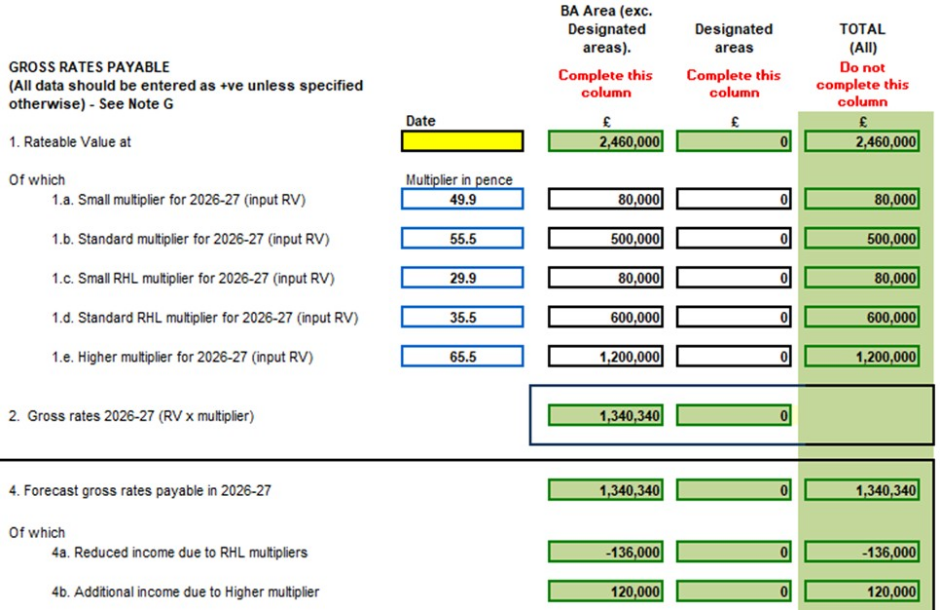
* Multiplier figures in this paper are purely illustrative and do not represent government policy.
6.3.6. At the reset the local authority’s Business Rates Baseline (BRB) for 2026-27 will be re-calculated. For the purpose of these examples a value of £678,170 is used.
6.3.7. What the local authority actually collects from ratepayers will need to be adjusted to arrive at the income the local authority will retain under its business rates retention arrangements. This can be illustrated as follows:
| Rates the local authority collections (as per NNDR form totals) | £1,340,340 |
|---|---|
| Added to the rates the local authority collects will be 31 grant funding for the reduction in rates collected under lower RHL multipliers | + £136,000 |
| The local authority will pay over extra amounts it collects as a result of the HVM | - £120,000 |
| Local authority share of income (assume 50% local share) | £1,356,340 x 50% |
| Local authority BRB (as calculated per para 5 explanation) | £678,170 |
| Assuming the LA has a tariff | - £378,170 |
| Baseline Funding Level (BFL) | £300,000 |
Year 2 (2027-28)
6.3.8. Under this scenario, in 2027-28, the small and standard multipliers have been indexed by CPI (2%). The fixed differential of the HVM and RHL multipliers stays the same. This scenario also assumes that there is no business rates growth beyond inflationary growth. I.e. there are no physical rateable value additions.
6.3.9. The local authority’s BFL and tariff will be indexed by CPI inflation directly. CPI is assumed to be 2%.
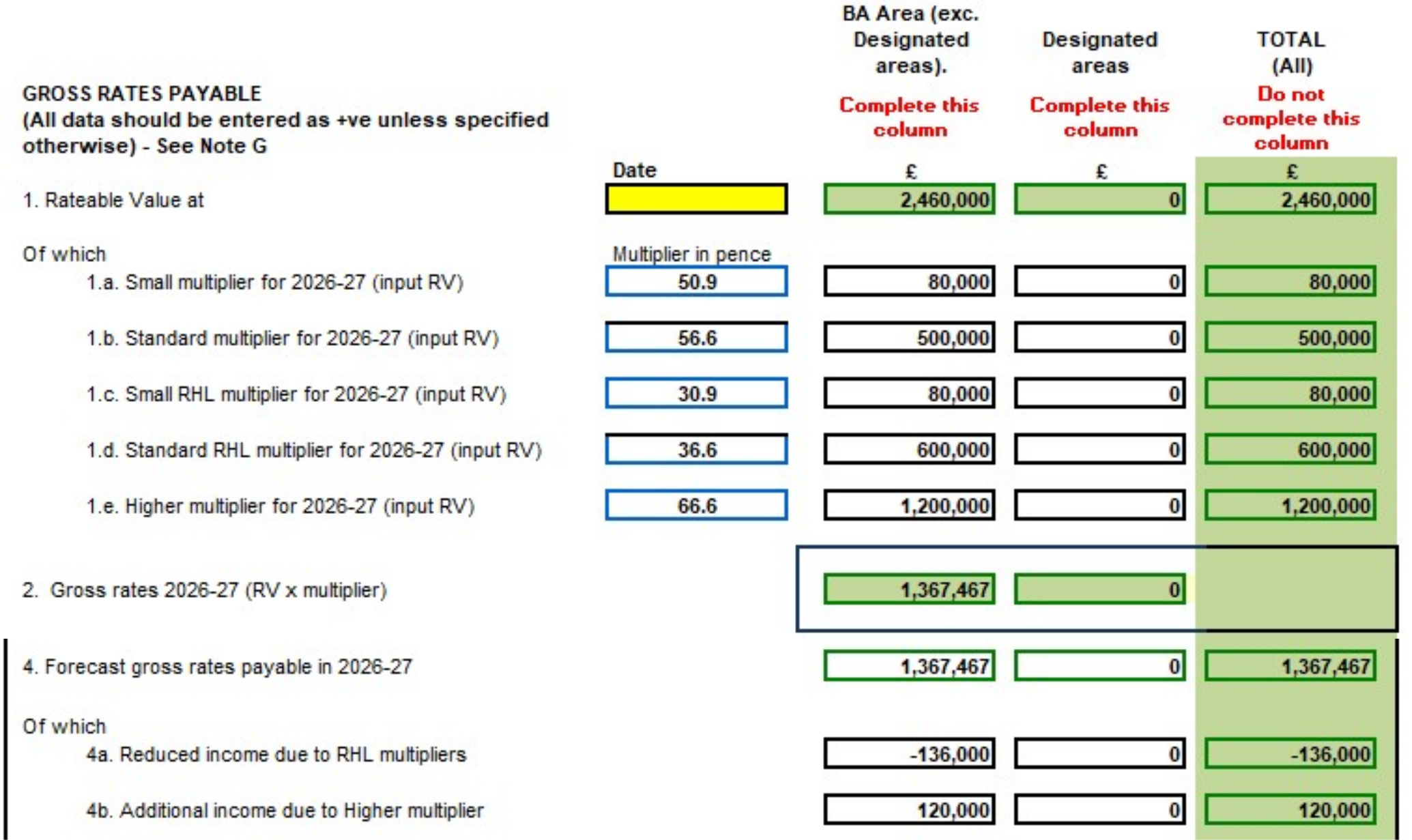
| Business rates the local authority collects (as per NNDR form totals) | £1,367,467 |
|---|---|
| Added to the rates the local authority collects will be s.31 grant funding for the reduction in rates collected under lower RHL multipliers | £136,000 |
| The local authority will pay over extra amounts it collects as a result of the HVM | - £120,000 |
| Local authority share of income (assume 50% local share) | £1,383,467 x 50% |
| Non-Domestic Rating Income | £691,734 |
| Tariff is now indexed by 2% CPI | - £385,734 |
| BFL – reconciles to BFL uprated by same CPI rate of inflation | £306,000 |
Different Year 2 scenario
6.3.10. A different scenario could see the differentials of the HVM and RHL multipliers changed in year 2. For example, the RHL multipliers could be set 10p below the existing multipliers (instead of 20p), and the HVM could be set 5p above the standard multiplier (instead of 10p).
6.3.11. Even though the differentials in the multipliers have changed, the same business rates retention income outcome is achieved (i.e. ensuring a local authority achieves its BFL). However, the RHL compensation and HVM supplement amounts will both decrease. The local authority’s income is insulated from this. This is demonstrated below:
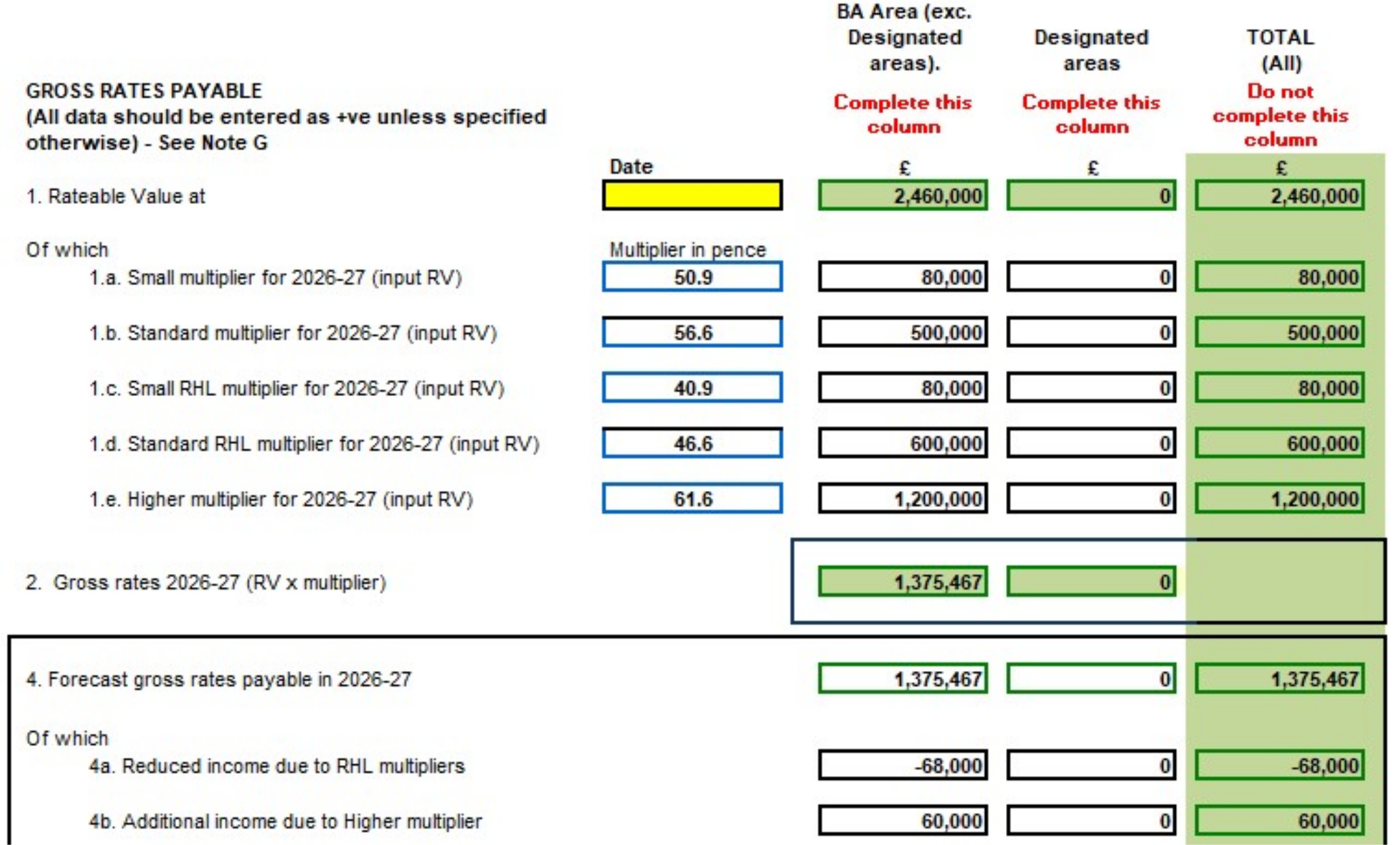
| Business rates the local authority collects (as per NNDR form totals) | £1,375,467 |
|---|---|
| Added to the rates the local authority collects will be s.31 grant funding for the reduction in rates collected under lower RHL multipliers | £68,000 |
| The local authority will pay over extra amounts it collects as a result of the HVM | - £60.000 |
| Local authority share of income (assume 50% local share) | £1,383,467 x 50% |
| Non-Domestic Rating Income | £691,734 |
| Tariff is now indexed by 2% CPI | - £385,734 |
| BFL – reconciles to BFL uprated by same CPI rate of inflation | £306,000 |
6.4. Bringing business rates retention s.31 grants into Non-Domestic Rating Income
6.4.1. From April 2026 local authorities will be compensated directly, by section 31 (s.31) grant, for all the reliefs they award to ratepayers which government funds. Alongside this, the government is also planning on expanding the definition of Non-Domestic Rating Income (NDRI) so that it includes grant compensation paid under the Business Rates Retention System (BRRS).
6.4.2. NDRI under the BRRS is estimated at the beginning of a financial year by billing authorities and is apportioned between central government, billing authorities and their major preceptors. Legislation currently requires that the sums due from ratepayers, and all transactions under the BRRS that comprise NDRI are accounted for in a billing authority’s collection fund.
6.4.3. Estimates of NDRI at the start of the year will differ from outturn figures. Surpluses and deficits which are generated by these variances are managed through the collection fund over two financial years. This means that variances do not affect a local authority’s general fund budget which must be ‘balanced’ each year with all expenditure met from available resources.
6.4.4. However, s.31 grant compensation paid under the BRRS, for business rates reliefs and for historic under-indexation of business rates multipliers, is not dealt with through the collection fund. Differences between initial estimates and outturn figures are reconciled, as necessary, at the end of the year and a local authority is required to reflect the outturn figures in its final accounts. Accordingly, any difference between the figures has an impact on local authorities’ reserves.
6.4.5. Given the government is expanding the role of s.31 grants post-2026, to cover the cost of reliefs, potential future under-indexation and the differences in income resulting from the introduction of the Retail, Hospitality and Leisure (RHL) multiplier and High Value Multiplier (HVM), the quantum of s.31 payments paid to local government under the BRRS could increase, potentially creating greater differences between estimated (NNDR1) and outturn (NNDR3) figures.
6.4.6. The delivery of the 2026 reset is the right moment to consider whether s.31 grant compensation stemming from the BRRS should be accounted for within NDRI going forwards. Going forward, s.31 compensation will be fully integrated into the BRRS.
6.4.7. The government is therefore planning on changing business rates retention legislation to specify what amounts local authorities should include in their Collection Fund accounts. Going forward this will include s.31 grants paid in connection with the main BRRS.
6.4.8. From April 2026 NNDR1s will automatically calculate the total s.31 due to a billing authority, its major precepting authorities and notionally to central government. NDRI (including the s.31 component) would be apportioned between relevant shareholders of NDRI on the basis of BRRS shares and paid from the collection fund in monthly instalments. A provisional s.31 payment of the total relief amount due would also be paid by central government to the billing authority in monthly instalments and it would be credited to the collection fund. Central government would receive amounts back from billing authorities where central share payments are due.
6.4.9. At year-end, the final s.31 payment would be calculated in NNDR3s. The difference between the provisional and final s.31 amounts would generate a reconciliation payment to or from central government. Reconciliation payments would be credited/charged to the collection fund.
6.4.10. By making this change, s.31 grant compensation in connection with the BRRS will no longer impact local authority reserves in the way it currently does. The BRRS will also be streamlined.
6.4.11. S.31 payments made in connection with Designated Areas or Renewables schemes will not be apportioned by BRRS shares. These amounts will still be retained by the relevant authority that is in receipt of these arrangements.
6.4.12. The government is planning to make changes to the relevant legislation in early 2026, and NNDR1 forms will be set up to reflect the proposed change in accounting treatment for s.31 grants. The government is working with CIPFA to ensure that these changes are reflected in accounting guidance issued to local government.
6.5. Operation of Designated Areas and Renewable Energy Schemes from 2026-27
6.5.1. Designated Areas (DAs or BRR Zones), enable billing authorities to keep 100% of their growth in business rates above a fixed baseline in a defined area, usually for a fixed period of 25 years. Any growth in a DA is protected from the reset as it is disregarded from the main Business Rates Retention System (BRRS).
6.5.2. Secondary legislation underpins DAs. These regulations include a baseline calculation which is a measure of net business rates income from the point the DA was established which future growth is measured against.
6.5.3. The baseline position is fixed for the term of the DA and is updated annually. Legislation permits baselines to be recalculated at a revaluation.
6.5.4. Annually, the collectible business rates in a DA is measured against the baseline to determine the amount of growth, if any, that is to be retained by the billing authority. This is calculated on a forecast basis at part of the NNDR1 collection and an outturn basis at the NNDR3.
6.5.5. DA regulations are subject to restrictions which prohibit changes to the boundaries of a DA or have the effect of reducing the proportion to be disregarded or the period that the designated has effect.
Accommodating new multipliers in Designated Area arrangements
6.5.6. In 2023, the government ran a technical consultation in response to the 2023 Non-Domestic Rating Act, which decoupled the non-domestic rating multipliers. A change was made to DAs introduced from 2023 onwards following the consultation.
6.5.7. The baseline for these DAs are indexed by the change in both the small and standard multiplier. A key reason for this change was the assumption that billing authorities with these arrangements would not be adversely impacted by the introduction of these tax changes at the time.
6.5.8. However, the introduction of the new multipliers in 2026-27 represents a more significant change to the structure of business rates multipliers, which could lead to both adverse and favourable impacts in DAs.
6.5.9. New business rates multipliers would impact the income retained by local authorities in DAs in two ways if no interventions were put in place.
6.5.10. There could be uncertainty in existing projections of business rates income in some DAs. Some authorities may collect additional revenues in their DAs where hereditaments change from the standard to higher multiplier. Conversely, other authorities might experience a reduction in revenues collected in designated areas where hereditaments change to the small and standard Retail, Hospitality and Leisure (RHL) multipliers. There could also be a notional misalignment with original baseline assumptions.
6.5.11. Further to the proposals set out in chapter 6.2, the government plans to address this by compensating local authorities for reduced revenues stemming from lower RHL bills in DA areas. To fund this, government will need to re-coup additional revenues from the High Value Multipliers (HVM) from local authorities who collect these extra amounts in DAs.
6.5.12. To deliver this, DA arrangements require specific consideration. The government cannot readily make changes to existing DA arrangements that are set out in legislation. Existing DAs have been approved by parliament and include a number of prohibited amendments.
6.5.13. Much like the main system, billing authorities currently receive funding for funded discretionary reliefs in DAs. These payments are made via section 31 (s.31) grant and are therefore outside the fixed legislative framework for DAs. From 2026-27, the government will therefore introduce a change to the s.31 grant calculation for DAs to address the issue related to uncertainty in existing projections.
6.5.14. A calculation will be made to offset gains from the HVM with compensation that billing authorities receive for losses from the lower RHL multipliers, and all other funded reliefs that the DA receives via s.31 grant. This would have the effect of funding losses from the RHL multipliers and funded relief payments, initially using additional revenues from the HVM. In effect, this updated calculation aims to achieve a similar outcome to how new business rates multipliers will be managed in the main BRRS.
6.5.15. There will be a “negative cap” on this calculation so that if gains from the HVM exceed available funding the authority cannot pay a negative s.31 grant.
6.5.16. Expressed as a formula, s.31 grant payments for reliefs in DAs is currently:
s.31 grant payment = funded reliefs
6.5.17. And from 2026-27 the formula will be:
S.31 grant payment* = funded reliefs + losses from RHL multipliers - gains on higher multiplier
* Number cannot go below 0 as s.31 grant cannot be negative
6.5.18. From 2026-27, calculations in the NNDR collections will contain additional information so that billing authorities will be able to identify amounts which relate to DAs more easily. This is set out in further detail in Chapter 6.6.
Worked example
6.5.19. If total funded reliefs for an authority totalled £20,000 and the impact of new multipliers on revenues collected from the new multipliers were £8,000 less collected from RHL properties and £13,000 more collected from HVM properties, then the total s.31 payment for DA reliefs would be £15,000. This is shown below in a table that compares the current method and the new method.
| Current method, £ | New method 2026-27, £ | |
|---|---|---|
| Funded reliefs | 20,000 | 20,000 |
| Loss from RHL multipliers | - | 8,000 |
| Gain on HVM | - | (13,000) |
| Adjustment to any under/over indexation | - | - |
| s.31 grant to billing authority under DA arrangement | 20,000 | 15,000 |
Compensating for Reliefs in Designated Areas
6.5.20. In the technical reset consultation earlier this year, government confirmed that it was reconsidering the way it compensates authorities for reliefs in DAs going forwards. The government has continued to look at this as part of its review of how DA arrangements should operate from 2026.
6.5.21. DAs will continue to operate on a collectable rates basis and s.31 compensation will continue for relevant mandatory and discretionary reliefs awarded in a DA. S.31 compensation will not be provided for portions of mandatory reliefs which historically have been included in the baseline calculation of a DA.
6.5.22. However, government plans to improve the calculation of how much eligible relief should be paid in a DA area depending on whether the DA is generating ‘growth’. Under the existing system, if collectable rates are below a DA baseline – i.e. there is no growth in the DA - then the authority’s local share under the BRRS applies to any funded reliefs.
6.5.23. From 2026-27, any portion of reliefs under the baseline will continue to be awarded at the relevant local share, but any portions above the baseline amount will be provided at 100% as per the terms of the DA arrangement. This calculation will still be made at the billing authority level, rather than for each DA individually.
6.5.24. This change will better compensate billing authorities, avoiding instances where authorities receive only the local share of s.31 compensation when a portion of relief is above DA baselines. The example below illustrates these changes for an example billing authority with three DAs. In this example, £30,000 of s.31 reliefs is above the baseline.
| DA A, £ | DA B, £ | DA C, £ | Total Billing Authority level, £ | ||
|---|---|---|---|---|---|
| Collectable rates | 60,000 | 40,000 | 20,000 | 120,000 | |
| S.31 reliefs | - | - | - | -80,000 | |
| Net rates | 10,000 | 20,000 | 10,000 | 40,000 | |
| Baseline | 30,000 | 20,000 | 0 | 50,000 | |
| Growth (disregarded amounts) | 0 | 0 | 10,000 | 10,000 | |
| Amount of s.31 below baseline | - | - | - | 50,000 | |
| Amount of s.31 above baseline | - | - | - | 30,000 |
6.5.25. If it is assumed the billing authority’s local share is 50%, under the existing method the authority would receive a total of £45,000 in s.31 grant in relation to reliefs across the DAs, as shown below.
6.5.26. The new method seeks to improve the accuracy of compensation as the local share is applied to the portion under the baseline, and the 100% DA arrangement is applied to the portion over the baseline, which means the total s.31 grant in relation to reliefs across the DAs £55,000 under the new method. The amount of s.31 above the baseline will be aggregated at the billing authority level.
| s.31 grant under main BRR system | 70,000 (total s.31 reliefs for DAs with no growth) x 50% = 35,000 | 50,000 (total amount of s.31 below baseline) x 50% = 25,000 |
|---|---|---|
| s.31 grant to authority under DA arrangement | 10,000 (total s.31 relief for DAs with growth) x 100% = 10,000 | 30,000 (total amount of s.31 above baseline) x 100% = 30,000 |
6.5.27. The portion of s.31 under the baseline is awarded to the billing authority and any relevant major precepting authorities as part of the BRRS. The portion above the baseline will be awarded to the relevant authority at 100% where the DA arrangement is linked to in legislation. In the majority of cases this is the billing authority.
Future changes to Designated Areas
6.5.28. These planned amendments to the on-going administration of DAs are interim adjustments to best accommodate tax policy changes into these arrangements. In the longer term, the government plans to explore permanent changes to how these arrangements operate to better accommodate tax policy changes.
6.5.29. The government believes that such changes would require primary legislation, and so these will take time to introduce. However, the government wishes to be clear with local government that changes will only seek to better align these arrangements with business rates tax policy.
6.5.30. Any changes would still prioritise the certainty that these arrangements are intended to provide whilst minimising instances of additional revenues accruing, or losses being incurred that are outside the control of the local government.
Treatment of Renewable Energy Project arrangements from 2026-27
6.5.31. Local authorities with eligible new renewable energy projects have been able to retain 100% of the business rates income ‘outside’ of the BRRS as a deduction to collectable rates to form Non-Domestic Rating Income (NDRI).
6.5.32. The renewable energy projects scheme was set up in secondary legislation via the Non-Domestic Rating (Renewable Energy Projects) Regulations 2013 (as amended). The regulations set up 6 classes of hereditament (classes A - F) for which growth in income in respect of the relevant hereditament can be kept in full, or in part (in line with a proportion of rateable value (RV) above a baseline or in line with a certificate). Growth is retained by the authority which was responsible for determining the planning application of the qualifying hereditament.
6.5.33. The amount of the disregarded amount is calculated as per the renewables regulations, for each class of hereditament. It is the NDRI for that hereditament as set out in regulation 13 of the renewables regulations, for classes A and F, or a proportion of the NDRI for each day that the hereditament meets the relevant conditions for that class, aggregated across the year. For classes B and C, this is where the RV of the hereditament on the day exceeds that of the notional baseline; for classes D and E, this is where an amount of RV in respect of the hereditament is certified for that day in respect of the scheme.
6.5.34. Where an initial baseline was set out in 2013 (notional baseline, relevant to class B and C hereditaments) above which new income can be retained, the initial baseline was set out as an RV figure, rather than a pound value figure. This notional baseline RV figure is adjusted at revaluations to reflect the revaluation change for that hereditament. This contrasts with the DA baselines, which are pound values. The calculation of the amount to be disregarded then, is the proportion above the baseline, multiplied by the NDRI, and therefore, no change in baseline is needed as a result of the changes to the multipliers themselves.
6.5.35. That said, in line with the wider principles as set out earlier in chapter 6, local authorities should not be impacted by decisions on the tax over which they do not have control. The introduction of new business rates multipliers mean that, some renewable energy hereditaments may be likely to move to the HVM, increasing the amount of income by the amount of the ‘supplement’ between the Standard multiplier and the new HVM. Conversely, any hereditaments which move from the small business multiplier or standard multiplier to one of the RHL multipliers, would stand to lose out by the equivalent ‘discount’. Whilst the majority of renewable energy projects are unlikely to sit on a new RHL multiplier, it is possible that this will happen for some class E hereditaments.
6.5.36. The government has set out in section 6.2 its intentions to compensate authorities for any loss from RHL multipliers, and to pay for such compensation using the revenues generated by the HVM. The government also intends to neutralise the impact of new multipliers on income retained under renewable energy projects, such that as far as is practicable, the amount of income retained in respect of such hereditaments is not affected by the introduction of the new multipliers.
6.5.37. To do this, it is necessary to amend the renewables regulations. The government plans to amend the calculation of disregarded amounts such that they exclude the impact of the new multipliers and in effect continue to be calculated as if only the existing multipliers continued to apply. The government will consult relevant authorities in early 2026 on the proposed changes to the regulations ahead of implementation from 1 April 2026.
6.5.38. The scheme will therefore continue to run with minimal change for authorities. As is usual, authorities with class B and C hereditaments will need to re-calculate the change in the class B and class C notional baselines in line with the revaluation.
6.5.39. As has been set out in chapter 2, the reset of the BRRS will proceed on the same basis as has been described here – the deduction to Business Rates Baselines (BRBs) will reflect amounts excluding the impact of the new multipliers. This will mean that initial BRBs will be lower by the value of the eligible disregarded renewables income, and it is therefore exempt from redistribution at the reset. Eligible authorities will continue to retain this income, administered through annual NNDR data collections.
6.5.40. S.31 grant payments will be adjusted each year in accordance with submitted local authority data, adding to any s.31 grant to be paid, the amount of any loss in respect of renewable hereditaments on RHL multipliers, and netting off from any s.31 payment, the amount of any such gain from the HVM. This will mirror the approach to the system more widely as set out in chapter 6.2, and will therefore be capped at zero s.31 grant.
6.6 Data collection from 2026-27
Context
6.6.1. Changes to data collection forms are made when changes to the business rates system are implemented to ensure data can continue to be collected on the correct basis.
6.6.2. Looking ahead, 2026-27 will see several changes to the business rates system including new multipliers, a business rates revaluation and a reset of the Business Rates Retention System (BRRS).
-
As set out in chapter 6.2, it is planned that BRRS will continue to be built on the two existing multipliers. The variance in income as a result of the new Retail, Hospitality and Leisure (RHL) multipliers and High Value Multipliers (HVMs) will be treated as supplementary amounts that will be adjusted for via section 31 (s.31) grant payments.
-
As set out in chapter 2, from 2026-27, local government will be compensated for all funded reliefs via s.31 grants, and as stated in chapter 6.4 these section 31 amounts will flow through local authority collection funds.
-
Government also plans to use s.31 payments to compensate for amounts that were previously dealt with via deductions to the central share.
6.6.3. These changes require amendments to how data is collected from local authorities on the business rates they collect locally. These proposed changes are set out below ahead of the NNDR1 2026-27 form launch in December 2025.
Changes in 2026-27 NNDR1
Part 1
6.6.4. In Part 1 of the form new lines have been added in Part 1a, to calculate the value of the s.31 grants being added back into Non-Domestic Rating Income (NDRI) so that it is included in billing authority Collection Funds.
6.6.5. This is made up of s.31 amounts for funded reliefs, adjustments for the supplement and discount and adjustments for any future under/over-indexation. The value of the total s.31 amount will be adjusted to remove any s.31 that is awarded at 100% in any Designated Areas (DAs). The minimum value of the s.31 grant will be capped at zero, to prevent a negative grant. To aid local authorities in reconciling, a new line will be included for information and will show any amount that would have been a negative grant. This is shown in the illustration below as line 9.
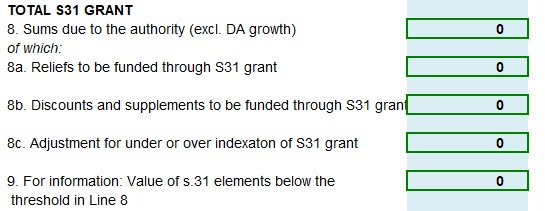
6.6.6. In Part 1b, the deductions from central share will be removed. Previously this included the adjustment for Case A and B relief in Enterprise Zones, and the Port of Bristol which will be paid via s.31 grant from 2026-27.
6.6.7. A new line will be included to add back amounts for the billing authority for any s.31 grant due to it in respect of growth in a DA which it retains in full. This is illustrated below as line 18 of Part 1b.
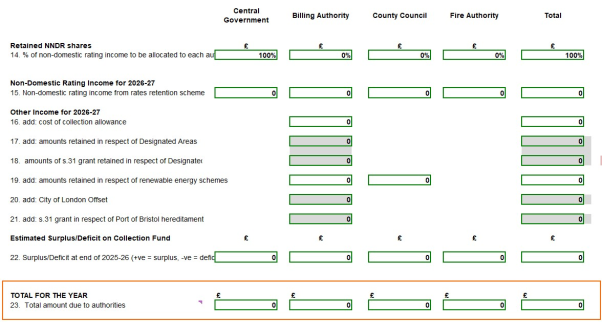
6.6.8. Part 1C has been updated. The s.31 grant due to local authorities will now be paid at 100% initially. This is to operationalise the change to include s.31 grant compensation in billing authority collection funds. Part of the total s.31 grant will be paid back to central government via the central share where applicable. This is illustrated below in column 1.
6.6.9. Amounts will also now be split out in column 6 where there is s.31 grant due to billing authorities in respect of growth in the DAs. This section is intended to ensure that billing authorities can fully reconcile the s.31 grant paid to them.
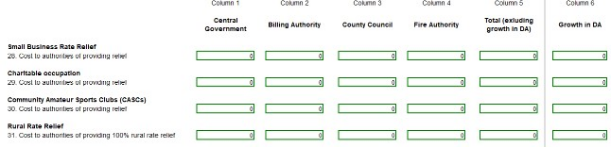
Part 2
6.6.10. For 2026-27 onwards, the government will revert to collecting data in three columns. These columns will be: billing authority area (excluding DAs), DAs and Total (All). This is illustrated in the diagram below.
6.6.11. The necessary data on each of the five multipliers will be collected at rateable value (RV) level only. This will be done in Part 2 line 1a - e. Part 2 line 3a - e will also collect data on the five multipliers for the estimated growth/decline in gross rates.
6.6.12. Formula based calculation cells have also been added to Line 4a - e. Local authorities will not need to complete these cells. They will work out the additional business rates collected and foregone as a result of the three new multipliers, against a base position of the two existing multipliers (small and standard).
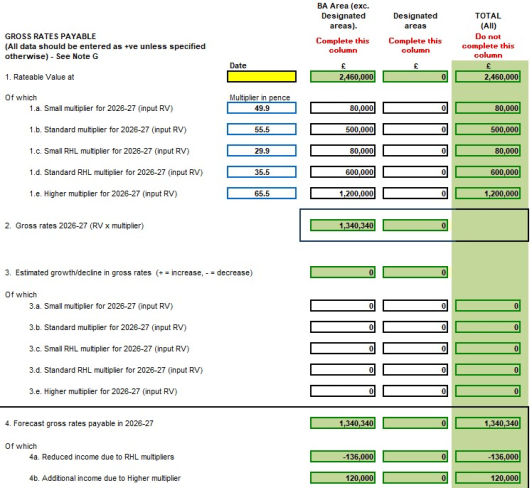
6.6.13. Transitional relief will be under a new scheme that will be announced by the Chancellor at Autumn Budget 2025.
6.6.14. Other plans for the BRRS reset include compensating for all government funded reliefs via s.31 grant. As a result, the ordering of the relief sections in Part 2 of the form will be reworked to show s.31 funded reliefs (Mandatory and Discretionary) and then Discretionary Reliefs (unfunded).
6.6.15. From 2026-27 the intention is to compensate Case A relief via s.31, rather than by a deduction from central share. The regulations that currently make the central share deduction will be updated to reflect this change and Case A relief is now shown in the Discretionary Reliefs Funded through s.31 Grant section.
Part 3
6.6.16. This part of the form collects data from local authorities on their accounting adjustments and other disregarded amounts and deductions from the central share.
6.6.17. In line with previous feedback from local government, data on accounting adjustments will continue to be collected at an aggregate level for accounting adjustments, and government will centrally apportions these amounts for income calculations related to the BRRS.
6.6.18. At the bottom of Part 3, a new for information section has been included for the calculation of the s.31 grant due to be retained at 100% by the billing authority for growth in any DAs.
6.6.19. This will show how compensation of ‘growth’ in the DA has been calculated when both retained rates and s.31 grant compensation are added together. Further detail on this is set out in chapter 6.5. To do this the value of compensation for net discounts and supplements, and funded reliefs in the DA is included in the total DA income. This is then compared to the DA baseline and any element of s.31 grant over the baseline is compensated for at 100% to the DA. An illustration of this is set out below.
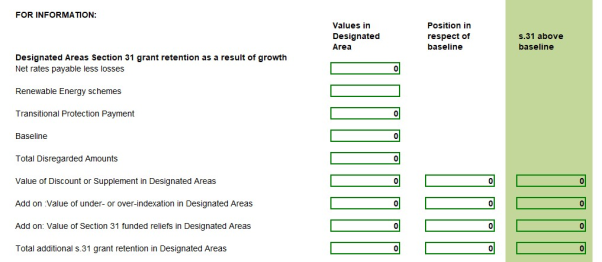
Part 3 Designated Area summary
6.6.20. DA baselines will be adjusted to account for the 2026 revaluation in the 2026-27 NNDR1 form. The baseline column will be left unlocked to allow authorities to complete this column with uprated values for 2026-27. It would then be for authorities to uprate their DA baselines according to the methodology that we will include as part of the 2026-27 NNDR1 guidance, as outlined in relevant regulations.
Part 4
6.6.21. No changes will be made to Part 4 of the 2026-27 NNDR1.
Proposed NNDR3 changes
6.6.22. The government is looking to better align the structure of NNDR1 and NNDR3 forms. It is proposed that the format of the NNDR3 will be adjusted so that it is a closer match to that of the NNDR1, including the changes outlined in this document.
| NNDR1 equivalent | NNDR3 current | NNDR3 updated |
|---|---|---|
| Part 1a | Part 1 | Part 1a (single tab) |
| Part 1 b & c | Part 4 | Part 1 b & c (single tab) |
| Part 2 | Part 3 | Part 2 |
| Part 2 DA Summary | Part 3 DA Summary | Part 2 DA Summary |
| Part 3 | Part 2 | Part 3 |
| Part 4 | Part 5 | Part 4 |
6.6.23. At the NNDR3 stage, calculations will be amended to include the Collection Fund statement for the changes to how s.31 grant is accounted for to ensure it flows through correctly. Government will follow up closer to the release of the 2026-27 NNDR3 to confirm what this will look like.
Glossary of terms
Baseline Funding Level (BFL)
The amount of an individual local authority’s Settlement allocation provided through the local share of retained business rates income. The intention is for Baseline Funding Levels to be updated in line with our updated distribution methodology, to ensure funding reflects local authority need.
Billing authority
A local authority empowered to collect tax, whether that is business rates or council tax on behalf of itself and other local authorities in its area. In England, shire districts, metropolitan districts, the Council of the Isles of Scilly, unitary authorities, London boroughs and the City of London are billing authorities.
Business rates
Business rates is the usual term for the National Non-Domestic Rate, a property tax charged on all properties which are not used for residential purposes.
Business Rates Baseline (BRB)
An authority’s Business Rates Baseline is an estimate of the authority’s business rates income generating ability, last determined on an individual basis at the outset of the BRRS. The intention is for these to updated as part of a Business Rates Retention System Reset.
Business Rates Retention System reset
A technical exercise to update our assessment of: how much business rates are available (updating Business Rates Baselines); and where they are needed (updating Baseline Funding Levels).
Business Rates Retention System (BRRS)
Business rates are a tax on non-domestic properties. Billing authorities have a responsibility to issue bills and collect rates in their areas. Since 2013-14, local government has retained, as a whole, 50% of its business rates (excluding areas with increased Business Rates Retention arrangements). This income is subject to redistribution across local government via ‘top-ups’ and ‘tariffs’. Growth in an authority’s locally raised business rates can be retained above its Baseline Funding Level, subject in some cases to the payment of a levy.
Estimated Business Rates Aggregate (EBRA)
The total business rates forecast to be collected by all billing authorities in England. This will include an England-level deduction for reliefs – i.e. it will be calculated on a net rates, not gross rates, basis.
Gross Rates Payable (GRP)
This is the measure of business rates income from ratepayers before deductions are made for reliefs, accounting adjustments, etc. To measure GRP, rateable value for each hereditament on a billing authority’s list will need to be multiplied by the relevant tax rate or ‘multiplier’. This total will form the aggregate GRP figure for each billing authority area.
Hereditament
The legal name for the unit of non-domestic property that is, or may become, liable to national non-domestic rates, and thus appears on the rating lists.
Levy
A charge on local authorities where growth in business rates income is generated locally.
Local authority
Local authorities are established under the Local Government Act 1972 and London Government Act 1963 to provide local services. There are five types of local authority: county councils; shire district councils; unitary authorities; London boroughs; and metropolitan boroughs.
In some areas of England there are two-tiers of local authority. In such areas, shire counties act as the ‘upper tier authority’, and shire districts as the ‘lower tier authority’. See Tier Splits for more information on how funding is allocated in these areas.
Fire and Rescue Authorities are also funded through the Settlement.
Local Government Finance Settlement
The local government finance settlement (the ‘Settlement’) is the annual determination of core funding to local authorities and fire and rescue authorities in England. The Settlement consists of grant, locally retained business rates and Council Tax. Settlement funding allocations are determined by the Settlement Funding Assessment.
Local list
A list of hereditaments that pay business rates to the local authority.
Local share
The percentage share of locally collected business rates that will be retained by local government.
Major precepting authority An authority that sets a precept to be collected by billing authorities through Council Tax. County councils, police and crime commissioners, the Greater London Authority and combined fire authorities are major precepting authorities.
Multiplier
The business rates multiplier when multiplied by the rateable value of a property determines a ratepayer’s business rate bill. There are currently two multipliers – one for small businesses and one for larger businesses. This is due to change in 2026-27, with two new permanently lower multipliers to be introduced for qualifying retail, hospitality and leisure properties, and one further new multiplier for properties with a valuation >£500,000.
National Non-Domestic Rates 1 Form (NNDR1)
The form submitted each year by a billing authority to its major precepting authority and central government to provide an estimate of its business rate income for the upcoming financial year.
National Non-Domestic Rates 3 Form (NNDR3)
The form submitted each year by billing authorities to its major precepting authority and central government to provide outturn data on its business rate income for that year.
Net Rates Payable (NRP)
This is the measure of business rates income from ratepayers after deductions are made for reliefs. This is therefore GRP, minus a deduction for relief awarded.
Pooled authorities/Pool
This is a facility for groups of authorities to join together and be treated as a single authority for the purposes of the BRRS. Doing so may enable authorities to share any risk and growth related to their collective business rates income in any given year.
Rateable value (RV)
The Valuation Office Agency calculates a rateable value for each business property in England and Wales. A rateable value is an estimate of what it would cost to rent a property for a year, on a set valuation date.
Revaluation
Business properties are re-valued every three years to reflect relative changes in rental valuations. The next revaluation is due in 2026.
Safety net
Mechanism to protect any authority which sees its retained rates income drop, in any year, below their Baseline Funding Level.
Section 31 grant
A Section 31 grant is a grant paid by the central government to local authorities in England under Section 31 of the Local Government Act 2003.
Tariff and top-up
Part of the redistribution system under the BRRS. Authorities whose income exceeds their assessed need will pay a tariff. Authorities whose income is less than their assessed level of need will receive a top up payment.
Tier split
The proportions by which local business rates income is split between billing and precepting authorities. For example, the current tier split between a district and a county in a two-tier area where the county has fire responsibilities would be 80:20 to the district.
Transitional arrangements
Measures which determine how authorities reach their updated allocations. This includes phasing in updated allocations over several years; and funding floors.
Valuation Office Agency (VOA)
A government agency that gives the government the valuations and property advice needed to support taxation and benefits.
-
Government is continuing to engage with the Greater London Authority and Greater Manchester and West Midland Combined Authorities on bespoke treatment. ↩