Local authority capital expenditure and receipts in England: 2024 to 2025 final outturn
Published 6 November 2025
Applies to England

© Crown copyright 2025
This publication is licensed under the terms of the Open Government Licence v3.0 except where otherwise stated. To view this licence, visit nationalarchives.gov.uk/doc/open-government-licence/version/3 or write to the Information Policy Team, The National Archives, Kew, London TW9 4DU, or email: psi@nationalarchives.gov.uk.
Where we have identified any third party copyright information you will need to obtain permission from the copyright holders concerned.
This publication is available at https://www.gov.uk/government/statistics/local-authority-capital-expenditure-and-receipts-in-england-2024-to-2025-final-outturn/local-authority-capital-expenditure-and-receipts-in-england-2024-to-2025-final-outturn
1. In this release:
- Capital expenditure by local authorities in England totalled £31.8 billion in 2024-25, up £915 million (3%) in real terms compared to 2023-24. This is £2.1 billion higher than was reported in the 2024-2025 provisional outturn in June.
- Total expenditure on fixed assets totalled £25.8 billion in 2024-25, up £1.2 billion (4.9%) in real terms compared to 2023-24. This was largely due to an increase of £683 million in expenditure on acquisition of land and existing buildings and an increase of £380 million in new construction, conversion and renovation.
- Total financial expenditure totalled £6 billion in 2024-25, down £290 million (4.6%) in real terms compared to 2023-24.
- Housing expenditure continues to be the service area with the greatest expenditure, with expenditure increasing to £10.4 billion (2.9%). Highways & Transport remains the service area with the second highest level of expenditure, increasing slightly (0.5%) to £8.3 billion.
- Capital receipts totalled £4.3 billion in 2024-25, up £534 million (14.3%) in real terms than in 2023-24.
- Capital grants totalled £13.3 billion and remained the largest source of financing of capital expenditure in 2024-25, broadly the same as 2023-24. Prudential borrowing increased to £10.7 billion, up £420 million (4.1%) on last year.
Release date: 6 November 2025
Date of next release: November 2026
Responsible Statistician: Imogen Johnson-Ormston
Contact: CapitalData@communities.gov.uk
Media enquiries: NewsDesk@communities.gov.uk
2. Introduction
Capital expenditure comprises the buying, constructing or improving of physical assets, such as buildings, land, vehicles and other miscellaneous property, including streetlights and road signs. It also includes grants and advances that authorities make to other bodies for capital purposes. Because of the project-based nature of capital expenditure, there can be relatively larger variance in expenditure over time compared with revenue expenditure.
This release provides the final outturn for local authority capital expenditure and receipts in the financial year April 2024 to March 2025. These data are derived from valid Capital Outturn Returns (COR) from 406 out of 409 local authorities in England. Data has been imputed for the following 3 authorities who have not yet submitted: Derbyshire, Dudley and North Warwickshire.
These data are collated by the Data, Analysis, Statistics and Surveys (DASS) division of the Ministry of Housing, Communities and Local Government (MHCLG). COR forms capture local authority capital expenditure and receipts by economic category and service area, as well as a breakdown of how expenditure is financed, prudential system information, and accumulated capital receipts and major repairs reserve levels. COR service areas are consistent with the Service Reporting Code of Practice (SeRCOP).
From 2024/25, local authorities are required to apply IFRS 16 Leases as adopted in CIPFA’s Code of Practice on Local Authority Accounting in the United Kingdom. The standard brings most leases on balance sheet, increasing recognised lease liabilities which are treated as credit arrangements for prudential purposes. This increases authorities’ Capital Financing Requirement (CFR) and total external debt within the COR, without a corresponding rise in in-year capital expenditure. It also leads to higher Minimum Revenue Provision (MRP) charges.
A provisional outturn was published in a Statistical Release in June 2025. This was based on information from Capital Payments and Receipts Returns 4 (CPR4) submitted by local authorities in England.
3. Capital expenditure and receipts by economic category
Local authorities report capital expenditure, incurred by buying, building or improving capital assets, and capital receipts, received from the sale of a capital asset.
Total capital expenditure is divided into total expenditure on fixed assets, which includes spending on tangible and intangible fixed assets, and total financial expenditure, which includes grants, loans, and acquisitions of share or loan capital for capital purposes.
As shown in Table 1 and Figure 1, capital expenditure by local authorities in England totalled £31.8 billion in 2024-25, up £915 million (3%) in real terms compared to 2023-24. This increase was driven by an increase of £1.2 billion (4.9%) in total expenditure on fixed assets, which totalled £25.8 billion.
The increase in expenditure on fixed assets was largely due to an increase of £683 million (26.2%) in expenditure on acquisition of land and existing buildings to £3.3 billion in 2024-25. New construction, conversion and renovation remained the largest category of capital expenditure at £20.2 billion, increasing by £380 million (1.9%) compared to 2023-24.
Total financial expenditure decreased by £290 million (4.6%) to £6 billion.
Capital receipts totalled £4.3 billion in 2024-25, an increase of £534 million (14.3%) in real terms compared to 2023-24.
Expenditure treated as capital by virtue of Section 16(2)(b) Direction increased to £1 billion, the highest level seen over the last 5 years. Since 2020-21, several authorities have been granted exceptional financial support (EFS), although not all of them may have used this, or used the full amount. See a full list of local authorities with agreed EFS.
Table 1: Local authority capital expenditure & other transactions and capital receipts by category: forecast and final outturn, England, 2020-21 to 2024-25
Real terms series, all monetary figures in 2024-25 prices (£ millions)
| Category | Type | 2020-21 | 2021-22 | 2022-23 | 2023-24 | 2024-25 |
|---|---|---|---|---|---|---|
| Acquisition of land & existing buildings | Forecast (adjusted) | 5,864 | 4,670 | 3,203 | 1,758 | 2,920 |
| Outturn (final) | 3,290 | 2,394 | 2,158 | 2,610 | 3,293 | |
| New construction, conversion & renovation | Forecast (adjusted) | 19,208 | 21,008 | 18,558 | 18,754 | 19,867 |
| Outturn (final) | 17,043 | 19,059 | 18,838 | 19,779 | 20,159 | |
| Vehicles, plant, furniture & equipment | Forecast (adjusted) | 1,856 | 1,921 | 1,996 | 1,917 | 1,989 |
| Outturn (final) | 1,794 | 1,786 | 1,688 | 1,857 | 1,999 | |
| Intangible fixed assets | Forecast (adjusted) | 355 | 417 | 421 | 279 | 326 |
| Outturn (final) | 335 | 315 | 323 | 353 | 353 | |
| Total expenditure on fixed assets | Forecast (adjusted) | 27,284 | 28,016 | 24,177 | 22,708 | 25,102 |
| Outturn (final) | 22,462 | 23,555 | 23,007 | 24,599 | 25,804 |
| Category | Type | 2020-21 | 2021-22 | 2022-23 | 2023-24 | 2024-25 |
|---|---|---|---|---|---|---|
| Grants, loans and other financial assistance | Forecast (adjusted) | 7,455 | 7,588 | 6,274 | 6,086 | 5,905 |
| Outturn (final) | 5,909 | 6,048 | 6,591 | 6,107 | 5,843 | |
| Acquisition of share and loan capital | Forecast (adjusted) | 505 | 293 | 279 | 198 | 174 |
| Outturn (final) | 1,217 | 928 | 514 | 136 | 110 | |
| Total financial expenditure | Forecast (adjusted) | 7,961 | 7,882 | 6,552 | 6,284 | 6,078 |
| Outturn (final) | 7,127 | 6,975 | 7,106 | 6,243 | 5,953 |
| Category | Type | 2020-21 | 2021-22 | 2022-23 | 2023-24 | 2024-25 |
|---|---|---|---|---|---|---|
| Total capital expenditure | Forecast (adjusted) | 35,244 | 35,898 | 30,730 | 28,992 | 31,181 |
| Outturn (final) | 29,588 | 30,530 | 30,112 | 30,842 | 31,757 | |
| of which GLA[1] | Forecast (adjusted) | 5,033 | 4,098 | 4,033 | 3,318 | 3,279 |
| Outturn (final) | 3,989 | 3,966 | 3,985 | 3,604 | 3,151 | |
| Payment of LSVT levy | Forecast (adjusted) | 0 | 0 | 0 | 0 | 0 |
| Outturn (final) | 0 | 5 | 1 | 0 | 0 | |
| Expenditure treated as capital by virtue of a Section 16(2)(b) Direction[2] | Forecast (adjusted) | 73 | 203 | 201 | 415 | 447 |
| Outturn (final) | 224 | 268 | 885 | 642 | 1,029 | |
| Total capital expenditure & other transactions | Forecast (adjusted) | 35,317 | 36,101 | 30,930 | 29,407 | 31,628 |
| Outturn (final) | 29,812 | 30,797 | 30,999 | 31,484 | 32,786 |
| Category | Type | 2020-21 | 2021-22 | 2022-23 | 2023-24 | 2024-25 |
|---|---|---|---|---|---|---|
| Total capital receipts | Forecast (adjusted) | 4,713 | 2,810 | 2,665 | 2,415 | 3,557 |
| Outturn (final) | 3,100 | 4,155 | 4,679 | 3,731 | 4,265 |
Notes:
-
Forecasts are unadjusted at the GLA level.
-
Expenditure which does not fall within the definition of expenditure for capital purposes but is treated as capital expenditure by a direction under section 16(2)(b) of the Local Government Act 2003. See further information about section 16(2)(b)
-
Outturn figures for 2023-24 have been revised since the previous publication, as these include a small number of late submissions or resubmissions of data by local authorities. Forecast figures have not been revised.
- Sources: CER 2020-21 to 2024-25 and COR 2020-21 to 2024-25
Figure 1: Local authority capital expenditure in real terms by economic category, England, 2020-21 to 2024-25
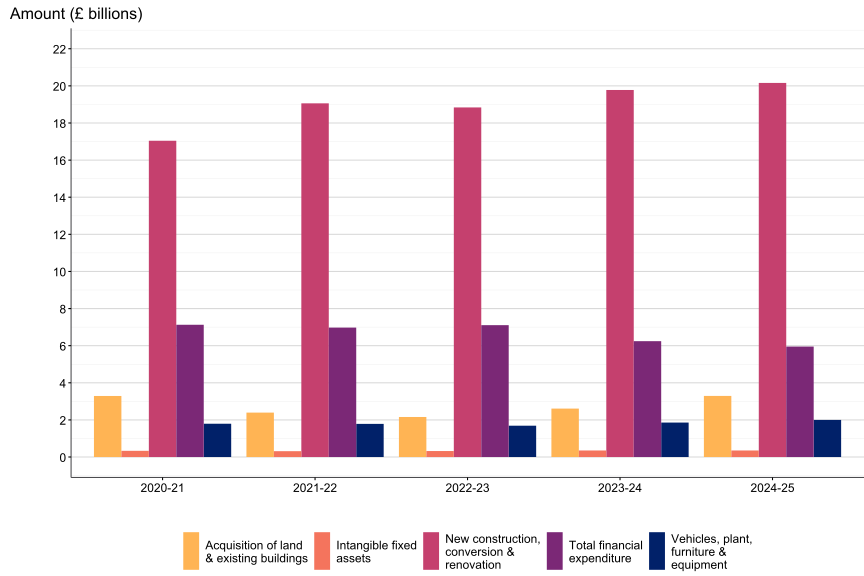
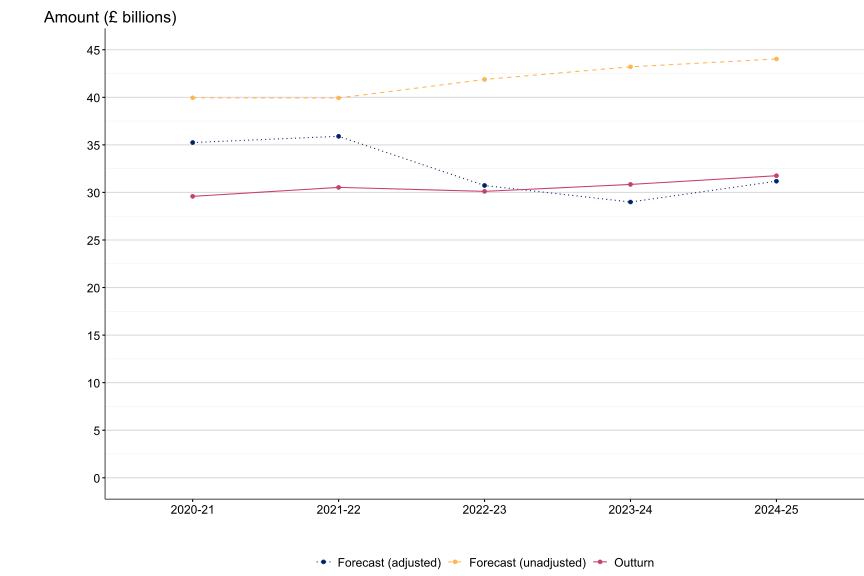
Figure 2 shows the difference between unadjusted forecasts, adjusted forecasts, and outturn data for total capital expenditure since 2020-21. Forecasts are adjusted as local authority forecasts are consistently higher than subsequent outturn. Differences between them can be caused by slippage in timings of projects, changes in service priorities or in financial capabilities of an authority throughout the year.
Caution should be taken when comparing outturn and forecast data over time in this release. This is especially true for 2020-21 since these forecasts were based on local authority estimates made prior to the impact of coronavirus (COVID-19) outbreak in early 2020.
Figure 2: Total capital expenditure in real terms: unadjusted forecast, adjusted forecast, and final outturn, England, 2020-21 to 2024-25 [note 1]
Notes:
- Figures are from the ‘England grossed excluding double counting’ total, which should avoid double counting due to any flow of grants, loans or other financial assistance or receipts between local authorities and/or between functional bodies of Greater London Authority.
4. Capital expenditure by service area
Local authorities report capital expenditure and receipts across 13 service areas, as shown in Table 2.
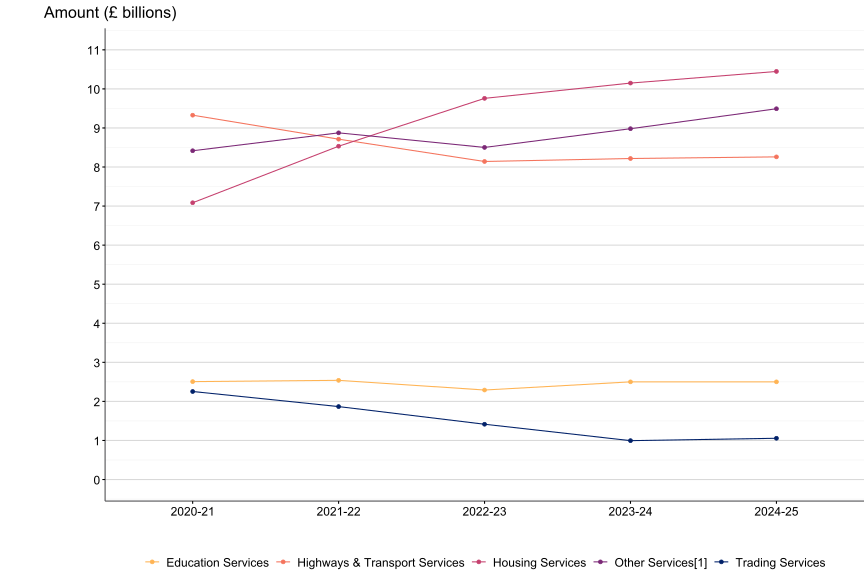
Figure 3 shows how capital expenditure across these service areas has changed since 2020-21.
Housing Services and Highways & Transport Services continued to account for the majority of local authority capital expenditure in 2024-25, with the two accounting for £10.4 billion (32.9%) and £8.3 billion (26%) of all capital expenditure respectively. Over the last 5 years, in real terms, the proportion of total capital expenditure attributed to Housing Services has increased by 8.9 percentage points.
Expenditure on Housing Services was up by £298 million (2.9%) in real terms compared to the previous year.
Expenditure on Highways & Transport Services was up slightly by 0.5% in real terms compared to the previous year. Greater London Authority (GLA) continues to have the highest expenditure on highways and transport from a single authority (£1.8 billion) despite a decrease of £143 million (7.4%) in real terms compared to the previous year.
Expenditure on Trading Services totalled £1.1 billion in 2024-25, up £61 million (6.1%) in real terms from the previous year. This is the first year we have seen an increase in the level of expenditure on trading services over the past 5 years, after 4 consecutive years of decline, although expenditure in 2024-25 remains lower than it was 2 years ago.
Table 2: Local authority total capital expenditure by service: final outturn, England, 2020-21 to 2024-25
Real terms series, all monetary figures in 2024-25 prices (£ millions)
| Service | 2020-21 Outturn (final) | 2021-22 Outturn (final) | 2022-23 Outturn (final) | 2023-24 Outturn (final) | 2024-25 Outturn (final) |
|---|---|---|---|---|---|
| Education | 2,507 | 2,540 | 2,292 | 2,501 | 2,501 |
| Highways & Transport | 9,327 | 8,713 | 8,142 | 8,218 | 8,260 |
| of which GLA | 2,987 | 2,505 | 2,165 | 1,943 | 1,800 |
| Social Care | 342 | 411 | 427 | 525 | 617 |
| Public Health | 28 | 30 | 43 | 27 | 32 |
| Housing | 7,086 | 8,533 | 9,758 | 10,149 | 10,447 |
| of which London Boroughs | 2,774 | 3,346 | 4,101 | 4,152 | 4,448 |
| of which GLA | 367 | 773 | 1,288 | 861 | 804 |
| Culture & Related Services | 1,357 | 1,507 | 1,469 | 1,604 | 1,782 |
| Environmental & Regulatory Services | 870 | 1,067 | 1,404 | 1,403 | 1,348 |
| Planning & Development Services | 2,064 | 2,353 | 2,145 | 2,513 | 2,167 |
| Digital Infrastructure | 209 | 269 | 201 | 162 | 123 |
| Police | 992 | 862 | 843 | 866 | 903 |
| Fire & Rescue Services | 199 | 190 | 218 | 283 | 311 |
| Central Services[1] | 2,356 | 2,186 | 1,752 | 1,598 | 2,209 |
| Trading[2] | 2,254 | 1,868 | 1,416 | 996 | 1,057 |
| Total Capital Expenditure | 29,588 | 30,530 | 30,112 | 30,842 | 31,757 |
Notes:
- Central Services include court costs, local tax collection, and other core council services costs (such as IT).
- Trading Services include the maintenance of direct labour and service organisations, such as civic halls, retail markets and industrial estates, and commercial activity.
- Source: COR 2020-21 to 2024-25
Figure 3: Local authority capital expenditure in real terms by service, England, 2020-21 to 2024-25
Notes:
- Other services includes expenditure on Social Care, Public Health, Culture & Related Services, Environmental & Regulatory Services, Planning & Development Services, Digital Infrastructure, Police Services, Fire & Rescue Services and Central Services.
5. Difference between 2024-25 provisional and final outturn
Table 3 details changes in expenditure between provisional and final outturn for 2024-25.
Provisional outturn figures are collected on a quarterly basis in the Capital Payments Return (CPR). For the first three quarters (CPR1-3) local authorities only provide all-service totals of capital expenditure and receipts. For the fourth quarter (CPR4) they provide annual outturn figures at the service level as well as financing and prudential data. The provisional outturn figures in Table 3 are from CPR4.
The level of capital spending varies between CPR4 and COR because local authority accounts are not yet finalised when CPR4 is collected.
Local authorities in England reported £31.8 billion of capital expenditure at final outturn, up £2.1 billion (7%) compared to the provisional outturn. This change is greater than is typically seen between CPR4 and COR. The largest increase in reported expenditure was on housing which increased by £786 million (8.1%). However, this year, all services other than Planning & Development Services and Digital Infrastructure showed an increase between CPR4 and COR.
Expenditure on trading services increased by £450 million 74.1% compared with provisional figures. Typically, this service shows more spend at final outturn due to recategorisation, as local authorities are reminded to report commercial acquisitions in this category. Last year, this category saw an increase of 38.3% between provisional and final outturn.
Four authorities (Barking & Dagenham, Greater London Authority, Newham and West Yorkshire Combined Authority) accounted for £677 million of the additional reported expenditure, however authorities across most types of authority have reported an increase between provisional and final outturn. Therefore, the change appears to reflect a general increase in reporting across most types of service and authority, rather than being driven by an specific type of expenditure or authority type.
Total Capital Receipts increased by £956 million (28.9%) compared with provisional figures.
Table 3: Local authority total capital expenditure and total capital receipts: provisional and final outturns by service, England, 2024-25
Cash terms table, all monetary figures as reported (£ millions)
| Service | Provisional | Outturn | Change | Percentage Change |
|---|---|---|---|---|
| Education | 2,271 | 2,501 | 230 | 10.1 |
| Highways & Transport | 8,055 | 8,260 | 205 | 2.5 |
| of which GLA | 1,789 | 1,800 | 11 | 0.6 |
| Social Care | 589 | 617 | 28 | 4.8 |
| Public Health | 29 | 32 | 3 | 10.3 |
| Housing | 9,661 | 10,447 | 786 | 8.1 |
| of which London Boroughs | 3,903 | 4,448 | 545 | 14.0 |
| of which GLA | 654 | 804 | 150 | 22.9 |
| Culture & Related Services | 1,472 | 1,782 | 310 | 21.1 |
| Environmental & Regulatory Services | 1,186 | 1,348 | 162 | 13.7 |
| Planning & Development Services | 2,466 | 2,167 | -299 | -12.1 |
| Digital Infrastructure | 174 | 123 | -51 | -29.3 |
| Police | 897 | 903 | 6 | 0.7 |
| Fire & Rescue Services | 243 | 311 | 68 | 28.0 |
| Central services[1] | 2,031 | 2,209 | 178 | 8.8 |
| Trading[2] | 607 | 1,057 | 450 | 74.1 |
| Total Capital Expenditure | 29,681 | 31,757 | 2,076 | 7.0 |
| Total Capital Receipts | 3,309 | 4,265 | 956 | 28.9 |
Notes:
-
Figures are from the ‘England grossed excluding double-counting’ total, which should avoid double counting due to any flow of grants, loans or other financial assistance or receipts between local authorities and/or between functional bodies of Greater London Authority.
-
Central Services include court costs, local tax collection, and other core council services costs (such as IT). Some local authorities report commercial activity within this category. New categories and guidance were issued in Spring 2018 encouraging such expenditure to be recorded under Trading Services.
-
Trading Services include the maintenance of direct labour and service organisations, such as civic halls, retail markets and industrial estates.
- Sources: CPR4 2024-25 and COR 2024-25
6. Financing of capital expenditure
Authorities finance their capital spending in a number of ways. A breakdown of the main elements of local authority capital funding is given below:
-
Capital grants are provided by government departments and other organisations. The majority of governmental grants are not ring-fenced, giving authorities flexibility to choose how to spend this money, provided it is used for capital purposes.
-
Prudential borrowing is borrowing freely undertaken by the local authority within the affordability limits stated by their auditors, as specified in the Local Government Act 2003.
-
Capital receipts are from the sale of capital assets.
-
Revenue resources can be used by local authorities to support capital spend. There is no restriction on revenue funds being used in this way, although accounting convention prevents capital resources being used to cover revenue spend.
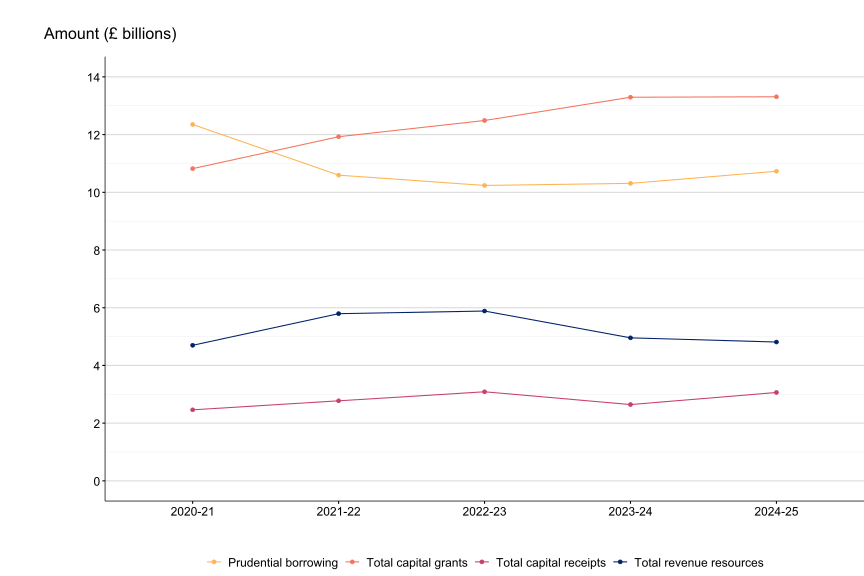
As shown in Table 4 and Figure 4, capital grants continue to be the largest source of financing of capital expenditure in 2024-25, broadly stable at £13.3 billion in real terms compared to last year. Prudential borrowing increased by £420 million (4.1%) to £10.7 billion.
Table 4: Financing of local authority capital expenditure by source: final outturn, England, 2020-21 to 2024-25
Real terms series, all monetary figures in 2024-25 prices (£ millions)
| Source of Financing | 2020-21 | 2021-22 | 2022-23 | 2023-24 | 2024-25 |
|---|---|---|---|---|---|
| Total capital grants | 10,821 | 11,927 | 12,489 | 13,295 | 13,311 |
| Grants from central government departments[4] | 8,071 | 9,443 | 9,991 | 10,586 | 10,359 |
| Grants from European structural & investment funds | 58 | 60 | 95 | 51 | 3 |
| Grants from private developers & leaseholders, etc. | 1,283 | 1,342 | 1,390 | 1,582 | 1,462 |
| Grants from non-departmental public bodies[1] | 608 | 613 | 776 | 942 | 1,325 |
| Grants from the National Lottery | 56 | 43 | 45 | 37 | 32 |
| Grants from Local Enterprise Partnerships | 745 | 424 | 191 | 97 | 129 |
| Total capital receipts | 2,462 | 2,774 | 3,087 | 2,644 | 3,063 |
| Total revenue resources | 4,698 | 5,794 | 5,885 | 4,956 | 4,811 |
| Housing Revenue Account | 492 | 777 | 571 | 485 | 567 |
| Major Repairs Reserve | 2,024 | 2,123 | 2,058 | 2,146 | 2,027 |
| General Fund (CERA) | 2,182 | 2,894 | 3,258 | 2,325 | 2,218 |
| Total prudential borrowing[2] | 12,351 | 10,594 | 10,238 | 10,310 | 10,730 |
| Loans & other financial assistance from Local Enterprise | 13 | 12 | 13 | 36 | 18 |
| Other borrowing & credit arrangements not supported by central government | 12,338 | 10,581 | 10,226 | 10,273 | 10,712 |
| Total resources used to finance capital expenditure | 30,333 | 31,087 | 31,699 | 31,205 | 31,916 |
Notes:
-
Non-Departmental Public Bodies, organisations that are not government departments but which have a role in the processes of national government, such as the Sport England, English Heritage and Natural England.
-
The Prudential System, which came into effect on 1 April 2004, allows local authorities to raise finance for capital expenditure - without government consent - where they can afford to service the debt without extra government support.
-
Total capital receipts used to finance capital expenditure.
-
From 2022/23, more detailed data on central government departments was collected, resulting in some corrections of categorisation from central government to non-departmental public bodies. This is an ongoing process.
-
From 2017-18 onwards, intra-local government transfers are being netted off both expenditure and financing. However, as grants and loans made to other local authorities as part of expenditure may not equal the use of grants and loans from other authorities to finance expenditure within a financial year, financing and expenditure may not match.
- Sources: COR 2020-21 to 2024-25
Figure 4: Financing of local authority capital expenditure in real terms by source, England, 2020-21 to 2024-25
7. Accompanying tables and open data
7.1 Symbols used
0 = zero or negligible
[x] = Data missing / not available
[z] = Not applicable
[r] = Revision
[b] = Discontinuity
7.2 Rounding
Where figures have been rounded, there may be a slight discrepancy between the total and the sum of constituent parts.
7.3 Tables
Accompanying tables are available to download alongside this release. These are:
Table 1a: Local authority capital expenditure & other transactions and capital receipts by category: forecast and final outturn, England, 2020-21 to 2024-25 (Real terms table, all monetary figures in 2024-25 prices)
Table 1b: Local authority capital expenditure & other transactions and capital receipts by category: forecast and final outturn, England, 2020-21 to 2024-25 (Cash terms table, all monetary figures as reported)
Table 2a: Local authority total capital expenditure by service: final outturn, England, 2020-21 to 2024-25 (Real terms table, all monetary figures in 2024-25 prices)
Table 2b: Local authority total capital expenditure by service: final outturn, England, 2020-21 to 2024-25 (Cash terms table, all monetary figures as reported)
Table 3: Local authority total capital expenditure and total capital receipts: provisional and final outturns by service, England, 2024-25 (Cash terms table, all monetary figures as reported)
Table 4a: Financing of local authority capital expenditure by source: final outturn, England, 2020-21 to 2024-25 (Real terms table, all monetary figures in 2024-25 prices)
Table 4b: Financing of local authority capital expenditure by source: final outturn, England, 2020-21 to 2024-25 (Cash terms table, all monetary figures as reported)
Table 5: Local authority total capital expenditure and total capital receipts: final outturn by service and category, England, 2024-25 (Cash terms table, all monetary figures as reported)
Table 6: Local authority prudential system information: final outturn by category, England, 2024-25 (Cash terms table, all monetary figures as reported)
Table 7a: Local authority prudential system information: net debt as at 31 March by class of authority, England, 2020-21 to 2024-25 (Real terms table, all monetary figures in 2024-25 prices)
Table 7b: Local authority prudential system information: net debt as at 31 March by class of authority, England, 2020-21 to 2024-25 (Cash terms table, all monetary figures as reported)
Table 8a: Local authority prudential system information: self-financed borrowing by class of authority, England, 2020-21 to 2024-25 (Real terms table, all monetary figures in 2024-25 prices)
Table 8b: Local authority prudential system information: self-financed borrowing by class of authority, England, 2020-21 to 2024-25 (Cash terms table, all monetary figures as reported)
Table 9: Local authority total value of assets, as at 31 March 2025: final outturn by category, England, 2024-25 (Cash terms table, all monetary figures as reported)
All data in this release are available at local authority level for:
COR A1: Total capital expenditure and receipts, England, 2024-25
COR A2: Further details of capital expenditure on Social Care, Grants & Loans, Roads, Street Lighting & Road Safety, and Section 16(2)(b) Direction, England, 2024-25
COR A3: Total acquisitions, disposals & impairment costs, England, 2024-25
COR B1: Financing of capital expenditure, England, 2024-25
COR B2: Grants from central government used to finance capital expenditure by authority, England, 2024-25
COR C: Prudential system information, England, 2024-25
COR D: Accumulated capital receipts and Major repairs reserve, England, 2024-25
COR E: Local authority trading companies, subsidiaries, associates and joint ventures by authority, England, 2024-25
COR F: Total value of assets held by the local authority directly, in trading companies and in subsidiaries, England, 2024-25
2024 to 2025 supplementary data: Housing Revenue Account capital receipts, expenditure and financing
See the Local authority capital expenditure, receipts and financing webpage for all tables and workbooks, as well as related statistical releases.
9. Technical notes
Please see the accompanying technical notes document for further details.
Information on Official Statistics is available via the UK Statistics Authority website.
Information about statistics at MHCLG is available via the Department’s website.