Livestock populations in the United Kingdom at 1 June 2025
Updated 2 October 2026

© Crown copyright 2026
This publication is licensed under the terms of the Open Government Licence v3.0 except where otherwise stated. To view this licence, visit nationalarchives.gov.uk/doc/open-government-licence/version/3 or write to the Information Policy Team, The National Archives, Kew, London TW9 4DU, or email: psi@nationalarchives.gov.uk.
Where we have identified any third party copyright information you will need to obtain permission from the copyright holders concerned.
This publication is available at https://www.gov.uk/government/statistics/livestock-populations-in-the-united-kingdom/livestock-populations-in-the-united-kingdom-at-1-june-2025
This release contains the estimates of cattle, sheep, pig and poultry populations on agricultural holdings in the UK on 1 June 2025. The notice is compiled using data available at the time of publication.
Results are sourced from the June Surveys run in each country.
The result tables are available at Livestock populations in the United Kingdom. This dataset contains detailed breakdowns for all livestock, including other livestock.
Key points
- The total number of cattle and calves in the UK decreased by 1.3% to 9.3 million in June 2025. The breeding herd continued its long-term downward trend, due to a 4.1% decrease in the beef herd to 1.3 million. The dairy herd has seen little change in recent years and this continued in 2025 with an increase of 0.7% to 1.8 million.
- In 2025, the total number of pigs in the UK remained almost unchanged at 4.7 million animals. A 0.9% increase in fattening pigs offset a 3.2% decrease in the number of breeding pigs.
- The total number of sheep and lambs decreased by 1.7% to 30.5 million. The reduction in flock size was mostly due to a 2.9% decrease in the number of lambs which account for almost half of all sheep and fell to 14.8 million in 2025.
- The total number of poultry increased by 4.1% to 183 million in 2025 and is the first increase in numbers since 2021. This was largely due to an increase in broiler numbers, which rose by 7.6% to 121 million. The breeding and laying flock declined by 1.2% to almost 54 million.
Section 1 Detailed results
1.1 Cattle
The number of cattle and calves in the UK has decreased by 1.3% between 2024 and 2025 and now stands at 9.3 million animals. This continues a gradual downward trend seen in cattle numbers over the past decade.
Figure 1: Female cattle breeding herd in the United Kingdom at 1 June (Number of cattle)
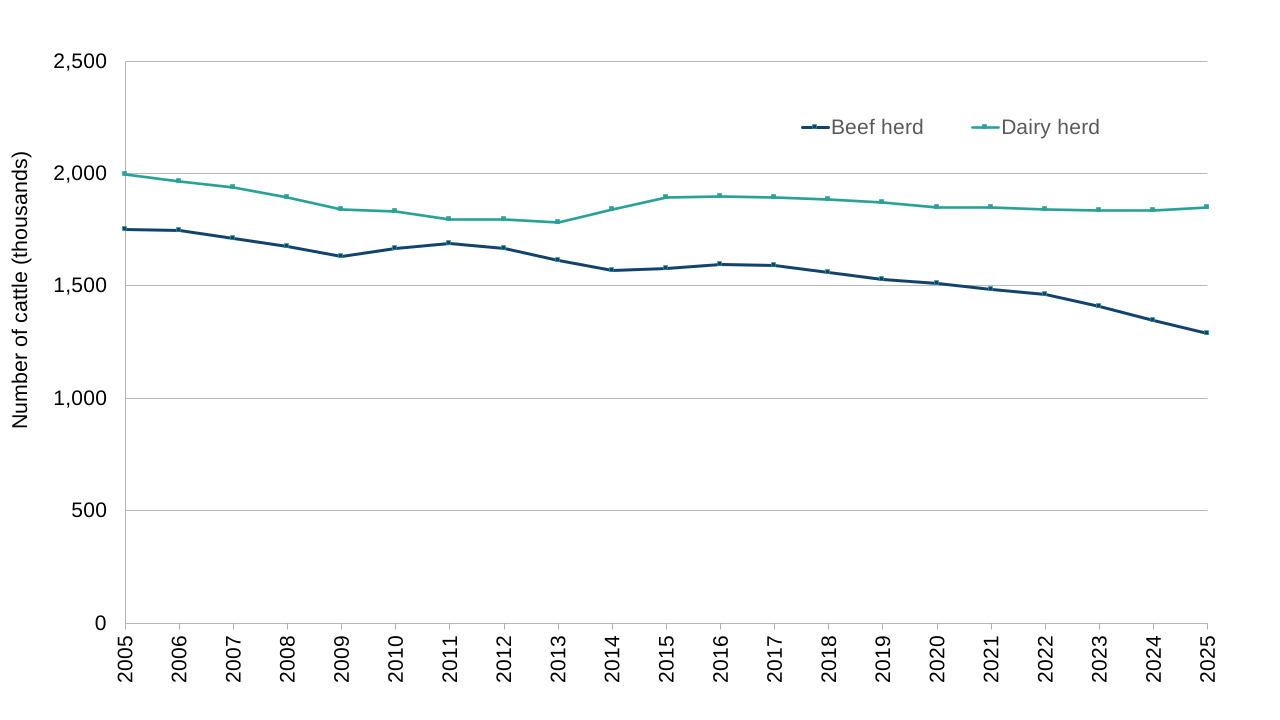
The breeding herd accounts for just over a third of the overall cattle population in the UK and decreased by 1.3% to 3.1 million in 2025. The decrease is due to a continuation in the long-term downward trend in the beef herd, which fell a further 4.1% between 2024 and 2025 and now stands at 1.3 million. In contrast, the dairy herd has remained broadly stable over the past decade and saw a small increase of 0.7% to 1.8 million (Figure 1).
Within the breeding herd, the gradual decrease seen in the beef herd has led to the dairy herd now accounting for almost 60% of the total (Figure 2).
Figure 2: Breakdown of the female cattle breeding herd in the United Kingdom at 1 June (Number of cattle)
| year | Beef herd | Dairy herd | Total |
|---|---|---|---|
| 2021 | 1,485,283 | 1,850,042 | 3,335,325 |
| 2022 | 1,462,980 | 1,841,845 | 3,304,825 |
| 2023 | 1,407,171 | 1,836,164 | 3,243,335 |
| 2024 | 1,344,374 | 1,836,442 | 3,180,816 |
| 2025 | 1,289,723 | 1,849,459 | 3,139,182 |
1.2 Pigs
The number of pigs in the UK remained broadly stable at 4.7 million in 2025. Fattening pigs account for 91% of all pigs and stood at 4.3 million. This was an increase of 0.9% when compared with 2024. Breeding pig numbers decreased by 3.2% to 407 thousand head.
Figure 3: Female pig breeding herd in the United Kingdom at 1 June (Number of pigs)
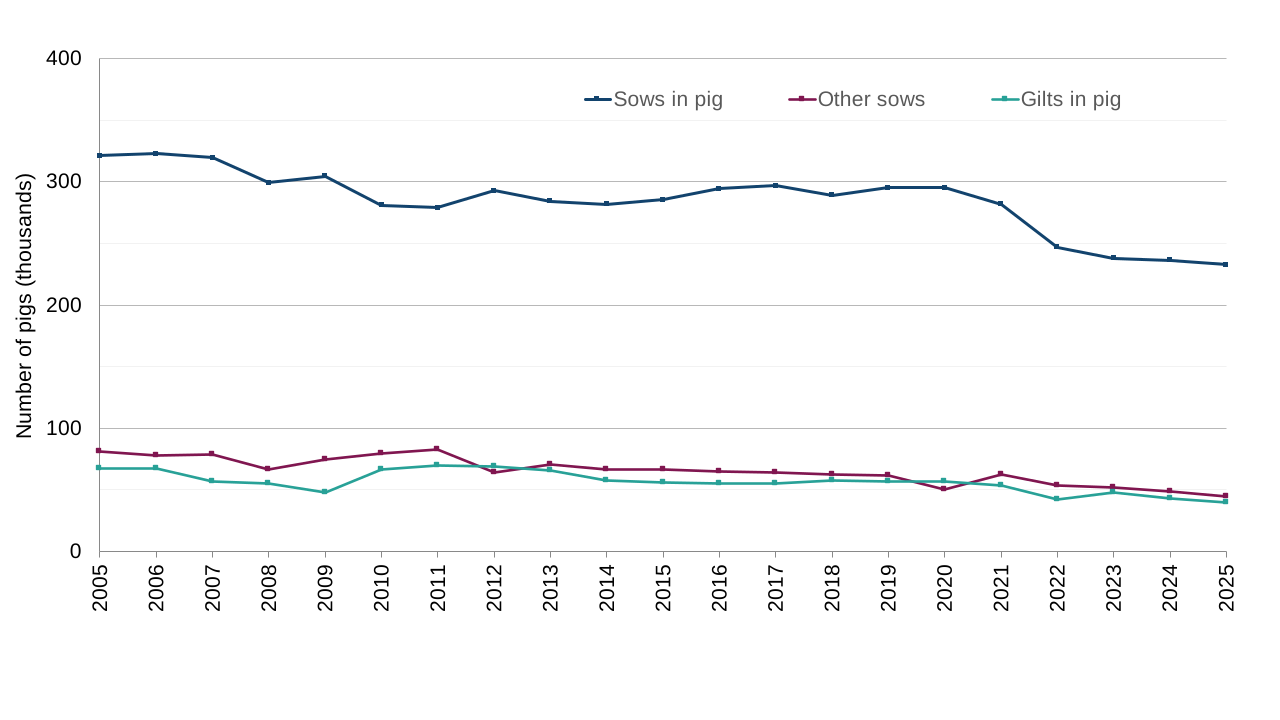
(1) Other sows are those either being suckled or dry sows kept for further breeding.
The female breeding herd, which accounts for 78% of breeding pigs, fell by 3.3% to 316 thousand head. Decreases were seen across each category within the breeding herd (Figures 3 and 4). Other breeding pigs also saw a decrease, falling by 2.8% from 93 thousand head in 2024 to 91 thousand head in 2025.
Figure 4: Breakdown of the female pig breeding herd in the United Kingdom at 1 June (Number of pigs)
| Year | Sows in pig | Gilts in pig | Other sows | Total |
|---|---|---|---|---|
| 2021 | 281,954 | 53,636 | 62,808 | 398,398 |
| 2022 | 247,004 | 42,304 | 53,794 | 343,102 |
| 2023 | 238,228 | 47,808 | 51,897 | 337,933 |
| 2024 | 236,210 | 42,579 | 48,517 | 327,306 |
| 2025 | 232,732 | 39,313 | 44,346 | 316,391 |
(1) Other sows are those either being suckled or dry sows kept for further breeding.
1.3 Sheep
The number of sheep and lambs in the UK decreased by 1.7% to 30.5 million in 2025 and continues the overall downward trend in flock size seen in recent years.
Figure 5: Female breeding sheep and other sheep and lambs in the United Kingdom at 1 June (Number of sheep)
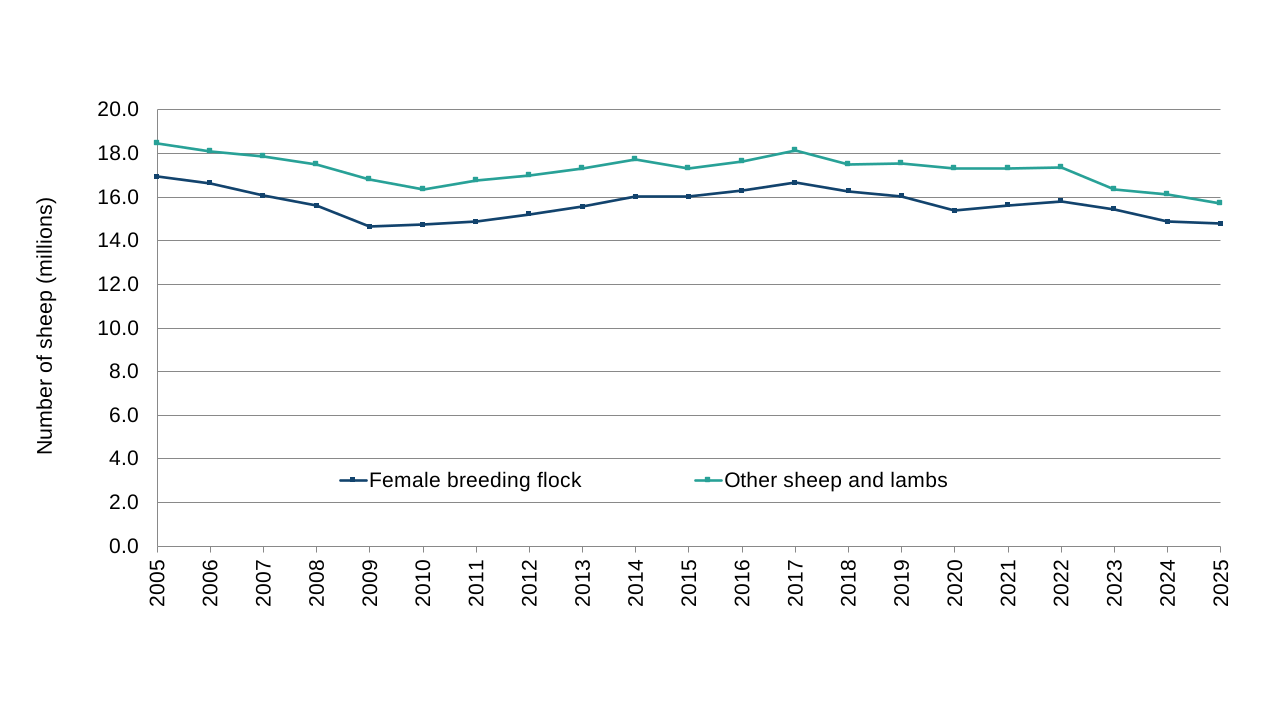
In 2025, the female breeding flock decreased by 0.7% to 14.8 million and other sheep & lambs fell by 2.7% to 15.7 million animals (Figures 5 and 6). Lambs account for the majority of other sheep & lambs and decreased by 2.9% to 14.8 million. They continue to make up almost half of the total sheep population in 2025.
Figure 6: Breakdown of the total sheep in the United Kingdom at 1 June (Number of sheep)
| year | Female breeding flock | Other sheep and lambs | Total |
|---|---|---|---|
| 2021 | 15,624,233 | 17,332,789 | 32,957,022 |
| 2022 | 15,825,519 | 17,348,229 | 33,173,748 |
| 2023 | 15,437,826 | 16,364,710 | 31,802,536 |
| 2024 | 14,881,531 | 16,135,170 | 31,016,701 |
| 2025 | 14,779,632 | 15,703,976 | 30,483,608 |
1.4 Poultry
The number of poultry in the UK has increased by 4.1% to 183 million birds in 2025. This is the first increase in total poultry numbers since 2021.
The overall rise in the number of poultry is largely due to a 7.6% increase in table chickens (broilers), which stand at 121 million and account for 66% of all poultry in 2025. The number of breeding and laying fowl decreased by 1.2% to 54 million (Figure 7).
Figure 7: Table chickens and total breeding and laying flock in the United Kingdom at 1 June (Number of birds)
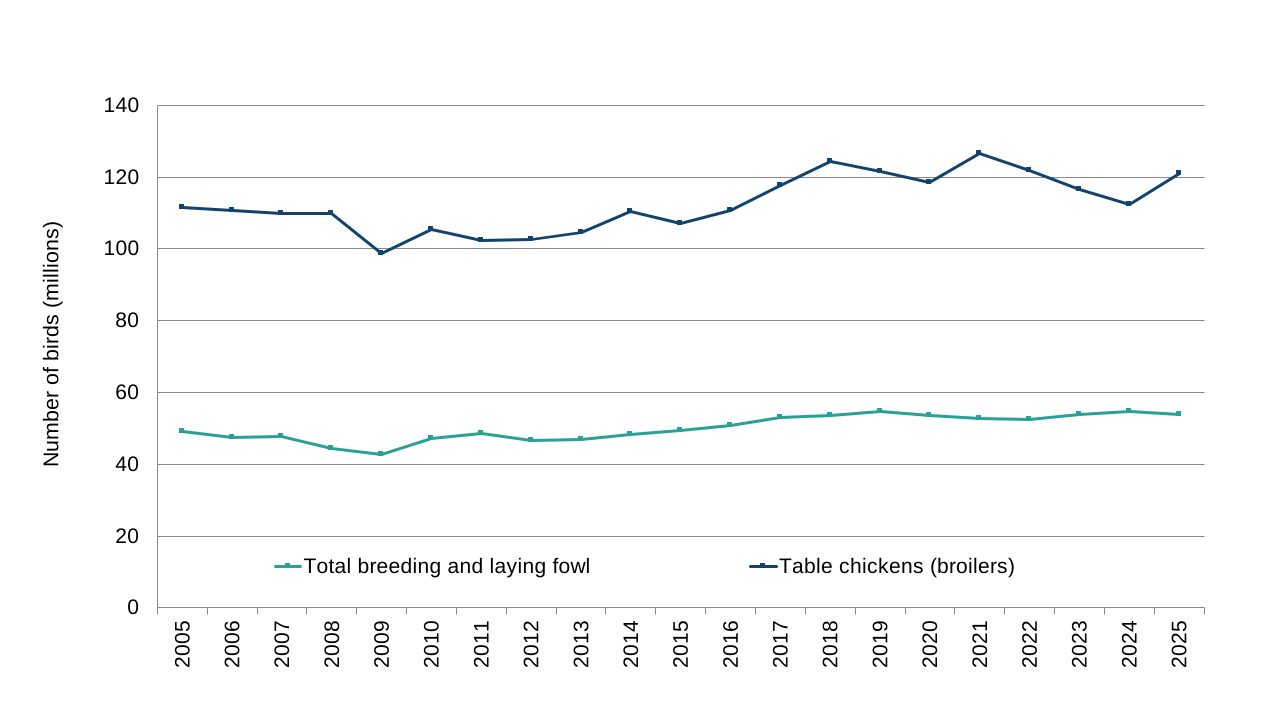
In 2025, the breeding flock decreased by 12% to 11 million birds. The number of hens and pullets laying eggs for eating increased by 2.0% to 43 million birds and accounts for 79% of total breeding and laying fowl (Figure 8).
Figure 8: Breakdown of the total breeding and laying flock in the United Kingdom at 1 June (Number of birds)
| Year | Hens and pullets laying eggs for eating | Breeding flock | Total |
|---|---|---|---|
| 2021 | 40,567,728 | 12,270,905 | 52,838,633 |
| 2022 | 40,442,225 | 12,020,826 | 52,463,051 |
| 2023 | 41,072,748 | 12,719,650 | 53,792,398 |
| 2024 | 41,862,895 | 12,748,629 | 54,611,524 |
| 2025 | 42,703,380 | 11,231,822 | 53,935,202 |
Section 2 About these statistics
2.1 Data uses and users
- Data from the June Survey help us monitor changes in livestock populations over time and effects of changing policies, including during the agricultural transition period.
- The numbers are also used to make forecasts of meat and milk production to inform industry of the availability of supply which affects prices.
- Livestock distributions across the UK help assess the risk of veterinary disease and to control outbreaks.
- The data are also used heavily in calculations of the greenhouse gas and ammonia emissions inventories.
Results from the England June Survey of Agriculture and Horticulture also have a wide range of uses and users with requests for data being made daily. A document providing information of specific uses and users can be found on our guidance and notes.
2.2 Other survey results and publications
More detailed results from the June Survey can be found on our Structure of the agricultural industry in England and the UK at June web page. This includes various time series of crop areas and livestock numbers dating back as early as 1866 and detailed geographical breakdowns of the results.
The results from the June Survey of Agriculture 2026 in England are expected to be published as follows:
- Cereal and oilseed rape areas and Livestock populations in August 2026.
- Agricultural land use and Agricultural workforce data expected to be available in September 2026.
United Kingdom results are expected to be published in December 2026.
Provisional cereal and oilseed harvest statistics for England are expected to be published in October 2026, with United Kingdom estimates expected in December 2026.
The definitive publication dates for all UK nation releases will be announced on the research and statistics webpage on gov.uk.
2.3 Methodology: June Survey of Agriculture and Horticulture
Data on crop areas and livestock populations are collected in the June Survey of Agriculture and Horticulture carried out by each of the UK agriculture departments. The methodology adopted by each country is below.
England
England results are from the June Survey of Agriculture and Horticulture in 2025. The June Survey of Agriculture and Horticulture has been run predominantly online since 2011, with an option for farmers to complete a paper form if they prefer. The survey is annual and samples around 30,000 holdings most years, with a full census run once a decade. The last census was run in 2021.
The June 2025 survey was sent to a sample of 55,000 commercial holdings and responses were received from 27,000 holdings, representing a response rate of 51%. This is a larger sample than usual which will enable us to provide detailed geographical breakdowns later in the year and help to understand changes currently happening within the farming sector, e.g. changes in land use following the introduction of ELM schemes. Commercial holdings are defined as those with more than five hectares of agricultural land, one hectare of orchards, 0.5 hectares of vegetables or 0.1 hectares of protected crops, or more than 10 cows, 50 pigs, 20 sheep, 20 goats or 1,000 poultry.
Table 1 provides details of the sample survey population broken down by farm size. The size of a farm is determined by its Standard Labour Requirement (SLR) which is the typical number of full-time workers required on the holding based on its activity. In the SLR system, each livestock type and land-use has a theoretical amount of labour required each year. This value is multiplied by the land area or livestock numbers and then summed to give the SLR for the holding. For pig and poultry sectors, an additional data collection exercise was run to collect data from a central point for some of the largest companies.
Table 1: June 2025 population size and sampling rate
| Stratum | Description | Sampling rate (%) | Population size | |
|---|---|---|---|---|
| 1 | SLR < 0.5 | 35% | 56,109 | |
| 2 | SLR >= 0.5 and < 1 | 55% | 13,020 | |
| 3 | SLR >= 1 and < 2 | 78% | 12,020 | |
| 4 | SLR >= 2 and < 3 | 78% | 5,652 | |
| 5 | SLR >= 3 and < 5 | 78% | 5,411 | |
| 6 | SLR >= 5 | 78% | 5,710 | |
| 10 | SLR unknown | 97% | 3,968 | |
| All | 52% | 101,890 |
Cattle results are sourced from the Cattle Tracing System (CTS). The data include returns from all holdings with cattle so are not subject to survey error. More information on the use of this administrative data can be found on the survey notes and guidance report
The data are subject to rigorous validation checks which identify inconsistencies within the data or large year-on-year changes. Any records that have not been cleaned by the results production stage are excluded from the analysis.
Population totals are estimated for each question on the survey to account for the non-sampled and non-responding holdings. This survey uses the technique known as ratio raising, in which the trend between the sample data and base data (previous year s data) is calculated for each stratum. The calculated ratio is then applied to the previous year s population data to give England level estimates. For holdings where we do not have base data (new holdings or long-term non-responders) the sample estimates are raised according to the inverse sampling fraction.
Cereal and oilseed areas and cattle, sheep and pig populations from the England 2025 June Survey were published on 28 August 2025 and Land use and agricultural workforce data were published on 25 September 2025. All can be viewed on our Statistics about the structure of the agricultural industry web page
More details on the June Survey methodology can be found on the Structure of the agricultural industry: survey notes and guidance web page
Scotland
Final results for Scotland were published by the Scottish Government on 30 October 2025 at: www.gov.scot/collections/june-scottish-agricultural-census
The June Agricultural Census is conducted annually by the Scottish Government’s Rural and Environmental Science Analytical Services division (RESAS). Data are requested from all holdings who submitted a Single Application Form (SAF) in the previous year, together with some other large businesses that would not be eligible for support payments. A sample of smaller holdings which didn’t submit a SAF or who didn’t return a form for the previous census were also sent a census form. Data for the June census is collected from three sources:
- Land data were extracted from the Single Application Form (SAF) database for holdings that are claiming under the Basic Payment Scheme (BPS).
- All holdings within our sample were sent a census form covering land, livestock and labour. Holdings completing a SAF were not expected to complete section 3 (land area) of the census form.
- All cattle data were collected from the Cattle Tracing Scheme administrative source. Farmers are required by law to register any births, deaths and movements of their cattle to the British Cattle Movement service who maintain an online database. More information can be found online here. By using this data source we effectively have 100 per cent coverage, even for those smaller holdings that were not selected for inclusion in the census. RESAS categorises all agricultural holdings in Scotland as either a “Main” holding or a “Min” holding. A holding is a “Main” if it meets certain thresholds such as a certain area of land or a certain amount of animals. All “Main” holdings in Scotland are included in the census. The smaller holdings are only surveyed around once every four years to reduce the burden on the smaller farms. Holdings which have not received a form in the past four years are included in the sample.
In 2025, there were 48,330 agricultural holdings in Scotland and within the census 33,927 were selected to complete a census form (the majority of these completed online). Of those who received a request to complete the census 18,818 provided a return, resulting in a final response rate of 55 per cent.
Table 2 below shows the response rates for different types of farms. The first column shows the percentage of holdings that responded. Since some larger farms account for a larger proportion of overall activity or land area in Scotland, the second column shows what percentage of land area, livestock or workforce each category represents. In most cases this is higher than the percentage of holdings, indicating that there is better coverage in the census of larger holdings.
Table 2: Percentage cover of holdings, land area, livestock and workforce for different farm features, 2025
| percentage cover of holdings | percentage cover of land, livestock or workforce | |
|---|---|---|
| Total cereals (hectares) | 85% | 96% |
| Arable area (hectares) | 51% | 95% |
| Total crops and fallow (hectares) | 66% | 96% |
| Total sole right agricultural area (hectares) | 54% | 97% |
| Total cattle (number) | 100% | 100% |
| Total sheep (number) | 48% | 73% |
| Total pigs (number) | 30% | 76% |
| Total poultry (number) | 39% | 89% |
| Total working occupiers (number) | 52% | 53% |
| Total employees (number) | 61% | 64% |
| Total agricultural workforce (number) | 53% | 58% |
For further details contact Scottish Government: RESAS Statistics (Agriculture) Email: agric.stats@gov.scot.
Wales
The Welsh population currently stands at around 24,000 active holdings. In 2025 a total of 10,300 farms were sampled. Returns were made both by paper form and online. Online returns comprised 60% of responses received. Final results were based on a response rate of 50%. Final results for Wales were published by the Welsh Government on 10 December 2025 at: https://gov.wales/survey-agriculture-and-horticulture
For further details contact Agricultural & Rural Affairs Statistics, Welsh Government, Cathays Park, Cardiff, CF10 3NQ (telephone: Cardiff 03000 255049). E-mail: stats.agric@gov.wales.
Northern Ireland
In 2025, the Northern Ireland Agricultural and Horticultural Survey was conducted as a full census using online data collection. Data for the pig and poultry sections are also complete censuses extracted from the NI Annual Inventory of Pigs and Update of NI Bird Register respectively. Data for the cattle section was extracted from the Northern Ireland Food Animal Information System (NIFAIS).
Telephone support was provided for farmers who could not complete online and a focussed telephone follow-up of non-responding farms was carried out.
A statistical estimation and imputation methodology was used to create statistics for those who did not provide a return.
A total of 28,370 letters were issued and a final farm register of 25,834 created. Results are based on 15,630 completed questionnaires.
Final results will be published on 11th December 2025 by the Department of Agriculture, Environment and Rural Affairs (DAERA) for Northern Ireland and can be viewed at: www.daera-ni.gov.uk/articles/agricultural-census-northern-ireland
For further details contact DAERA surveys@daera-ni.gov.uk.
2.4 Feedback
We welcome feedback and any thoughts to improve the publication further. Please send any feedback to: farming-statistics@defra.gov.uk.
Section 3 What you need to know about this release
3.1 Contact details
Responsible statistician: Sarah Thompson
Team: Farming Statistics Department for Environment, Food and Rural Affairs
Email: farming-statistics@defra.gov.uk
Tel: 0300 060 0170
3.2 Accredited official statistics
Accredited official statistics are called National Statistics in the Statistics and Registration Service Act 2007. An explanation can be found on the Office for Statistics Regulation website.
Our statistical practice is regulated by the Office for Statistics Regulation (OSR). OSR sets the standards of trustworthiness, quality and value in the Code of Practice for Statistics that all producers of official statistics should adhere to.
These accredited official statistics were independently reviewed by the Office for Statistics Regulation in 2014. They comply with the standards of trustworthiness, quality and value in the Code of Practice for Statistics and should be labelled accredited official statistics.
You are welcome to contact us directly with any comments about how we meet these standards (see contact details). Alternatively, you can contact OSR by emailing regulation@statistics.gov.uk or via the OSR website.
Since the latest review by the Office for Statistics Regulation, we have continued to comply with the Code of Practice for Statistics, and have made the following improvements:
- Reviewed and amended the validation checks carried out on response data including validation against new administrative data sources to better assure ourselves of the quality of the statistics.
- Enhanced trustworthiness by removing pre-release access.