Open University report (2nd analysis) (HTML version)
Published 29 January 2026
Applies to England and Wales

© Crown copyright 2026
This publication is licensed under the terms of the Open Government Licence v3.0 except where otherwise stated. To view this licence, visit nationalarchives.gov.uk/doc/open-government-licence/version/3 or write to the Information Policy Team, The National Archives, Kew, London TW9 4DU, or email: psi@nationalarchives.gov.uk.
Where we have identified any third party copyright information you will need to obtain permission from the copyright holders concerned.
This publication is available at https://www.gov.uk/government/statistics/justice-data-lab-statistics-january-2026/open-university-report-2nd-analysis-html-version
This analysis looked at the reoffending behaviour of 4,286 men and 338 women who participated in The Open University Programme of Higher Education in prisons between 1986 and 2023.
The Open University Programme of Higher Education enables people in England and Wales who are in prisons for six months or more to work towards a degree by distance learning. Offenders begin the course of study in prison, but can continue it after release. A previous analysis was published in July 2019, covering an earlier cohort. This can be found in the Justice Data Lab statistics collection on GOV.UK.
Men and women were analysed separately in this evaluation due to the known differences in reoffending behaviour.
1. Headline results - male
The overall results show that men who participated in the Open University programme were less likely to reoffend and reoffended less frequently than those who did not take part. These results are statistically significant.
The headline analysis in this report measured proven reoffences in a one-year period for a ‘treatment group’ of 4,286 male offenders who participated in an Open University programme some time between 1986 and 2023, and who were released from prison between 2002 and 2023, and for a much larger ‘comparison group’ of similar offenders who did not take part. The analysis estimates the impact of receiving support from The Open University on reoffending behaviour.
| For 100 typical men in the treatment group, the equivalent of: | For 100 typical men in the comparison group, the equivalent of: | |
| 12 of the 100 men committed a proven reoffence within a one-year period (a rate of 12%), 4 men fewer than in the comparison group. | 16 of the 100 men committed a proven reoffence within a one-year period (a rate of 16%). | |
| 28 proven reoffences were committed by these 100 men during the year (a frequency of 0.3 offences per person), 16 offences fewer than in the comparison group. | 44 proven reoffences were committed by these 100 men during the year (a frequency of 0.4 offences per person). | |
| 170 days was the average time before a reoffender committed their first proven reoffence, 7 days later than the comparison group. | 163 days was the average time before a reoffender committed their first proven reoffence. |
Please note totals may not appear to equal the sum of the component parts due to rounding.
| For 100 typical men who receive support, compared with 100 similar men who do not: | |
| The number of men who commit a proven reoffence within one year after release could be lower by between 3 and 5 men. This is a statistically significant result. | |
| The number of proven reoffences committed during the year could be lower by between 13 and 19 offences. This is a statistically significant result. | |
| On average, the time before an offender committed their first proven reoffence could be shorter by as many as 2 days, or longer by as many as 16 days. This is not a statistically significant result. |
| ✔ | What you can say about the one-year reoffending rate: |
| “This analysis provides evidence that support from Open University decreases the number of proven reoffenders during a one-year period.” | |
| ✖ | What you cannot say about the one-year reoffending rate: |
| “This analysis provides evidence that support from Open University increases/has no effect on the reoffending rate of its participants.” | |
| ✔ | What you can say about the one-year reoffending frequency: |
| “This analysis provides evidence that support from Open University decreases the number of proven reoffences committed during a one-year period by its participants.” | |
| ✖ | What you cannot say about the one-year reoffending frequency: |
| “This analysis provides evidence that support from Open University increases/has no effect on the number of proven reoffences committed during a one-year period by its participants.” | |
| ✔ | What you can say about the time to first reoffence: |
| “This analysis does not provide clear evidence on whether support from Open University shortens or lengthens the average time to first proven reoffence. There may be a number of reasons for this and it is possible that an analysis of more participants would provide such evidence.” | |
| ✖ | What you cannot say about the time to first reoffence: |
| “This analysis provides evidence that support from Open University shortens/lengthens/has no effect on the average time to first reoffence for its participants.” |
2. Headline results - female
The overall results show that women who participated in the Open University programme reoffended less frequently and took longer to reoffend than those who did not take part. These results are statistically significant.
The headline analysis in this report measured proven reoffences in a one-year period for a ‘treatment group’ of 338 female offenders who participated in an Open University programme some time between 1986 and 2023, and who were released from prison between 2002 and 2023, and for a much larger ‘comparison group’ of similar offenders who did not take part. The analysis estimates the impact of receiving support from The Open University on reoffending behaviour.
| For 100 typical women in the treatment group, the equivalent of: | For 100 typical women in the comparison group, the equivalent of: | |
| 9 of the 100 women committed a proven reoffence within a one-year period (a rate of 9%), 1 woman more than in the comparison group. | 8 of the 100 women committed a proven reoffence within a one-year period (a rate of 8%). | |
| 15 proven reoffences were committed by these 100 women during the year (a frequency of 0.2 offences per person), 11 offences fewer than in the comparison group. | 26 proven reoffences were committed by these 100 women during the year (a frequency of 0.3 offences per person). | |
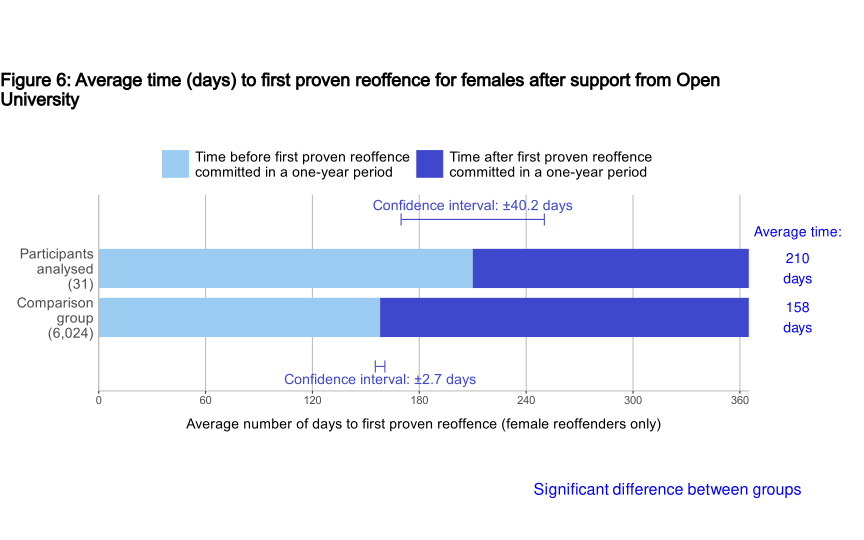
| 210 days was the average time before a reoffender committed their first proven reoffence, 52 days later than the comparison group. | 158 days was the average time before a reoffender committed their first proven reoffence. |
Please note totals may not appear to equal the sum of the component parts due to rounding.
| For 100 typical women who receive support, compared with 100 similar women who do not: | |
| The number of women who commit a proven reoffence within one year after release could be lower by as many as 2 women, or higher by as many as 4 women. This is not a statistically significant result. | |
| The number of proven reoffences committed during the year could be lower by between 4 and 17 offences. This is a statistically significant result. | |
| On average, the time before an offender committed their first proven reoffence could be longer by between 11 and 92 days. This is a statistically significant result. |
| ✔ | What you can say about the one-year reoffending rate: |
| “This analysis does not provide clear evidence on whether support from Open University increases or decreases the number of participants who commit a proven reoffence in a one-year period. There may be a number of reasons for this and it is possible that an analysis of more participants would provide such evidence.” | |
| ✖ | What you cannot say about the one-year reoffending rate: |
| “This analysis provides evidence that support from Open University increases/decreases/has no effect on the reoffending rate of its participants.” | |
| ✔ | What you can say about the one-year reoffending frequency: |
| “This analysis provides evidence that support from Open University decreases the number of proven reoffences committed during a one-year period by its participants.” | |
| ✖ | What you cannot say about the one-year reoffending frequency: |
| “This analysis provides evidence that support from Open University increases/has no effect on the number of proven reoffences committed during a one-year period by its participants.” | |
| ✔ | What you can say about the time to first reoffence: |
| “This analysis provides evidence that support from Open University lengthens the average time to first proven reoffence for its participants.” | |
| ✖ | What you cannot say about the time to first reoffence: |
| “This analysis provides evidence that support from Open University shortens/has no effect on the average time to first proven reoffence for its participants.” |
3. Charts of key reoffending measures
The figures in this section present the key measures of reoffending for the treatment and comparison groups. Figures 1 and 2 show the one-year proven reoffending rate, figures 3 and 4 show the proven reoffending rate frequency, and figures 5 and 6 show the average days to first proven reoffence.
Figure 1: One-year proven reoffending rate for males after support from Open University
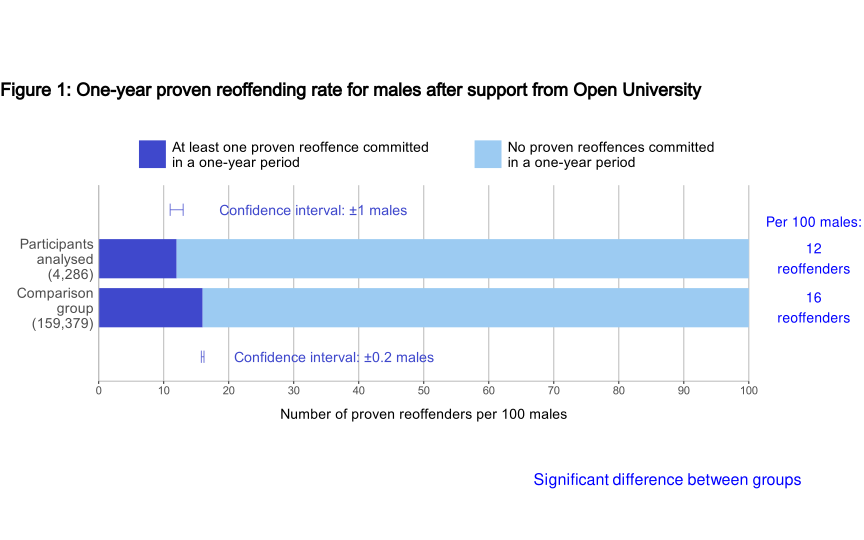
Figure 2: One-year proven reoffending rate for females after support from Open University
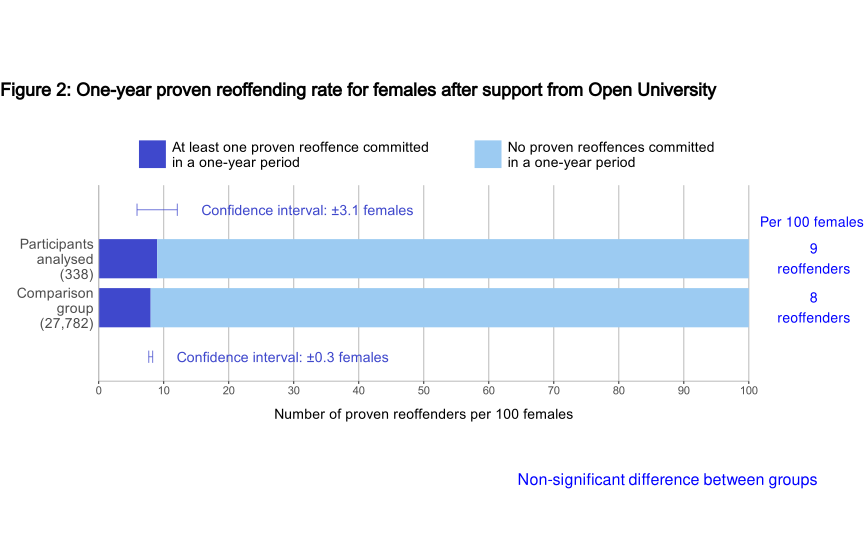
Figure 3: One-year proven reoffending frequency for males after support from Open University
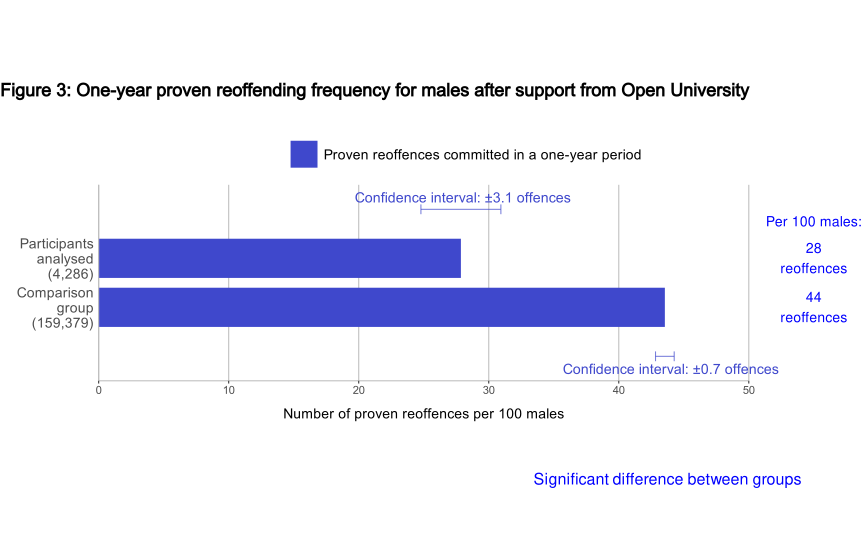
Figure 4: One-year proven reoffending frequency for females after support from Open University
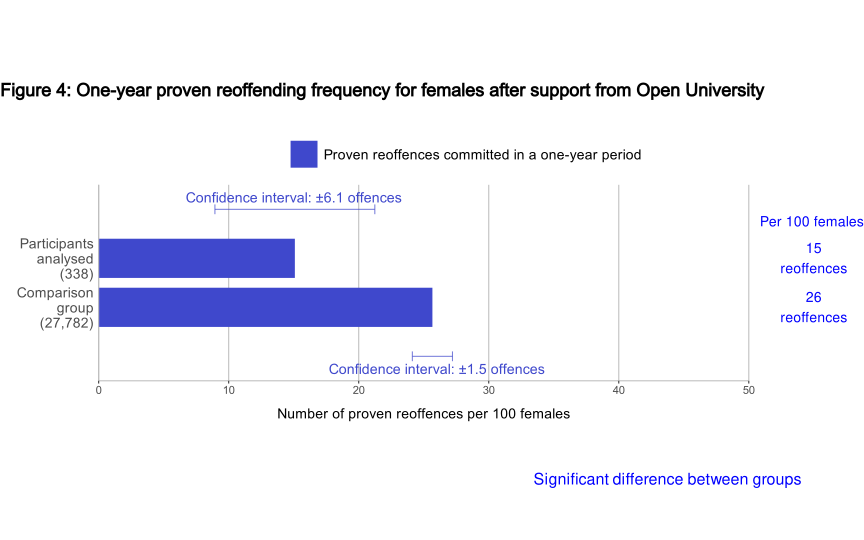
Figure 5: Average time (days) to first proven reoffence for males after support from Open University
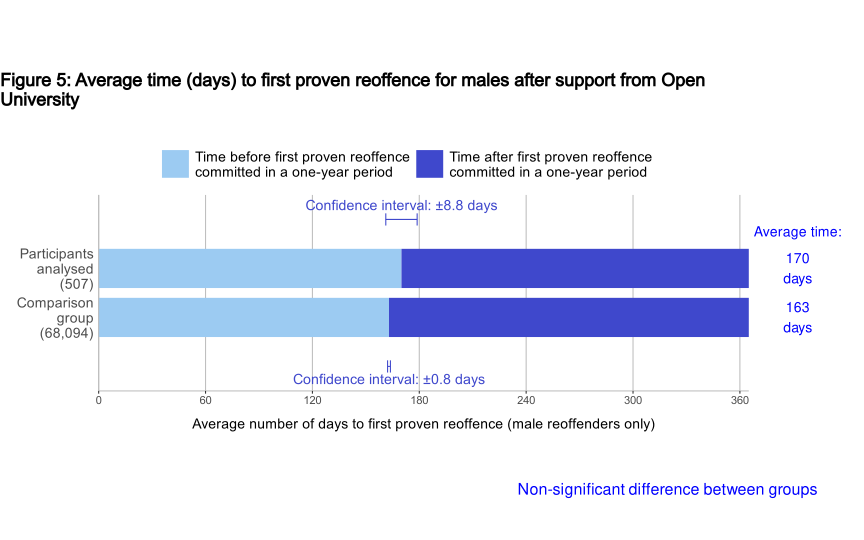
Figure 6: Average time (days) to first proven reoffence for females after support from Open University
4. Results in detail
The headline results in this report refer to the following:
-
Male Overall analysis: treatment group matched to offenders across England and Wales using demographics, criminal history and individual risks and needs.
-
Female Overall analysis: treatment group matched to offenders across England and Wales using demographics, criminal history and individual risks and needs.
These headline results controlled for offender demographics and criminal history and the following risks and needs: accommodation, employment history, education, financial history, relationships, behaviour, mental health, thinking skills, drug and alcohol use, and attitudes towards offending.
The sizes of the treatment and comparison groups for reoffending rate and frequency analyses are provided below. To create a comparison group that is as similar as possible to the treatment group, each person within the comparison group is given a weighting proportionate to how closely they match the characteristics of individuals in the treatment group. The calculated reoffending rate uses the weighted values for each person and therefore does not necessarily correspond to the unweighted figures.
| Gender | Analysis | Treatment group size | Comparison group size | Reoffenders in treatment group | Reoffenders in comparison group (weighted number) |
|---|---|---|---|---|---|
| Male | Overall | 4,286 | 159,379 | 507 | 68,094 (24,708) |
| Female | Overall | 338 | 27,782 | 31 | 6,024 (2,246) |
Three measures of one-year reoffending were analysed, as well as four additional measures (see results in Tables 1-7):
- Rate of reoffending
- Frequency of reoffending
- Time to first reoffence
- Rate of first reoffence by court outcome
- Frequency of reoffences by court outcome
- Rate of custodial sentencing for first reoffence
- Frequency of custodial sentencing
4.1 Significant results
9 measures show a statistically significant result. These provide significant evidence that for:
Male Overall Analysis
-
Male participants are less likely to commit a proven reoffence within a one-year period than non-participants.
-
Male participants commit fewer proven reoffences within a one-year period than non-participants.
-
Male participants who reoffend within a one-year period commit fewer triable-either-way offences than non-participants who commit triable-either-way offences.
-
Male participants who reoffend within a one-year period commit fewer summary offences than non-participants who commit summary offences.
-
Male participants who reoffend within a one-year period receive fewer custodial sentences than non-participants who reoffend.
Female Overall Analysis
-
Female participants commit fewer proven reoffences within a one-year period than non-participants.
-
Female participants who reoffend within a one-year period commit their first proven reoffence later than non-participants.
-
Female participants who reoffend within a one-year period commit fewer triable-either-way offences than non-participants who commit triable-either-way offences.
-
Female participants who reoffend within a one-year period receive fewer custodial sentences than non-participants who reoffend.
Note: Indictable-only, Triable-either-way, and Summary are classifications of offences based on severity, with Indictable-only being the most severe and Summary the least. For more information, see the Additional information on the dataset and terminology section.
4.2 Tables of all reoffending measures
Tables 1 to 7 show the overall measures of reoffending. Rates are expressed as percentages and frequencies expressed per person.
Tables 3 to 7 include reoffenders only, and are only shown where the total number of offenders in the treatment group is greater than 30.
In tables 4 to 7, court and custodial outcomes are only shown if the number of offenders in both the treatment and comparison groups is greater than 10 for that outcome.
Results that are statistically significant are presented in bold.
Table 1: Proportion of men and women who committed a proven reoffence in a one-year period (reoffending rate) after support from Open University compared with a matched comparison group
| Gender | Number in treatment group | Number in comparison group | Treatment group rate (%) | Comparison group rate (%) | Estimated difference (% points) | Significant difference? (p-value) |
|---|---|---|---|---|---|---|
| Male | 4,286 | 159,379 | 12 | 16 | -5 to -3 | Yes (<0.01) |
| Female | 338 | 27,782 | 9 | 8 | -2 to 4 | No (0.49) |
Table 2: Number of proven reoffences committed in a one-year period (reoffending frequency - offences per person) by men and women who received support from Open University compared with a matched comparison group
| Gender | Number in treatment group | Number in comparison group | Treatment group frequency | Comparison group frequency | Estimated difference | Significant difference? (p-value) |
|---|---|---|---|---|---|---|
| Male | 4,286 | 159,379 | 0.28 | 0.44 | -0.19 to -0.13 | Yes (<0.01) |
| Female | 338 | 27,782 | 0.15 | 0.26 | -0.17 to -0.04 | Yes (<0.01) |
Table 3: Average time (days) to first proven reoffence in a one-year period for men and women who received support from Open University, compared with a matched comparison group (reoffenders only)
| Gender | Number in treatment group | Number in comparison group | Treatment group time (days) | Comparison group time (days) | Estimated difference | Significant difference? (p-value) |
|---|---|---|---|---|---|---|
| Male | 507 | 68,094 | 170 | 163 | -2 to 16 | No (0.12) |
| Female | 31 | 6,024 | 210 | 158 | 11 to 92 | Yes (0.01) |
Table 4: Proportion of men and women supported by Open University with first proven reoffence in a one-year period (reoffending rate) by court outcome, compared with similar non-participants (reoffenders only)
| Gender | Number in treatment group | Number in comparison group | Court outcome [1] | Treatment group rate (%) | Comparison group rate (%) | Estimated difference (% points) | Significant difference? (p-value) |
|---|---|---|---|---|---|---|---|
| Male | 503 | 68,002 | Indictable | 7 | 6 | -1 to 3 | No (0.29) |
| Either way | 61 | 64 | -7 to 2 | No (0.23) | |||
| Summary | 30 | 29 | -3 to 5 | No (0.55) | |||
| Female | 31 | 6,019 | Either way | 55 | 68 | -31 to 6 | No (0.17) |
| Summary | 42 | 27 | -4 to 33 | No (0.11) |
[1] Indictable, Either-way, and Summary are classifications of offences based on severity, with Indictable being the most severe and Summary the least. For more information, see the Additional information on the dataset and terminology section.
Table 5: Number of proven reoffences in a one-year period (reoffending frequency) by court outcome for men and women supported by Open University, compared with similar non-participants (reoffenders only)
| Gender | Number in treatment group | Number in comparison group | Court outcome | Treatment group frequency | Comparison group frequency | Estimated difference | Significant difference? (p-value) |
|---|---|---|---|---|---|---|---|
| Male | 503 | 68,002 | Indictable | 0.12 | 0.13 | -0.05 to 0.04 | No (0.83) |
| Either way | 1.40 | 1.71 | -0.46 to -0.16 | Yes (<0.01) | |||
| Summary | 0.78 | 0.91 | -0.24 to -0.02 | Yes (0.02) | |||
| Female | 31 | 6,019 | Either way | 1.06 | 2.30 | -1.67 to -0.81 | Yes (<0.01) |
| Summary | 0.55 | 0.74 | -0.46 to 0.07 | No (0.15) |
Table 6: Proportion of men and women who received a custodial sentence for their first proven reoffence after support from Open University, compared with similar non-participants (reoffenders only)
| Gender | Number in treatment group | Number in comparison group | Treatment group rate (%) | Comparison group rate (%) | Estimated difference (% points) | Significant difference? (p-value) |
|---|---|---|---|---|---|---|
| Male | 503 | 68,002 | 50 | 51 | -5 to 4 | No (0.75) |
Table 7: Number of custodial sentences received in a one-year period by men and women who received support from Open University, compared to similar non-participants (reoffenders only)
| Gender | Number in treatment group | Number in comparison group | Treatment group frequency | Comparison group frequency | Estimated difference | Significant difference? (p-value) |
|---|---|---|---|---|---|---|
| Male | 503 | 68,002 | 1.25 | 1.43 | -0.34 to -0.03 | Yes (0.02) |
| Female | 31 | 6,019 | 0.48 | 1.42 | -1.28 to -0.59 | Yes (<0.01) |
The standard acceptable level of statistical significance to demonstrate impact is 0.05. This means that for the difference between the treatment and comparison groups to be considered statistically significant or impactful, the p-value in the tables above must be 0.05 or lower, indicating that the probability of the result occurring by chance is 5% or less.
5. Profile of the male treatment group
The Open University work with offenders currently serving a prison sentence of at least six months, who have already achieved levels 1 and 2 and who want to work towards a degree. Prospective students go through a sift to determine their suitability, and are then offered a choice of courses. They complete an application and also apply for their funding (scholarship, student loan or self-funding).
| Participants included in analysis (4,286 offenders) | Participants not included in analysis (9,898 offenders with available data) | |
|---|---|---|
| Sex | ||
| Male | 100% | 100% |
| Ethnicity | ||
| White | 63% | 67% |
| Black | 25% | 19% |
| Asian | 8% | 6% |
| Unknown | 3% | 7% |
| Other | 1% | 1% |
| Nationality | ||
| UK nationality | 90% | 74% |
| Unknown nationality | 6% | 16% |
| Foreign nationality | 4% | 11% |
| Index disposal | ||
| Prison | 100% |
Please note totals may not appear to equal the sum of the component parts due to rounding.
The individuals in the treatment group were aged 18 to 76 years at the beginning of their one-year period (average age 35).
Information on index offences for the 9,898 males not included in the analysis is not available, as they could not be linked to a suitable sentence.
For 1,196 males, no personal information is available as they could not be identified in our databases.
Information on individual risks and needs was available for 2,779 males in the treatment group (65% of males), recorded near to the time of their original conviction. This information is not complete for all males across all risks considered for this analysis. For those where information is known for specific risks, some key findings are shown below:
- 84% of males had some or significant problems with problem solving skills
- 64% of male participants would be unemployed upon release or were unemployed, and 8% of male participants were not available for work or would not be available for work upon release
- 55% of males had some or significant problems with achieving goals
6. Profile of the female treatment group
The Open University work with offenders currently serving a prison sentence of at least six months, who have already achieved levels 1 and 2 and who want to work towards a degree. Prospective students go through a sift to determine their suitability, and are then offered a choice of courses. They complete an application and also apply for their funding (scholarship, student loan or self-funding).
| Participants included in analysis (338 offenders) | Participants not included in analysis (835 offenders with available data) | |
|---|---|---|
| Sex | ||
| Female | 100% | 100% |
| Ethnicity | ||
| White | 68% | 63% |
| Black | 21% | 23% |
| Asian | 5% | 3% |
| Unknown | 4% | 10% |
| Other | 2% | 1% |
| Nationality | ||
| UK nationality | 81% | 69% |
| Unknown nationality | 12% | 18% |
| Foreign nationality | 7% | 13% |
| Index disposal | ||
| Prison | 100% |
Please note totals may not appear to equal the sum of the component parts due to rounding.
The individuals in the treatment group were aged 19 to 68 years at the beginning of their one-year period (average age 35).
Information on index offences for the 835 females not included in the analysis is not available, as they could not be linked to a suitable sentence.
For 568 females, no personal information is available as they could not be identified in our databases.
Information on individual risks and needs was available for 216 females in the treatment group (64% of females), recorded near to the time of their original conviction. This information is not complete for all females across all risks considered for this analysis. For those where information is known for specific risks, some key findings are shown below:
- 81% of females had some or significant problems with problem solving skills
- 64% of female participants would be unemployed upon release or were unemployed, and 15% of female participants were not available for work or would not be available for work upon release
- 65% of females had some or significant psychological problems
7. Matching the treatment and comparison groups
The analyses matched the treatment group to a comparison group. A large number of variables were identified and tested for inclusion in the regression models. The matching quality of each variable can be assessed with reference to the standardised differences in means between the matched treatment and comparison groups (see standardised differences annex). Over 95% of variables are categorised as green on JDL’s traffic light scale, indicating that the matching quality achieved on the observed variables was very good.
Further details of group characteristics and matching quality, including risks and needs recorded by the Offender Assessment System (OASys), can be found in the Excel annex accompanying this report.
This report is also supplemented by a general annex, which answers frequently asked questions about Justice Data Lab analyses and explains the caveats associated with them.
8. Additional information on the dataset and terminology
Index dates
The index date is the date at which the follow up period for measuring reoffending begins.
- For those with custodial sentences, the index date is the date they are released from custody.
- For those with a court order (such as a community sentence or a suspended sentence order), the index date is the date when an offender begins the court order.
Court outcomes
A ‘court outcome’ refers to a guilty verdict for a criminal offence based on its offence type. For adults, there are three broad types of offence, based on severity:
- Indictable only offences are the most serious and must be tried at the Crown Court.
- Triable-either-way offences are of intermediate severity and may be tried at either court based on the circumstances of the case.
- Summary offences are the least serious and must be tried at magistrates’ courts.
For more information, see guidance provided by the Sentencing Council: Which court will a case be heard in? - Sentencing Council (HTML)
Participants excluded from the analysis
Participants were excluded if they were previously convicted of a sexual offence.
9. Numbers of males in the treatment and comparison groups
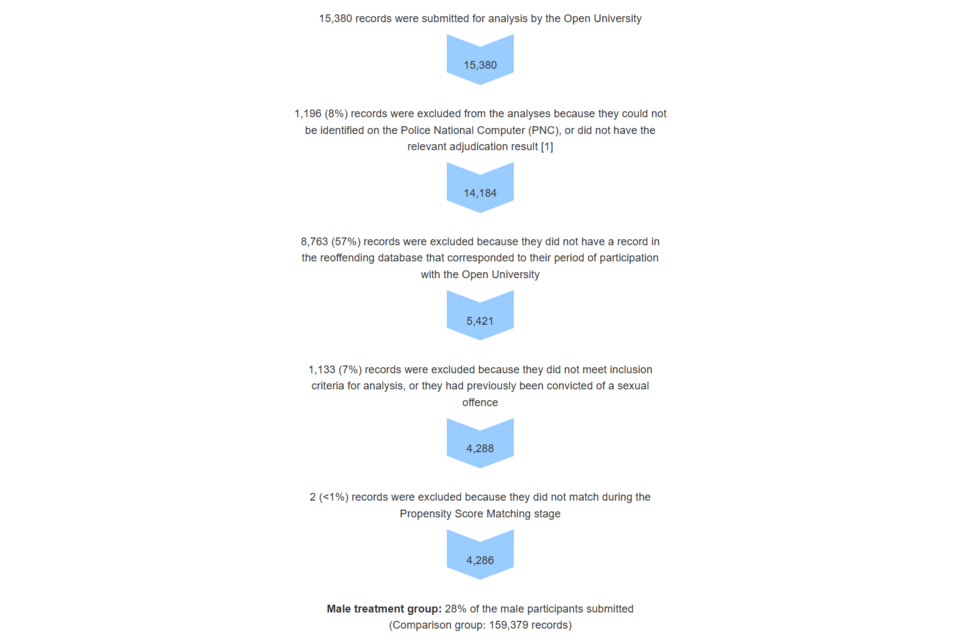
[1] Adjudication results must be guilty to be considered for analysis, as an individual must have committed an initial offence and have been convicted for it in order for the reoffending rate to be measured.
10. Numbers of females in the treatment and comparison groups
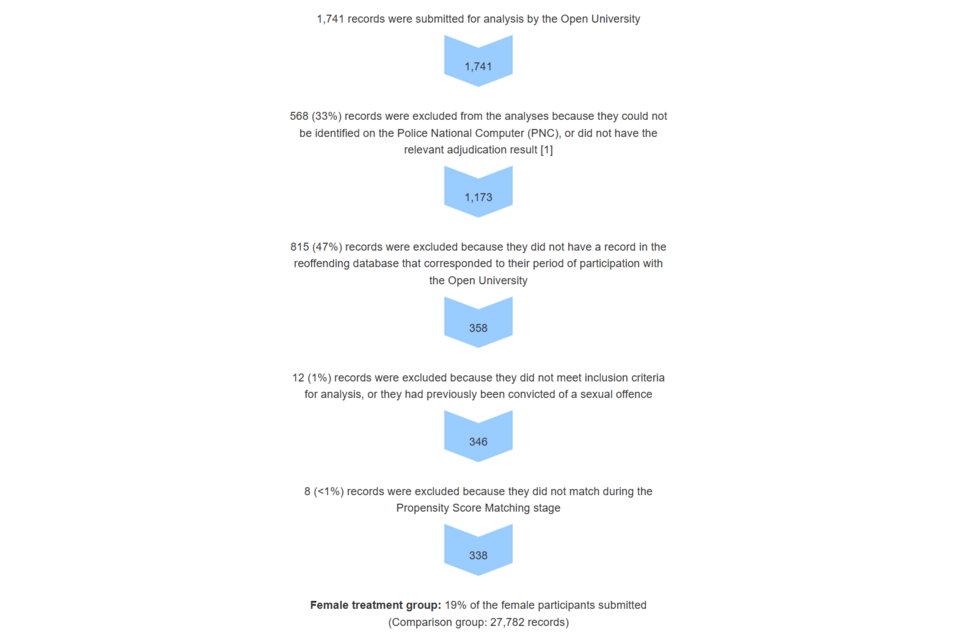
[1] Adjudication results must be guilty to be considered for analysis, as an individual must have committed an initial offence and have been convicted for it in order for the reoffending rate to be measured.
11. Further information
Official Statistics
Our statistical practice is regulated by the Office for Statistics Regulation (OSR).
OSR sets the standards of trustworthiness, quality and value in the Code of Practice for Statistics that all producers of official statistics should adhere to.
You are welcome to contact us directly with any comments about how we meet these standards.
Alternatively, you can contact OSR by emailing regulation@statistics.gov.uk or via the OSR website.
Contact
Press enquiries should be directed to the Ministry of Justice press office.
https://www.gov.uk/government/organisations/ministry-of-justice/about/media-enquiries
Other enquiries about the analysis should be directed to:
Justice Data Lab team
Email: justice.datalab@justice.gov.uk
© Crown copyright 2026
Produced by the Ministry of Justice
Alternative formats are available on request from justice.datalab@justice.gov.uk
This document is released under the Open Government Licence