Government revenues from oil and gas production October 2026
Updated 22 October 2026

© Crown copyright 2026
This publication is licensed under the terms of the Open Government Licence v3.0 except where otherwise stated. To view this licence, visit nationalarchives.gov.uk/doc/open-government-licence/version/3 or write to the Information Policy Team, The National Archives, Kew, London TW9 4DU, or email: psi@nationalarchives.gov.uk.
Where we have identified any third party copyright information you will need to obtain permission from the copyright holders concerned.
This publication is available at https://www.gov.uk/government/statistics/government-revenues-from-uk-oil-and-gas-production--2/government-revenues-from-oil-and-gas-production-october-2026
1. About this release
This publication contains statistics on government revenues from UK oil and gas production.
2. Key findings
The headline findings in this year’s publication are:
-
total net tax revenues from UK oil and gas production were £4.3 billion in financial year 2025 to 2026, compared with £4.5 billion in 2024 to 2025, which is a reduction of £0.14 billion (3%)
-
Net Offshore Corporation Tax (CT) receipts, comprising Ring Fence Corporation Tax (RFCT) and Supplementary Charge (SC), increased from £2.0 billion in 2024 to 2025 to £2.2 billion in 2025 to 2026, a rise of £0.2 billion (13%)
-
Net Petroleum Revenue Tax (PRT) receipts were negative £0.44 billion in 2025 to 2026 compared with negative £0.35 billion in 2024 to 2025. This means that repayments increased by £0.09 billion (27%)
-
Energy Profits Levy (EPL) receipts decreased from £2.9 billion in 2024 to 2025 to £2.6 billion in 2025 to 2026, a reduction of £0.3 billion (10%)
Chart 1: UK Government revenues from oil and gas taxes
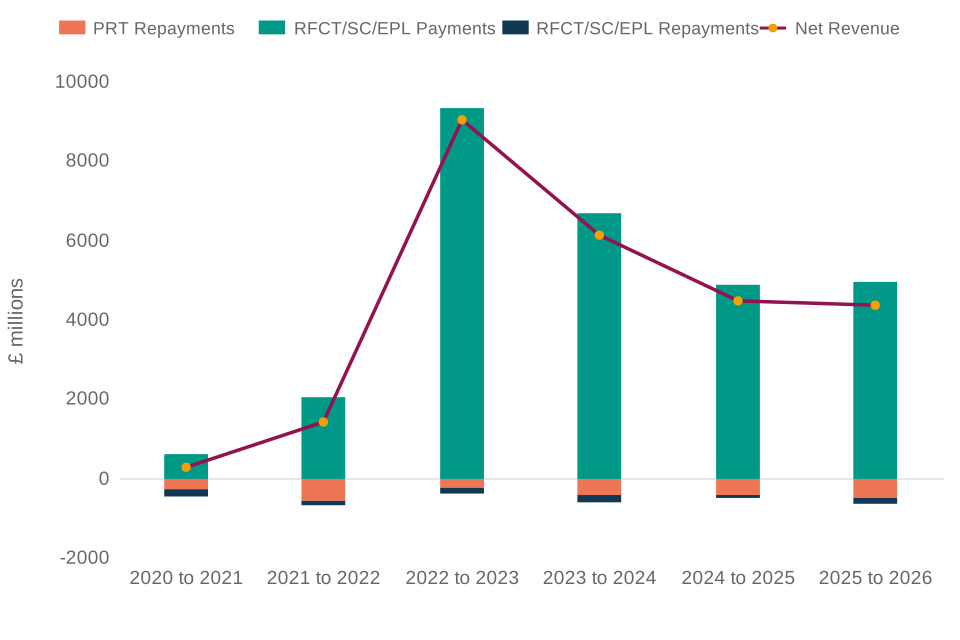
Main points illustrated by Chart 1
Chart 1 shows oil and gas tax revenues over the 6 financial years from 2020 to 2021 to 2025 to 2026. It shows total net revenues alongside payments and repayments for the individual taxes.
Key observations from Chart 1 are:
-
PRT receipts have been negative throughout the period. Since the PRT rate was reduced to 0% in 2016, almost all PRT receipts relate to repayments and are shown as negative values. Repayments were highest in 2021 to 2022 at £0.6 billion and lowest in 2022 to 2023 at £0.2 billion. They averaged £0.4 billion over the period and were £0.5 billion in 2025 to 2026
-
Offshore CT payments, comprising RFCT and SC, were £0.7 billion in 2020 to 2021 during the COVID-19 pandemic. They increased to £2.1 billion in 2021 to 2022 as the economy recovered. From 2022 to 2023, the chart also includes EPL payments
-
energy prices remained high in 2022 to 2023 following Russia’s invasion of Ukraine. Together with the introduction of the EPL, this meant that total Offshore CT and EPL payments reached £9.3 billion. Total payments then fell to £6.7 billion in 2023 to 2024 and £4.9 billion in 2024 to 2025. They remained broadly unchanged at £4.9 billion in 2025 to 2026
-
total net revenues across all oil and gas taxes, including PRT, were £0.3 billion in 2020 to 2021. They increased to £1.4 billion in 2021 to 2022 and then rose sharply to £9.0 billion in 2022 to 2023. Net revenues subsequently fell to £6.1 billion in 2023 to 2024, £4.5 billion in 2024 to 2025 and £4.3 billion in 2025 to 2026
3. Publication Information
Information about the publication is listed below:
-
Theme: The economy
-
Released: October 2026
-
Frequency: Annual
-
Next release: Autumn 2027
-
Media Contact: HMRC Press Office (03000 585 158)
-
Statistical Contact: ct.statistics@hmrc.gov.uk
-
Media Enquiries: HMRC Press Office (03000 585 158); hmrc.communications@hmrc.gov.uk
4. Key statistics
Corporation Tax receipts
Between financial years 2024 to 2025 and 2025 to 2026, net Offshore CT receipts, comprising RFCT and SC, increased by £0.2 billion (13%), from £2.0 billion to £2.2 billion. These figures are on a net cash basis and can be affected by the timing of payments and repayments.
Petroleum Revenue Tax receipts
Net PRT repayments were £0.44 billion in financial year 2025 to 2026, an increase of £0.09 billion (27%) compared with 2024 to 2025. Loss-making oil and gas fields can carry losses back to relieve profits and tax paid in previous years, subject to time limits and other rules.
From 1 January 2016, the PRT rate was reduced to 0%.
Energy Profits Levy receipts
EPL receipts were £2.6 billion in financial year 2025 to 2026, a decrease of £0.3 billion (10%) compared with 2024 to 2025. These figures are on a net cash basis and can be affected by the timing of payments.
Historic revenues from UK oil and gas production
Government revenues from UK oil and gas production generally decreased during the 2010s before a significant increase in financial year 2022 to 2023. From 2016, the PRT rate was reduced from 50% to 0% and the SC rate was reduced from 20% to 10%. Together with the general maturing of oil and gas fields on the UK Continental Shelf (UKCS), these changes contributed to lower revenues over the period.
In 2022 to 2023, high energy prices following Russia’s invasion of Ukraine, and the introduction of the EPL, increased government revenues from oil and gas production to their highest level since 2011 to 2012. Revenues have since fallen from that peak as energy prices have reduced from their previous highs.
Chart 2: Historic UK Government tax revenues from oil and gas production
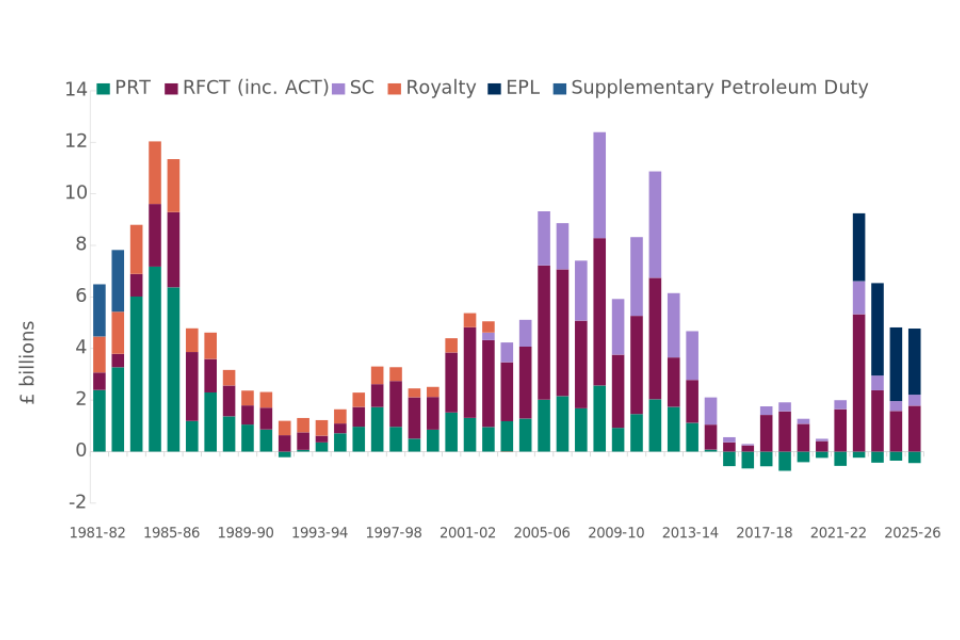
Main points illustrated by Chart 2
Chart 2 shows how net revenues have fluctuated since financial year 1981 to 1982. Oil and gas revenues were at an all-time high as a share of total UK tax revenues and GDP in 1984 to 1985.
RFCT includes Advance Corporation Tax, charged between 1978 to 1979 and 1999 to 2000.
Key observations from Chart 2 are:
-
UK Government revenues from oil and gas production decreased significantly from their peak of £12.4 billion in financial year 2008 to 2009 to £0.3 billion in 2020 to 2021. Net revenues were negative in two years during this period. Rising energy prices during 2021 and early 2022 reversed this trend. High energy prices, together with the introduction of the EPL, resulted in net revenues of £9.0 billion in 2022 to 2023. Net revenues then fell to £6.1 billion in 2023 to 2024, £4.5 billion in 2024 to 2025 and £4.3 billion in 2025 to 2026
-
total net revenues were negative in 2015 to 2016 and 2016 to 2017 because repayments exceeded payments. This was followed by a modest recovery in the next 2 financial years, before revenues fell again in 2019 to 2020 and 2020 to 2021. Revenues recovered in 2021 to 2022, increased sharply in 2022 to 2023 and then fell in each of the following 3 financial years
5. Exchequer liability from decommissioning
In August 2026, the North Sea Transition Authority estimated the total future industry costs for decommissioning all UK upstream oil and gas infrastructure from 2026 onwards to be £43.4 billion (in 2025 prices). HMRC estimates that £6.7 billion of tax repayments will result from this decommissioning expenditure, in present value terms, as set out in HMRC’s Annual Report and Accounts 2025 to 2026. In addition, an estimated £5.1 billion of offshore CT revenue is expected to be forgone. This is because decommissioning expenditure reduces company profits and therefore lowers the overall tax take. Combined, the total exchequer cost is estimated to be £11.8 billion in present value terms.