Forced Marriage Unit statistics 2025
Published 28 April 2026

© Crown copyright 2026
This publication is licensed under the terms of the Open Government Licence v3.0 except where otherwise stated. To view this licence, visit nationalarchives.gov.uk/doc/open-government-licence/version/3 or write to the Information Policy Team, The National Archives, Kew, London TW9 4DU, or email: psi@nationalarchives.gov.uk.
Where we have identified any third party copyright information you will need to obtain permission from the copyright holders concerned.
This publication is available at https://www.gov.uk/government/statistics/forced-marriage-unit-statistics-2025/forced-marriage-unit-statistics-2025
1. Key points
In 2025, the joint Home Office and Foreign, Commonwealth and Development Office Forced Marriage Unit (FMU) received 1,295 contacts related to a possible forced marriage and/or possible female genital mutilation (FGM)[footnote 1]. This figure includes contact that was made to the FMU through its public helpline or by email in relation to a new case and comprises 406 cases of forced marriage and/or FGM where tailored assistance was provided and 889 forced marriage or FGM enquiries.
All percentages and analysis throughout this document relate to the figure of 406 (which consists of 391 forced marriage and 15 FGM tailored assistance cases). This figure is not directly comparable to that of 2020, or to those of years prior to that, due to a change in recording practices allowing for tailored assistance cases (and between 2021 to 2024 advice and support cases) to be recorded separately from forced marriage or FGM enquiries. It is also not directly comparable to the years between 2021 and 2024 because there has been a further change to the recording practice, with the introduction of the ‘tailored assistance’ category in place of advice and support cases.
A ‘tailored assistance case’ is where specific details have been provided by an individual, organisation, UK authority or statutory body that the victim has been forced into a marriage or is at risk of being so[footnote 2]. In cases where there is an overseas angle, this includes victims who have been forced into or are at risk of FGM[footnote 3]. In last year’s data release, we classified some cases as ‘advice and support cases,’ but the change reflects the level of engagement the FMU provides for such cases.
A ‘forced marriage or FGM enquiry’ is one where the FMU is asked to provide general advice and/or signposting to other sources of guidance or information without requiring continuous actions or support by the FMU. These include historical forced marriages where advice about divorce or annulment is requested, how to apply for a Forced Marriage Protection Order and immigration advice about foreign spouses. In last year’s release, we called these ‘forced marriage enquiries,’ but the name has been changed to ‘forced marriage or FGM enquiries’.
These statistics only represent the cases that have been reported to the FMU, and where the FMU has actively given tailored assistance. Forced marriage is often hidden in nature, and these figures will not reflect the full scale of the abuse.
Of the cases in which the FMU provided tailored assistance in 2025:
- 163 cases (40%) involved victims aged 17 and under
- 122 cases (30%) involved victims aged 18 to 25
- 75 cases (18%) involved victims with mental capacity concerns[footnote 4]
- 301 cases (74%) involved female victims and 105 cases (26%) involved male victims
Forced marriage is not a problem specific to one country, religion or culture; there is no archetypal victim or perpetrator, and no 2 cases are the same.
In recent years, the FMU has handled cases relating to countries across 5 continents.
In 2025, the FMU handled cases relating to 34 ‘focus countries’, excluding the UK. The ‘focus country’ is the country to which the forced marriage risk relates. This could be the country where the forced marriage (or FGM) is due to take place, the country where it has taken place, and/or the country that the spouse is currently residing in. The ‘focus countries’ (other than the UK) with the highest number of cases in 2025 were: Pakistan with 165 cases (41%); Bangladesh which had 36 cases (9%); and Afghanistan with 28 cases (7%).
The majority of victims (79%) were in the UK at the time the case was referred to the FMU.
In 2025, 58 cases (14%) had no overseas element, with the potential or actual forced marriage taking place entirely within the UK. This is an increase from 15 cases (6%) in 2024 and 10 cases in 2023 (4%). It continues to highlight that forced marriages can and do take place in the UK.
This document is accompanied by a data sheet which contains the figures quoted in this report and additional information. Categories containing data relating to fewer than 5 (including zero) cases have been recorded as ‘[x]’ to preserve the anonymity of victims.
1.1 Awareness raising and outreach activity
The FMU runs training workshops for frontline professionals (including police, social workers and registrars of marriage) on how to support victims of forced marriage. The unit also conducts bespoke presentations on request to local authorities, non-governmental organisations, health officials and other organisations. The FMU has placed a greater emphasis on prevention and early intervention in recent years and made substantial efforts to raise awareness of forced marriage amongst professionals and provide guidance on how best to support victims at an early stage.
In the last 3 years, the FMU has endeavoured to deliver outreach events with the aim of raising awareness among professionals and building their capability on how best to support victims. In 2025, the FMU delivered training to 2,669 professionals in England and Wales[footnote 5].
In addition, between 1 April 2024 and 31 March 2025, 5,634 people from a wide range of professions took the government’s ‘Awareness of forced marriage’ free online course and passed. The FMU has also been asked to attend more safeguarding meetings organised by local authorities and the police.
In 2025 the unit also delivered training to groups including health professionals, local authorities, the Crown Prosecution Service, the National Crime Agency and Joint International Crime Centre, Border Force staff and community groups.
2. Forced Marriage Unit statistics
In 2025, the Forced Marriage Unit (FMU) provided tailored assistance to 406 cases related to a possible forced marriage and/or female genital mutilation (FGM). This does not include 889 forced marriage or FGM enquiries the unit received, which required signposting to relevant advice without requiring continuous actions or support by the FMU.
The 406 cases in 2025 represents a 69% increase on the number of cases received in 2024 (240).
While we do not have data to help understand why cases have increased, it could be attributed to the change of the category from ‘advice and support cases’ to ‘tailored assistance cases,’ which widens the scope of the category. It could also be a result of many different factors, for example: the increase in the level of the unit’s outreach activity, which empowers professionals to handle forced marriage cases and encourages them to engage directly with the FMU; and relatively recent legislation raising the age of marriage to 18 in England and Wales, which resulted in greater media publicity about forced marriage being illegal in the UK.
Of the 406 cases in which the FMU provided tailored assistance in 2025:
- 75 cases related to mental capacity concerns
- 24 cases related to a ‘reluctant sponsor’[footnote 6]
- 15 cases related to FGM where the victim or potential victim was overseas
Owing to changes in recording practices, the data in 2025 is not directly comparable with that from before 2020.
Table 1: Number of cases in which the Forced Marriage Unit provided tailored assistance, 2015 to 2025
| Year | Number |
|---|---|
| 2015 | 1,220 |
| 2016 | 1,428 |
| 2017 | 1,196 |
| 2018 | 1,507 |
| 2019 | 1,355 |
| 2020 | 7591 |
| 2021 | 3372 |
| 2022 | 3022 |
| 2023 | 2832 |
| 2024 | 2402 |
| 2025 | 4063 |
Source: Forced Marriage Unit; Home Office and Foreign, Commonwealth and Development Office
Notes:
- This figure is not directly comparable to those of previous years, owing principally to the effects of the COVID-19 pandemic, and to a lesser degree to a change in recording practices.
- This figure is not directly comparable to that of 2020, or to those of years prior to that, owing to the further embedding of a change in recording practices.
- This figure is not directly comparable to the years before because there has been a change to the recording practice, namely that the tailored assistance cases category has a wider scope.
3. Sources of referrals
Every year the Forced Marriage Unit receives referrals from a variety of sources. The majority of these come from professionals charged with safeguarding responsibilities, such as the police, social services and education professionals. In 2025, 112 cases (28% of referrals) were made by social services, 52 cases (13%) by the police, and 25 cases (6%) by education professionals.
In 63 cases (16%) the referral was made by the Home Office - these were mostly related to reluctant sponsor cases or where capacity concerns were highlighted either by Home Office officials or other professionals.
There were 58 cases (14%) which were made by victims seeking support and guidance. The remaining 23% of cases were referred by friends, partners, family members, colleagues, health professionals, NGOs and others.
The following sections provide further information about the cases that the FMU handled in 2025.
4. Monthly breakdown of cases
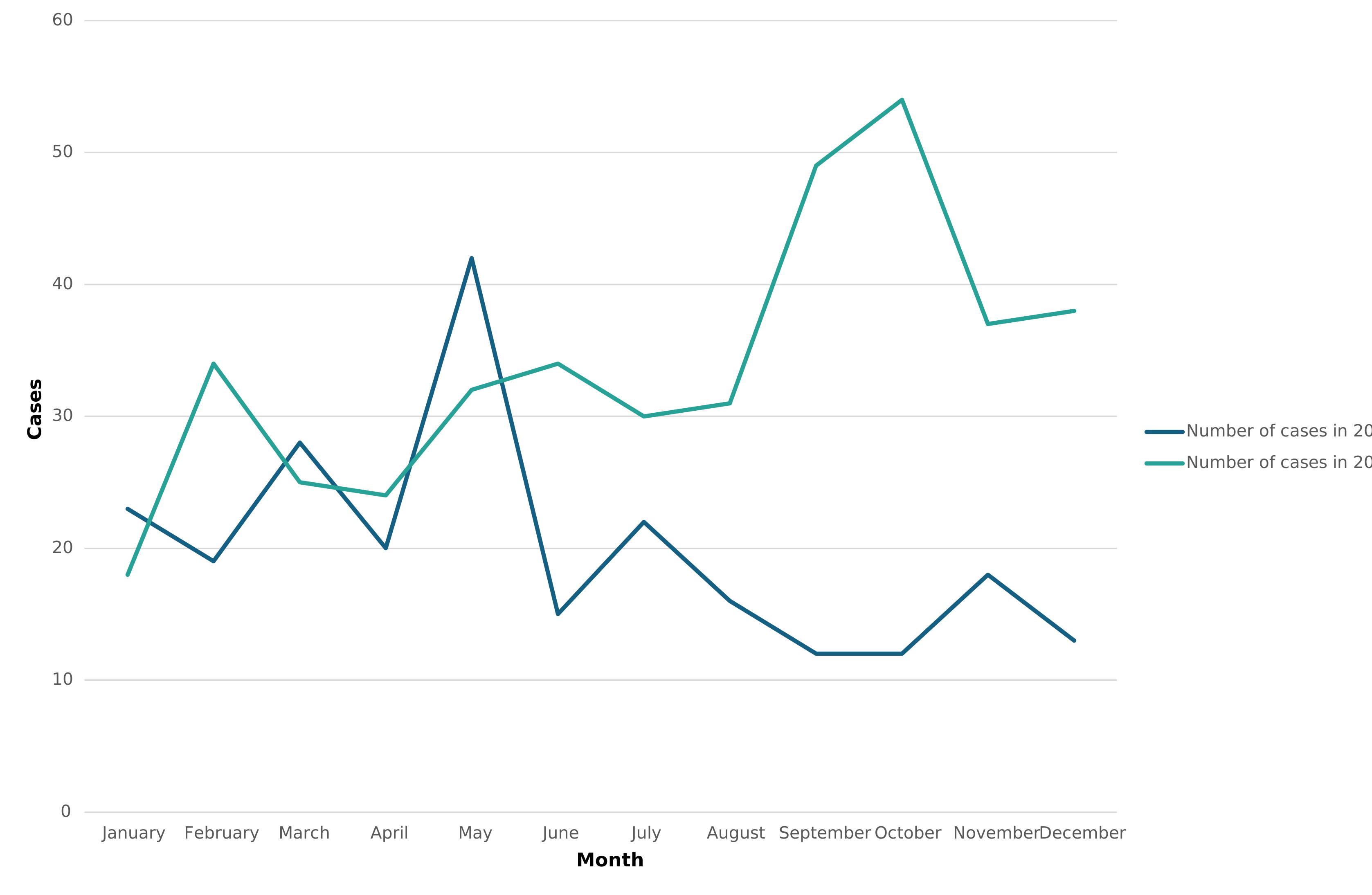
In 2025, the FMU received 54 (13%) referrals in October, which was its peak month. In contrast, in October 2024, the FMU received 12 (5%) referrals.
Case referrals saw an increase from July to October 2025, while there was a steady decline in cases from July to October 2024.
On the whole, referrals were higher between June and December 2025 than the same period the year before.
Figure 1 below show the monthly breakdown of cases referred to the FMU in 2025 in comparison to 2024.
Figure 1: Number of cases in which the Forced Marriage Unit provided tailored assistance in 2025 and advice and support in 2024, by month
Source: Forced Marriage Unit; Home Office and Foreign, Commonwealth and Development Office
5. Sex of victims
In 2025, 301 cases (74%) involved female victims and 105 cases (26%) involved male victims. These figures are similar to those of 2024 wherein 71% of victims were female and 29% male. This reinforces that forced marriage is a crime which disproportionately affects women and girls, but that men and boys can also be victims. As in 2024, this year men were particularly represented in cases where the victim had mental capacity concerns, making up 64% of those victims.
6. Age of victims
In 2025, 40% (163 cases) involved victims 17 and under; specifically 21% (87 cases) involved victims who were aged 15 and under and 19% (76 cases) involved victims who were aged 16 to 17. In comparison to 2024, this represents an increase of 6 percentage points regarding cases in which the victim was aged 17 years or under.
A total of 17% of cases were known to be aged 18 to 21 (21% in 2024) and 13% were known to be aged 22 to 25 (same figure in 2024).
Cases concerning young children often involve the ‘promise’ of a future marriage (betrothal), or the younger sibling of someone at a direct risk, rather than an imminent marriage. The case numbers also include cases of FGM, which often involves child victims.
In 2025, 14% of cases involved victims who were aged 26 to 30, 9% who were aged 31 to 40 and 4% who were 41 and over. In 3% of the cases the age of the person was unknown.
Table 2: Number of cases in which the Forced Marriage Unit provided tailored assistance, by age, 2025
| Age | Numbers | Percentages |
|---|---|---|
| 15 and under | 87 | 21% |
| 16 to 17 | 76 | 19% |
| 18 to 21 | 69 | 17% |
| 22 to 25 | 53 | 13% |
| 26 to 30 | 55 | 14% |
| 31 to 40 | 37 | 9% |
| 41+ | 18 | 4% |
| Unknown | 11 | 3% |
| Total | 406 |
Source: Forced Marriage Unit; Home Office and Foreign, Commonwealth and Development Office
7. Nationality of victims
In 2025, 64% of victims (261 cases) were British nationals, including dual nationals and 25% of victims (101 cases) were non-British nationals (including EU nationals). The nationality of the individual was unknown in 11% of cases (44 cases).
8. UK regions where victims live
In 2025, the UK regions associated with the greatest number of cases were London, the North West, West Midlands and the South East. Together, they accounted for 59% of referrals.
Table 3: Number of cases in which the Forced Marriage Unit provided tailored assistance, by region, 2025
| UK Region | Number of cases | Percentage of cases |
|---|---|---|
| London | 82 | 20% |
| North West | 57 | 14% |
| West Midlands | 54 | 13% |
| South East | 49 | 12% |
| Yorkshire and The Humber | 45 | 11% |
| East Midlands | 36 | 9% |
| South West | 28 | 7% |
| East | 27 | 7% |
| North East | 7 | 2% |
| Scotland | 7 | 2% |
| Wales | [x] | [x] |
| Northern Ireland | [x] | [x] |
| Unknown | [x] | [x] |
| Total | 406 |
Source: Forced Marriage Unit; Home Office and Foreign, Commonwealth and Development Office
9. Focus country overview
The ‘focus country’ is the country to which the risk of forced marriage relates. This could be the country where the forced marriage is due to take place, the country where it has taken place, and/or the country in which the spouse is currently residing.
In 2025, the FMU handled cases relating to 34 ‘focus countries’ excluding the UK.
9.1 Pakistan
Pakistan is routinely the ‘focus country’ with the largest number of cases of forced marriages reported to the FMU.
There were 165 cases (41% of the total 406 cases) linked to Pakistan as the focus country in 2025, of those 119 (72%) were female and 46 (28%) male. In 123 (75%) of these cases the victim was in the UK, with support provided to 90 (55%) cases pre-marriage and 75 (45%) cases post-marriage. In 42 (25%) of the cases, victims were overseas when the referral was made. In such cases, support is usually delivered through a combination of consular staff in-country and FMU staff in the UK.
Of the cases linked to Pakistan, 57 cases (35%) involved victims who were known to be aged 17 and under, and 52 cases (32%) were known to be aged 18 to 25.
The most common UK regions linked to cases involving Pakistan were North West, Yorkshire and the Humber, West Midlands and South East, together accounting for 67% of these cases.
9.2 UK
In 2025, 58 cases (14%) did not have an overseas element and instead were linked entirely to the UK. Of these cases, 42 (72%) victims helped were female and 16 (28%) were male.
In 48 cases (83%) support was provided pre-marriage, while in 10 cases (17%) support was provided post-marriage.
In 20 cases (35%) support was provided to victims who were known to be aged 17 and under, and 18 cases (31%) involved victims known to be aged 18 to 25.
9.3 Bangladesh
Bangladesh was linked to 36 cases (9%) in 2025, with 86% of the referrals made when the victims were known to be in the UK. Of the 36 cases, 61% of the victims helped were female and 39% were male.
London was the region involving the largest number of cases linked to Bangladesh with 13 referrals to the FMU (36%).
9.4 Afghanistan
Afghanistan was linked to 28 cases (7%) in 2025 and 79% of those referrals were made when the victim was known to be in the UK.
Of the cases linked to Afghanistan, 17 cases (61%) involved victims who were known to be aged 17 and under.
London was the region involving the largest number of cases linked to Afghanistan with 9 referrals to the FMU (32%).
10. Victims with mental capacity concerns
In 2025, 75 cases (18%) involved victims whose mental capacity to consent to marriage was in doubt[footnote 7]. Victims with mental capacity concerns were more likely to be male (64%) and older (58% of victims were 26 years old or over) than in cases on average.
11. LGBT+ cases
In 2025, the FMU provided tailored assistance to 5 (1%) cases where the victim had voluntarily identified being LGBT+ and that was a driving factor in the forced marriage. Given the FMU does not collect this level of information from the victims it assists, the total number of LGBT+ victims in forced marriage and/or FGM is predicted to be higher. Forced marriage as a form of ‘conversion therapy’ is a concern, wherein families use marriage as a ‘cure’ for the victim being LGBT+.
12. Status of the marriage
The status of the marriage is recorded under 4 categories. These categories are:
- ‘UK Pre’ (this means that the victim is in the UK and the marriage is yet to take place; the marriage could be in the UK or overseas)
- ‘UK Post’ (the victim is in the UK and the marriage has taken place)[footnote 8]
- ‘Overseas Pre’ (the victim is overseas, and the marriage is yet to take place)
- ‘Overseas Post’ (the victim is overseas, and the marriage has taken place)
The risks for the victims are different at each point. When a victim is overseas, the need for support is often more urgent because it can mean that the wedding is imminent. The security and legal situation in certain countries or regions within countries also affects the level of consular support which the FMU can offer.
In 2025, 156 cases (38%) were referred to the FMU once the marriage had taken place. In 138 of these cases the victims were in the UK and in 18 cases the victims were overseas when the referral was made.
In 2025, 251 cases (62%) were referred to the FMU prior to the marriage taking place. In 184 of these cases the victims were in the UK and in 67 cases the victims were overseas when the referral was made to the FMU.
In general, the earlier the FMU is contacted, the greater the range of options available to help support the victim and mitigate the risk of a forced marriage taking place. As a result of an extensive outreach programme being delivered by the FMU in recent years, the FMU has been requested to attend a greater number of strategy meetings organised by the safeguarding professionals. These have resulted in early intervention being made.
13. Repatriations
In 2025, the FMU provided practical help or advice to support the repatriations[footnote 9] of 22 individuals (5% of cases). This is up from 5 cases in 2024. Repatriation figures are not fully representative of the assistance provided to forced marriage victims overseas.
For example, the figures do not include cases where:
- a Forced Marriage Protection Order was used to facilitate direct repatriation without practical involvement from the FMU
- victims did not require assistance from the FCDO to return to the UK
- direct contact with the victim resulted in no further assistance being required by the victim
14. Further information
These statistics are produced as Official Statistics, in accordance with the Statistics and Registration Service Act 2007, signifying compliance with the Code of Practice for Statistics.
14.1 Accompanying user guide
See the accompanying user guide for information including:
- background information on the data collection
- uses of the statistics, and links to related statistics
- details on methodology and data quality issues
14.2 Data quality
This release presents details on the number and characteristics of cases reported to the Forced Marriage Unit (FMU) via its public helpline and email inbox from 1 January 2025 to 31 December 2025.
Owing to changes in recording practices, the data in 2025 is not directly comparable with that from previous years (see Table 1 for more information). In addition, caution should be exercised when comparing small differences between time periods.
The statistics only reflect cases which have been referred to the FMU and do not reflect the true scale of forced marriage, which is often hidden in nature.
More information on data quality and definitions can be found in the accompanying user guide.
These statistics have been produced in line with Foreign, Commonwealth and Development Office’s statement on Quality.
-
The FMU can provide assistance relating to FGM which has affected or may affect UK nationals (including dual nationals) who are overseas. ↩
-
Examples of UK authorities include police and the Crown Prosecution Service. Examples of statutory services include adult and children’s social care, and emergency services. ↩
-
Cases of FGM in the UK are handled by the National Society for Prevention Cruelty of Children (NSPCC). ↩
-
The Mental Capacity Act 2005 defines mental capacity as the ability to make decisions, which includes understanding, retaining, using information, and communicating decisions. For more information Mental Capacity Act 2005. ↩
-
While the FMU did not actively offer training to Scotland specific cohorts, Scotland based participants did join our outreach sessions. We are working to expand our training delivery to Scotland. ↩
-
This is when assistance is provided to an individual who is being forced / pressured to sponsor a visa application for a spouse to come to the UK. ↩
-
Cases involving victims with a suspected or confirmed lack of capacity to consent to marriage under the Mental Capacity Act 2005. ↩
-
These cases often involve reluctant sponsors. ↩
-
To come back to the UK or to their country of ordinary residence. ↩