English Housing Survey 2024 to 2025: private rented sector - pre-Renters’ Rights Act overview
Published 14 May 2026
Applies to England

© Crown copyright 2026
This publication is licensed under the terms of the Open Government Licence v3.0 except where otherwise stated. To view this licence, visit nationalarchives.gov.uk/doc/open-government-licence/version/3 or write to the Information Policy Team, The National Archives, Kew, London TW9 4DU, or email: psi@nationalarchives.gov.uk.
Where we have identified any third party copyright information you will need to obtain permission from the copyright holders concerned.
This publication is available at https://www.gov.uk/government/statistics/english-housing-survey-2024-to-2025-private-rented-sector-pre-renters-rights-act-overview/english-housing-survey-2024-to-2025-private-rented-sector-pre-renters-rights-act-overview
Introduction and main findings
The English Housing Survey (EHS) is a national survey of people’s housing circumstances and the condition and energy efficiency of housing in England. It is one of the longest standing government surveys and was first run in 1967.
The Renters’ Rights Act 2025 was introduced to Parliament in September 2024 and completed its passage in October 2025. Phase One of its reforms took effect on 1 May 2026. The Act aims to improve the current system by providing greater security for tenants, strengthening protections against unfair evictions and raising housing standards while maintaining a fair system for both tenants and landlords.
This factsheet provides an overview of the private rented sector before the implementation of the Renters’ Rights Act. It covers topics relevant to the new policy, including tenancy security in the private rented sector, eviction practices, notice periods, tenure types, satisfaction with tenure and landlord/agency service, barriers to renting and complaints processes.
Section 1 outlines private renters’ satisfaction with their tenure and their recent experiences in the sector, including reasons for moving and trends in tenant demographics.
Section 2 examines tenancy security and eviction practices, including how and why tenancies end, views on notice period lengths, and whether these are sufficient to find new tenancies.
Section 3 explores the barriers renters face, such as rent in advance, guarantor requirements, and reported discrimination.
Section 4 looks at complaints and dispute resolution, covering how satisfied renters are with the landlord/agency service upon receiving notice, how satisfied they are with the outcome of complaints, the barriers to making a complaint and the extent to which issues are escalated beyond the landlord or agent.
Background to this report
This factsheet presents a baseline picture of the private rented sector prior to the implementation of the Renters’ Rights Act. The analysis is limited to the areas for which relevant data is currently available and therefore will not cover all elements of the reforms. The findings provide a benchmark against which future changes can be considered as further data becomes available.
Acknowledgements and further queries
Each year the English Housing Survey relies on the contributions of a large number of people and organisations. The Ministry of Housing, Communities and Local Government (MHCLG) would particularly like to thank the following people and organisations, without whom the 2024-25 survey and this report, would not have been possible: all the households who gave up their time to take part in the survey, the National Centre for Social Research, the Building Research Establishment (BRE) and CADS Housing Surveys.
This report was produced by Anamaria Popa and Joshua Ray at The National Centre for Social Research, in collaboration with Karina Matjuhhina at MHCLG.
If you have any queries about this report, would like any further information or have suggestions for analyses you would like to see included in future EHS reports, please contact ehs@communities.gov.uk.
The responsible analyst for this report is: Karina Matjuhhina, Data, Analysis, Statistics and Surveys Division, MHCLG. Contact via ehs@communities.gov.uk.
1. Renters’ satisfaction and experiences
Satisfaction with tenure in the private rented sector
In 2024-25, two-thirds of private renters (66%) were satisfied with their tenure. However, this was lower than the 70% of private renters who were satisfied 5 years ago, Annex Table 1.1. The proportion of private renters neither satisfied nor dissatisfied with their tenure in the most recent data was 15%, and the proportion dissatisfied with their tenure was 19%.
Private renters’ dissatisfaction with tenure varied by demographic and household characteristics. Private renters aged 45-64 were more likely to be dissatisfied with their tenure (23%) than private renters aged 65 or over (14%) and those aged 16 to 29 (17%).
Private renters from a white ethnic background were more dissatisfied (20%) with their tenure than those from ethnic minority backgrounds (16%).
Private renters who received housing support and those with a long‑term illness or disability were more likely to be dissatisfied with their tenure than other private renters.
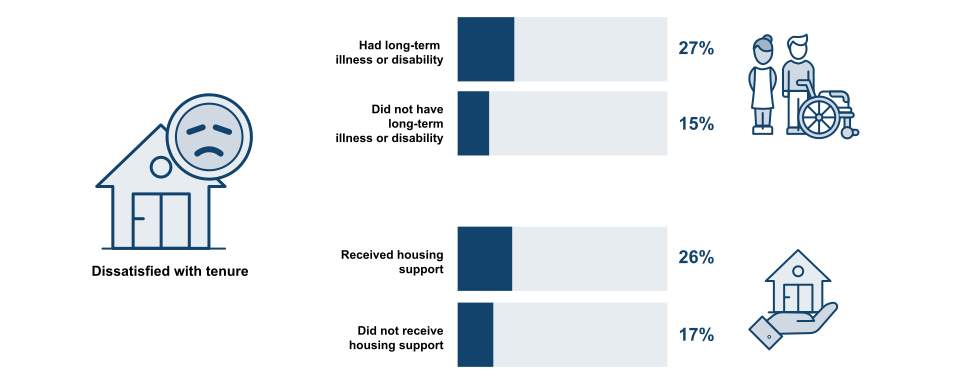
Households containing someone with a long-term illness or disability were also more likely to be dissatisfied with their tenure (27%) than those not containing a household member with a long-term illness or disability (15%).
Private renters receiving housing support were more dissatisfied with their tenure (26%), than those not receiving housing support (17%).
Private renters who were in converted/used-as-shared accommodation (i.e. shared kitchen and/or bathroom/WC, often with non‑self‑contained bedsits or flatlets occupied by 2 or more households) were more dissatisfied with their tenure (40%) than those living with family (20%) or sharing with other tenants (12%).
Dissatisfaction with tenure did not significantly vary by region (London compared with the rest of England), gender, employment status, income or presence of dependent children.
Reasons for moving last time
Private renters who moved from one PRS tenancy to another most commonly did so because they wanted a larger home, for job‑related reasons, to move to a better neighbourhood, or due to being asked to leave by their landlord.
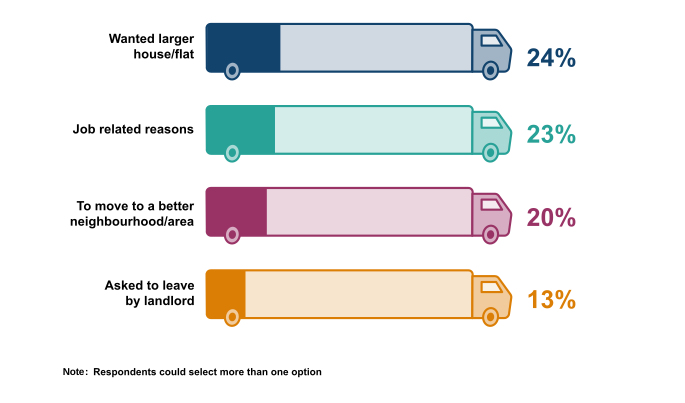
Among private renters who moved from one private rented tenancy to another, the most common reason for moving was wanting a larger property (24%), followed by job-related reasons (23%), Annex Table 1.2. Smaller proportions moved to live with friends or relatives (10%), because they wanted a cheaper home (9%), or because their previous accommodation was in poor condition (9%). Other renters moved to be closer to friends or relatives (8%), for other family or personal reasons (8%), or because their previous home was unsuitable (7%). Less than 5% chose to move due to not getting on with their landlord, being unable to afford mortgage payments or rent, or wanting a smaller home. Respondents could have selected more than one reason for moving for this question.
More tenants moved within the private rented sector for personal reasons, including because they wanted to move to a better neighbourhood (20%) or to live closer to friends or relatives (8%), than for landlord‑related reasons, including being asked to leave by the landlord (13%) or because they didn’t get on with their landlord (4%). Fewer moved because they wanted to live independently (5%) than because they were asked to leave by their landlord (13%).
Private renters who moved to ownership most commonly did so because they wanted to buy a property (66%) or wanted to live independently (33%).
2. Tenancy security and eviction practices
Tenancy type of private renters
Nearly 9 in 10 private renters had an assured shorthold tenancy.
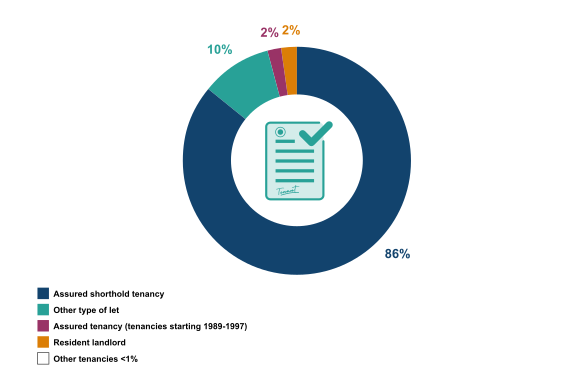
The most common tenancy type among private renters was an assured shorthold tenancy, with 86% of private renters having this tenancy agreement and 14% having another type of let agreement: 10% other type of let, 2% other assured tenancy, 2% tenancies with a resident landlord, fewer than 1% were regulated tenancies, and fewer than 1% of tenancies let by educational institution, Annex Table 2.6
The Renters’ Rights Act removed assured shorthold tenancies and prevented assured tenancies from having a fixed-term, meaning Private Rented Sector tenancies are now Assured Periodic Tenancies.
Reason last tenancy ended in the previous 12 months
Of all households whose tenancies ended in the last 12 months, 14% ended due to eviction.
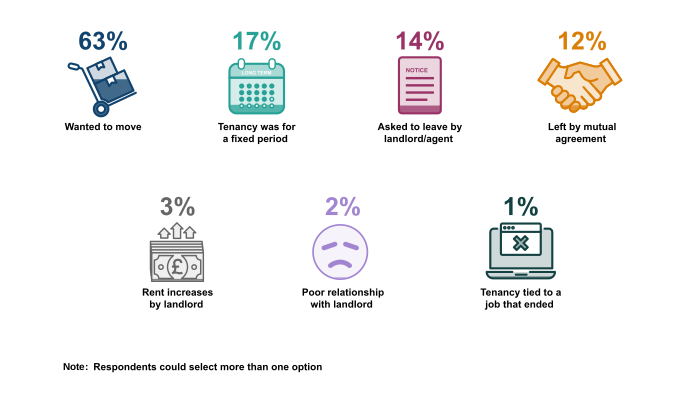
Private renters whose tenancies ended in the last 12 months were asked the reason why it ended. Respondents could select more than one option.
In 2024-25, the majority of private renters (63%) said their tenancy ended because they wanted to move, 17% said the tenancy was agreed for a fixed period, 14% said they were asked to leave by their landlord/agent, 12% ended the tenancy by mutual agreement, 3% left because of rent increases imposed by the landlord, 2% ended their tenancy because of their poor relationship with the landlord and 1% said their accommodation was tied to their job and their job ended, Annex Table 2.1.
The list of reasons private renters gave for ending their tenancy was similar in 2024-25 to 2023-24. When compared to the reasons for ending the tenancy given at the start of the pandemic in 2019-20 (compared to 2024-25), more private renters said they wanted to move in 2019-20 (76% vs. 63%), fewer private renters said they were asked to leave by their landlord or agent (8% vs. 14%) and fewer ended their tenancy because it was agreed for a fixed period (9% vs. 17%).
Opinions about notice period by notice period length
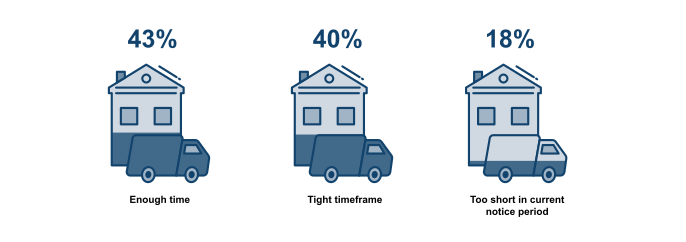
Over a half of private renters felt the notice period in their tenancy agreement was tight or too short to find a new place to live.
In this section, 2 years of the EHS full household sample were combined to increase the sample size and allow us to better observe smaller groups.
All private renters were asked about the length of their notice period, defined as the amount of time a landlord must give the tenant to move out when seeking to end the tenancy. Respondents selected 1 of 4 options: no formal notice period, less than 2 months, 2 months, or more than 2 months. The most reported notice period was 2 months (53%), while having no notice period (8%) was the least common, Annex Table 2.2.
Private renters were then asked whether the notice period in their tenancy agreement gives them enough time to move or would make it difficult for them to find a new place. Overall, between 2023 and 2025, the largest proportion of private renters (43%) said their notice period gave them enough time to move, 40% thought it would possibly be too little time for them to find a new place, and 18% said it would be impossible to find a new place to live in that time, Annex Table 2.3.
Private renters tended to think their current notice-period agreement would give them enough time to move on, regardless of whether they did not have a formal notice period in their tenancy agreement (75% felt it was enough) or had more than 2 months’ notice (57% felt it was enough). Only 13% of private renters with no formal notice and 11% of private renters with more than 2 months’ notice period thought it would be impossible for them to find a new place to live in this time.
Landlords seeking to regain possession are required to use statutory Section 8 possession grounds, when seeking possession, with the minimum notice period determined by the ground used. The Renters Rights Act introduced longer notice periods of 4 months for key grounds such as moving in and selling. It also introduced a protected period at the start of a tenancy, during which certain grounds cannot be used, meaning that in many cases notice cannot expire within the first 12 months.
Type of eviction notice received from landlord or agency
Nearly half of private renters asked to leave their tenancy in the last 3 years were served a Section 21 notice.
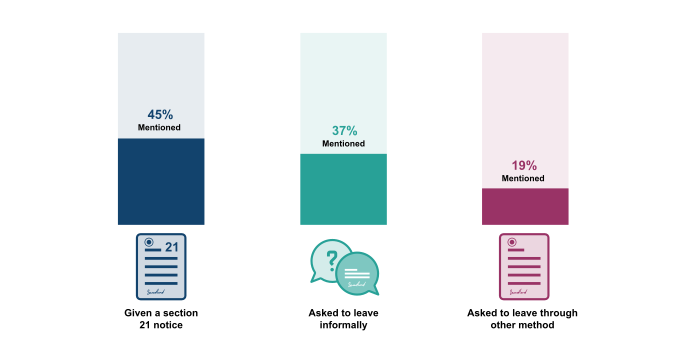
Of private renters whose tenancy ended in the last 3 years, almost half (45%) said their landlord or agent asked them to leave by issuing a Section 21 notice, 37% said they were asked to leave informally and 19% said their landlord or agent used another method to ask them to leave, including the existing Section 8 grounds, Annex Table 2.4.
From 1 May 2026 in England, Section 21 of the Housing Act 1988, which allowed landlords to evict tenants without giving a reason (known as “no-fault” evictions), was abolished as part of the Renters’ Rights Act reforms. Landlords are no longer able to serve new Section 21 notices to evict tenants and, instead, landlords who wish to regain possession must rely on reformed grounds for possession under Section 8. This means, they must provide a valid legal reason, such as rent arrears, antisocial behaviour, selling the property, or moving in themselves.
Reasons landlord or agency asked tenant to leave
More than half (57%) of private renters whose tenancy ended in the last 3 years said their landlord asked them to leave because they wanted to sell the property or use it themselves, Annex Table 2.5. A further 38% said their landlord gave some other reason and 4% said the landlord asked them to leave because they complained to them or the council or agent about problems with the property.
Perceived security in housing situation
Around 1 in 10 private renters said they did not feel safe from eviction. Almost 1 in 5 private renters said that their housing situation was not secure enough to feel confident making long-term decisions.
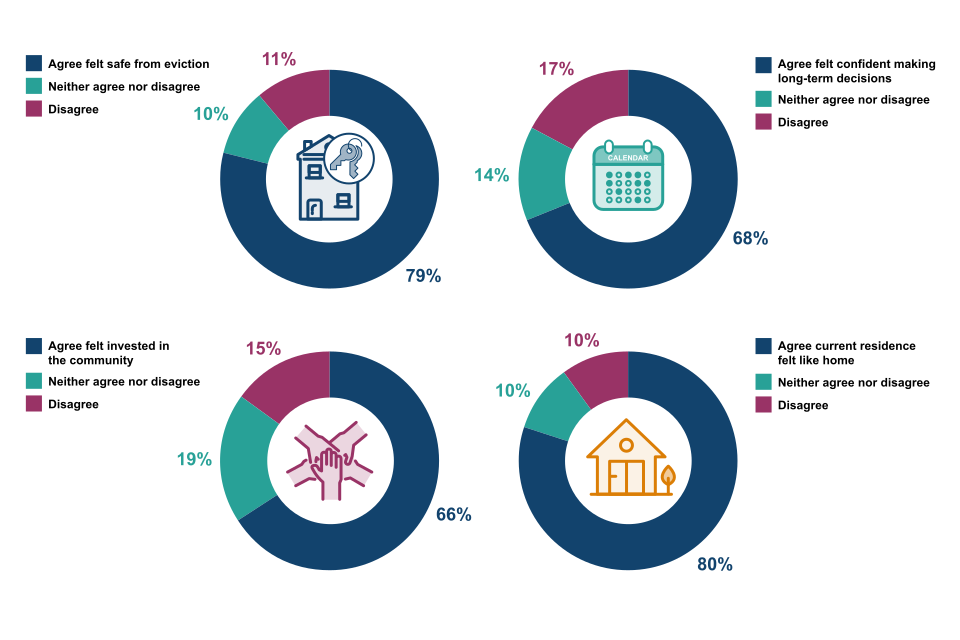
Private renters were asked about their attitudes towards eviction risk and housing security, including whether they felt safe from eviction and whether their housing situation was secure enough to support long-term decisions, community involvement, or a sense of home.
In 2024-25, private renters generally expressed positive views about their housing security. Most reported feeling safe from eviction (79%), while many also felt that their housing situation was stable enough to support long-term planning (68%), encourage them to invest in their community (66%), and give them a sense of home (80%), Annex Table 2.7.
At the other end of the scale, 11% of private renters said they did not feel safe from eviction, 17% felt their housing situation was not stable enough to make long-term decisions, 15% did not feel invested in their community, and 10% did not feel a sense of home in their current accommodation.
Compared with 2022-23, private renters in 2024-25 were as likely to feel safe from eviction (79% in 2024-25 compared with 78% in 2022-23) and as likely to feel confident making long‑term decisions (both 68%). They were, however, more likely to feel that their housing situation was secure enough to make them feel invested in their community (66% compared with 62%) and more likely to feel a sense of home where they live (80% compared with 75%), Annex Tables 2.7 and 2.8.
3. Renting barriers
Rent paid in advance in addition to deposit
Over half a million private rented households (626,000) paid rent in advance in addition to the deposit in 2024-25. The majority (70%) paid 1 month of rent or less, while a further 18% paid more than 1 month and up to 2 months. Smaller proportions paid higher amounts in advance, with 3% paying more than 3 and up to 4 months, and 8% paying more than 4 months, Annex Table 3.1.
Since 1 May 2026 in England, under the Renters’ Rights Act, landlords are banned from taking any rent before a tenancy has been entered into. A landlord is now only able to require up to 1 month’s rent once a tenancy agreement has been signed and before that tenancy begins. For tenancies that have started since the 1 May 2026, landlords are now unable to enforce any terms in a tenancy agreement that require rent to be paid in advance of the due date. This prevents practices such as demanding 6 or 12 months’ rent in advance.
Prevalence of guarantor requirement
One in five private renters (22%) were asked to provide a guarantor for the rent payments before moving into the accommodation, Annex Table 3.2.
Reported discrimination when trying to rent
In the last 12 months, just under 2% of private renters were told they could not rent a property because they received benefits or because they had children living with them.
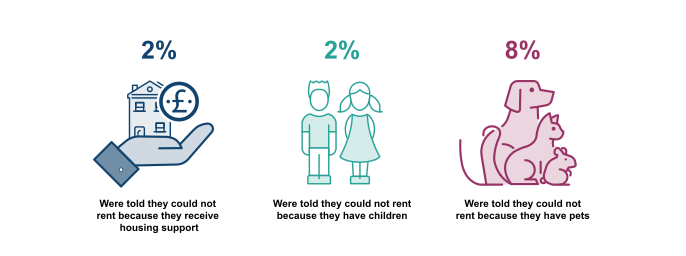
Just under 2% of private renters said that, in the last 12 months, they were told they could not rent a property because they received housing support (80,000 households) or because they had children in the home (91,000 households), Annex Table 3.3.
Almost 1 in 10 private renters said that, in the last 12 months, they were told they could not rent a property due to having pets (8%, 363,000 households).
In 2024-25, similar proportions of private renting tenants reported being refused a tenancy due to receiving housing support or having children as in 2023-24.
The Renters’ Rights Act strengthened protections against rental discrimination in the private rented sector. Landlords and agents are now prohibited from refusing a tenancy on the basis that a prospective tenant receives housing support or has children in the household. The Act also introduced a right for tenants to request to keep a pet, with refusals permitted only on reasonable grounds set out in legislation.
4. Complaints and dispute resolution
Satisfaction with landlord/agent service after notice
Among recent movers, those who left their tenancy unwillingly were more likely to be dissatisfied with their landlord or agent’s service after notice than those who left by choice.
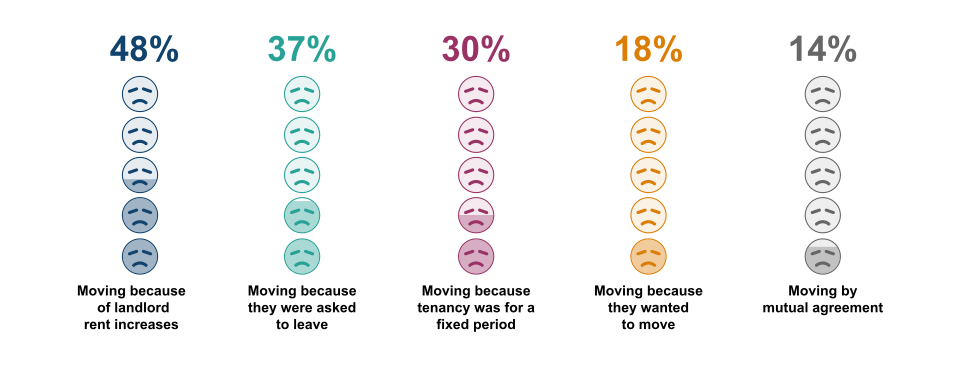
Approximately 14% of private renters whose tenancy ended by mutual agreement and 18% of private renters who wanted to move reported being dissatisfied with the service of their landlord or agent after notice was served, Annex Table 4.1. In comparison, 48% of private renters whose tenancy ended because their landlord raised the rent, 37% of those who were asked to leave, and 30% of those who left because their tenancy had reached the end of its fixed term reported dissatisfaction.
Satisfaction with complaint outcome by reason for complaining
Half of private renters who made a complaint were unhappy with the outcome (50%), Annex Table 4.2. Satisfaction levels varied by the reason for the complaint. The majority of private renters were unhappy with the response they got to their complaints about administration issues such as the renewal of the tenancy agreement (76%), about the behaviour of the landlord (65%), antisocial behaviour in the area (64%), the quality of their home (60%) or other issues (58%). Fewer than half of private renters were unhappy about the response to complaints they made about their neighbours (47%) or repairs (46%).
Escalation of complaints beyond landlord or agent
Most private renters who raised a complaint with their landlord or letting agent and were not happy with the response, did not take their complaint any further, with 94% not contacting any other organisation, Annex Table 4.3. Among the small number who did escalate a complaint after being unhappy with the response from their landlord or letting agent, most went to the Local Council’s Environmental Health Officer (4%), followed by the Tenancy Relations Officer (2%), and an exceedingly small proportion contacted the Property Ombudsman or the Property Redress Scheme (less than 1%).
Reasons for not making a complaint
The main reasons private renters gave for not complaining were a lack of confidence in the complaints process, concerns about upsetting their landlord or concerns about facing negative consequences.
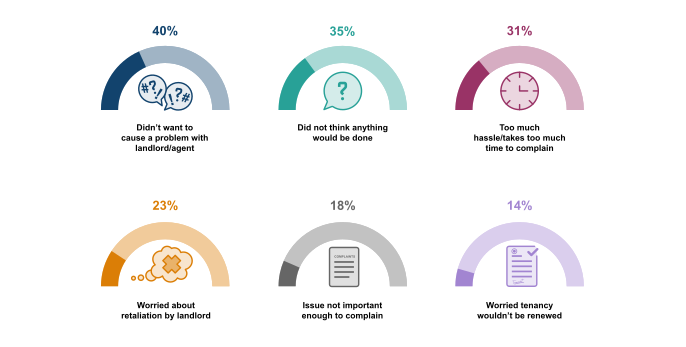
Some of the most common reasons private renters who considered making a complaint gave for not complaining were that they did not want to cause a problem with their landlord or agent (40%), they did not believe something would be done if they complained (35%) or that complaining would be too much of a hassle and take too much time (31 %), Annex Table 4.4. Other reasons included concerns about retaliation by the landlord (23%), feeling that the issue was not important enough to raise (18%), or worries that their tenancy would not be renewed (14%). Some renters wanted to remain in their current home (12%), felt they could not afford to move elsewhere (9%), or did not want to damage their relationship with neighbours (6%).
The Renters’ Rights Act makes provision for the introduction of a Private Rented Sector Ombudsman and a digital landlord database, which are to be implemented following commencement of the Act. Once in force, landlords will be required to be members of the ombudsman scheme, providing private renters with access to a free and independent route for resolving complaints where issues cannot be resolved directly with the landlord. The digital landlord database will record landlord registration and compliance information, supporting oversight and enforcement.
Technical notes and annex tables
Further details on the English Housing Survey methodology and glossary of terms can be found in the Technical Notes and Housing statistics and English Housing Survey Glossary.
Underlying data for this factsheet are published as Annex Tables.